

Earned Media Value (EMV) is one of those marketing metrics that sounds complicated, but the idea behind it is actually pretty simple. Think of it as the price tag for all the organic buzz your brand gets.
It answers the question: If we had to pay for all the social media mentions, press features, and influencer shout-outs we got for free, what would it have cost us? Essentially, EMV puts a dollar value on your digital word-of-mouth.
What Is Earned Media Value Really
Imagine you launch a new product. You could spend a fortune on TV ads and social media campaigns. Or, a popular influencer could post an amazing review, a major news outlet could feature your story, and hundreds of happy customers could start sharing photos online—all without you paying them a dime. That organic excitement is earned media.
Earned Media Value (EMV) simply translates that organic buzz into a concrete financial figure. It lets you move beyond just counting likes and shares and helps you see the real-world financial impact of your PR, influencer, and content marketing efforts. For teams that need to prove their ROI, this is a game-changer.
Why This Metric Matters for Modern Marketers
Let's be honest, people trust recommendations from friends, peers, and unbiased sources far more than they trust a paid ad. That built-in credibility is what makes earned media so powerful. Because it comes from genuine enthusiasm, it resonates more deeply with audiences and often drives better results.
This is why the value of earned media is often estimated at 2-5x the equivalent paid ad space. That's a benchmark the PR industry has used for years, reflecting the added trust and authenticity that you just can't buy.
Earned Media Value isn’t just a vanity metric; it’s a strategic tool. It helps you understand which conversations are driving the most value, which channels are most effective, and where your brand’s reputation is strongest.
Understanding Its Place in Your Strategy
To truly get a handle on EMV, it helps to understand the three fundamental types of media in marketing. This is also a core part of figuring out what marketing attribution means and how different channels contribute to your success.
The media landscape is generally broken down into three buckets: earned, paid, and owned.
Earned vs Paid vs Owned Media At a Glance
This table breaks down the key differences to show you exactly where EMV fits into the bigger picture.
| Media Type | Definition | Examples | Key Benefit |
|---|---|---|---|
| Earned Media | Organic exposure you earn through your reputation and relationships. | Press mentions, influencer posts, customer reviews, social shares. | High credibility and trust. |
| Paid Media | Exposure you pay for directly to reach a specific audience. | Google Ads, social media ads, sponsored content, billboards. | Control and scalability. |
| Owned Media | Channels and platforms your brand controls completely. | Your website, blog, email newsletter, company social profiles. | Full control over messaging. |
As you can see, EMV is all about measuring the impact of that first category: earned media. It’s the metric that proves your investment in a fantastic product, top-notch customer service, and great storytelling is creating tangible financial value for your brand.
The Building Blocks of an EMV Calculation
So, how do you turn a viral tweet or a glowing blog review into a hard number? It might feel like marketing magic, but it's actually a pretty methodical process. To really grasp what is earned media value, we first need to break down the formula into its core ingredients. Think of it like a recipe—each component adds a specific flavor to the final result.
At its core, calculating EMV means combining several key metrics to put a dollar value on your organic exposure. These aren't just abstract terms; they're measurable data points that tell a story about how well your brand is resonating with people. Once you deconstruct the formula, you can see exactly how every interaction adds up to that final figure.
The Four Pillars of EMV
Most EMV formulas stand on four essential pillars. Each one gives you a different angle on your content's performance, from how many eyeballs saw it to how much people actually cared.
-
Impressions: This is your broadest metric. It’s the total number of times your content was displayed, whether someone clicked on it or not. It's like counting every single person who walked past a billboard on the highway.
-
Reach: This one is a bit more refined. Reach counts the number of unique individuals who saw your content. One person might see your post five times (that’s five impressions), but they only count as one person in your reach.
-
Engagement: Here’s where things get interesting. Engagement measures how people actively interacted with your content—we're talking likes, comments, shares, and saves. It's a clear signal that your message was compelling enough to make someone stop scrolling and take action.
-
Sentiment: This is the qualitative piece of the puzzle. It assesses the feeling behind a mention. A glowing review from an influencer is obviously worth more than a neutral or negative one, and sentiment analysis helps you weigh that difference appropriately.
This concept map really helps visualize where earned media fits into the bigger marketing picture, right alongside paid and owned channels.
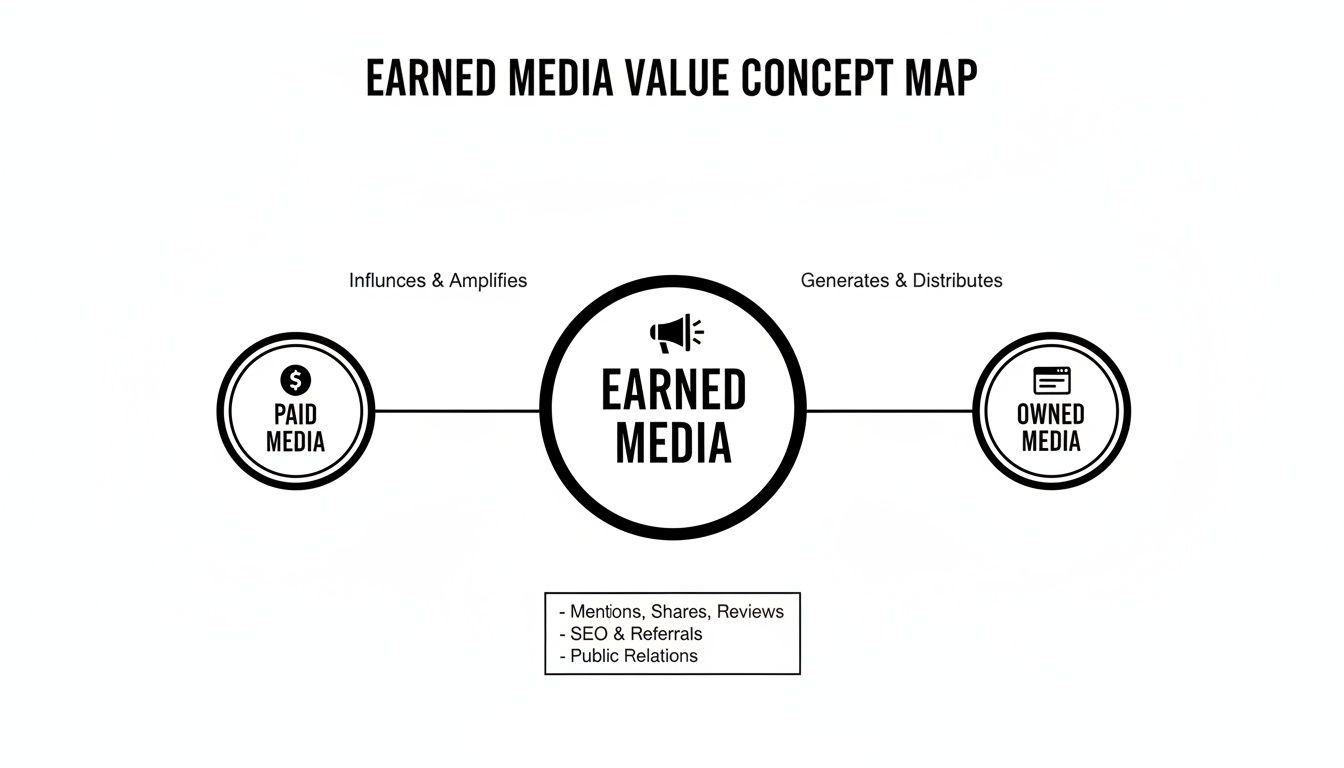
It perfectly shows earned media's unique power as a trusted, third-party endorsement that bridges the gap between what you pay for (paid) and what you directly control (owned).
Putting the Pieces Together in a Formula
Once you have these components, you can start plugging them into a formula. While different platforms have their own slightly tweaked models, a common approach is to combine visibility metrics with interaction metrics and assign a cost equivalent to each.
A practical formula might look something like this: EMV = (Impressions + Reach) × CPM + (Likes + Comments) × CPE.
Here, CPM stands for Cost Per Mille (the cost per thousand impressions) and CPE is the Cost Per Engagement. These are industry benchmarks representing what you would have paid to get similar results through advertising.
For example, I've seen influencer campaigns generate $36,000 in value from impressions and reach alone. But when you add in the value of all the interactions (likes, comments, etc.), which was calculated at $100,000, the total earned media value jumped to $136,000. That number gives you a powerful benchmark, showing the campaign delivered the same value as a pretty significant paid media investment. You can find more great insights on calculating EMV over at Engage Coders.
An Example with an Instagram Story
Let’s make this even more concrete. Imagine a micro-influencer with 20,000 followers posts an Instagram Story about your new skincare product.
- Impressions and Reach: The Story gets 15,000 views (impressions) from 12,000 unique accounts (reach).
- Engagement: It receives 200 replies, 50 shares, and 100 sticker taps.
- Benchmark Costs: Let's assume the industry CPM for this audience is $10 and the average CPE is $0.50.
Using these numbers, you’d calculate the value of the visibility and the engagement separately, then just add them together. Each reply, share, and tap contributes a specific monetary value based on that CPE benchmark.
Suddenly, those abstract interactions are translated into a clear financial equivalent. This makes it so much easier to prove the ROI of your influencer relationships and PR efforts. This step-by-step process takes the mystery out of it, showing that any marketer can get a handle on the mechanics behind EMV.
How to Calculate EMV with Real-World Examples
Okay, let's move past the theory. The real magic happens when you start putting numbers to your earned media wins. To truly get a feel for what earned media value is, we need to roll up our sleeves and do the math.
The core idea is simple: we're putting a dollar value on the organic buzz you get. What would it have cost to buy that same level of attention with paid ads? Each platform and every interaction—a like, a share, a comment—carries a different weight, which makes the calculation both an art and a science.
Let's walk through a few real-world marketing scenarios to see how it works.
Scenario 1: The Micro-Influencer Product Launch
Imagine your brand just dropped a new line of sustainable activewear. You've partnered with a few micro-influencers, and one of them, let's call her "EcoFit Alex," posts an incredible Instagram Reel about your products.
Here's how you’d figure out the EMV from just that one post:
- Impressions: The Reel was viewed 80,000 times.
- Engagements: It got 4,500 likes, 300 comments, and 250 shares.
- Industry Benchmarks: For this example, we'll use a standard Cost Per Mille (CPM) of $12 and a Cost Per Engagement (CPE) of $0.75.
Now for the fun part—the math:
- Impression Value: (80,000 impressions / 1,000) * $12 CPM = $960
- Engagement Value: (4,500 likes + 300 comments + 250 shares) * $0.75 CPE = 5,050 * $0.75 = $3,787.50
- Total EMV: $960 + $3,787.50 = $4,747.50
Think about that. A single post from one micro-influencer generated nearly $5,000 in equivalent advertising value. This isn't just a vanity metric; it’s a powerful way to justify your influencer marketing spend and pinpoint which partners are truly moving the needle. If you want to dive deeper, we have a whole guide on how to boost influencer marketing ROI with expert strategies.
Scenario 2: The B2B LinkedIn Thought Leadership Piece
EMV isn't just for B2C brands selling cool products. Let's say you're a B2B tech company, and your CEO pens a sharp thought leadership article on LinkedIn. It gets noticed and shared by a few industry heavyweights.
We'll focus on just one of those shares. An influential tech publication reposts the article to its 250,000 followers.
- Impressions: The share generates 120,000 impressions on LinkedIn.
- Engagements: It pulls in 1,200 reactions, 150 comments, and 90 reposts.
- Platform-Specific Benchmarks: LinkedIn is a premium space, so the ad costs are higher. Let's use a CPM of $35 and a CPE of $3.00.
By assigning different values to actions on different platforms, you create a more accurate and defensible EMV calculation. A comment on a niche LinkedIn post from an industry professional is often more valuable than a simple like on a broad consumer platform.
Let's run the numbers for this single, powerful share:
- Impression Value: (120,000 impressions / 1,000) * $35 CPM = $4,200
- Engagement Value: (1,200 reactions + 150 comments + 90 reposts) * $3.00 CPE = 1,440 * $3.00 = $4,320
- Total EMV: $4,200 + $4,320 = $8,520
This shows how one high-quality piece of earned media on a professional network can deliver massive value, making a strong case for investing time in executive branding and quality content.
Scenario 3: The Viral TikTok User-Generated Video
Finally, let's look at the explosive potential of user-generated content (UGC). A customer posts a hilarious TikTok video featuring your product, and it completely blows up.
The scale here can be mind-boggling. To give you some perspective, influencer-created content alone generated a staggering $236 billion in Earned Media Value (EMV) globally—that's the equivalent paid advertising cost for all that organic buzz.
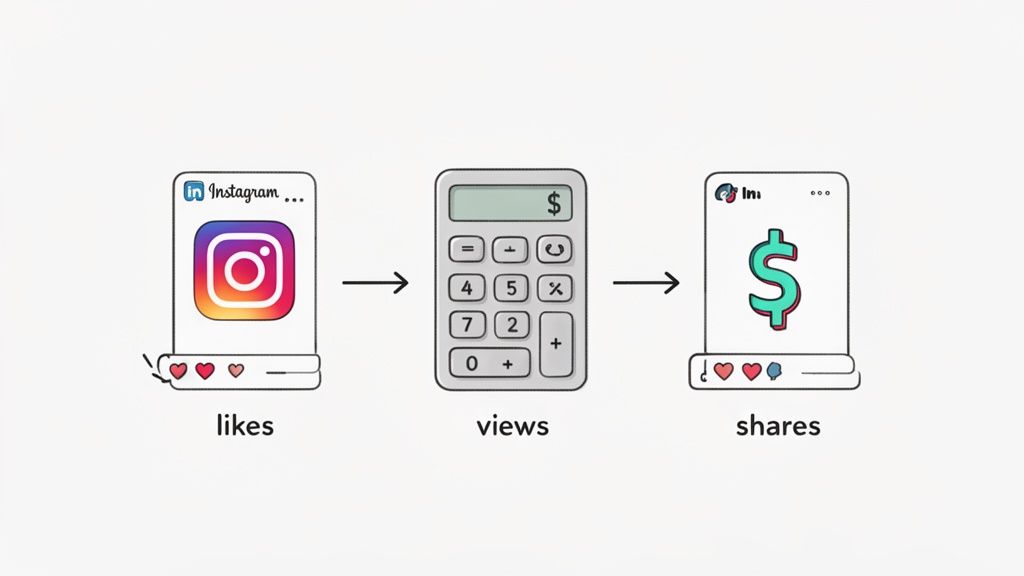
This image perfectly illustrates how EMV isn't just one number. It's a score built from multiple weighted data points, making it a much more robust metric than just counting likes or views alone.
Let's calculate the EMV for that viral TikTok:
- Impressions: The video soars to 5,000,000 views.
- Engagements: It racks up 750,000 likes, 8,000 comments, 15,000 shares, and 20,000 saves.
- Platform Benchmarks: TikTok's CPM is around $10, and its CPE is lower because of the sheer volume of interaction, so we'll estimate $0.20.
Here’s the final tally:
- Impression Value: (5,000,000 impressions / 1,000) * $10 CPM = $50,000
- Engagement Value: (750,000 + 8,000 + 15,000 + 20,000) * $0.20 CPE = 793,000 * $0.20 = $158,600
- Total EMV: $50,000 + $158,600 = $208,600
That's over $200,000 in value from a single, authentic customer video. As these examples show, EMV gives you a consistent way to measure success across completely different channels and campaigns, turning your organic marketing wins into a language everyone can understand.
Why EMV Is More Than a Vanity Metric
It’s tempting to write off Earned Media Value (EMV) as just another vanity metric. After all, it’s a hypothetical figure, not real dollars in your bank account. But dismissing it like that means you’re missing out on its real strategic value.
When you know how to use it, EMV is anything but a hollow number. Think of it as a vital diagnostic tool that finally puts a value on all the organic, authentic conversations happening around your brand. It helps every marketer answer that one big question from leadership: "What did we actually get from our PR and influencer efforts?"
EMV essentially acts as a universal translator for your marketing performance. How do you possibly compare the impact of a feature in a major online magazine to a burst of user-generated videos on TikTok? EMV gives you a common currency to measure them both on a level playing field.
A Barometer for Brand Health and Resonance
Here’s where it gets really interesting. When you track EMV over time, it stops being a one-off number and becomes a powerful indicator of your brand’s health. If your EMV is consistently climbing, it’s a strong signal that your message is hitting home, people are genuinely excited about your product, and your reputation is on the upswing.
On the flip side, a sudden dip in EMV can be an early warning sign. Maybe a competitor is stealing your thunder, or your latest campaign just isn't connecting with your audience. This gives you a chance to dig in and adjust your strategy before it starts to hurt your bottom line.
Earned Media Value serves as a crucial barometer for audience sentiment and brand momentum. It’s not just about the dollar amount; it’s about what the fluctuations in that amount tell you about your brand's position in the market.
This data-driven perspective pulls you out of the "I think this is working" mindset and into making smarter, faster decisions. By keeping an eye on these trends, you can put more resources behind what's successful and quickly pivot away from what isn't.
Guiding Smarter Budget and Resource Allocation
Maybe the most practical use for EMV is how it helps you make smarter budget decisions. When you can show your team that one influencer partnership generated $50,000 in EMV while another only pulled in $5,000, the next steps become crystal clear.
This kind of insight is gold for optimizing your marketing spend. It helps you:
- Spot High-Performing Channels: Figure out which platforms and partners are consistently giving you the most bang for your buck.
- Justify Your Spend: Walk into a budget meeting with solid data that defends (or even increases) your funding for PR and influencer marketing.
- Sharpen Your Message: See which types of content and talking points are sparking the most valuable organic buzz.
This level of detail is a huge part of measuring social media ROI, because EMV gives you a tangible figure that connects all that organic chatter back to real financial value.
Proving the Business Impact of Authenticity
At the end of the day, EMV’s real power is its ability to put a number on authenticity. People trust recommendations from their friends and creators they follow way more than they trust a paid ad. A glowing review or an unprompted rave on social media has a credibility that money just can’t buy.
If you want to dig deeper into this topic, we've put together a comprehensive guide on how to measure social media ROI that you'll find helpful.
EMV captures the value of that trust. It proves that building a great product, offering stellar customer service, and nurturing a strong community aren't just "nice-to-haves"—they are direct drivers of business growth. By turning organic buzz into a metric everyone can understand, EMV validates the hard work of your PR, comms, and community teams, proving they are essential to building a brand people truly love.
The Unvarnished Truth: Understanding EMV's Limitations
Earned Media Value is a fantastic tool for putting a dollar figure on your brand's organic buzz, but let's be clear: it’s not a magic bullet. To use it wisely, you have to be acutely aware of its blind spots. If you ignore its weaknesses, you risk running your marketing strategy on skewed data.
Think of EMV like a compass. It gives you a great sense of direction, but it won't tell you about the terrain ahead. It provides a solid estimate of your media's value, but it doesn't paint the full picture of your brand's health. Relying on it alone is like trying to fly a plane with just one gauge on the dashboard.
To give you a clearer picture, let's break down the pros and cons.
Here's a balanced view of Earned Media Value, showing both where it shines and where it falls short. This can help you make smarter decisions about how to use it in your own reporting.
Pros and Cons of Relying on EMV
| Advantages of EMV | Limitations of EMV |
|---|---|
| Simple to Understand: Provides a straightforward dollar value that resonates with executives and non-marketers. | Lacks Standardization: Different tools use different formulas, making "apples-to-apples" comparisons nearly impossible. |
| Great for Benchmarking: Helps compare your earned media performance against competitors over time. | Favors Quantity Over Quality: Can reward a high volume of low-impact mentions over a few high-quality placements. |
| Justifies PR/Influencer Spend: Puts a tangible value on efforts that are traditionally hard to measure in financial terms. | Doesn't Measure Business Impact: A high EMV doesn't automatically equal more sales, leads, or conversions. |
| Quick Performance Snapshot: Offers a fast, high-level look at the visibility a campaign has generated. | Ignores Sentiment: Doesn't distinguish between positive, negative, or neutral mentions without additional analysis. |
Ultimately, EMV is a powerful directional metric, but it needs context. Let's dig into a few of these limitations more deeply.
The Standardization Problem
One of the biggest knocks against EMV is that there’s no universal, agreed-upon formula. It’s the wild west of metrics.
Every tool, platform, and agency cooks up its own secret sauce—proprietary algorithms, unique benchmarks, and different weighting systems. This "black box" approach means you can run the same campaign data through two different tools and get wildly different EMV numbers. This makes it a nightmare to compare results and can quickly erode trust with stakeholders who are used to clean, standardized data.
At its core, the problem with Earned Media Value is that there is no single, accepted "value." It's a fantastic estimate, but until there's a standard, it will always be more of a directional guide than a precise financial measurement.
Quantity Can Trump Quality
Here’s another pitfall: a basic EMV calculation often prioritizes the sheer number of mentions over their actual quality.
Think about it. A hundred quick mentions on low-traffic blogs could easily generate a higher EMV score than one in-depth feature in Forbes or The New York Times. But which one actually moves the needle for your brand's credibility and authority? The feature, of course. This can create a perverse incentive to chase volume, pushing teams to secure easy, low-impact placements instead of focusing on what really matters.
EMV Isn’t a Business Outcome
This is the most critical point to remember: EMV does not directly measure business results. A sky-high EMV score is great, but it doesn't guarantee a single extra sale, lead, or loyal customer. It simply estimates what you would have paid for that media exposure.
This is where EMV needs help. To understand the real impact of your earned media, you have to layer it with other metrics. You need to connect that buzz to tangible outcomes. That means integrating EMV with things like conversion tracking, sentiment analysis, and a solid framework for what is attribution modeling.
When you combine these elements, you can finally see the full story—not just how much noise you made, but whether that noise actually drove your business forward.
How to Weave EMV into Your Marketing Strategy
Turning Earned Media Value from a neat metric into a strategic powerhouse requires a plan. It’s not just about looking back at what you’ve earned; it’s about making EMV a central part of your daily operations to make smarter decisions and prove your impact. This means setting real goals, picking the right tools, and learning to tell a compelling story with the data.
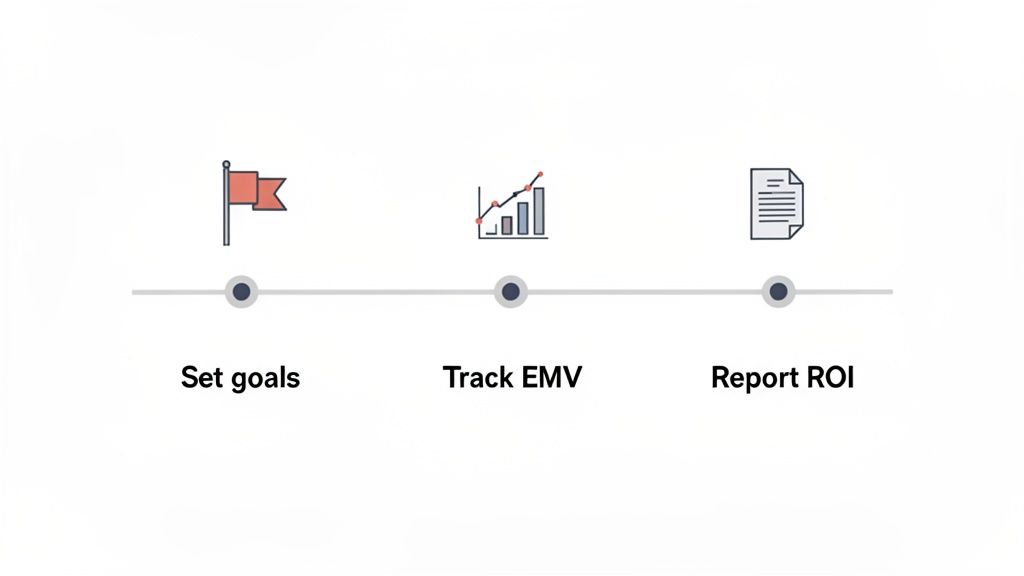
The trick is to stop treating EMV as a report card and start using it as a roadmap. It should inform your campaign planning, your choice of collaborators, and even your budget from day one.
Set Meaningful EMV Goals
First things first: you need clear, measurable goals for your earned media. Without a target, EMV is just a number floating in space. Make sure these goals tie directly back to what the business is trying to achieve.
Start by asking a few key questions:
- What are we trying to do? Are you aiming for a massive burst of awareness for a new product, or are you playing the long game to build brand credibility? A launch might call for a huge spike in EMV over a few weeks.
- How do we stack up? Look at your top competitors. What's a realistic EMV for your space? A concrete goal could be aiming for a 15% increase in your share of voice.
- Where do we want to win? Should you focus on growing EMV from TikTok influencer campaigns or from securing thought leadership articles in industry journals?
Setting these benchmarks gives your team a clear finish line. It moves the conversation beyond impressions and engagement, turning EMV into a genuine performance indicator.
Choose Your Tools and Automate the Tracking
Let's be real: manually tracking every single mention and calculating its value is a recipe for insanity. To get serious about EMV, you need to invest in technology that does the heavy lifting for you. Platforms like Meltwater, CreatorIQ, or Brandwatch are built to monitor mentions across thousands of channels in real-time.
These tools don’t just count mentions. They use complex algorithms to assign a dollar value, analyze sentiment, and track how you're doing against your goals. This automation frees up your team to focus on what humans do best—strategy and building relationships—instead of getting lost in spreadsheets.
When you're shopping for a tool, look for platforms that let you customize the formulas and are transparent about their methods. This ensures the what is earned media value calculation actually reflects your industry and what matters to your business.
Build Reports That Actually Mean Something to Stakeholders
The real magic of EMV happens when you can clearly explain its value to everyone from your creative team to the C-suite. Your reporting needs to tell a story, connecting the dots between your earned media activities and their impact on the business.
This is especially true in influencer marketing. In fact, demonstrating impact is the top priority for 89% of communicators. As a result, 74% of brands have boosted their budgets after seeing solid proof of EMV’s value. You can dig into more stats around influencer marketing and EMV on Captiv8.io.
When it's time for that quarterly review, don't just drop the final EMV number on a slide. Walk them through the journey. Highlight the campaigns that killed it, the influencers who delivered the most value, and the messages that resonated most. That’s how you transform a simple metric into a strategic asset that guides future investment and proves your team's contribution to the bottom line.
Got Questions About Earned Media Value? We've Got Answers.
Even after you get the hang of EMV, a few questions always pop up when you start applying it in the real world. Let's tackle some of the most common ones to clear up any lingering confusion and help you use this metric with confidence.
Think of this as your go-to cheat sheet for the practical stuff—the nuances and tricky bits that come up on the job.
How Is EMV Different from Advertising Value Equivalency (AVE)?
Great question. Think of Advertising Value Equivalency (AVE) as EMV's outdated, much less sophisticated predecessor. AVE simply took a piece of press coverage and calculated what that physical space would have cost as a paid ad. That's it.
The problem? It was a terrible way to measure value. AVE couldn't tell the difference between a glowing feature and a scathing takedown—it valued them exactly the same. It completely ignored the most important elements: audience trust, sentiment, and whether anyone actually cared.
EMV is the modern, smarter approach. It looks beyond just the space and measures the actual impact of the conversation. By factoring in digital signals like shares, comments, reach, and the credibility of the person talking about you, EMV measures the value of engagement, not just the real estate.
What Are the Best Tools for Tracking Earned Media Value?
Manually tracking EMV is a nightmare you don't want. Thankfully, there are some fantastic platforms out there that do the heavy lifting for you by monitoring brand mentions across social media, blogs, and news outlets.
Tools like CreatorIQ, Captiv8, and Meltwater are industry favorites. They use their own sophisticated algorithms to calculate value based on real-time data, saving your team from endless spreadsheets.
When you're shopping for a tool, here’s what to look for:
- Platform Coverage: Does it monitor the channels where your audience actually lives?
- Analytics Depth: Can it go beyond basic numbers and give you sentiment analysis or see how you stack up against competitors?
- Integration Capabilities: Will it play nice with the other tools in your marketing stack?
Don't forget, partnering with a specialized agency can also be a smart move. They not only bring the tools but also the expertise to turn all that data into a winning strategy.
Can EMV Be Used for B2B Marketing?
Absolutely. It's easy to see EMV in action with B2C brands on Instagram or TikTok, but the core principle—measuring third-party credibility—is arguably even more critical in the B2B space. After all, big-ticket decisions rely heavily on trust and reputation.
In the B2B world, valuable earned media looks a little different. It could be:
- A respected industry analyst praising your software on LinkedIn.
- A detailed, positive review in a major trade publication.
- Your CEO getting quoted as a thought leader in a top-tier business journal.
The way you calculate the value is the same, though your benchmarks will be different—you'll be focused on niche, professional audiences. At its core, EMV is a powerful way to put a number on the impact of your brand’s authority and thought leadership.
At ReachLabs.ai, we turn these complex metrics into clear, actionable strategies that actually grow your brand. Our specialists blend data-driven insights with creative campaigns to make sure every mention, share, and shout-out makes a real impact. See how our full-service marketing approach can amplify your brand’s voice and deliver results you can measure by visiting https://www.reachlabs.ai.