
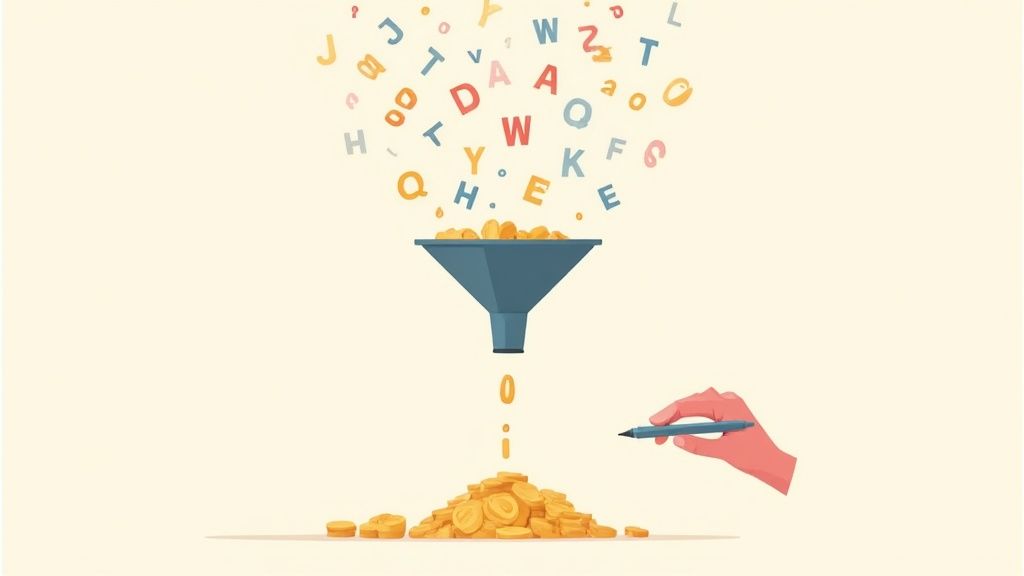
At its core, business copywriting is the art and science of writing words that convince someone to take a specific action. It's the engine powering your sales pages, the personality in your emails, and the hook in your ads—all working in concert to grow your business.
What Is Business Copywriting, Really?

Let's ditch the dry, formal definitions. Think of business copywriting as your best salesperson—one who works 24/7 without ever taking a break. It doesn't just list features or describe what you sell. Instead, it taps into your audience's deepest needs, speaks directly to their problems, and presents your product or service as the ideal solution.
Picture your customer standing at a crossroads. They have a problem they desperately want to solve, but they're not sure which path to take. Your copy is the friendly, expert guide who shows up, earns their trust, and points them in the right direction.
The Guide on the Customer Journey
Every word you write should serve a purpose, meeting your customer exactly where they are. This looks different at various stages of their journey.
- Awareness: At the start, blog posts and social media ads are designed to catch their eye and make them think, "Hey, that sounds like a solution to my problem."
- Consideration: Once you have their attention, email newsletters and case studies offer proof and build confidence, showing them why your solution is the best fit.
- Decision: Finally, powerful sales pages and compelling product descriptions are crafted to seal the deal and encourage them to click that "buy" button.
This isn't just about stringing sentences together; it's about strategically using language to build a relationship that drives real results.
Copywriting isn't just about what you say; it's about how you say it. The right message, delivered with the right tone, can turn a passive browser into a loyal customer.
More Than Just Words
Great business copywriting is deeply rooted in human psychology. It understands what motivates people, what they desire, and what they fear. By connecting with these core emotions, your words can create a lasting impact that sticks with the reader long after they’ve left your site.
This persuasive writing is also how you build your brand’s personality. The words you choose shape how people see you. If you want to go deeper, our complete brand voice guide breaks down how to create a consistent and memorable identity. In today's market, mastering this skill isn't just a nice-to-have—it's essential for success.
Why Modern Copywriting Is a Different Game
Copywriting has changed. A lot. We've moved way beyond the old-school print ads that defined the industry for decades. Think of it this way: traditional advertising was like putting up a single, well-placed poster in a quiet library. It had a captive audience and very little competition.
Today? It’s like trying to get your message heard in the middle of Times Square during New Year's Eve. You're surrounded by thousands of flashing screens, all screaming for attention. The internet didn't just open up a new place to advertise; it completely flipped the script.
Back then, the copywriter was in the driver's seat, controlling the story. Now, the power is squarely in the hands of the audience. They can vanish with a single click, pit you against three competitors in a heartbeat, and completely tune out anything that doesn't instantly solve their problem or grab their interest.
This fundamental shift means copywriting for business is now a multi-headed beast. Just being persuasive isn’t enough anymore. Great copy today has to wear several hats at once:
- It must be a magnet for search engines. Your words have to charm algorithms like Google's just as much as they charm people, or you'll never even get seen.
- It has to be incredibly scannable. Let's be honest—people don't read online; they skim. Your copy needs clear headlines, bold text, and bullet points to deliver the key message in seconds.
- It has to be a "scroll-stopper." Your message needs to be compelling enough to jolt someone out of their mindless social media scroll and make them pay attention.
The Scale of the Digital Revolution
The story of modern copywriting is tied directly to the explosion of online commerce. Everything changed in 1995 when the internet was first opened up for commercial use, letting pioneers like Amazon and eBay set up shop online. This didn't just create a new market; it created a whole new universe for words to live in.
Fast-forward to today, and the scale is just staggering. It’s estimated that by 2025, the web will be home to nearly 4.62 billion pages. That’s the level of competition you're up against. For a deeper dive into these trends, check out a great report on the state of the industry in 2025.
This content overload has created a battlefield for attention. You aren't just competing with the business down the street. You're fighting against news alerts, cat videos, and text messages from friends for a sliver of your customer's brainpower.
In the modern attention economy, great copywriting doesn't just sell a product. It earns the most valuable currency of all: a moment of your audience's focused time.
Why This Matters for Your Business
Getting a handle on this new reality is the first, and most important, step to writing copy that actually works. The old playbook of shouting a one-way message into the void is officially dead.
Your copy has to be sharper, smarter, and more in tune with your reader's needs than ever before. It has to serve them first by being useful, clear, and genuinely helpful. Only after you’ve done that can it begin to serve your business by getting them to act. This is the mindset you need to truly master the modern techniques that drive real results.
Writing Copy That Actually Converts
Great business copywriting isn't about being clever or stringing together fancy words. At its core, it’s about making a real connection with your audience—a connection that nudges them to take action. To get there, you have to stop guessing what your customers want and start building your message around what you know they need. This means trading in theory for a repeatable, strategic process.
The path from a casual browser to a paying customer is rarely an accident. It's carefully paved with words that hit home on a personal level. Let's dig into the core principles that separate copy that falls flat from copy that consistently brings in results.
Get Inside Your Customer's Head
Before you even think about writing, you have to know who you're writing for. The most powerful copywriting for business always feels like it’s speaking to one person, not a faceless mob. This is exactly where buyer personas come in—they are your secret weapon. A buyer persona is essentially a detailed profile of your ideal customer, pieced together from market research and real data about your existing audience.
Don't just stop at demographics like age and location. What are the little frustrations they face every day? What big problems keep them up at night? What are they secretly hoping to achieve? When you can answer these questions, you can start speaking their language and frame your product as the obvious solution to their problems.
For example, instead of a generic line like, "Our software improves efficiency," you could say, "Stop wasting hours on manual data entry and get back to what you do best: growing your business." See the difference? The second version speaks directly to a real, tangible pain point.
Define Your Unique Value Proposition
Okay, you know your audience. Now, you need to be crystal clear about why you're the best choice for them. This is your Unique Value Proposition (UVP). Think of your UVP as a short, punchy promise that explains the benefit you deliver, how you solve their problem, and what makes you different from everyone else.
A strong UVP isn't a list of features. It's a promise of value. It should instantly answer your customer's core question: "What's in it for me?"
Nailing your UVP is a non-negotiable step for creating a high-converting landing page and acts as the foundation for every ad, email, and social media post you write. It should be the very first thing someone understands when they land on your site.
Use the AIDA Framework to Guide Your Reader
The AIDA model is a time-tested marketing framework that gives you a simple, powerful roadmap for your copy. It stands for Attention, Interest, Desire, and Action, and it’s designed to walk your reader through the decision-making process, one step at a time.
Here's how it works:
- Attention: You have to grab them immediately. A bold headline, a shocking statistic, or a direct question that pokes at a major pain point works wonders here.
- Interest: Now that you have their attention, keep it. Share relevant, genuinely useful information that digs deeper into the problem they're facing and subtly introduces your solution.
- Desire: This is where you make them want it. Shift your focus from what your product does (features) to what it does for them (benefits). Paint a vivid picture of how much better their life or work will be once they have your solution.
- Action: Don't leave them hanging! Tell them exactly what to do next with a clear and compelling Call to Action (CTA). Use strong, direct language like "Get Your Free Trial Now" or "Schedule Your Consultation."
Following this structure creates a smooth emotional and logical journey that makes it easy for your reader to say "yes." If you want to see this framework in the wild, it's always a good idea to learn from successful campaigns. You can check out these 7 viral ad copy examples to see how the pros do it.
Adapting Your Copy for Every Channel
Great business copywriting isn't a "one-size-fits-all" deal. You have to be a bit of a chameleon. Your core message might be solid, but the way you present it has to change dramatically depending on where people are reading it. The detailed, persuasive story on your website just won’t work in a snappy email subject line or a fast-scrolling social media feed.
Every channel has its own unwritten rules, audience expectations, and even a unique psychological vibe. Someone landing on your homepage is in a completely different headspace than someone killing time on Instagram. The real craft of copywriting for business is knowing how to tweak your voice and message to make a genuine connection in each of these unique spaces.
Website Copy: Your Digital Handshake
Think of your website as your digital storefront. The copy you write is everything—it's the friendly greeting at the door, the helpful salesperson, and the cashier ringing up the sale. Its main job is to build trust and show you know your stuff, and it has to do it fast.
Visitors need to understand three things almost instantly: what you do, who you help, and why it matters to them.
This means your website copy absolutely must be:
- Crystal Clear: It has to immediately answer the visitor's unspoken question: "What's in it for me?"
- Focused on Benefits: Don't just list what your product does; spell out how it solves a problem or makes a customer's life better.
- A Trust Builder: Weave in social proof like testimonials, case studies, or client logos. These are the little signals that tell a visitor they’re in good hands.
Email Marketing: The Art of the Inbox
Email is different. It’s personal. When you land in someone's inbox, you're in their private digital space, so your writing needs to feel more direct and one-on-one. The single most important piece of copy here? The subject line. It's the gatekeeper that decides if your message gets opened or sent straight to the trash.
A study even found that 47% of people open emails based on the subject line alone. That's a huge number.
Once they're in, your email copy should be valuable and conversational. This is your chance to tell stories, build a real relationship over time, and gently guide subscribers from being merely curious to becoming loyal customers.
Social Media: The Scroll-Stopping Conversation
On social media, you’re not just competing with other businesses; you’re competing with baby photos, vacation pics, and funny memes. You have a split second to grab someone's attention. Your copy has to be a certified scroll-stopper.
It needs to be bold, engaging, and feel like it belongs there. This is where you can let your brand's personality really come out to play.
- LinkedIn: Think professional, share genuine insights, and focus on delivering industry-specific value.
- Instagram: The visuals lead, but your captions should add context, tell a short story, or ask a question to get people talking.
- Twitter/X: It’s all about being short and punchy. Your goal is to spark an immediate reaction or conversation.
This infographic breaks down the core components that make any piece of copy work, but remember to adjust the recipe for each channel you're on.

No matter the platform, it always comes back to a few universal truths: truly understanding your customer, clearly defining the value you offer, and using a proven structure like AIDA to guide your reader.
The goal isn't just to be present on every channel; it's to be effective on every channel. That means speaking the native language of the platform and respecting why the user is there in the first place.
Here’s a quick breakdown of how these strategies look across different channels.
Copywriting Strategies Across Different Business Channels
| Channel | Primary Goal | Key Techniques | Success Metric |
|---|---|---|---|
| Website | Build trust, establish authority, and drive conversions. | SEO optimization, clear value propositions, social proof, benefit-driven headlines. | Conversion rate, bounce rate, time on page. |
| Email Marketing | Nurture relationships, drive repeat business, and promote offers. | Compelling subject lines, personalization, storytelling, clear call-to-action (CTA). | Open rate, click-through rate (CTR), unsubscribe rate. |
| Social Media | Build community, increase brand awareness, and drive engagement. | Conversational tone, questions, short-form video scripts, trending topics. | Engagement rate (likes, comments, shares), reach, follower growth. |
| Paid Ads (PPC) | Generate immediate leads or sales with targeted messaging. | Strong hooks, urgency, direct response copy, A/B testing headlines. | Click-through rate (CTR), cost per acquisition (CPA), return on ad spend (ROAS). |
Ultimately, tailoring your message to the medium is what separates amateur marketing from a professional, cohesive brand experience.
Maintaining a unified brand voice across all these platforms is what builds a strong, recognizable identity. To dive deeper into creating that kind of seamless strategy, check out our guide on developing effective multi-channel marketing campaigns. When you master the art of adaptation, you ensure your message doesn't just reach your audience—it actually connects with them, no matter where they are.
The Real Business Case for Great Copywriting
It’s easy to see business copywriting as just another line item on the budget—an expense to be managed. But that’s a fundamental misunderstanding of its role. Think of it less like an expense and more like a direct investment into the heart of your business: your ability to grow.
In a marketplace flooded with options, your words are what cut through the noise. They're the bridge that connects what you sell to a problem your customer is desperate to solve. When that connection is made, passing interest converts into actual revenue.
The Numbers Behind the Words
This isn't just a hunch; the market data tells a compelling story. The global demand for skilled writing is exploding. In 2023, the copywriting services market was already valued at a massive $25.29 billion.
And it’s not slowing down. Projections show it rocketing to $42.22 billion by 2030, growing at a steady clip of 7.6% every year. You can dig into the specifics in the full report on copywriting market trends. This incredible growth is a direct result of businesses everywhere realizing that words are the currency of the digital economy.
Great copywriting isn't about filling a page with words. It's about filling a bank account with revenue. It connects a business's value directly to a customer's wallet.
What’s truly interesting is who is doing all this writing. A huge chunk of this talent—59% of copywriters, in fact—are freelancers. This is fantastic news for businesses of all sizes.
It means that world-class persuasive writing is no longer locked away inside massive corporations with bottomless marketing budgets. Small and medium-sized businesses can now tap into the same level of expertise as their biggest competitors. You can hire a specialist for a single project, like a website overhaul or a critical ad campaign, and get incredible results without adding to your permanent headcount.
This new reality levels the playing field, allowing you to compete and win with the strategic power of words.
What's Next for Copywriting?
Business copywriting never sits still. It's constantly shifting, adapting to new technologies and the ever-changing ways people behave online. While the core of great persuasion—understanding human psychology—remains the same, the tools we use and the places we connect with customers are changing dramatically.
One of the biggest shifts is the rise of AI writing assistants. Think of these not as a threat to human writers, but as a powerful co-pilot. They're fantastic for speeding up research, kicking off a first draft, or blasting through writer's block. This frees you up to focus on the truly human parts of the job: strategy, emotional depth, and perfecting that unique brand voice. AI can't do that. For a deeper dive, a guide on mastering Ad Copy AI can show you how to blend this tech into your workflow for better ads.
Finding a New Voice and Building Smarter Teams
Another huge change is the growing demand for voice copywriting. With smart speakers in millions of homes and voice search becoming second nature, writing for the ear is a whole new ballgame. It’s less about scannable text and more about creating a natural, conversational flow. The rhythm and tone of spoken language become your primary tools.
The future of copywriting isn’t about humans versus AI. It’s about skilled humans using AI to create more powerful, relevant, and timely messages on channels we're only just beginning to explore.
Experts see the years between 2025 and 2030 as a period of major change, all driven by technology. As voice copywriting becomes essential, writers will need to master a new set of skills, even using tools to generate AI-powered video avatars. At the same time, companies are rethinking how they build their creative teams. Flexible models like staff augmentation are becoming the norm, letting businesses bring in top-tier writing talent exactly when they need it.
Ultimately, these trends point to one clear truth: success in copywriting for business now hinges on adaptability. It's about being open to new tools, mastering new formats like voice, and building nimble teams that can deliver on a high-level strategy. This is how you ensure your brand's message doesn't just get heard, but actually connects and converts, no matter what comes next.
Common Questions About Business Copywriting
Even after you've got a solid plan, a few questions always seem to pop up when you're getting serious about business copywriting. Let's tackle a couple of the big ones so you can move forward with total confidence.
What's the Real Difference Between Copywriting and Content Writing?
I get this one all the time. Here’s the simplest way to think about it: copywriting is designed to persuade, and content writing is designed to inform.
Copywriting is all about getting someone to take a specific, immediate action—buy now, sign up, book a demo. It’s the pointed, high-stakes language you see in ads, on sales pages, and in your email campaigns. It's built for conversion.
Content writing, on the other hand, plays the long game. Think blog posts, in-depth guides, or case studies. The goal here is to educate your audience, build trust, and position your brand as the go-to authority in your space. It supports sales by building a relationship first. You absolutely need both, but they have very different jobs to do.
How Can I Get Great Copy on a Tight Budget?
You don't need to break the bank to get results. Honestly, one of the smartest moves is to simply improve the copy you already have. Pick your most important pages—your homepage, a top-performing service page, or a key landing page—and rework them using the AIDA framework and a crystal-clear UVP.
Investing a few hours to rewrite a single high-traffic page can produce a much higher ROI than spreading a small budget across ten different, less important initiatives.
Another tip? Start with small, high-impact changes. A/B test the headlines on your ads or the subject lines for your emails. These tweaks cost nothing but time, yet they can lead to massive jumps in clicks and conversions. It's the perfect way to prove the power of good copywriting for business without a big upfront investment.
At ReachLabs.ai, we build the expert teams that turn persuasive words into measurable growth. We integrate world-class talent with data-driven insights to elevate your brand's voice and drive results. Discover how our collective approach can transform your marketing by visiting us at https://www.reachlabs.ai.