
A well-crafted marketing plan is the strategic compass that guides your brand toward its goals. It's not just a formal document for stakeholders; it's a living roadmap that aligns your team, optimizes your budget, and ensures every action is purposeful and measurable. Without one, you're navigating a competitive market blindfolded, risking wasted resources and missed opportunities. Many businesses either skip this crucial step or create a static document that gathers dust. A truly effective plan, however, is an active, adaptable tool that informs day-to-day decisions and fuels long-term success.
This guide moves beyond theory to provide a practical, in-depth look at the essential components to a marketing plan. We will break down eight critical elements, from market research and competitive analysis to budgeting and defining your marketing mix. Each section is designed to be actionable, offering clear steps and real-world examples to help you build a comprehensive strategy that drives tangible results. Forget generic templates; you will learn how to construct a dynamic framework that not only defines your objectives but also provides the specific tactics needed to achieve them, ensuring your marketing efforts lead to sustainable growth.
1. Executive Summary
The executive summary is the cornerstone of your marketing plan. It's a high-level, condensed overview of the entire document, designed to give busy stakeholders a clear and immediate understanding of your core strategy, objectives, and anticipated results. Think of it as the elevator pitch for your entire marketing effort; it must be compelling enough to secure buy-in and concise enough to be absorbed in minutes. While it appears first, it should always be written last, after all other components of a marketing plan are finalized.
This section isn’t just a formality. It’s a strategic tool that frames the entire conversation, making it one of the most critical components to a marketing plan for gaining executive approval and aligning teams. A powerful executive summary distills complex strategies into a potent, persuasive narrative.
Why It’s a Critical Component
An effective executive summary respects the time of decision-makers. It provides them with the essential information they need to understand the plan's value proposition without getting lost in operational details. It should succinctly answer key questions: What is our goal? How will we achieve it? What resources are needed? What is the expected return on investment?
Real-World Examples
- Airbnb: Early marketing plan summaries likely focused on a single, disruptive idea: creating a trusted, community-driven platform for people to monetize their spare space and offer unique travel experiences, directly challenging the traditional hotel industry.
- Tesla (Model S): The executive summary for the Model S would have centered on positioning the vehicle not just as an electric car, but as a high-performance luxury sedan that offered superior technology and sustainability, fundamentally changing consumer perceptions of electric vehicles.
Actionable Implementation Tips
To craft a compelling executive summary, follow these guidelines:
- Target Key Metrics: Don't just state goals; make them specific and measurable. Instead of "increase brand awareness," use "achieve a 15% increase in unaided brand recall among our target demographic within 12 months."
- Emphasize Your Edge: Clearly articulate your unique selling proposition (USP). What makes your approach or product superior to the competition? This should be a central theme.
- Keep It Jargon-Free: Use clear, direct language that anyone in the organization can understand. Avoid marketing-specific acronyms and buzzwords that could confuse non-marketers.
- Focus on the "Why": Beyond the "what" and "how," the summary must convey the "why." Why this strategy? Why now? Connect the plan directly to the company's broader business objectives.
2. Market Research and Analysis
Market research and analysis is the fact-finding mission that underpins your entire marketing plan. It's a systematic investigation into your industry, market size, growth potential, and competitive landscape. This component moves your strategy from guesswork to a data-informed, calculated approach, providing the essential context needed for every subsequent decision. It's the bedrock on which successful marketing strategies are built.

This section isn't just a data dump; it’s a strategic intelligence report. It illuminates opportunities, identifies potential threats, and clarifies the path forward. As one of the most fundamental components to a marketing plan, robust research ensures you are entering a viable market with a clear understanding of the forces at play.
Why It’s a Critical Component
Without thorough market research, a marketing plan is built on assumptions, which can be costly and ineffective. This component provides the crucial evidence needed to validate your strategy. It helps you understand customer needs, identify unmet demands, and benchmark against competitors, ensuring your marketing efforts are relevant, targeted, and positioned for success from day one.
Real-World Examples
- Netflix: The company’s deep analysis of internet adoption rates and consumer dissatisfaction with traditional cable models directly informed its pivot to a streaming-first strategy, fundamentally disrupting the entertainment industry.
- Uber: Research into urban transportation challenges, including taxi scarcity and payment friction, revealed a massive market gap. This analysis was the foundation for its app-based ride-hailing service that solved key consumer pain points.
Actionable Implementation Tips
To conduct effective market research and analysis, follow these guidelines:
- Use Multiple Sources: Don't rely on a single report. Triangulate your findings by using a mix of primary research (surveys, interviews) and secondary research (industry reports, competitor analysis, government data) for a more accurate picture.
- Focus on Actionable Insights: The goal isn’t to collect the most data, but the most useful data. For every data point, ask, "How does this information influence our marketing strategy?"
- Include Qualitative and Quantitative Data: Combine hard numbers (market size, demographics) with qualitative insights (customer motivations, pain points) to understand both the "what" and the "why" of your market.
- Keep It Current: Markets evolve rapidly. Your research should not be a one-time event but an ongoing process to ensure your marketing plan remains relevant and responsive to changing conditions.
3. Target Audience and Customer Personas
Defining your target audience and creating detailed customer personas are foundational components to a marketing plan. This process involves moving beyond broad demographics to build semi-fictional, yet data-driven, profiles of your ideal customers. These personas encapsulate their goals, pain points, behaviors, and motivations, ensuring your marketing messages are precisely aimed at the people most likely to convert.

This component is not just about identifying who to market to; it's about deeply understanding how to connect with them. By humanizing data, personas allow your entire team, from content creators to product developers, to maintain a laser focus on the customer's needs, making every strategic decision more relevant and effective.
Why It’s a Critical Component
Without a clear understanding of your target audience, marketing becomes a guessing game, wasting valuable resources on efforts that don't resonate. Customer personas ensure that your messaging, channel selection, and product offerings are tailored to a specific individual's needs rather than a vague, faceless market. This targeted approach dramatically increases the chances of engagement and conversion.
Real-World Examples
- HubSpot: Their well-known "Marketing Mary" persona represents a marketing manager at a mid-sized company. This detailed profile guides their content strategy, ensuring their blog posts, webinars, and tools directly address Mary's professional challenges and goals.
- Nike: The brand develops distinct personas for different athletic segments, such as the "serious marathon runner" or the "casual weekend basketball player." This allows them to create highly specific campaigns and products that speak directly to the unique mindset of each group.
Actionable Implementation Tips
To develop effective personas that drive your strategy, follow these key steps:
- Base on Real Data: Ground your personas in quantitative and qualitative research. Use customer interviews, surveys, website analytics, and sales team feedback, not assumptions. You can learn more about creating buyer personas to refine your process.
- Include Negative Personas: Define who you are not trying to reach. This helps you avoid wasting budget on unqualified leads and allows your sales and marketing teams to filter prospects more efficiently.
- Use Personas to Guide Content: Let each persona's pain points and goals dictate your content calendar. Ask, "What content would 'Marketing Mary' find most valuable today?"
- Update Personas Regularly: Markets and customer behaviors evolve. Revisit and update your personas at least quarterly to ensure they remain accurate and relevant to your current business landscape.
4. Competitive Analysis
A competitive analysis is a systematic evaluation of your direct and indirect competitors, dissecting their strengths, weaknesses, strategies, and market positioning. It’s the reconnaissance mission of your marketing plan, providing critical intelligence to help you identify market gaps, anticipate competitive moves, and carve out a distinct space for your brand. This isn’t about imitation; it’s about understanding the battlefield to build a superior strategy.
This section is one of the most vital components to a marketing plan because it grounds your strategy in reality. Without a clear understanding of your competitors' actions, your plan operates in a vacuum, risking wasted resources on saturated channels or undifferentiated messaging. A thorough analysis reveals opportunities to exploit and threats to mitigate.
Why It’s a Critical Component
A robust competitive analysis prevents you from reinventing the wheel and helps you leapfrog competitors. It answers fundamental questions: Where are our rivals succeeding and why? What customer needs are they failing to meet? What marketing channels are they using effectively? This knowledge allows you to make informed decisions, allocate resources more efficiently, and develop a powerful unique selling proposition (USP).
Real-World Examples
- Coca-Cola vs. Pepsi: Both giants continuously analyze each other's advertising campaigns, product launches, and pricing strategies, leading to a decades-long marketing chess match that defines the beverage industry.
- Samsung vs. Apple: Samsung rigorously studies Apple’s iPhone launches to position its Galaxy series, often highlighting features the iPhone lacks, such as specific camera capabilities or screen technology, directly in its marketing.
- Zoom vs. Microsoft Teams: Zoom’s initial dominance was challenged by Teams; both now scrutinize each other’s feature updates, pricing tiers, and integration capabilities to capture and retain the corporate and educational markets.
Actionable Implementation Tips
To execute an effective competitive analysis, integrate these practices:
- Monitor Digital Footprints: Regularly track competitors' social media activity, content marketing, SEO performance, and online advertising. This provides real-time insight into their strategic priorities.
- Use Intelligence Tools: Leverage platforms like Semrush or Ahrefs to analyze competitor keyword strategies, backlink profiles, and ad copy. This data uncovers their digital marketing playbook.
- Include Indirect Competitors: Don't just focus on direct rivals. Analyze companies that solve the same customer problem with a different solution. For instance, a cinema's indirect competitor is Netflix.
- Focus on Learning, Not Copying: The goal is to identify their strategic patterns to find your own unique angle. A detailed competitor analysis framework can guide this process to ensure you gather actionable insights rather than simply mimicking tactics.
5. Marketing Objectives and Goals
Marketing objectives are the specific, quantifiable targets that your marketing plan aims to achieve. This section translates your high-level business ambitions into concrete, actionable benchmarks, providing a clear roadmap for your team and a definitive measure of success. By setting goals using the SMART (Specific, Measurable, Achievable, Relevant, Time-bound) framework, you move from vague aspirations to a focused strategy where every action has a purpose.
This section is where strategy meets execution. Well-defined goals are among the most essential components to a marketing plan because they prevent wasted resources, align teams toward common outcomes, and create accountability. Clear objectives empower marketers to prioritize initiatives that directly contribute to the bottom line.
Why It’s a Critical Component
Without clear objectives, your marketing efforts lack direction and a basis for evaluation. This component provides the "what" and "by when" that guides your tactical decisions. It allows you to track progress, justify your budget, and demonstrate the tangible impact of your marketing activities on the broader business, making it far easier to prove ROI to stakeholders.
Real-World Examples
- HubSpot: An early goal would have been to "generate 5,000 marketing qualified leads (MQLs) from organic blog traffic in Q3." This is a SMART goal that directly supports their inbound marketing model and overall business growth.
- Glossier: A key objective for a new product launch might be to "achieve an online share of voice of 30% within the first month of launch," focusing their efforts on social media buzz and PR to dominate the conversation in their target niche.
Actionable Implementation Tips
To establish effective marketing objectives, implement the following practices:
- Set Leading and Lagging Indicators: Track lagging indicators like revenue and market share, but also monitor leading indicators like website traffic, lead quality, and conversion rates to get an early read on performance.
- Align with Sales: Ensure your marketing goals, especially those related to lead generation, are directly aligned with sales team targets. This creates a cohesive revenue-generation engine.
- Be Ambitious but Realistic: Your goals should stretch your team but not be so unattainable that they cause discouragement. Use historical data and market analysis to set challenging yet achievable targets.
- Review and Adjust Quarterly: The market changes quickly. A static annual plan is insufficient. Review your objectives every quarter to adjust for new opportunities, challenges, and performance data.
6. Marketing Strategies and Positioning
This component is the heart of your plan, defining the high-level approach and unique identity you will carve out in the marketplace. Marketing strategies dictate how you will achieve your objectives, while positioning establishes who you are in the minds of your target audience. It’s about creating a distinct, memorable, and desirable brand perception relative to your competitors.
Without a clear strategy and positioning, your marketing efforts become a series of disconnected tactics. This section acts as the strategic compass for every campaign, message, and channel choice, making it one of the most foundational components to a marketing plan for achieving long-term market leadership.
Why It’s a Critical Component
Strong positioning allows a brand to stand for something specific, simplifying consumer choice and building loyalty. It answers the fundamental question for your customer: "Why should I choose you over anyone else?" Your strategy provides the roadmap to bring that positioning to life, ensuring all marketing activities work in concert to reinforce a single, powerful brand idea. This alignment prevents wasted resources and confusing brand messaging.
Real-World Examples
- Volvo: For decades, Volvo has built its entire brand around a single concept: safety. Every marketing message, product feature, and ad campaign has reinforced this safety-first positioning, making it the undeniable leader in that automotive niche.
- Southwest Airlines: Southwest differentiated itself in a crowded market by positioning itself as the low-cost, fun, and friendly airline. This strategy influenced everything from its "bags fly free" policy to its casual in-flight announcements.
Actionable Implementation Tips
To develop robust marketing strategies and positioning, focus on these actions:
- Ensure Positioning is Credible: Your brand must be able to deliver on its promise. If you position yourself as the premium option, your product quality, customer service, and pricing must all align with that claim.
- Test Positioning Concepts: Before a full-scale launch, use surveys, focus groups, or A/B testing on ad copy to validate that your chosen positioning resonates with your target audience and effectively differentiates you.
- Align with Brand Capabilities: Your positioning should leverage your company’s inherent strengths. If your strength is innovation, position around cutting-edge technology; if it's efficiency, position around cost savings.
- Consistently Reinforce at All Touchpoints: From your website copy and social media posts to your customer service interactions, every touchpoint must consistently reflect your established positioning to build a cohesive brand identity. For further guidance, you can explore some of the best marketing strategies on reachlabs.ai.
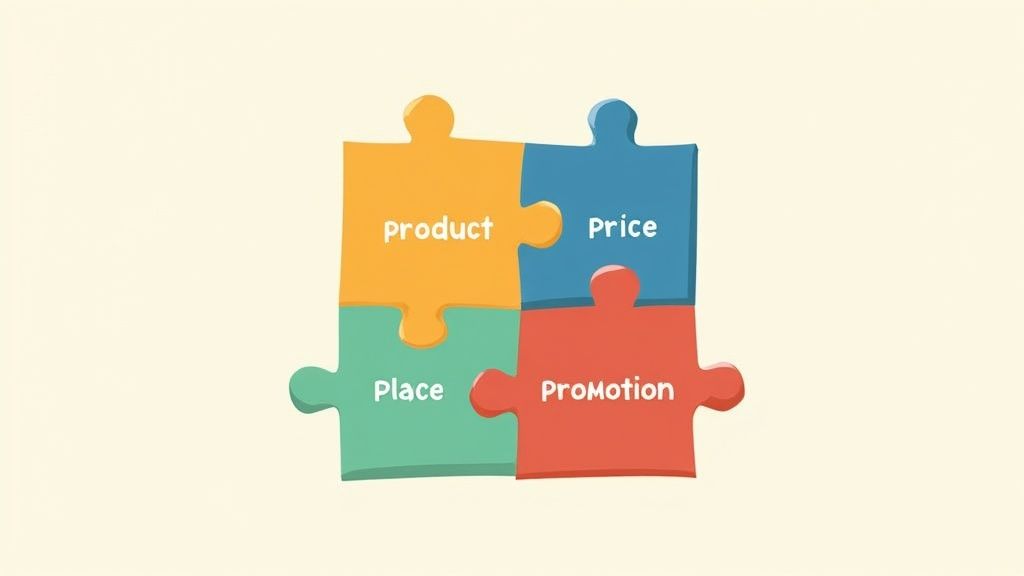
7. Marketing Mix (4Ps/7Ps)
The Marketing Mix is the tactical heart of your marketing plan, translating your high-level strategy into tangible actions. It’s a foundational framework, often referred to as the 4Ps (Product, Price, Place, Promotion), that provides a complete checklist for bringing a product or service to market. For service-based businesses, this is often expanded to the 7Ps, adding People, Process, and Physical Evidence to the mix. Getting these elements right ensures you have a comprehensive and well-rounded approach to meet customer needs.
This framework is not just an academic exercise; it’s a practical tool that forces you to consider every angle of your market offering. A well-defined marketing mix is one of the most essential components to a marketing plan because it ensures all your tactical efforts are aligned and work together harmoniously to achieve your objectives.
Why It’s a Critical Component
A cohesive marketing mix prevents disjointed efforts where, for example, a premium product is sold through a discount channel or promoted with a budget-focused message. It aligns every customer-facing decision, creating a consistent and powerful brand experience. It answers the fundamental questions: What are we selling? What is its value? Where can customers find it? And how will they learn about it?
Real-World Examples
- McDonald's: Its success is a masterclass in the 4Ps: a globally standardized product (Big Mac), competitive pricing accessible to the masses, ubiquitous place (thousands of locations), and consistent global promotion (the "I'm Lovin' It" campaign).
- Starbucks: It uses a different mix to target a different audience: a premium product (specialty coffee), premium pricing to match, a carefully selected place (cozy, branded stores), and promotion focused on lifestyle and brand experience rather than price.
Actionable Implementation Tips
To effectively build your marketing mix, follow these guidelines:
- Ensure Synergy: The 4Ps must work together. Your pricing strategy must reflect your product's quality, your distribution channels must match your target audience's habits, and your promotional message must align with your brand positioning.
- Adapt to Feedback: Use customer surveys, sales data, and market research to continuously evaluate and adjust your mix. If customers perceive your price as too high for the value, you may need to adjust the product, price, or promotion.
- Consider the Digital "P"s: Re-evaluate each "P" for the digital age. "Place" now includes your website and social media channels. "Promotion" heavily involves digital advertising, content marketing, and SEO.
- Review and Optimize Regularly: Markets are not static. Schedule quarterly or annual reviews of your marketing mix to ensure it remains relevant and effective against competitor actions and shifting consumer trends.
8. Budget and Resource Allocation
The budget is where your marketing strategy meets reality. This section provides a detailed financial and resource roadmap, outlining precisely how you will fund each initiative and who will be responsible for executing it. It transforms abstract goals into a tangible, operational plan, ensuring that your ambitions are both realistic and achievable. Without a clear budget, even the most brilliant strategy is just an idea.
This section is more than just a spreadsheet of expenses. It’s a strategic document that justifies every dollar spent, linking financial outlays directly to expected outcomes. Proper budget and resource allocation is one of the most vital components to a marketing plan because it enforces accountability and enables effective performance tracking.
Why It’s a Critical Component
A well-defined budget prevents resource waste and ensures that funds are directed toward the highest-impact activities. It provides a clear framework for making decisions, from choosing marketing channels to hiring staff or investing in new technology. This component allows you to measure ROI accurately, demonstrating the value of marketing efforts to the wider organization and securing future investment.
Real-World Examples
- Coca-Cola: Its global marketing budget is strategically allocated across different regions based on market maturity and growth potential. Emerging markets might see a higher percentage of the budget focused on brand awareness campaigns, while established markets might focus on new product launches and loyalty programs.
- A SaaS Startup: A startup with a lean budget might allocate 70% of its funds to low-cost, high-ROI digital channels like content marketing and PPC, 20% to essential marketing automation tools, and 10% to experimental channels like influencer partnerships.
Actionable Implementation Tips
To develop a robust budget and resource allocation plan, follow these steps:
- Allocate for Experimentation: Set aside 10-20% of your total budget specifically for testing new channels, platforms, or creative approaches. This "innovation fund" allows you to adapt to market changes without jeopardizing core campaigns.
- Use Historical Data as a Baseline: Analyze past performance to inform future spending. Identify which channels delivered the best ROI and use that data as a starting point, adjusting for new objectives and market conditions.
- Include Measurement Costs: Don't forget to budget for the tools and technology needed to track performance. This includes analytics platforms, CRM software, and reporting tools that are essential for proving ROI.
- Plan for Seasonality: Account for predictable fluctuations in business. A retailer, for instance, should allocate a significantly larger portion of their budget to the holiday season (Q4) to capitalize on peak consumer spending.
Key Components Comparison of 8 Marketing Plan Elements
| Component | Implementation Complexity 🔄 | Resource Requirements ⚡ | Expected Outcomes 📊 | Ideal Use Cases 💡 | Key Advantages ⭐ |
|---|---|---|---|---|---|
| Executive Summary | Low – concise and summary focused | Low – brief document, post-plan | Quick understanding, decision support | Stakeholder briefings, executive review | Saves time, enhances buy-in, clear direction |
| Market Research and Analysis | High – data gathering & synthesis | High – extensive primary & secondary research | Informed decisions, risk reduction | Market entry, strategy validation | Identifies opportunities, competitive intel |
| Target Audience and Customer Personas | Medium – data analysis & profiling | Medium – requires customer data | Tailored messaging, improved conversion | Campaign targeting, product development | Increases relevance, optimizes spend |
| Competitive Analysis | Medium – requires ongoing updates | Medium – data on competitors | Market gaps identification, benchmarking | Strategy development, positioning decisions | Reveals opportunities, informs differentiation |
| Marketing Objectives and Goals | Low to Medium – goal setting framework | Low – planning and review | Clear direction, measurable success metrics | Performance tracking, team alignment | Focuses efforts, improves accountability |
| Marketing Strategies and Positioning | Medium – strategic planning | Medium – creative and research input | Brand differentiation, consistent messaging | Brand building, market competition | Strong differentiation, guides communication |
| Marketing Mix (4Ps/7Ps) | Medium – tactical coordination | Medium – cross-functional input | Integrated marketing actions, strategic coverage | Campaign planning, product launches | Comprehensive framework, strategic integration |
| Budget and Resource Allocation | Medium – detailed planning | Medium – financial and human data | Efficient resource use, ROI monitoring | Financial planning, campaign management | Ensures accountability, optimizes spending |
From Plan to Performance: Activating Your Strategy
You've now explored the critical anatomy of a powerful marketing plan. We've dissected everything from the high-level Executive Summary that aligns stakeholders, to the granular details of your Target Audience Personas and the competitive landscape revealed through a thorough Competitive Analysis. Each piece serves a distinct, vital purpose in building a comprehensive roadmap for success.
The journey through setting clear Marketing Objectives, defining your overarching Strategy and Positioning, and detailing your tactical Marketing Mix is not just an academic exercise. It's the process of transforming abstract business goals into a concrete, actionable blueprint. When you top it off with a realistic Budget and Resource Allocation, you're not just hoping for growth; you're engineering it.
The Power of an Integrated, Living Document
The true value of mastering these components to a marketing plan lies in understanding their interconnectedness. Your market research directly informs your target personas, which in turn shape your positioning statement and tactical choices. A change in one area, like an adjustment to the budget, will inevitably ripple through the others.
For this reason, your marketing plan should never be a static document gathering dust on a server. It is a living, breathing guide that must be revisited, tested, and refined.
- Review Quarterly: Set aside time each quarter to measure your performance against the KPIs you established. Are you on track to meet your objectives?
- Adapt to Market Shifts: Did a new competitor enter the market? Has there been a significant shift in consumer behavior? Your plan must be flexible enough to adapt to these changes.
- Iterate and Optimize: Use the data you collect to make informed decisions. If a particular channel in your marketing mix is underperforming, reallocate those resources to one that is driving better results.
Turning Your Blueprint into a Business Asset
By diligently building and maintaining your plan, you move beyond reactive marketing tactics and embrace a proactive, strategic approach. You create a single source of truth that aligns your team, justifies your budget, and provides a clear framework for measuring success. This disciplined process is what separates thriving brands from those that merely survive.
This strategic document becomes your compass, ensuring every campaign, piece of content, and marketing dollar is purposefully invested to achieve maximum impact. It empowers you to navigate market complexities with confidence, make data-driven decisions, and ultimately, drive sustainable, predictable growth for your business. The effort you invest in creating a robust plan today will pay dividends in clarity, efficiency, and performance for years to come.
Ready to transform your marketing blueprint into tangible business growth? The experts at ReachLabs.ai specialize in crafting and executing data-driven marketing strategies tailored to your unique goals. Visit ReachLabs.ai to discover how our world-class talent can help you build and activate a marketing plan that delivers exceptional results.