
Social media reputation management is all about actively keeping an eye on, shaping, and defending how the public sees your brand across different platforms. It means you're in the trenches—tracking mentions, responding to feedback (the good and the bad), and steering the conversation to build a solid, positive online image. This isn't a side gig for an intern anymore; it's a core business function.
Why Your Social Reputation Is a Core Business Asset
Let's be real—social media isn't just another marketing channel. It's the new town square, and your brand's reputation can be made or broken there in an instant. Every comment, every share, and every review adds to the public story about your business, and that story has a direct line to your bottom line.
Think about it: one poorly handled customer complaint can spiral into a full-blown PR crisis overnight. On the flip side, a thoughtful and quick response can turn an unhappy customer into one of your biggest fans. The stakes have never been higher.
The Financial Impact of Public Perception
Your reputation on social media is a real asset with a tangible financial value. It touches everything from how you win new customers to who you can hire. Before anyone even clicks over to your website, they're likely checking you out on Instagram, X, or Facebook.
What they discover there has a huge impact on their decision to buy. In fact, a whopping 93% of consumers say online reviews sway their choices just as much as a recommendation from a friend. This means that casual scrolling has turned into active background checks. A positive presence builds the trust that drives sales and keeps customers coming back. To see how all these pieces fit together, you can dig into how this shapes your overall brand perception.
Today, a brand's social media presence acts as its digital storefront, customer service desk, and public forum all rolled into one. Neglecting its health is like leaving your most valuable asset uninsured.
The market data tells the same story. The online reputation management market, which is massively influenced by social media, was valued at $175 million in 2022. It's expected to balloon to $585 million by 2030, growing at a staggering 16.28% each year. This explosion highlights a critical truth: if you're not actively managing your reputation on social, you're already falling behind your competition.
Beyond Sales and Marketing
The ripple effect of your social reputation goes way beyond sales conversions. It’s also a massive factor in attracting and keeping great employees. Potential hires are absolutely looking at your social channels to get a feel for your company culture, see if your current team is happy, and understand how you talk to your community. A positive, engaging feed sends a powerful signal that you're a great place to work, giving you a serious advantage in a tight job market.
Ultimately, having a clear strategy for managing your reputation on social media isn't just a "nice-to-have." It's essential for survival and growth. For a deeper look at the fundamentals, check out these social media online reputation management best practices. A good plan shifts your team from constantly putting out fires to proactively building and protecting your most important asset.
Building Your Social Listening Command Post
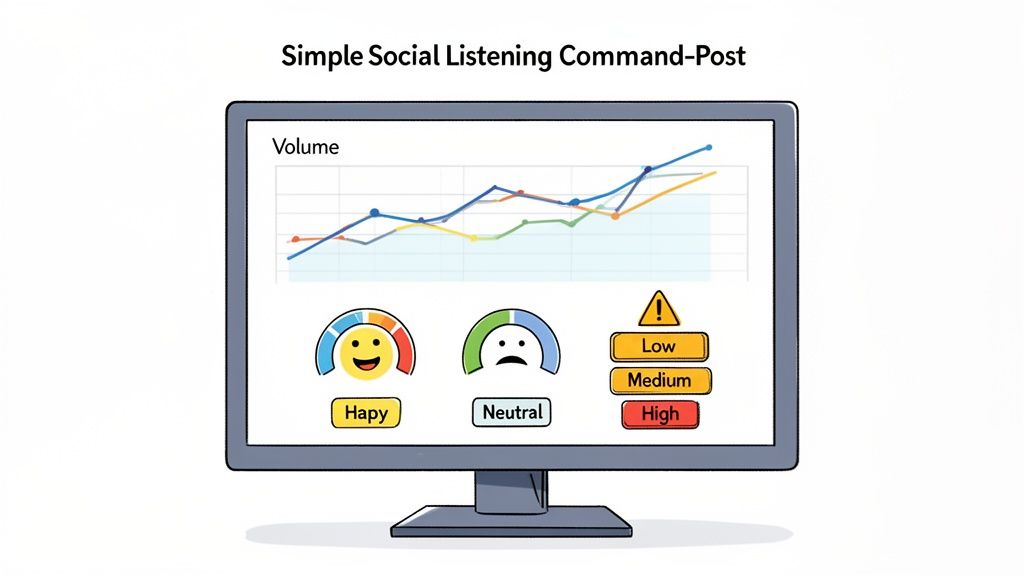
You can't manage what you don't monitor. That’s the core truth of reputation management on social media. Before you can jump in, craft a response, or build a positive narrative, you have to know what people are actually saying.
Think of your social listening setup as an early-warning system. It’s your command post, giving you a real-time, unfiltered view of every conversation that matters to your brand. It’s what helps you spot a brewing storm on the horizon or a golden opportunity hiding in plain sight.
This is about so much more than just counting brand mentions. A proper command post gives you the why behind the numbers—the sentiment, the recurring themes, and the people driving the conversation. It's the foundation that helps you move from reactive panic to a proactive, strategic game plan.
Defining What to Monitor
One of the biggest mistakes I see businesses make is tracking only their brand name. It’s a start, but it’s like looking at the world through a keyhole. You’re missing the bigger picture.
A truly effective listening strategy casts a wider net. You need to be tracking several layers of keywords to understand the full context of your brand's reputation.
Your setup should absolutely include:
- Brand and Product Keywords: This is your bread and butter. Think company name, product names, common nicknames or abbreviations, and even the misspellings people use all the time.
- Competitor Keywords: Always keep tabs on the competition. Watching their mentions can clue you into their latest product launch, reveal customer service fumbles you can learn from, or shine a light on market gaps your brand can swoop in and fill.
- Industry and Topic Keywords: What are the broader conversations in your space? A local coffee shop, for example, should be tracking terms like "specialty coffee" or "best espresso" in their city. That’s where you find trends and new customers.
- Key Personnel Keywords: Your CEO's reputation is often tied directly to the company's. The same goes for any public-facing executives. Monitoring their names is crucial for managing both their personal brand and your corporate image.
Configuring Your Listening Dashboard
Once you’ve figured out what to track, you need the right tools to turn all that raw data into something useful. You don't want to just create more noise for yourself.
For businesses just starting out, free tools like Google Alerts or the lists feature in X Pro (formerly TweetDeck) are great. They get you in the game without any budget commitment.
But when you're ready to get serious, you'll need a dedicated platform. There are some incredibly powerful options out there. If you're exploring what's available, this guide to the best social media analytics tools available is a solid place to start, as many have robust listening capabilities built-in.
No matter which tool you choose, the key is configuring your dashboard for clarity.
The goal of a listening dashboard isn't to see everything; it's to see the right things at the right time. Configure your alerts to distinguish between casual chatter and a brewing crisis.
A smart way to do this is with tiered alerts. For instance, a single negative comment might just land in a daily digest email for your social media manager. But a sudden spike of 50+ negative mentions in an hour? That should trigger an immediate, high-priority alert to your crisis team via Slack or SMS.
From Data to Actionable Insights
Your command post is only as valuable as the action you take based on its intel. A well-tuned system doesn’t just spit out charts; it helps you understand sentiment, spot influential voices, and catch trends before they explode.
To get there, you need to focus on a handful of key metrics. I've broken down the most important ones for reputation management in this table.
Key Metrics for Your Social Listening Dashboard
This table outlines the essential metrics you should have front and center on your dashboard. Tracking these will give you a quick, comprehensive snapshot of your brand's health online.
| Metric | What It Measures | Why It's Important for Reputation |
|---|---|---|
| Mention Volume | The total number of times your tracked keywords are mentioned. | A sudden spike can signal a viral post (good or bad) or a potential crisis. |
| Sentiment Analysis | The emotional tone behind the mentions (positive, negative, neutral). | Quickly shows you the overall feeling toward your brand and helps you prioritize what to address first. |
| Share of Voice | Your brand's mentions as a percentage of total industry mentions. | Puts your brand's relevance in context and shows how you stack up against competitors. |
| Top Influencers | The accounts with the largest reach that are talking about your brand. | Helps you identify potential brand advocates to build relationships with, or detractors to keep an eye on. |
By keeping a close eye on these numbers, your team can finally get ahead of the conversation. You’ll be able to spot patterns in customer complaints to improve your products, find your biggest fans to start an ambassador program, and—most importantly—protect your brand’s reputation with confidence.
Building Your Social Media Response Playbook
Once you've got your social listening system humming, you'll have a constant stream of intel pouring in. But data without a plan is just noise. The next move is to build your response playbook—a clear, practical guide that empowers your team to act decisively, no matter what social media throws their way.
Consistency is everything here. A playbook isn't about churning out robotic, copy-paste answers. It’s about defining your brand's voice and setting clear guidelines for handling different kinds of interactions. This ensures that whether a customer is singing your praises or airing a grievance, the response they get is always on-brand, empathetic, and actually helpful.
Finding Your Voice for Every Scenario
Your brand’s personality shouldn’t disappear when a conversation gets tough. In fact, that's when it matters most. Your playbook needs to map out how your voice adapts to different situations—positive, negative, and neutral—while still sounding like you.
Start by nailing down the core attributes of your voice. Are you witty and informal? Or more buttoned-up and reassuring? Once you've got that foundation, you can apply it to specific scenarios.
- Positive Mentions: This is your chance to amplify the good vibes. Responses should be appreciative and personal. Go beyond a simple "Thanks!" and try to match the user's energy. If they're excited, be excited with them.
- Negative Feedback: Here, the tone needs to shift to empathetic, professional, and solutions-focused. The goal is to acknowledge their frustration, take ownership, and quickly guide the conversation toward a fix.
- Neutral Inquiries: For general questions, your voice should be helpful, clear, and straight to the point. Give them the info they need without the fluff, getting them to an answer as quickly as possible.
Creating a Library of Pre-Approved Responses
Speed is non-negotiable on social media. People have incredibly high expectations, with 63% now demanding a reply within just one hour of posting a question or complaint. Getting it right pays off, too. A whopping 71% of consumers who have a positive social experience with a brand are likely to recommend it. You can dig into more stats on the impact of brand responsiveness from ReputationX.
To meet these expectations, you need a library of pre-approved response templates for common issues. This isn't about killing creativity; it's about giving your team a solid starting point they can quickly customize.
A response template should be a launchpad, not a cage. It provides the approved language and key information, but your team should always be encouraged to personalize it to fit the specific context of the conversation.
Your template library should cover all the usual suspects, like:
- Shipping times and costs
- Return policies
- Questions about product features
- Store hours and locations
- Common technical glitches
Having these answers ready to go frees up your team to spend less time on routine replies and more time on complex or sensitive issues that demand a completely custom approach.
De-escalation Plans and Getting to a Resolution
Not all negative comments are created equal. A simple question is a world away from a heated complaint that’s on the verge of going viral. Your playbook absolutely must include clear, step-by-step workflows for handling and de-escalating tense situations.
A solid de-escalation framework is the heart of effective reputation management on social media. It gives your team a roadmap for taking control of a negative interaction and turning it into something constructive.
A Simple Three-Step De-Escalation Model
This model provides a clear path for handling customer complaints with confidence, not panic.
| Step | Action | Example Phrase |
|---|---|---|
| Acknowledge | Validate their feelings and show you're listening. Don't argue or get defensive. | "I can definitely understand why you're frustrated, and I'm so sorry to hear you had this experience." |
| Align | Empathize with their position and show you're on their side, ready to find a solution. | "That's not the standard we aim for, and we want to make this right for you." |
| Assure | Take ownership and give them a clear next step, moving the conversation to a private channel. | "I'm sending you a DM right now to get a few more details so I can personally look into this for you." |
This structured approach helps prevent those emotional, off-the-cuff replies that can pour gasoline on a fire. It ensures every unhappy customer is met with a calm, professional, and genuinely helpful response.
Finally, your playbook needs to define exactly when a conversation should move from a public forum (like a comment thread) to a private one (like DMs or email). A good rule of thumb: the moment you need to ask for personal info like an email address, order number, or phone number, take it private. This protects the customer’s privacy and pulls a potentially heated discussion out of the public spotlight, giving you the space to resolve it properly.
Developing Your Social Media Crisis Communication Plan
Your day-to-day response playbook is great for handling typical comments and complaints, but what happens when a small spark turns into a wildfire? A real social media crisis doesn't care about business hours. It's a high-stakes, high-pressure storm that demands a completely different, more robust plan.
This is exactly why you need a dedicated crisis communication plan. Think of it as your emergency blueprint, ready to be activated the second an issue escalates beyond routine negativity. Without it, teams scramble, leading to delayed responses, mixed messages, and a total loss of control over the narrative. A solid plan means you can act fast, speak with one voice, and protect your brand when it matters most.
Defining What Constitutes a Crisis
First things first: not every negative comment is a crisis. A critical step is to clearly define what turns a standard complaint into a full-blown emergency. This clarity stops you from overreacting to minor issues while ensuring genuine threats get the immediate, all-hands-on-deck attention they require.
Your crisis triggers can't be vague; they need to be specific and measurable. Consider setting clear thresholds for when the plan kicks in.
- Sudden Volume Spike: A 500% increase in negative mentions within just a few hours.
- Influential Detractors: A critical post from an account with over 100,000 followers or a verified journalist.
- Legal or Safety Threats: Any mention of product safety problems, potential legal action, or threats to your staff or customers.
- Virality Potential: A negative post that explodes in popularity, hitting something like 1,000 shares or retweets in its first hour.
This kind of triage is essential for categorizing mentions as they come in.
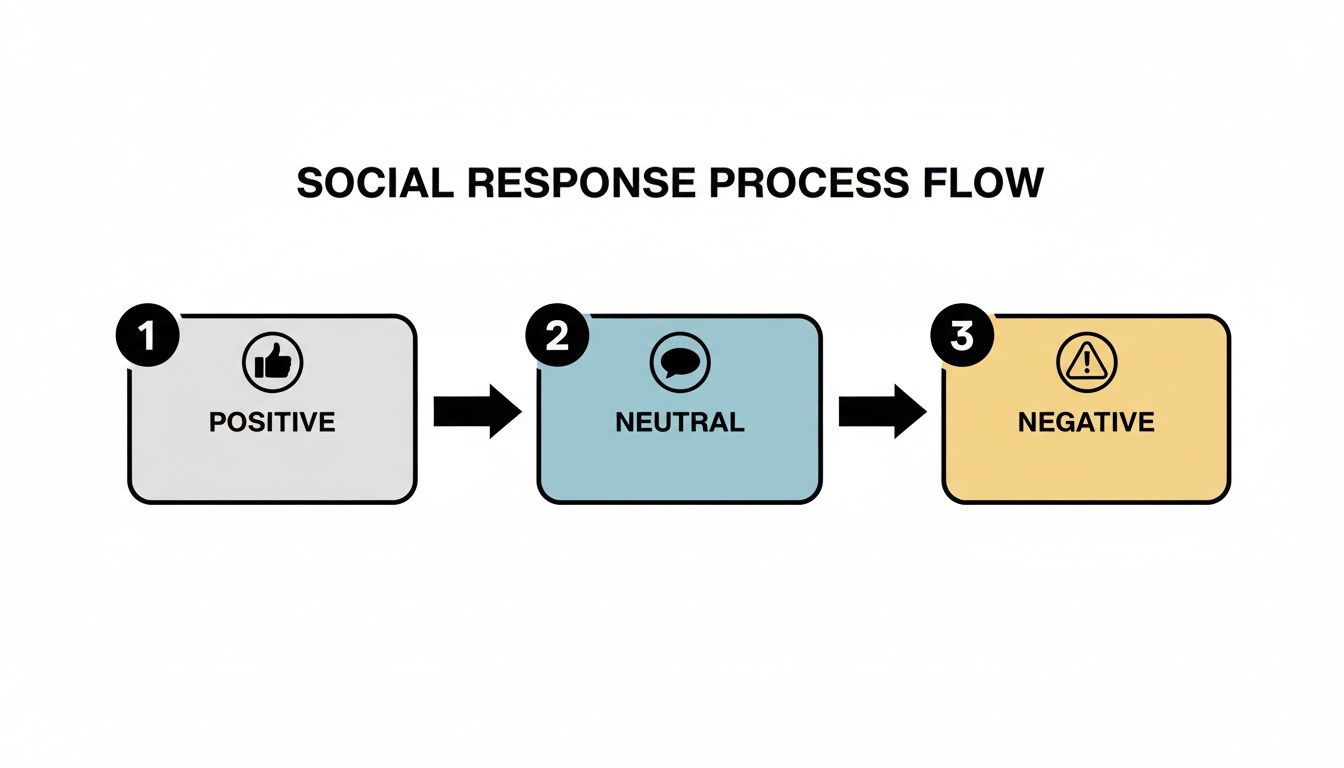
As you can see, every mention gets sorted, but it's the negative feedback that needs a structured and immediate escalation path.
Establishing a Clear Chain of Command
In a crisis, confusion is the enemy. Your plan has to spell out exactly who is in charge and what every single person's role is. This "crisis team" should pull in key people from different departments to ensure you’re looking at the problem from all angles.
Key Roles in Your Crisis Team:
- Crisis Lead: The ultimate decision-maker, usually a Head of Marketing, Communications, or even the CEO. They give the final green light on all public statements.
- Social Media Manager: Your eyes and ears on the ground. They're the ones monitoring the situation and executing the approved responses on social media.
- Legal Counsel: Reviews every public-facing message to make sure you're not creating legal headaches for yourself.
- PR/Communications: Handles any media inquiries and keeps the messaging consistent everywhere—not just on social.
- Customer Support Lead: Offers vital context on the customer issue at the heart of the problem and helps coordinate a real resolution.
From my experience, the most common failure point in a crisis is a slow or disorganized internal response. A pre-defined chain of command gets rid of any debate over who does what, letting the team focus 100% on fixing the external problem.
Having this team defined ahead of time means you can get the right people on a call in minutes, not hours. For a deeper look at getting this team organized, our comprehensive guide on social media crisis management is a great resource.
Preparing Statements and Information Flow
When a crisis breaks, silence often looks like guilt. But rushing out inaccurate information is even worse. The solution is to have pre-drafted "holding statements" ready to deploy at a moment's notice.
A holding statement is a short, empathetic message that simply acknowledges the situation. It buys you precious time to get your facts straight. The key is to be transparent without speculating.
Example Holding Statement:
"We're aware of the situation regarding [brief, neutral description of issue] and are taking it very seriously. Our team is investigating to understand all the details. We're committed to being transparent and will share an update as soon as we can. Thank you for your patience."
A simple message like this shows you're listening and in control. It prevents rumors from filling the information vacuum. Beyond external messaging, your plan must also map out internal communication. A dedicated Slack channel or email group for the crisis team ensures information flows quickly and securely, keeping everyone on the same page as the situation unfolds.
Proactively Building a Positive Online Reputation

Smart reputation management on social media isn't just about damage control. The best brands don't just sit back and wait for negative comments to pop up. They go on the offensive, building a rock-solid foundation of positive sentiment that acts as a shield when criticism inevitably strikes.
Think of it as creating a "reputation buffer." When your social feeds are overwhelmingly filled with good stuff, a single negative comment looks like an oddity—an outlier, not the norm. This proactive strategy turns your social media from a potential liability into a trust-building powerhouse that insulates your brand.
Turn Happy Customers into Vocal Advocates
Your most satisfied customers are your greatest untapped marketing asset. They already think you're great, but they often need a little encouragement to share that feeling with the world. Your job is to make it dead simple for them to become your brand's biggest fans.
Don't just hope for praise; create pathways for it. Here are a few simple, non-intrusive ways to get the ball rolling:
- Follow-Up Emails: After a customer makes a purchase or has a great support chat, send a quick email asking for their thoughts. If the feedback is positive, follow up with a direct link to the review site or social page you're focusing on.
- In-App Prompts: If you have an app or a SaaS product, a well-timed, polite prompt can work wonders.
- QR Codes: For brick-and-mortar businesses, a QR code on a receipt or a table tent can take customers directly to a review platform, cutting out all the friction.
This isn't just a "nice to have"—it's a critical piece of the trust puzzle. A striking 39% of customers simply won't trust a brand if they haven't seen it engage directly on social platforms. When you actively engage, you turn quiet supporters into vocal advocates. In fact, 71% of customers will recommend a brand after a positive experience. You can dig deeper into these online reputation statistics from Nader Nejad Media.
Showcase Authentic User-Generated Content
User-Generated Content (UGC) is the gold standard of social proof. It’s real, it’s relatable, and it’s way more convincing than any branded ad you could ever create. When a customer posts a photo with your product or shares a story about your service, they’re handing you a powerful, authentic testimonial.
You need to actively encourage and amplify this. Come up with a branded hashtag and feature it everywhere, making it easy to find and share posts from your community. Just remember the golden rule: always ask for permission before resharing and give proper credit to the original creator. This small gesture makes your advocates feel appreciated and encourages others to share their own content.
A feed full of real customer photos and stories tells a much more powerful story than a polished ad campaign ever could. It’s proof, not just promises.
Using a dedicated reputation monitoring service is like having a 24/7 watchtower, constantly scanning for brand mentions and UGC so you never miss a chance to engage.
Amplify Testimonials and Positive Feedback
Don't let five-star reviews die on third-party sites. Your social media channels are the perfect megaphone to broadcast that positive feedback to a wider audience.
Take a fantastic quote from a Google review and turn it into a shareable graphic for Instagram. Post a link to a glowing blog post on X. Create a short video clip from a customer testimonial for your Facebook page.
By strategically cross-promoting your best reviews, you make sure that positive sentiment gets the visibility it deserves. It’s a simple but incredibly effective way to build a public track record of excellence, one positive comment at a time.
Your Top Social Media Reputation Questions, Answered
When you're in the trenches of managing a brand's social media presence, you run into some tough situations. The "right" answer isn't always cut and dry. Let's walk through some of the most common questions and break down how to handle them with confidence.
How Do I Handle Fake or Malicious Reviews?
It’s incredibly frustrating to see a fake review pop up, but reacting emotionally is the worst thing you can do. The real goal here is twofold: show genuine customers you're professional and, behind the scenes, work to get the fraudulent post taken down.
First things first, resist the urge to get into a public argument. Post one single, calm, and professional reply. This shows you're paying attention without giving the fake claim any oxygen.
"We take all feedback seriously, but we can't seem to find any record of this customer interaction in our system. We'd love to help resolve this, so please contact our support team directly at [email/phone]."
This simple script does wonders. It shows your real audience that you're accountable. Once you've posted that, your public job is done.
Now, shift your energy to reporting it. Use the platform’s reporting tools and build your case. Take screenshots and document anything that seems off—maybe the reviewer's account was created yesterday, they have no purchase history, or their wording is suspiciously similar to other bad reviews. Submit a detailed report. Removal isn't always guaranteed, but you have to try.
Your best long-term defense? Dilution. Drown out the fakes by actively encouraging a steady flow of genuine, positive reviews. When you have dozens of great reviews, a single fake one just looks like the outlier it is.
What Are the Best Free Tools for a Small Business to Start With?
If you're a small business owner, you're probably keeping a close eye on the budget. The good news is you don't need a pricey, enterprise-level suite to get started. A few excellent free tools can lay a solid foundation for social listening.
Here's where I'd start:
- Google Alerts: This is non-negotiable. Set up alerts for your brand name, key products, and even your CEO's name. It's a simple way to catch mentions across the web—especially on blogs and forums that get shared on social.
- X Pro (formerly TweetDeck): If X (Twitter) is a major channel for you, this tool is a lifesaver. You can set up custom columns to track keywords, hashtags, and mentions in real-time, all on one clean dashboard.
- Platform-Native Tools: Don't forget what the platforms themselves give you. Meta Business Suite, for example, has a unified inbox that lets you manage Facebook and Instagram comments and messages all in one place.
These tools won't give you the deep sentiment analysis of paid software, but they give you what you need most: visibility. They ensure you never miss a critical conversation, which is half the battle.
Should I Delete Negative Comments on My Social Media Pages?
Let's make this simple: almost never.
Deleting a negative comment is like pouring gasoline on a fire. The original commenter will almost certainly notice, take a screenshot, and come back even angrier, accusing you of censorship. Suddenly, a small customer service complaint blows up into a major crisis about your brand's transparency.
The only time deletion is okay is when a comment clearly violates your community guidelines. You should absolutely remove content that contains:
- Hate speech or discriminatory language
- Spammy links or obvious trolling
- Personal threats against your team or other users
- Private or confidential information
For every other piece of legitimate negative feedback—even the stuff that stings—the best move is to respond publicly. Acknowledge their frustration, show empathy, and offer to take the conversation to a private channel (like DMs or email) to get it solved.
Think of it this way: a public complaint, handled well, can turn into a powerful testimonial for your amazing customer service. That's far more valuable than a "perfect" but completely inauthentic comment section.
At ReachLabs.ai, we build robust digital strategies that protect and enhance your brand's voice. We integrate world-class talent with data-driven insights to help you navigate the complexities of your online presence. To see how our collective approach can move the needle for your business, learn more about what we do.