

A solid investor pitch deck isn't just a presentation; it's a finely-tuned story designed to get you from an idea to a funded company. The best frameworks, like the one pioneered by Y Combinator, are built on this principle. They focus on delivering a powerful narrative in just 10-15 slides, getting straight to the point without overwhelming the investor.
Why Most Pitch Decks Fail and How Yours Can Succeed
The road from a brilliant concept to a funded startup is littered with failed pitches. Where do most founders go wrong? They often treat the pitch deck like a homework assignment—a dense, all-inclusive business plan crammed with text, confusing charts, and vanity metrics. This is a fundamental misunderstanding of how investors actually work.
Let's be real: investors are swamped. They see hundreds of decks and simply don't have time to read a novel. The data is sobering: an investor spends, on average, just a few minutes on a deck, and an eye-watering 99% of pitches get a "no." This isn't just bad luck; it's a failure to make an immediate, compelling impression. To see what does work, it's worth studying these real-world pitch deck examples.
Adopt the Mindset of the 1%
So, how do you break into that top 1%? It all starts with a change in perspective. Stop thinking of your deck as a document to be read. Instead, treat it as a story to be absorbed. Your goal isn’t to answer every single question an investor might have. It's to pique their interest enough to get that all-important follow-up meeting.
A winning deck stands on three pillars:
- Clarity: Can someone grasp the problem and your solution in 30 seconds? Your value proposition needs to be crystal clear from the get-go.
- Brevity: Every single word, image, and number must earn its spot. If it doesn't advance the story, cut it. No fluff.
- Impact: Does your deck scream "massive opportunity"? You need to convince them not only that the market is huge, but that your team is the only one that can win it.
The 10 Essential Slides of a Winning Pitch Deck
Before jumping into slide design, it helps to have a map. Investors have seen thousands of pitches and have developed a mental checklist for what they expect to see. This table breaks down the core narrative flow of a standard 10-slide deck, outlining what each slide needs to accomplish.
| Slide Number | Slide Title | Core Purpose |
|---|---|---|
| 1 | Company / Vision | Hook them with a single, powerful sentence about what you do and why it matters. |
| 2 | The Problem | Clearly define the pain point you are solving. Make it relatable and urgent. |
| 3 | The Solution | Present your product or service as the elegant answer to that problem. |
| 4 | Market Size (TAM) | Show them the money. How big is the potential opportunity? |
| 5 | Product | Give a demo or a visual walkthrough. How does it actually work? |
| 6 | Business Model | Explain how you make money. Who pays, how much, and why? |
| 7 | Go-to-Market Strategy | How will you reach and acquire customers efficiently? |
| 8 | Team | Why is your team uniquely qualified to solve this problem and win the market? |
| 9 | Financials / Traction | Show your progress. What have you achieved so far? (Revenue, users, etc.) |
| 10 | The Ask | State exactly how much you are raising and what you'll use the funds for. |
Think of this structure as your narrative backbone. While you might add a slide or two for competition or traction, these 10 are the non-negotiable core of your story.
Building a Foundation for Success
Before you even touch a slide-building tool, you need to get inside the investor's head. They're pattern-matching, constantly scanning for signals that remind them of other successful companies they've backed. Getting ahead of their questions is key. Familiarizing yourself with a typical venture capital due diligence checklist is a smart move; it helps you build answers to their toughest questions right into your narrative.
Your pitch deck is more than a funding request—it's the first real test of your ability to communicate a big, complex idea with persuasive simplicity. The Y Combinator model, which has helped its alumni reach a combined valuation of over $600 billion, is living proof that this philosophy works.
A great pitch deck tells a story that makes an investor feel like they are missing out on the next big thing if they don't act now. It's not about features; it's about the future you're building.
Crafting Your Narrative with Core Story Slides
Investors are people, and people connect with stories far more than they do with spreadsheets. Before you even think about showing off your financial projections or team bios, you have to grab their attention with a compelling narrative. The most successful pitches I've seen all do this exceptionally well.
They dedicate the opening slides to building a powerful story, one that hinges on three critical elements that flow seamlessly into one another: the Problem, the Solution, and the Market Opportunity. You need to make an investor feel the problem before you can sell them on the solution. This is your hook, and it’s what makes them lean in and listen to the rest.
The stakes are incredibly high. Just look at the numbers.
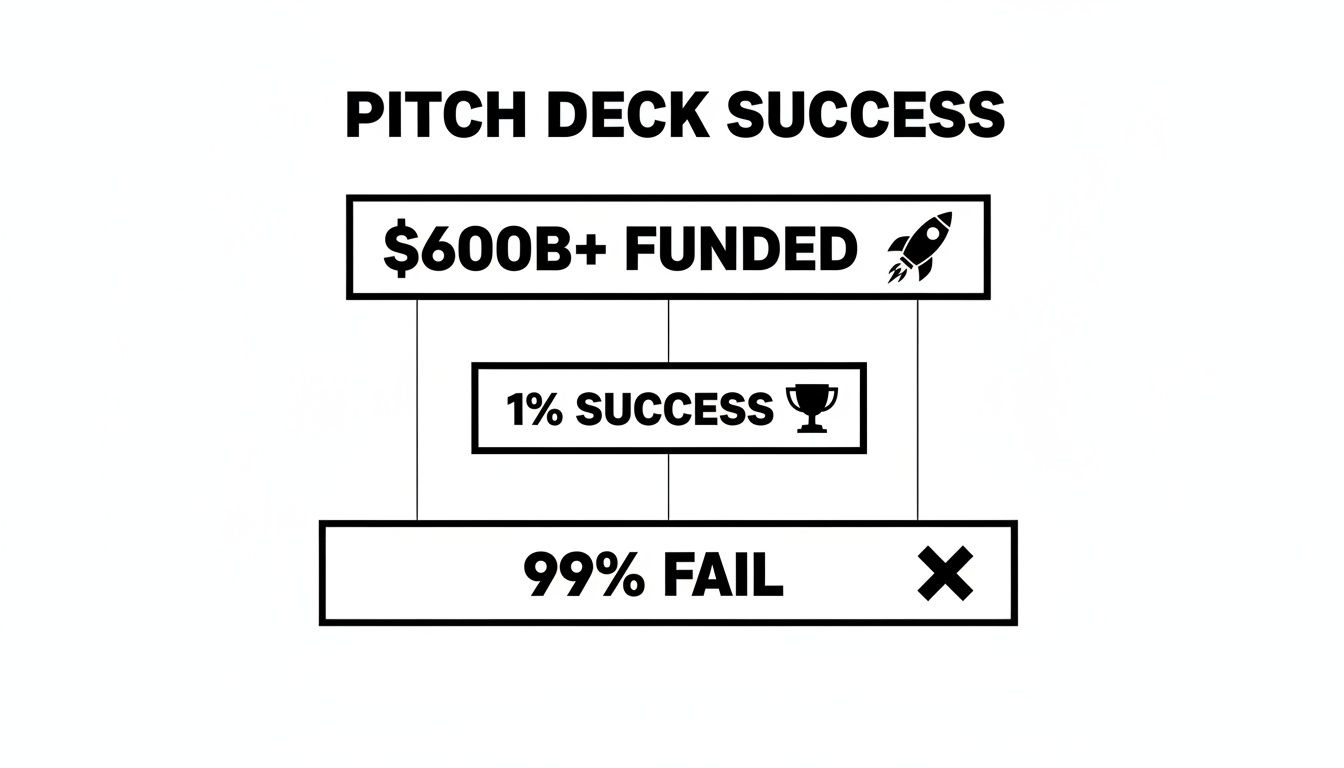
While YC-backed companies alone have raised over $600 billion, the raw truth is that 99% of pitch decks fail to secure any investment. A masterfully crafted narrative isn't just a nice touch—it's your best shot at breaking through the noise and being part of that 1%.
Defining a Painful Problem
Your problem slide needs to land with a punch. It has to establish an urgent, undeniable pain that a specific group of people is experiencing. Forget vague statements about market inefficiencies; get specific. The more visceral and relatable the problem, the more your pitch will stick in their minds long after the meeting is over.
Think about the early Airbnb deck. They didn't just say, "hotels are expensive." They zeroed in on a very specific issue: "Price is an important concern for customers booking travel online." Then they added the emotional layer—the disconnect from local culture that comes with staying in a cookie-cutter hotel. Suddenly, the problem is tangible and personal.
A common mistake I see founders make is describing a mild inconvenience instead of a true "hair-on-fire" problem. Investors hunt for solutions to significant pain points because those are the problems people will happily pay to solve.
To really nail this slide, ask yourself these questions:
- Who is actually experiencing this? Get as specific as you can.
- How bad is the pain? If you can, quantify it in terms of lost time, wasted money, or frustration.
- Why do the current solutions suck? This perfectly sets the stage for your brilliant alternative.
Presenting Your Elegant Solution
After you've made the investor feel the pain, your solution slide should arrive like a breath of fresh air. This is where you reveal your product or service as the simple, elegant answer. Clarity is everything here.
This isn't the time to get bogged down in technical jargon or list every single feature. You need to convey your core value proposition in a single, powerful statement. Airbnb’s was perfect: "A web platform where users can rent out their space to host travelers to save money, make money, and share culture." Simple, clear, and compelling.
Your slide should show, not just tell. Use clean mockups, a few key screenshots, or a simple diagram to make the concept instantly understandable. To really make your solution resonate, it's worth exploring a proven brand storytelling framework that helps build a much deeper connection with your audience.
Quantifying the Market Opportunity
Okay, you've established a painful problem and presented a great solution. Now, the investor's mind immediately goes to one question: "How big can this actually get?" Your market opportunity slide is where you answer that with credible data, not just wishful thinking. This is where the classic TAM, SAM, and SOM model comes in.
- Total Addressable Market (TAM): This is the entire potential market for your product—the biggest slice of the pie imaginable.
- Serviceable Available Market (SAM): This is the segment of the TAM you can realistically serve with your business model and geographic reach.
- Serviceable Obtainable Market (SOM): This is the portion of your SAM you can realistically capture in the near term. It's your beachhead.
Let's go back to Airbnb. Their TAM was absolutely massive—over 1.9 billion trips booked annually. But they were smart. They started with a believable, niche SOM, aiming to capture just 15% of a specific travel segment. This approach shows investors you have a huge long-term vision but also a grounded, focused plan to get started. Grounding your big idea in a tangible, achievable initial market is how you build credibility and show a clear path to growth.
Proving Your Worth with Traction and Metrics
Alright, let's talk about the slide that can make or break your pitch: traction. Up to this point, you've been telling a compelling story. Now, you have to prove it's not just a story. This is where your pitch meets reality, and it's often the single most persuasive slide you'll present.
Investors see countless "brilliant ideas" every single day. What separates a startup that gets funded from one that gets forgotten? Tangible proof of progress. Your traction slide is the evidence that real people are already excited about what you're building. It validates your market, reduces the perceived risk for investors, and shows your team can actually execute.

Choosing the Right Metrics to Showcase
First things first: forget vanity metrics. No one cares about your social media likes. Investors need to see the numbers that directly signal the health and scalability of your business. The KPIs you highlight will really depend on your specific business model.
If you're running a SaaS or subscription company, it's all about recurring revenue and customer economics.
- Monthly Recurring Revenue (MRR): This is the lifeblood. A simple, clean chart showing your MRR climbing month-over-month is probably the most powerful visual you can put in your deck.
- Customer Acquisition Cost (CAC): How much do you spend to get one new paying customer? Investors need to know that your growth is efficient and not just fueled by unsustainable spending.
- Lifetime Value (LTV): This number predicts how much revenue a customer will bring in over their entire relationship with you. A classic sign of a healthy model is an LTV that's at least 3x your CAC.
These metrics aren't just numbers; they tell a story about your business's viability. You can dive deeper into other relevant KPIs by looking at these marketing performance metrics examples to see what else fits your strategy.
Don't underestimate this slide's importance. Research shows investors spend a whopping 60% of their time looking at your traction and metrics. It’s what separates theory from reality. Just look at Buffer's early pitch—they highlighted 55,000 users and $150K ARR, which helped them lock in their seed round by proving they had found product-market fit.
Visualizing Data for Maximum Impact
How you show your numbers is just as important as the numbers themselves. A confusing, cluttered graph can completely kill the momentum of an otherwise fantastic pitch. Aim for clarity and immediate impact.
Stick to simple bar or line charts to illustrate growth over time. Label your axes clearly and give the chart a title that tells the story for you, like "MRR Growth (Last 12 Months)." Please don't try to cram every metric onto a single graph. If you have multiple important numbers, give each one its own clean, simple visual. An investor should be able to glance at it and "get it" in three seconds flat.
The best traction slides are brutally simple. They show a chart that goes up and to the right. That's it. This visual shorthand screams "growth" and immediately gets investors excited about the opportunity.
For early-stage companies, it's also incredibly helpful to define a clear North Star Metric. This is that one single metric that best captures the core value you deliver. It gives investors a clear focal point to track your true progress.
What to Show When You're Pre-Revenue
"But we don't have any revenue yet!" I hear this all the time from pre-seed startups, and it's perfectly fine. It doesn't mean you have zero traction. Traction is about proving the market wants what you have, and revenue is just one (very good) way to do that.
If you're pre-revenue, you just need to show momentum in other ways.
- Pilot Programs: Have you run successful pilots with well-known companies? Showcase the results, key usage data, and any glowing testimonials.
- Letters of Intent (LOIs): These are gold. A signed LOI from a potential customer is a powerful signal of future revenue and confirms real market demand.
- Waitlist Growth: A long and rapidly growing waitlist is fantastic proof of pent-up demand. Put a number on it: "Over 10,000 users signed up for our waitlist in just 3 months."
- User Engagement: If your product has a free tier, lean into engagement metrics. Things like Daily Active Users (DAU), session length, or retention rates prove that your product is sticky long before you turn on monetization.
Whether it’s dollars or data points, your traction slide is where you prove you’re building something people genuinely want. It’s what elevates your pitch from a hopeful story to a credible investment opportunity.
Alright, you’ve hooked them with your story and proven you’ve got traction. Now, investors want to look under the hood. It’s time to show them the engine of your business—your product and how it actually makes money.
These next two slides are where your grand vision meets reality. You need to show investors exactly what you’re selling and the mechanics of how you get paid for it. They need to see a clear, believable path from your brilliant idea to a profitable company. Get this wrong, and you might as well pack it up.
Showcasing Your Product's Magic
Your Product slide needs to make your solution feel real and tangible. This isn’t the place for a laundry list of every feature you’ve ever dreamed up. Instead, your goal is to showcase the "underlying magic"—that core thing that makes your product special.
Visuals are everything here. Forget long, text-heavy descriptions.
- High-Fidelity Mockups: Use clean, professional screenshots that walk through the most important user flows. Make it look and feel like a real product.
- Simple Diagrams: If you’re building something more complex, like a backend API, use a simple flowchart. Help investors understand the moving parts without getting lost in the weeds.
- Short Demo Video: Never, ever do a live demo in a pitch. It's a recipe for disaster. Instead, have a polished, 2-minute video ready and link to it.
Think back to Airbnb's legendary early deck. They didn't bother explaining their search algorithm. They just showed three simple screenshots: search, review, and book. That’s all it took to convey the elegance and simplicity of their user experience.
Defining Your Business Model Clearly
After an investor understands what your product is, their very next thought is, "Okay, so how do you make money?" Your Business Model slide has to answer this question with zero ambiguity. Complexity and confusion are deal-killers.
State your primary revenue streams directly. If you’re a SaaS company, "subscriptions" isn't good enough. You need to lay out your pricing tiers and what drives the value for each one.
The best Business Model slides can be understood in ten seconds. An investor should instantly get who pays, what they pay for, and how much. If they have to squint and think about it, you’ve failed.
For instance, a marketplace should clearly state its take rate. A hardware company needs to show its unit cost versus its retail price. Nailing this is a vital part of any investor pitch deck template because it's the direct link between your product and your profits.
Aligning Price With Value
Your pricing can't feel like you just pulled numbers out of thin air. It has to be logically tied to the value you deliver to your customers. For SaaS businesses, nothing beats a simple, clean pricing table.
Here’s a classic way to structure it:
| Plan | Price | Key Features |
|---|---|---|
| Basic | $29/mo | Core feature set, 5 users |
| Pro | $99/mo | Advanced features, 20 users, priority support |
| Enterprise | Custom | Unlimited users, dedicated account manager |
This kind of table immediately shows that you've thought about market segmentation and how your pricing scales with customer value.
Ultimately, your Product and Business Model slides work as a team. They have to prove you’ve built a viable commercial engine, not just a cool side project. You're showing investors a clear, compelling path from creating value for a user to capturing it as revenue for the company.
Outlining Your Go-To-Market and Financial Plan
So, you've hooked them with a powerful story and maybe even some early traction. That's fantastic. But seasoned investors know that a great idea is just the starting point. The real question is, can you execute?
This is where you connect your big vision to the nuts and bolts of building a business. The next few slides—Go-To-Market, Financials, and Team—are where you prove you have a real-world plan to turn your idea into a profitable, scalable company. It’s not enough to have a great product; investors need to see a credible, data-informed strategy for winning customers, managing money, and leading the charge.
Architecting Your Go-to-Market Strategy
Your Go-to-Market (GTM) slide answers the million-dollar question: "How are you actually going to get customers?" This isn't a theoretical exercise. Investors have heard "we'll use social media" a thousand times. They want to see a focused, efficient, and well-reasoned plan.
Start by naming your primary customer acquisition channels. Are you all-in on content marketing? Building a direct sales force? Or are channel partnerships your key to growth? For whichever path you choose, you need to explain why it’s the right one for your specific market and product.
Let's say you're a B2B SaaS company. A detailed plan might look something like this:
- Content Marketing: Creating high-value blog posts and webinars that speak directly to the pain points of VPs of Sales in mid-market tech.
- LinkedIn Outreach: Running a targeted campaign using Sales Navigator to book demos with pre-qualified leads.
- Direct Sales: Building a small inside sales team to close the high-value enterprise leads that marketing brings in.
This level of detail shows you’ve moved beyond just throwing ideas at a wall. It demonstrates that you actually understand how to reach your ideal customer.
Building Defensible Financial Projections
Let's be honest, the financials slide is where a lot of founders get nervous, and for good reason. Your projections are a make-or-break moment. Investors will expect to see at least a 3-year forecast to understand your business's potential scale. In fact, pitch decks without this slide fail nearly 80% of the time. You absolutely have to show a realistic, data-backed path to profitability. For a deeper dive, check out these insights on the essential slides investors want to see.
Your forecast should clearly outline revenue, major expenses like headcount and marketing, and your projected bottom line. But here’s the secret: the final numbers are less important than the assumptions you used to get there.
An investor knows your 3-year forecast will be wrong. What they're really testing is how you think. Your assumptions reveal whether you understand the core drivers of your business.
Be ready to defend every assumption. If you're projecting $5 million in revenue by year three, you need to show the math. How many customers is that? What's your average revenue per customer? What's the conversion rate you're banking on? Grounding your projections in this kind of bottom-up logic builds incredible credibility.
Don't forget to visualize this data with clean, easy-to-read charts—it can boost comprehension by up to 40%. Make sure you highlight key unit economics, like a Customer Acquisition Cost (CAC) to Lifetime Value (LTV) ratio that is well over 3:1. It's always better to present conservative, milestone-driven growth figures than wildly optimistic ones you can't defend.
Investors have seen thousands of financial slides and can spot unrealistic assumptions from a mile away. Here’s a quick guide to some of the most common mistakes founders make and how to steer clear of them.
Common Financial Projection Mistakes to Avoid
| Common Mistake | Why It's a Red Flag | How to Fix It |
|---|---|---|
| "Hockey Stick" Growth from Day One | Projects explosive, unrealistic growth without any ramp-up period. It signals a lack of understanding of market adoption cycles. | Show a more gradual, S-curve adoption rate. Tie major growth inflection points to specific events like product launches or marketing campaigns. |
| Vague or Missing Assumptions | Simply presenting a spreadsheet of numbers without explaining the "why" behind them (e.g., CAC, churn rate, conversion rates). | Include a concise "Key Assumptions" section. Clearly state your assumed conversion rates, pricing, customer lifetime, and sales cycle. |
| Underestimating Costs | Ignoring or lowballing major expenses like hiring, marketing, legal fees, or office space. It makes the founder seem naive. | Build a bottom-up forecast. Research real-world salary data, marketing costs in your channels, and other operational expenses. Add a 10-15% buffer for unexpected costs. |
| Ignoring Unit Economics (LTV:CAC) | Focusing only on top-line revenue without showing that each customer is profitable over their lifetime. | Prominently feature your LTV to CAC ratio. A healthy ratio (ideally 3:1 or higher) proves your business model is sustainable and scalable. |
Avoiding these traps isn't just about crunching numbers; it's about demonstrating that you have a firm grasp on the financial realities of your business. A credible, well-reasoned financial model is one of the most powerful tools you have for building investor trust.
Showcasing Your A-Team
Ideas are cheap; execution is everything. At the end of the day, investors aren't just betting on a product or a market—they are betting on you. Your Team slide is your opportunity to prove that you have the right people with the right combination of skill and resilience to navigate the messy, chaotic, and exhilarating startup journey.
This slide should feature your core founding members. For each person, include:
- A professional headshot (no vacation photos, please).
- Their name and title (e.g., CEO, CTO, Head of Product).
- 2-3 bullet points that scream relevance. Focus on past wins, deep domain expertise, or unique skills that apply directly to the problem you're solving.
This is not the time to list every job they've ever had. Curate their experience to tell a story. If your CTO previously led an engineering team that scaled a product to millions of users, that’s a massive signal. If your CEO has prior startup experience—even a failed one—that shows grit and lessons learned. The perfect investor pitch deck template always focuses on the why behind the team, showing that this specific group is uniquely equipped to win.
Answering Those Lingering Pitch Deck Questions
You’ve spent countless hours getting your story straight and making your data look sharp, but there are always a few questions that pop up right at the end. It's totally normal. Building a pitch deck can sometimes feel like trying to guess a secret password.
To help you out, I’ve pulled together answers to the questions I hear most often from founders. This is your last-minute gut check to make sure your deck is tight, professional, and ready to open doors.
So, How Long Should This Thing Actually Be?
Keep it between 10 and 15 slides. Seriously. Any longer, and you risk losing your audience.
Investors are drowning in decks. Your only job here is to tell a compelling story, quickly. Think about it—the legendary Y Combinator template is just 10 slides. If they can do it, so can you. Each slide needs to earn its spot by serving one clear purpose.
If you find yourself pushing past 15 slides, it's time to get ruthless. Ask yourself: is this detail truly critical for a first conversation? You can always stash extra financial models, deep-dive market research, or technical specs in an appendix. Have it ready, but don't lead with it.
Your pitch deck is the trailer, not the feature film. Its goal isn't to answer every single question. It's to get them excited enough to want to meet you. That's when the real discussion begins.
What's the One Slide That Matters Most?
If you ask a dozen VCs, you’ll probably get a dozen different answers, but most will eventually admit the Traction slide is where they spend the most time.
Why? Because up until that point, everything is a hypothesis. The problem, the solution, the market size—it’s all just a well-argued theory. Your traction is the hard evidence that people actually want what you're selling. It’s proof that you’re onto something real.
Strong traction—whether that's revenue, user growth, or insane engagement metrics—is the great equalizer. It can make up for a smaller market or a team that doesn't have a flashy pedigree. It shows you know how to execute, and at the end of the day, that’s what investors are betting on.
Do I Need to Talk About an Exit Strategy?
For an early-stage deck (think pre-seed or seed), my advice is to leave it out.
Bringing up an exit this early can be a red flag. It can make it seem like you're just looking for a quick payday instead of dedicating yourself to building a massive, category-defining company. Investors at this stage want to see that you're obsessed with the problem and have a vision that spans a decade, not just a few years.
Save the exit talk for later rounds. Once your business is more mature and the path to an IPO or acquisition is less of a wild guess, it becomes a much more relevant conversation.
How Much Money Should I Actually Ask For?
Your "ask" can't just be a number you pulled out of thin air. It has to be grounded in a rock-solid plan.
Your Ask slide needs to do two things perfectly: state how much capital you're raising and show exactly what you'll achieve with it over the next 12-18 months. This is your operational roadmap.
Break down how you plan to use the funds. For example:
- Product Development: Hiring 2 senior engineers, building out X and Y features.
- Sales & Marketing: Scaling our Google Ads budget, hiring our first salesperson.
- Key Hires: Bringing on a Head of Product to own the roadmap.
This shows an investor you're disciplined and have a clear plan for their money. It gives them confidence that you’ll use their capital to hit the milestones that justify a much higher valuation in your next round.
Crafting a pitch deck that gets funded is both an art and a science. If you want an expert hand in shaping your narrative and designing a deck that gets you noticed, the team at ReachLabs.ai lives and breathes this stuff. We help founders build stories that secure meetings. Find out more about how we can help.