You're probably looking at a messy setup right now.
One freelancer handles paid ads. Someone else writes blog posts. Your web developer only touches the site when something breaks. Social posts go out, but they don't connect to email. SEO reports arrive in one dashboard, ad reports in another, and neither tells you whether the business is moving.
That's usually the moment companies start searching for a full service marketing agency.
The appeal is obvious. One partner. One strategy. One team that can connect brand, content, media, analytics, and execution. But often, many buyers get burned. A lot of agencies sell the idea of integrated service while staffing the account with broad generalists who know a little about everything and not enough about the channels that matter most.
The decision isn't just whether to hire a full service marketing agency. It's whether the agency is built as a coordinated team of specialists or just packaged to look that way.
What Is a Full Service Marketing Agency Really
A full service marketing agency should solve coordination problems first.
If you've ever had your SEO consultant asking for content the writer hasn't planned, while your paid media manager sends traffic to a landing page your designer never optimized, you already know the cost of fragmented marketing. Work gets done, but it doesn't compound. Each vendor hits their own deliverable. Nobody owns the whole system.

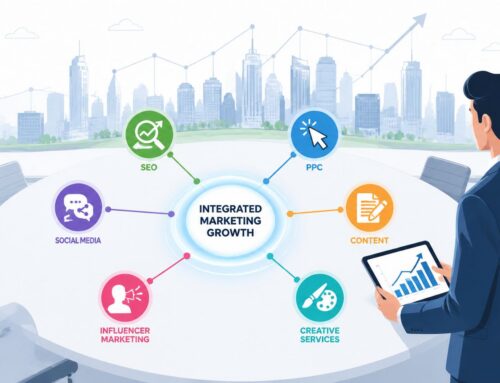
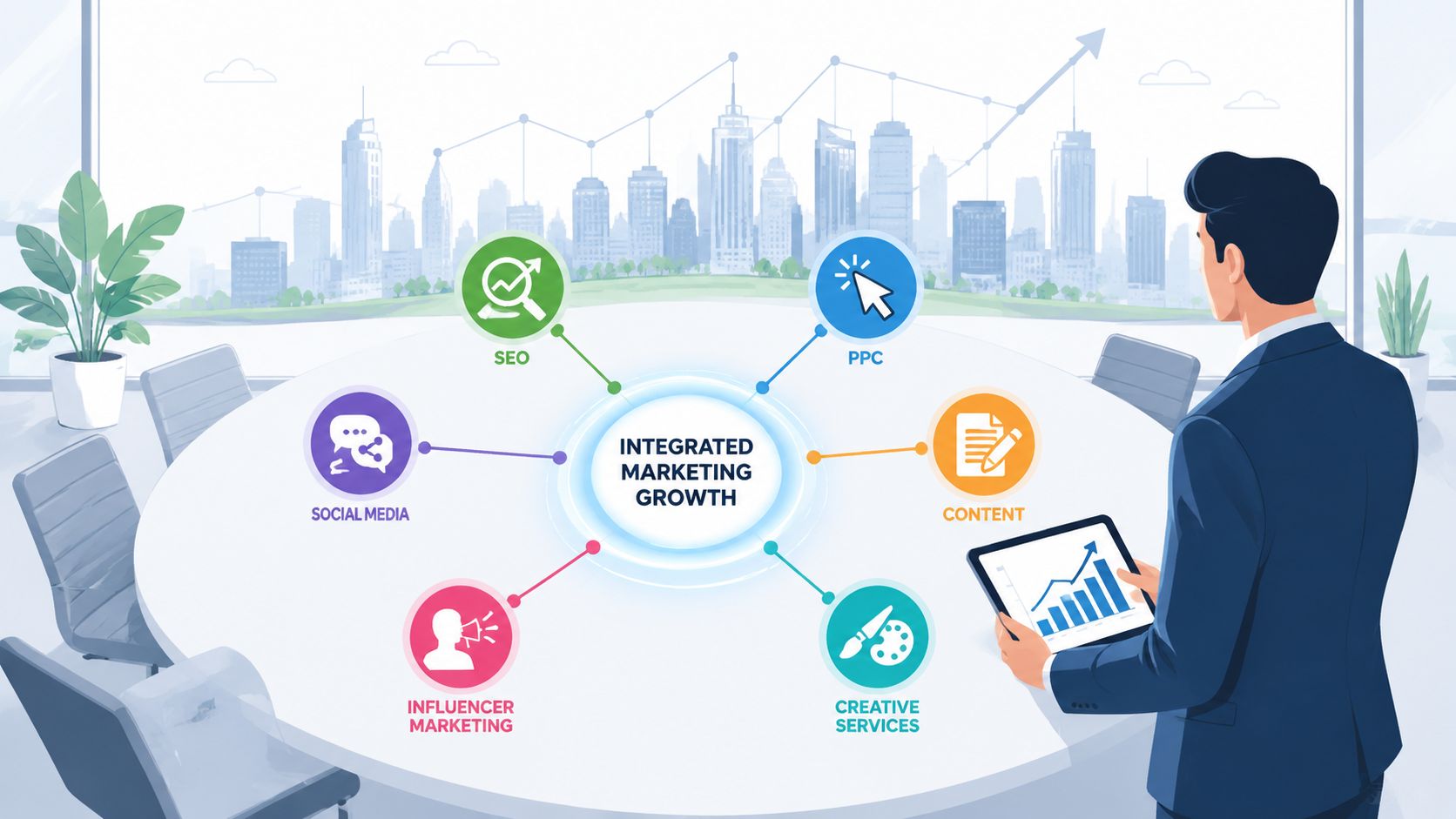
A true full service agency operates more like a marketing department than a vendor list. Strategy, creative, media, content, and analytics need to work as one operating unit. That's the practical meaning behind the technical definition from Breef's explanation of full-service vs. specialized agencies, which describes a full-service agency as having integrated capability across strategy, creative, media, content, and analytics.
What the relationship should feel like
You shouldn't have to play project manager across channels.
A good agency gives you one accountable team that can answer questions like:
- Why are leads down: Not just what happened in ads, but whether the drop came from audience quality, landing page friction, weak follow-up, or broken attribution.
- What should we prioritize next: Not a pile of disconnected ideas, but a ranked plan tied to pipeline, revenue, retention, or market visibility.
- How do channels support each other: SEO informs content. Paid search tests messaging. Email nurtures non-buyers. Creative adapts based on performance data.
A full-service model only works when one team owns the connections between channels, not just the channels themselves.
What it is not
It's not a menu of services pasted onto a website.
Many agencies say they do SEO, paid media, content, design, social, web, and analytics. That claim means very little by itself. The core question is whether those functions are staffed by people with real depth and whether someone can integrate them into one growth plan.
That distinction matters more than most SMBs realize. An agency can look full-scope in a pitch deck and still leave you coordinating the hard parts after the contract is signed.
The Anatomy of a Full Service Marketing Agency
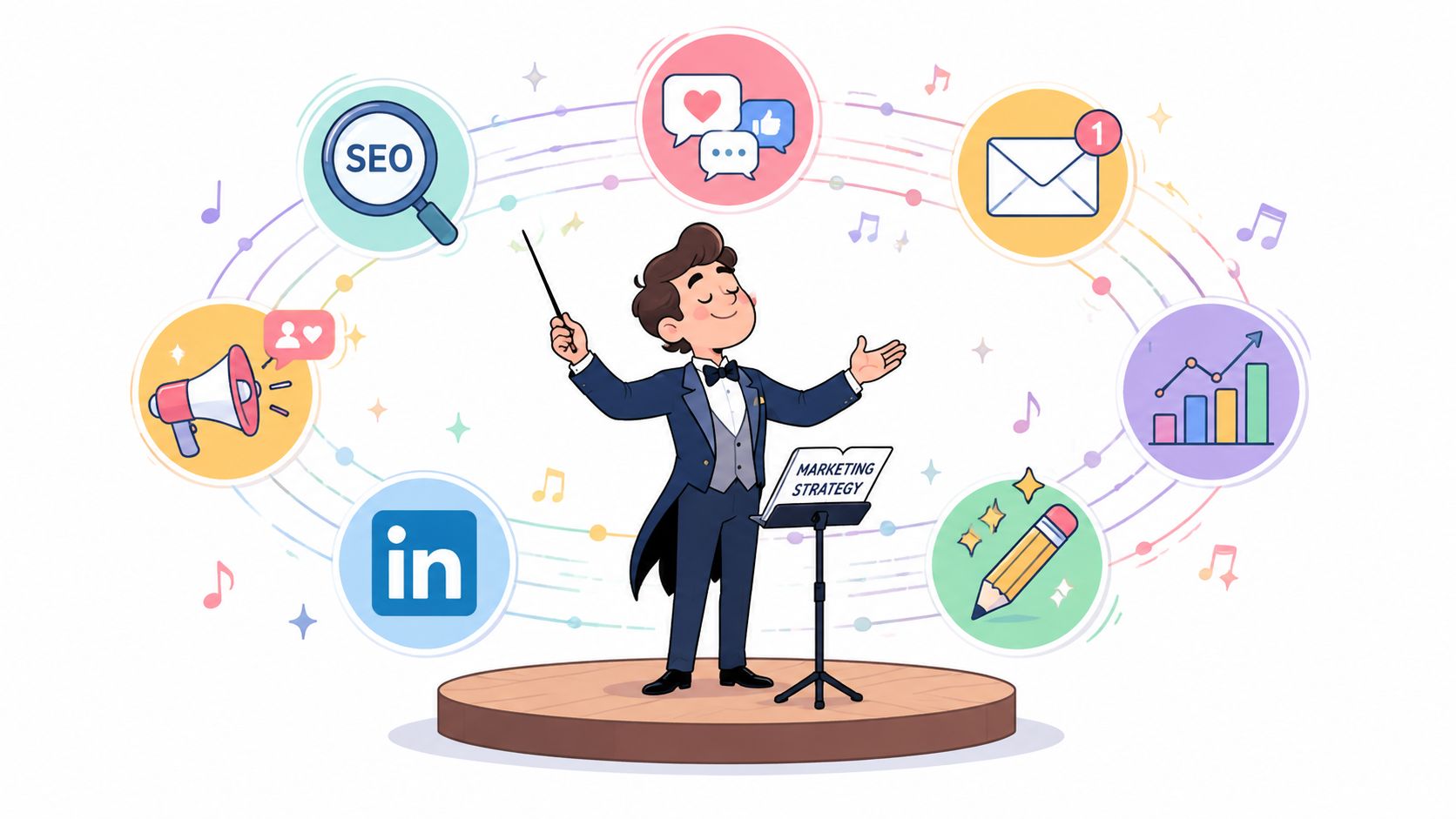
A full service agency becomes useful when its parts reinforce each other. Think of it less like a buffet and more like an orchestra. If each section plays well on its own but ignores timing, the result is noise. Marketing works the same way.

A useful way to evaluate an agency is to break it into four integrated pillars. If one pillar is weak, the whole system underperforms. If you want a broader overview of how digital agency functions fit together, this breakdown of what a digital marketing agency does is a helpful companion.
Strategic Foundation
The foundation of good agency work is laid. Before campaigns, before content calendars, before ad launches.
A strong strategy function handles audience research, category understanding, positioning, offer clarity, messaging hierarchy, and channel prioritization. Without that, execution gets busy fast and effective slowly. Teams publish content, spend budget, and hold meetings, but they're still unclear on the actual buyer, the strongest angle, and the business objective.
What I look for here is simple. Can the agency explain what problem the business really has? Not “you need more traffic.” The deeper issue might be weak conversion paths, poor offer-market fit, or muddled positioning.
Creative Execution
Creative is not decoration. It's how strategy becomes visible and persuasive.
That includes brand language, landing page copy, paid ad concepts, email sequences, sales collateral, short-form video, and design systems. The best agencies don't separate “creative” from performance. They know that the headline on a landing page affects paid search efficiency, and that visual consistency improves trust when a prospect clicks from social to site to inbox.
Practical rule: If the creative team doesn't understand the campaign objective, they're producing assets, not marketing.
Digital Activation
This is the distribution engine. It includes SEO, paid search, paid social, organic social, lifecycle campaigns, and email marketing that supports the buyer journey instead of blasting a list.
This pillar matters because channels don't perform in isolation. SEO content can support remarketing audiences. Paid campaigns can validate value propositions before the content team builds a bigger editorial push around them. Email can recover visitors who weren't ready to buy on first touch.
The Breef definition is useful here because it gets to the operational point, not just the service list. It notes that integrated capability helps brands avoid the inefficiency of managing separate agencies for paid social, SEO, email, and creative production, so every part of marketing contributes to a unified result instead of isolated spikes.
Performance and Growth
Many agencies look competent in a pitch and disappoint in practice.
Performance means tracking, reporting, interpretation, and optimization. Not screenshot-heavy reports. Not vanity metrics. Not “reach was strong this month.” The team should connect activity to business outcomes and explain what changes next because of the data.
Here's the structure I want to see:
- Tracking discipline: Clean conversion tracking, CRM alignment, and channel tagging.
- Reporting clarity: Fewer metrics, better interpretation.
- Optimization rhythm: Regular decisions tied to evidence.
- Cross-channel insight: Paid data shaping content. Sales feedback shaping creative. Funnel analysis shaping landing pages.
A real full service marketing agency is built on these connections. If you can remove one department and nobody notices, the integration isn't real.
Benefits and ROI of an Integrated Agency Partnership
Businesses aren't moving toward agency consolidation by accident. The global full-service digital marketing agencies market reached USD 369.08 billion in 2025 and is projected to reach USD 889.91 billion by 2035, with the 2026 market size assessed at USD 399.64 billion, according to Research Nester's full-service digital marketing agencies market report. That growth reflects a practical shift. More companies want fewer handoffs and tighter execution.

The value of an integrated partnership usually shows up in places that don't fit neatly into one channel report.
Where the return actually comes from
The first gain is strategic cohesion. Messaging gets tighter because one team sees the whole funnel. The paid search headline, landing page copy, sales follow-up, and email nurture stop sounding like four different companies.
The second gain is operational speed. When design, copy, media, and analytics sit in one workflow, campaign changes don't require three meetings and a week of chasing approvals. Teams can test faster and correct faster.
The third gain is management efficiency. One point of contact matters more than people think. Not because communication is simpler, but because accountability is clearer. You know who owns outcomes, not just tasks.
How to think about ROI without oversimplifying it
Agency ROI isn't just lead volume.
If you only evaluate an agency on raw lead count, you can reward bad marketing fast. Cheap, low-intent leads often look good in dashboards and create headaches for sales. Better evaluation asks harder questions:
- Lead quality: Are the right prospects entering the pipeline?
- Conversion path health: Are more visitors moving from click to inquiry to close?
- Message consistency: Does the market understand what you do more clearly?
- Revenue support: Is marketing making sales easier, not just busier?
For teams trying to tighten this measurement discipline, this guide to mastering content marketing measurement is useful because it pushes ROI discussions beyond surface-level engagement numbers. You can also pair that with a more practical framework for how to calculate marketing ROI when you need a cleaner internal scorecard.
The right agency improves results partly by producing better work, and partly by removing friction between the workstreams you already have.
That's why integrated partnerships often outperform fragmented setups even before any single channel becomes exceptional.
A Checklist for Choosing Your Marketing Partner
At this point, the specialist versus generalist problem becomes real.
A lot of agencies can pitch “full service.” Far fewer can prove that they have strong operators in the channels your business depends on. That gap is not small. A 2025 industry survey found that 68% of agencies claiming full-service capabilities lack native expertise in emerging channels like influencer marketing, and brands using these agencies see 22% lower ROI on multi-channel campaigns according to ClicksGeek's analysis of full-service digital marketing agencies.
That finding lines up with what many marketing leaders already feel during the buying process. The proposal looks broad. The bench turns out thin.
Start with team structure, not service lists
Ask who does the work.
Not the founder. Not the salesperson. Not the strategist on the discovery call. The day-to-day team matters more than the presentation. If an agency says it handles SEO, paid media, content, design, email, and video, ask whether those are in-house specialists, regular contractors, or white-labeled partners.
That question gets even sharper if your growth depends on visual channels. If video is part of your mix, this guide to video advertising partners gives a useful benchmark for what a true specialist partner should be able to explain around creative, placement, and production workflow.
Use a practical vetting table
| Vetting Area | What to Look For | Red Flag |
|---|---|---|
| Team depth | Clear roles for SEO, paid media, design, content, analytics, and strategy | One account manager appears to “cover” every specialty |
| Channel expertise | Specific thinking on your priority channels and how they connect | Generic claims like “we do everything” with no operational detail |
| Strategic process | Discovery, research, roadmap, KPI alignment, testing plan | They recommend tactics before understanding the business |
| Reporting | KPI-driven reporting tied to business outcomes | Reports full of impressions, clicks, and vague commentary |
| Execution model | Defined workflow, owners, timelines, approvals, feedback loops | Constant references to “we'll figure it out as we go” |
| Emerging channels | Honest clarity on what's native in-house and what isn't | They claim expertise in every new channel without examples |
| References and proof | Relevant case discussions, references, and work samples | They dodge specifics or only show polished creative reels |
| Communication fit | Direct answers, healthy pushback, clear meeting cadence | Overpromising, excessive jargon, or slow follow-up before you've signed |
What strong agencies do differently
Strong agencies don't try to impress you by saying yes to everything.
They draw boundaries. They tell you where they have depth, where they have process, and where they'd rather partner than bluff. That honesty is a good sign. It means they care more about fit than closing.
One practical example. ReachLabs.ai positions itself around a collective model that combines specialists across creative, digital strategy, outreach, and influencer work. That kind of structure can make sense when the actual bench matches the promise. The key is still verification. Ask to meet the team, not just the salesperson.
If an agency's expertise lives mostly in the pitch, you'll feel the drop-off within the first month of onboarding.
Navigating Agency Pricing and Engagement Models
Agency pricing gets confusing when buyers compare proposals that aren't built the same way.
One firm includes strategy, creative, and reporting. Another includes execution only. A third prices cheaply because key work sits outside scope. Before comparing cost, compare operating model. This overview of digital marketing agency pricing is useful if you need a baseline for how scopes are usually structured.
Monthly retainer
This is the most common model for ongoing work.
A retainer fits when you need continuous strategy, execution, optimization, and reporting across multiple channels. It usually works best for businesses with recurring marketing needs, active lead generation goals, or a steady content and campaign cadence.
The upside is continuity. The downside is that retainers can hide soft scope if the contract is vague. Make sure the agreement spells out deliverables, meeting rhythm, turnaround expectations, approval process, and what happens when priorities change mid-month.
Project-based engagement
This model works for discrete needs.
Think website redesign, brand messaging overhaul, analytics setup, campaign launch package, or content sprint. It's cleaner than a retainer when the work has a clear start, finish, and definition of done.
The risk is fragmentation. Project work can solve an immediate problem without fixing the larger marketing system. A business may get a great site, for example, but still lack traffic strategy, follow-up automation, or reporting discipline.
Performance-based pricing
This model sounds attractive because it appears lower risk.
In practice, it needs careful scrutiny. Performance pricing works best when outcomes are clearly attributable, data is reliable, and both sides agree on what counts as success. Otherwise, arguments start fast. Marketing affects revenue, but it rarely controls every variable.
Before signing, ask these questions:
- What outcome triggers payment: Lead, meeting, sale, qualified opportunity, or revenue event?
- Who controls attribution: Agency dashboard, CRM, or shared reporting logic?
- What work is included: Strategy and creative, or just media buying?
- What happens if tracking breaks: You need that answer in writing.
Good pricing models aren't just about affordability. They align incentives and reduce surprises.
Critical Questions to Ask and Red Flags to Avoid
There are a lot of agencies to sort through. The advertising agencies industry included roughly 450,000 businesses globally in 2025, with revenue forecast to reach USD 444.7 billion in 2026, according to The Business Research Company's advertising agencies global market report. In a crowded market, a disciplined buying process matters.

The final screen should be simple. Ask questions that expose process, depth, and accountability. Then pay close attention to how the agency answers, not just what it says.
Questions that reveal real capability
Use the sales process to test how the agency thinks.
How do you define success for a business like ours?
Good answers connect channel metrics to business outcomes. Weak answers stay at the level of traffic, reach, or engagement.Who will be on the account, and what do they own?
You want names, roles, and decision rights. If the answer stays vague, staffing is probably fluid.What does your first ninety days look like?
Strong agencies can explain onboarding, research, implementation priorities, reporting setup, and early testing logic.What work is done in-house versus through partners?
This matters more than agencies like to admit. Outsourced work isn't automatically bad. Hidden outsourcing is.How do you handle disagreement with clients?
The right partner won't act like an order taker. They should be able to challenge weak ideas with evidence and alternatives.
Red flags that usually show up early
You can spot most bad fits before the contract.
Guaranteed outcomes
If an agency guarantees rankings, lead volume, or channel performance without caveats, treat that as a warning. Responsible marketers know that platform shifts, competition, offer quality, sales follow-up, and market conditions all affect results.
Strategy-light selling
If the first call is mostly about packages, deliverables, and urgency, they're probably trying to close before they diagnose. Good agencies ask uncomfortable questions early.
Too much polish, too little substance
A clean deck doesn't prove operating quality. Ask for process detail. Ask who writes copy, who manages paid media, who reviews analytics, and who presents recommendations.
A strong agency usually sounds clearer, not flashier. They explain trade-offs. They don't hide behind jargon.
One-size-fits-all roadmaps
Be cautious when every prospect gets the same channel mix. The right plan depends on sales cycle, average deal size, internal resources, category maturity, and how buyers make decisions in your market.
The best sign to look for
Look for calibrated confidence.
The best partners don't promise certainty. They promise a sound process, honest reporting, and informed adjustment. That's what long-term agency value looks like in practice.
If you're evaluating whether a collective of specialists would fit your growth goals better than a loose bundle of generalist services, ReachLabs.ai offers full-service support across digital strategy, creative, outreach, and influencer marketing. It's worth a conversation if you want to compare how different agency models handle integration, channel depth, and accountability before you commit.