You may be in this spot right now. Your team has a solid product, your customers are happy once they buy, and your offer solves a real problem. But new prospects land on your website, scroll your social posts, glance at your sales deck, and move on.
That disconnect usually isn't about the product. It's about perception.
I've seen this happen in every kind of business. A founder spends months refining a service, then launches it with a logo that looks improvised, a site navigation that makes people work too hard, and ads that don't feel connected to the brand at all. The result is frustrating because the market isn't reacting to the actual quality of the business. It's reacting to the signals the business sends.
That's where creative design services matter. Not as decoration. Not as an afterthought. As the system that helps people understand who you are, why they should trust you, and what they should do next.
The Widening Gap Between Product and Perception
A small software company launches a tool that saves its customers hours of manual work each week. The product is smart. The onboarding is thoughtful. Support is responsive. Yet the homepage headline is vague, the screenshots are inconsistent, and the logo looks like it came from three different ideas stitched together.
Prospects don't know any of that context. They only see what's in front of them.

That gap between what you've built and how it looks in the market is wider than often realized. A strong product can still feel risky if the brand looks careless. A premium service can seem generic if every customer touchpoint tells a different story. Even a capable internal team can struggle when there's no design system holding the experience together.
What customers notice first
People don't evaluate your business in a neat sequence. They don't read your strategy doc, then your feature list, then your customer testimonials. They scan.
They notice things like:
- Visual consistency: Does your website match your ads, deck, and social presence?
- Ease of use: Can they find the next step without hunting for it?
- Professional polish: Does the business look established, current, and intentional?
- Message clarity: Do the visuals reinforce the offer, or distract from it?
When those pieces are weak, customers fill in the blanks themselves. Usually not in your favor.
Good design closes the trust gap before your sales team ever joins the conversation.
Creative design services are the bridge. They align your visuals, messaging, and user experience so the outside of the business finally reflects the quality on the inside.
What Are Creative Design Services Really
Often, hearing “design services” brings to mind logos, color palettes, or someone choosing better fonts. Those things matter, but they're the visible surface of a much bigger job.
A better way to think about creative design services is this: they're the architecture and interior design of your brand's public presence. Architecture decides how the structure works. Interior design shapes how it feels to be inside it. You need both.
Strategy first, aesthetics second
If a website looks sleek but users can't find the pricing page, the design failed. If a package is beautiful but doesn't communicate what the product is, the design failed. If a brand identity is stylish but so vague that every campaign feels disconnected, the design failed.
That's why good creative work starts with business questions:
- What action do you want people to take?
- What should they understand within seconds?
- What objections need to be reduced?
- What impression should remain after they leave?
Core idea: Creative design services are strategic visual communication. They help a business shape perception, guide behavior, and support specific commercial goals.
Every design choice sends a message
A typeface can signal authority, warmth, speed, or tradition. A landing page layout can either reduce friction or create hesitation. Motion can clarify a product demo or make it feel more confusing. Design isn't separate from business decisions. It is one of the ways those decisions become visible.
Here's where new marketing managers often get stuck. They ask for design deliverables before they've defined the job each deliverable needs to do. That leads to comments like “make it pop” or “can we try something more modern,” which sound actionable but usually aren't.
A better approach is to define the function first. Then shape the form around it.
| Design question | Better business question |
|---|---|
| Does this look good? | Does this help the right customer understand and act? |
| Can you make it more exciting? | What do we need this asset to accomplish? |
| Which color should we use? | What feeling or signal does the brand need to send? |
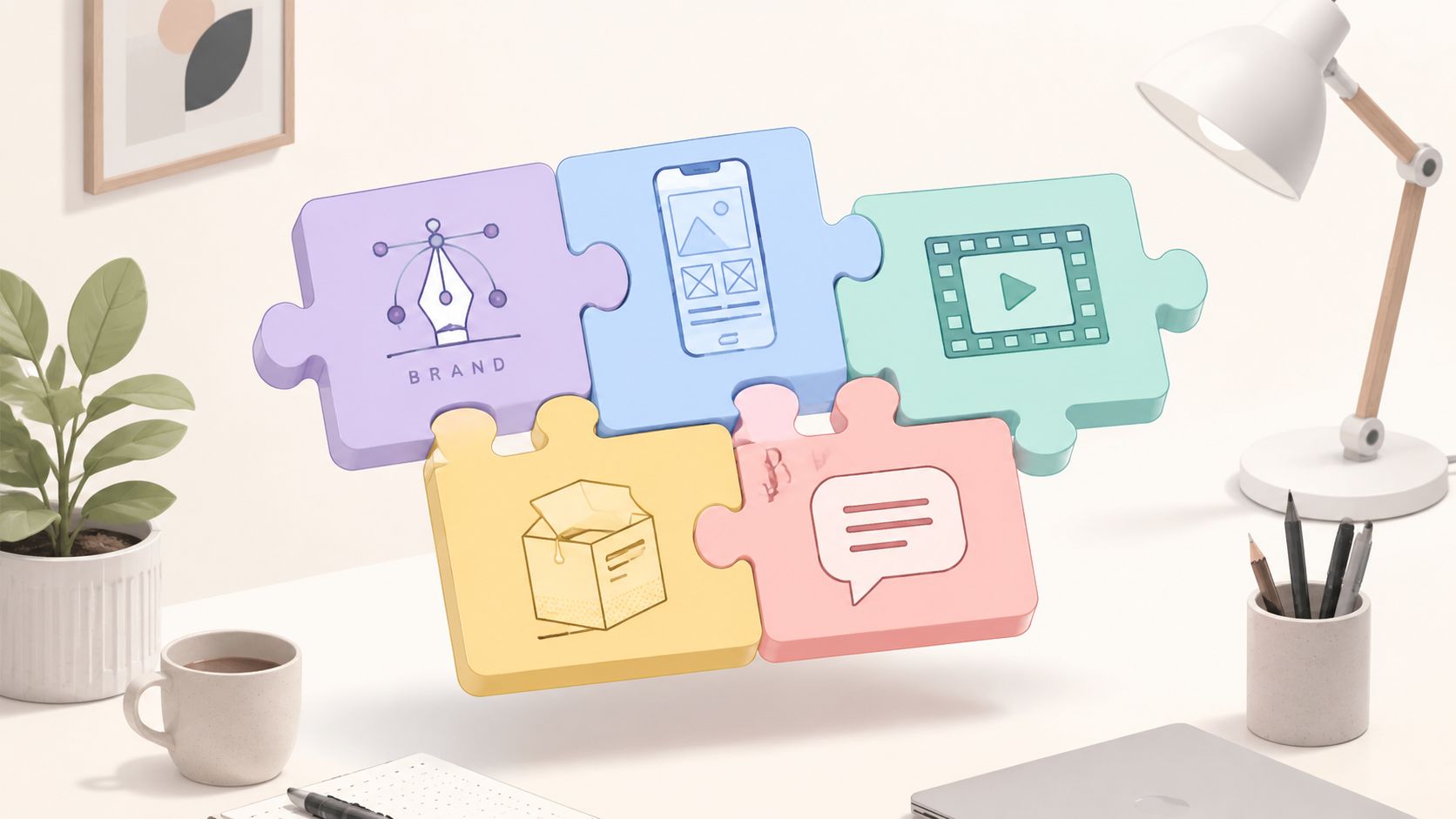
The Spectrum of Creative Design Services
“Design” is a broad label. Most businesses don't need everything at once. They need the right mix of services for the problem they're solving.

Branding and identity
This is the foundation. Branding and identity work solves inconsistency and gives your company a recognizable visual language. If every proposal, social graphic, sales one-pager, and landing page feels like it came from a different business, this is usually the missing layer.
Typical deliverables include:
- Logo systems: Primary logo, alternate marks, icon versions
- Brand guidelines: Rules for color, typography, imagery, and usage
- Visual language: Shapes, patterns, art direction, and layout principles
If you're trying to make your brand feel more coherent across channels, a strong visual brand identity framework helps teams stop reinventing the brand every week.
UI and UX design
These services solve user friction. UX focuses on how something works. UI focuses on how the interface looks and communicates. In practice, they work together.
A common example is a lead generation page. If the page buries the call to action, uses vague labels, or asks for too much too soon, users drop off. Better UX simplifies the path. Better UI makes the path obvious.
Deliverables often include:
- Wireframes: Low-fidelity page structure and content hierarchy
- Interface designs: Buttons, forms, menus, cards, and states
- Prototype flows: Clickable journeys for testing before development
Motion graphics and video
Motion solves attention and explanation. Some ideas are hard to communicate with still images alone. Product demos, service explainers, social teasers, event openers, and animated diagrams all benefit from movement when used with restraint.
This category usually includes:
- Explainer videos: Short visual narratives for products or services
- Animated social assets: Cutdowns, reels, motion posts
- Title cards and transitions: Branded motion systems for recurring content
Motion can make a brand feel sharper, but only if it supports the message instead of overwhelming it.
Packaging and print design
Packaging solves shelf perception and print solves physical brand presence. For consumer products, packaging is often the first real-world interaction someone has with the brand. For B2B companies, print still matters in brochures, event materials, leave-behinds, and sales kits.
Common deliverables:
- Packaging concepts: Labels, cartons, sleeves, and structural mockups
- Print collateral: Brochures, flyers, menus, signage
- Production-ready files: Files prepared to printer specifications
Content and ad creative
This category solves campaign fatigue and message clarity in-market. Your paid social ads, email graphics, carousels, display banners, and landing page visuals all need to work as a system. Otherwise your campaign feels fragmented.
Teams usually need:
- Ad variations: Static, carousel, and story assets for testing messages
- Content templates: Repeatable designs for social and internal use
- Campaign visual systems: A consistent creative look for launches or promotions
The important point is simple. Don't buy categories. Buy solutions to business problems.
The Creative Process From Brief to Launch
A lot of clients think design work begins when someone opens Figma, Adobe Illustrator, or Premiere Pro. It doesn't. Work starts earlier, with clarity.

Stage one and two
The first stage is discovery and strategy, in which the team defines the audience, business goal, competitive context, constraints, and success criteria. A weak brief creates weak work. If you need help tightening yours, this resource on how to write a creative brief is a useful starting point.
The second stage is concepting and ideation. Designers explore directions, test visual routes, and translate strategy into possible creative systems. This isn't random brainstorming. It's structured exploration with a reason behind each direction.
A simple planning habit helps here. If your campaign includes design, copy, and publishing, this guide to creating content is a practical companion because it shows how creative assets fit into a broader production workflow.
Stage three and four
The third stage is design and development. Concepts become real assets. Brand systems get applied. User flows get refined. Screens, layouts, motion sequences, or deck slides move from rough thinking to polished execution.
The fourth stage is feedback and iteration. This phase often determines whether projects improve quickly or stall. Vague feedback slows everything down. Clear feedback speeds it up.
Instead of saying “I'm not sure this feels right,” say:
- Reference the goal: “The headline doesn't explain the value fast enough.”
- Point to the audience: “This looks premium, but our buyer needs something more approachable.”
- Note the decision point: “The call to action is getting lost below the fold.”
Practical rule: Give feedback on whether the work solves the brief, not whether it matches a personal preference.
Here's a useful overview of the process in action:
Stage five
The last stage is final delivery and handoff, followed by launch support if needed. Files are organized, usage rules are documented, and the team gets what it needs to publish, print, build, or deploy the work properly.
That handoff matters more than people think. A strong design can lose value fast if nobody knows which logo version to use, how to crop imagery, or what format fits which channel.
Pricing Models and Budgeting for Design
Design pricing can feel confusing because two vendors may appear to offer the same thing while pricing it in completely different ways. Usually that's because they're not selling the same thing. One may be selling execution only. Another may include strategy, stakeholder workshops, revisions, and production support.
Hourly pricing
Hourly pricing works best when the scope is fluid. If you need design support for small tasks, evolving requests, or ongoing fixes, paying by time can make sense.
The tradeoff is uncertainty. If the brief changes often or internal approvals move slowly, the final cost can drift. You also need trust in how time is estimated and tracked.
Project-based pricing
A fixed project fee suits work with a clear beginning and end, such as a rebrand, landing page design, investor deck, or packaging refresh. It gives clients budget visibility and forces both sides to define scope early.
The downside is rigidity. If you approve one scope and later ask for extra page templates, new concepts, or additional campaign variations, those changes usually require a new fee or change order.
Retainer pricing
A monthly retainer fits companies with steady creative demand. Marketing teams often choose this model when they need recurring ad creative, social assets, presentation design, and campaign support without re-scoping every request.
It can be efficient, but only if the volume is consistent and priorities are managed. Otherwise you either underuse the retainer or overload it.
| Pricing model | Best fit | Main caution |
|---|---|---|
| Hourly | Flexible, undefined work | Final cost can be hard to predict |
| Project fee | Clear scope and timeline | Scope changes can get expensive |
| Retainer | Ongoing creative demand | Requires steady planning and prioritization |
Think in terms of value, not cheapness
A low-cost logo isn't always cheap if it creates confusion, limits future use, or forces a rebrand later. The same logic applies to websites, packaging, and campaign assets. Price matters, but so does durability.
There's also a business case for taking design seriously. A 2025 report by the Design Management Institute found that design-led companies outperformed the S&P 500 by 211% (Design Management Institute). That doesn't mean every design project guarantees a financial jump. It does mean design deserves to be treated as a strategic investment, not a cosmetic line item.
If you're comparing agency structures, a breakdown of digital marketing agency pricing models can help you frame what's included and where hidden complexity tends to show up.
How to Evaluate and Choose a Design Partner
A polished portfolio can get a meeting. It can't tell you whether a partner thinks clearly, communicates well, or can survive a messy internal approval process.
The right design partner should be able to connect creative decisions to business outcomes. If they talk only about trends, style, and aesthetics, you're probably hiring a vendor. If they ask about audience behavior, conversion points, internal workflows, and rollout constraints, you may be talking to a real partner.
Questions worth asking
Don't ask only whether they can make something look modern. Ask questions that reveal how they work.
Try these:
- How do you define success for a project like this?
- What would you need from our team to keep this moving?
- How do you handle feedback when stakeholders disagree?
- What happens after final delivery?
- Can you explain the reasoning behind a past project's creative direction?
Their answers should sound specific, organized, and grounded in process.
A strong design partner doesn't just present options. They explain why one option serves the audience and business better than another.
Match the provider to the problem
Not every engagement needs the same type of partner.
| Provider type | Usually best for | Watch for |
|---|---|---|
| Freelancer | Narrow, well-defined tasks | Capacity limits and dependency on one person |
| Boutique studio | Brand-focused or specialist work | Narrow service range if your needs expand |
| Full-service agency | Multi-channel campaigns and ongoing support | More process than a small one-off job may need |
If you're a founder sorting through options, this founder's guide to design outsourcing gives a helpful overview of where different outsourcing models fit.
Red flags to take seriously
Some warning signs show up early:
- No discovery questions: They jump straight to visuals without understanding the problem.
- No process: They can't describe milestones, approvals, or revision structure.
- Weak communication: Replies are slow, vague, or defensive.
- Portfolio without context: They show attractive work but can't explain the brief or business challenge.
- Everything looks the same: Their portfolio style overpowers the client's distinct brand needs.
You're not choosing a pair of hands. You're choosing a thinking partner who will shape how the market sees your business.
Measuring the Impact of Great Design
Design gets dismissed when teams treat it as subjective. It becomes easier to defend when you tie it to decisions, behavior, and outcomes.
That doesn't mean every result can be reduced to a single number. It means you should decide in advance what success looks like for the asset or system you're creating.

What to measure by asset type
A redesigned landing page should be judged differently from a brand identity refresh or a motion graphics package. The KPI has to match the job.
For example:
- Website or landing page design: Form completions, click paths, scroll depth, bounce patterns, and sales conversations started
- Brand identity work: Consistency across channels, easier internal asset creation, stronger sales presentations, and clearer customer recognition
- Ad creative: Click-through quality, message resonance, cost efficiency patterns, and creative fatigue over time
- Video and motion assets: View completion, clearer product understanding, and stronger reuse across channels
A practical way to think about this is to ask, “What changed because this design changed?”
Combine hard signals with human feedback
Teams often overcorrect in one of two directions. They either rely only on analytics or only on opinions. You need both.
Quantitative signals tell you what people did. Qualitative signals help explain why. Sales call notes, customer support questions, user testing comments, and internal team observations all add context.
If video is part of your creative mix, this practical guide to video outsourcing is useful because it highlights the operational side of producing video assets that teams can effectively ship and evaluate.
When stakeholders ask whether the design “worked,” the best answer is tied to a specific behavior change, not a general impression.
Build measurement into the brief
This is the habit that separates mature teams from reactive ones. Don't wait until launch to decide how you'll evaluate the work.
Before the project starts, define:
- The business goal: More qualified leads, clearer positioning, better onboarding, stronger retention support
- The user action: Click, sign up, book a call, watch, understand, return
- The evidence: Analytics, feedback, stakeholder observations, sales team notes
- The review window: When you'll assess early signals and what counts as meaningful progress
Once you build that discipline, creative design services stop feeling intangible. They become part of a business system you can assess, improve, and defend.
Frequently Asked Questions About Creative Design Services
Some of the most useful questions come up after the main conversation, usually when a team is about to hire, approve a budget, or kick off a project. These are the ones I hear most often.
FAQ on Creative Design
| Question | Answer |
|---|---|
| How do I know whether I need branding work or just better marketing assets? | Look for the root issue. If your team keeps producing materials that feel inconsistent, if nobody agrees on how the brand should look, or if every campaign starts from scratch, you likely need branding work first. If your brand is already defined but your ads, landing pages, or decks aren't performing or keeping pace, you may need execution-focused creative support instead. |
| Should I hire one designer or a team? | It depends on the range of work. One designer can be a strong fit for steady, focused needs such as social graphics, sales collateral, or template production. A team makes more sense when the work spans strategy, brand systems, web, motion, copy, and rollout across channels. The broader the challenge, the more valuable cross-functional thinking becomes. |
| How much input should I give during a project? | More than you think, but in the right way. You should provide business context, audience insight, internal constraints, and clear feedback at review points. You shouldn't art direct every move unless that's your role and expertise. The healthiest setup is collaborative. You define the problem and react to solutions. The design partner translates that into execution. |
A few practical clarifications
One question sits behind many of the others: how polished does a business need to be before investing in design? The answer is that you don't need to be a large company to benefit from structure. Small businesses often gain the most when they stop looking improvised and start presenting themselves with consistency.
Another common concern is whether design should wait until the product, offer, or messaging is “perfect.” Usually, no. Some uncertainty is normal. The better move is to get enough clarity to make informed creative decisions, then improve as the business learns.
“The best projects happen when the client is decisive about the goal and open-minded about the solution.”
The last concern is timing. Teams often bring in design too late, after strategy is set, channels are chosen, and launch dates are locked. That turns design into surface treatment. Bring design in earlier and it can shape the experience, not just decorate it.
If you're sorting through brand, website, content, or campaign design decisions and need a partner who can connect creative work to business goals, ReachLabs.ai offers creative services alongside broader marketing support. That can be useful when your design needs don't live in isolation, but need to align with content, growth, and brand strategy.