
Crafting a successful marketing strategy can often feel like navigating without a map. While theoretical knowledge is abundant, the real challenge lies in translating abstract concepts into concrete, high-impact actions. The secret isn’t just about having a plan; it’s about having the right plan, one that is tested, adaptable, and aligned with clear business objectives. This is where learning from real-world strategic marketing plan examples becomes invaluable.
This guide moves beyond generic advice to dissect eight powerful marketing blueprints from leading brands. We will unpack the specific frameworks that turned ambitious goals into measurable growth. You won’t find surface-level success stories here. Instead, we provide a deep dive into the core objectives, specific tactics, and performance metrics that underpinned each campaign’s triumph.
Our goal is to provide a practical toolkit of replicable strategies. Whether you’re a startup founder aiming for market disruption or a seasoned marketer refining a global brand’s approach, these examples offer actionable insights. We will explore a diverse range of approaches, including:
- Value-Based Positioning
- Content Marketing Ecosystems
- Customer Journey Mapping
- Growth Hacking
- Omnichannel Integration
- Community-Driven Marketing
- Account-Based Marketing (ABM)
- Agile Marketing Methodologies
By analyzing these blueprints, you will gain a clearer understanding of how to build a more resilient and effective strategy for your own business. Let’s explore the frameworks that drive real results.
1. Value-Based Positioning: Apple’s Premium Ecosystem
A Value-Based Positioning strategy shifts the conversation from “how much it costs” to “what value it delivers.” Instead of competing on price, this approach focuses on communicating a unique value proposition to a specific customer segment that is less price-sensitive and more value-conscious.
Apple has mastered this by positioning itself not as a computer company, but as a purveyor of premium, user-friendly technology that seamlessly integrates into a user’s lifestyle. Their strategic marketing plan isn’t about selling a phone; it’s about selling an experience, status, and innovation. This powerful narrative justifies premium pricing and fosters intense customer loyalty, making it a cornerstone example of a successful strategic marketing plan.
Strategic Analysis
Apple’s strategy is built on a foundation of perceived value, not just product features. They meticulously control every touchpoint, from the minimalist product design and intuitive user interface to the “Apple Store” retail experience and polished keynote presentations. This creates a cohesive brand identity that screams quality, simplicity, and sophistication.
Their marketing materials rarely focus on technical specifications like RAM or processor speeds. Instead, they showcase the outcomes: professional-quality photos, seamless multi-device workflows, and robust privacy protections. This transforms a product into a solution for a better life.
Key Insight: Apple sells the benefit, not the feature. They communicate what you can do with the technology, effectively decoupling the product’s price from its raw components and linking it to its aspirational value.
Replicable Tactics & Actionable Takeaways
Implementing a value-based strategy requires a deep understanding of your target audience’s core desires.
- Identify Your Niche’s “Pains and Gains”: Don’t just list what your product does. Map out how it solves a customer’s deepest frustrations (pains) or helps them achieve their aspirations (gains). Apple targets creatives who value performance and individuals who desire simplicity and security.
- Craft a Value-Centric Narrative: Build all marketing communications around the value proposition. Use storytelling to show your product in action, creating an emotional connection that transcends price.
- Invest in Premium Branding: Your visual identity, packaging, and customer service must align with the premium value you claim to offer. Every interaction reinforces the perception of quality.
- Focus on the Ecosystem: If you offer multiple products or services, emphasize how they work together to create a more valuable, integrated experience. This increases customer lifetime value and builds a competitive moat.
2. Content Marketing Ecosystem Strategy: HubSpot’s Inbound Engine
A Content Marketing Ecosystem strategy moves beyond single blog posts or social media updates. It involves creating a web of valuable, interconnected content that attracts, engages, and guides customers through their entire buying journey. This approach establishes brand authority and turns a company into a trusted resource, pulling customers in rather than pushing advertisements out.
HubSpot is the quintessential example of this strategy in action. They didn’t just sell marketing software; they pioneered the concept of “inbound marketing” and built a massive ecosystem of free content around it. Their blogs, ebooks, webinars, and free tools educate their audience on how to succeed, making their software the logical next step. This strategic marketing plan example demonstrates how to build a brand by giving value first.
Strategic Analysis
HubSpot’s strategy is built on solving their audience’s problems at every stage. A potential customer might first discover HubSpot through a blog post about “how to generate leads.” From there, they might be offered a free ebook on the topic in exchange for their email, entering them into a lead-nurturing sequence that offers more advanced content like webinars or case studies.
The entire system is designed to provide increasing value, establishing HubSpot as an indispensable expert. By the time a sales representative makes contact, the lead is already educated, qualified, and convinced of HubSpot’s expertise. This dramatically shortens the sales cycle and builds a foundation of trust before a transaction ever occurs.
Key Insight: HubSpot doesn’t sell software; it sells marketing and sales success. Its content ecosystem is the primary product that attracts users, while its software is the tool that helps them implement what they’ve learned.
Replicable Tactics & Actionable Takeaways
Building a content ecosystem requires a long-term commitment to educating your audience, not just promoting your products.
- Map Your Customer’s Journey: Identify the questions and challenges your audience has at the awareness, consideration, and decision stages. Create specific content that addresses each of these points, guiding them from one piece to the next.
- Create Pillar and Cluster Content: Develop comprehensive “pillar” pages on broad topics central to your business (e.g., “social media marketing”). Then, create smaller “cluster” content (blog posts, videos) on related subtopics that all link back to the main pillar. This is a powerful SEO strategy.
- Repurpose Content Aggressively: Turn one major piece of content into many smaller assets. A webinar can become a blog post, a series of social media clips, an infographic, and a quote-based graphic. This maximizes your reach without reinventing the wheel.
- Use Gated Content for Lead Generation: Offer your most valuable, in-depth resources (like ebooks or templates) in exchange for contact information. This is the crucial step that converts an anonymous visitor into a known lead you can nurture.
3. Customer Journey Mapping Strategy
A Customer Journey Mapping strategy involves visualizing every interaction a customer has with your brand, from the first spark of awareness to long-term advocacy. Instead of focusing on individual transactions, this approach optimizes the entire customer experience, identifying pain points and opportunities at each touchpoint to build stronger, more profitable relationships.
Starbucks exemplifies this strategy by seamlessly integrating its mobile app and loyalty program into the customer’s daily routine. The journey isn’t just about buying coffee; it’s a fluid experience from pre-ordering on the app to earning rewards and receiving personalized offers. This meticulous focus on the entire journey makes the process frictionless and highly engaging, transforming a simple purchase into a valued ritual.
Strategic Analysis
The core of this strategy is empathy. By stepping into the customer’s shoes, brands can understand their needs, emotions, and frustrations at each stage. Starbucks doesn’t just see a “customer,” but a commuter in a rush, a student looking for a quiet study spot, or friends meeting for a chat. Each persona has a different journey with unique needs.
Their marketing plan addresses this by using the app to solve specific problems like long wait times (Mobile Order & Pay) and payment friction (in-app payments). The loyalty program then rewards desired behaviors, creating a positive feedback loop that encourages repeat business. This comprehensive understanding is a key reason why it’s a powerful strategic marketing plan example.
Key Insight: The strategy’s goal is to create a cohesive and positive experience across all channels. It treats the customer relationship as a long-term narrative rather than a series of disconnected transactions.
The infographic below illustrates the fundamental stages of the customer journey that a mapping strategy aims to optimize.
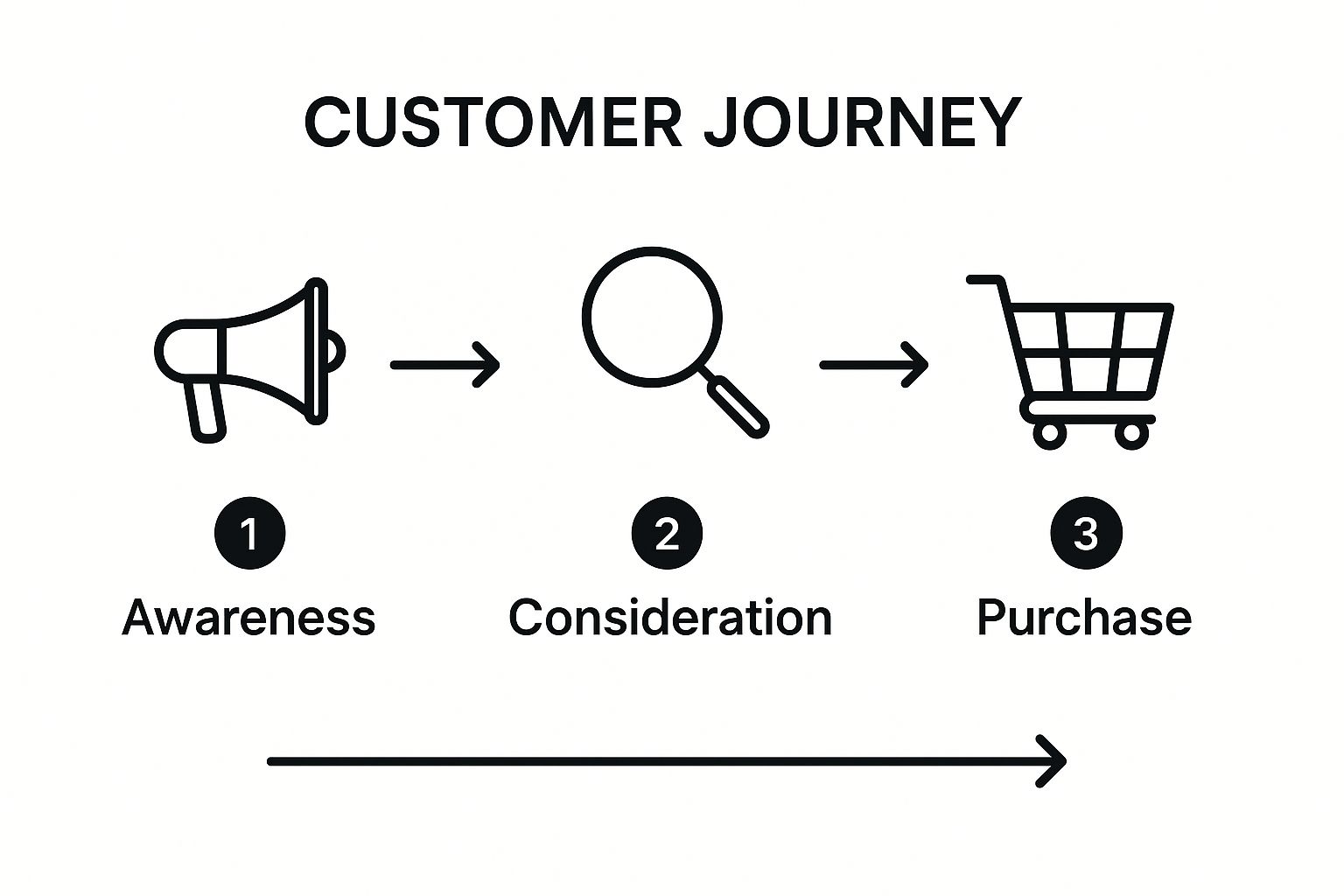
This visualization highlights how a customer moves from initial discovery to making a final purchase, with each stage requiring a distinct marketing focus.
Replicable Tactics & Actionable Takeaways
Implementing a customer-centric journey map requires a shift from an internal, company-first perspective to an external, customer-first view.
- Define Customer Personas: Start by developing detailed profiles of your key customer segments. Understand their goals, motivations, and the channels they use to interact with your brand.
- Map All Touchpoints: Identify every single point of interaction, from seeing a social media ad and visiting your website to contacting customer support and unboxing a product.
- Identify Friction and Opportunities: At each touchpoint, ask what’s working and what’s causing frustration. Where can you add value, simplify a process, or create a moment of delight?
- Use Cross-Functional Teams: Involve representatives from marketing, sales, product development, and customer service. A comprehensive map requires a holistic view of the business, and you can explore customer journey mapping templates to guide your team’s efforts.
4. Growth Hacking Strategy: Dropbox’s Viral Referral Loop
Growth Hacking is a strategic marketing methodology laser-focused on one thing: rapid, scalable growth. It moves away from traditional marketing channels and instead uses a data-driven, experimental approach across the entire product and marketing funnel to identify the most efficient ways to acquire and retain users. It’s less about budget and more about ingenuity.

Dropbox is a classic case study. Instead of pouring money into expensive ads, they built a growth mechanism directly into their product: a two-way referral program. This wasn’t just a marketing campaign; it was a core feature that turned their users into an army of passionate advocates, forming a powerful example of a strategic marketing plan built for exponential growth. This approach allowed them to acquire millions of users with a minimal marketing spend.
Strategic Analysis
Dropbox’s masterstroke was understanding that their best marketers were their existing, happy customers. The referral program was brilliantly simple: invite a friend, and both you and your friend get extra free storage space. This strategy targeted the core user desire for more storage while simultaneously leveraging the most trusted marketing channel: word-of-mouth.
This created a self-perpetuating viral loop. Every new user was incentivized to become an acquisition channel, driving down the customer acquisition cost (CAC) to near zero. This growth engine was deeply integrated into the onboarding process, making it a natural and rewarding next step for every user. The entire system was trackable, measurable, and optimized for maximum sharing.
Key Insight: Dropbox didn’t just market their product; they made the product itself the engine of marketing. By building a valuable incentive directly into the user experience, they transformed product usage into a viral growth mechanism.
Replicable Tactics & Actionable Takeaways
A growth hacking mindset requires creativity, analytics, and a focus on the user experience. You can explore more about what growth hacking is and find additional resources online.
- Embed Virality into Your Product: Brainstorm features that incentivize sharing. Can you offer a discount, exclusive content, or an upgraded feature for successful referrals? Make it a win-win for both the referrer and the new user.
- Identify Your “Aha!” Moment: Pinpoint the moment a new user truly understands the value of your product. Structure your onboarding to get them to that point as quickly as possible, as this increases their likelihood of becoming an advocate.
- Focus on One Key Metric: Don’t get lost in vanity metrics. Identify your “One Metric That Matters” (OMTM), such as the number of referrals sent or daily active users, and focus all your experiments on improving it.
- Run Small, Fast Experiments: Continuously test different headlines, incentives, and user flows. A growth hacking strategy is about learning quickly from a high volume of small bets, not placing one large one.
5. Omnichannel Marketing Strategy: Disney’s Seamless Magic
An Omnichannel Marketing Strategy is an integrated approach that creates a unified and cohesive customer experience across all channels and touchpoints. Unlike a multi-channel approach where channels operate in silos, an omnichannel strategy ensures that a customer’s journey is seamless, whether they are on a website, using a mobile app, or physically in a store.
Disney is a master of this, creating an immersive world where the digital and physical realms are perfectly intertwined. Their strategic marketing plan is designed to eliminate friction and enhance the customer experience at every step. From planning a trip on their website to using the MagicBand wristband in the park, every interaction is part of one continuous, magical narrative. This synchronicity is a powerful example of a strategic marketing plan that prioritizes the customer journey above all else.
Strategic Analysis
Disney’s omnichannel strategy is powered by a deep integration of technology and customer data. The My Disney Experience platform acts as the central hub, allowing guests to plan their entire vacation, from booking hotel rooms and making dinner reservations to scheduling FastPass+ ride times. This data is then linked to their MagicBand.
The MagicBand becomes the key to a frictionless park experience. It serves as a room key, park ticket, payment method, and photo pass. This turns every interaction into a data point, allowing Disney to personalize offers and understand guest behavior on a granular level. The experience feels effortless and magical for the guest, while providing invaluable insights for Disney.
Key Insight: Disney’s strategy succeeds by making technology invisible. They don’t sell the tech; they sell the seamless experience it enables, ensuring that every touchpoint reinforces the brand’s core promise of magic and wonder.
Replicable Tactics & Actionable Takeaways
Implementing a true omnichannel strategy requires a customer-centric mindset and strong technological integration.
- Map the Complete Customer Journey: Identify every possible touchpoint a customer has with your brand, both online and offline. Look for points of friction or disconnection between channels and prioritize fixing them.
- Unify Customer Data: Invest in a central system, like a CRM or a Customer Data Platform (CDP), to create a single view of each customer. This allows for consistent personalization and service across all interactions.
- Empower Front-line Staff: Ensure your in-person staff have access to the same customer information as your digital systems. A retail employee who can see a customer’s online wish list can provide a much more personalized and effective service.
- Create a Central Content Hub: Develop a content strategy that allows assets to be easily adapted and deployed across different channels. This ensures your brand messaging remains consistent, whether it’s on social media, in an email, or on in-store signage.
6. Community-Driven Marketing Strategy: Harley-Davidson’s Rider Nation
A Community-Driven Marketing strategy focuses on building a dedicated and engaged group of customers around a shared passion or lifestyle connected to the brand. This approach transforms customers from passive buyers into active brand evangelists, leveraging their enthusiasm and user-generated content to fuel organic growth and create an unshakeable sense of belonging.
Harley-Davidson has perfected this model with its Harley Owners Group (H.O.G.). This isn’t just a loyalty program; it’s a global community built on the shared values of freedom, adventure, and rebellion. The H.O.G. platform gives riders a way to connect, share experiences, and live the brand, making it one of the most powerful and enduring examples of a community-focused strategic marketing plan.
Strategic Analysis
Harley-Davidson’s strategy is rooted in the understanding that their product is more than a motorcycle; it’s a ticket to an identity and a community. They strategically facilitate this by sponsoring rallies, organizing local chapter events, and publishing branded content that celebrates the rider lifestyle, not just the machinery. This creates a powerful feedback loop where the community reinforces the brand’s core identity.
Their marketing doesn’t just sell bikes; it sells the experience of joining a brotherhood. The focus is on shared stories, group rides, and the collective identity of being a “Harley owner.” This turns the brand into a platform for connection, making the community itself the most valuable product.
Key Insight: Harley-Davidson doesn’t market to its customers; it markets through and with them. By empowering the community to become the face of the brand, they create authentic, powerful marketing that no traditional campaign could ever replicate.
Replicable Tactics & Actionable Takeaways
Building a vibrant community requires a commitment to nurturing connections, not just broadcasting messages.
- Define Your Community’s Core Purpose: What shared passion, goal, or identity unites your customers? For Harley, it’s the spirit of the open road. For a software company, it might be a passion for productivity. Define this purpose and build everything around it.
- Facilitate Member-to-Member Interaction: The strongest communities connect members with each other, not just with the brand. Create dedicated spaces like forums, private groups (like H.O.G. chapters), or exclusive events where these connections can flourish.
- Empower Brand Ambassadors: Identify your most passionate members and give them a platform. Feature their stories, recognize their contributions, and give them leadership roles within the community. This validates their loyalty and inspires others.
- Provide Exclusive Value: Give community members a reason to belong. This could be early access to products, exclusive content, special event invitations, or merchandise. The goal is to make membership feel like a privilege.
7. Account-Based Marketing (ABM) Strategy
Account-Based Marketing (ABM) is a highly focused B2B strategy that inverts the traditional marketing funnel. Instead of casting a wide net to capture as many leads as possible, ABM concentrates marketing and sales resources on a select group of high-value target accounts, treating each one as a market of its own.
Companies like Salesforce and Adobe use ABM to pursue large enterprise clients by dedicating teams to understand the specific challenges and needs of each target account. This “fishing with a spear” approach ensures marketing efforts are personalized and highly relevant, increasing the likelihood of engaging key decision-makers and closing significant deals, making it a powerful strategic marketing plan example for B2B growth.
Strategic Analysis
The core of an ABM strategy is the tight alignment between sales and marketing teams. Both departments collaborate from the outset to identify and define the Ideal Customer Profile (ICP) and then select a list of “named accounts” that fit this profile. All marketing activities are then orchestrated to engage stakeholders within these specific companies.
Instead of generic content, marketing creates account-specific assets, personalized email campaigns, and targeted digital ads directed at key individuals. For instance, a campaign for a large financial institution would feature content addressing regulatory compliance challenges, while a campaign for a manufacturing firm might focus on supply chain optimization. The goal is to surround the account with valuable, hyper-relevant messaging across all channels.
Key Insight: ABM shifts the focus from lead volume to account quality. Success isn’t measured by the number of leads generated, but by the depth of engagement and revenue generated from a small, well-defined set of target accounts.
Replicable Tactics & Actionable Takeaways
Implementing an ABM strategy requires a disciplined, collaborative approach that treats marketing as a precision tool.
- Define Your Ideal Customer Profile (ICP): Work closely with your sales team to build a detailed profile of your perfect customer based on firmographics (industry, company size, revenue) and qualitative factors (business challenges, strategic goals).
- Identify and Tier Target Accounts: Use your ICP to build a list of target accounts. Tier them based on revenue potential and strategic importance to focus your most intensive efforts on the highest-value targets.
- Invest in Account Intelligence: Use tools like LinkedIn Sales Navigator, ZoomInfo, or Bombora to gather deep insights into your target accounts, including their organizational structure, key decision-makers, and current business priorities.
- Execute Personalized Multi-Channel Campaigns: Create content and messaging tailored to each account’s specific pain points. Reach out via personalized emails, targeted social media ads, direct mail, and even account-specific webinars to engage stakeholders.
8. Agile Marketing Strategy: Spotify’s Data-Driven Sprints
An Agile Marketing Strategy applies the principles of agile software development to marketing campaigns, prioritizing speed, adaptability, and data-driven iteration over rigid, long-term plans. Instead of building a massive, “perfect” campaign over months, agile teams work in short “sprints” to launch, test, learn, and optimize in real-time.
Spotify exemplifies this approach, using its vast user data to run countless small-scale experiments simultaneously. From playlist curation algorithms to personalized ad campaigns like the annual “Wrapped” experience, its marketing is in a constant state of evolution. This iterative process allows Spotify to respond swiftly to user behavior and cultural trends, making it a prime example of a modern strategic marketing plan that thrives on change.
Strategic Analysis
Spotify’s strategy is rooted in a continuous feedback loop between the user and the platform. Marketing initiatives are treated as hypotheses to be tested, not as final products. For instance, they might test multiple ad creatives on a small user segment, analyze engagement metrics like click-through rates and listening time, and then scale the winning version to a broader audience.
This data-first approach extends beyond advertising to content and product features. The success of user-generated playlists directly informed the development of major features like “Discover Weekly.” Marketing and product teams work in cross-functional “squads,” breaking down silos and enabling rapid response to performance data.
Key Insight: Spotify treats marketing as a science. By running hundreds of small, controlled experiments, they minimize the risk of large-scale campaign failures and ensure that their marketing spend is continuously optimized for maximum impact.
Replicable Tactics & Actionable Takeaways
Adopting an agile approach requires a cultural shift towards experimentation and accepting that not every test will be a success.
- Establish Cross-Functional “Squads”: Break down traditional marketing departments. Create small, autonomous teams with a mix of skills (e.g., content, analytics, design, paid ads) that can execute a full campaign sprint from start to finish.
- Implement Marketing Sprints: Define short, time-boxed work cycles (typically 1-4 weeks). Each sprint should have a clear, measurable goal, such as “increase free trial sign-ups by 5%.”
- Prioritize a “Test and Learn” Backlog: Instead of a fixed annual plan, maintain a prioritized list of campaign ideas, experiments, and optimizations. The team pulls from this backlog for each sprint based on potential impact and strategic alignment.
- Conduct Regular Retrospectives: At the end of each sprint, the team should meet to discuss what worked, what didn’t, and how to improve the process for the next cycle. This institutionalizes learning and continuous improvement.
8-Strategy Comparison Matrix
| Strategy | Implementation Complexity 🔄 | Resource Requirements ⚡ | Expected Outcomes 📊 | Ideal Use Cases 💡 | Key Advantages ⭐ |
|---|---|---|---|---|---|
| Value-Based Positioning Strategy | High – requires deep market research | High – marketing investment initially | Strong market positioning, premium pricing | Brands seeking differentiation and premium segments | Sustainable competitive advantage, stronger customer loyalty |
| Content Marketing Ecosystem | Medium – multi-platform coordination | Medium – consistent content creation effort | Long-term organic traffic and brand authority | Educating and nurturing leads via content over time | Cost-effective lead generation, enhanced brand credibility |
| Customer Journey Mapping | High – complex data collection & mapping | High – cross-departmental coordination | Improved experience and retention | Companies optimizing customer experience and touchpoints | Higher conversions, better resource allocation |
| Growth Hacking | Medium-High – rapid experimentation | Medium – technical expertise required | Rapid scalable growth | Startups and fast-growth companies needing quick wins | Fast growth potential, strong ROI measurement |
| Omnichannel Marketing | High – complex tech & organizational integration | High – technology and alignment costs | Seamless cross-channel customer experience | Large enterprises with multi-channel presence | Higher CLV, improved satisfaction and loyalty |
| Community-Driven Marketing | Medium – ongoing community management | Medium – time-intensive engagement | Organic growth and strong loyalty | Brands building engagement and peer-driven advocacy | High trust, cost-effective content creation |
| Account-Based Marketing (ABM) | High – tailored campaigns per account | High – intensive data and resource use | Higher conversion and deal size | B2B targeting high-value individual accounts | Better sales-marketing alignment, shorter sales cycles |
| Agile Marketing | Medium – cultural change and team alignment | Medium – training and iterative planning | Faster time-to-market and adaptability | Teams needing fast iterative campaign development | Improved effectiveness, reduced risk, better collaboration |
Building Your Own Strategic Marketing Blueprint
As we’ve journeyed through these diverse strategic marketing plan examples, a clear pattern emerges. A winning strategy is never an accident; it is the result of intentional design, deep customer insight, and a relentless focus on a core objective. From LEGO’s community-driven empire to Dropbox’s viral growth hacking model, these case studies demonstrate that the most powerful marketing isn’t about having the biggest budget, but the smartest blueprint.
Each example serves as a testament to the power of a well-defined strategic framework. Whether you’re a startup aiming for rapid market penetration or an established brand seeking deeper customer loyalty, the principles remain the same. The common thread woven through a Value-Based Positioning strategy, an Agile Marketing workflow, or an Account-Based Marketing campaign is a commitment to a central, guiding idea. They prove that tactics without strategy are just noise, but tactics aligned with a clear plan become a powerful engine for growth.
Synthesizing the Core Lessons
The true value of analyzing these strategic marketing plan examples lies not in direct imitation, but in adaptation. Your business has a unique audience, a distinct voice, and specific goals. Therefore, your marketing plan must be a custom-fit garment, not a one-size-fits-all uniform.
Let’s distill the most critical takeaways:
- Clarity is King: Every successful plan began with a crystal-clear objective. Was it brand awareness, lead generation, customer retention, or market disruption? Without a defined finish line, your marketing efforts will lack direction and impact.
- Customer Centricity is Non-Negotiable: Strategies like Customer Journey Mapping and Community-Driven Marketing are built entirely around understanding and serving the user. The most effective plans don’t just sell to customers; they solve problems for them and build relationships with them.
- Integration Amplifies Impact: The Omnichannel Marketing strategy highlights a crucial modern truth: your brand must present a seamless, unified experience across every touchpoint. Siloed channels lead to a fragmented customer experience and diluted results.
- Measurement is Your Compass: From tracking viral coefficients in a Growth Hacking strategy to monitoring engagement in a Content Marketing ecosystem, data is what separates guessing from knowing. Your metrics tell you what’s working, what isn’t, and where to pivot.
Your Actionable Next Steps
Feeling inspired is the first step; taking action is what creates results. It’s time to move from analyzing these strategic marketing plan examples to architecting your own.
Use this simple, three-step framework to get started:
- Define Your “North Star” Objective: Before you think about a single tactic, ask the big question: What is the single most important business goal we need to achieve in the next 6-12 months? Be specific and make it measurable (e.g., “Increase qualified leads by 30%” or “Improve customer retention by 15%”).
- Select Your Strategic Framework: Based on your objective and your target audience, which of the strategic models we’ve explored resonates most? If you’re in a competitive B2B space, ABM might be your answer. If you need to build trust and authority, a Content Marketing Ecosystem is a powerful choice.
- Outline Key Tactics and Metrics: With your strategy chosen, list the specific actions you will take (e.g., launch a podcast, develop a webinar series, run targeted LinkedIn ads). For each tactic, assign a key performance indicator (KPI) that directly ties back to your North Star objective. This creates a clear line of sight between your daily activities and your ultimate goal.
A strategic marketing plan is more than a document; it’s a declaration of intent. It’s your commitment to being proactive instead of reactive, focused instead of scattered, and data-driven instead of hope-driven. The examples in this article prove that with the right blueprint, any organization can build a powerful, predictable, and profitable marketing machine. The tools and frameworks are here. It’s time to start building.
Ready to move from inspiration to implementation? Crafting a comprehensive strategic marketing plan requires deep expertise and data analysis. The team at ReachLabs.ai specializes in developing bespoke, data-driven marketing blueprints that align with your unique business goals, connecting you with the talent and insights needed to execute flawlessly. Explore how ReachLabs.ai can build your next winning strategy.