
In a crowded market, a great product or service is no longer enough. Small businesses need a powerful, strategic digital presence to stand out and connect with their ideal customers. Many owners and marketers feel overwhelmed by the sheer number of options, struggling to identify which channels deliver tangible results without draining their limited budgets. The challenge isn’t a lack of information; it’s a lack of a clear, actionable roadmap. Which tactics will actually move the needle for your specific business? How do you measure success and justify your marketing spend?
This guide cuts directly through that noise. We are breaking down 10 of the most effective digital marketing strategies for small businesses, providing a comprehensive playbook for sustainable growth. Forget generic advice and vague theories. Instead, we offer a deep dive into each strategy, packed with practical implementation steps, real-world examples, and the specific metrics you need to track your progress. This isn’t just a list; it’s a blueprint for building a resilient marketing engine.
You will learn how to optimize your website to attract organic traffic, engage customers through targeted social media campaigns, and build lasting relationships with powerful email marketing. From mastering local search to leveraging the impact of video and influencer collaborations, each section is designed to empower you with the confidence and knowledge to execute campaigns that attract new customers, foster loyalty, and drive real revenue. Let’s explore the strategies that will help you achieve digital dominance.
1. Search Engine Optimization (SEO)
Search Engine Optimization (SEO) is the foundational practice of enhancing your website to rank higher in search engine results like Google, Bing, and DuckDuckGo. For a small business, this is one of the most powerful digital marketing strategies available because it attracts high-intent customers actively searching for your exact products or services. Unlike paid advertising, which stops when you stop paying, SEO builds long-term, organic visibility that generates traffic around the clock.
Think of a local bakery ranking #1 when someone in their city searches for “fresh sourdough bread,” or a plumber appearing in the Google “map pack” for an emergency “leaky pipe repair” search. These top positions are not accidental; they are the result of a deliberate SEO strategy focused on providing value and meeting search engine criteria.
Getting Started with Small Business SEO
For businesses with a physical presence or service area, Local SEO is the perfect starting point. This involves optimizing your online presence to attract more customers from relevant local searches.
- Claim and Optimize Google Business Profile: This is your digital storefront. Fill out every section completely, including services, hours, photos, and encourage customer reviews.
- Target Long-Tail Keywords: Instead of competing for broad terms like “jewelry,” target more specific, lower-competition phrases like “handmade silver necklaces Austin.” These “long-tail” keywords are used by customers who are closer to making a purchase.
- Create Valuable Content: Regularly publish blog posts, guides, or FAQs that answer your customers’ questions. A boutique, for example, could write a guide on “how to style handmade jewelry for spring.”
- Prioritize Technical Health: Ensure your website is mobile-friendly and loads quickly. These are critical ranking factors that also improve user experience.
The following visual summary highlights the key investment and return expectations for a small business SEO campaign.
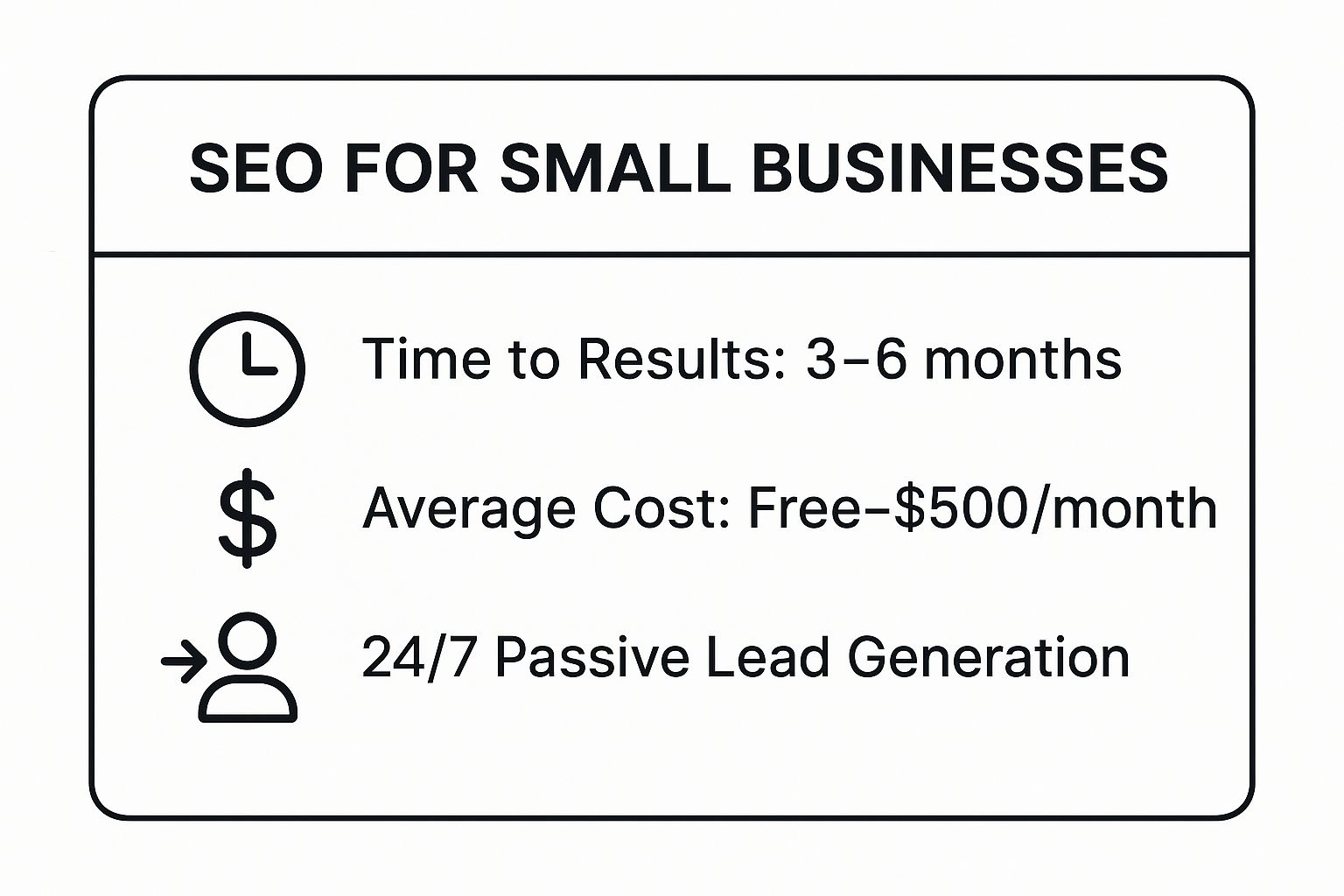
The data clearly shows that while SEO requires patience, it provides a cost-effective, passive lead generation engine once it gains momentum. This approach is a core component of many sustainable growth strategies. For those interested in rapid, experimental marketing techniques, it’s worth exploring the concepts behind growth hacking and how it can complement traditional SEO efforts.
2. Social Media Marketing
Social Media Marketing involves leveraging platforms like Instagram, Facebook, LinkedIn, and TikTok to connect with your audience, build brand loyalty, and drive sales. For a small business, it’s a direct line of communication to both current and potential customers, offering a unique opportunity to build a community and showcase brand personality in a way that traditional advertising cannot. This is one of the most dynamic digital marketing strategies for small businesses, enabling real-time engagement and authentic relationship-building.
Imagine a local coffee shop using Instagram Stories to announce a “latte of the day,” fostering daily engagement, or a B2B consultant sharing industry insights on LinkedIn to establish themselves as a thought leader. These actions transform a business from a faceless entity into a trusted, humanized brand. The goal is not just to sell, but to create a loyal following that advocates for your business.
Getting Started with Social Media Marketing
Effective social media is about focused effort, not being everywhere at once. The key is to choose the right platforms and engage authentically with your specific community.
- Focus on Relevant Platforms: Don’t stretch yourself thin. If you run a handmade crafts business, visual platforms like Pinterest and Instagram are ideal. A B2B service provider will find more value on LinkedIn. Pick two or three where your target audience is most active.
- Post with Purpose and Consistency: Use a content calendar to plan your posts. A mix of promotional content, behind-the-scenes glimpses, educational tips, and user-generated content works best. Consistency keeps your audience engaged and your brand top-of-mind.
- Engage with Your Community: Social media is a two-way street. Respond to comments and direct messages promptly. Ask questions, run polls, and encourage your followers to share their experiences with your brand.
- Leverage High-Quality Visuals: In a visually driven space, high-quality photos and videos are non-negotiable. You don’t need a professional studio; a modern smartphone and good lighting can produce stunning content that stops the scroll.
Social media allows you to build brand equity and customer relationships directly. For those looking to master the art of engaging content, it’s helpful to understand the principles of viral marketing and what makes content shareable, which can supercharge your efforts.
3. Email Marketing
Email marketing is a direct communication channel that involves sending targeted messages to a subscriber list to nurture leads, retain customers, and drive sales. For small businesses, it offers one of the highest returns on investment (ROI) among all digital marketing strategies because it allows for highly personalized communication at scale. It is a direct line to your most engaged audience, an asset you own and control completely, unlike social media followings which are subject to algorithmic changes.
Think of a local gym sending weekly fitness tips and class schedules, a consultant sharing an exclusive monthly industry insights newsletter, or an e-commerce store with an automated abandoned cart recovery sequence. These actions build relationships, provide value, and keep your business top-of-mind, turning one-time buyers into loyal advocates.

Getting Started with Small Business Email Marketing
Building and nurturing an email list is crucial for sustainable growth. The key is to treat every subscriber’s inbox with respect by delivering relevance and value, not just sales pitches.
- Offer Valuable Lead Magnets: To build your list ethically, provide a compelling reason for people to subscribe. This could be a discount, a free ebook, a checklist, or access to an exclusive webinar.
- Segment Your Audience: Avoid sending the same message to everyone. Group your subscribers based on their interests, purchase history, or engagement level to send more targeted and effective campaigns.
- Write Compelling Subject Lines: Your subject line is the gatekeeper to your message. Make it intriguing, urgent, or benefit-driven to significantly improve your open rates.
- Include Clear Calls-to-Action (CTAs): Every email should have a purpose. Guide your reader on what to do next, whether it’s “Shop Now,” “Read More,” or “Book a Consultation,” using a clear, prominent button or link.
Email marketing is a fundamental component of a well-rounded marketing plan, providing a direct and measurable way to communicate with your audience. For a deep dive into creating this valuable asset, explore our detailed guide on how to build email lists from scratch.
4. Content Marketing
Content Marketing is a strategic approach focused on creating and distributing valuable, relevant, and consistent content to attract and retain a clearly defined audience. For small businesses, this is one of the most effective digital marketing strategies for building trust and establishing authority. Instead of directly pitching your products, you provide genuinely useful information that solves your audience’s problems, positioning your brand as a helpful expert.
Think of an HVAC company creating seasonal maintenance tip videos or an accounting firm publishing blog posts with timely tax advice. This content builds a relationship with potential customers long before they need to make a purchase. When they are ready to buy, your business is the first one they think of because you have already provided immense value.
Getting Started with Content Marketing
An effective content strategy goes beyond just publishing random blog posts. It requires a documented plan focused on your audience’s needs and your business goals.
- Solve Customer Problems: Center your content around the questions and pain points of your ideal customer. Use tools like AnswerThePublic or browse forums like Reddit to discover what your audience is asking.
- Create an Editorial Calendar: Plan your content in advance to ensure consistency. A simple calendar can help you map out topics, formats, and publishing dates, keeping your marketing efforts organized and on track.
- Repurpose Content: Maximize your efforts by turning one piece of content into multiple formats. A detailed blog post can be repurposed into a series of social media posts, an infographic, a short video, or a podcast episode.
- Use Storytelling: Connect with your audience on an emotional level by weaving stories into your content. Share customer successes, behind-the-scenes looks at your business, or the journey that led to your brand’s creation.
- Include Clear Calls-to-Action (CTAs): Every piece of content should guide the user on what to do next. Whether it’s “download our free guide,” “schedule a consultation,” or “read another article,” a clear CTA is essential for converting readers into leads.
The following video provides a concise overview of how to build a content strategy that delivers results.
By consistently delivering value, content marketing transforms your business from a simple vendor into a trusted resource. This strategy is a cornerstone for building a loyal community and sustainable growth, as famously championed by experts like Joe Pulizzi at the Content Marketing Institute.
5. Pay-Per-Click (PPC) Advertising
Pay-Per-Click (PPC) advertising is a model of digital marketing where businesses pay a fee each time one of their ads is clicked. Unlike SEO, which builds visibility over time, PPC offers immediate exposure on platforms like Google Ads and Facebook Ads. This makes it one of the most effective digital marketing strategies for small businesses needing to generate traffic, leads, and sales quickly.
Imagine a local dentist instantly appearing at the top of Google search results for “emergency dental care,” or an e-commerce store showcasing its products directly to users searching for specific items. PPC places your business in front of potential customers at the exact moment they are looking for a solution, providing a level of control and speed that organic methods cannot match.
Getting Started with Small Business PPC
A successful PPC campaign is built on precision and continuous optimization. For a small business, the key is to manage your budget effectively while maximizing your return on ad spend (ROAS).
- Set Clear Goals and Target Audience: Begin by defining what you want to achieve, whether it’s website traffic, lead form submissions, or online sales. Use platform tools to target users based on demographics, interests, and search behavior.
- Use Negative Keywords: Prevent wasted spend by adding negative keywords to your campaigns. For example, a business selling premium coffee beans might add “free” and “jobs” as negative keywords to avoid irrelevant clicks.
- Write Compelling Ad Copy: Your ad is your first impression. Craft a clear headline, highlight a unique selling proposition, and include a strong call-to-action (CTA) like “Shop Now,” “Get a Free Quote,” or “Book Your Appointment.”
- Monitor and Optimize Relentlessly: PPC is not a “set it and forget it” strategy. Regularly review your campaign performance, adjust bids for high-performing keywords, pause underperforming ads, and test new landing pages to improve conversion rates.
6. Local SEO and Google My Business
Local Search Engine Optimization (SEO) is a specialized digital marketing strategy focused on making your business more visible in local search results on Google. For any small business with a physical location or a designated service area, this is non-negotiable. It connects you with customers in your immediate vicinity who are actively looking for the solutions you provide, often with high intent to purchase.
Think of a local coffee shop appearing in the “map pack” for a “coffee near me” search, or an auto repair shop with hundreds of positive reviews ranking first when a driver needs an urgent fix. These valuable positions are a direct result of a strong Local SEO strategy, with Google Business Profile (formerly Google My Business) at its core. This free tool is your digital storefront on Google Search and Maps.
Getting Started with Local SEO
Optimizing for local search is one of the highest-return activities for brick-and-mortar and service-area businesses. It ensures you are found at the precise moment a local customer needs you.
- Complete 100% of Your Google Business Profile: This is the most crucial step. Fill out every single field: services, products, hours, photos, accessibility information, and a detailed business description.
- Encourage and Respond to Reviews: Actively ask satisfied customers for reviews. Positive reviews are a powerful ranking signal and build trust. Always respond to all reviews, both positive and negative.
- Ensure NAP Consistency: Your Name, Address, and Phone number (NAP) must be identical across your website, Google Business Profile, and all other online directories (like Yelp or TripAdvisor).
- Post Regular Updates: Use the Google Posts feature to share updates, offers, events, and new products. This signals to Google that your business is active and engaged.
- Target Location-Specific Keywords: Create content on your website that includes your city, neighborhood, or service area. For example, a hair salon could write a blog post on “the best wedding hairstyles in downtown Phoenix.”
7. Influencer Marketing
Influencer marketing is the strategy of partnering with individuals who have a dedicated following and established credibility in a specific niche to promote your products or services. For small businesses, this approach offers a way to build trust and reach a targeted audience through a voice they already respect. Unlike traditional ads, influencer promotions feel more like authentic recommendations from a trusted friend, cutting through the noise of conventional advertising.
Imagine a local farm-to-table restaurant partnering with regional food bloggers to showcase a new seasonal menu, or a small, eco-friendly skincare brand collaborating with beauty micro-influencers who champion sustainable living. These partnerships place your brand directly in front of an engaged, relevant audience, leveraging the influencer’s hard-earned authority to drive awareness and sales.
Getting Started with Small Business Influencer Marketing
The key to a successful campaign, especially with a limited budget, is to focus on micro-influencers (typically 1,000 to 100,000 followers). These creators often have higher engagement rates and a more dedicated community, making them powerful advocates for your brand.
- Find the Right Partners: Focus on relevance and engagement, not just follower count. An influencer’s audience should mirror your ideal customer profile. Ensure their values and aesthetic align perfectly with your brand.
- Prioritize Engagement Rate: A high follower count is meaningless without an active audience. Look for influencers whose posts generate genuine comments and conversations, not just likes.
- Provide Creative Freedom: Trust the influencer to create content that resonates with their audience. Provide clear guidelines and key messages, but avoid being overly prescriptive. Authenticity is crucial for success.
- Track Your ROI: Use unique discount codes, affiliate links, or dedicated landing pages for each influencer. This allows you to measure the direct impact of their promotion on your sales and website traffic.
- Build Long-Term Relationships: Instead of one-off sponsored posts, aim to build lasting partnerships. Long-term collaborations feel more genuine to the audience and can turn influencers into true brand ambassadors. For deeper insights into building these relationships, consulting with experts like Shane Barker can provide a strategic advantage.
8. Video Marketing
Video marketing is the strategic use of video content to promote your brand, educate your audience, and drive engagement. In today’s fast-paced digital landscape, video has become a dominant force, allowing small businesses to connect with customers on a more personal and dynamic level than static text or images ever could. It’s an incredibly versatile tool, effective across platforms like YouTube, TikTok, Instagram Reels, and even on your own website.
Consider a local hair salon creating short styling tutorial videos on TikTok, or a home improvement store sharing a time-lapse of a DIY project on Instagram. These visual stories don’t just sell a product or service; they build a community, establish authority, and showcase the personality behind the brand. This human connection is what makes video one of the most compelling digital marketing strategies for small businesses looking to stand out.
Getting Started with Small Business Video Marketing
You don’t need a Hollywood budget to create effective video content. Modern smartphones and user-friendly editing apps have made video production accessible to everyone.
- Start Simple and Authentic: Use your smartphone to record behind-the-scenes footage, product demonstrations, or customer testimonials. Authenticity often resonates more than high-production gloss.
- Hook Viewers Immediately: The first 3-5 seconds are critical. Start with a compelling question, a surprising visual, or a clear statement of the value the viewer will get from watching.
- Optimize for Silent Viewing: Many users watch videos with the sound off. Add captions to ensure your message is accessible and understood in any environment.
- Repurpose Your Content: Turn a single long-form video, like a webinar or in-depth tutorial, into dozens of short clips for social media. This maximizes your effort and extends the life of your content.
- Focus on Searchability: On platforms like YouTube, use keyword-rich titles and descriptions to help your videos appear in search results, creating a long-term asset that attracts viewers over time.
9. Marketing Automation
Marketing automation involves using software to streamline, automate, and measure marketing tasks and workflows. For a small business struggling with limited time and resources, it is one of the most impactful digital marketing strategies for scaling operations. It enables personalized communication at scale, nurtures leads efficiently, and saves countless hours by handling repetitive tasks without manual intervention.
Imagine an e-commerce store automatically sending a reminder email to a customer who left items in their cart, or a service business that triggers a welcome email sequence for new subscribers. These automated actions ensure consistent communication, improve customer experience, and drive conversions while the business owner focuses on other critical tasks. This strategy bridges the gap between limited manpower and the need for consistent customer engagement.
Getting Started with Small Business Automation
The key is to start small and build complexity over time. Focus on automating high-impact, repetitive tasks first to see immediate returns on your investment.
- Implement an Abandoned Cart Sequence: This is a must-have for any e-commerce business. Automatically email shoppers who add items to their cart but don’t complete the purchase, often recovering otherwise lost sales.
- Create Lead Nurturing Workflows: When a potential customer downloads a guide or fills out a contact form, enroll them in an automated email series that provides more value and guides them toward a purchase.
- Segment Your Audience: Use automation software like Mailchimp or ActiveCampaign to tag subscribers based on their behavior (e.g., pages visited, links clicked). This allows you to send highly relevant messages instead of generic blasts.
- Maintain a Personal Touch: Automation should not feel robotic. Use personalization tokens (like the customer’s first name) and write copy that reflects your brand’s voice to keep communications feeling human.
By automating the right processes, a small business can build a powerful marketing engine that works 24/7. It’s about working smarter, not harder, to build and maintain customer relationships. For those ready to dive deeper, understanding the core principles is crucial to success; explore these marketing automation best practices to build a solid foundation.
10. Customer Reviews and Reputation Management
Online reputation management is the strategic process of monitoring, influencing, and managing how your business is perceived online through customer reviews, ratings, and social media mentions. For a small business, a strong positive reputation is a powerful asset that builds trust and credibility. It’s one of the most impactful digital marketing strategies for small businesses because modern consumers rely heavily on social proof to make purchasing decisions.
Think of a local restaurant with a 4.8-star Google rating that consistently attracts more reservations, or a contractor whose website showcases dozens of glowing testimonials, instantly setting them apart from competitors. These outcomes are not left to chance; they are the result of a proactive approach to managing online feedback and leveraging it as a marketing tool.
Getting Started with Reputation Management
A systematic process for generating and managing reviews is essential for building a trustworthy brand image and improving local search visibility.
- Systematize Your Ask: Don’t just hope for reviews; actively and politely request them. Ask satisfied customers at the peak of their happiness, such as right after a successful project completion or positive service experience. Use email, SMS, or even a simple QR code on a receipt.
- Respond to All Feedback: Engage with every review, both positive and negative. Thanking customers for positive feedback reinforces their good experience, while a professional, empathetic response to a negative review shows you care and can often resolve the issue or even win back a customer.
- Showcase Your Best Reviews: Turn your positive feedback into marketing assets. Feature top testimonials and high ratings prominently on your website’s homepage, service pages, and in your social media posts.
- Monitor Your Presence: Regularly check key platforms like Google, Yelp, Facebook, and industry-specific sites. Tools like BirdEye or Podium can help automate this monitoring so you never miss a new review.
By actively managing your online reputation, you not only build invaluable social proof but also gain critical insights into customer satisfaction that can guide business improvements.
Digital Marketing Strategies Comparison Table
| Marketing Strategy | Implementation Complexity 🔄 | Resource Requirements ⚡ | Expected Outcomes 📊 | Ideal Use Cases 💡 | Key Advantages ⭐ |
|---|---|---|---|---|---|
| Search Engine Optimization (SEO) | Moderate to High (technical and ongoing) 🔄 | Low to Moderate (tools $0-$500/month) ⚡ | Organic traffic growth, credibility, 24/7 leads 📊 | Small businesses seeking cost-effective online visibility 💡 | Long-term growth, high-intent traffic, measurable results ⭐ |
| Social Media Marketing | Moderate (consistent content and engagement) 🔄 | Low to Moderate (content creation/tools) ⚡ | Brand awareness, engagement, direct customer feedback 📊 | Businesses targeting active social audiences 💡 | Direct communication, viral potential, detailed ad targeting ⭐ |
| Email Marketing | Moderate (list building and content creation) 🔄 | Low (email tools, list building) ⚡ | High ROI, customer retention, personalized communication 📊 | Any size business with customer contact lists 💡 | Highest ROI, direct inbox access, measurable results ⭐ |
| Content Marketing | High (steady content creation and strategy) 🔄 | Moderate (time and expertise) ⚡ | Authority building, SEO support, long-term traffic 📊 | Businesses aiming to educate and engage deeply 💡 | Builds expertise, supports SEO, reusable content ⭐ |
| Pay-Per-Click (PPC) Advertising | High (campaign setup and optimization) 🔄 | Moderate to High (ad spend and management) ⚡ | Immediate traffic and visibility, measurable ROI 📊 | Businesses needing fast, targeted online presence 💡 | Instant results, precise targeting, budget control ⭐ |
| Local SEO & Google My Business | Low to Moderate (profile setup and maintenance) 🔄 | Low (mostly free, some tools) ⚡ | High-intent local customer acquisition 📊 | Physical location businesses targeting local customers 💡 | Local customer focus, free setup, competitive local advantage ⭐ |
| Influencer Marketing | Moderate (finding & managing influencers) 🔄 | Low to Moderate (partnership costs) ⚡ | Authentic engagement, niche audience reach 📊 | Small brands seeking trust via authentic voices 💡 | Trusted recommendations, high engagement, cost-effective ⭐ |
| Video Marketing | High (production and editing time) 🔄 | Moderate to High (equipment and skills) ⚡ | High engagement, better explanation, social reach 📊 | Brands showcasing products/education visually 💡 | Strong engagement, personal connection, favored by algorithms ⭐ |
| Marketing Automation | High (setup and management complexity) 🔄 | Moderate (software costs & data quality) ⚡ | Time saving, consistent messaging, improved conversions 📊 | Businesses scaling communications and lead nurturing 💡 | Saves time, personalization at scale, detailed analytics ⭐ |
| Customer Reviews & Reputation Mgmt | Low to Moderate (monitoring and responding) 🔄 | Low (tools or manual effort) ⚡ | Trust building, improved local SEO, conversion uplift 📊 | Local and service businesses relying on reputation 💡 | Builds credibility, improves SEO, free word-of-mouth marketing ⭐ |
Putting Your Plan into Action: Your Next Steps for Growth
You’ve just navigated a comprehensive roadmap of the most effective digital marketing strategies for small businesses. From the foundational power of Search Engine Optimization (SEO) and the community-building potential of Social Media Marketing to the precision of Pay-Per-Click (PPC) Advertising and the trust-building capacity of Customer Reviews, each strategy offers a unique pathway to connect with your audience and drive measurable growth. The sheer volume of options can feel overwhelming, but the goal isn’t to master all ten simultaneously. The real key to success lies in strategic selection and consistent execution.
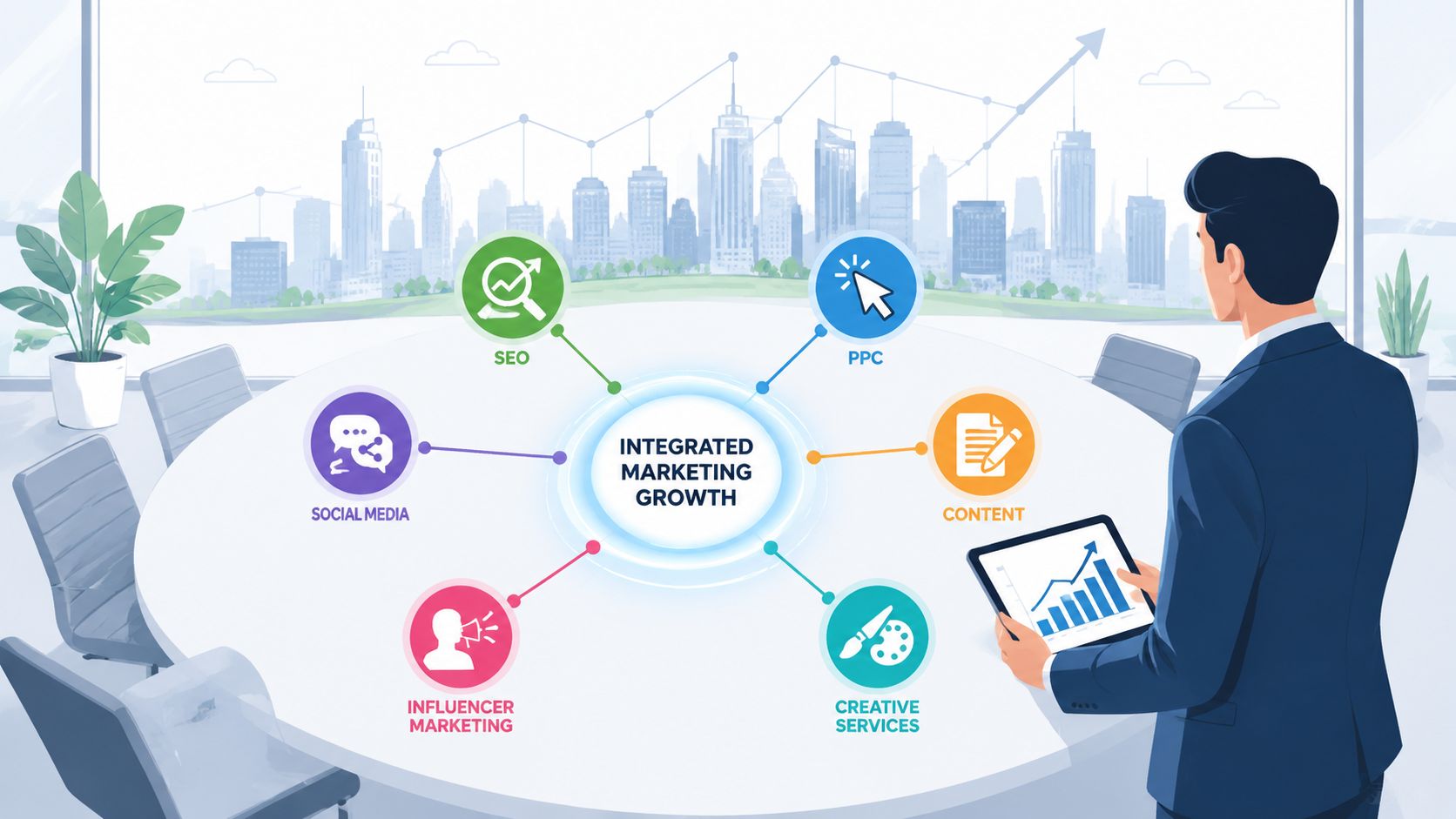
The journey from awareness to implementation is where the real work begins. Your business is unique, with its own set of goals, budget constraints, and customer behaviors. Therefore, your marketing mix should be just as unique. The power of these strategies is unlocked when they are integrated, creating a synergistic effect where the whole is far greater than the sum of its parts. For instance, your Content Marketing efforts fuel your SEO, provide valuable assets for your Email Marketing campaigns, and give your brand a voice on social media.
Your Actionable Blueprint for Success
Instead of feeling pressured to launch ten new campaigns tomorrow, focus on a phased, strategic approach. This prevents burnout and allows you to properly measure the impact of each new initiative. Here is a practical framework to guide your next steps:
- 1. Conduct a Quick Audit: Before you move forward, look back. Where are you now? Do you have a Google Business Profile? Are you collecting email addresses? A simple audit of your current digital footprint will reveal your biggest opportunities and most urgent needs.
- 2. Prioritize Based on Goals: Identify your single most important business objective for the next quarter. Is it generating local leads? Driving online sales? Increasing brand awareness?
- For local leads: Prioritize Local SEO and Google My Business optimization.
- For e-commerce sales: Focus on PPC advertising and email marketing funnels.
- For brand awareness: Lean into video marketing and social media engagement.
- 3. Commit to Two Strategies: Choose one foundational strategy (like SEO or Content Marketing) and one growth-focused strategy (like PPC or Influencer Marketing). Dedicate your resources to implementing these two exceptionally well. Consistency is far more impactful than scattered, half-hearted efforts across multiple channels.
The Long-Term Vision: Building a Resilient Brand
Mastering these digital marketing strategies for small businesses is more than just a short-term project; it’s an investment in your company’s future resilience and scalability. In today’s competitive landscape, a strong digital presence isn’t a luxury, it’s a fundamental requirement for survival and growth. Each email you send, each piece of content you publish, and each positive review you earn builds brand equity and creates a direct line of communication with your customers.
This is an ongoing process of testing, learning, and adapting. Some campaigns will exceed expectations, while others may require tweaking. The crucial element is to remain agile and data-driven, using the key metrics discussed for each strategy to inform your decisions. By embracing this iterative process, you transform your marketing from a set of disconnected tasks into a powerful, integrated engine for sustainable business growth. Take that first, focused step today. Your future self will thank you.
Feeling ready to implement these strategies but need an expert partner to accelerate your results? The team at ReachLabs.ai specializes in creating integrated digital marketing plans that drive real-world growth for businesses just like yours. Visit ReachLabs.ai to learn how our data-driven approach can build a comprehensive digital presence that moves the needle for your brand.