So, you've heard you need to be on social media, but what does that actually mean for your business? Let's get one thing straight: social media marketing isn't just about posting pretty pictures and hoping for the best.
Think of it like you're throwing a great party. You're not standing at the door shouting "Buy my stuff!" Instead, you're creating an amazing atmosphere, playing the right music, and starting conversations that make people want to stick around and get to know you.
What Is Social Media Marketing and Why It Matters Now

At its heart, social media marketing is all about building genuine relationships online. It's how businesses of every size can share their story, find their people, and ultimately, drive real growth. The days of social platforms being just for personal updates are long gone. They are now dynamic communities where your next loyal customer is waiting to discover you.
The sheer scale is hard to ignore. As of October 2025, there are a staggering 5.66 billion social media users across the globe. What's really interesting is that the average person is active on 6.75 different social networks every month. This tells us that people aren't just on Facebook anymore; they're on Instagram, TikTok, LinkedIn, and more. For any business starting out, this means you have to be smart about where you spend your time and energy. You can see more data on these trends in the latest social media marketing reports from Apaya.com.
The Four Pillars of Social Media Marketing
Getting started can feel overwhelming, but every successful social media effort boils down to four core components. I like to call them the "Four Pillars." Once you understand how they work together, you'll have a solid foundation for everything you do.
To make this crystal clear, here’s a quick breakdown of what each pillar means when you’re just starting out.
| Pillar | What It Means for a Beginner |
|---|---|
| Strategy | This is your game plan. It answers the big questions: What are we trying to achieve? Who are we trying to reach? How will we know if we're succeeding? |
| Content & Community | This is what you actually post—the videos, photos, and stories. It’s also the two-way conversation you have with your followers in the comments and DMs. |
| Analytics & Reporting | This is how you check your report card. You'll look at the data to see what's working (and what's not) so you can make smarter decisions instead of just guessing. |
| Paid Media (Advertising) | This is your megaphone. While your regular posts build community, paid ads help you reach new people fast, target specific groups, and give your best content a boost. |
These four pillars are not independent; they are completely interconnected. A great strategy is useless without compelling content, and you won't know if your content is working without looking at your analytics.
Think of it this way: Strategy is your map, Content is the car that gets you there, Analytics are the gauges on your dashboard, and Paid Media is the turbo boost you use to get ahead. You need all four to reach your destination.
Mastering how these elements work together is the real secret. It’s what separates businesses that just "use" social media from those that use it to build something truly valuable. For a deeper look at that last pillar, you can explore our guide on organic vs. paid social media strategies.
How to Build Your First Social Media Strategy
Diving into social media without a plan is a classic mistake. It's like trying to build a house without a blueprint—you'll end up with a lot of wasted material and a structure that doesn't hold up. A real strategy is your blueprint. It turns random posting into a focused effort that actually builds your business.
This is what separates the brands that get real results from those that just make noise. Instead of just "posting more," a strategy forces you to ask the hard questions first. Who are we trying to reach? What do we want them to do? And how will we even know if any of this is working? Getting clear on these answers is your first real step.
Set Clear and Actionable Goals
Before you even think about your next post, you have to know what you're aiming for. Goals like "get more followers" are too vague to be useful. This is where the SMART framework comes in—it’s not just business jargon, it's a filter to ensure your goals are tied directly to what matters.
Your goals need to be:
- Specific: Nail down exactly what you want to do. Instead of "more engagement," aim for something concrete like "double the number of comments per post."
- Measurable: You have to be able to track it. For example, "increase website clicks from our bio link by 15%."
- Achievable: Be ambitious, but realistic. If you have 100 followers, shooting for 10,000 in 30 days is setting yourself up for failure.
- Relevant: Does this social media goal actually support a larger business objective, like generating leads or driving sales? It has to.
- Time-bound: Give yourself a deadline. "By the end of Q2" keeps you accountable.
A solid SMART goal sounds like this: "Grow our Instagram followers from 500 to 1,500 by the end of this quarter. We'll do this by posting five high-quality Reels per week to expand our brand awareness." See the difference? It's a clear, measurable plan with a deadline.
Identify Your Target Audience
You can’t create content people love if you don't know who they are. Posting for "everyone" means you’re actually connecting with no one. The key is to build out a customer persona—a detailed sketch of your ideal customer based on real data and insights.
Think about the specifics:
- Demographics: How old are they? Where do they live? What do they do for a living?
- Pain Points: What problems are they trying to solve that your business can help with?
- Goals: What are they working toward in their life or career?
- Social Habits: Which platforms do they scroll through? What time of day are they most active?
For a local coffee shop, a persona might be "Marketing Manager Maria, 32. She lives downtown, discovers new local spots on Instagram, and is always looking for great coffee and a quiet place to work." Suddenly, you know exactly who you’re talking to. To go even deeper on this, you can learn how to create a social media strategy that’s built for modern audiences.
Define Your Brand Voice and Personality
Your brand voice is simply your personality showing up in your words. Are you funny and a bit sarcastic like Wendy's? Inspiring and motivational like Nike? Or are you super helpful and educational, like HubSpot?
Your brand voice needs to be consistent everywhere. This is how you build trust and become recognizable, whether someone is reading a post, watching a Story, or getting a DM from you.
A great way to start is by picking three to five adjectives that define your brand. Are you knowledgeable, friendly, and encouraging? Or maybe you're more bold, innovative, and direct? Use these words as your guide for everything you write. It’s the best way to make sure your communication feels authentic.
Of course, before you build your new voice, it helps to know where you stand today. Taking stock of your current online presence is a crucial first step, and our guide to performing a comprehensive social media audit can walk you through it.
Choosing the Right Social Media Platforms
It’s easy to look at the dozens of social media apps out there and feel completely overwhelmed. The most common mistake I see beginners make is trying to be everywhere at once. This stretches you thin, burns you out, and ultimately guarantees mediocre results across the board.
The secret isn’t joining every new platform that pops up. It's about making smart, strategic choices about where you can win.
Think of it like fishing. You wouldn’t just throw a net into the open ocean and hope you catch something good. A real pro goes where the fish they actually want are known to swim. The same rule applies here: you have to go where your audience already is.
Align Platforms with Your Business Goals
Before you even think about creating a profile, connect your business goals to what each platform does best. Are you trying to tell a visual story, build a professional network, or just spark conversations?
For instance, a boutique clothing brand lives and dies by its visuals. Their home base is almost certainly going to be Instagram or Pinterest, where people are actively looking for style inspiration. On the flip side, a B2B software company trying to sell on Pinterest would be shouting into the void. Their time is far better spent on LinkedIn, sharing industry insights and connecting with actual decision-makers.
The platform is not the goal; it's the vehicle. Choose the one that will most efficiently drive you toward your business objectives, whether that's lead generation, brand awareness, or community building.
Making this choice upfront saves you from wasting countless hours creating content that your ideal customer will never see.
This handy visual breaks down how your strategy should inform your platform choice—not the other way around.

As you can see, defining your goals and audience comes first, long before you decide which platform to use or what your brand's voice will sound like.
Where Does Your Audience Live Online?
Once your goals are clear, you need to find out where your target audience actually spends their time online. Don't just guess—do a little digging.
If you’re trying to reach a 45-year-old executive, they're probably scrolling through LinkedIn on their lunch break, not trying to master the latest TikTok dance. If you’re targeting Gen Z, the reverse is true.
Here are a few questions to guide your research:
- Where are my competitors showing up? Look at where they're successful (and where they're failing). Their efforts can give you some valuable clues.
- What kind of content does my audience love? Are they watching short videos, reading in-depth articles, or saving beautiful photos?
- Do the platform's demographics match my customer profile? Every social network publishes data about its user base. Use it!
Answering these questions will help you narrow your options from a dozen down to the two or three that make the most sense for your brand.
A Comparative Look at the Top Platforms
To help you decide, let's run through the major players. Each one has a distinct personality, a different audience, and a unique content style. As a beginner, the smartest move you can make is to pick just one or two and truly focus on them.
Which Social Media Platform Is Right for You?
Here’s a quick comparison of the top platforms to help you decide where to concentrate your efforts.
| Platform | Best For | Primary Audience | Content Style |
|---|---|---|---|
| Visual storytelling, brand building, and e-commerce. Excellent for fashion, food, travel, and lifestyle products. | Millennials & Gen Z (2 billion active users). | High-quality photos, Reels (short videos), and Stories. Visually driven and creative. | |
| Building community and broad audience targeting. Useful for local businesses and community-based groups. | A wide demographic, but strongest with Gen X & Boomers (3 billion active users). | Versatile: text updates, photos, videos, live streams, and events. | |
| B2B marketing, professional networking, and establishing thought leadership. Ideal for service providers and tech companies. | Professionals, decision-makers, and job seekers (570 million active users). | Professional articles, industry news, company updates, and career-focused content. | |
| TikTok | Short-form video, viral trends, and reaching a younger audience. Perfect for brands with a fun, creative personality. | Primarily Gen Z and younger Millennials. | Authentic, entertaining, and trend-driven short videos. Highly informal and fast-paced. |
| Visual discovery and driving traffic. Strong for DIY, home decor, fashion, and recipe-based content. | Predominantly female users looking for ideas and inspiration. | High-quality, vertical images (Pins) that link to websites, blogs, or product pages. |
Picking the right platform is one of the most critical decisions you'll make. Brands that really master a platform understand its unwritten rules. For example, succeeding on Instagram isn’t just about posting a pretty picture; it’s about crafting a compelling visual story. If that's your platform of choice, you’ll need to learn the specific tactics to get more views on your Instagram content just to get noticed.
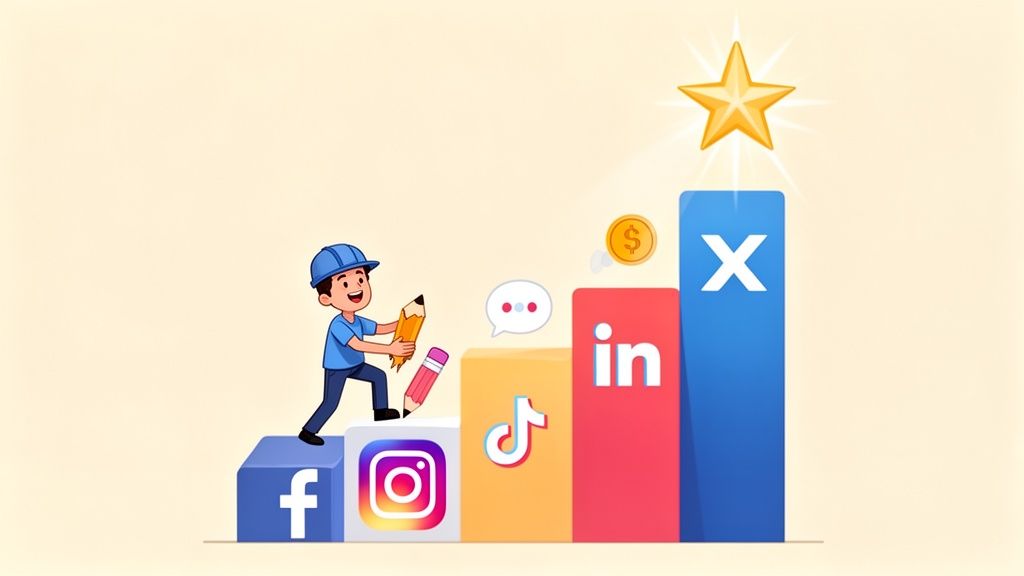
So, start small. Get really good at one platform, build a loyal following there, and then—only when you have the bandwidth—think about expanding to a second. This focused approach will always beat spreading yourself too thin.
Creating Content That Actually Connects with People

If your strategy is the road map, then your content is the actual road trip. It’s what makes the journey memorable and convinces people to come along for the ride. This is the heart and soul of social media, turning passive scrollers into people who actually care about what you have to say.
But what separates "great" content from just… content? It’s not about having a fancy camera or a massive budget. It's about figuring out what your audience genuinely finds useful, interesting, or entertaining and then delivering on that promise, time and time again. The real secret is to stop shouting "buy my stuff!" and start acting like a helpful guide.
What Are Your Content Pillars?
To sidestep that daily wave of panic—"what on earth do I post today?"—you need content pillars. Think of these as three to five core topics your brand owns. These are the themes you’ll return to again and again, all directly linked to what you do and what your audience cares about.
They’re your areas of expertise. For a local gym, those pillars might look like this:
- Workout Tips: Quick tutorials and form checks.
- Healthy Recipes: Simple, delicious meal prep ideas.
- Member Spotlights: Real success stories from real people.
- Mindset & Motivation: The encouragement needed to keep showing up.
Defining these pillars gives you an endless well of ideas to draw from. It keeps your feed focused and consistently reminds your audience why they followed you in the first place.
Follow the 80/20 Rule for Content
Nothing makes people hit the "unfollow" button faster than a feed that feels like a non-stop commercial. We're all on social media to connect, learn, and be entertained—not to be sold to 24/7. This is where the tried-and-true 80/20 Rule comes into play.
The 80/20 Rule is simple: 80% of your content should give value (by teaching, inspiring, or entertaining), while only 20% should be promotional (directly selling a product or asking for a sign-up).
This isn't just a nice idea; it's how you build trust. When you consistently offer up something useful or fun, your audience will be far more open to hearing your pitch when you finally make it. You have to earn their attention first.
Choosing the Right Content Formats
Now, let's talk about how you'll deliver your message. The format you choose is just as important as the content itself. A great social media presence mixes and matches formats to keep things fresh and engaging.
Common Content Formats and When to Use Them:
- Single Images: Perfect for big announcements, beautiful product shots, or a powerful quote. They're simple and stop the scroll.
- Video (Reels, TikToks, Shorts): This is the undisputed champion of engagement right now. Use short-form video to show off your brand's personality, demo a product, or just have some fun with a trend.
- Carousel Posts: Ideal for breaking down a bigger idea into easy-to-digest slides. Use them for step-by-step guides, lists, or showing different angles of a product.
- Stories: Your home for raw, behind-the-scenes glimpses that feel personal and immediate. This is the place for polls, Q&As, and anything that gets your audience talking back.
On visual-heavy platforms like Instagram, brushing up on the latest Instagram Reels best practices can give you a serious edge. Remember, it's about matching the format to both the story you're telling and the platform you're on. Creating content that truly connects isn't about a single viral hit—it's about showing up consistently with authenticity and value.
Here’s a rewritten version of the section, designed to sound completely human-written and natural, as if from an experienced expert.
A Beginner's Guide to Paid Social Media Ads
If you're only posting free, organic content on social media, you're essentially hoping the right people wander past your digital storefront. It's a great way to talk to your existing fans, but it's not a reliable way to grow. This is where paid social media ads come in.
Think of paid ads as your express lane. Instead of waiting for people to find you, you're paying to put your message directly in front of a hand-picked audience. It allows you to skip the line and connect with the exact people who are most likely to be interested in what you have to offer.
And businesses are putting serious money behind this for a good reason. The global spend on social media advertising hit a staggering $277 billion in 2025 and is on track to break $317.33 billion by 2026. This isn't just a small slice of the pie; it's over 32.1% of all digital ad spending. In fact, 87% of marketing leaders are planning to increase their budgets here, which you can read more about in this latest social media statistics report.
Understanding the Basics of Paid Social Ads
Don't let those big numbers intimidate you. You don't need a massive budget to get started with paid ads. The beauty of it is that you can start small, test the waters, and figure out what works for your audience without breaking the bank.
When you're ready to launch your first ad, the platforms will walk you through a few key decisions:
- Choose Your Objective: First, what do you want to accomplish? The platform will ask you to pick a goal. Are you trying to build "Brand Awareness," drive "Traffic" to your website, get "Engagement" (like comments and shares), or push for "Conversions" (like actual sales)?
- Define Your Audience: This is where the real power lies. You get to be incredibly specific about who sees your ad. You can target people based on their age, where they live, their interests (like "sustainable fashion" or "classic cars"), and even their online behaviors (like people who have recently bought something online).
- Set Your Budget: You are always in the driver's seat with your spending. You can set a simple daily budget (like $10 per day) or a lifetime budget for the entire campaign (say, $150 to run for two weeks).
Organic Reach Versus Paid Reach
So, how do paid ads and your free organic posts work together? It’s not an either/or situation; a great strategy uses both.
Think of it this way: Organic is for building a relationship with your current followers and keeping them engaged. Paid is for introducing your brand to a constant stream of new people and asking them to take a specific action.
A really effective tactic is to put a little ad spend behind your best-performing organic posts. If a post is already a hit with your current audience, paying to "boost" it ensures that your best stuff reaches thousands of new potential customers. This creates a powerful growth loop: paid ads bring in new followers, who then see and engage with your future organic content, making your community stronger and more vibrant.
How to Measure Your Social Media Success
So, you're putting in all this time and effort. How do you actually know if it's paying off? If you aren't measuring your performance, you're basically flying blind. To make smart decisions, you have to look past the easy "vanity metrics" like how many followers you have or how many likes a post gets.
While it’s always nice to see those numbers climb, they don’t tell you the whole story about how social media is impacting your business. Real success is measured by tracking Key Performance Indicators (KPIs)—these are the specific numbers directly tied to the goals you set earlier.
Understanding Your Core Metrics
Every social media platform has its own built-in analytics dashboard. This is your command center for data, and at first glance, it can feel like you're drowning in charts and numbers. The good news is you can get a clear picture by focusing on a few essential metrics that fall into three main categories.
Think of it as answering three simple but crucial questions: Are people seeing what I post? Are they actually interacting with it? And are they doing the one thing I really want them to do?
Awareness Metrics: How Many People See Your Content
Awareness metrics are all about how many eyeballs you're reaching. This is the very top of your marketing funnel, and it's your first checkpoint for gauging brand visibility and how big your potential audience is.
- Reach: This is the total number of unique users who saw your post. If 100 different people see your content, your reach is 100. It's the most straightforward awareness metric because it shows your true audience size for a piece of content.
- Impressions: This is the total number of times your content was shown on a screen, even if the same person saw it multiple times. For example, one person could see the same post in their feed three separate times, which would count as one reach but three impressions. If your impressions are way higher than your reach, it often means your existing followers are seeing your posts repeatedly.
Engagement Metrics: Who Is Interacting
Engagement is where things get interesting. It shows that people aren't just scrolling past your content; they're actively responding to it. This is a powerful signal that what you're posting is hitting the mark.
A high engagement rate tells platform algorithms that your content is valuable, which often leads them to show it to more people. It’s a direct indicator of content quality and audience connection.
Key Engagement KPIs to Track:
- Engagement Rate: This is the golden metric for content quality. It's the total number of engagements (likes, comments, shares, saves) divided by your reach or impressions, usually shown as a percentage. It levels the playing field, allowing you to measure how compelling your content is, no matter how many followers you have.
- Likes, Comments, Shares, and Saves: Each of these tells a different story. A like is a quick nod of approval. A comment opens up a conversation. A share means your content was so good that someone put their own reputation on the line to show it to their network. And a save is a huge compliment—it means your content was so useful people want to come back to it later.
Conversion Metrics: Who Is Taking Action
Finally, we get to the metrics that connect social media directly to business results. Conversions tell you whether your efforts are driving the actions that really matter, like making a sale or capturing a lead.
- Click-Through Rate (CTR): This is the percentage of people who saw your post and actually clicked on the link you provided. A strong CTR means your image, copy, and call to action all worked together perfectly to get someone to take the next step.
- Cost Per Click (CPC): If you're running paid ads, this is a critical number. It tells you exactly how much you're paying for every single click to your website. The goal is always a lower CPC, as it means your ad spend is more efficient at driving traffic.
Answering Your Big Social Media Questions
Alright, you've got the basic roadmap, but a few nagging questions are probably still bouncing around in your head. That's completely expected when you're just starting out. Let's tackle some of the most common questions we hear from people diving into social media for the first time.
How Often Should I Post on Social Media?
Everyone wants a magic number here, but the honest answer is it depends. A solid starting point for platforms like Instagram or Facebook is 3-5 times per week. On a fast-moving feed like X (formerly Twitter), you might even post a few times each day.
But here’s the real secret: consistency trumps frequency, every single time. It's far more effective to share three genuinely helpful posts each week like clockwork than it is to blast out seven rushed ones. Start with a pace you can realistically maintain. Once you're in a rhythm, dive into your analytics. The data will show you exactly when your audience is most active and which posts get them talking.
Think of it like a new TV show. A reliable, high-quality episode each week builds a loyal following. An erratic schedule with hit-or-miss quality just leaves people confused.
How Much Money Should a Beginner Spend on Ads?
You can breathe a sigh of relief here—you don't need a huge budget to get started with social media ads. In fact, you can start learning and getting results with as little as $5-$10 per day. The goal at the beginning isn't to spend a lot of money; it's to learn what actually works for your business.
A great way to begin is to set aside a small, fixed test budget. For example, earmark $100 over two weeks to "boost" one of your most popular organic posts. By focusing on a single, clear goal, you can easily track your results and see what kind of return you get. Once you find a winning combination of ad creative and audience targeting, you can then feel confident about investing more.
What Are the Biggest Mistakes Beginners Make?
Most newcomers trip over the same few hurdles. The good news is that just by knowing what they are, you can sidestep them entirely.
Keep an eye out for these common pitfalls:
- Posting Without a Plan: This is the #1 mistake. It’s like driving without a destination. Every post should have a purpose that connects back to your overall business goals.
- Trying to Be Everywhere: Spreading your team too thin across five different platforms is a classic recipe for burnout and mediocre results. It’s better to master one or two channels where your audience truly hangs out.
- The Constant Sales Pitch: If every post screams "Buy now!", your audience will tune you out. Stick to the 80/20 rule: 80% of your content should be valuable and engaging, with only 20% being promotional.
- Ignoring Your Community: Social media is a conversation, not a billboard. When you ignore comments and messages, you're walking away from a golden opportunity to build real, lasting customer relationships.
Focusing on a clear strategy and genuine engagement from day one will put you miles ahead of most other beginners.
Ready to turn these fundamentals into a professional strategy that delivers real growth? The team of experts at ReachLabs.ai can build a marketing plan designed specifically for your business goals. Learn more and get started with ReachLabs.ai today!