
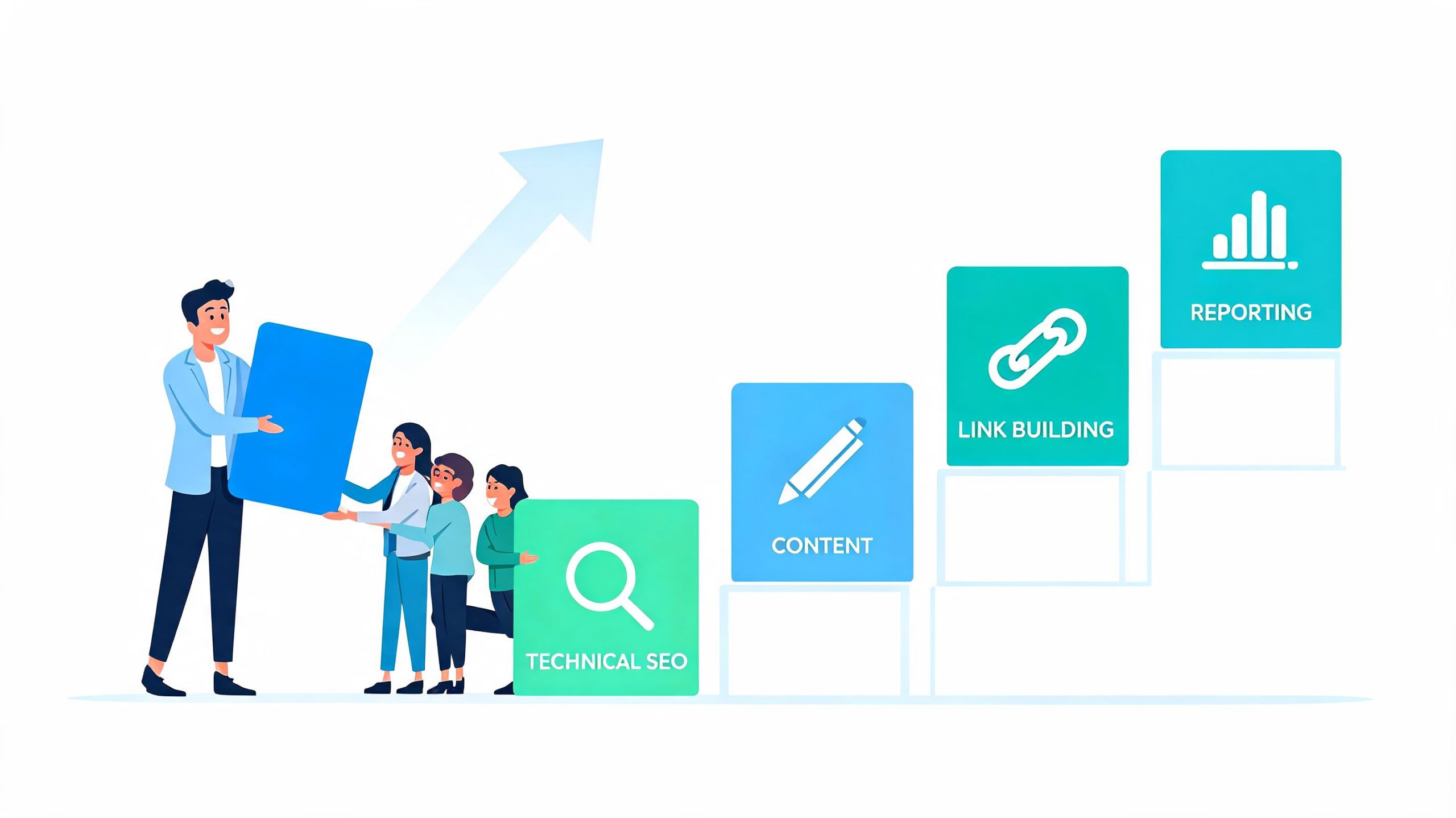
You're probably here because SEO has become a pile of half-finished jobs.
A developer says the site is “basically fine.” A content writer publishes blog posts that don't rank. Someone on your team checks Search Console once a month, spots a few issues, then gets pulled back into paid campaigns, sales enablement, or client work. Meanwhile, traffic quality feels uneven, reporting is fuzzy, and every agency pitch sounds the same.
That's usually the moment a managed seo service starts to make sense. Not because outsourcing is fashionable, but because search has become an operational discipline. It needs prioritization, technical oversight, content direction, and someone accountable for tying activity back to pipeline or revenue.
The market is moving that way for a reason. The global SEO services market was valued at $82.3 billion in 2023 and is projected to reach $143.9 billion by 2030, expanding at a 8.3% CAGR, according to Exploding Topics' SEO statistics roundup. That isn't just a growth story. It's a signal that more companies have decided SEO is too important, and too specialized, to run as an occasional side project.
The Search for a Smarter SEO Strategy
The mistake I see most often is treating SEO like a collection of tactics instead of a managed function.
A team buys an audit. Then a freelancer updates title tags. Then a writer publishes articles based on keyword volume alone. Then leadership asks why leads haven't improved. Nothing is technically “wrong,” but nothing is coordinated either. Search performance suffers when nobody owns the system end to end.
A stronger setup starts with a simpler question. Who is responsible for the roadmap, the execution queue, the dependencies, and the reporting?
That's what a managed seo service solves when it's run well. It gives you one accountable partner that can translate business goals into search priorities, coordinate specialists, and keep work moving even when your internal team has limited bandwidth.
Practical rule: If your SEO program depends on three different people “getting to it when they can,” you don't have a strategy. You have leftovers.
The appeal isn't only convenience. It's operational continuity. Search changes constantly, competitors keep publishing, and technical problems compound when nobody is watching the foundation. A managed relationship works best when the vendor acts less like a task vendor and more like an extension of your marketing operations.
That doesn't mean every company should hand over the keys. Some teams can run large parts of SEO in-house. But if your bottleneck is execution, prioritization, or cross-functional follow-through, managed SEO is often the cleanest fix.
What Exactly Is a Managed SEO Service
Think of it like hiring a general contractor for a renovation.
You could hire an electrician, a plumber, a tile installer, and a painter separately. You could also try to coordinate all of it yourself. Sometimes that works. More often, timelines slip, responsibilities blur, and no one owns the final outcome.

A managed seo service is the SEO version of that general contractor. The provider doesn't just hand you recommendations. They manage strategy, execution, prioritization, and ongoing optimization across the moving parts that affect search performance.
What managed means in practice
At minimum, “managed” should imply four things:
- Ongoing ownership: The vendor is responsible for maintaining a roadmap, not just delivering a one-time audit.
- Specialist coordination: Technical SEO, content, on-page work, and reporting are handled in a connected way.
- Business alignment: The work is tied to lead generation, revenue goals, or qualified demand, not only rankings.
- Regular adjustment: The plan changes when data says it should.
If a provider mostly sells deliverables, that's a service package. If they own outcomes, dependencies, and decisions over time, that's closer to managed SEO.
What it is not
It helps to separate managed SEO from nearby options:
| Model | Good for | Limitation |
|---|---|---|
| Freelancer | A narrow skill like metadata updates or content briefs | Usually lacks authority to run the whole program |
| One-time audit | Diagnosing issues and creating a backlog | Nothing gets managed after the deck is delivered |
| In-house only | Teams with strong SEO leadership and execution bandwidth | Can stall when SEO competes with other priorities |
| Managed SEO service | Companies that need strategic ownership plus implementation | Requires process, trust, and shared accountability |
A good primer on how SEO helps your business is useful here because it reminds teams that SEO isn't just about ranking pages. It supports discoverability, buyer education, and lead flow across the full funnel.
Managed SEO should reduce management overhead for your team, not add another vendor you have to chase every week.
That's the standard I'd use. If you still have to define tasks, follow up on execution, and assemble your own performance story, the service isn't really managed.
The Core Components of a Managed SEO Program
A quality SEO program isn't mysterious. It has a few core parts, and each one needs clear ownership.

Technical SEO and auditing
This is the part many teams neglect because it's less visible than content. It's also the part that can insidiously undermine everything else.
Technical SEO covers crawlability, indexation, site speed, internal linking structure, duplicate content issues, redirects, canonicals, schema, XML sitemaps, and mobile performance. A capable vendor should be fluent in tools like Google Search Console, Google Analytics 4, Screaming Frog, PageSpeed Insights, and a rank tracker.
Core Web Vitals belong in this bucket too. Fresh Move Media's overview of SEO packages notes that poor CWV scores can lead to 24% lower rankings, and managed services that resolve those issues have shown mobile ranking lifts of up to 32% in competitive markets. That's why technical work should never be treated as a one-time cleanup.
What good looks like:
- Clear issue prioritization: Not every warning matters equally.
- Developer-ready tickets: Recommendations should be implementable.
- Recurring QA: Fixes need validation after deployment.
Content strategy and optimization
Content fails when it's disconnected from search intent or business intent.
A managed provider should map content to actual opportunities: service pages that need expansion, commercial pages that need stronger topical support, and editorial content that can attract the right searches without bloating the site. This isn't a blog quota exercise.
I'd expect a vendor to show how topics connect to funnel stages, internal links, and conversion paths. They should also know when not to publish. Some sites need consolidation, refreshes, and pruning more than net-new articles.
For teams serving other clients, this same discipline matters in delivery. Agencies looking to boost agency revenue with white label SEO face the same challenge. The work has to be operationally sound, not just packaged neatly.
On-page and off-page SEO
Many agencies overpromise in this area.
On-page work includes title tags, headings, internal links, copy refinement, image optimization, and alignment between query intent and page structure. Off-page work includes authority building, digital PR, citation management where relevant, and backlink acquisition that isn't spammy or detached from the brand.
A simple test helps here: ask whether the vendor can explain why a page should rank beyond “it has the keyword.” If the answer is weak, the strategy probably is too.
For companies that need help diagnosing the foundation before committing to a broader engagement, a structured SEO audit service can help surface technical gaps, content overlap, and priority fixes.
Reporting and analytics
Reporting is where weak SEO engagements usually get exposed.
Good reporting shows what was done, what changed, what the next priorities are, and how performance maps to business outcomes. Bad reporting is a pile of ranking screenshots, traffic graphs, and jargon.
The best SEO report is the one your sales leader can read and immediately connect to pipeline quality.
A managed program only works when these four components reinforce each other. Technical fixes support indexation and page experience. Content creates relevance. On-page and off-page optimization strengthen visibility and authority. Reporting tells you whether the system is working or drifting.
Decoding Pricing Models and Setting Realistic KPIs
Pricing questions are fair. They're also where a lot of SEO buying goes sideways.
Some teams shop for the lowest retainer and assume the rest will sort itself out. Others sign a large contract without agreeing on what success looks like. Both mistakes create friction fast.

How pricing usually works
Most managed SEO engagements fall into one of these structures:
| Pricing model | When it fits | Watch for |
|---|---|---|
| Monthly retainer | Ongoing SEO management and continuous execution | Vague scope and drifting priorities |
| Project plus retainer | A cleanup phase followed by monthly management | Big upfront audit with weak follow-through |
| Hybrid support | Internal team owns some execution, vendor fills gaps | Confusion over who is doing what |
The smartest way to review proposals is to ask what capacity the fee buys. Which specialists are involved? How often are technical reviews done? Who writes briefs? Who handles implementation QA? Who joins reporting calls?
If you need context for broader budgeting across channels, this breakdown of digital marketing agency pricing is a useful reference point for comparing SEO against other service models.
The KPI mistake that kills engagements
The biggest problem isn't usually price. It's misaligned expectations.
A Visionet article on managed SEO services cites a 2026 study showing that 42% of SMBs abandon managed SEO services prematurely because reporting is opaque and doesn't connect SEO work to business outcomes. That tracks with what I've seen. Teams get tired of reports full of activity but light on accountability.
Here's the KPI split I'd use:
- Leading indicators: Rankings for priority themes, indexed pages, technical fixes completed, organic landing page visibility.
- Business indicators: Qualified leads, demo requests, booked calls, sales conversations, pipeline contribution.
- Efficiency indicators: Conversion rate from organic sessions, cost per qualified lead compared with other channels.
A monthly report should connect all three. If the vendor only reports traffic, they're making their life easier, not yours.
This video gives a good frame for thinking about SEO expectations and measurement:
What realistic looks like
Realistic SEO KPIs are directional at first, then commercial over time.
In the early phase, expect baseline cleanup, tracking fixes, and clearer visibility into what's broken or underperforming. Later, the conversation should move toward lead quality and contribution to revenue. If a provider can't explain that progression before you sign, the engagement will likely feel vague by month three.
Your Vendor Evaluation Checklist
Most SEO sales processes are built to make vendors sound interchangeable. They aren't.
One firm has senior strategists but weak execution. Another produces content efficiently but can't handle technical dependencies. A third communicates well but hides behind generic dashboards. You need to screen for operating model, not just promises.
One outside perspective on choosing an SEO company is helpful because it pushes buyers to look beyond pitch language and ask how the work gets done.
Managed SEO Vendor Evaluation Checklist
| Evaluation Criteria | What to Look For | Red Flags |
|---|---|---|
| Strategy ownership | They can explain how priorities are set and revised | They jump straight to deliverables without diagnosis |
| Team structure | Named specialists across technical, content, and analytics | One account manager appears to do everything |
| Technical depth | Comfort with Search Console, GA4, crawling tools, and developer coordination | “We'll send recommendations” with no implementation path |
| Content process | Briefs tied to search intent, funnel stage, and internal linking | Random publishing cadence or keyword stuffing language |
| Reporting quality | Sample dashboard tied to leads, pipeline, or conversion actions | Reports focused on impressions and vanity rankings only |
| Communication rhythm | Clear meeting cadence, owners, and escalation path | Slow replies, unclear contacts, reactive communication |
| Adaptability | They can explain what happens when a tactic underperforms | Rigid packages with no room to reallocate effort |
| Transparency | They show work completed, blockers, and next steps plainly | Black-box language or refusal to share methods |
Questions worth asking on the call
These questions cut through polished decks quickly:
- How do you prioritize between technical fixes, content production, and page updates?
- What do you need from our team each month to keep momentum?
- Can you show a real sample report with annotations and business context?
- How do you handle implementation when our developer queue is slow?
- What changes when rankings improve but leads don't?
- Who will perform the work after the sale?
If a vendor can't explain how they respond when a strategy isn't working, they probably haven't had to do it in a disciplined way.
For buyers comparing providers, curated lists like SEO company rankings can help build a shortlist, but the final decision should come down to process fit, clarity, and accountability.
A final filter matters too. Favor teams built around specialists rather than generalists when the site, sales cycle, or market is complex. Managed SEO breaks down when one person is trying to be strategist, writer, analyst, technical lead, and project manager all at once.
The First 90 Days What to Expect After Signing
The first three months tell you a lot about the quality of the engagement.
Good SEO partners avoid rushing into random output. They stabilize tracking, inspect the foundation, and build a roadmap your team can support. Weak partners try to look busy immediately, then spend the next quarter explaining why the early activity didn't matter.

Days 1 through 30
The first month should feel investigative and structured.
A solid vendor will review analytics setup, Search Console coverage, site architecture, core templates, existing content, and competitor positioning. They should also clarify your conversion points, sales process, and what counts as a qualified lead. At this stage, many engagements either gain clarity or reveal that the business itself hasn't defined success tightly enough.
Expected outputs often include a baseline report, a technical findings summary, and a prioritized roadmap.
Days 31 through 60
This period is about quick wins and decision-making.
The team should start implementing high-impact technical fixes, updating obvious on-page issues, and finalizing the content plan. They should also identify pages that deserve immediate attention because they're close to performing or already carry commercial intent.
A healthy month two usually includes:
- Priority implementation: Fixes that unblock crawling, indexing, or page quality issues
- Content planning: Briefs and page outlines based on intent and business value
- Workflow setup: Approval paths, ticketing, and meeting cadence that prevent delays
Days 61 through 90
By month three, execution should look more consistent.
New or refreshed content starts publishing. Internal linking gets tightened. Early ranking movement may appear for some terms, but the more important signal is whether the program has rhythm: clear owners, shipped work, resolved blockers, and reporting that your team understands.
Month three isn't the finish line. It's when you should be able to tell whether the machine is built correctly.
If you're still unclear on priorities by this point, the problem usually isn't “SEO takes time.” It's weak onboarding.
Measuring Real ROI and Seeing Results
Real SEO ROI isn't a ranking report. It's a business report.
That means looking at whether the managed seo service improved the quality of inbound demand, strengthened important landing pages, reduced friction across the site, and made organic search a more dependable acquisition channel. The exact pattern will differ by company. A local services business may care most about calls and form fills. A B2B SaaS team may care more about demo requests and sales-qualified pipeline.
What matters is that SEO performance connects to commercial outcomes, not just visibility.
What stronger ROI usually comes from
The highest-value SEO engagements tend to combine technical rigor with content that earns trust and captures intent. Reboot Online's SEO statistics roundup reports that thought leadership SEO yields an average three-year ROI of 748%, while B2B SaaS sees a 702% ROI with breakeven in 7 months. Those numbers are a useful benchmark because they reflect a pattern many marketers recognize: content works better when the site can support it technically, and technical fixes matter more when strong content gives them something worth ranking.
What results look like in the field
You don't need a dramatic case study to know whether SEO is working. You need evidence such as:
- Sales feedback: Reps say inbound leads are better informed and closer to the actual offer.
- Page-level improvement: Priority service or product pages start attracting the right searches.
- Attribution clarity: Organic becomes easier to defend in budget discussions because reporting shows what it contributes.
A good vendor helps you see those patterns early, then backs them with cleaner reporting over time.
The businesses that get the most from managed SEO aren't the ones chasing tricks. They're the ones that treat search like an operating system: clear goals, clear ownership, disciplined execution, and enough patience to let compounding work in their favor.
If you're evaluating a managed SEO partner and want a team that combines specialist execution with data-driven marketing support, ReachLabs.ai is one option to consider. The agency works across SEO, content, and broader digital strategy, which is useful for teams that need search to connect cleanly with lead generation, reporting, and brand growth rather than sit in its own silo.