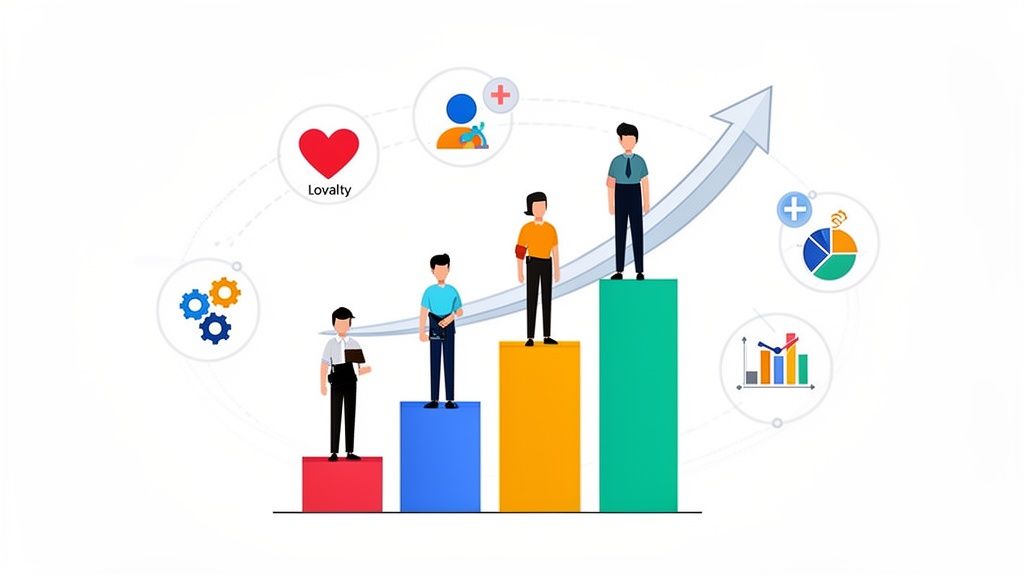
Increasing customer lifetime value isn't just about nudging a metric. It’s about making a fundamental shift away from chasing one-off sales and toward building profitable, long-term relationships. It all boils down to knowing what your customers are really worth over time and then making smart decisions to grow that value.
Why Customer Lifetime Value Is Your Growth Engine
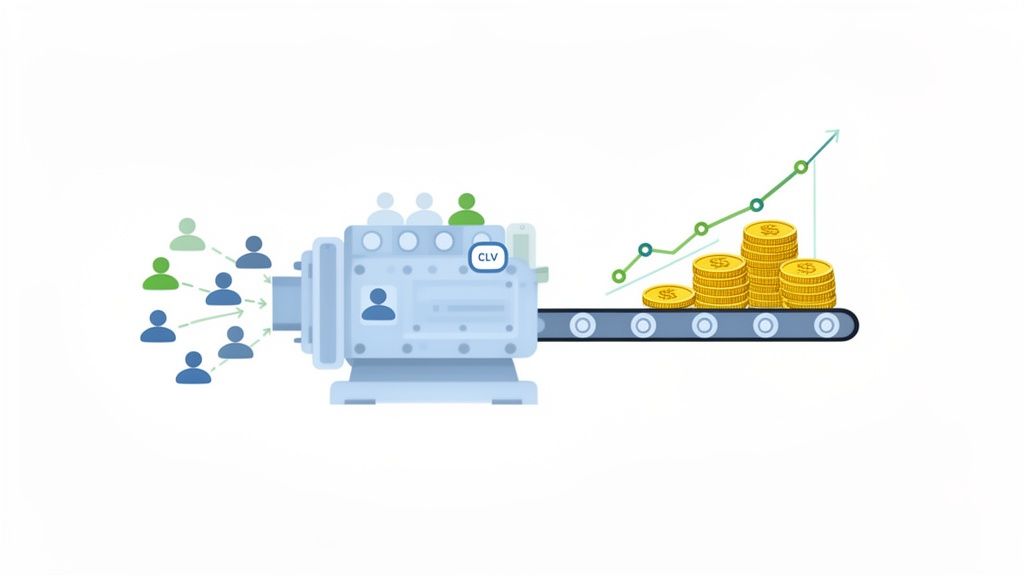
It’s easy to fall into the trap of prioritizing customer acquisition above everything else. Many businesses just keep pouring money into finding new faces. While you always need new customers, getting stuck on that treadmill leads to diminishing returns, especially as your market gets more crowded.
This is where focusing on Customer Lifetime Value (CLV) completely changes the game.
CLV is a prediction of the total revenue you can expect from a single customer over the entire time they do business with you. It’s a forward-looking metric that gets you thinking beyond the next sale and focused on long-term health and profitability.
The Simple Math Behind Long-Term Growth
At its core, calculating CLV doesn't require a data science degree. It just hinges on a few key variables that, when put together, give you a surprisingly clear picture of customer value. Getting these down is the first real step.
To get a handle on CLV, you first need to understand its building blocks. These metrics are the foundation for any meaningful calculation, from a simple back-of-the-napkin estimate to a more complex predictive model.
The Core Components of CLV Calculation
| Metric | What It Measures | Example |
|---|---|---|
| Average Purchase Value (APV) | The average amount a customer spends per transaction. | A customer typically spends $75 each time they order. |
| Purchase Frequency (PF) | How often a customer buys from you within a set period. | The average customer places an order 4 times per year. |
| Customer Lifespan (CL) | The average duration a customer remains active before they churn. | On average, a customer stays with the brand for 3 years. |
Once you have these numbers, the basic formula is straightforward: CLV = APV x PF x CL.
Let's use a real-world example. A subscription coffee service finds their average customer spends $40 per month (APV) and stays for 24 months (CL). Their CLV is $960. This simple math immediately shows how a small bump in any one of those variables can have a huge impact on your bottom line.
Shifting From Cost Center to Profit Center
The real magic happens when CLV starts shaping your marketing and operational decisions. Once you know what a customer is worth, you can stop guessing and start making smarter choices.
For instance, knowing your ideal customer's lifetime value helps you decide what you can reasonably spend to acquire them in the first place—your Customer Acquisition Cost (CAC). A healthy benchmark I've seen across many successful businesses is a CLV to CAC ratio of at least 3:1.
A deep understanding of CLV allows businesses to stop guessing and start making data-informed decisions. It transforms the marketing budget from a necessary expense into a strategic investment in profitable, long-term relationships.
Think about this: a loyal customer can be worth up to 10 times the value of their first purchase, yet so many businesses bleed customers they worked hard to win. With acquisition costs soaring by over 222% in recent years, focusing only on the next sale is just not sustainable.
By organizing your spending around long-term value, you gain clarity and a serious competitive edge. You can learn more about how to structure media spend around CLV and see how it works in practice. When you identify and nurture your most valuable customer segments, you're putting your resources exactly where they’ll generate the highest return.
Finding the Hidden Growth in Your Customer Journey
Before you can start boosting customer lifetime value, you have to get a clear, honest look at where you stand today. The biggest opportunities are almost always hiding in plain sight, tucked away in moments of friction or delight you might be completely overlooking.
Think of it like this: auditing your customer journey is like flipping on the lights in a dark room. Suddenly, you can see the obstacles and the clear paths forward.
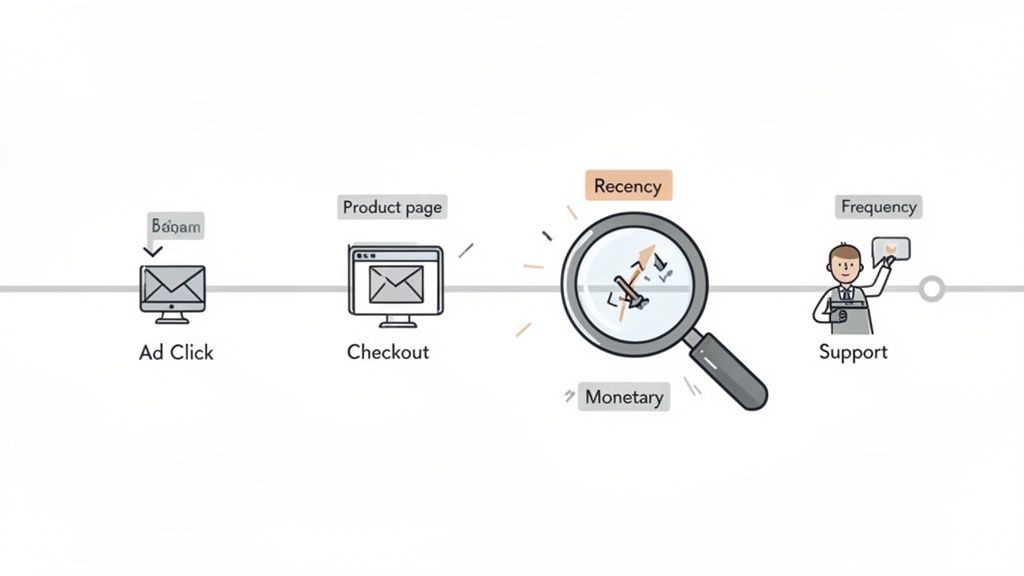
This isn't just about the sale. You need to map out every single touchpoint, from the very first interaction—that social media ad they scrolled past or a blog post they found on Google—all the way through the post-purchase experience. What happens when they unbox the product? What’s it like to contact customer support? Those moments matter. A lot.
Identifying Friction and Opportunity
Your mission here is to find the pain points and the bright spots. Where do customers get stuck, and where do they feel truly valued? A clunky checkout process is a classic example of a friction point that kills sales. On the other hand, a personalized follow-up email after their first purchase is a golden opportunity to build a real relationship.
You don't need fancy tools to get started. Your CRM and Google Analytics are absolute goldmines of behavioral data. Look for drop-off points in your funnels, dig into support ticket themes to spot recurring problems, and actually read your customer reviews. People will tell you exactly what they think. If you need a bit more structure, these customer journey mapping templates can be a great starting point.
A Practical Approach to Customer Segmentation
Once you see the entire journey, it’s time to understand who is making it. Let's be honest: not all customers are created equal when it comes to business value. This is where a simple but powerful method called RFM analysis comes into play.
RFM is an acronym for:
- Recency: How recently did they buy from you?
- Frequency: How often do they come back to buy?
- Monetary: How much do they typically spend?
By scoring your customers on these three factors, you can stop blasting generic messages and start creating targeted, relevant strategies. It’s all about identifying distinct groups with very different behaviors.
Your customer data tells a story about who is driving your growth and who is about to walk away. RFM analysis gives you the framework to listen to that story and act on it decisively.
For example, someone who bought last week, buys every month, and spends a lot is a 'Champion'. But what about the customer who used to buy frequently but hasn't been back in six months? That person is 'At-Risk'. This simple act of segmentation lets you tailor your approach. Champions should get early access to new products. At-risk customers need a thoughtful re-engagement campaign, not just another discount code.
Putting Your Data to Work
Here’s the thing—insights are worthless until you act on them. There's a reason the customer analytics market is projected to hit $29.8 billion by 2026. Businesses are finally realizing that using data to create a unified view of the customer is the key to loyalty and, ultimately, lifetime value. RFM is a huge piece of that puzzle.
So, how do you translate these findings into real action?
- For your High-Value Champions: Don't just give them discounts. Create an exclusive loyalty program with perks that make them feel like insiders—VIP support, exclusive content, or early access to sales. Show them they’re appreciated.
- For your At-Risk Customers: A "we miss you" campaign can work, but dig deeper. Use survey data or their support history to figure out why they left and address that specific problem in your outreach.
- For your New Customers: Nail the onboarding experience. Give them clear instructions, helpful content, and a genuinely personal welcome to set the foundation for a long-term relationship.
This whole diagnostic phase is foundational. It’s what gives you the data-driven confidence you need to build retention and monetization strategies that actually work because they resonate with real people.
Building Loyalty Through Unforgettable Experiences
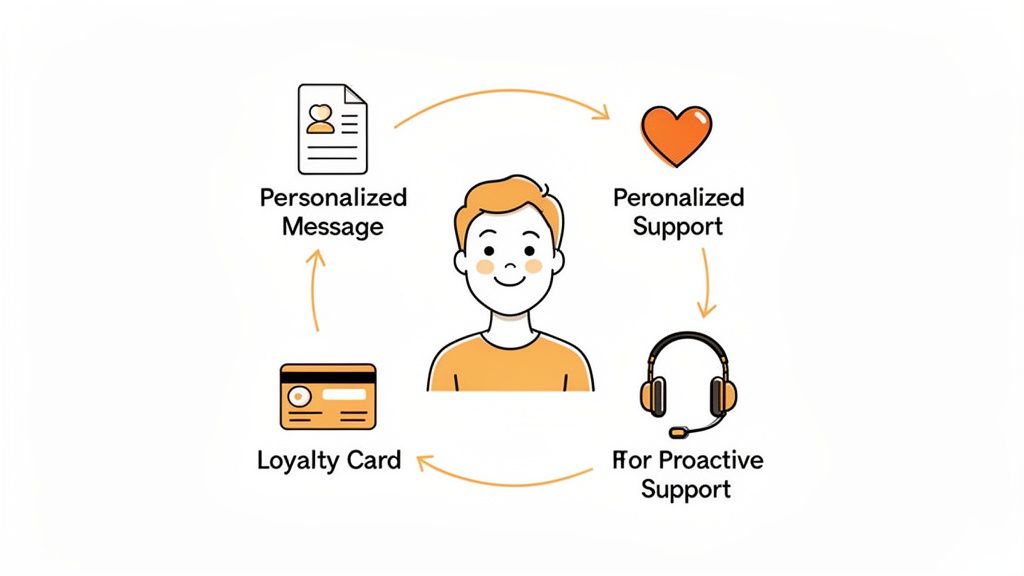
True customer loyalty isn't bought with a simple discount; it's earned through consistent, memorable experiences. The diagnostic work you've done gives you the map, but this is where you start paving the roads that keep your best customers coming back again and again. At its core, increasing customer lifetime value hinges on one thing: making people feel seen, understood, and genuinely valued.
This means we have to move past the generic, soulless loyalty programs of yesterday. The real goal is to forge connections that turn one-time buyers into enthusiastic brand advocates.
Beyond Points and Punches
Let's be honest—most traditional loyalty programs are transactional and uninspired. A "buy ten, get one free" punch card might work for the local coffee shop, but for most businesses, it barely scratches the surface of what’s possible. The programs that truly move the needle create a powerful sense of belonging and exclusivity.
You can think of it in two distinct ways:
- Transactional Programs: These are built on points, cashback, or simple discounts. They're easy to grasp but rarely build an emotional bond. Customers play the game to save a buck, not because they feel any real affinity for your brand.
- Experiential Programs: This is where the magic happens. These programs focus on perks that money can't always buy, like exclusive access to new products, invitations to special events, or a dedicated support line. It’s all about making your most valuable customers feel like insiders.
Loyalty is the direct result of a customer feeling that the value they get from you consistently outweighs the price they pay. Experiential perks amplify this feeling in a way that simple discounts never can.
Look at Sephora's Beauty Insider program. It’s a brilliant hybrid model. It combines transactional points with tiered, experience-based benefits like early access to sales and members-only events. This approach rewards spending while simultaneously building a vibrant community—a potent combination for boosting CLV. You can find more inspiration in these proven customer retention strategies that focus on building deeper connections.
Personalization That Actually Matters
"Personalization" is probably one of the most overused buzzwords in marketing. Too often, it just means sticking a first name in an email subject line. Real personalization runs much deeper. It’s about using customer data to anticipate needs and deliver true relevance at every single touchpoint.
This is where you'll find explosive growth in CLV. The numbers don't lie: a modest 5% bump in customer retention can increase profitability by 25% to 95%. And what’s the engine driving that retention? Personalization. Companies that nail it generate 40% more revenue than their peers, and 60% of consumers say they’re more likely to become repeat buyers after a personalized experience.
Effective personalization is all about connecting the dots in your data. It’s about turning what you know about a customer into what you do for them.
Imagine an e-commerce store selling outdoor gear. They could use a customer's recent purchase of hiking boots to:
- Recommend complementary gear like high-performance socks or waterproofing spray in a follow-up email.
- Send them a targeted article a few weeks later about "The 5 Best Day Hikes in Their Region."
- Showcase personalized banners on the homepage featuring new hiking backpacks the next time they visit.
This isn’t just pushy selling; it's providing real value that improves the customer's life. It shows you’re paying attention not just to their wallet, but to their passions.
Proactive Service and Omnichannel Cohesion
Finally, nothing solidifies loyalty faster than incredible service that solves a problem before the customer even knew they had one. This is proactive support, and it’s a total game-changer. It could be a SaaS company noticing a user is struggling with a new feature and automatically sending them a helpful tutorial. Or an airline rebooking a passenger on the next flight after a cancellation without them ever having to ask.
These moments turn potential frustration into genuine delight.
This proactive mindset has to be woven into every channel. A true omnichannel strategy ensures the customer experience is seamless, whether they're on social media, using live chat, or walking into a store. The conversation has to flow effortlessly from one channel to the next without forcing the customer to repeat themselves.
When a customer can start a support ticket on Twitter and finish it over email with an agent who already has the full context, you're not just providing a solution—you're showing you respect their time. This level of cohesion is the final piece of the puzzle, creating the unforgettable experiences that are the foundation of a high CLV.
Boosting Value with Smarter Monetization
Building loyalty is a huge piece of the puzzle, but you can’t fully realize your CLV potential without a smart monetization strategy. This isn’t about squeezing every last cent from your customers. Far from it. It’s about being a trusted advisor, presenting the right offers at the right time so your customers feel helped, not just sold to.
When you get this right—through well-timed upsells, cross-sells, and intelligent pricing—you’ll see a real impact on average order value and how often people buy. The secret is to use the customer data you’ve gathered to make every offer feel like a natural, helpful next step in their journey with you.
Getting Upselling and Cross-Selling Right
Upselling and cross-selling are probably the most powerful tools in your monetization toolkit, but they're so often misunderstood and poorly executed. An upsell is simply nudging a customer toward a more premium version of a product. A cross-sell is suggesting related or complementary items. Both work wonders when they anticipate and solve a customer's next need.
Think of it like a great barista. They see you looking tired and suggest a large latte instead of a medium because they know you've got a long day ahead—that’s a perfect upsell. Then they ask if you’d like a croissant to go with it—a classic cross-sell. In both cases, the offer genuinely enhances your original purchase.
Timing and relevance are everything here.
- During the Purchase: Your product page and checkout flow are prime real estate. An e-commerce site selling cameras might show a "Frequently Bought Together" bundle with a memory card and a camera bag (cross-sell) right on the product page. It just makes sense.
- After the Purchase: Don't let the conversation end at the "buy" button. Follow-up emails are perfect for planting the seed for the next sale. Someone who just bought running shoes might get an email a week later featuring high-performance running socks or a GPS watch.
The best monetization plays don't feel like sales pitches at all. They feel like expert recommendations that make the customer’s life easier or help them get better results.
Smart Pricing and Bundling Strategies
Your pricing structure itself is a powerful lever for CLV. A static, one-size-fits-all price tag almost always leaves money on the table. A more dynamic approach allows you to cater to different customer segments and encourage higher spending over time. If you want to dive deeper into this, our guide on advanced customer segmentation techniques is a great place to start.
Here are a few pricing strategies I’ve seen work time and again:
1. Tiered Service Models
This is a staple in the SaaS world for a reason. Offering different levels of service (like Basic, Pro, and Enterprise) at different prices creates a clear upgrade path. It lets customers grow with you. As their needs get more complex, they can seamlessly move to a higher tier, increasing their lifetime spend without you having to find a brand new customer.
2. Product Bundling
This is a classic for a reason. You group several products together and sell them as a single package, usually at a discount compared to buying them separately. This isn't just about boosting the average order value; it's a brilliant way to introduce customers to products they might not have tried otherwise.
For example, a skincare brand could create a "Morning Routine" bundle with a cleanser, moisturizer, and sunscreen. It simplifies the decision for the customer and makes them feel like they're getting a great deal.
It All Comes Down to Relevance
Every one of these tactics lives or dies on one thing: relevance. A generic, shotgun approach will backfire, annoying the very customers you’re trying to build a relationship with. This is where the real work you did in your customer audit pays off.
Let's walk through a quick scenario. A meal-kit delivery service spots a group of customers who consistently order vegetarian meals and buy frequently. Instead of blasting them with generic promotions, they could get specific:
- Cross-sell: Send a post-purchase email offering a set of premium kitchen knives or a high-quality vegetable peeler.
- Upsell: Invite them to a "Gourmet Vegetarian" plan with more exotic ingredients for a slightly higher price.
- Bundle: Offer to include a free pack of organic snacks if they prepay for their next three boxes.
Each offer is tailored directly to that customer's known habits and tastes. This simple shift transforms a transaction into a personalized experience, building the kind of deep-rooted relationship that is absolutely essential for long-term CLV growth.
Your 90-Day Roadmap to a Higher CLV
Let's be honest, turning a big strategy like "increasing CLV" into actual, day-to-day work is where most companies get stuck. It’s one thing to nod along with the concepts, but it's a whole different ballgame to put them into practice without derailing your entire team.
That's why I've put together this 90-day roadmap. We'll break the whole process down into three manageable 30-day sprints. Think of it as your playbook for getting real results, building momentum, and creating sustainable growth from the ground up.
Days 1-30: The Foundational Audit and Quick Wins
The first month is all about reconnaissance. You can't fix what you don't understand, so the mission here is to get a crystal-clear snapshot of your customer landscape. We're not launching huge campaigns just yet; instead, we’re gathering the intelligence that will make every future move smarter and more effective.
Your non-negotiable task is to run that customer journey audit and RFM analysis we talked about earlier. You absolutely need to know who your ‘Champions’ are, who’s ‘At-Risk,’ and where everyone else falls in between.
Here’s your action plan for the first 30 days:
- Wrangle Your Data: Pull all your sales and engagement data from your CRM, e-commerce platform, and analytics tools. You don’t need a fancy data warehouse; a consolidated spreadsheet is a perfectly good place to start.
- Segment Your Customers: Run your first RFM (Recency, Frequency, Monetary) analysis. Your goal is to create at least three core segments. Give them names your team will actually use, like "VIP Spenders" or "Sleeping Giants."
- Find One 'Quick Win': Hunt for a single, glaring friction point in the customer journey that you can fix fast. Maybe it’s a confusing return policy or the lack of a simple post-purchase "thank you" email. Fix it.
Pro Tip: Don't chase perfection in this first month—chase clarity. By day 30, you should be able to confidently answer, "Who are our most valuable customers, and what's one easy thing we can do right now to make them happier?"
Days 31-60: Targeted Implementation and Personalization
Alright, with that foundational data in hand, month two is where the action begins. But we're going to be smart about it. Instead of a "spray and pray" approach, you’ll launch a targeted pilot initiative at just one of your key customer segments. This keeps the risk low and the learning high.
This is where you make your customer insights tangible. I'd recommend picking the segment with the biggest immediate upside—that’s usually your super-loyal 'Champions' or the 'At-Risk' customers you're about to lose. The goal is to test a specific retention tactic and see what happens.
If you need a more detailed guide during this phase, this resource is excellent: How To Increase Customer Lifetime Value: A Small Business Playbook.
Your core tasks for this month:
- Launch a Pilot Loyalty Program: This doesn't have to be a complicated points system. For your 'Champions,' it could be as simple as an email giving them early access to a new product or a surprise discount code.
- Run a Personalized Re-engagement Campaign: Target your 'At-Risk' segment with an email sequence that reminds them why they shopped with you in the first place. Use their purchase history to craft an offer that feels personal and relevant.
- Define What Success Looks Like: Before you launch, decide exactly how you'll measure the outcome. Track metrics like the repeat purchase rate for that specific segment, email open rates, and direct customer feedback.
Days 61-90: Monetization and Refinement
Now we get to the fun part. In your final 30-day sprint, you’ll shift from engagement to actively increasing average order value and purchase frequency. Because you've spent the last 60 days building goodwill, you can now introduce smart monetization tactics that feel helpful, not pushy.
This is also when you’ll review the data from your pilots to plan your next moves.
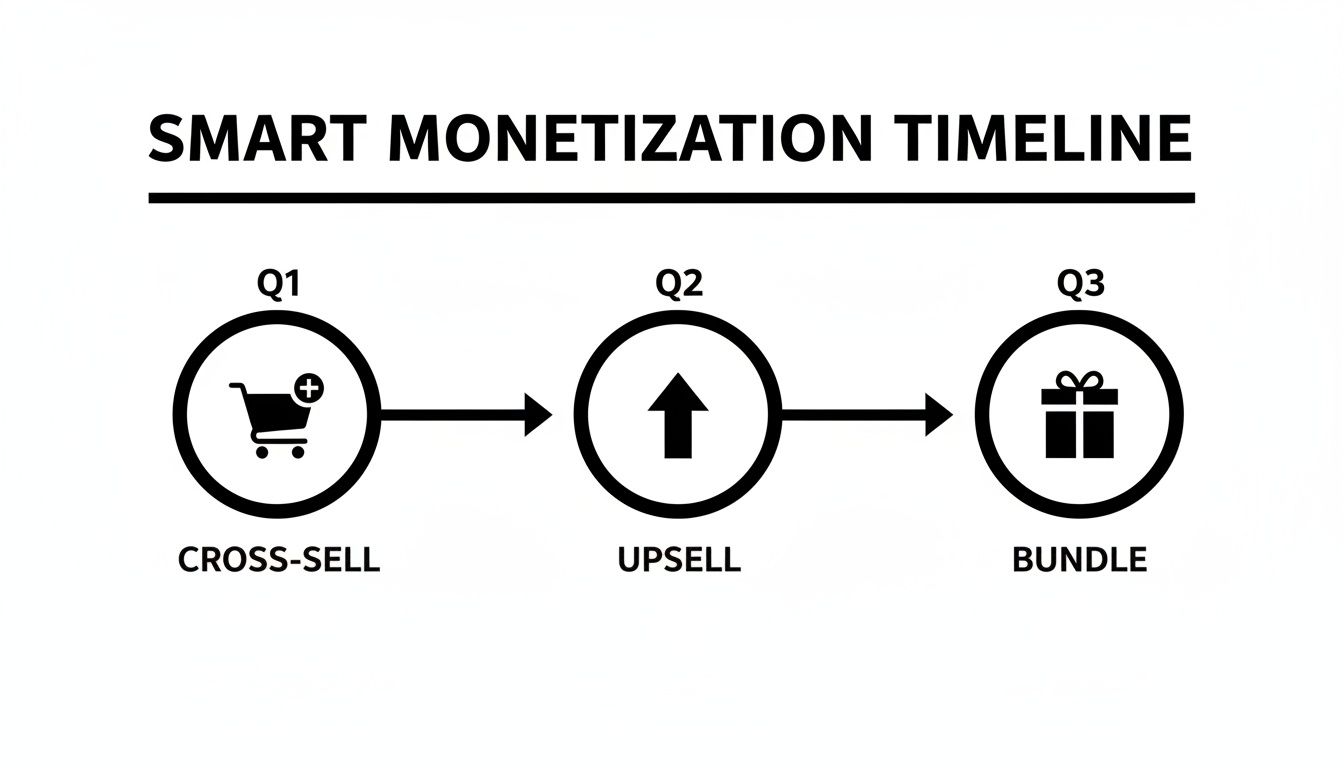
As you can see, the idea is to layer in different offers over time. This approach prevents customers from getting banner blindness and maximizes your revenue potential.
Here are your objectives for this final phase:
- Introduce an Upsell or Cross-sell: Using your customer data, implement one strategic upsell or cross-sell offer. A classic example is adding a "Frequently Bought Together" section on your top product pages or suggesting a complementary item during checkout.
- Analyze the Pilot Data: Really dig into the results from month two. Did the re-engagement campaign bring people back? What was the ROI on that loyalty perk for your VIPs? This data tells you whether to scale the program, tweak it, or scrap it.
- Plan the Next 90 Days: Increasing CLV isn't a one-and-done project. It's a continuous cycle. Use what you’ve learned to map out your next quarter, deciding which strategies to expand and what new ideas to test.
To help you stay on track, here is a simple table that summarizes your first 90 days.
90-Day CLV Implementation Plan
| Phase (Days) | Primary Focus | Key Actions | Success Metric |
|---|---|---|---|
| 1-30 | Discovery & Audit | Consolidate data, perform RFM analysis, identify one quick win. | Defined customer segments; 1 friction point fixed. |
| 31-60 | Targeted Action | Launch pilot loyalty and re-engagement campaigns for key segments. | >10% lift in repeat purchase rate for the targeted segment. |
| 61-90 | Monetization & Analysis | Test one upsell/cross-sell tactic, analyze pilot ROI, plan next quarter. | Increase in Average Order Value (AOV); clear plan for days 91-180. |
This roadmap provides a structured yet flexible framework. The key is to start, learn from the data, and build on your successes quarter after quarter.
Your Top CLV Questions, Answered
Once you start digging into customer lifetime value, the practical questions quickly follow. How do you go from knowing what CLV is to actually using it? It's easy to get bogged down in the details of benchmarks, tools, and the best ways to get started.
This section is your quick-fire guide to the most common questions I hear from businesses getting serious about CLV. Let's clear up the confusion and get you on the right track.
What Is a Good Customer Lifetime Value?
This is always the first question, and the honest-to-goodness answer is: it depends. A "good" CLV is all about its relationship to your Customer Acquisition Cost (CAC). There’s no magic dollar amount that works for everyone. The real health check is your CLV to CAC ratio.
The gold standard everyone talks about is a 3:1 ratio. For every dollar you spend bringing a new customer in the door, you should get back at least three dollars over their lifetime with you.
- A 1:1 ratio is a serious warning sign. You're basically breaking even on acquisition, which means you’re losing money once you factor in the cost of actually running your business.
- A 3:1 ratio means you’ve got a solid, sustainable business model. Your marketing engine is turning acquisition dollars into real, long-term profit.
- Hitting 5:1 or higher? You're in an incredible position. It's a strong signal that you could probably be spending more on acquisition to grow even faster.
Forget chasing some arbitrary industry number. The first thing you need to do is figure out your own ratio. That gives you a real baseline to work from.
How Often Should I Calculate CLV?
CLV isn’t a metric you calculate once and then file away. It's a living number that tells you how your business is doing. You need to check on it regularly to see if your efforts are actually moving the needle.
For most companies, running the numbers on a quarterly or semi-annual basis is the sweet spot. It's frequent enough to spot trends and see the impact of new marketing campaigns or product changes without getting lost in noisy, short-term fluctuations.
Of course, if your sales cycle is faster—think of a fast-fashion brand or a subscription box—you might want to look at it monthly. The most important thing is just to be consistent. Pick a schedule and stick with it so you can see how your CLV trends over time.
What Are the Best Tools for Tracking CLV?
You don't need a massive software budget or a data science team to get started here. The right tool depends on where your business is today.
Here's a look at the typical progression:
- Spreadsheets: Seriously, don't underestimate Google Sheets or Excel. When you're just starting, exporting your sales data and building a simple model is a fantastic way to get a handle on the basics.
- CRM Platforms: As you grow, a CRM like HubSpot or Salesforce becomes essential. They centralize all your customer data, which makes calculating CLV far more automated and accurate.
- E-commerce Platforms: If you're on a platform like Shopify, you're in luck. They often have built-in CLV analytics or powerful apps in their ecosystem that can do the heavy lifting for you.
- Customer Data Platforms (CDPs): For a truly granular view, a CDP like Segment is the top tier. It pulls data from every single customer touchpoint to create an incredibly precise picture of customer value.
The bottom line? Start simple and level up your toolkit as your needs get more complex.
To truly understand and increase customer lifetime value, it is essential to first grasp the fundamentals of how to calculate CLTV for your business. Getting the calculation right is the bedrock of any successful CLV strategy.
Can I Increase CLV Without a Formal Loyalty Program?
Absolutely. In fact, you should. A loyalty program is just one tool in the toolbox, and it's often not the most powerful one. Rushing to launch a points program before you've nailed the fundamentals is a classic mistake.
You can make huge strides in CLV by simply focusing on the core experience.
- Provide incredible, proactive customer service that solves problems before they even happen.
- Personalize your emails and website experience based on what people have bought before.
- Actively ask for feedback with surveys and reviews—and then actually show customers you're listening.
- Create genuinely useful content that helps customers succeed with your product.
These are the things that build real trust and make people want to stick around. They show you care about the relationship, not just the next sale, and that's the ultimate driver of high lifetime value.
Ready to stop guessing and start growing? At ReachLabs.ai, we blend data-driven insights with world-class creative to build strategies that turn one-time buyers into lifelong fans. Let our team of specialists help you unlock your brand's true potential and build the profitable, long-term relationships that fuel sustainable growth. Discover how we can move the needle for your business at https://www.reachlabs.ai.