
So, you want to create something that goes viral. It often feels like catching lightning in a bottle, but I've found it's far less about luck and much more about understanding what makes people tick.
It really boils down to three things: triggering high-arousal emotions, giving people social currency to spend, and providing genuine, practical value that they feel almost obligated to pass along.
Understanding What Makes Content Go Viral

Before you even think about the content itself, you have to get inside the mind of the person who will share it. Forget about just hopping on the latest trend. The real secret to learning how to create viral content is understanding predictable human behavior.
Content spreads when it taps into an emotion so powerful that hitting the "share" button feels like a natural reflex.
And I'm not just talking about making people happy or sad. Virality is supercharged by high-arousal emotions—the ones that get your heart pumping and demand an immediate reaction. Think about the awe you feel watching a jaw-dropping video from space, the gut-busting laughter from a perfectly executed meme, or even the anger that wells up when you see a story about injustice. These feelings create an almost physical need to share the experience.
The Core Drivers of Virality
Emotion is the fuel, but you still need a vehicle. That's where two other key ingredients come into play.
First, there's social currency. People are wired to share things that make them look good. It's a subconscious thing. When you share a mind-blowing statistic, a clever life hack, or an insightful article, you're not just sharing content—you're signaling to your network that you're smart, funny, or in-the-know. You're building your own personal brand with every share.
The second ingredient is straight-up practical utility. If your content solves a real problem, teaches a new skill, or offers a tangible benefit, people will share it because it's genuinely helpful. It’s the digital version of leaning over to a friend and saying, "You've got to try this." You can see this all over the place with great https://www.reachlabs.ai/user-generated-content-examples/—real people sharing authentic solutions that spread like wildfire because they just work.
The true magic happens when these elements overlap. Viral content often delivers real-world value wrapped in an emotional punch, all while giving the person who shares it a little boost in social status.
To break it down even simpler, here's a quick look at the core pillars.
The Three Pillars of Virality
| Pillar | Description | Example |
|---|---|---|
| High-Arousal Emotion | Triggers a strong physiological response like awe, anger, or intense amusement. | A video of a surprise military homecoming. |
| Social Currency | Makes the sharer look smart, witty, or "in the loop" with their network. | An infographic with surprising industry statistics. |
| Practical Utility | Provides clear, actionable advice that solves a common problem or teaches a skill. | A 60-second video showing how to properly chop an onion. |
Nailing this combination is what separates a piece of content that gets a few likes from one that gets shared thousands of times.
Tying It All Together with Data
This isn't just theory; we're seeing it play out with data. Modern social listening and AI-powered tools have become my secret weapon for spotting these opportunities.
I've seen brands boost their engagement rates by as much as 73% by digging into what their audience is actually talking about and feeling. These tools let you monitor conversations and community sentiment in real time, so you can stop guessing and start creating content that you already know will connect on a deeper level. It's about finding where the emotional energy is and meeting it with valuable, shareable content.
Crafting Share-Worthy Video That Clicks
Let's be clear: short-form video is the engine driving virality today. Platforms like TikTok have completely rewired our brains. We now expect content to be fast, authentic, and immediately engaging.
Forget the perfectly polished corporate videos of the past. Success on these platforms isn't about a Hollywood budget; it's about speed, authenticity, and speaking the native language of the app. In fact, a quick video shot on your phone can often feel more real and relatable, outperforming a slick production that costs thousands. This is a massive advantage if you're working with limited resources.
You Have Three Seconds. Make Them Count.
Your one and only job is to stop the scroll. The first three seconds are everything. If you don't grab someone's attention in that tiny window, they're gone. Forever.
So, how do you create a killer hook? Here are a few battle-tested methods:
- Lead with the finale. Show the incredible end result right at the start. For a cooking video, that means flashing that mouth-watering finished dish before you even show the ingredients.
- Ask a burning question. Spark immediate curiosity. Pose a question that your viewer feels an internal pull to answer or see answered.
- Make a bold, controversial statement. Start with a surprising fact or an opinion that goes against the grain. Anything that makes someone stop and think, "Hold on, what did they just say?" will work.
This initial hook is your promise to the viewer that sticking around will be worth their time.
Ride the Wave of Trends
You don't need to invent a new format for every single video. Seriously. One of the smartest and fastest ways to get eyes on your content is to tap into what's already blowing up.
Trending audio isn't just background noise; it's a direct signal to the platform's algorithm. Using a hot sound tells the algorithm your content is relevant right now, which can lead to a huge distribution boost with people who already love that sound.
The real magic happens when you don't just copy a trend, but adapt it to your own niche. Take a popular format or sound and put your unique spin on it. That combination of familiar and fresh is what gets shares.
Keep an eye on popular challenges and video formats, too. Participating shows you're part of the platform's culture and makes your content more discoverable. For a deeper dive into this, check out this great guide on How to Create Instagram Reels That Go Viral.
Weave a Simple, Human Story
Even a 15-second clip needs a story. It doesn't have to be complicated—just a clear beginning (the hook or problem), a middle (the solution or process), and an end (the satisfying takeaway). This simple structure makes your content feel complete and much more memorable.
This is truer than ever in a space where people connect with genuine, authentic content. The numbers back this up. By 2025, it's predicted that 78% of people will prefer learning about products through short-form video. Marketers see the writing on the wall, too, with 93% planning to boost their social media budgets, pouring more resources into video.
Creating truly high-impact video is a skill, and sometimes it pays to bring in an expert. If you're serious about taking your content to the next level, exploring professional https://www.reachlabs.ai/service-video-production/ can help you craft the kind of compelling stories that people can't help but share.
Choosing the Right Platform for Your Content
Here’s the thing about viral content: a brilliant idea on the wrong platform is like telling a great joke to an empty room. You can create the most amazing piece of content in the world, but if you don't deliver it to the right people, in the right place, it’s just not going to land.
Think of each social media platform as its own unique universe. Each has a distinct culture, a tricky algorithm, and a long list of unspoken rules. What goes gangbusters on TikTok might get completely ignored on Facebook. Nailing these differences isn’t a minor detail—it’s the entire foundation of a winning strategy.
Know Your Audience and Where They Live Online
Before you even think about hitting "post," you have to ask yourself one crucial question: who is this for, and where do they actually spend their time online?
If you've created a fast-paced, funny clip, it’s going to feel right at home with the Gen Z crowd that dominates TikTok. But if you’ve designed a detailed, value-packed infographic, you'll probably find a much warmer reception in a professional community on Threads or a niche Facebook Group.
The format has to match the platform's DNA. Trying to shove a long, text-heavy post onto a visual-first platform like Instagram is a surefire way to get scrolled past. You're fighting against user expectations from the very start.
Your content shouldn't just be on a platform; it should feel like it was made for that platform. The goal is to blend in so seamlessly that sharing feels completely natural to the user.
The fight for eyeballs has never been tougher. By 2025, there will be an estimated 5.42 billion social media users across the globe, and the average person is juggling about 6.83 different networks every month. With that much noise, you can't afford to be generic. You have to be laser-focused with your platform choice to even stand a chance. If you want to dive deeper, you can learn more about social media trends and see why this is so critical.
Matching Your Content to the Platform's Vibe
Let’s get practical and break down the unique personalities of the major platforms. Each one is hungry for something different, and to go viral, your content needs to speak its native language.
-
TikTok: The Trend Engine
This is the home of pure entertainment, speed, and what’s happening right now. To win on TikTok, you need to jump on trends, use popular audio, and grab attention in the first half-second. Forget polished perfection; authenticity and raw video almost always perform better. -
Instagram: The Aesthetic Showcase
Even with Reels pushing it closer to TikTok, Instagram still prizes high-quality visuals and a curated look. It’s a discovery hub where gorgeous imagery, inspirational stories, and lifestyle content really shine. Don't sleep on carousels, either—they're fantastic for telling a visual story or breaking down educational tips. -
Facebook: The Community Hub
Over on Facebook, the algorithm favors content that gets people talking and builds community. Longer videos, personal stories, and posts that genuinely ask for opinions tend to do very well. It's less about fleeting trends and more about creating content that connects with people in specific life stages or interest groups. -
Threads: The Conversation Starter
As a text-first platform, Threads is built for quick thoughts, witty one-liners, and jumping into public conversations. It’s the perfect spot to share a controversial opinion, a clever insight, or a question that makes people stop and think. Virality here is all about the power and shareability of the words themselves.
Your Strategic Promotion Playbook for Growth
Let's be honest: even the most amazing content won't go viral on its own. It's a nice thought, but reality doesn't work that way. Think of your promotion strategy as the spark that lights the wildfire. Without a smart launch plan, your masterpiece is just shouting into an empty room. That initial push is what gets the right people to see your work and signals to the algorithms that something interesting is happening here.
This isn't about blasting your link across every social media platform you can find. It's about surgical, strategic seeding. You need to find the specific corners of the internet where your content will feel like a gift, not just another ad.
Plant Seeds in Niche Communities
Your first job is to find the digital town squares where your target audience already hangs out. I'm not talking about massive, general-interest groups. I mean the hyper-focused subreddits, niche Facebook Groups, or specialized Slack and Discord channels where real conversations are happening.
The goal is to find places where your content solves a real problem, answers a burning question, or adds a ton of value to a discussion that's already taking place.
For instance, if you just published a deep-dive on a new productivity hack in Notion, don't just post it in a generic "business" group. Go find the subreddit for Notion power-users or a Facebook group for virtual assistants struggling with workflow optimization. The context is everything.
The golden rule here is simple: add value before you ask for anything. Jump into discussions, answer a few questions, and become a familiar face first. When you finally share your content, people will see it as a helpful resource from a peer, not a self-serving promo from a stranger.
Harness the Power of Micro-Influencers
Forget about paying a fortune for a shoutout from a celebrity with millions of followers. The real magic for kickstarting viral growth often comes from micro-influencers—creators with smaller but incredibly engaged audiences, usually in the 10,000 to 100,000 follower range.
Their followers genuinely trust their recommendations. A single, authentic share from a respected voice in a niche can set off a powerful domino effect. It gives your content instant credibility and pushes it deep into a dedicated community. Building real relationships with these creators is one of the most effective content promotion strategies out there.
- Find the right people: Look for influencers whose audience is a dead ringer for yours and whose personal brand actually fits the style and tone of your content.
- Make it incredibly easy for them: When you reach out, don't just dump a link in their inbox. Give them a quick, personalized note explaining why your content would be a perfect fit for their specific audience. You can even provide some pre-written text or a few bullet points to make sharing completely effortless.
Use a Small Ad Spend as a Catalyst
Organic reach is the goal, but pairing it with a small, laser-targeted ad spend can be the accelerant your content needs to take off. We're not talking about a massive campaign here; even a modest budget of $50-$100 can get the ball rolling.
The objective isn't to make sales. It's to generate those crucial initial engagement signals—the likes, comments, and shares. When social media algorithms see that first spike of interaction from a highly relevant audience, they're far more likely to start showing your content to a wider organic audience.
Think of it as priming the pump. You're just giving the algorithm a little nudge to trigger a much bigger wave of natural, unpaid sharing.
Analyze, Adapt, and Repeat
Hitting "publish" is just the beginning. That's when the real work starts. Creating something that truly catches fire isn't a fluke; it's a process of learning and refining. You have to be a detective, figuring out what worked, what didn't, and most importantly, why. This is how you stop guessing and start building a real system for success.
Forget about just counting likes and views. Those are vanity metrics. They might give you a temporary ego boost, but they won't tell you why something is spreading like wildfire. You need to dig deeper into the metrics that actually signal momentum and a genuine connection with your audience.
The Metrics That Actually Matter
I've learned over the years that to really get a handle on viral potential, you have to look past the surface. There are a few key indicators that are way more telling than the basic numbers everyone else is watching.
Here's what I pay close attention to:
- Share Velocity: This is the big one. How fast are people sharing your content? A huge spike in shares within the first few hours is a massive signal to platform algorithms that you've got something special. It's the purest measure of virality.
- Audience Sentiment: Read the comments. Seriously. Are people tagging their friends and saying, "This is so you!" or "OMG, we have to try this"? This is qualitative gold. It tells you you’ve struck an emotional nerve, which is often more powerful than any number.
- Completion Rate: For videos, this is crucial. If people are sticking around to the end, especially on a longer video, it tells the algorithm your content is captivating. That's a green light for them to push it out to a wider audience.
These data points paint a much richer picture. They don't just show you if people are engaging, but how and why they're doing it.
Your goal isn't just to see if a piece went viral. It's to build a playbook from every single thing you post—the hits and the misses—so your next attempt is that much smarter.
This simple chart breaks down how different metrics can spin completely different narratives about your content's success.
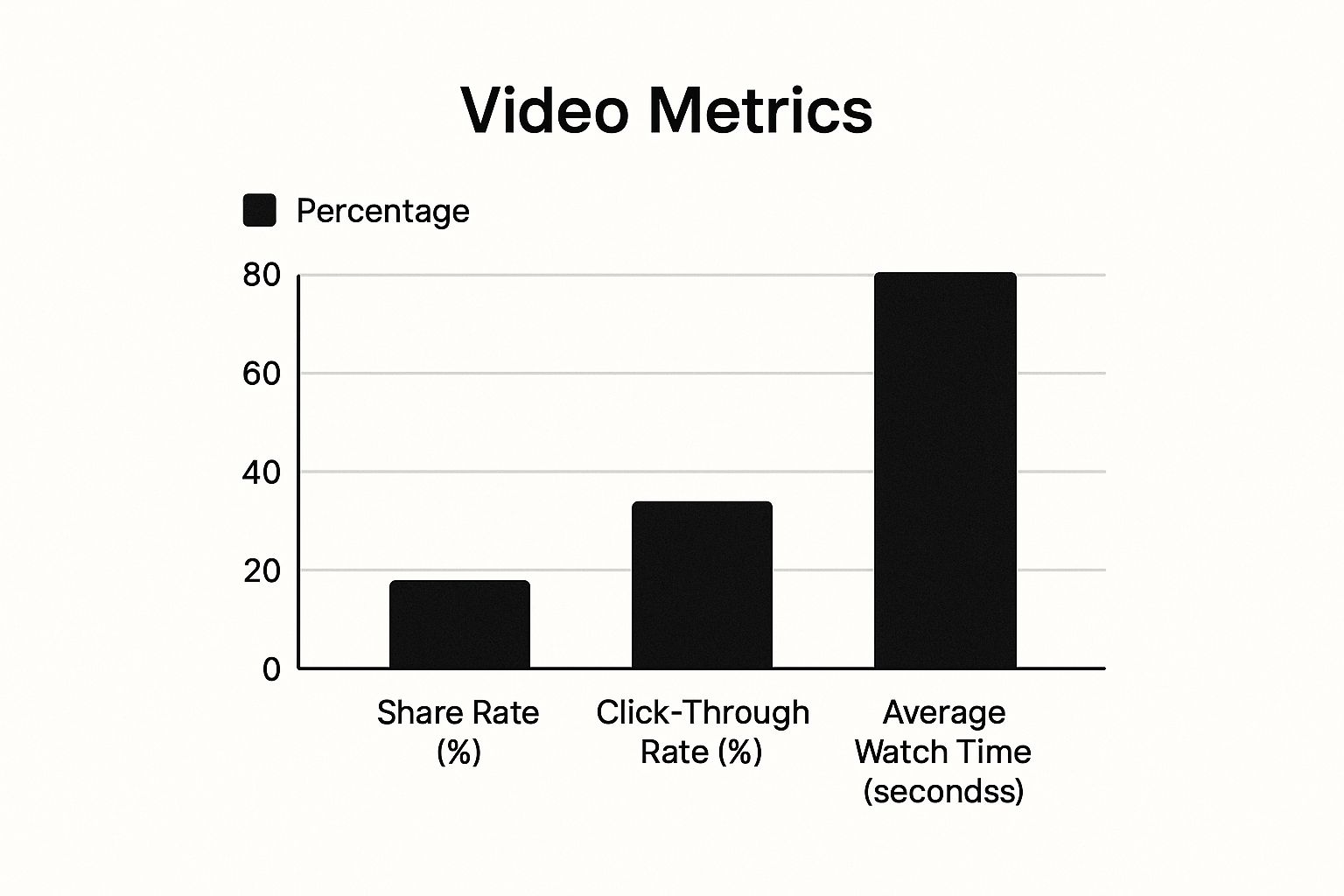
As you can see, a high share rate is the clearest sign of something taking off, even if other numbers like click-throughs are just so-so.
Key Metrics for Tracking Viral Potential
Once your content is live, tracking the right data is everything. This table breaks down the most important metrics to watch and why they're critical for understanding viral momentum.
| Metric | What It Measures | Why It's Important for Virality |
|---|---|---|
| Share Velocity | The rate at which your content is shared in a specific timeframe (e.g., first 24 hours). | A rapid share rate signals to algorithms that the content is highly engaging, triggering wider distribution. |
| Engagement Rate | The percentage of your audience that interacts (likes, comments, shares) with your post. | High engagement shows the content resonates deeply, encouraging platforms to favor it in feeds. |
| Audience Sentiment | The emotional tone of comments and reactions (positive, negative, neutral). | Positive, emotional comments indicate you've created a strong connection, which is a key driver of sharing. |
| Completion Rate | The percentage of viewers who watch a video to the end. | A high completion rate proves your content is holding attention, making it more likely to be recommended. |
| Click-Through Rate (CTR) | The percentage of people who click a link within your content. | While less of a virality metric, a high CTR shows your headline and hook are compelling enough to spark action. |
By focusing on these specific metrics, you move beyond surface-level analysis and gain real insights into what makes your audience tick.
Build Your Feedback Loop
With this data in hand, the real work begins. You have to connect the dots between the numbers you're seeing and the creative decisions you made. Start asking sharp, specific questions to turn those analytics into a concrete plan for next time.
For example, did that video with a really polarizing opening hook get a 50% higher share rate than your other stuff? That's a clue. Did the article where you shared a vulnerable, personal story get flooded with supportive comments? That's a clear signal you've tapped into a powerful theme.
This is the cycle: create, measure, adapt, repeat. Every piece of content is an experiment. Over time, you’ll stop guessing and start developing a real, gut-level feel for what your audience truly loves. This is how you turn the chaotic art of virality into a repeatable science.
Your Burning Questions About Viral Content, Answered
If you've ever tried to create viral content, you've probably run into the same questions and roadblocks that everyone else does. It's easy to get sidetracked by myths and misconceptions.
Let's clear the air and tackle some of the most common questions head-on.
So, How Long Does It Really Take for Content to Go Viral?
There's no golden rule here. Sometimes, a piece of content is like a wildfire, exploding in a matter of hours. Other times, it's more of a "slow burn," picking up steam over days or even weeks. It often comes down to getting that crucial first push—whether it’s from the right pocket of your audience or a single, influential share.
Keep a close eye on the first 24 to 48 hours. If you see a surge in shares and a genuinely positive reaction during that window, you might be onto something big. That initial velocity is a strong signal.
Can Any Type of Content Actually Go Viral?
I get this one a lot. While it's true that some formats, like short-form videos or memes, are built for speed and sharing, the underlying principles of virality can be applied to just about anything. It’s less about the type of content and more about the impact it has on people.
The real secret isn't the format; it's the value and emotion you pack into it. A deep-dive blog post can go viral if its insights are truly game-changing. An infographic can take off if it makes a complex idea beautifully simple.
Do I Need a Hollywood-Sized Budget?
Definitely not. In fact, some of the most legendary viral hits were created with little more than a clever idea and a smartphone. High production value can sometimes backfire, feeling too corporate or staged for platforms where authenticity reigns supreme.
Think about it: a raw, relatable video often connects with people on a much deeper level than a polished, expensive production. A small budget for promotion can help get the ball rolling, but at the end of the day, the idea is what truly matters.
Is It Realistic to Go Viral Consistently?
Trying to manufacture a viral hit on demand is a fool's errand. There’s always an element of luck, timing, and cultural zeitgeist that you just can't control. But what you can control is your process.
Instead of chasing lightning in a bottle, focus on building a system that consistently produces content with viral potential. By mastering audience psychology, creating content that packs an emotional punch, and promoting it smartly, you dramatically stack the odds in your favor. The goal isn’t to make every single piece explode, but to build a machine that regularly creates content that could.
At ReachLabs.ai, we specialize in building those systems—the ones that help brands create content that consistently connects and converts. See our strategic approach in action at https://www.reachlabs.ai.