Before you even think about DMing a single influencer, you need a blueprint. Seriously. Jumping into influencer marketing without a solid plan is a surefire way to waste time and money. Your strategy starts by nailing down three critical pieces: what you want to achieve, who you want to reach, and how you’ll measure success.
Building Your Influencer Collaboration Blueprint
Think of it this way: you wouldn't build a house without architectural plans. The same goes for influencer marketing. A clear blueprint turns hopeful guesses into a calculated strategy, making sure every dollar you spend actually moves the needle for your business.
The influencer marketing world is exploding—it’s projected to hit a market size of $32.55 billion in 2025, a huge jump from $24 billion in 2024. It’s no surprise that 86% of marketers are already working with creators, and a full 80% say these collaborations are effective. This isn't just a trend; it's a core marketing channel that delivers real results when done right.
Define Your Core Objectives
First things first: what are you actually trying to accomplish? Vague goals like "get more brand awareness" just won't cut it. You need to get specific and tie your objectives directly to your business goals.
For example, are you trying to:
- Drive direct sales? This is a classic for e-commerce brands. Success here is measured by tracking conversions from an influencer’s unique discount code or affiliate link.
- Generate high-quality leads? Perfect for B2B or service-based businesses. You’d track this by counting sign-ups for a webinar, newsletter, or product demo.
- Boost user-generated content (UGC)? This is gold for building social proof. You can measure it by tracking the amount of content created by an influencer’s audience using your campaign hashtag.
- Increase website traffic? A great goal for driving new eyes to your blog or product pages. You’ll need to track this with UTM parameters in every link you share.
Getting crystal clear on your goals at this stage is non-negotiable. It’s what will guide your choice of influencer, the kind of content you co-create, and the metrics you’ll obsess over later.
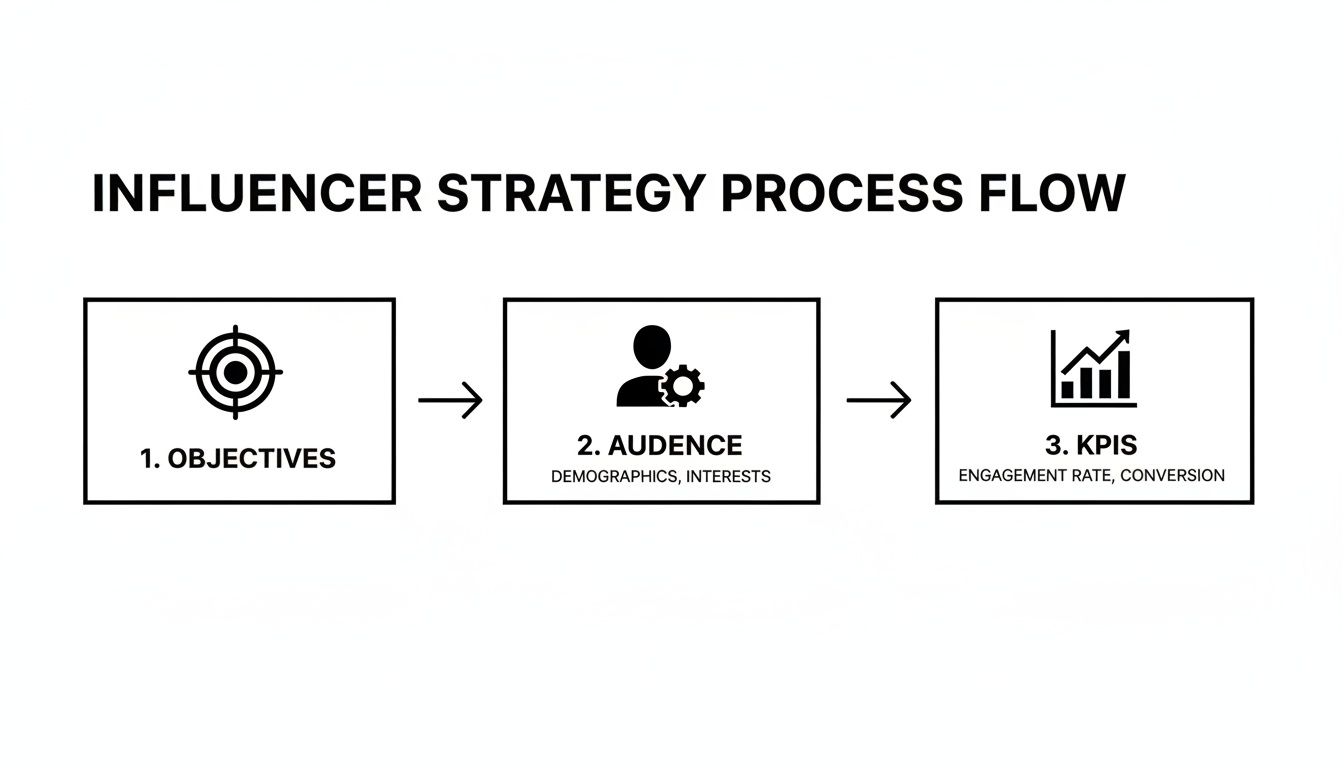
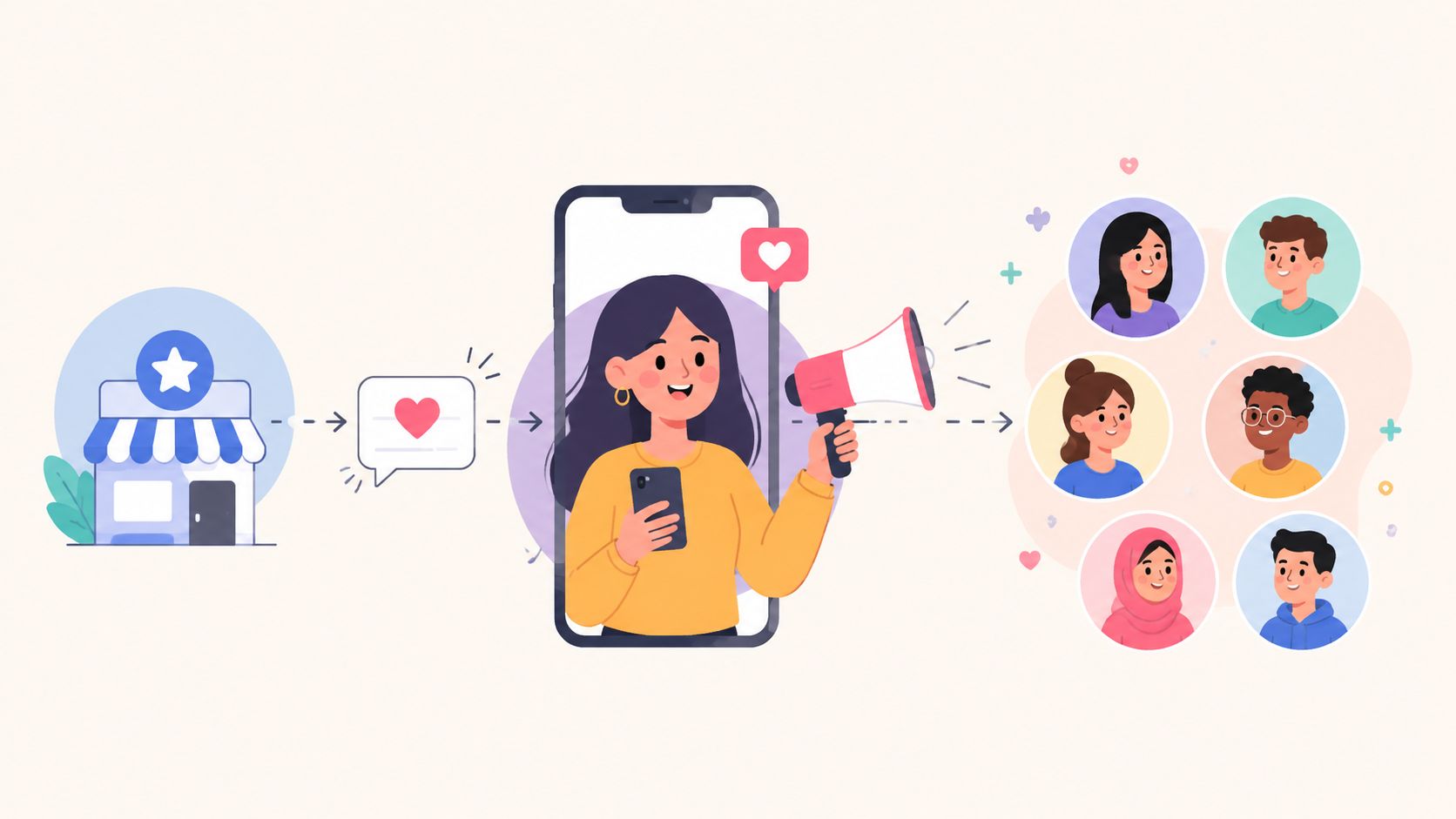
As you can see, it's a simple flow: your objectives determine who you target, which in turn dictates how you'll measure the outcome.
Profile Your Ideal Audience
You can’t find the right audience if you don’t know who you're looking for. Forget broad assumptions and build a detailed persona of the exact customer you want to attract through a creator’s community.
Get granular with it. Your persona should include:
- Demographics: Age, gender, location, income level.
- Interests & Hobbies: What do they geek out about? What podcasts do they listen to?
- Pain Points: What problem are they trying to solve that your product or service addresses?
- Online Behavior: Where do they hang out online? Are they on TikTok, Instagram, or reading niche blogs?
Think of this persona as your North Star. When you’re looking at a potential influencer, the first question you should ask is, "Does their audience actually match our persona?" If the answer is no, their follower count is just a vanity metric.
Set Your Budget and KPIs
Now it’s time to get real about the numbers. Your budget is more than just what you pay the influencer. You have to account for everything: the cost of sending them products, shipping fees, any ad spend you plan to put behind their posts, and even the software you use to manage the campaign.
With your budget set, you can define the Key Performance Indicators (KPIs) that link directly back to those objectives you set earlier. If your goal is sales, your primary KPI is conversion rate. If it's brand awareness, you'll be tracking reach and impressions.
Mapping your goals to specific metrics is the only way to prove your campaign worked. Here’s a quick-and-dirty guide to get you started.
Matching Campaign Goals to Real Metrics
| Campaign Goal | Primary KPI | Secondary KPI |
|---|---|---|
| Brand Awareness | Reach & Impressions | Follower Growth, Mentions |
| Driving Sales | Conversion Rate | Revenue, Average Order Value (AOV) |
| Generating Leads | Cost Per Lead (CPL) | Sign-ups, Form Fills |
| Building Community | Engagement Rate | Comments, Shares, Saves |
| Driving Traffic | Click-Through Rate (CTR) | Unique Website Visitors, Bounce Rate |
This framework isn't just about tracking numbers; it’s about proving the value of your work and justifying your marketing spend. As you build out this blueprint, you also need to keep an eye on what's next, like the future of AI influencers and how the landscape is shifting beyond basic promotions. A forward-thinking approach is what separates a good strategy from a great one.
How to Find and Vet the Right Influencers
Once your blueprint is solid, the real hunt begins. Finding the right influencer isn't about chasing massive follower counts. It's about discovering a genuine connection—someone whose audience trusts them implicitly and looks a lot like your ideal customer.
This part of the process is a mix of art and science. You need good intuition to spot authentic creators, but you also need hard data to back up your choices. Let's get beyond basic hashtag searches and dig into how you can find and properly vet creators who can become true partners for your brand.
Uncovering Influencers in Their Native Habitats
Your search should start exactly where your audience already hangs out. Instead of casting a wide, generic net, focus your energy on the platforms that actually matter to your brand.
- Platform-Specific Searches: Go deep on Instagram and TikTok. Don't just search for hashtags; use keywords related to your industry, your product, or the problems you solve. See who's making great content in that space and, more importantly, who your target customers are already following and talking to.
- Explore Your Community: You might be surprised to find that some of your best future partners are already fans. Scour your tagged posts, mentions, and comments. Who’s already shouting you out for free? These people are gold because their advocacy is already 100% authentic.
For small and medium-sized businesses, the real magic is often with smaller creators. Believe it or not, nano-influencers now make up 75.9% of Instagram's entire influencer base. Brands are catching on, with 73% of them now prioritizing collaborations with micro and mid-tier influencers. They've figured out that the engagement-to-cost ratio is just unbeatable, making them a smart, strategic choice for high-impact campaigns. You can find more data on this trend in the latest influencer marketing report from influencermarketinghub.com.
Using Influencer Discovery Platforms to Your Advantage
Let's be honest: manually searching for creators can feel like a full-time job. This is where dedicated influencer marketing platforms come in and save you a ton of time, helping you filter through millions of profiles to find the needles in the haystack.
These platforms let you get super specific with your search criteria:
- Audience demographics (age, location, gender)
- Niche or content category
- Engagement rates
- Follower count
- Keywords in their bio or content
Here’s a glimpse of how a platform dashboard can help you quickly sort through and analyze potential partners.
A tool like this turns your search from pure guesswork into a data-driven process. It lets you build a highly targeted list of potential collaborators without all the manual grunt work. If you're specifically looking to tap into the power of smaller, more engaged creators, our guide on how to find micro-influencers has even more focused strategies.
The Critical Vetting Process
Finding a list of potential influencers is really just step one. The real work happens when you start vetting them, digging deep to make sure they’re a legitimate and effective partner for your brand. A bad partnership can do more harm than good, and your credibility is on the line.
Vetting isn't about judgment; it's about alignment. You're not just hiring a spokesperson. You're choosing a partner to represent your brand, and their values, voice, and audience have to be a reflection of your own.
I always recommend creating a checklist to evaluate every candidate systematically.
Your Essential Vetting Checklist
-
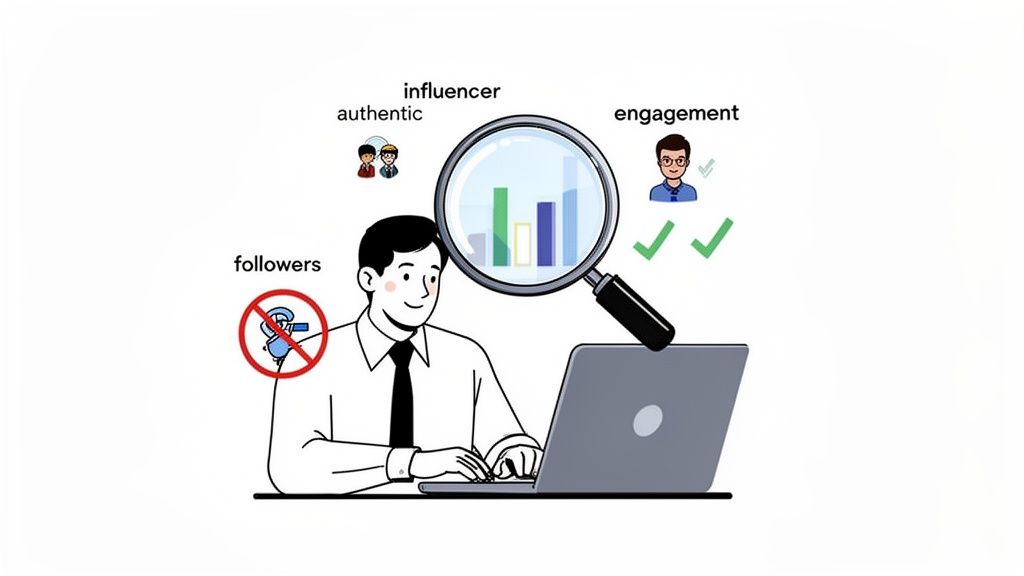
Analyze Engagement Authenticity: Forget the raw follower number for a second. What you really care about is a healthy engagement rate (likes, comments, shares, saves) relative to their follower count. A creator with 10,000 followers and 500 likes per post (5% engagement) is almost always more valuable than one with 100,000 followers and 1,000 likes (1% engagement).
-
Scrutinize the Comments: What's the quality of the comments on their posts? Are they all generic things like "Nice pic!" that could easily be from bots? Or are people asking real questions and having actual conversations? This is one of the biggest tells of a creator's true connection with their community.
-
Review Past Partnerships: Take a look at their previous sponsored posts (usually marked with #ad or #sponsored). Did the content feel forced, or was it a natural fit? How did their audience react? If their feed is just a long stream of ads for random brands, that’s a red flag. It suggests they aren’t very selective.
-
Assess Content Quality and Brand Alignment: Does their visual style and tone of voice actually match your brand? If you’re a minimalist, high-end skincare brand, partnering with an influencer whose aesthetic is loud and chaotic probably won't land well. The content should feel like it could live on your own marketing channels.
-
Confirm Audience Demographics: Don't just guess who follows them. Ask for their media kit or for recent screenshots of their audience analytics. You have to confirm that their followers line up with the ideal customer you mapped out in your strategy. If there’s a mismatch here, you'll be shouting into the void, no matter how great the content is.
Mastering Your Outreach and Negotiation
If there's one surefire way to get your outreach email sent straight to the trash, it's sending a generic, copy-paste message. You’ve done the hard work of finding the perfect creators; now comes the real challenge: cutting through the noise in their jam-packed inboxes.
This isn't about blasting out a template. It's about starting a genuine conversation. A successful pitch feels less like a business proposal and more like a note from a genuine fan who actually understands their brand and what they're trying to build. You want them to feel seen, not just targeted.
Crafting a Compelling First Impression
Your first email or DM has to be short, personal, and to the point. Influencers are busy people, so vague compliments just won't cut it. You have to be specific.
Instead of a generic line like, "I love your content," try something with more substance: "Your recent series on sustainable travel was incredible, especially the video from Costa Rica. The way you captured the local culture is exactly why we think you'd be a perfect fit for our brand's mission." See the difference? One is a template; the other shows you've actually paid attention.
To make your outreach impossible to ignore, nail these three things:
- A specific, genuine compliment: Reference a recent post, video, or story that caught your eye. More importantly, explain why it did.
- The "why you" angle: Clearly state what makes your brand a great partner for them. How does your product naturally fit into their world and bring value to their audience?
- A clear, easy CTA: Don't ask for the moon on the first date. Instead of pitching a full campaign, simply ask for a quick 15-minute call to explore a potential collaboration.
Mastering this first touchpoint is everything. For a deeper dive, check out these proven strategies for connecting with influencers.
Navigating the Negotiation Process
Once you get an interested reply, it's time to talk specifics. This shouldn't feel like a battle over dollars and cents. The best negotiations are about finding common ground and structuring a fair deal that gets both you and the creator excited.
Think of it as a collaborative discussion where you align on the core components: deliverables, content usage rights, and, of course, compensation. Walking into this conversation with a clear budget and a firm grasp of your goals is non-negotiable.
A great negotiation ends with both the brand and the creator feeling valued and motivated. It’s about building a win-win partnership that lays the foundation for authentic, high-performing content.
Understanding Compensation Models
There’s no one-size-fits-all approach to influencer compensation. The right model really depends on your campaign goals, the creator’s tier, and the scope of work you have in mind. Knowing your options helps you propose a structure that makes sense for everyone.
Here’s a quick rundown of the most common payment structures you'll come across:
| Compensation Model | Best For | Key Consideration |
|---|---|---|
| Flat Fee | Brand awareness campaigns with specific deliverables (e.g., 2 Instagram posts, 3 stories). | This is the most common model. It gives you budget certainty but requires a crystal-clear scope of work upfront. |
| Affiliate Commission | Driving direct sales and easily tracking ROI. Perfect for performance-focused campaigns. | The influencer earns a cut of sales from their unique link or code. It’s a low-risk way for brands to start. |
| Product Seeding | Working with nano or micro-influencers to build buzz and generate authentic reviews and UGC. | You gift products in exchange for content. It's cost-effective, but you give up creative control. |
| Hybrid Model | Campaigns aiming for both awareness and sales. It offers security for the creator and a performance upside. | This combines a base flat fee with a commission component, balancing the risk and reward for both sides. |
Whatever model you choose, make sure your final proposal is buttoned up. It should clearly outline every single expectation—from the number of posts and content themes to payment terms and FTC disclosure requirements. This level of clarity prevents headaches down the road and shows you’re a professional partner they'll want to work with again.
Co-Creating Campaigns That Resonate
Ever see an influencer partnership that just works? It doesn't feel like a jarring ad shoved into your feed. Instead, it’s woven so seamlessly into the content you already love that it feels like a natural recommendation from a trusted friend. That’s the magic of co-creation.
Forget about micromanaging. The goal isn't to turn creators into puppets reading your ad copy. It’s about empowering them to be genuine storytellers for your brand. When you hand over the creative reins, they produce content that truly hits home with their community, building a level of trust a scripted ad could never achieve.
Building a Brief That Guides, Not Dictates
The creative brief is your campaign's North Star. Get it right, and everything else falls into place. A great brief walks a fine line, providing essential direction without strangling the creator's unique voice.
Think of it as setting the boundaries of the playground. You need to be crystal clear on the non-negotiables:
- The Big Goal: What, specifically, do you want people to do? Is it about driving sign-ups, using a discount code, or just building awareness for a new feature?
- Key Messages: What are the one or two absolute must-knows about your product? Don't overwhelm them; keep it focused.
- Mandatory Bits: This is where you list the official product name, specific campaign hashtags (like #YourBrand2024), and any social handles they need to tag.
- FTC Compliance: This is non-negotiable. You must require them to clearly disclose the partnership with #ad or #sponsored right at the beginning of the caption. It protects you, the creator, and the audience.
The most common mistake I see is brands sending over a rigid script or a shot-for-shot storyboard. That approach completely kills authenticity and leads to content that feels stiff and forced. Your brief should provide the "what" and the "why," then trust the influencer to figure out the "how."
Your brief should be a guardrail, not a straitjacket. It’s there to keep the campaign on track while giving the creator the space to drive. True collaboration with influencers means trusting their expertise in connecting with their own audience.
The Power of Creative Freedom
Once the brief is locked in, the best thing you can do is step back. When a creator integrates your product into their signature content—like a "Get Ready With Me" video or a "Day in the Life" vlog—it just feels right. For instance, a tech brand could send a new monitor to a productivity YouTuber and let them show how it actually fits into their daily workflow, instead of demanding a sterile, feature-by-feature review.
That’s where the real results come from. The audience trusts that creator for a reason. When your product becomes a natural part of their story, the endorsement carries so much more weight.
It's a model that works, and brands are catching on. In fact, 73.2% of them now work with at least ten influencers on a single campaign to broaden their reach. This strategy is especially potent in major markets; for example, the US accounts for 22.7% of all sponsored posts on Instagram. You can dive deeper into these numbers and other insights into influencer marketing trends on influencermarketinghub.com.
Managing the Campaign Workflow
Empowering creators doesn't mean you just throw your hands up and hope for the best. A smooth, predictable workflow is crucial for keeping everything on schedule and making the process stress-free for both sides. It all comes down to communication.
Lay out the process from day one:
- Content Submission: Give them a firm deadline for submitting their draft content for you to look over.
- Feedback Loop: When you give notes, make them timely and consolidated. Focus your feedback on the important stuff, like brand safety or factual errors, not nitpicking their creative choices.
- Go-Live: Agree on a posting date and time that makes sense for their audience's peak engagement.
This simple, structured approach shows respect for the creator's time while making sure your core brand needs are met. It turns a one-off transaction into a real partnership. If you want to see how this plays out in the wild, check out these successful influencer marketing campaign examples for some great inspiration.
Measuring Your Campaign's True Impact
Once the influencer's content goes live, your job isn't over—it's just shifting gears from creation to analysis. This is where the real work begins. You need to peel back the layers of your campaign's performance, prove its value, and uncover the golden nuggets of insight that will make your next partnership even better.
This isn't just about counting likes. It’s about connecting every single data point back to the business objectives you set out from the very beginning.

The real game-changer in modern influencer marketing is using technology to track what’s actually working. A recent study found that 66.4% of marketers see significantly better results when they use AI-powered tools for creator discovery and performance analytics. These platforms make it so much easier to pinpoint which posts are hitting the mark and calculate a clear, undeniable ROI.
Connecting Performance to Your Initial KPIs
Remember those Key Performance Indicators you defined in your campaign brief? It's time to pull them out. They are now your official scorecard. Every metric you look at should directly answer the question, "Did we hit our target?"
Here are the non-negotiable tools you should be using:
-
UTM-Tagged Links: These are your best friends for tracking web traffic. By giving each influencer a unique URL, you can see precisely how many clicks, new users, and even sales came directly from their posts. If your goal is traffic or lead gen, this is a must.
-
Custom Discount Codes: For e-commerce brands, nothing beats a unique code like "CREATOR15" for attributing sales. It draws a straight, clean line from an influencer's content to a customer's shopping cart, making revenue tracking a breeze.
-
Platform Analytics: Don't sleep on the native analytics inside Instagram, TikTok, or YouTube. These dashboards are packed with rich data on reach, impressions, saves, and shares—all critical for gauging brand awareness and how well the content resonated with the audience.
One metric alone doesn't tell the whole story. High engagement is great, but when you pair it with a strong click-through rate from a UTM link, you've got a much more powerful narrative about that influencer's ability to actually drive action.
Calculating Your Bottom-Line Impact
Beyond the surface-level metrics, you have to get into the financial nitty-gritty. This is how you prove your investment paid off in a tangible way. Getting comfortable with a few key formulas will completely change how you report on success and argue for future budgets.
To really get this right, you have to understand the nuances of what "return" means for your brand. If you want to go deeper, our complete guide on calculating your influencer marketing ROI breaks down more advanced models and industry benchmarks to help you measure success with precision.
Here's a look at the essential calculations you should be running for every single campaign.
This table breaks down the most important metrics, what they actually tell you, and the simple formulas to calculate them.
Essential Influencer Campaign Metrics
| Metric | What It Measures | How to Calculate |
|---|---|---|
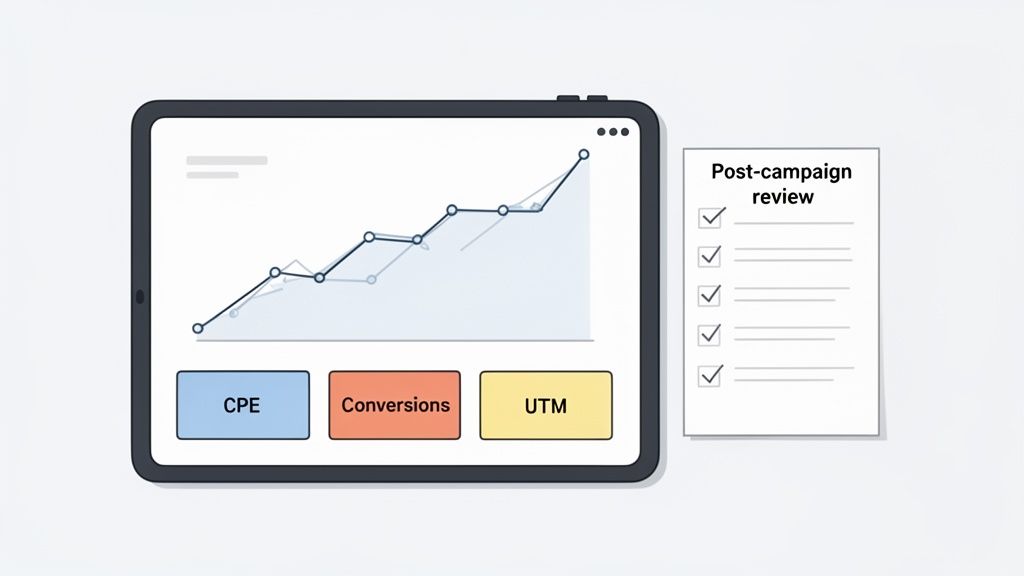
| Cost Per Engagement (CPE) | The cost-effectiveness of generating interactions like likes, comments, and shares. | Total Campaign Cost / Total Engagements |
| Conversion Rate | The percentage of people who completed a desired action (like a purchase or sign-up). | (Total Conversions / Total Clicks) * 100 |
| Return on Ad Spend (ROAS) | The revenue generated for every dollar you spent on the campaign. | Total Revenue from Campaign / Total Campaign Cost |
Mastering these figures helps you move the conversation from subjective feedback ("the post looked great!") to objective results ("the post drove a 3x ROAS"). This data-driven approach is what separates one-off experiments from a professional, scalable influencer program.
Analyzing Qualitative Feedback
Numbers tell a huge part of the story, but the rest is hidden in the comments. An influencer’s comment section is a goldmine of raw, unfiltered audience sentiment. Are people tagging their friends? Are they asking smart questions about the product?
Look for comments like, "OMG, I've been looking for something just like this!" or "Just ordered with your code, thank you!" This is powerful proof that the influencer's recommendation felt genuine and landed perfectly. On the flip side, a sea of generic comments or questions showing confusion can be a red flag that the messaging was off. This qualitative deep-dive helps you understand the why behind the data.
Conducting a Post-Campaign Review
The final, crucial step is to wrap everything up in a comprehensive post-campaign review. This isn’t just about creating a report to file away; it's a strategic meeting to figure out what to do more of and what to fix next time.
Gather your team and ask these key questions:
- Which influencer drove the most engagement and conversions?
- What content formats (Reels, Stories, carousels) worked best?
- Did the audience's comments and reactions align with how we want our brand to be seen?
- What were our biggest challenges or unexpected wins?
This process transforms a single campaign from a standalone project into a valuable learning opportunity. It helps you identify your true top-tier partners—the ones worth building long-term relationships with—and gives you a clear roadmap to make every future campaign even more successful.
Frequently Asked Questions
Diving into your first few influencer collaborations can feel a little like you're learning a new language. You've got questions about costs, those tricky legal terms, and what everyone else is doing. Let’s clear up some of the most common questions I hear so you can partner with creators confidently.
How Much Does It Cost To Collaborate With An Influencer?
If you're looking for a simple price tag, you won't find one. The cost of an influencer collaboration is all over the map, depending on everything from the creator’s audience size and engagement rate to the platform they use and how much work you’re actually asking them to do.
To give you a ballpark, a nano-influencer might be thrilled with free products in exchange for a post. Micro-influencers often fall in the $100 to $1,000 per post range. Once you get into macro-influencer territory, you're talking several thousand dollars, and the mega-stars can easily command six-figure deals for a single campaign. Your negotiation should always circle back to the full scope of work, not just the post itself.
What Is The Difference Between Usage Rights And Ownership?
This is probably one of the most critical—and often misunderstood—parts of any deal. By default, the creator always owns the copyright to the content they make for your campaign. It's their intellectual property.
When you negotiate for "usage rights," you're basically licensing that content from them. You’re getting permission to use it for a specific purpose (like on your social channels or in paid ads) for a limited time (say, 90 days).
Full "ownership" or a total content "buyout" is a different beast entirely. It gives your brand the keys to the kingdom—perpetual, unrestricted rights to use that content however you want, forever. As you can imagine, this is way more expensive and much less common. Always, always get the usage rights spelled out in your contract to avoid a massive headache later.
How Do I Ensure Influencers Comply With FTC Disclosures?
Here’s the deal: making sure sponsored content is properly disclosed is a shared legal responsibility. Both your brand and the creator are on the hook if you don't follow the Federal Trade Commission (FTC) guidelines. The easiest way to get this right is to be crystal clear from day one.
Your creative brief and influencer contract must state that clear, conspicuous disclosure is a non-negotiable part of the collaboration. This protects you, the creator, and most importantly, maintains transparency with the audience.
In practice, this means requiring hashtags like #ad, #sponsored, or #BrandPartner at the very beginning of the caption. Don't bury it. Just put it in writing and make it a requirement for payment.
What Should Be Included In An Influencer Contract?
A solid contract is your best friend in this business. It’s not about being difficult; it’s about setting clear expectations to prevent any confusion or disputes down the road. A good agreement will always cover these key areas:
- Scope of Work: Be specific. How many deliverables and what kind? (e.g., 2 Instagram Reels, 5 Stories).
- Campaign Timeline: Include all the key dates—draft submissions, feedback rounds, and the final go-live post date.
- Compensation: State the payment amount, how you'll pay, and when you'll pay it.
- FTC Disclosure: Yes, put it in the contract again. It’s that important.
- Usage Rights: Detail exactly how, where, and for how long your brand can use the influencer's content.
- Exclusivity: Does the deal prevent the creator from working with competitors for a certain period? If so, define it here.
- Termination Clause: Outline the conditions under which either of you can decide to end the partnership.
Ready to build a powerful, data-driven influencer marketing program that gets real results? At ReachLabs.ai, we blend expert strategy with creative execution to elevate your brand's voice and drive authentic engagement. Discover how our tailored approach can move the needle for your business at https://www.reachlabs.ai.