

Calculating your marketing return on investment, or ROI, isn't as complicated as it might sound. The basic formula is straightforward: you take the net revenue from your campaign, subtract what you spent on marketing, divide that by your marketing cost, and then multiply by 100 to get a percentage.
Here’s the formula: [(Net Revenue – Marketing Investment) / Marketing Investment] x 100
Getting comfortable with this calculation is the first real step toward showing marketing's direct impact on the bottom line.
Why Mastering Marketing ROI Matters

Let's be real—marketing can often be seen as just a cost center until you can tie it directly to revenue. Without solid ROI numbers, trying to get a bigger budget or even defend your current strategies feels like a constant uphill battle.
But when you can walk into a meeting and clearly show how your team's work is generating profit, the whole conversation changes. Suddenly, you're not just talking about clicks and impressions; you're talking about growth and profitability. This is the language executives and finance teams speak.
To calculate ROI accurately, you need to be crystal clear on what goes into the formula. Each component plays a critical role.
Key Components of the Marketing ROI Formula
A breakdown of the essential variables needed to calculate marketing ROI accurately.
| Component | Definition | Example |
|---|---|---|
| Net Revenue | The total revenue generated from a campaign, minus the cost of goods sold (COGS). | Your PPC campaign generated $100,000 in sales. If COGS was $40,000, your net revenue is $60,000. |
| Marketing Investment | The total cost of executing the marketing campaign. This includes ad spend, software, and creative costs. | Your total PPC ad spend was $15,000, plus $5,000 for a landing page and design work, making the total investment $20,000. |
| ROI Percentage | The final calculated percentage that represents the return on your marketing investment. | [($60,000 – $20,000) / $20,000] x 100 = 200% ROI. |
Understanding these pieces helps ensure your calculations are grounded in reality, giving you a number you can confidently stand behind.
Justify Your Budget and Strategy
Imagine this scenario: you're trying to decide between a splashy, high-cost PPC campaign that promises quick leads and a long-term content marketing plan designed to build organic authority. The PPC campaign will cost $20,000, while the content initiative is $15,000 spread over six months. Which one do you pick?
This is where ROI brings much-needed clarity. Instead of going with your gut, you can forecast the potential return from each and make a decision backed by data. A solid handle on ROI helps you:
- Secure Bigger Budgets: Proving a 300% ROI on your last campaign makes asking for more funding a whole lot easier.
- Defend Strategic Choices: When stakeholders are skeptical, showing them a clear financial upside gets them on your side.
- Optimize Future Campaigns: You’ll know exactly what’s working and what isn’t, so you can shift resources to your most profitable channels.
You can learn more about how to continuously improve marketing ROI with the right data and strategic adjustments.
The narrative shifts from "we spent $20,000" to "we invested $20,000 to generate $80,000 in revenue." This simple reframe moves marketing from an operational cost to a core business driver.
Make Smarter Investment Decisions
Getting good at calculating ROI isn't just about looking backward; it's about shaping a more successful future. When you consistently measure your returns, you start to spot powerful patterns. You'll learn which channels bring in the most valuable customers and which messages truly connect with them.
To really dig in, you can evaluate the effectiveness of different strategies, like Account-Based Marketing (ABM). This deeper analysis helps you answer the tough questions:
- Does our email marketing really deliver a better return than paid social?
- Which types of content are actually converting leads into paying customers?
- What’s the long-term value of a customer we won through organic search versus one from a trade show?
This is the kind of insight that lets you build a smarter, more profitable marketing machine. You stop throwing money at tactics that don't perform and double down on what works, making sure every dollar you spend is pulling its weight.
Gathering the Right Data for Your ROI Calculation

Any ROI calculation is only as good as the data you feed it. That "garbage in, garbage out" saying isn't just a cliché—it's a serious warning for marketers. To get a number you can actually trust and take to your leadership team, you need a complete, honest picture of both your costs and your returns.
The process kicks off with your investments, and this is where many people trip up. It’s easy to remember the big-ticket items like ad spend, but a true ROI calculation goes much, much deeper. If you only count the obvious costs, you’ll end up with a wildly inflated ROI that doesn't reflect reality.
Identifying All Your Marketing Costs
To really get a handle on how to calculate marketing ROI, you have to account for every single dollar that went into making a campaign happen. This means tracking both the direct expenses you see on invoices and the indirect costs that are easier to forget.
Direct Costs are usually the most straightforward. These are the expenses you can point to on a budget line item that are directly tied to running a campaign:
- Ad Spend: The money paid directly to platforms like Google, Meta, or LinkedIn.
- Software and Tools: All those subscriptions for your marketing automation platform, analytics dashboards, SEO tools, or social media schedulers add up.
- Agency or Freelancer Fees: The cost of any external help you hired for creative work, campaign management, or content creation.
Indirect Costs, on the other hand, are often overlooked but are absolutely critical for an accurate picture. These include things like:
- Team Salaries: A proportional slice of the salaries for the marketing team members who dedicated time to the campaign.
- Content Creation Overhead: The internal time and resources your team spent creating blog posts, shooting videos, or designing ad creative.
- Promotional Materials: Don't forget the costs for printing flyers, booth fees for events, or shipping for a direct mail campaign.
Capturing every single cost—from a $50,000 ad budget down to a $30 monthly software subscription—is what separates a vanity metric from a valuable business insight. It’s the difference between guessing and knowing.
Think about it this way: a recent social media campaign might have a $10,000 ad spend. But if your internal designer and copywriter spent a combined 40 hours on it, that labor cost is a very real expense. Ignoring it makes the campaign look far more profitable than it actually was.
Accurately Attributing Revenue to Marketing
Once your costs are all tallied up, the next big challenge is connecting sales directly back to your marketing efforts. This is where attribution becomes your best friend. Without a solid way to link revenue to specific campaigns, you're essentially flying blind and can't prove your worth.
The whole point is to answer the question: "Did this marketing activity actually lead to a sale?" Luckily, we have several tools at our disposal to do this with confidence.
Leveraging Tracking Tools and Techniques
-
UTM Parameters: These are simple snippets of code added to your URLs that tell analytics tools exactly where your traffic came from. By tagging links in your emails, social posts, and ads, you can see which specific campaigns are driving conversions down to the last click. Getting this right is a fundamental skill, so it's worth mastering the art of marketing campaign tracking.
-
CRM Data: Your Customer Relationship Management (CRM) system, whether it's Salesforce or HubSpot, is an absolute goldmine of data. It should be configured to track a lead's source from their very first interaction all the way through to a closed deal. This creates an undeniable line between a marketing touchpoint and a final revenue number.
-
Google Analytics and Other Platforms: These tools give you incredibly detailed reports on traffic sources, user behavior, and goal completions. You can set up specific goals, like form submissions or e-commerce purchases, to measure the direct impact of your different marketing channels.
For example, a customer might click a Facebook ad (which you've tracked with a UTM), download a guide from your landing page (which is tracked in your CRM), and then make a purchase a week later. A robust tracking system connects all these dots, ensuring marketing gets the credit it earned.
To take it a step further, it's helpful to understand the key metrics for measuring ROI using AI and BI, as these advanced tools can automate and seriously refine your attribution process. Building a reliable data collection system from the start is what prevents ROI calculations from turning into a nightmare, giving you clear, defensible numbers to guide your strategy.
The Nuts and Bolts of Calculating Marketing ROI
Alright, let's get down to the brass tacks. At the end of the day, calculating marketing ROI is all about one thing: figuring out if the money you're putting in is bringing even more money back out. It's that simple.
We'll start with the most common formula you'll see everywhere. It’s a great way to get a quick read on a campaign's performance.
The Classic, Revenue-Based ROI Formula
You’ve probably seen this one before. It's the go-to for a reason—it's clean, direct, and gets you an answer fast.
[(Sales Growth – Marketing Cost) / Marketing Cost] x 100
Here, Sales Growth is just the total revenue your campaign pulled in. For instance, if you ran a social media ad campaign that directly led to $25,000 in sales, that’s your sales growth figure.
Let's put it into a real-world context. Say your e-commerce brand just wrapped up a new influencer marketing push.
- Sales Growth Attributed to Campaign: $25,000
- Total Marketing Cost: $5,000 (this should include everything—influencer fees, ad spend, creative, etc.)
Let's plug those numbers in:
[($25,000 – $5,000) / $5,000] x 100 = 400% ROI
A 400% return? That looks incredible. For every dollar you spent, you got four dollars back in profit. But hold on. This number, as impressive as it seems, is hiding a major blind spot. It completely ignores the cost of the products you sold.
Getting Real with a Gross Profit-Based Calculation
To get a true understanding of your campaign's financial impact, you have to look beyond raw revenue. You need to factor in your Cost of Goods Sold (COGS)—what it actually cost you to produce the items that people bought.
The more accurate formula looks like this:
[(Sales Growth – COGS – Marketing Cost) / Marketing Cost] x 100
This one small tweak makes a world of difference. It shifts the focus from simply generating sales to generating actual profit, which is what really keeps the lights on.
Let’s go back to our influencer campaign example, but this time, we’ll include the COGS.
- Sales Growth Attributed to Campaign: $25,000
- Cost of Goods Sold (COGS): $15,000
- Total Marketing Cost: $5,000
Now, when we run the numbers with the updated formula, the story changes.
[($25,000 – $15,000 – $5,000) / $5,000] x 100 = 100% ROI
See the difference? Our ROI just dropped from a stellar 400% to a much more grounded 100%. This is a far more honest picture of how the campaign actually performed.
By including COGS, you move from measuring top-line revenue to bottom-line impact. It’s the kind of distinction that prevents you from patting yourself on the back for a "successful" campaign that was barely profitable.
This is especially critical if you sell physical products. The data backs this up. One report found the median marketing ROI across channels was around 122%, but the numbers were consistently lower when COGS was included. I’ve seen this firsthand—some businesses saw their ROI drop from an apparent 400% to just 60% after factoring in product costs. You can dig into more of these digital marketing ROI statistics to see just how common this is.
Why This Little Detail Matters So Much
Ignoring COGS is a recipe for bad decisions. You could end up pouring more and more of your budget into a campaign that looks like a winner on paper but is actually just breaking even—or worse, losing money.
On the flip side, you might overlook a campaign with a lower revenue-based ROI that’s actually more profitable because it’s moving high-margin products. The gross profit formula brings these crucial nuances to light, giving you the clarity you need to put your budget where it will truly make a difference. It’s the only way to measure how your marketing is contributing to the real financial health of the business.
Digging Deeper: Advanced Models for a More Accurate ROI
https://www.youtube.com/embed/aCfXHGYVbGs
While the basic formula gives you a solid snapshot of a single campaign, it doesn't tell the whole story. Let's be honest, real marketing success isn't just about one-off wins. It's about building profitable, long-term relationships with customers. This is where more advanced models come into play, helping you see far beyond the initial transaction.
To truly get a handle on how to calculate marketing ROI, you have to shift your focus from short-term gains to lifetime value. This one change completely reframes the entire conversation you have about marketing investments.
It’s All About Customer Lifetime Value
Customer Lifetime Value (CLV) is essentially a prediction of the total net profit you'll earn from a customer over the entire course of their relationship with your business. Instead of asking, "How much did we make from this one sale?" CLV forces you to ask, "How much profit will this person generate over their entire time with us?"
That's a massive distinction. A campaign might have a pretty modest ROI at first glance, but if it brings in customers who stick around and make repeat purchases for years, its true value is enormous. By bringing CLV into the picture, you can justify spending more to acquire a customer because you have the data to prove the long-term payoff is there.
Think about it this way: a $100 acquisition cost for a customer who only makes one $120 purchase (with $50 in costs) leaves you with a disappointing -30% ROI. But what if that same customer makes that same purchase every single year for five years? The total profit jumps to $250, and the long-term ROI on that initial $100 investment is a much healthier 150%.
By incorporating CLV, you move from a transactional mindset to a relational one. It's the difference between winning a single battle and winning the entire war for market share.
This decision tree helps visualize when it's okay to stick with basic ROI and when you really need to bring in a more advanced analysis.
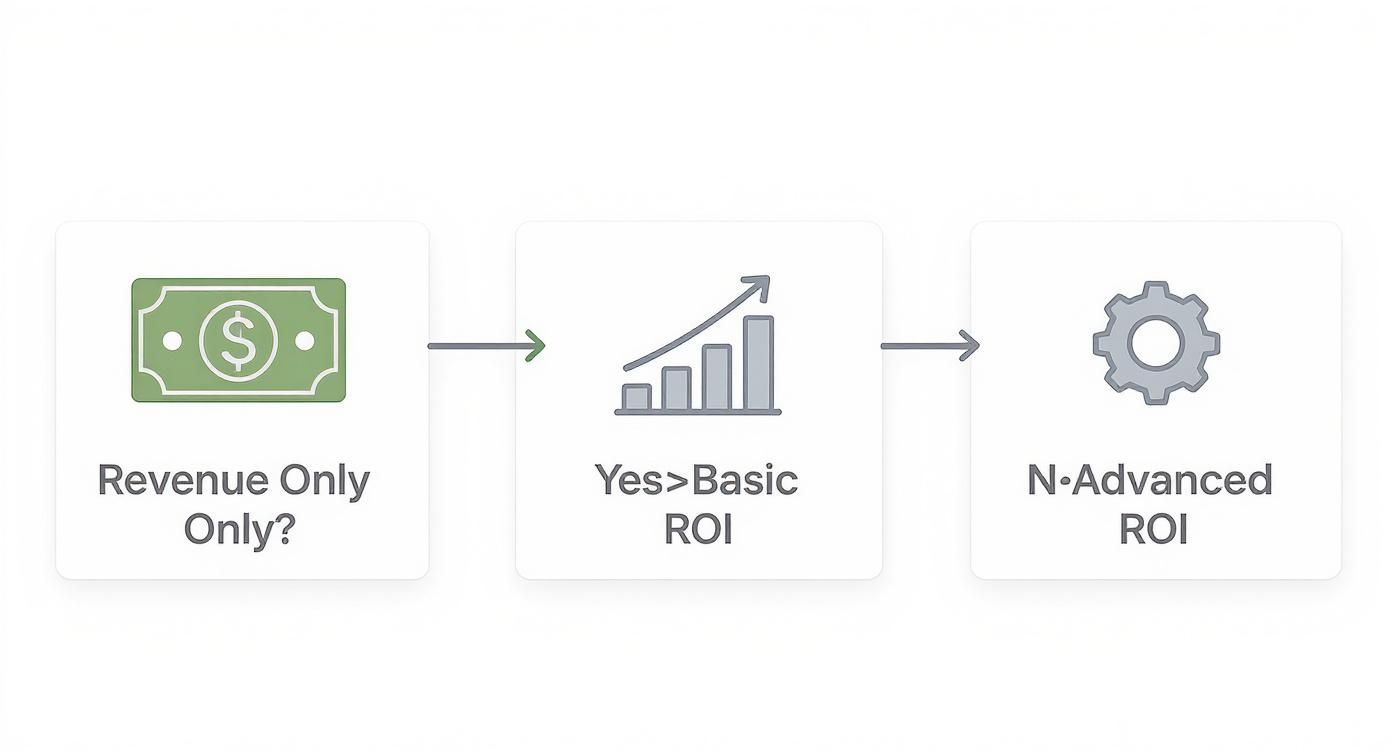
As the infographic shows, if your analysis stops at immediate revenue, you're only getting a surface-level view. To get a real understanding, you have to go deeper with advanced models.
Unraveling the Customer Journey with Attribution Models
The other big piece of the advanced ROI puzzle is attribution. It’s the art and science of giving credit where credit is due. When a customer interacts with your brand across five different channels before buying, how do you decide which one was most effective?
Most businesses, out of sheer simplicity, fall back on last-click attribution. This model gives 100% of the credit to whatever the customer clicked on right before they converted. It’s easy, but it's also deeply flawed. It almost always overvalues channels like branded search and direct email while completely ignoring the hard work done by your blog posts, social media content, and top-of-funnel ads that introduced the customer to you in the first place.
To get a more accurate picture, you need to look at multi-touch attribution models. These models are built on the idea that the entire customer journey matters, not just the final step.
A 2023 survey found that companies using advanced attribution were 2.3 times more likely to report a positive ROI. The same study revealed that businesses incorporating CLV into their ROI calculations saw a 40% increase in long-term profitability. You can explore more about these findings on marketing ROI to see the full impact.
I've put together a quick comparison of some of the most common attribution models to help you figure out which one might be right for you.
Comparing Marketing Attribution Models
| Attribution Model | How It Works | Best For |
|---|---|---|
| Linear | Gives equal credit to every single touchpoint on the customer's path to purchase. | Getting a baseline understanding of all the channels that play a role in the customer journey. Simple and fair. |
| Time-Decay | The touchpoints closest in time to the conversion get the most credit. | Longer sales cycles where recent interactions are likely more influential in the final decision. |
| U-Shaped | Gives 40% credit to the first touch and 40% to the last touch, splitting the remaining 20% among the middle touches. | Businesses that value both generating the initial lead and closing the deal, seeing both as critical milestones. |
| Last-Click | Gives 100% of the credit to the final touchpoint before a conversion. | Simple, quick analysis, but often provides a skewed and incomplete picture of what's actually working. |
Each model gives you a different lens through which to view your marketing performance. The key is to move beyond the limitations of last-click and choose a model that reflects how your customers actually behave.
Tying It All Back to Smarter Decisions
Adopting these more sophisticated models does a lot more than just give you a more accurate number to put in a report. It fundamentally changes how you think about your budget and where you put your resources.
When you can finally see how different channels work together, you stop making decisions in a vacuum. You might discover, for example, that your organic blog content—which has a terrible last-click ROI—is actually the number one way you introduce new customers to your brand. Armed with that knowledge, you can confidently invest more in your SEO and content strategy, knowing it’s what fuels the top of your funnel. This holistic view is also a key principle in other advanced strategies, which you can dive into in our guide on what is marketing mix modeling.
Ultimately, using CLV and multi-touch attribution helps you build a much smarter, more resilient, and more profitable marketing engine. It’s how you start making intelligent investments, prove the value of your long-term strategies, and finally get a true understanding of what really drives growth for your business.
Proving Your Impact with Incremental ROI

You've crunched the numbers, calculated the ROI, and the result looks fantastic. But just as you're about to take a victory lap, someone in the boardroom asks the killer question: "How do we know those sales wouldn't have happened anyway?"
It’s a fair and tough question. Proving your campaign caused a sales lift—rather than just being along for the ride—is the final boss of ROI calculation. This is precisely where incremental ROI comes into play.
Essentially, it's a way to measure the true impact of your marketing. The goal is to figure out the exact amount of extra revenue a specific marketing campaign generated, above and beyond what you would have earned organically without it.
Isolating Your Marketing's True Influence
To measure this incremental lift, you need a baseline. The most reliable way to do this is by setting up a control group—a segment of your audience that you intentionally don't show your campaign to.
By comparing the behavior of the group that saw the campaign (the test group) to the group that didn't (the control), you can attribute the difference in performance directly to your marketing efforts. It’s a clean, scientific approach that gives you bulletproof evidence.
Here are a few ways to set up these kinds of experiments:
- A/B Testing: A classic for a reason, especially in email or digital ads. You split your audience, show one group the campaign, and withhold it from the control group. Simple and effective.
- Geo-Targeted Experiments: For bigger campaigns (think TV or radio), you can choose specific cities or states as your test markets and leave others as a control. This works when you can't control exposure on an individual level.
- Holdout Groups: Here, you randomly select a portion of your audience and deliberately exclude them from a campaign, like retargeting ads or a promotional email series. It’s a powerful way to measure the ongoing impact of your activities.
Incremental ROI shifts the conversation from correlation to causation. It’s no longer about what happened while your campaign was running, but what happened because your campaign was running.
A Practical Example of Incremental ROI
Let’s walk through how this looks in the real world. Imagine an e-commerce company decides to test a new email personalization engine. The engine costs $8,000 to run for a one-month campaign.
To see if it's worth it, they set up a test:
- Test Group: 90% of their email list gets emails with hyper-personalized product recommendations.
- Control Group: The remaining 10% gets the standard, non-personalized emails they would have received anyway.
After a month, the results are in. The test group brought in $50,000 in revenue, while the control group only generated $30,000. The incremental lift—the revenue directly caused by the new engine—is the $20,000 difference between the two.
Now, calculating the incremental ROI is straightforward:
[($50,000 – $30,000) / $8,000] x 100 = 250% ROI
This 250% figure is far more defensible than a simple ROI calculation. It proves that the $8,000 investment didn't just coincide with sales; it directly generated an extra $20,000. In fact, one benchmark report found that companies using these methods reported a more realistic average ROI of 250% because they could finally isolate marketing's true contribution. You can discover more insights about these marketing campaign findings and see how this approach brings clarity.
When you start measuring incrementally, you arm yourself with credible, data-backed proof of your value. You can turn those skeptical questions into confident conversations about how marketing directly impacts the bottom line.
Answering the Tough Questions About Marketing ROI
Once you’ve got the basic formulas down, you start bumping into the real world. And the real world is messy. Calculating ROI isn't just a matter of plugging numbers into a spreadsheet; it’s about wrestling with the complex, sometimes frustrating realities of modern marketing.
Let's dig into some of the most common hurdles marketers face when trying to prove their work is moving the needle. Getting these right can be the difference between getting more budget and getting your budget cut.
How Do You Calculate ROI for Long-Term Strategies?
This is one of the biggest headaches, especially for things like SEO and content marketing. You publish a fantastic blog post today, but it might not generate a solid lead for six months. So how in the world do you measure that?
The trick is to stop waiting for the final sale and start tracking the breadcrumbs that lead to it. You need to measure the intermediate steps that tell you you're heading in the right direction.
- Track Leading Indicators: Keep a close eye on metrics like organic traffic growth, keyword rankings (especially for high-intent terms), and the number of marketing-qualified leads (MQLs) coming from your content. These aren't dollars in the bank yet, but they're strong predictors of future revenue.
- Use Cohort Analysis: This sounds complicated, but it's pretty simple. Group together everyone who first found you through your content in a specific month (that's your "cohort"). Then, watch how that group behaves and converts over the next 6, 12, or even 18 months. This method directly ties long-term sales back to the content that first hooked them.
This approach helps you show progress and keep the faith (and the funding) for your long-game strategies. You're proving that you’re building a valuable, revenue-generating asset, not just running a flash-in-the-pan campaign.
You're not just measuring the immediate harvest; you're proving the value of planting the seeds. This mindset shift is crucial for justifying investments in foundational marketing channels like SEO and content.
What Is Considered a Good Marketing ROI?
Ah, the million-dollar question. And the honest-to-goodness answer is: it depends. There’s no magic number here. A “good” ROI is completely tied to your business model, industry, and, most importantly, your profit margins.
A 3:1 ROI (300%) might be incredible for a high-volume, low-margin ecommerce store. But a high-end B2B SaaS company might need to see a 5:1 (500%) or even a 10:1 (1000%) return to feel like a campaign was a home run.
To set a realistic target for your own efforts, think about:
- Profit Margins: The fatter your margins, the lower your break-even ROI needs to be.
- Industry Benchmarks: Do a little digging. See what the average ROI is for your specific industry. You'll quickly find that email marketing, for example, often blows paid social out of the water.
- Business Goals: Are you in a hyper-growth phase where market share is everything? Or are you laser-focused on profitability? Your overarching goals will dictate what an "acceptable" return really looks like.
A good starting point is to aim for a return that easily covers your costs and adds a healthy slice of profit. From there, you can adjust your targets as you get more data.
How Should I Account for Team Salaries?
Forgetting to factor in salaries is probably the most common mistake I see. It leads to a wildly inflated ROI that looks great on paper but doesn't reflect reality. You've got two main ways to handle this crucial cost.
- Allocate by Percentage: This is for when you need a granular view. Estimate the percentage of time your team members spent on a specific campaign and then allocate that portion of their salary to the campaign's cost. It's perfect for comparing the true performance of different initiatives.
- Include the Full Cost: If you need a bird's-eye view of your entire marketing function, just include the whole marketing department's salary costs in your total investment. This will tell you the overall ROI your team is generating for the business.
Which method is right? It just depends on the question you're trying to answer. The first one is for campaign-level decisions; the second is for C-suite-level reporting.
What Tools Can Help Automate ROI Tracking?
Let's be real: trying to manually track every click, cost, and conversion is a fast track to burnout. Thankfully, the right tech stack can do most of the heavy lifting for you, giving you cleaner data with a lot less effort.
- CRM Platforms: Your CRM, whether it's Salesforce or HubSpot, is your source of truth for revenue. This is where you connect the dots between marketing touchpoints and actual closed deals.
- Marketing Automation Platforms: Tools like Marketo or Pardot are brilliant for mapping out the entire customer journey, from that very first click to the final conversion.
- Dedicated Analytics Tools: You can't live without Google Analytics. When you pair it with a disciplined UTM tracking system, it becomes essential for attributing website traffic and conversions back to the campaigns that drove them.
The goal here is to build an integrated system where data flows smoothly between platforms. That's how you get a clear, reliable picture of what’s actually working.
At ReachLabs.ai, we specialize in creating and executing data-driven strategies that deliver a clear, measurable return on investment. If you're ready to move beyond guessing and start proving your marketing's impact, let's talk. Learn more about our full-service marketing solutions.