

Before you can even think about improving your marketing ROI, you have to know exactly where you stand. It’s easy to get sidetracked by vanity metrics—things like likes, shares, or even a spike in website traffic. While they might feel good, they don’t pay the bills.
The real challenge is connecting your marketing spend directly to business results, and let’s be honest, that’s rarely a straight line. A customer might see a social media ad, get an email a week later, and then finally make a purchase through a Google search. Tying that final sale back to the initial touchpoints is tough.
It turns out this isn’t just a hunch; it’s a widespread problem.
The Supermetrics 2025 Marketing Data Report revealed a telling disconnect. While 63% of marketers say ROI is their most important metric, a staggering 41% admit they can’t measure it effectively across all their channels. This measurement gap is a huge roadblock. You can dig deeper into these findings by checking out the latest marketing data trends on their blog.
So, how do you bridge that gap? It starts by focusing on what actually drives revenue.
Pinpointing the Right KPIs
You need to get laser-focused on the key performance indicators (KPIs) that have a direct impact on your bottom line. Don’t drown in data; zero in on the numbers that tell you if you’re making or losing money.
Here are the heavy hitters I always recommend starting with:
- Customer Acquisition Cost (CAC): This is your all-in cost to get a new customer through the door. If this number is going down while your customer count is going up, you’re on the right track.
- Customer Lifetime Value (CLV): This metric predicts the total revenue you can expect from a single customer over their entire relationship with your brand. A healthy business has a CLV that’s substantially higher than its CAC. It’s the ultimate sign of sustainable growth.
- Conversion Rate by Channel: Don’t just look at your overall conversion rate. Dig into how each channel—SEO, paid ads, email marketing—performs individually. This is where you’ll find your hidden gems and your money pits.
Once you know what to track, you have to get your data house in order. This means setting up a reliable system to pull everything together. You need your analytics, CRM, and ad platforms talking to each other to create a single, trustworthy view of your performance.
Trying to improve ROI without clean, centralized data is like trying to navigate a ship in a storm without a compass. It’s pure guesswork. Nailing this foundation is the first, non-negotiable step to making marketing decisions that actually drive profit.
To give you a clearer picture, here’s a breakdown of the most critical metrics you should be watching. Think of this as your ROI dashboard—a go-to list for keeping your marketing efforts grounded in financial reality.
Key Metrics for Tracking Marketing ROI
| Metric | What It Measures | Why It’s Important for ROI |
|---|---|---|
| Customer Acquisition Cost (CAC) | The total marketing and sales cost to acquire a single new customer. | Directly measures the efficiency of your marketing spend. A lower CAC means a higher return on each dollar spent. |
| Customer Lifetime Value (CLV) | The total net profit your business makes from any given customer. | Puts acquisition costs into perspective. A high CLV:CAC ratio (e.g., 3:1 or higher) indicates a profitable marketing model. |
| Return on Ad Spend (ROAS) | The gross revenue generated for every dollar spent on advertising. | Provides a clear, channel-specific view of ad campaign profitability. Essential for optimizing paid media budgets. |
| Marketing Originated Customer % | The percentage of new customers who originated from a marketing-led effort. | Demonstrates marketing’s direct contribution to customer growth and revenue generation. |
| Lead-to-Close Ratio | The percentage of leads that convert into paying customers. | Helps you understand the quality of leads your marketing is generating and the efficiency of your sales process. |
Monitoring these metrics consistently will shift your focus from “Are we busy?” to “Are we profitable?” This data-driven approach allows you to confidently double down on what works and cut what doesn’t, which is the core of smart ROI optimization.
Drive Efficiency with Automation and First-Party Data

If you want to boost your marketing ROI, the answer isn’t always about working harder—it’s about working smarter. This is where your own first-party data and smart automation come into play. When budgets get tight, efficiency is your best friend, and these two elements are key to creating personalized experiences that actually move the needle.
Fortunately, modern marketing automation platforms are built for this. They can take over the repetitive but crucial tasks like sending welcome emails, nurturing new leads, or reminding customers about abandoned carts. This doesn’t replace your team; it supercharges them, freeing them up to focus on the big-picture strategy that truly drives growth.
This isn’t just a niche tactic; it’s a major shift in how top-tier companies operate. Nielsen’s 2025 Annual Marketing Report found that 71% of major brands are banking on AI-powered personalization. With more than half of marketers facing budget cuts, the spotlight is firmly on using first-party data to build trust and get better results. You can dive deeper into these trends and their impact on data-driven strategies in the full report.
Put Your First-Party Data to Work
So, what exactly is first-party data? It’s all the information you collect directly from your audience—think website behavior, past purchases, email sign-ups, and form submissions. It’s your most powerful marketing asset because it’s accurate, unique to your business, and built on the trust you’ve already established with your audience.
Here are a few practical ways to activate it:
- Create Meaningful Segments: Go beyond basic demographics. Group your audience based on their actions, like segmenting repeat buyers from first-time visitors. A VIP customer who buys often shouldn’t get the same generic offer as someone who just signed up for your newsletter.
- Personalize Experiences at Scale: Use dynamic content to make every interaction feel relevant. If a user spends time browsing a specific product category on your site, your next email or website banner should reflect that interest. It’s a simple, yet incredibly effective, touch.
- Sharpen Your Ad Targeting: Stop wasting money on broad audiences. Upload your customer lists to create custom and lookalike audiences on ad platforms. This allows you to retarget warm prospects or find new people who behave just like your best customers.
To make any of this happen, you need a system that pulls all your data together into a cohesive view. This is why solid marketing campaign tracking is essential—it ensures you’re capturing clean, reliable data from every single touchpoint.
By leaning on data your customers have willingly shared, you not only improve marketing ROI but also respect their privacy. This approach builds stronger, more loyal relationships that pay dividends long-term.
Build Smart Automation Workflows
Once you have your data organized, you can start building automated workflows that deliver the right message at the right time. This is how you turn raw data into real revenue and see a direct impact on your marketing ROI.
Think about a classic e-commerce example: the abandoned cart. A customer adds items to their cart but leaves. An hour later, an automated email gently reminds them. If they still don’t buy, another email might arrive the next day with a small incentive, like free shipping. This single workflow can recapture a huge chunk of otherwise lost sales, all without any manual effort after the initial setup.
This isn’t just for e-commerce, either. A B2B company can set up a lead nurturing sequence for new subscribers. Over a few weeks, a series of automated emails can deliver valuable content, build trust, and guide the prospect toward booking a demo. These systems are your 24/7 marketing assistants, making sure no opportunity ever falls through the cracks.
Turning Social Media Into a Powerful Sales Engine
If you’re still treating social media as just a digital billboard for brand awareness, you’re leaving money on the table. The game has changed. These platforms have evolved into dynamic sales channels that can directly fuel your revenue and dramatically improve your marketing ROI. It’s time to shift from passively collecting followers to actively driving sales.
This means getting serious about social commerce. By using features like shoppable Instagram posts, TikTok product tags, or a dedicated Facebook Shop, you remove the annoying friction that kills conversions. A customer can go from “Ooh, I like that” to “Order confirmed” in a few quick taps, all without ever leaving the app. This isn’t just a cool feature anymore—it’s what savvy consumers expect.
Mastering Influencer Marketing for Direct Sales
One of the most powerful tools in your social sales toolkit is influencer marketing. But I’m not talking about paying for pretty pictures with lots of likes. To see a real return, you have to focus on collaborations that drive actual conversions. The goal is to find creators who have a genuine, trusted relationship with their audience and can actually inspire them to buy.
Forget one-off posts. Think bigger and build performance-based collaborations that you can actually measure.
- Create unique discount codes. This is the classic, and for good reason—it works. It gives followers a tangible reason to buy now and gives you crystal-clear data on which influencer is driving sales.
- Lean on affiliate links. Arm your creators with trackable links. This lets you see every click, conversion, and dollar generated, drawing a straight line from their content to your bottom line.
- Build long-term partnerships. One-off campaigns feel like ads. An authentic, ongoing relationship allows an influencer to naturally weave your product into their life and content, which builds far more trust and credibility with their followers.
This approach stops influencer marketing from being a fuzzy brand expense and turns it into a predictable, measurable sales channel. And the data shows just how big this opportunity is.
Research highlights the massive potential of social selling. Social networks are on track to make up 17.11% of all global online sales by 2025. Influencers are a huge driver of this, with 49% of consumers reporting they make monthly purchases based on influencer posts. You can dig into more of these numbers in the full influencer marketing ROI statistics.
An Integrated Strategy Delivers Superior Results
To truly max out your ROI, you can’t just push for sales all the time. Your social media efforts need to be integrated. This means you also have to be consistently building your community and offering top-notch customer service, because both of those activities feed directly into the sales cycle. When your followers feel like you’re listening, they’re much more likely to trust you enough to buy from you.
A strong content plan that establishes you as a helpful authority is non-negotiable. An engaged community is far more open to a sales pitch because they already see value in what you share. If you’re struggling to create that spark, our guide on how to boost social media engagement is packed with practical tips for cultivating a loyal audience.
Ultimately, making social media a real sales engine means creating a complete ecosystem where your content, community, and commerce all support each other. When you start tracking sales directly and genuinely nurturing your audience, your social channels will transform from a cost center into a reliable driver of profitable growth.
Fine-Tuning Your Channel Mix and Budget Allocation
Is your marketing budget really working for you, or are you just going through the motions? A set-it-and-forget-it budget is a surefire way to waste money. To get a better marketing ROI, you have to think of your budget as a dynamic, living thing. That means continuously shifting funds from the channels that aren’t delivering to the ones that are knocking it out of the park. This takes a serious commitment to following the data and a willingness to question what you think you know.
The first move is always a top-to-bottom audit of your current channel mix. Don’t get distracted by vanity metrics like total revenue. You need to dig deeper into the cost per acquisition (CPA) and customer lifetime value (CLV) for every single channel. It’s not uncommon to find that a channel sending you tons of traffic actually has a terrible CPA, while a slower-burn channel is quietly delivering your most profitable customers.
This simple graphic breaks down the fundamental process of calculating your marketing ROI. It’s the bedrock of every budget decision.
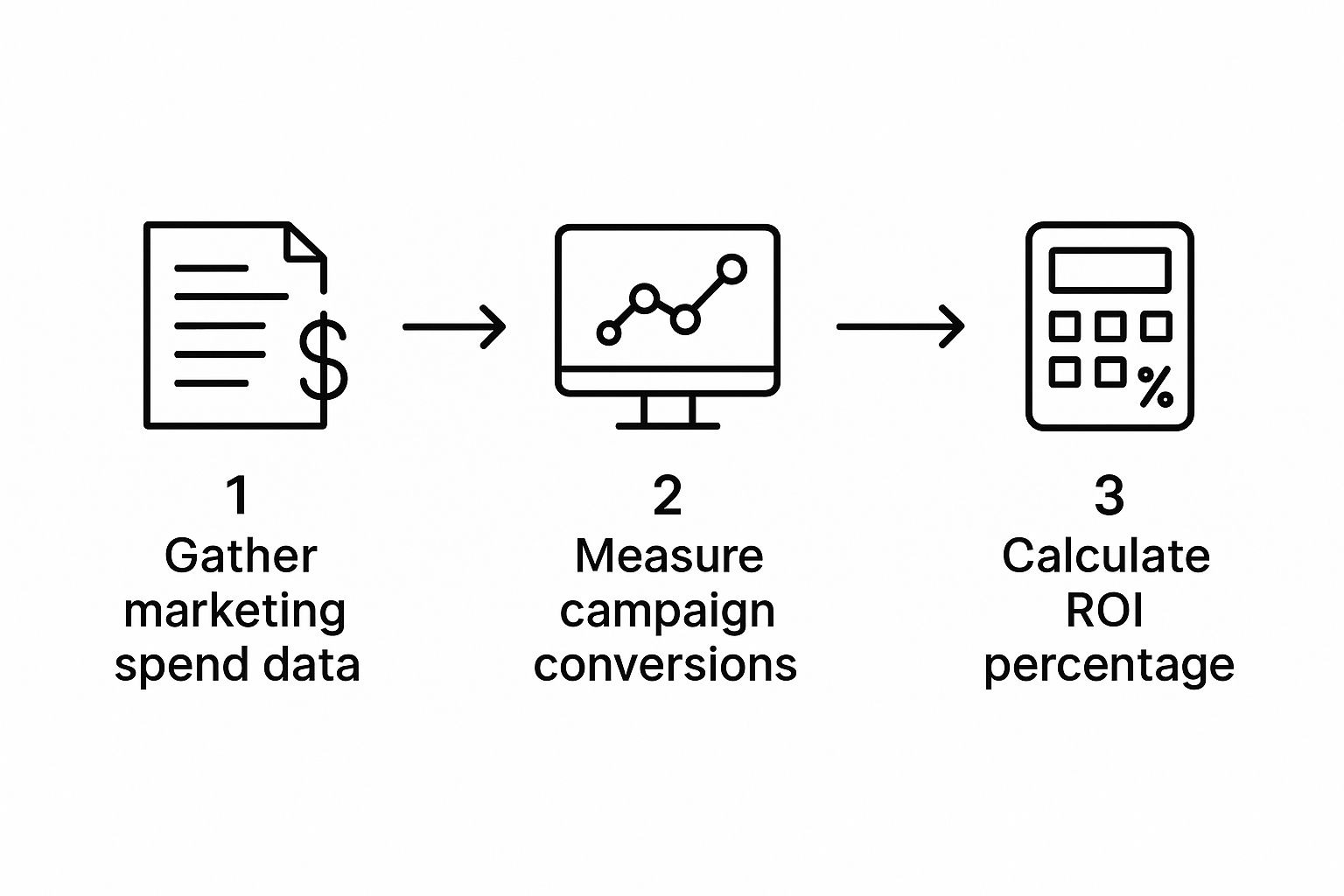
From gathering your spend data to measuring the results and calculating the final return, this flow underpins everything.
Auditing Your Current Channels
I can’t stress this enough: you need to be auditing your channels regularly. It’s the only real way to find out where your budget is leaking and where it’s generating the strongest returns.
For example, I’ve seen countless companies find that their paid social campaigns bring in a lot of quick, cheap leads, but their organic search efforts—while slower—attract customers with a 3x higher CLV. That single insight completely changes how you should think about allocating your budget for long-term growth.
When you do an audit, you’re trying to answer a few critical questions for each channel:
- What are the direct costs? Think ad spend, software subscriptions, agency retainers—all of it.
- What’s the average CPA for a customer coming from this channel?
- How does the CLV of these customers stack up against customers from other channels?
- Is performance trending up or down over the last three to six months?
This kind of data-first thinking takes the emotion and guesswork out of your strategy. It gives you the confidence to move money around because you know it’s the right call.
The point isn’t just about cutting costs. It’s about reinvesting that money intelligently. By trimming 15% from a channel that’s just not performing and reallocating it to one of your top performers, you can see a major lift in your overall marketing ROI without spending a single extra dollar.
To make this process more concrete, here’s a framework I use to compare channels side-by-side. It forces you to look at the numbers that truly matter and make a clear decision for each channel.
Channel Performance Audit Framework
| Channel | Key Performance Metric | Cost per Acquisition (CPA) | Customer Lifetime Value (CLV) | Action (Increase/Maintain/Decrease) |
|---|---|---|---|---|
| Paid Search (Google Ads) | ROAS: 4.5x | $45 | $350 | Maintain |
| SEO/Content Marketing | Organic Leads: 150/mo | $25 (estimated) | $950 | Increase |
| Paid Social (Facebook) | Leads: 400/mo | $80 | $200 | Decrease |
| Email Marketing | Open Rate: 28% | $5 | $600 | Increase |
By laying everything out like this, the path forward becomes incredibly clear. You can see immediately where your best opportunities lie and where you’re getting diminishing returns.
Testing and Expanding to New Channels
While optimizing the channels you already have is crucial, you can’t afford to ignore what’s next. New frontiers are always opening up—think Connected TV (CTV) or the explosion of retail media networks. These can offer amazing opportunities to connect with entirely new audiences.
The trick is to experiment without risking your entire budget. I recommend setting aside a small, dedicated portion of your budget—maybe 5-10%—just for testing new things.
Run small-scale, time-limited experiments. For instance, a direct-to-consumer brand could launch a one-month CTV campaign targeting a very specific demographic. The goal wouldn’t be massive sales right away, but to measure the impact on things like brand-name searches and direct website traffic.
If the pilot shows a spark—a decent Return on Ad Spend (ROAS) or a promising CPA—you can start feeding it a little more budget. If it flops? You’ve learned a valuable lesson with minimal financial damage. This disciplined approach to experimentation is what keeps your marketing mix fresh, adaptive, and consistently driving the best possible ROI.
Driving Long-Term Value with Content and SEO

Paid ads can give you a quick shot of traffic, but it’s a bit like renting an apartment. The moment you stop paying the rent, you’re out. The traffic vanishes. For real, compounding growth that builds on itself, you need to own your traffic sources. That’s where a savvy content and SEO strategy becomes your most powerful asset for long-term ROI.
Instead of just pouring money into the ad machine, you’re building a permanent library of valuable resources. This library works for you 24/7, attracting qualified leads and cementing your brand as an authority. Over time, this organic engine can drastically lower your dependence on costly paid channels.
Uncovering High-Intent Keywords
A solid content strategy always starts with understanding what your ideal customers are actually typing into Google. It’s about more than just chasing broad, high-volume keywords. The real gold is in finding those high-intent, low-competition keywords—the ones that signal someone is actively looking for a solution.
Think about it. A search for “content marketing” is incredibly broad. But a search for “content marketing agency for B2B tech” is coming from someone with a specific, urgent need. Focusing on these long-tail keywords brings in visitors who are already much closer to making a decision, which naturally leads to better conversion rates.
Tools like Ahrefs or Semrush are fantastic for this research, but don’t forget to talk to your own customer service team. They’re on the front lines, hearing the exact language and pain points your customers use. Those conversations are a goldmine for content ideas that truly connect.
Crafting Problem-Solving Content
Once you’ve identified your keywords, the mission isn’t just to rank for them. It’s to create a piece of content so helpful that it becomes the go-to answer for that query. This is how you shift from being just another company trying to sell something to being a trusted industry resource.
A truly great piece of content should:
- Solve the searcher’s problem head-on. If they’re searching for “how to reduce customer churn,” your article needs to give them clear, actionable steps they can implement.
- Be comprehensive but easy to read. Nobody wants a wall of text. Use short paragraphs, clear subheadings, bullets, and relevant images to make your content scannable.
- Include real-world examples. Generic advice is forgettable. Showing how a specific strategy worked for a real company makes your points far more credible and impactful.
Businesses that nail this see incredible results. In fact, companies that consistently publish helpful blog content generate 13x more positive ROI than those that don’t. It’s definitely a marathon, not a sprint, but the payoff is well worth the effort.
The ultimate goal of content is to build a relationship with your audience before they are even ready to buy. By consistently solving their problems, you become the first brand they think of when they finally need your product or service.
Proving the Value of Your Content
Connecting your content directly to revenue can feel tricky. It’s rarely a straight line from a blog post click to a purchase. To really show its impact, you need to look at a combination of metrics that tell the complete story.
Start by tracking how your organic traffic turns into leads—things like newsletter sign-ups, ebook downloads, or demo requests that originate from a blog post. From there, you can use your CRM to track how many of those leads eventually become paying customers. This complete view is essential for calculating your content marketing ROI. For a deeper dive, our guide on measuring content marketing ROI provides a detailed, step-by-step framework.
By connecting these dots, you can confidently show stakeholders that every guide and article you publish is a direct contributor to the company’s bottom line, cementing content as a cornerstone of your growth strategy.
Common Questions About Improving Marketing ROI
Even experienced marketers run into the same tricky questions when it comes to ROI. Getting a real, measurable return on your marketing spend is a constant challenge, but a few common hurdles pop up time and time again. Let’s walk through some of those frequent questions and get you some clear, practical answers.
One of the biggest puzzles is figuring out the ROI for top-of-funnel marketing—things like brand awareness campaigns. These initiatives rarely lead directly to a sale, so trying to tie them to immediate revenue can feel like fitting a square peg in a round hole.
Instead of getting frustrated, shift your focus to leading indicators. Are more people searching for your brand name? Is your direct website traffic climbing? Is social media engagement on the rise? These metrics are powerful signals that your brand is gaining traction and building an audience that will convert down the line. It’s a different way of proving value, but it’s crucial for justifying long-term brand building.
When Should You Pull the Plug on a Channel?
Knowing when to cut a low-performing channel is another tough call. The gut reaction is to kill anything that isn’t producing immediate results, but that’s often a mistake. Before you axe a channel, you have to be sure you’ve given it a fair shake.
Run through this checklist first:
- Have we genuinely tried different creative assets and messaging?
- Did we experiment with targeting different audience segments?
- Is it possible the channel is fine, but our landing page or offer is the real problem?
If you’ve explored all these angles and the cost per acquisition (CPA) is still way out of line with your other channels, then it’s time to make a move. Don’t think of it as a failure. It’s a smart, data-backed decision that frees up budget for what’s actually working. This kind of strategic reallocation is exactly how you improve marketing ROI over the long haul.
A critical mistake is blaming a channel for poor performance when the real problem is a weak offer or a confusing user journey. Always diagnose the entire funnel before deciding a channel isn’t viable.
How Long Until I See a Return?
And the million-dollar question: “How long will this take?” The honest answer is, it completely depends on the tactic.
With something like paid search, you can see results almost immediately, sometimes within days. You’re tapping into existing demand, so the feedback loop is incredibly short.
On the other hand, SEO and content marketing are marathons, not sprints. You should be prepared to invest for 6-12 months before you start seeing significant organic traffic and a meaningful return. Email marketing can often deliver a great ROI quickly, especially if you have an engaged list of customers. The key is setting realistic expectations for each channel to build a balanced strategy that scores quick wins while also investing in sustainable, long-term growth.
At ReachLabs.ai, we build integrated strategies that answer these tough questions with data. We move beyond guesswork to deliver marketing campaigns designed for measurable impact and maximum ROI. See how our expert team can elevate your brand.