I like to think of a digital marketing team less as a department and more as the engine that powers a company's growth. And just like the engine in a high-performance race car, every single part needs to be specialized, tuned, and working together perfectly to win the race. This guide is your blueprint for building that engine. I'll show you how to assemble a powerhouse team that doesn't just look good on an org chart but actually delivers measurable results.
Why Your Marketing Team Structure Defines Your Success
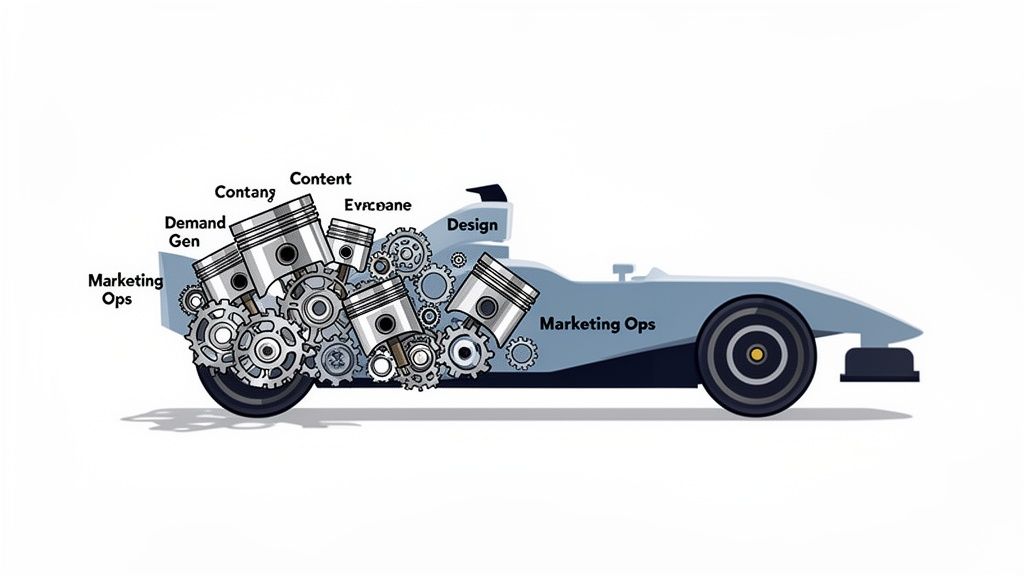
Getting your digital marketing team structure right isn't just about filling seats or creating a tidy hierarchy. It's about designing a system where your people, your strategy, and your day-to-day work all click into place to hit your business goals.
When a team is poorly designed, you feel it everywhere: wasted ad spend, missed opportunities, and a team that’s constantly on the verge of burnout. But a well-structured team? That’s a different story. They operate with clarity, accountability, and a kind of efficiency that feels almost effortless.
The truth is, there's no one-size-fits-all solution. The "best" structure is the one that fits your company's specific situation. Forget the generic templates. We're going to dig into proven models that you can adapt, whether you're a startup with a two-person team or a large enterprise coordinating global campaigns.
The Core Components of a Growth Engine
Every high-performing marketing engine is built from a few core, interconnected functions. Think of it like a real engine: you need fuel, a spark, and pistons working in sync. Your team needs specialists who own their roles but collaborate seamlessly.
Here are the essential components:
- Strategy and Leadership: This is your driver. They set the destination (the goals), chart the course (the strategy), and make sure every marketing activity pushes the company forward.
- Content and Creative: Your storytellers and artists. They create the compelling blog posts, videos, graphics, and ad copy that grab your audience's attention and won't let go.
- Demand Generation: The fuel injectors. This group is laser-focused on driving traffic, capturing qualified leads, and guiding them toward a sale using channels like SEO, paid ads, and email.
- Operations and Analytics: This is the team's central nervous system. They manage the marketing tech stack, dive deep into the data, and constantly fine-tune processes to make everything run faster and smarter. Understanding what is marketing operations is the first step to building this crucial pillar.
A well-structured digital marketing team is the backbone of any successful business. How you structure your team influences your ability to scale, adapt to trends, and achieve measurable results.
To take your team from good to truly great, it's worth exploring proven strategies for building high-performance teams. This kind of framework gives you the blueprint for assembling a group of specialists who can deliver consistent, scalable growth and give your business a serious competitive edge.
The Four Pillars of a Modern Marketing Team
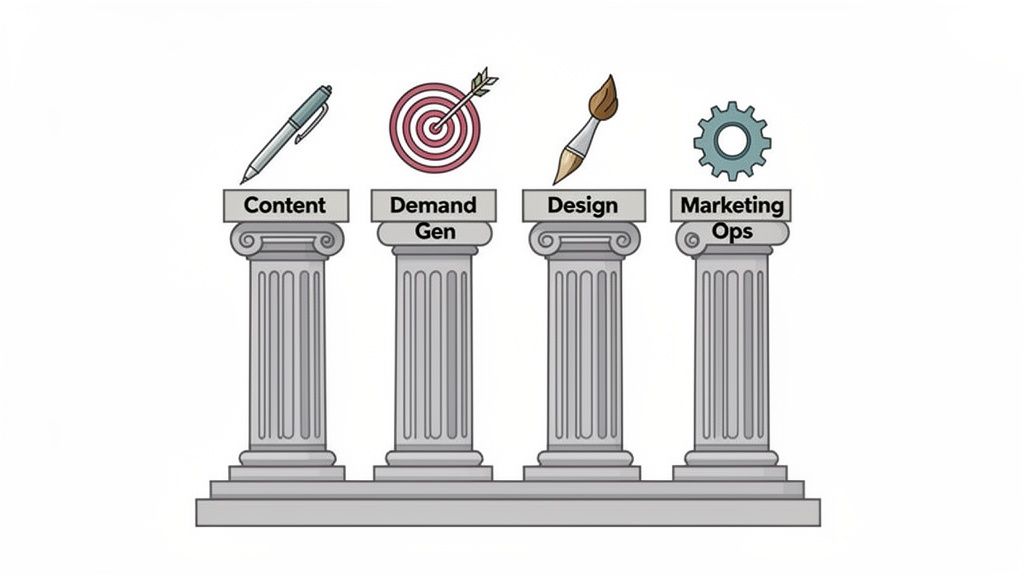
Before we get into specific org charts, let's talk about the bedrock. Every high-performing marketing machine, no matter its size, is built on four core functions. Think of these as the non-negotiable pillars that hold everything up. Get them right, and you have a solid foundation for growth.
Trying to scale your marketing without these is like building a house on sand. You might get the walls up, but it won't be long before things start to crumble.
Content Creation: The Fuel for Your Engine
Content is the lifeblood of modern marketing. It's the blog posts that pull in search traffic, the social media updates that build your community, and the ad copy that convinces people to click. Without a steady stream of valuable content, your other marketing channels will run on empty.
This is the team responsible for creating and sharing information that positions your brand as a go-to expert and attracts potential customers. In fact, a well-oiled content marketing team structure is often the first major step toward building a predictable growth engine.
Their day-to-day work usually involves:
- Blog Writing & SEO: Creating articles that answer customer questions and rank on search engines.
- Social Media Content: Crafting posts, videos, and stories to engage your audience on different platforms.
- Email Marketing Copy: Writing newsletters and automated email sequences that nurture leads.
Demand Generation: The Engine That Drives Action
If content is the fuel, demand generation is the engine itself. This function is all about turning that fuel into forward momentum. Its sole focus is to create awareness and interest in what you sell, ultimately generating a pipeline of qualified leads for the sales team.
Demand gen specialists are the ones who take the content and strategically place it where it will capture attention and guide people through their buying journey. This is where marketing becomes directly responsible for revenue.
This is the function that transforms marketing from a "cost center" into a "revenue driver." It connects every activity to tangible business outcomes like leads, pipeline, and closed deals.
Creative and Design: Your Visual Identity
Creative and design are what make your brand feel like a brand. In a noisy world, a strong visual identity is what makes you memorable and look professional. This function ensures everything—from your website to your social media ads—is consistent, appealing, and effective.
They work closely with the content and demand gen folks to ensure every campaign doesn't just work well, but looks great doing it. According to an Adobe report, a staggering 59% of consumers will choose beautifully designed content over something plain and simple. Good design builds trust.
Marketing Operations: The Central Nervous System
Marketing Operations (or MarOps) is the hidden-in-plain-sight function that keeps the entire marketing department from descending into chaos. Think of MarOps as the central nervous system, connecting all the parts and making sure they work together smoothly.
These are the people who manage your marketing technology (like your CRM and automation platforms), streamline workflows, and manage the data that tells you what's actually working. Without a strong ops function, teams end up with messy data, clunky processes, and no real way to prove their impact. As you grow, this role goes from a "nice-to-have" to absolutely essential.
To pull it all together, here’s a quick breakdown of what each function owns and how they measure success.
Core Digital Marketing Functions and Key Responsibilities
| Function | Primary Mission | Key Responsibilities | Example KPIs |
|---|---|---|---|
| Content Creation | To attract and engage the target audience by creating valuable, relevant content. | Blog writing, SEO, social media content, email newsletters, video production, case studies. | Organic traffic, time on page, social engagement rate, email open/click rates. |
| Demand Generation | To create a pipeline of qualified leads and drive revenue for the business. | Paid advertising (PPC, social), lead nurturing, campaign management, conversion rate optimization (CRO). | Cost Per Lead (CPL), Marketing Qualified Leads (MQLs), Sales Qualified Leads (SQLs), Pipeline value. |
| Creative & Design | To build and maintain a consistent and compelling visual brand identity across all channels. | Graphic design, web design, UI/UX, video editing, branding guidelines. | Brand recall, conversion lift from A/B tests, user engagement metrics, time to produce assets. |
| Marketing Ops | To enable efficiency and prove ROI through technology, data, and process management. | MarTech stack management, data analysis & reporting, workflow automation, lead routing. | Lead-to-close time, marketing automation efficiency, data accuracy, campaign ROI. |
These four pillars form the foundation of any successful marketing organization. Whether you have one person wearing all four hats or a dedicated specialist for each, understanding how they work together is the first step to building a team that truly drives growth.
Structuring Your Team for Early-Stage Growth
When you're a startup or a small business, your early marketing efforts are all about being fast, flexible, and making every dollar count. This is the perfect environment for a Lean & Agile team structure. Forget about the sprawling, complex departments you see in big companies; this model is designed for a small crew of two to five people to punch way above their weight.
Think of this team less like a traditional department and more like a special forces unit. Everyone on the team has multiple skills. They have their core job, of course, but they can also jump in and help their teammates. This setup means you can pivot on a dime, launch new ideas without getting stuck in red tape, and get results that make you look much bigger than you are.
The Core Trio of a Lean Team
At the heart of this agile model is a core group of three roles, each handling a critical piece of the marketing puzzle. With this trio in place, you’ve got all your essential bases covered—from grabbing your audience's attention to turning them into paying customers.
The classic small business marketing team is usually built around a Marketing Manager who guides the whole operation. They typically lead a content person who handles writing and social media, and a demand generation specialist focused on ads and SEO. A freelance designer is often in the mix, too. Industry data shows this setup helps startups generate leads without a ton of overhead, making it a fantastic model for scaling. In fact, some analyses show that small teams using this model can accelerate campaign launches by up to 30%.
Let's dig into who these key players are.
Key Roles and Responsibilities
A lean team's real power comes from having well-defined roles coupled with a "we're all in this together" attitude. Each person has their specialty, but they're all rowing in the same direction, sharing what they learn, and helping each other win.
-
Marketing Manager (The Quarterback): This is your strategic leader. They set the marketing direction, make sure it lines up with the company's bigger goals, manage the budget, and analyze performance. Their job is to keep the team laser-focused on the activities that will actually make a difference.
-
Content & Social Media Specialist (The Storyteller): This person is the voice of your brand. They create the blog posts, social media content, emails, and website copy that pull people in and keep them engaged. They're focused on building a community, positioning the brand as an expert, and creating great content to fuel the sales pipeline.
-
Demand Generation Specialist (The Growth Driver): This is the person obsessed with turning eyeballs into leads and revenue. They run paid ad campaigns on platforms like Google Ads or social media, manage SEO to bring in organic traffic, and build out campaigns to nurture potential customers. Their success is measured in hard numbers like Cost Per Lead (CPL) and Marketing Qualified Leads (MQLs).
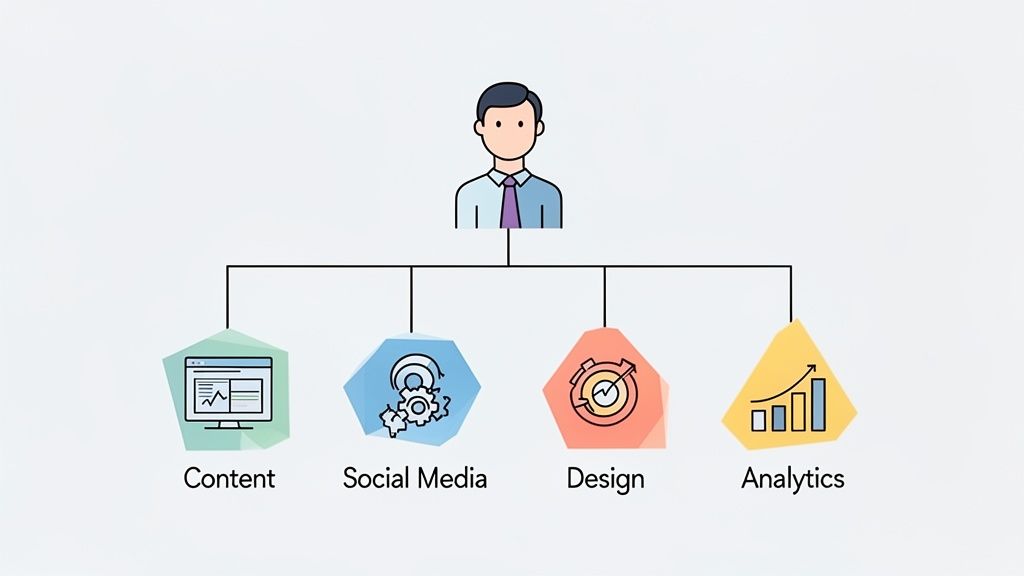
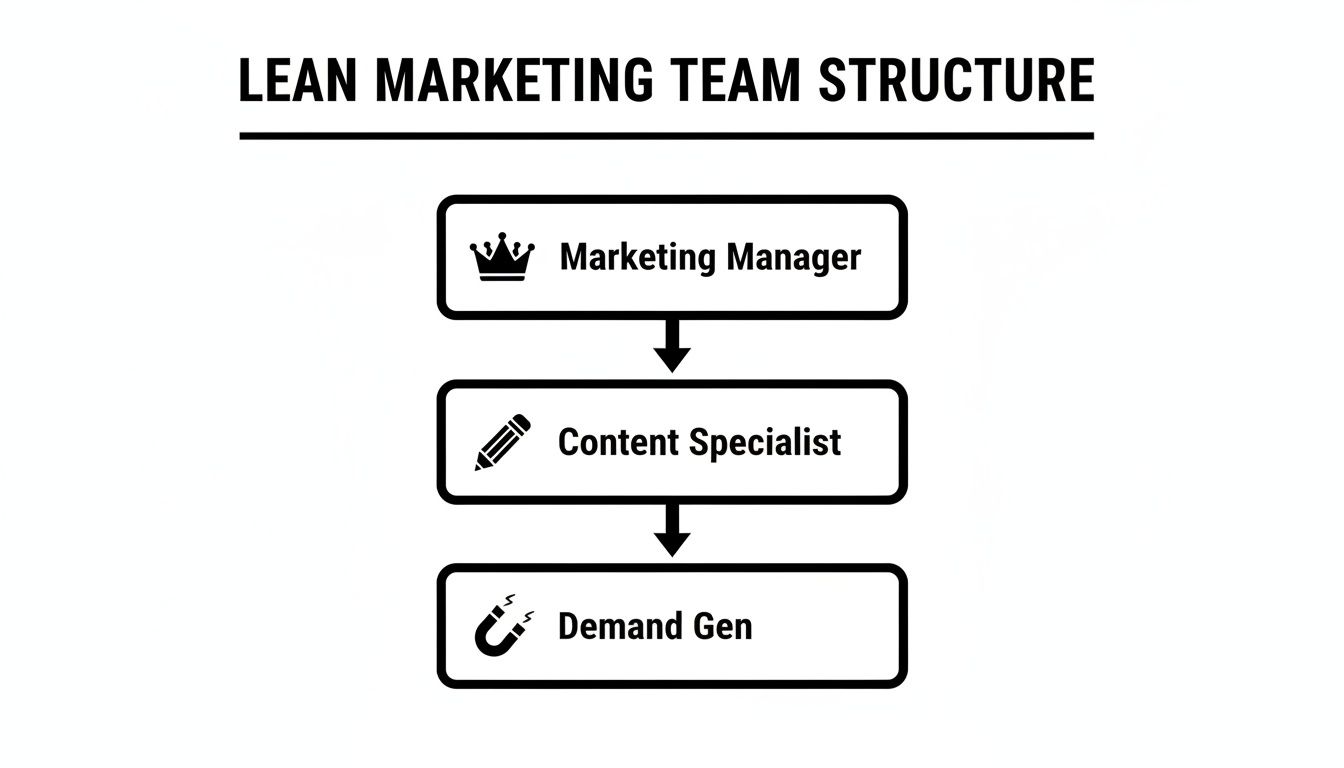
Seeing this lean and agile digital marketing team structure laid out visually can help clarify how everyone works together.
Here’s a sample org chart that shows this simple, effective hierarchy.
This chart shows a flat, clear structure where the specialists report directly to the Marketing Manager, which is exactly what you want for quick decisions and tight alignment.
Key Takeaway: The Lean & Agile model is all about versatility, not hyper-specialization. Team members wear multiple hats, focusing on getting things done and learning quickly to find out what really drives growth.
This stripped-down approach means that even with a tight budget and a small team, a startup can still run a solid digital marketing strategy. It's all about being resourceful, following the data, and staying focused on what moves the needle.
Scaling Your Team for Mid-Size Business Success
Once your business starts hitting that $10 million revenue mark, the lean, do-it-all marketing team that got you there begins to feel the strain. The generalists who wore multiple hats are now stretched thin, and you'll notice that a lack of deep expertise in key channels starts to put the brakes on growth. It's a classic growing pain.
This is the point where you need to evolve your team. The goal is to move from a versatile special ops unit to a more structured, specialized force. The most effective way I've seen this done is with a Pod-Based Specialist structure. This approach organizes your talent into focused teams—like Content, Demand Generation, and Marketing Operations—each with a clear leader and mission.
Think of it like a symphony orchestra. You have your strings section, your woodwinds, and your percussion, each led by a principal player who is an expert in their craft. They all focus on their specific role but work in perfect harmony under a single conductor. For your team, that conductor is a VP or Director of Marketing. This model doesn't just add headcount; it builds deep expertise, clarifies who owns what, and lets you run much more sophisticated campaigns.
From Generalists to Specialized Pods
When your team grows to between 6 and 15 members, the switch to specialization isn't just a good idea—it's essential. Instead of one person trying to manage all content creation, you now have a dedicated pod for it. The same goes for driving leads and managing the marketing technology that makes everything run smoothly.
This shift allows each person to go deep in their field. They can stay on top of the latest trends, master new tools, and truly hone their skills. The result is a noticeable jump in the quality of work across the board. Campaigns become more integrated and data-driven, which ultimately means they get better at driving revenue.
This chart shows a simplified view of how this starts, with a manager leading dedicated specialists who own their respective areas.
The key takeaway here is the clear hierarchy and defined roles. It cuts down on confusion and empowers your specialists to take real ownership of their work.
Anatomy of a Mid-Size Marketing Team
So what does this team actually look like? A typical pod-based structure for a mid-size company is helmed by a VP of Marketing or a Director, who sets the strategy and orchestrates the big picture. Reporting to them are the managers leading each specialist pod.
Here’s a common breakdown of the roles:
- Leadership: A VP or Director of Marketing is at the top, responsible for the high-level strategy, managing the budget, and making sure all the pods are pulling in the same direction.
- Content Pod: This team, led by a Content Manager, usually includes Content Writers and a Social Media Specialist. Their job is to build the brand's authority and keep the audience engaged.
- Demand Generation Pod: A Demand Gen Manager runs this group, which includes a Paid Media Specialist and an SEO Specialist. Their entire focus is on generating a predictable pipeline of qualified leads.
- Creative Pod: Often guided by a Creative Lead or Art Director, this pod has Graphic Designers who ensure the brand's visual identity is consistent and compelling across all channels.
- Marketing Operations: At this stage, this is often a one-person show. A Marketing Ops Manager is responsible for the tech stack, data, and analytics that keep the entire department humming.
The pod-based structure is designed to break down silos before they can even form. By grouping specialists who need to work closely together, you create natural collaboration points that make integrated campaigns seamless.
This structure is ideal for brands growing in the $10M-$50M revenue range. It’s not just theory, either. Recent data shows that mid-size teams using this collaborative pod model achieve 35% higher conversion rates by getting rid of those traditional department walls. And with ad costs rising at a 13.9% CAGR industry-wide, 65% of mid-size teams report that this structure significantly boosts their efficiency and ROI. You can dive deeper into these numbers by exploring a full analysis of digital marketing trends.
By shifting to a pod-based specialist model, mid-size businesses can scale their marketing in a smart, methodical way. This digital marketing team structure gives you the depth of expertise needed to compete in crowded markets while keeping you agile enough to jump on new opportunities.
Choosing Between In-House Hires and Outsourcing
Sooner or later, every growing business hits a fork in the road. It’s the classic "build vs. buy" question, but for your marketing team: which roles should you fill with full-time hires, and which are better off outsourced to an agency or freelancer?
There’s no magic answer, but getting this decision right is one of the most important things you can do to scale your marketing without breaking the bank. Your choice directly impacts your budget, your team's agility, and ultimately, how effective your marketing becomes.
Think about it. Bringing a senior SEO specialist in-house is a massive commitment—salary, benefits, expensive software licenses, the works. On the other hand, you could tap into a top-tier agency for a fraction of that cost and get access to an entire team of experts. You can see why it's a tough call.
The Strategic Calculus of Building vs Buying
At its core, this decision is a balancing act. You're weighing direct control and brand immersion against specialized expertise and the flexibility to scale on a dime.
An in-house team lives and breathes your company culture. They're 100% dedicated to your brand, which is a huge advantage for core strategic roles. But outsourcing gives you instant access to specialized skills you might not be able to find or afford in a full-time hire. An agency also brings a fresh perspective, drawing on experience from dozens of other clients and industries.
The key is figuring out which model makes the most sense for specific functions within your digital marketing team structure. To really get into the weeds on this, our guide comparing a marketing agency vs in-house teams is a great next step.
So, what does this look like in practice? A smart hybrid approach is often the winner. You keep the strategic thinkers—the Marketing Manager, the Content Strategist—in-house to protect the brand voice and guide the ship.
Then, you can outsource the heavy-lifting and highly technical tasks. Good candidates for outsourcing often include:
- Technical SEO Audits: This requires deep, constantly evolving knowledge that's hard to maintain internally.
- Paid Media Management: Managing ad platforms is a full-time job of constant monitoring, testing, and optimizing.
- Graphic Design: You might need a lot of design work one month and very little the next, making it perfect for project-based work.
In-House vs Outsourcing A Comparative Analysis
To really make an informed choice, it helps to put the two models head-to-head. Let's lay out the key pros and cons, looking at everything from long-term costs to how fast you can pivot when the market shifts.
This table breaks down the crucial differences to help you decide what's right for your business right now.
| Consideration | In-House Team | Outsourced Agency/Freelancer |
|---|---|---|
| Cost | High fixed costs (salary, benefits, training, overhead). | Lower, more predictable variable costs (retainer or project-based fees). |
| Expertise | Expertise is limited to the individuals you hire. | Access to a broad team of specialists with diverse industry experience. |
| Scalability | Scaling up or down is slow and costly (hiring/layoffs). | Highly flexible; you can easily adjust the scope of work as needed. |
| Control & Focus | Full control over priorities and workflow; 100% focus on your brand. | Shared focus among multiple clients; less direct control over daily tasks. |
| Onboarding | Requires significant time for hiring, onboarding, and integration. | Minimal onboarding time; agencies can often start delivering results quickly. |
Ultimately, the best solution isn't about choosing one or the other. It's about finding the right mix for your unique situation.
Strategic Takeaway: The optimal solution is rarely all or nothing. The most successful businesses build a hybrid digital marketing team structure that leverages the strengths of both in-house talent for core strategy and outsourced experts for specialized execution. This blended model offers a powerful combination of control, expertise, and flexibility.
How Top Agencies Build Teams for Client Wins
Forget the old-school agency model where one overworked account manager tries to do everything. That just doesn't cut it anymore. Today's top-performing agencies have shifted to a smarter, more effective structure that gives clients direct access to a dedicated team of specialists. It’s a flexible, pod-based approach that ensures every account gets the focused brainpower it needs to crush its goals.
Think of it as being assigned your own marketing A-Team. Instead of funneling every request through a single point of person who's a jack-of-all-trades (and master of none), each client gets a dedicated pod. This small, cross-functional team lives and breathes your account, making sure every piece of your strategy is handled by a true expert.
This model is all about speed, better communication, and delivering superior results. It breaks down the communication silos that plague traditional agencies and slow everything down.
The Anatomy of an Agency Pod
A high-impact agency pod is a lean, mean, marketing machine. It’s built to cover all the critical angles of a digital marketing campaign. While the specific roles can be tweaked for a client's unique needs—maybe you need an influencer marketing guru or a lead gen wizard—the core team usually has a few key players working in perfect sync.
Each person brings a specific, high-level skill set to the project:
- The Strategist: This is your quarterback. They’re responsible for getting inside your business goals, crafting the big-picture marketing strategy, and making sure every single campaign action ties back to it. They're your main point of contact and own the client relationship.
- The Content Creator: This specialist is your brand’s storyteller. They’re masters at creating blog posts, social media content, email copy, and anything else needed to grab and hold your target audience's attention.
- The Demand Generation Expert: This is the growth engine, obsessed with results. They handle paid ads, SEO, and lead nurturing campaigns, turning eyeballs into measurable business outcomes like qualified leads and real sales opportunities.
- The Designer: This is the visual pro who ensures everything looks sharp, stays on-brand, and is designed to convert. From ad creative to landing pages, they make your brand look good and work hard.
This pod-based digital marketing team structure is a direct answer to how complex marketing has become. By giving clients a dedicated team of specialists, agencies like ReachLabs.ai deliver far deeper expertise and more connected campaigns than any single generalist ever could.
With this approach, strategy, content, promotion, and design are never working in isolation. The team is in constant communication, sharing insights and tweaking tactics on the fly to get the best performance. For the client, that means quicker launches, seamless messaging, and—most importantly—better results that you can see on the bottom line.
Got Questions? We've Got Answers
Putting together the right digital marketing team often sparks more questions than answers. Let's tackle some of the most common ones that come up when leaders are trying to figure this all out.
What's the First Marketing Hire a Startup Should Make?
Your first hire needs to be a jack-of-all-trades, what we often call a “T-shaped” marketer. Think of someone who knows a little bit about a lot of things—SEO, content, social media, paid ads—but has really deep expertise in one or two areas that are critical for you right now, like demand generation or content creation.
This person is your initial spark. They can get the strategy off the ground, experiment with different channels to find out what actually sticks, and run campaigns from concept to completion. You need that kind of flexibility before you can justify bringing in dedicated specialists for every single function.
How Can You Tell if Your Marketing Team Structure is Actually Working?
The real measure of a successful team structure isn't how many tasks are getting checked off a list. It's about whether you're hitting your business goals without everyone pulling their hair out.
The ultimate test of your team structure isn't how busy people are, but whether their collective efforts are moving the business forward. If revenue is growing and your team isn't burning out, your structure is working.
Forget vanity metrics. You'll know your structure is effective by looking at the numbers that matter:
- Lead Velocity Rate: Is your pipeline of qualified leads growing month-over-month?
- Marketing-Sourced Revenue: How much actual revenue can you trace back directly to your marketing efforts?
- Customer Acquisition Cost (CAC): Are you acquiring new customers efficiently?
On the inside, you'll feel it, too. Campaigns will get out the door faster, teams will be collaborating smoothly without drama, and people will generally be happy to come to work.
When Should You Hire a Dedicated Marketing Ops Person?
The moment your team hits about five to eight people, or when your tech stack starts to look like a bowl of spaghetti, it's time to think about Marketing Operations (MarOps). Juggling a CRM, marketing automation platforms, and all the analytics tools is a full-time job in itself.
Here's a clear signal: if your marketers are spending more than 20% of their week on tedious administrative tasks, wrestling with messy data, or manually pulling reports, you're losing money. A MarOps pro comes in to build the engine—automating workflows, ensuring data is clean and reliable, and setting up the dashboards that prove marketing’s real impact on the bottom line.
What's the Difference Between Functional and Pod-Based Teams?
A functional structure is the traditional way of doing things. You group people by their specialty. All the SEO experts sit on one team, all the content writers on another, and so on. This approach is great for building deep, specialized knowledge, but it can easily lead to silos where the left hand doesn't know what the right is doing.
A pod-based structure, on the other hand, breaks down those walls. You create small, self-contained teams that have all the skills they need to achieve a specific goal. A single pod might have an SEO specialist, a writer, and a designer all working together on a single product launch or campaign. It’s a much more agile and collaborative model, which is why so many fast-moving companies are shifting to it.
At ReachLabs.ai, we're big believers in the pod model. We build client-focused pods of world-class specialists to create tailored strategies that drive real growth. To see how our collective approach can elevate your brand, check out our work at https://www.reachlabs.ai.