
Data-driven marketing solutions are simply the tools and strategies that help you make sense of all the information your customers leave behind. Think about their clicks, purchases, and social media interactions—it’s all raw data. These solutions turn that jumble of information into a clear roadmap for growing your business.
Instead of just guessing what your customers want, you get to use hard evidence to know what they need and how to connect with them in a way that actually works.
What Are Data-Driven Marketing Solutions?
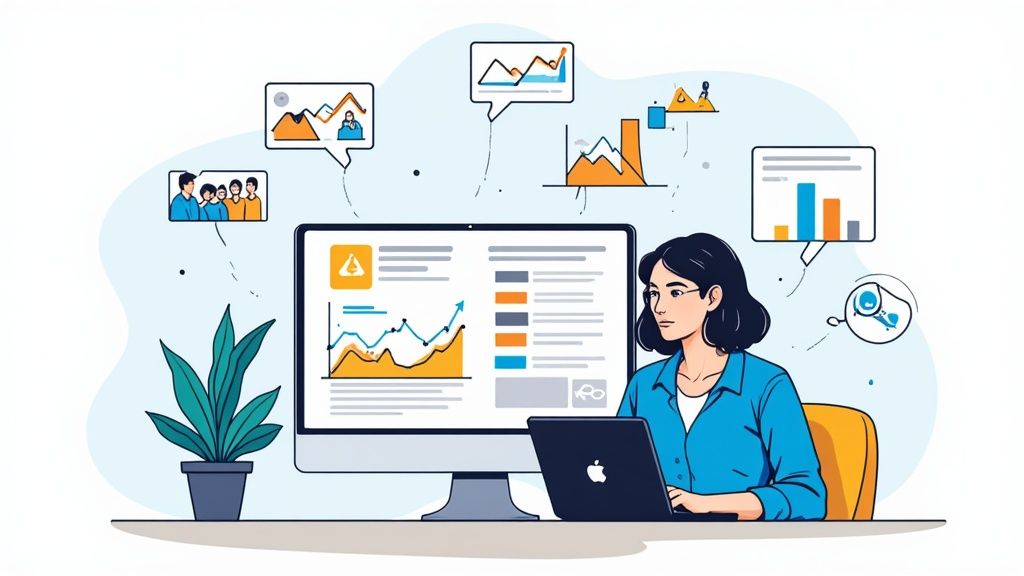
Picture trying to navigate a huge, unfamiliar city without a map or GPS. That's pretty much what marketing looks like without data. You might have a great product (your car) and a solid team (your passengers), but you’re essentially just driving around, hoping to stumble upon your destination (new customers).
Data-driven marketing solutions act as your modern navigation system. They gather, analyze, and interpret information to point your marketing efforts in exactly the right direction. This means you can stop running broad, hopeful campaigns and start creating precise, evidence-backed strategies that genuinely connect with your audience. It’s the difference between shouting into a crowded stadium and having a real, one-on-one conversation with someone who wants to hear from you.
The Shift From Guesswork to Certainty
At its heart, this entire approach is about making smarter, more informed decisions. You move away from relying on gut feelings or old assumptions and instead use concrete data to understand what your customers are doing, what they like, and what problems they need solved.
This insight gives you the confidence to answer some pretty critical questions:
- Which marketing channels are actually making me money? Data shows you where your budget is having the biggest impact.
- What should my ads say to a specific group of people? Analytics help you craft messages that grab their attention.
- When is the perfect time to follow up with a potential lead? Behavioral data can pinpoint the ideal moment to reach out.
This isn't just another passing trend; it’s a fundamental change in how modern businesses connect with people. The global big data analytics market—the engine powering all of this—is projected to jump from $32.30 billion in 2021 to a staggering $924.39 billion by 2025.
Why the massive growth? Because the technology allows for deep personalization, which has been shown to boost revenues by 5-15% and improve marketing efficiency by up to 30%. You can dive deeper into how data drives marketing performance on Designveloper.
A data-driven approach isn't about getting lost in spreadsheets. It's about finding the human stories hidden within the numbers to create better experiences for your customers and achieve real business goals.
Ultimately, using data means you stop wasting money on what you think works and start investing in what you know works. Building on that foundation of certainty is how you create stronger customer relationships, get the most out of every dollar you spend, and consistently steer your brand toward success.
The Pillars of a Powerful Data-Driven Strategy
A great data-driven marketing strategy isn't a one-and-done tactic; it's a living, breathing process. Think of it like building a house—it needs a solid foundation and strong support beams to actually work and last. This whole structure rests on three critical pillars: Data Collection, Data Analysis, and Data Application.
Each pillar really does build on the one before it, turning raw information into real business results. Once you grasp this framework, you can stop just having data and start using it to fuel your growth. Let's break down how each piece fits into the puzzle.
The First Pillar: Data Collection
This is where it all begins—the foundation. Data collection is all about gathering the raw materials you need to build any meaningful insights. It's the act of listening to your customers through every click, call, and interaction they have with your brand. The goal here is to paint a complete picture of who they are, what they like, and what they need.
To do this well, you have to tap into multiple sources that act as your digital eyes and ears. Each source gives you a different piece of the puzzle, and when you put them all together, you get a much clearer, richer view of your audience.
We're not just talking about one or two places. A solid collection strategy pulls from a variety of sources to create a complete customer profile.
To give you a better idea, here's a look at some of the most common places marketers pull their data from.
Key Data Sources for Marketing Insights
| Data Source | Type of Data | Primary Use Case |
|---|---|---|
| CRM Systems | Transactional & Behavioral | Personalizing sales outreach and improving customer retention. |
| Website Analytics | Behavioral & Engagement | Optimizing user experience and improving conversion funnels. |
| Social Media Platforms | Demographic & Psychographic | Understanding audience sentiment and identifying content trends. |
| Email Marketing Platforms | Engagement & Preference | Segmenting audiences for targeted campaigns and A/B testing. |
| Customer Surveys | Attitudinal & Qualitative | Gathering direct feedback to improve products and services. |
Each of these sources provides a unique lens through which to view your customer, and combining them is where the magic really happens.
A huge part of modern data collection is focusing on first-party data—that's the information you gather directly from your audience yourself. It's no longer optional. With privacy rules getting stricter and browsers clamping down on third-party cookies, building your own robust data assets is essential for survival.
In fact, a recent study found that 64% of marketing executives strongly agree that a first-party data strategy is critical today. This push is being driven by regulations like GDPR and new browser policies that now control over 90% of the market. You can get a deeper dive into this trend and how it’s shaking up marketing by checking out the full report.
The image below breaks down the cascading benefits you get from a well-executed strategy.
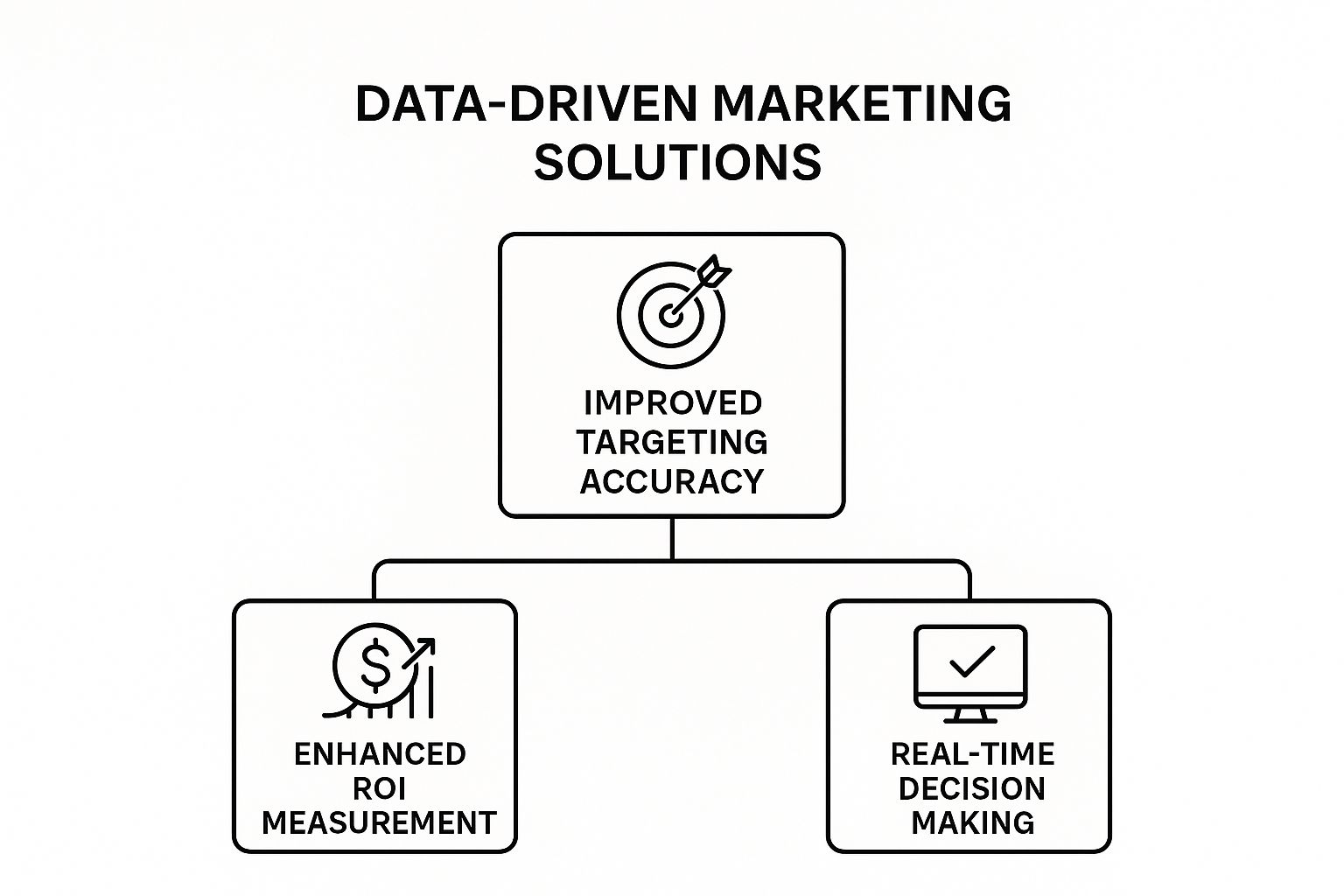
As you can see, it all starts with good data. That leads to sharper targeting, which lets you measure your ROI more accurately, and ultimately, helps you make smarter decisions on the fly.
The Second Pillar: Data Analysis
So, you've collected all this data. Now what? The next step is to actually make sense of it all. Data analysis is the art and science of turning a giant sea of raw numbers into a clear, understandable story. This is where you uncover the "why" behind the "what," spotting the hidden patterns and trends that tell you what’s really going on.
Think of analysis as your data translator. It takes the complex, often messy language of data and converts it into straightforward business intelligence. Without it, even the best data is just noise.
The goal of data analysis isn't just to report on what already happened. It's about finding actionable insights that help you predict what's coming next and guide where you put your marketing dollars.
A couple of common techniques you'll see here include:
- Segmentation: This involves grouping your audience into smaller, more defined segments based on things they have in common, like their purchase history, location, or how they behave on your website. It’s the key to sending the right message to the right person.
- Predictive Modeling: Here, you use your historical data to make educated guesses about the future. For instance, you can predict which customers are most likely to leave or which leads are primed to convert into a sale.
The Third Pillar: Data Application
This final pillar is where all your hard work pays off. Data application is the execution phase—it’s where you take all those brilliant insights you uncovered and use them to create smarter, more effective marketing. It’s the bridge between knowing your customers and actually delivering experiences that connect with them.
For example, maybe your analysis shows that a certain customer segment absolutely loves video content. The application? You create a targeted video ad campaign just for them. Or perhaps your data shows that people are abandoning their carts right when they see the shipping costs. Your move could be to apply that insight by sending a follow-up email with a free shipping coupon.
This is the most crucial step of all. It’s where your data-driven marketing solutions finally come to life and start delivering measurable results, turning those strategic insights into real revenue and growth for your business.
What’s in the Modern Marketer’s Toolkit?
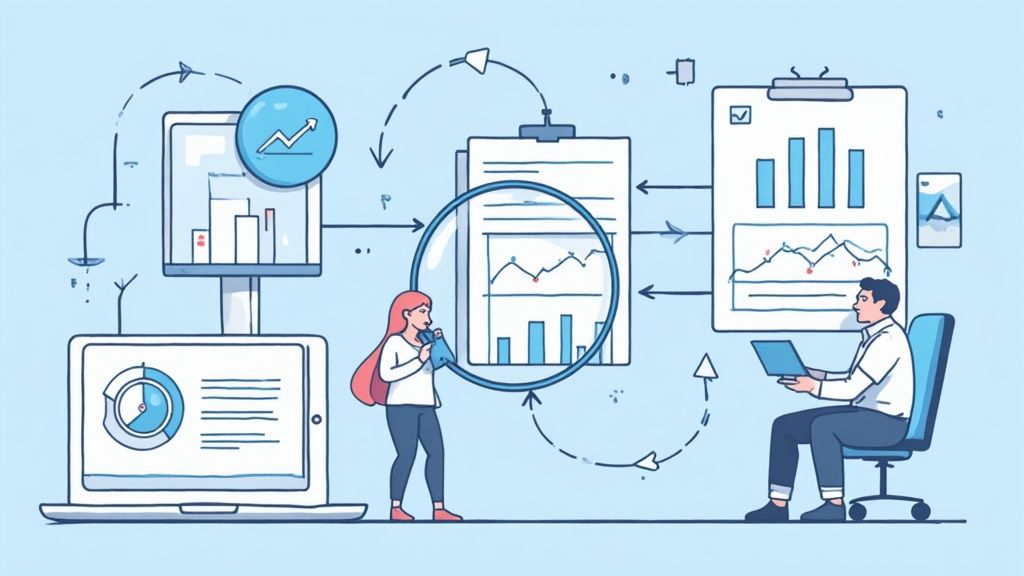
Pulling off a great data-driven strategy isn't about getting lost in spreadsheets. Forget manual number-crunching. It's about having the right tech to do the heavy lifting so you can focus on the big picture. Today’s marketers have an incredible suite of tools designed to gather, analyze, and act on customer information at scale.
Think of these platforms less like complex software and more like highly specialized members of your team. Each one has a unique job, but they all work together to help you win.
Customer Data Platforms: Your Single Source of Truth
The foundation of any modern marketing stack is the Customer Data Platform (CDP). Its job is simple in concept but incredibly powerful in practice: to pull all your customer data from every source into a single, unified profile for each person.
Imagine your customer information is scattered across a bunch of disconnected islands—your email system, your e-commerce platform, your website analytics, your CRM. A CDP builds bridges between those islands, creating one complete map of every customer's journey.
This single-handedly solves one of the biggest headaches in marketing: data silos. Instead of seeing a fragmented picture, you get a 360-degree view. This is what allows you to deliver truly consistent and personal messages across every channel. Platforms like Segment and Tealium are masters at this, helping companies build that solid data foundation.
A Customer Data Platform doesn't just hold data; it makes it useful. It turns a chaotic mess of interactions into an organized, actionable asset that fuels smarter marketing.
Marketing Automation Platforms: The Engine of Execution
Once you have that unified customer view, you need an engine to act on what you know. That’s where Marketing Automation Platforms come into play. These tools are the workhorses of any modern marketing team, handling repetitive tasks and running personalized campaigns on autopilot.
Their whole purpose is to get the right message to the right person at the right time—without you having to press "send" every single time. This could be anything from a welcome email series for new subscribers to nurturing leads with tailored content or rescuing an abandoned shopping cart with a timely reminder.
By automating these workflows, you can connect with customers at just the right moments, grow your efforts without growing your headcount, and make sure no opportunity falls through the cracks. Industry-leading data-driven marketing solutions like HubSpot, Marketo, and ActiveCampaign are brilliant at turning complex customer journeys into smooth, automated experiences that actually convert.
Business Intelligence Tools: Your Window into Performance
The final piece of the puzzle is your Business Intelligence (BI) tool. While CDPs unify your data and automation platforms execute your campaigns, BI tools help you see and understand the results. They turn raw performance data into clear, intuitive dashboards and reports.
Think of a BI tool like the cockpit of an airplane. It displays all your vital signs—campaign ROI, customer acquisition cost, conversion rates—in an easy-to-read visual format. This lets you spot trends in an instant, figure out what’s working (and what’s not), and share your progress with the rest of the team.
Without these tools, proving the impact of your marketing is a nightmare. Platforms like Tableau, Google Looker Studio, and Microsoft Power BI give marketers the ability to answer tough questions with compelling visuals. To see what’s possible, check out these powerful marketing dashboard examples and see how data can be shaped into a clear story.
When you bring these three solutions together—a CDP for unity, an automation platform for action, and a BI tool for analysis—you create a complete marketing ecosystem. This integrated stack gives you everything you need to not only understand your customers but to act on that understanding to drive real, measurable growth.
How AI Is Supercharging Marketing Solutions
If data is the fuel for modern marketing, then Artificial Intelligence (AI) is the high-performance engine that makes it all run. AI takes the mountains of information we collect and turns simple insights into smart, automated actions.
Think of it this way: Data might give you a map, but AI is the GPS that not only shows you the best route but also reroutes you around traffic jams before you even see them. It's a practical tool that gives marketing teams an almost unfair advantage.
AI algorithms can sift through customer behavior at a scale and speed that no human team could ever match. They spot the subtle patterns that lead to real breakthroughs, allowing for a level of personalization and efficiency that completely changes the game.
From Predictive Insights to Generative Content
AI’s influence on marketing really shines in two key areas. The first is predictive analytics, which uses past data to make educated guesses about the future. It’s like Netflix's recommendation engine—it doesn't just know what you watched, it predicts what you'll want to watch next with uncanny accuracy. In marketing, we use this same idea to figure out which customers might be about to leave or which leads are primed to buy.
The second, and more recent, development is generative AI. These are the tools that can actually create new content from scratch. They can write a dozen personalized email subject lines in seconds, draft different versions of ad copy, or even map out an entire blog post. This takes the repetitive grunt work off our plates, freeing us up to focus on the big-picture strategy.
By combining predictive power with creative automation, AI helps marketers not only understand their audience on a deeper level but also communicate with them in a more relevant and timely manner.
Real-World AI Applications
AI isn't just theory; it's being used in powerful ways across almost every part of a marketing campaign. And these tools aren't just for massive corporations anymore—businesses of all sizes are using them to get a leg up on the competition.
Here are a few practical examples of how AI is being used today:
- Dynamic Ad Targeting: AI can optimize campaigns in real-time by constantly analyzing performance data. It automatically shifts your budget to the best-performing channels and audiences, making sure every dollar you spend is working as hard as possible.
- Hyper-Personalization: This is personalization on an individual level. Think about how an e-commerce site can show every single visitor a unique homepage with products based on their specific browsing history and past purchases. That's AI at work, creating an experience like Amazon's, tailored just for you.
- Customer Service Chatbots: AI-powered chatbots can handle thousands of customer questions at once. They provide instant answers to common problems, which frees up human support agents to tackle the trickier, more complex issues.
The growth in this space is absolutely explosive. The global AI marketing market is projected to jump from $47.32 billion in 2025 to over $107.5 billion by 2028. You can dig into more statistics on this incredible growth over at SEO.com. This rapid expansion makes it clear: these technologies are no longer a "nice to have"—they're essential.
Choosing the Right Solution for Your Business

Picking the right data-driven marketing solution can feel like searching for a needle in a haystack. There's a sea of platforms out there, all promising the moon. It's easy to get sidetracked by flashy features that, in reality, don't solve the problems you actually have.
The secret is to tune out the marketing noise and zero in on what truly matters for your business. It's not about finding the tool with the longest feature list. It’s about finding the one that fits your company's unique DNA.
Evaluate Your Core Needs First
Before you even book a demo, take a step back and get brutally honest about what you need to fix. Are you flying blind when it comes to customer behavior? Drowning in repetitive marketing tasks that could be automated? Or is your biggest headache simply proving that your marketing efforts are even working?
Your specific pain points are your roadmap. Start by asking some tough questions:
- What is the one big problem this tool absolutely must solve? Don't settle for vague answers like "better marketing." Get specific. A goal like "reduce shopping cart abandonment by 15%" is something you can actually measure.
- Who will be living in this software every day? Think about their technical skills. A platform designed for a team of data scientists will be a frustrating dead-end for a two-person marketing team.
- What does a "win" look like six months from now? Define clear, measurable outcomes that will justify the investment.
Answering these questions first gives you a personalized scorecard to judge every potential vendor against. This keeps you grounded, helping you resist the temptation of a cool feature you’ll never use and stay focused on what will actually move the needle for your business.
If you’re struggling to define these needs, bringing in an expert can make all the difference. A specialized data-driven marketing agency can help you cut through the complexity and build a strategy that points you to the right technology.
Aligning Solutions with Your Business Model
There’s no such thing as a one-size-fits-all “best” solution. What’s perfect for a bootstrapped e-commerce brand is completely wrong for a global enterprise. A startup might need something affordable and easy to set up, while a large corporation will prioritize things like iron-clad security and deep customization.
Understanding this from the start is the key to making a smart investment.
Comparing Solution Priorities by Business Type
To see this in action, look at how different businesses should prioritize features. What's a "must-have" for one is just a "nice-to-have" for another.
| Selection Criterion | Small E-commerce Store | B2B SaaS Company | Large Enterprise |
|---|---|---|---|
| Primary Goal | Drive initial sales and find new customers. | Generate qualified leads for a long sales cycle. | Manage complex customer journeys at a massive scale. |
| Must-Have Feature | Seamless integration with Shopify or WooCommerce. | Deep CRM integration with platforms like Salesforce. | Advanced security protocols and granular user permissions. |
| Scalability | Can it handle a massive Black Friday traffic spike? | Can it grow with our sales team and product line? | Can it process huge data volumes across global markets? |
| Budget Focus | Low monthly cost with a fast, clear ROI. | Predictable pricing that scales with users or leads. | Total cost of ownership, including training and support. |
As you can see, context is everything. The right choice depends entirely on your goals, your team, and your budget.
The best tool doesn't just add a new capability; it removes a roadblock. By focusing on your specific business context, you can choose a solution that actively accelerates your growth instead of just adding to your overhead.
Putting Your Data-Driven Strategy into Action
A brilliant strategy is only as good as its execution. This is the moment where plans on paper meet the real world, and it's often where data-driven initiatives either take off or fall flat. The trick isn't a massive, overnight overhaul but a thoughtful, realistic roadmap that considers your people and processes just as much as your technology.
The whole journey really starts with one clear objective. Without a specific destination in mind, your data is just noise. Nailing down a measurable goal gives you the focus you need to guide your efforts and show real, tangible progress right from the start.
Start with Clear, Measurable Goals
Before you even think about new software or digging into a dataset, you have to define what success actually looks like. Vague goals like "improve marketing" are pretty much doomed from the start. Instead, you need to anchor your strategy to a specific, concrete business outcome.
Good goals are sharp and have a deadline. Think along these lines:
- Increase customer lifetime value by 20% within six months.
- Reduce customer acquisition costs by 15% in the next quarter.
- Improve lead-to-conversion rates from paid search by 10% over the next 90 days.
Setting a precise target like this turns a fuzzy project into a focused mission. It gives your team a clear finish line to run toward and a simple metric to prove the value of your data driven marketing solutions. That first win, no matter how small, is incredibly important for building momentum and getting everyone else on board for what comes next.
Build the Right Team and Culture
Tech is just a tool; your people are the ones who will truly drive the change. Getting this right is about more than just hiring a data analyst. It's about building a culture of curiosity, where everyone on the team feels comfortable asking questions and looking to the data for answers.
This cultural shift often begins with tackling one of the biggest roadblocks: data silos. When your marketing, sales, and customer service data are all locked away in different systems, you get a fractured, incomplete picture of the customer. Real collaboration happens when everyone has access to the same information and agrees on what the key metrics mean.
Building a data-driven culture isn’t about turning everyone into a data scientist. It’s about making everyone a data-conscious decision-maker. It’s a collective shift from "I think" to "the data shows."
A great way to get the ball rolling is to pull together a small, cross-functional pilot team. This group can lead an initial project, prove the value of working together, and become internal champions for this new approach. Their success story becomes the perfect case study to win over any skeptics and encourage the rest of the company to get on board.
Overcome Common Implementation Hurdles
The road to a fully data-driven strategy is rarely a straight line. You're bound to hit a few bumps, from messy, inconsistent data to a bit of resistance from teams who are used to doing things the old way. The key is to see these hurdles coming and deal with them head-on.
The best advice? Start small. Don't try to roll out a company-wide change on day one. Instead, pick a pilot project with a limited scope—maybe optimizing a single email campaign or analyzing the customer journey on one specific landing page. A small, successful project gives you a low-risk space to work out the kinks, prove the concept, and build everyone's confidence.
The effort is well worth it. Research shows that businesses that get their data strategies right drive five to eight times as much ROI as those who don't. By starting with clear goals, nurturing a collaborative culture, and taking a phased approach, you can turn your strategy from a document into a living, breathing part of your business that gets real results.
Frequently Asked Questions
When you start digging into data-driven marketing, a few common questions always pop up. Let's tackle them head-on so you can move forward with a clear plan.
How Much Do Data Driven Marketing Solutions Cost?
Honestly, the price range is huge. You could start for free with a powerful tool like Google Analytics, or you might look at enterprise-level platforms that can cost thousands of dollars every month. The final price really depends on what you need—how many features, how much data you're crunching, and how many people on your team need access.
But here’s the thing: the sticker price isn't the most important number. The real question is about the return on investment (ROI). A solid solution should more than pay for itself by making your team more efficient or, even better, by directly boosting your revenue. Instead of getting hung up on the initial cost, focus on how a specific tool will solve your biggest business problems and deliver real, measurable growth.
Do I Need a Data Scientist to Use These Tools?
Not usually, no. While a data scientist is a massive asset for super deep analysis or building custom predictive models, you definitely don't need one just to get your feet wet. Most modern data-driven marketing solutions are built with marketers in mind.
They come with intuitive dashboards, automated reports, and AI-powered insights that handle the heavy technical work for you. The more important thing is to build data literacy within your marketing team.
The goal is to empower every marketer to ask smart questions and understand the story the data is telling, rather than relying on a single expert to translate everything.
When your whole team thinks this way, data-backed decisions become part of your everyday routine, making everything you do more effective.
Where Is the Best Place to Start with Data Driven Marketing?
My best advice? Start small and stay focused. It's easy to get overwhelmed, so don't try to roll out ten new tools or track every metric under the sun from day one. Instead, pick one foundational platform—Google Analytics 4 is a great starting point—and really master it. Get a solid handle on your website traffic and how people are actually using your site.
Once you're comfortable, set a single, clear goal. For example, maybe you want to increase the conversion rate on your homepage by 5% over the next three months. Hitting a specific target like that gives you a tangible win. More importantly, it builds the confidence and momentum your team needs to take on bigger challenges and more advanced tools down the road.
Ready to transform your marketing with a strategy built on data, not guesswork? The team at ReachLabs.ai integrates world-class talent with data-driven insights to elevate your brand and drive real results. Discover how our collective approach can work for you at https://www.reachlabs.ai.