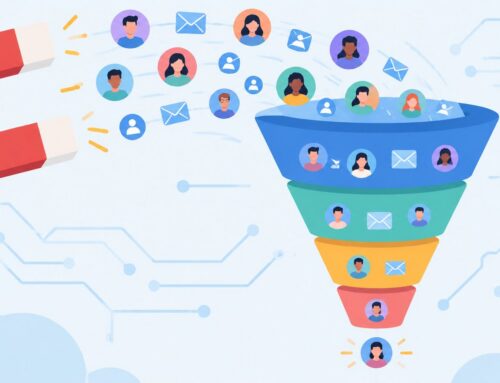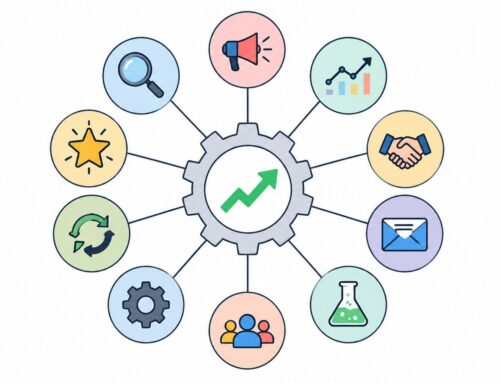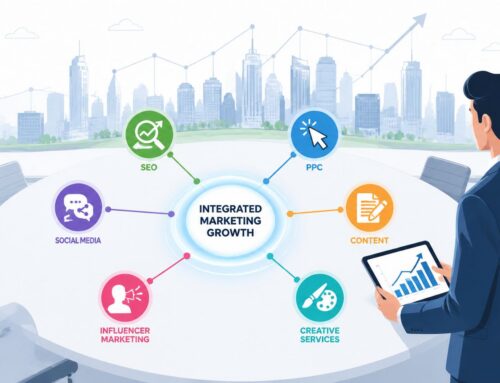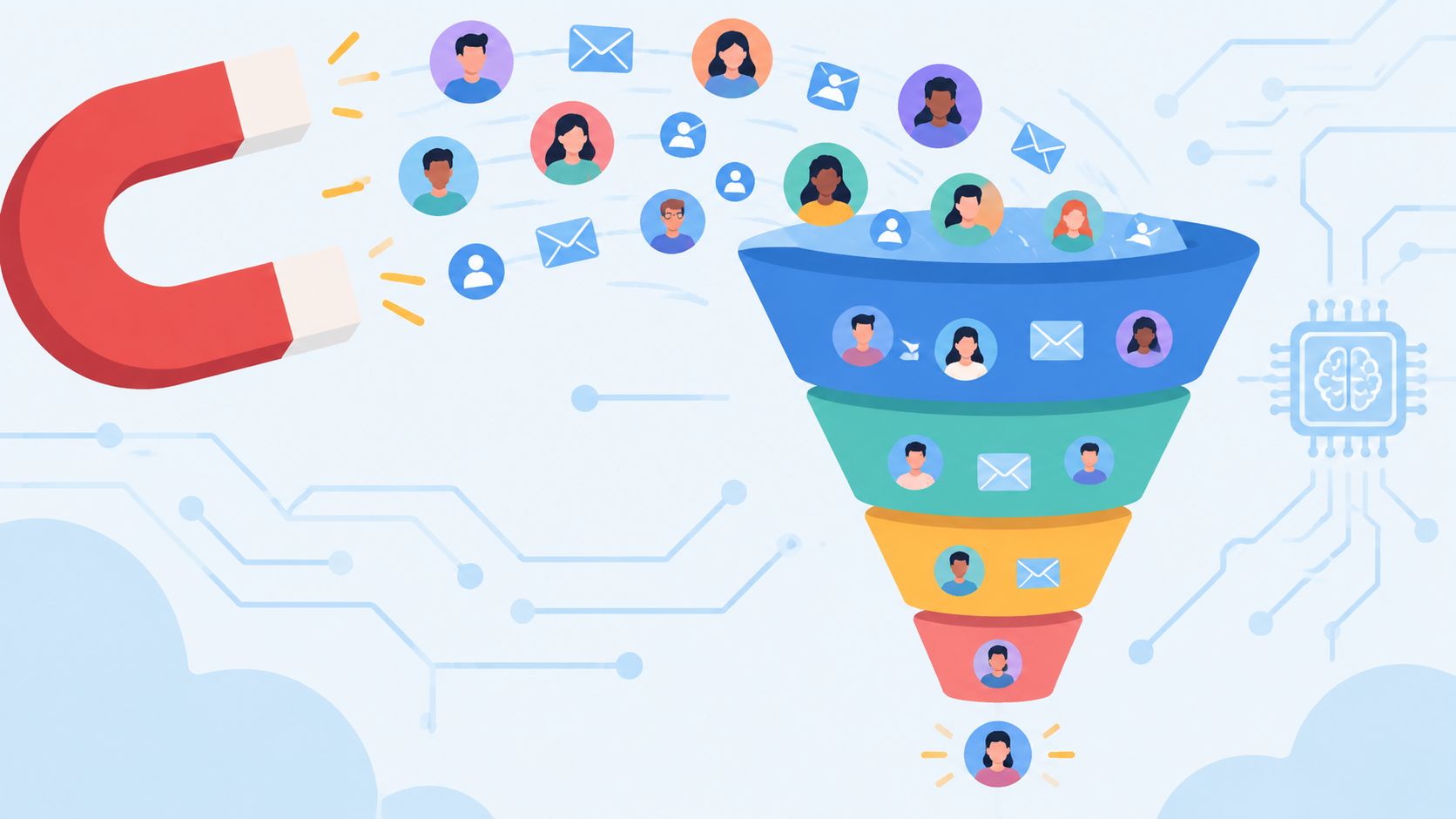
Data-driven marketing solutions are all about using real customer information to make smarter marketing decisions. It’s the difference between guessing what your audience wants and knowing what they want. This approach takes raw data—things like website clicks, past purchases, and social media interactions—and turns it into actionable insights that help you create truly personal experiences for your customers.
What Is Data-Driven Marketing, Really?
Let's cut through the jargon. Think of data-driven marketing less like staring at complicated charts and more like a skilled chef following a time-tested recipe instead of just throwing ingredients in a bowl. It’s a fundamental shift from marketing based on what we think might work to what we know works, all proven by actual customer behavior.
At its core, this is about listening to the story your data is trying to tell you. Every click, every view, every purchase—each one is a clue. When you put all those clues together, you get a crystal-clear picture of who your customers are, what they need, and how they like to connect with you.
The Core Idea Behind It All
The whole point is to make smarter, evidence-based decisions. Instead of blanketing the internet with a generic ad campaign and crossing your fingers, you use data to find the exact people who are most likely to become customers. That precision is what separates a wildly successful campaign from a costly mistake.
The goal is beautifully simple: get the right message to the right person at the right time.
This way of thinking is completely changing the marketing game. The more information businesses gather, the more powerful it becomes to analyze it and act on it. In fact, the global big data analytics market was valued at around $32.30 billion in 2021 and is expected to rocket to roughly $924.39 billion by 2025. That’s not just growth; it's a massive signal that data is now the backbone of modern marketing. You can explore more about these marketing trends and their impact here: https://www.reachlabs.ai/data-driven/
From Raw Data to Real Results
So, how does this actually happen? Data-driven marketing solutions are the tools that make this transformation possible. They're what help businesses turn a pile of numbers into tangible results.
These solutions are designed to help you:
- Understand Customer Behavior: See exactly how people move through your website, which products catch their eye, and what content keeps them hooked.
- Personalize Experiences: Use someone's purchase history to suggest other products they’ll love or create super-specific email lists for targeted promos.
- Optimize Ad Spend: Put your money where it counts by focusing on the channels and campaigns that bring in the best return on investment (ROI).
- Improve Customer Retention: Spot customers who might be drifting away and reach out with a personalized offer to bring them back.
In short, data-driven marketing solutions give you a system for turning abstract numbers into stronger customer relationships and real, measurable growth. It's about building a marketing engine that's always learning and getting better.
When you start thinking this way, you stop shouting at your audience and start having a meaningful conversation—one that’s guided by their own actions.
Building a Powerful Data Strategy: The Three Core Pillars
A great data-driven marketing strategy isn't about buying a single piece of software and calling it a day. It’s a complete system built on three interconnected pillars. I like to think of it like building a house. You can't put up the walls without a solid foundation, and the roof is useless until the walls are secure. Each piece builds on the last, creating something strong, reliable, and meant to last.
This framework helps cut through the noise and breaks down data-driven marketing solutions into a clear, step-by-step process. It starts with gathering the right information (the foundation), moves to finding the story within it (the walls), and ends with taking meaningful action (the roof). Getting these pillars to work together is the secret to building a marketing engine that learns, adapts, and gets better over time.
Pillar 1: Data Collection and Unification
First things first, you need to gather your raw materials. This stage is all about collecting high-quality data directly from your audience in an ethical and transparent way. In a world that’s rightly focused on privacy, your most valuable asset is first-party data—the information your customers willingly share with you.
This information flows in from all sorts of places:
- Website Analytics: Who's visiting your site? What pages do they look at? How long do they stick around?
- CRM Data: Every customer interaction, purchase, and support ticket logged in one central spot.
- Social Media Insights: Engagement stats, follower demographics, and what content is actually resonating.
- Email and App Interactions: Open rates, click-throughs, and specific in-app actions tell a powerful story.
The goal here isn't just to hoard data; it's to unify it. When your customer information is trapped in different systems (we call these "silos"), you only see disconnected snapshots of their journey. A solid data strategy breaks down those walls and brings everything together for a single, 360-degree view of each customer.
Pillar 2: Analysis and Insight Generation
With a foundation of unified data in place, it’s time for the second pillar: analysis. This is where you transform all those raw numbers into a compelling story. It’s about moving beyond what happened to truly understanding why it happened and what it means for your business.
This pillar is less about mind-bending algorithms and more about asking smart questions. For example, instead of just noting that 20% of users abandon their shopping carts, you dig deeper. You start asking which users are leaving and at what specific point in the checkout process. This is where you uncover the patterns and trends that lead to real breakthroughs.
A fantastic technique for this is customer segmentation. This simply means grouping your audience based on shared behaviors or characteristics. Instead of looking at a list of "10,000 customers," you start seeing distinct groups, like:
- High-Value Shoppers: The loyalists who make frequent, large purchases.
- First-Time Buyers: Newcomers who need a killer first impression to come back.
- At-Risk Customers: People who haven't bought anything in a while and might just need a gentle nudge.
Suddenly, a faceless crowd becomes a collection of real people, allowing you to tailor your marketing with incredible precision.
Pillar 3: Activation and Personalization
The final pillar is where your hard-earned insights turn into action. Data is completely useless if it just sits on a dashboard. Its real power is unleashed when you use it to create better, more relevant experiences for your customers. This is the activation stage—where insights fuel your campaigns and personalization efforts.
Activation simply means using what you’ve learned to deliver the right message to the right person at the right time. For instance, if your data shows that first-time buyers who get a welcome email are 33% more likely to buy again, you can automate that email and make it part of every new customer's experience.
This creates the continuous feedback loop that is the heart of modern data-driven marketing solutions:
- You collect data on how customers behave.
- You analyze it to find meaningful insights.
- You activate those insights with personalized campaigns.
- You measure the results, which in turn creates new data.
This cycle guarantees your strategy is never static. Every campaign, every interaction, and every customer response feeds back into the system, making your marketing smarter, more efficient, and more effective with every single go-around.
Picking the Right Tools for Your Data-Driven Marketing Toolkit
Once you've mapped out your strategy, it’s time to gear up. The world of data-driven marketing solutions isn't about finding one single, all-powerful platform. It’s about assembling a specialized toolkit. A carpenter wouldn't build a house with just a hammer, and a marketer can't build a great customer experience with just one piece of software.
Each tool has a specific job: one to gather, one to analyze, and another to act. Understanding how they fit together is the secret to building a tech stack that actually works for you, not against you. Let's break down the essential components.
Customer Data Platforms (CDPs): Your Single Source of Truth
At the very core of most modern data strategies, you'll find a Customer Data Platform (CDP). Its main purpose is to solve one of marketing's oldest headaches: data that's scattered everywhere. A CDP acts as a central hub, pulling information from every customer touchpoint—your website, app, CRM, support tickets, and even in-store sales—to build a single, unified profile for every single customer.
This complete picture is a game-changer. You're no longer looking at disconnected actions; you're seeing one person's entire journey with your brand.
- What it really does: It creates a persistent, 360-degree view of each customer by tearing down data silos.
- How it looks in the real world: An online store uses a CDP to link a shopper's browsing history with their past purchases and a recent customer service email. When that shopper returns to the site, the homepage shows recommendations based on their entire history, not just what they clicked on five minutes ago.
A CDP makes sure every other tool in your stack is working from the same complete, up-to-date playbook. That consistency is where real personalization begins.
Analytics and Business Intelligence (BI) Tools: Finding the Story in the Numbers
Okay, so you have all this clean, unified data. Now what? You need tools to make sense of it all. This is where Analytics and Business Intelligence (BI) platforms shine. Think of them as the detective's magnifying glass for your data, helping you spot the trends, patterns, and "aha!" moments hiding in the numbers.
These platforms turn massive spreadsheets into easy-to-understand visual dashboards and reports. This makes tracking performance, monitoring KPIs, and finding new opportunities much less of a chore. You can see some great marketing dashboard examples to understand how raw data gets transformed into clear, actionable insights. These tools help you answer why things are happening, not just what.
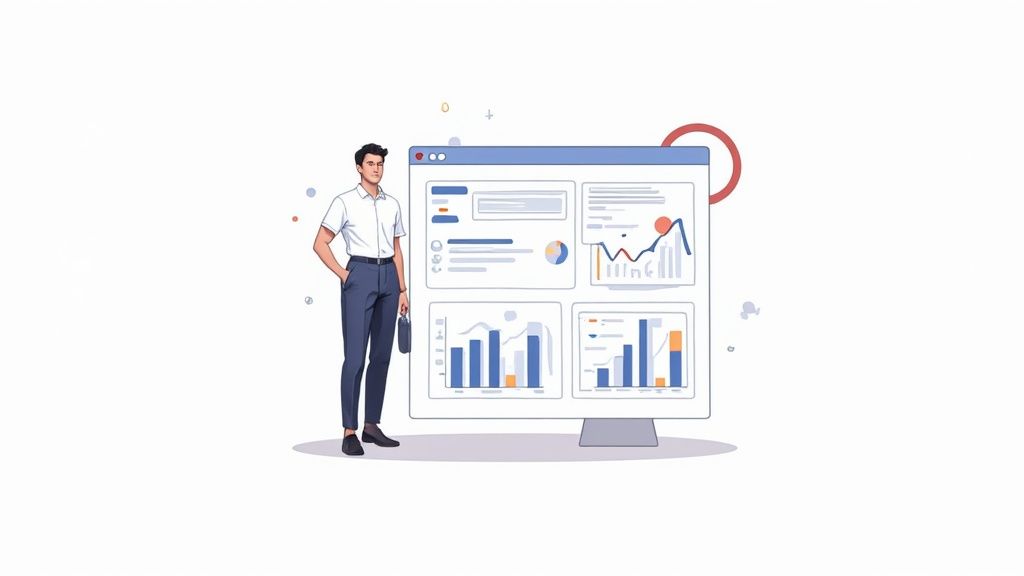
The chart below shows how businesses use these tools to visualize key metrics and spot growth trends.
By visualizing data this way, companies can quickly see what’s working and where they can double down.
Marketing Automation Platforms: Putting Your Insights to Work
With clear insights from your BI tools, you need a way to act on them without hiring an army of marketers. Marketing Automation platforms are the workhorses of your toolkit, built to run personalized campaigns at a scale no human could ever manage manually.
These are the systems that handle the day-to-day tasks like sending welcome emails, posting on social media, or nurturing leads through the sales funnel. You can set up a "flow" that automatically sends a discount to someone who abandoned their cart or a re-engagement offer to a customer who hasn't been back in a while.
Simply put, these platforms are how you turn your data-driven ideas into consistent, automated actions that guide customers along their journey.
AI Personalization Engines: Crafting One-to-One Experiences
The final piece of the puzzle—and one that's quickly becoming essential—is the AI-powered Personalization Engine. These are the most advanced tools in the kit, using artificial intelligence and machine learning to deliver unique, one-to-one experiences in the moment.
They don't just rely on past behavior; they analyze what a user is doing right now to predict what they want next and serve up the perfect content, product, or offer. It's no wonder the AI marketing industry, valued at $12.05 billion in 2020, is on track to hit $107.5 billion by 2028. This explosive growth is all about AI's incredible ability to hyper-personalize every interaction.
These engines are the magic behind Amazon's "Customers who bought this also bought…" feature and Netflix's uncanny ability to know what movie you want to watch next. They represent the peak of data-driven marketing, creating living, breathing experiences that adapt to every individual.
Comparing Key Data Driven Marketing Solutions
To make it easier to see how these pieces fit together, here’s a quick breakdown of the main categories of data-driven marketing tools.
| Solution Type | Primary Function | Key Benefit | Example Use Case |
|---|---|---|---|
| Customer Data Platform (CDP) | Collects and unifies customer data from all sources into a single profile. | Creates a 360-degree customer view for consistent personalization. | An e-commerce brand combines web, mobile, and in-store data for targeted ads. |
| Analytics & BI Tools | Analyzes large datasets to find trends, track KPIs, and create reports. | Turns raw data into actionable business insights. | A SaaS company visualizes user engagement to identify drop-off points. |
| Marketing Automation | Executes repetitive marketing tasks and personalized campaigns at scale. | Saves time and ensures consistent communication across the customer journey. | Sending an automated email series to nurture new leads based on their behavior. |
| AI Personalization Engine | Uses AI to deliver real-time, one-to-one content and product recommendations. | Increases engagement and conversion with hyper-relevant experiences. | A media site dynamically changes its homepage based on a visitor's reading history. |
As you can see, each tool plays a critical, distinct role. The real power comes not from using one, but from integrating them into a cohesive system where data flows seamlessly from collection to insight to action.
How to Choose the Right Solution for Your Business
Picking new marketing technology can be a nerve-wracking, high-stakes decision. We’ve all been there. Choose the wrong tool, and you’re stuck with a costly mistake. The real trick is to find data driven marketing solutions that fit your business like a glove, not the other way around. A thoughtful selection process helps you cut through all the sales noise and invest in something that actually drives growth.
This whole process starts with a simple, honest look in the mirror. Before you even sit through a single product demo, you need a crystal-clear picture of where your business stands today and where you want to take it. This initial self-assessment is the foundation for making a smart, confident decision.
Assess Your Company’s Data Maturity
"Data maturity" is just a fancy way of asking, "How good are we with data right now?" Are you just getting your feet wet, or do you have seasoned analytics teams running complex models? Being realistic about your team's current capabilities is absolutely critical for picking a tool you can actually use.
- Beginner Stage: At this point, you're likely relying on the basics, like Google Analytics and the built-in insights from social media platforms. The focus here should be on solutions that are a breeze to implement and give you clean, straightforward reports without making your team’s heads spin.
- Intermediate Stage: You’ve got a good handle on your different data sources but pulling them all together into a single view is a struggle. A Customer Data Platform (CDP) or a more powerful marketing automation tool could be the perfect next step to finally connect all the dots.
- Advanced Stage: You have clean, unified data and a team that knows exactly what to do with it. At this level, you’re probably on the hunt for more sophisticated data driven marketing solutions, like an AI-powered personalization engine, to really sharpen your competitive edge.
Knowing where you are on this spectrum stops you from buying an overly complex system your team isn’t ready for—or, just as bad, a simple tool you’ll outgrow in six months.
Define Your Business Goals and Needs
Once you know your starting point, it's time to map out your destination. Vague goals like "we need more leads" just won't cut it. You have to get specific.
A well-defined goal acts as your compass. It guides every decision, ensuring the solution you choose directly addresses a real business problem instead of just adding another shiny object to your tech stack.
Here’s how you can translate those broad wishes into concrete needs:
- Goal: Increase customer retention by 15% this year.
- Need: A solution that can spot at-risk customers based on their behavior and automatically kick off re-engagement campaigns.
- Goal: Improve marketing ROI by 20%.
- Need: An analytics platform with clear attribution modeling, so you can finally see which channels are actually making you money.
- Goal: Personalize the website experience for key customer segments.
- Need: A tool that talks to your CRM and can adjust website content in real-time based on who is visiting.
With these specific needs written down, you can build a checklist to hold up against any potential vendor.
Create an Actionable Evaluation Checklist
Okay, now you’re ready to start looking at your options. This checklist is what will keep you focused on what truly matters for your business. When you start evaluating different data driven marketing solutions, every single platform will promise you the world. This list keeps you grounded in reality.
-
Core Functionality: Does the tool do the main thing you need it to do? Seriously. Ignore the flashy, extra features you'll never touch and focus on the core capabilities that line up with your goals.
-
Integration Capabilities: Your marketing tools have to play nice together. Make sure any new solution integrates seamlessly with your existing tech, especially your CRM (like Salesforce), email platform, and website CMS. A lack of integration creates data silos, which is the exact problem you’re trying to fix.
-
Scalability: Will this solution grow with you? Think about where you want your business to be in the next three to five years. A tool that’s perfect today might hold you back tomorrow. Ask vendors about their product roadmap and what it takes to scale up.
-
Budget and Total Cost of Ownership: Don’t just look at the sticker price. You have to dig deeper. Ask about implementation fees, training costs, and any extra charges for support or if you go over your data limits. Understanding the total cost of ownership is the only way to calculate a realistic ROI. For more complex needs, partnering with a knowledgeable team can simplify this process; you can learn more about how a data-driven marketing agency can help guide technology selection and implementation.
By following this structured approach—assessing your maturity, defining clear goals, and using a practical checklist—you can confidently pick a solution that not only solves today's problems but also becomes a valuable asset for years to come.
Your Step-by-Step Implementation Plan

Shifting your marketing from guesswork to a data-powered engine can seem daunting. The good news? You don’t need a massive, disruptive overhaul. The secret is to take small, deliberate steps that build momentum and prove their worth along the way.
This practical roadmap will guide you from theory to action, minus the overwhelm. By focusing on a phased approach, you can launch effective data-driven marketing solutions that deliver real, measurable progress right from the start.
Phase 1: Start with a Clear Objective
Before you even think about touching a single line of data, you need to know where you're going. A vague goal like "improve marketing" is just a recipe for getting lost. Your very first step is to define one single, measurable objective to act as your north star.
Think of it like planning a road trip. You wouldn't just get in the car and start driving—you'd pick a city on the map. The same logic applies here. A specific, focused goal gives your efforts a clear purpose and makes it simple to know if you've succeeded.
Here are a few examples of strong, clear objectives:
- Increase customer retention by 10% over the next six months.
- Reduce customer acquisition cost (CAC) by 15% this quarter.
- Improve email campaign click-through rates by 20% for our new product line.
By starting with a single, achievable goal, you give your team a clear finish line. This focus keeps you from getting bogged down in endless possibilities and sets your first data-driven initiative up for a clean win.
Phase 2: Unify Your Core Data
With your objective set, it's time to gather your supplies. This means identifying, collecting, and cleaning the specific data you'll need to hit your goal. If you're trying to boost retention, for instance, you'll want to pull together purchase histories, customer support tickets, and website engagement logs.
The landscape for this has changed dramatically. Privacy regulations like GDPR and CCPA, plus browser changes from giants like Chrome and Safari, have put a laser focus on first-party data. It's no surprise that by 2025, 64% of marketing executives strongly agree that data-driven marketing is critical for success, largely due to this new reality. You can find more details on how marketing strategies are adapting on Invoca.com.
This stage is all about breaking down data silos. You need to get your CRM, analytics platform, and e-commerce system talking to each other. The goal is a unified view of the information that actually matters for the objective you defined in phase one.
Phase 3: Launch a Pilot Project
Now for the fun part: putting your data to work. But we're going to start small. Instead of rolling out a massive, company-wide campaign, you'll begin with a pilot project. Think of this as your test lab—it's a low-risk way to prove the value of your data-driven approach before you commit serious resources.
A pilot project isolates a small segment of your audience to test a specific hypothesis. It lets you work out the kinks in your process, validate your ideas, and get some early results that can build support for bigger initiatives down the road.
Examples of Effective Pilot Projects:
- A Targeted Email Campaign: Identify a small group of customers who haven't purchased in 90 days. Based on their past buying behavior, send them a personalized re-engagement offer.
- A Personalized Landing Page: For a specific ad campaign, create a unique landing page with messaging tailored to the audience segment you're targeting.
- A Retargeting Ad Test: Run a small-scale retargeting campaign on social media for users who abandoned their shopping carts. Test two different ad creatives to see which one performs better.
These small-scale tests are the heart and soul of successful data-driven marketing solutions. They provide quick, actionable learnings that tell you exactly what to do next.
Phase 4: Measure, Iterate, and Scale
The final phase isn't an end point—it's a continuous loop of improvement. Once your pilot project wraps up, you have to rigorously measure the results against the objective you set back in Phase 1. Did you hit your goal? Did that personalized email campaign actually increase open rates? Did the retargeting ad lower your cost per conversion?
Use these insights to refine your approach. If the pilot was a success, you now have a proven case to secure more budget and scale the strategy to a larger part of your business. If it fell short, the data will tell you why, allowing you to adjust your tactics and try again.
This cycle—measure, iterate, and scale—is what turns a one-off project into a sustainable, data-driven culture. Each success builds on the last, gradually weaving data into the very fabric of every marketing decision your team makes.
Common Questions About Data Driven Marketing
Diving into data-driven marketing is exciting, but it almost always kicks up a few practical questions and potential hurdles. It's totally normal to wonder if these strategies will work for your specific business size or what kind of challenges you might run into.
Let's walk through some of the most common questions I hear from people. The goal here is to clear up any confusion and help you feel more confident about getting started.
Can Small Businesses Actually Use Data Driven Marketing?
Yes, absolutely. One of the biggest myths out there is that you need a Fortune 500 budget to do this stuff. That’s just not true. At its core, data-driven marketing is simply about using what you know about your audience to make better decisions, and that principle works for everyone.
Most small businesses are already sitting on a goldmine of data they can use right away, often with free tools.
Think about it:
- Google Analytics: This will show you exactly which pages on your website people love and how they found you in the first place.
- Social Media Insights: Your Facebook or Instagram business pages give you a detailed breakdown of your followers' demographics and interests.
- Email Marketing Reports: Tools like Mailchimp or ConvertKit track open and click rates, giving you a direct line of sight into what content actually grabs your audience's attention.
Even something as simple as creating a separate email list for your repeat customers or building a lookalike audience on social media is a form of data-driven marketing. You don't need a fancy, expensive tech stack to start seeing a real impact on your sales and engagement.
The secret is to just start with the data you already have. Don't worry about capturing everything all at once. Just focus on using information to answer one business question at a time and let that guide your next step.
What Is the Biggest Challenge People Face with This?
You might be surprised to hear it's not the technology. The biggest roadblocks are almost always data quality and company culture.
So many businesses struggle with "data silos." This is when valuable customer information gets trapped in different systems that don't talk to each other. For instance, your Shopify store knows what people bought, but your Zendesk account has all their support history, and Mailchimp has their email activity.
Trying to piece all that scattered information together to get a single, clear picture of a customer is a massive headache. Without that unified view, you're always working with an incomplete puzzle.
The other hurdle is cultural. It takes a real shift for a team to move from making decisions based on "gut feelings" to trusting what the data is telling them. It means building a habit of testing, learning, and being willing to be wrong. This change in mindset needs strong, vocal support from leadership to really stick and become part of how the company operates.
How Do Privacy Laws Like GDPR Change Things?
Regulations like Europe's GDPR and California's CCPA have completely changed the game, putting the focus squarely on trust and transparency. They've made first-party data—the information customers give you directly and with their consent—incredibly valuable. The old days of buying up massive lists of third-party data are quickly coming to a close.
This change really encourages businesses to build genuine, direct relationships with their customers. Instead of sneakily tracking people, you're now earning their data through a fair exchange of value. Think about things like:
- Signing up for a genuinely useful newsletter
- Downloading an insightful ebook or guide
- Creating a customer account to save preferences
Sure, it adds a few compliance steps to your workflow, but it ultimately steers marketing toward a more ethical and sustainable model. It’s a shift from data quantity to data quality, where the real win is building a loyal audience that trusts you with their information. That trust is the bedrock of any effective data driven marketing solution.
Ready to harness the power of data for your own brand? At ReachLabs.ai, we specialize in creating data-driven strategies that deliver real results. We take a collective approach, integrating world-class talent with powerful insights to elevate your brand’s voice and drive growth. Discover how our tailored solutions can move the needle for your business at https://www.reachlabs.ai.