At its most fundamental level, marketing is all about profitably identifying, anticipating, and satisfying customer needs. It’s the entire process of connecting your business's value to the right audience, spanning everything from the first spark of an idea to the follow-up email after a purchase. The core functions that make this happen are research, product development, pricing, promotion, and distribution.
Marketing as Your Business Growth Engine
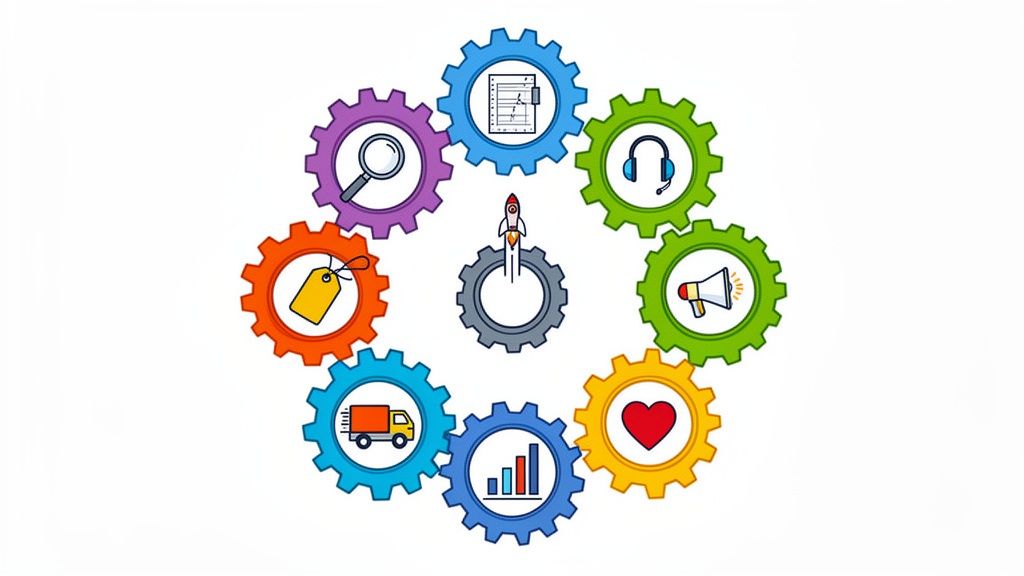
Stop thinking of marketing as just a department or a simple checklist of tasks. Instead, picture it as the engine that drives your entire business forward. Each function is a critical gear in that engine, and they all have to work together seamlessly to build momentum, attract customers, and generate predictable revenue.
When you ask "what are the functions of marketing?" you're really asking how these interconnected parts create a powerful system. This perspective is a game-changer. It means research isn't just data collection; it's the intelligence that shapes your product. Pricing isn't just a number; it's a reflection of your value. And promotion isn't just noise; it's how you tell your story. If one gear breaks, the whole machine grinds to a halt.
Let’s look at how these core functions branch out from a central hub.
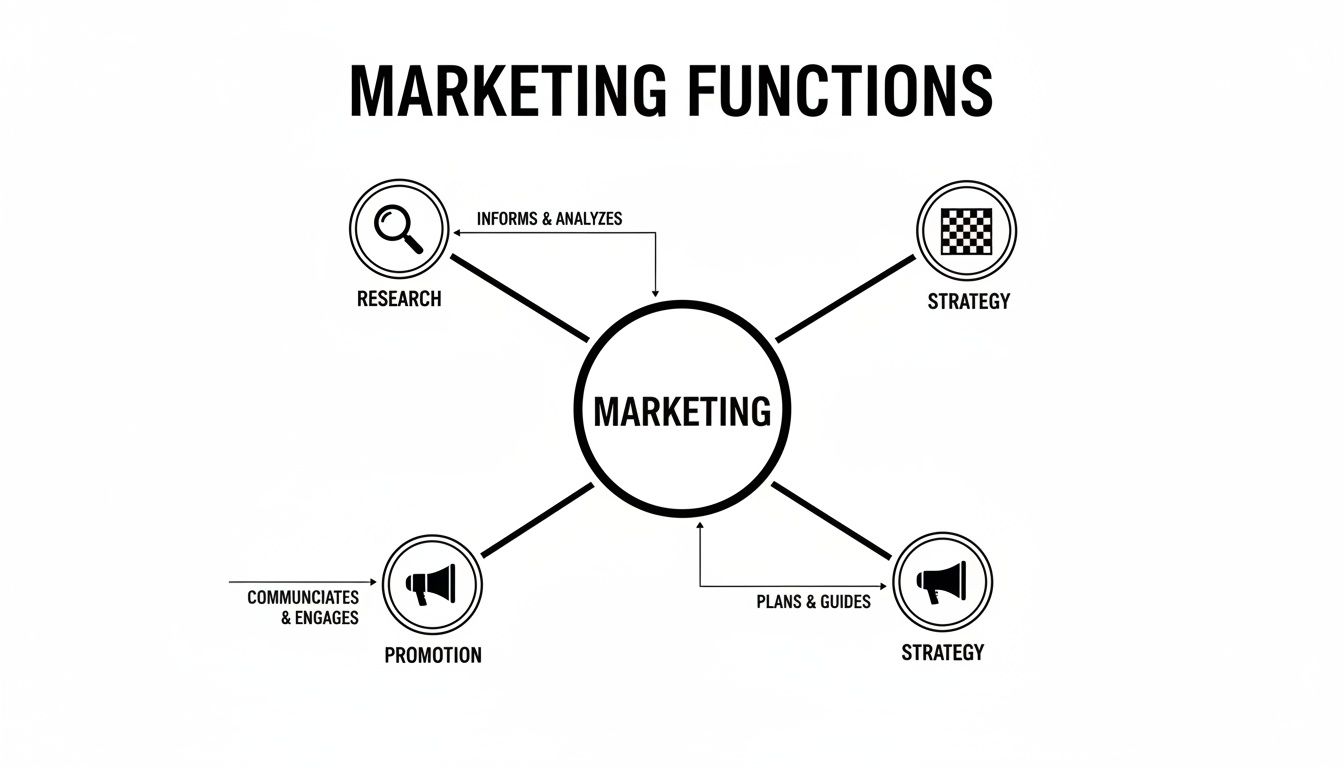
This diagram nails a key point: great marketing always starts with research. That research informs a solid strategy, which is then brought to life through promotion. These three pillars hold up everything else you do.
The Interconnected System of Marketing Functions
None of these functions can succeed on their own. They're all part of a larger, dynamic system where information and action have to flow smoothly from one area to the next.
Research to Strategy: Market research gives you the raw intelligence—the deep dive into customer pain points, desires, and what your competitors are up to. This is the bedrock of your entire strategy. Without it, you're just guessing.
Strategy to Promotion: Your strategy sets the game plan. It defines what you're selling, who you're selling it to, and the compelling reason why they should choose you. All your promotional work—the ads you run, the content you create, and the sales pitches you make—is just the vehicle for that core message.
Promotion to Analytics: Once a campaign is live, analytics closes the loop. This is where you measure what’s working and what isn’t. That feedback gets channeled right back into the system, refining your research, sharpening your strategy, and making your next promotional push even better.
By viewing marketing as a connected system, businesses can move from reactive tactics to a proactive growth strategy. Each function feeds into the next, creating a cycle of continuous improvement and adaptation. This guide will break down each gear in this powerful engine.
To help you keep track, here's a quick look at how the primary marketing functions fit together.
The Core Functions of a Marketing Engine
| Marketing Function | Primary Goal |
|---|---|
| Market Research | To understand customer needs, market trends, and the competitive landscape. |
| Product Development | To create a product or service that solves a real problem for the target audience. |
| Pricing | To set a price that reflects value, covers costs, and achieves profit goals. |
| Distribution | To make the product or service easily accessible to customers. |
| Promotion | To communicate the value of the product and persuade customers to buy. |
| Sales Enablement | To equip the sales team with the tools and content they need to sell effectively. |
| Branding | To build a strong, recognizable identity that resonates with customers. |
| Customer Service | To support customers and build long-term loyalty after the sale. |
| Analytics | To measure performance, track ROI, and inform future marketing decisions. |
Each function listed here is a critical piece of the puzzle. As we go through this guide, we'll explore each one in detail to show you how to build a marketing engine that truly performs.
Charting Your Course with Market Research

Before you can win any race, you need a map. In the world of business, market research is that map. It’s the foundational intelligence that guides every single marketing decision you make. This isn't just about sending out a few surveys; it's about playing detective to uncover your customers' real needs, spot market shifts before they happen, and get an honest look at your competition.
Think of it like being the captain of a ship. Without a navigation system, you’re just sailing blind, burning fuel, and hoping you eventually drift toward land. Market research steers you clear of costly mistakes and points you toward hidden opportunities, making sure your product actually solves a problem people are willing to pay to fix.
You simply can’t overstate how crucial this is. Understanding customer needs, preferences, and behaviors is what informs every smart strategic move. The stakes are high; in 2025, global advertising and marketing spending is estimated to hit a staggering $1.87 trillion, an increase from $1.78 trillion the previous year. You can dig into these numbers more over at Statista.
Uncovering Who Your Customer Really Is
At its core, market research answers one deceptively simple question: "Who are we actually serving?" The whole point is to ditch the assumptions and build a sharp, data-backed picture of your ideal customer. That's why a critical first step is identifying your target audience with precision.
This process involves gathering two different but equally important types of data:
- Quantitative Data: This is the "what." It's all the measurable stuff like market size, customer demographics (age, location, income), and how often they buy.
- Qualitative Data: This is the "why." You get this from conversations—interviews, focus groups, and even combing through online reviews to understand your customers' motivations, frustrations, and feelings.
When you blend the two, you get the full story. For instance, quantitative data might show that 70% of your customers are women between 25 and 40. But qualitative data would tell you why they picked you, revealing that it’s your brand’s commitment to ethical sourcing or your standout customer service that sealed the deal.
Market research transforms guesswork into a data-backed plan for growth. It’s the difference between building a product you think people want and one you know they need.
From Insights to Actionable Strategy
The real magic happens when you turn all that raw data into an actionable strategy. These insights create a ripple effect, directly shaping every other marketing function in your business. For a deeper dive, check out our guide on https://www.reachlabs.ai/how-to-identify-target-audience/.
Once you truly understand your audience and the competitive field, you can:
- Refine Your Product: Pinpoint feature gaps your competitors have missed or find new opportunities for innovation.
- Optimize Your Pricing: Figure out what your customers truly value and, just as importantly, what they’re willing to pay for it.
- Sharpen Your Messaging: Speak your customers' language by using the exact words and phrases they use to describe their problems and what they hope to achieve.
Ultimately, market research ensures your entire business is built on the solid ground of customer understanding. It makes every dollar and every hour you spend on marketing afterward that much more effective.
Aligning Product Pricing and Distribution
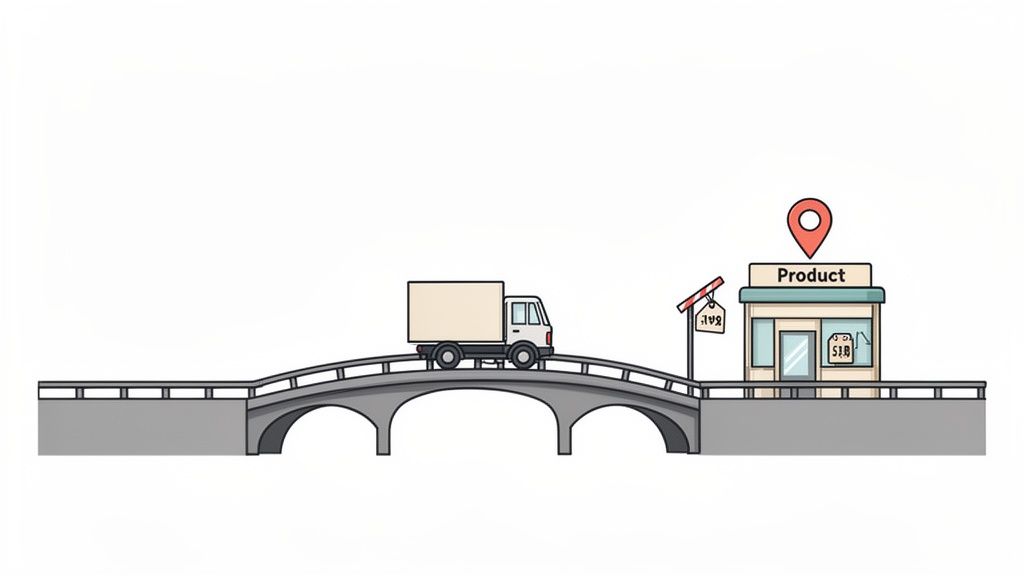
You can have the most brilliant product in the world, but if the price is wrong or customers can't find it, you're dead in the water. This brings us to the tightly woven functions of pricing and distribution—the actual logistics of getting your value into a customer's hands.
Think of it like building a bridge to your customer. Your product is the amazing destination on the other side, your pricing is the toll to cross, and distribution is the bridge itself. If the toll is too high, no one will use your perfectly good bridge. And if there’s no bridge at all, no one can even get to your destination. All three have to work in harmony.
The Art and Science of Pricing
Pricing is so much more than just slapping a number on a product to cover your costs. It's a powerful signal. The price you set instantly communicates your product's quality, who it's for, and its value in the marketplace. A smart pricing strategy grows directly out of the market research you've already done, making sure it lines up with what customers are willing to pay.
Here are a few common ways to approach it:
- Value-Based Pricing: You're pricing based on how much value the customer believes they're getting. Apple is a classic example—they price iPhones based on the premium experience and ecosystem, not just the sum of their parts.
- Competitive Pricing: This is where you peg your price to what your competitors are charging. You see this all the time in crowded markets with similar products, like gas stations or airlines.
- Cost-Plus Pricing: The most straightforward model. You calculate your costs and add a standard markup. It's a safe way to guarantee a profit, but you might be leaving money on the table if customers would happily pay more.
Creating an Accessible Distribution Network
Distribution is all about the "how"—how you physically get your product to your customers. It’s the "Place" in the classic marketing mix. The channels you choose have to make sense for both your product and your customers' habits. These decisions are also critical inputs for effective marketing mix modeling, which helps you forecast results.
The goal of distribution is to make your product not just desirable, but also accessible and profitable. It’s about being in the right place at the right time.
For example, a high-end luxury watch brand isn't going to stick its products in a vending machine. They'll opt for exclusive distribution through a handful of authorized, high-end jewelers to protect their prestigious image.
On the other hand, a company selling potato chips wants intensive distribution. They want their snacks in every supermarket, convenience store, and gas station they can find. Getting product, price, and place right is how marketing functions sync up to create real business success.
Amplifying Your Message with Promotion

Having a fantastic product is only half the battle. If nobody knows it exists, it might as well not. This is where promotion and advertising come in—they are the megaphone for your brand.
But it’s not just about shouting into the void. This is about smart, strategic communication. The goal is to build awareness, spark genuine interest, and gently guide potential customers toward making a purchase.
This function is all about bringing your brand's story to life. It’s about making sure your message reaches the right people and actually connects with them on a level that drives real results. And the scale of this is massive—global ad spending hit a historic $1 trillion in 2025 and is projected to grow 8.9% to $1.19 trillion.
Crafting a Cohesive Promotional Mix
Great promotion is never just one thing. It's a carefully blended mix of different tactics that work together to tell a consistent and compelling story. Think of it like a symphony orchestra—each instrument plays its part, but together they create something beautiful.
Your promotional mix is your collection of "instruments." Here are a few key ones:
- Content Marketing: This is about creating genuinely helpful content—think blog posts, videos, or guides—that attracts your ideal customer. It's how you build trust and position yourself as an expert.
- Digital Advertising: Paid channels like Google ads, social media ads, and display ads let you get your message in front of very specific groups of people with incredible precision.
- Public Relations (PR): This involves earning media coverage and managing your public reputation to build credibility. A single positive story in a respected outlet can often be more valuable than a dozen paid ads.
- Social Media Marketing: It's about showing up where your customers hang out online, building a community, and starting conversations around your brand.
To really connect with today's customers, it's also worth looking into modern approaches like conversational marketing, which focuses on real-time, one-on-one interactions.
The goal of promotion is to move a potential customer from awareness to consideration and finally to a decision. Each promotional touchpoint should guide them smoothly along that journey.
Integrating Channels for Maximum Impact
The real magic happens when you integrate your channels. When your social media posts, your email newsletter, and your PR efforts all tell the same story, the message hits home much harder. This is the core idea behind building effective multi-channel marketing campaigns.
Imagine a B2B software company launching a new feature. They could write a detailed blog post (content marketing), run targeted LinkedIn ads to professionals in that industry (digital advertising), and pitch the story to a few tech publications to get a mention (PR).
Each of these activities on its own is fine, but together, they create a wave of momentum. They reinforce the same message from different angles, making the launch far more successful than any single tactic ever could.
Building Loyalty Through Branding and Relationships
In a market flooded with options, a single sale is just a blip on the radar. Real, sustainable growth? That comes from building genuine relationships that turn a first-time buyer into a loyal fan. This is where two crucial marketing functions come together: branding and customer relationships.
Think of your brand as your company's personality. It’s the story you tell and the feeling people get when they hear your name. It’s the promise you make, long before they even see a product. It's so much more than a logo; it's the entire vibe, the sum of every single interaction someone has with you. It’s no surprise that companies with strong, memorable brands consistently leave their competitors in the dust.
Customer relationship management, on the other hand, is how you make good on that brand promise, day in and day out. It’s the hands-on work of building and nurturing those connections over time, using smart communication to show you care.
From One-Off Sale to Raving Fan Club
Stop thinking about selling a product and start thinking about building a community. Your brand is the flag everyone rallies around, the shared values that bring people together. Your customer relationship efforts are the conversations and high-fives that make them feel like they truly belong.
This simple shift in perspective changes everything. You stop chasing short-term sales and start investing in long-term loyalty. When customers feel a real connection to your brand, they’ll stick with you, even if a competitor dangles a cheaper price. In fact, a whopping 86% of customers say they'll gladly pay more for a great experience—and that experience is a direct result of smart branding and relationship-building.
The ultimate competitive advantage isn't just what you sell. It's the loyalty you build around it. Branding creates the emotional hook, while strong customer relationships give people the logical reasons to stay for the long haul.
This isn't some fluffy, feel-good idea. It's a core marketing function that directly boosts your bottom line by keeping the customers you’ve already earned.
How to Nurture Relationships for Lasting Growth
So, how do you actually do this? It boils down to a few key strategies that blend your brand's personality with thoughtful customer engagement.
- Talk Like a Human: Stay in touch with email newsletters, social media, and personal follow-ups. But don't just blast sales pitches. Share content that’s genuinely helpful and reinforces what your brand stands for.
- Make It Personal: Use what you know about your customers to offer recommendations that actually make sense for them. Acknowledge a birthday or the anniversary of their first purchase. Little things like this show you see them as a person, not a data point.
- Create a Feedback Loop: Ask for their opinions—and then actually listen. When you implement a customer's suggestion, you make them feel like a valued partner in your success, not just a consumer.
When you focus on these marketing functions, you elevate your strategy beyond just promoting stuff. You create a world where customers feel seen, heard, and appreciated. That's how you build a brand that people don't just buy from—they believe in it.
9. Measuring Success with Analytics and Optimization
You’ve probably heard the old saying, "what gets measured gets managed." In marketing, that’s the absolute truth. The final core function, analytics and optimization, is the command center for your entire marketing strategy. It gives you the real-time feedback needed to fine-tune performance, eliminate waste, and prove your worth.
This isn't about chasing empty "vanity metrics" like social media likes or a spike in page views. Real analytics is about tying every action back to the numbers that actually matter to the business. It’s how you create a powerful feedback loop where data from every campaign teaches you how to make the next one even better.
Connecting Data to Business Goals
Great analytics work goes way beyond simply tracking activity; it’s about measuring real impact. The entire point is to draw a straight line from your marketing efforts to tangible business outcomes. This means focusing on key performance indicators (KPIs) that tell a story about growth, revenue, and profitability.
Two of the most critical metrics you'll ever track are:
- Customer Acquisition Cost (CAC): This tells you exactly how much you have to spend, on average, to bring a new customer through the door.
- Customer Lifetime Value (LTV): This metric forecasts the total revenue you can reasonably expect from a single customer over the entire course of your relationship.
For a business to be healthy and sustainable, your LTV must be significantly higher than your CAC. Analytics is how you keep a close eye on this ratio, making sure your marketing budget is a profitable investment, not just another line-item expense. This is the heart of data-driven marketing.
By consistently tracking and analyzing the right KPIs, marketers can finally move from making educated guesses to making data-backed strategic decisions. This cycle of continuous optimization is what separates good marketing from truly great marketing.
To put this into practice, it's crucial to align specific KPIs with each marketing function. Doing this helps you see exactly which parts of your machine are running smoothly and which ones need a tune-up. The table below matches core functions to the metrics that matter most, giving you a clear way to measure what’s working and show the direct impact of your efforts.
Matching KPIs to Core Marketing Functions
Here's a breakdown of how you can connect specific metrics to different marketing activities. This approach gives every function a clear benchmark for success.
| Marketing Function | Primary KPI | Secondary KPI |
|---|---|---|
| Market Research | Market Share Growth | Customer Satisfaction (CSAT) |
| Promotion | Conversion Rate | Cost Per Lead (CPL) |
| Branding | Brand Recall / Awareness | Social Media Engagement |
| Customer Service | Customer Retention Rate | Net Promoter Score (NPS) |
Using a framework like this ensures that every team understands what they're aiming for and how their specific work contributes to the bigger picture. It's about creating accountability and clarity across the entire marketing organization.
Frequently Asked Questions About Marketing Functions
Now that we’ve pulled apart the core components of a marketing engine, let's tackle some of the questions that pop up most often. Getting a handle on these nuances is key to understanding how marketing really works in different situations.
How Do Marketing Functions Differ Between B2B and B2C Companies?
While the fundamental goals are the same—attract and retain customers—the execution looks completely different. It's like the difference between a trial lawyer and a real estate agent. Both rely on persuasion, but their tactics, timelines, and audiences are worlds apart.
B2B (Business-to-Business) marketing is all about the long game. Sales cycles can stretch for months and involve convincing a whole committee of people. This puts a huge emphasis on functions like sales enablement (giving your sales team the knockout materials they need), in-depth content that builds trust, and nurturing professional relationships over time.
B2C (Business-to-Consumer) marketing is often a much faster, more emotional affair. You're usually talking to a single person with a shorter decision-making window. Here, branding, widespread advertising, and social media campaigns take center stage, all aimed at creating an immediate connection and driving a high volume of individual sales.
What Is the Most Important Marketing Function for a Startup?
For a startup just getting off the ground, one function stands above all others: market research. No question. Before you even think about logos, websites, or ad campaigns, you have to know—not guess—that you're solving a real problem for a real audience. An audience that is actually willing to open their wallets for your solution.
Without solid market research, every other function operates on pure guesswork. It's the foundation for your entire business. Getting this wrong means you risk burning through your limited cash and energy building something nobody actually wants to buy.
How Has Technology Reshaped These Functions?
Technology hasn't so much replaced the core functions as it has put them on steroids. AI and modern software have dramatically changed the speed and precision with which we can execute. For example, data analytics can now deliver deep customer insights in a matter of minutes—a process that used to take months of painstaking manual work.
Think about it. Promotion is now hyper-targeted through programmatic advertising, reaching the exact person you want. Customer relationships are managed at an incredible scale using powerful CRM platforms. Technology is the great accelerator, allowing marketers to do their jobs with a level of accuracy and personalization that was unimaginable just a decade ago. It frees up human brainpower from repetitive tasks to focus on what really matters: strategy.
At ReachLabs.ai, we blend data-driven insights with world-class talent to build marketing strategies that actually drive results. Our integrated approach makes sure every function of your marketing engine is firing on all cylinders. Learn how we can elevate your brand's voice.