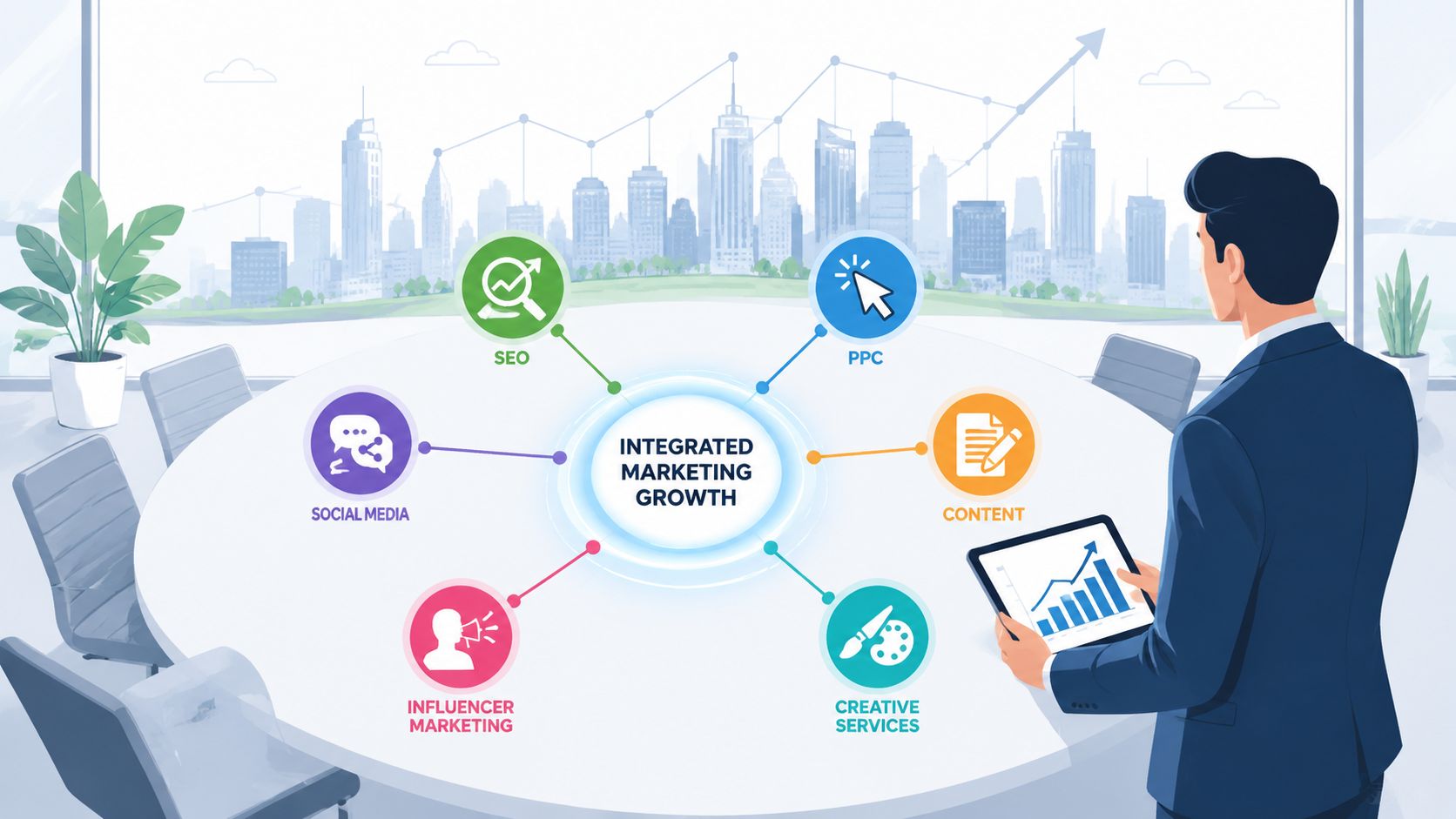
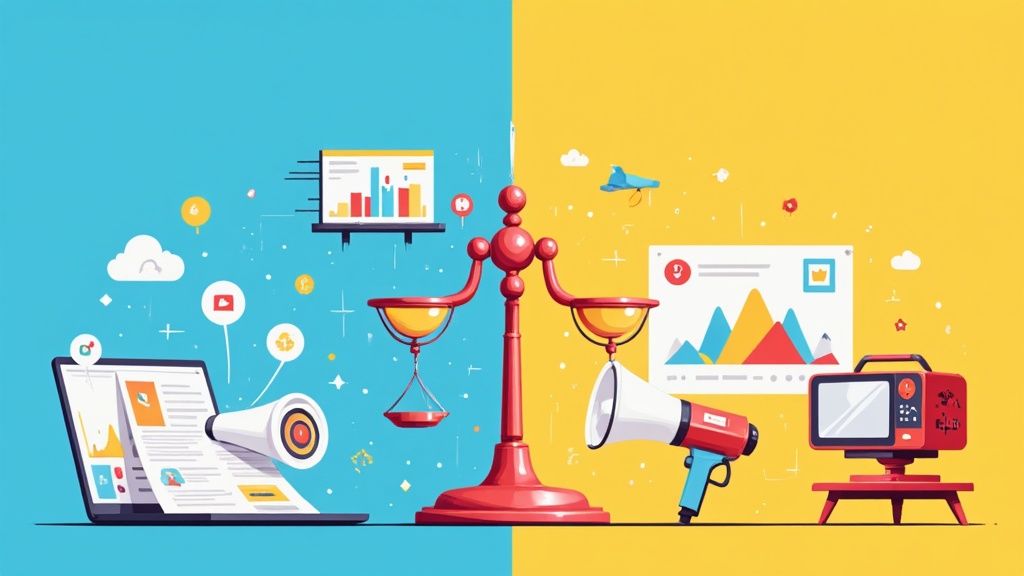
The real difference in the digital marketing vs. traditional marketing debate boils down to one thing: precision versus scale. Think of digital marketing as a scalpel—it allows for hyper-targeted, measurable campaigns with instant feedback. On the other hand, traditional marketing is more like a megaphone, fantastic at building broad brand awareness across mass-media channels.
Your decision really hinges on whether you need to connect with a very specific audience or make a big splash with widespread visibility.
Choosing Your Marketing Path: A Clear Comparison
Trying to figure out where to put your marketing dollars can be a tough call. The options feel endless, and there's a lot on the line. Traditional methods, like print ads and TV commercials, have been the bedrock of brand building for decades. There's something tangible and familiar about them that can create a powerful sense of credibility in a customer's mind.
But then there's digital marketing, which offers a toolkit with an incredible level of accuracy. It lets you speak directly to specific demographics, track every single dollar spent, and adjust your strategy on the fly based on real-time data. In a market that moves as fast as ours, that kind of adaptability is a massive advantage.
I've found that the most successful strategies almost never pick just one. They weave together the broad-stroke brand building of traditional ads with the laser-focused precision of digital channels. That’s how you build a truly comprehensive plan.
The smartest approach isn't about crowning a winner but understanding how each method helps you achieve different business goals. To make the right call, you need a clear, side-by-side view of how they compare across the criteria that matter most. That's what this guide is for—to break down the strengths and weaknesses of each so you can build a marketing mix that actually delivers.
To kick things off, here’s a high-level overview to frame the more detailed analysis that follows.
Digital vs. Traditional Marketing At a Glance
The table below offers a quick summary of the core differences between the two disciplines. It's a great starting point for understanding their fundamental strengths and weaknesses before we dive deeper into specific tactics and strategies.
| Attribute | Digital Marketing | Traditional Marketing |
|---|---|---|
| Primary Channels | Social media, SEO, PPC, email, content marketing | TV, radio, print (newspapers, magazines), billboards |
| Audience Targeting | Highly specific (demographics, interests, behavior) | Broad and general (geography, mass demographics) |
| Cost Structure | Flexible and scalable; pay-per-click or impression | High upfront investment; fixed costs for placement |
| Measurement & ROI | Precise and real-time (analytics, conversion tracking) | Difficult to track direct ROI; often estimated |
| Interaction | Two-way and engaging (comments, shares, clicks) | One-way and passive (broadcast to audience) |
| Speed to Market | Immediate; campaigns can launch in minutes | Slow; requires long lead times for production |
As you can see, the contrast is stark. One offers speed and precision, while the other provides scale and a different kind of authority. Now, let's explore how these differences play out in the real world.
Defining the Two Marketing Arenas
To really get to the heart of the digital marketing vs traditional marketing conversation, you first have to understand their playbooks. They aren't just different sets of tools; they represent two completely different philosophies for reaching people.
Traditional marketing is everything that happens offline. These are the classic, time-tested channels that have built global brands for the better part of a century. Think of them as broad-stroke methods designed to cast a wide net and capture mass attention.
This older school of thought relies on tangible media and broadcast channels to make a big impression. Its real power comes from its ability to create widespread brand familiarity and project a sense of established authority.
Understanding Traditional Methods
The core channels of traditional marketing are the ones we all grew up with, so ingrained in our daily lives we barely notice them. Their entire strategy is built on high visibility.
- Print Media: We're talking about ads in newspapers and magazines. For many consumers, these sources still carry a lot of weight and trustworthiness.
- Broadcast: Television and radio commercials are brilliant at creating those shared cultural moments—like a hilarious Super Bowl ad everyone talks about the next day.
- Outdoor (OOH): Billboards, ads on the sides of buses, and posters in subway stations. These build brand recognition through sheer repetition in high-traffic areas.
- Direct Mail: This is the stuff that lands in your physical mailbox—flyers, postcards, and catalogs that create a tangible touchpoint with a potential customer.
A great real-world example is a new local pizzeria blanketing nearby neighborhoods with flyers. They aren't trying to find one specific person; they're playing a numbers game, hoping to hit every hungry resident in a defined area. It's all about volume and visibility.
Exploring the Digital Frontier
Digital marketing, on the other hand, operates on a completely different premise. It uses online channels to connect with consumers in a much more direct way. The entire field is defined by its data-driven approach, which allows for incredibly precise targeting, instant interaction, and meticulous measurement.
It’s less about shouting to a crowd and more about starting a one-on-one conversation with exactly the right person. A huge piece of this puzzle involves building a strong social media presence, a tactic that operates under a completely different set of rules than any traditional method.
The digital toolkit is vast and always changing, but the mainstays include:
- Search Engine Optimization (SEO)
- Pay-Per-Click (PPC) Advertising
- Social Media Marketing
- Content Marketing
- Email Marketing
For example, a modern e-commerce shop can launch a Facebook ad campaign that targets only users between the ages of 25-34, who live in specific zip codes, and have already shown an interest in sustainable fashion. This kind of laser focus ensures nearly every ad dollar is spent reaching a highly qualified audience, cutting out waste and maximizing potential impact.
Comparing Audience Reach and Targeting Precision
When you get down to it, the digital vs. traditional marketing debate often boils down to one simple question: are you trying to talk to everyone, or are you trying to talk to someone? Your answer really dictates which path makes the most sense, because each one excels at connecting with people in fundamentally different ways.
Traditional marketing plays the numbers game. It’s all about mass reach. Picture a local car dealership running a radio ad—it blasts across the entire metro area, hitting the ears of thousands of people stuck in their morning commute. This is fantastic for building general brand awareness in a geographic area or reaching folks, like older adults, who still tune into traditional media. The strategy isn't about surgical strikes; it's about casting a wide net and hoping to pull in a piece of a large, loosely defined audience.
The Power of Granular Digital Targeting
Digital marketing flips that script entirely. It trades the wide net for a laser pointer. Instead of blanketing a whole city, you can single out individuals based on an incredible amount of data—demographics, hobbies, what they’ve bought before, and even how they behave online.
This pinpoint accuracy is powered by some seriously sophisticated analytics and platforms built for audience segmentation. To really get the most out of it, you have to understand the different customer segmentation techniques that let you group potential customers into very specific buckets.
- Behavioral Targeting: This lets you get back in front of people who recently visited your site or ditched their shopping cart.
- Interest-Based Targeting: You can connect with users based on the hobbies, brands, or influencers they follow.
- Lookalike Audiences: This is like cloning your best customers. You find new people who share the same traits as your existing loyal fans.
This level of detail means your marketing dollars work harder, putting your message right where it needs to be—in front of the people most likely to actually buy something.
Digital marketing gives you the unique power to tap into niche communities that are almost impossible to isolate with old-school methods. A business selling rare vintage camera parts can find its exact audience across the globe, something a billboard or magazine ad could never dream of doing.
Reaching Today's Connected Consumer
The worldwide shift to online life has only amplified digital marketing's edge. Consumer habits have clearly moved online, with social media platforms now connecting over 5 billion active users. For younger groups like Gen Z, a staggering 90% say social content impacts what they decide to buy.
On top of that, search engines are the starting point for 93% of all website traffic, and 46% of Google searches have local intent. This shows just how critical digital channels are for everyone, from global brands to the local coffee shop. You can dig deeper into these trends and what they mean for marketers by reviewing the latest digital marketing statistics. The data makes it clear: digital precision isn't just an option anymore; it's essential for engaging with people today.
Analyzing Cost and Return On Investment
https://www.youtube.com/embed/sHg-QK2IuoY
When you stack up digital marketing vs traditional marketing, the conversation almost always lands on money: how much you spend and what you get back for it. These two factors are often the ultimate decider for most businesses.
Traditional marketing, by its very nature, demands deep pockets right from the start. Think about what it takes to produce and run a TV commercial—we're talking costs that can easily spiral into the hundreds of thousands of dollars before a single person even sees it.
That kind of high barrier to entry can immediately sideline smaller businesses. Even if you can afford it, figuring out what’s actually working is a whole other challenge. You might see a general lift in brand awareness or a bump in regional sales, but trying to pin a specific purchase on a radio ad or a billboard? That’s usually more of an educated guess than a science.
The Digital Advantage in Financial Flexibility
Digital marketing plays by a completely different set of rules. The financial model is incredibly flexible, letting you dip your toes in with a small budget and ramp up spending only when you see things are working. This scalability opens the door for just about any company to compete.
The real game-changer is how we measure return on investment (ROI). With platforms like Google Ads or Meta Ads, you get a live, transparent look at how your campaigns are performing. You can see exactly which ads and messages are resonating with people and shift your budget on the fly. This makes your campaigns far more efficient.
A small business can kick off a campaign with just a few hundred dollars, zero in on a specific audience, and scale up based on real, measurable results. Traditional methods just can't offer that. They demand a big bet upfront with very little insight into what's actually driving customer behavior.
Precision Measurement and Clear KPIs
The true power of a digital budget is in its accountability. You can track every single dollar, drawing a clear, undeniable line from your investment to the final outcome.
This data-rich environment lets us calculate key performance indicators (KPIs) that simply have no direct equivalent in the traditional marketing world.
Some of the most critical digital metrics we track include:
- Cost Per Click (CPC): Exactly what you pay every time someone clicks on your ad.
- Customer Acquisition Cost (CAC): The total marketing and sales cost to bring in one new customer.
- Return on Ad Spend (ROAS): The revenue you earn for every dollar you spend on ads. This is a big one.
With digital marketing, you aren't just spending money; you're investing in data. Every campaign, whether it’s a home run or a flop, teaches you something that makes your next move smarter and more profitable.
Knowing how to calculate your return on ad spend is non-negotiable for optimizing your budget and driving real growth. To get a handle on your campaign success and truly understand the impact of your investments, you’ll need the right tools. Digging into the best digital marketing analytics tools is a must; they turn mountains of raw data into clear, actionable strategies that guide your financial decisions.
Tracking the Global Shift in Marketing Spend
When you boil down the digital vs. traditional marketing debate, one question cuts through the noise: where is the money actually going? The answer paints a clear picture of a massive, ongoing shift of advertising dollars away from traditional channels and onto digital platforms.
This isn't just some small trend—it's a complete reshaping of the marketing world. The reasons are pretty straightforward: consumer habits have changed, and businesses now demand measurable, data-backed results. As more eyeballs move online, brands are right there with them, shifting their budgets to where they can make the biggest splash.
Following the Financial Flow
The global ad spending numbers really tell the story. A recent forecast projects that by 2025, worldwide digital ad spend is on track to hit a staggering $800 billion. That figure absolutely dwarfs the $200 billion expected for traditional marketing in the same year.
That means for every one dollar spent on traditional ads, four will go to digital. This gap isn't just a number; it highlights the precision and efficiency advertisers get from digital channels and shows a market-wide pivot toward strategies that can be tracked and scaled. You can dive deeper into this financial migration and what it means for marketers by checking out the full 2025 forecast.
This shift is more than just moving budgets around; it reflects a fundamental change in business thinking. Companies are no longer content with the fuzzy, hard-to-measure impact of a billboard or a 30-second TV spot. They’re putting their money into platforms that give them instant feedback and a clear return on investment.
The flow of marketing spend is the ultimate vote of confidence. When businesses consistently invest four times more in digital, it signals that the old ways of reaching customers are no longer the primary engine for growth.
This spending gap cements digital marketing's role as the dominant force in modern advertising. Traditional methods certainly still have their place, especially for broad brand-building campaigns. But the financial data confirms that the future of marketing investment is overwhelmingly digital—a practical choice driven by the need for efficiency, accountability, and a direct line to today's consumers.
Building Your Optimal Marketing Mix
The whole debate over digital marketing vs. traditional marketing is a bit of a red herring. It’s not an either/or situation. The sharpest brands I’ve seen don’t pick a side; they create a blended strategy that plays to the strengths of both worlds. The real goal isn’t to crown a winner but to figure out the smartest way to allocate your budget for your specific business.
Your strategy has to be built on a solid foundation of a few key factors. For instance, a local bakery might get incredible results from pairing old-school flyers with super-focused local SEO to get people in the door. A global SaaS company, on the other hand, would be wise to pour its resources into digital channels like content marketing and PPC ads to connect with a very specific, tech-savvy audience scattered across the world.
This infographic really puts the current state of marketing spend into perspective, showing where most companies are placing their bets.
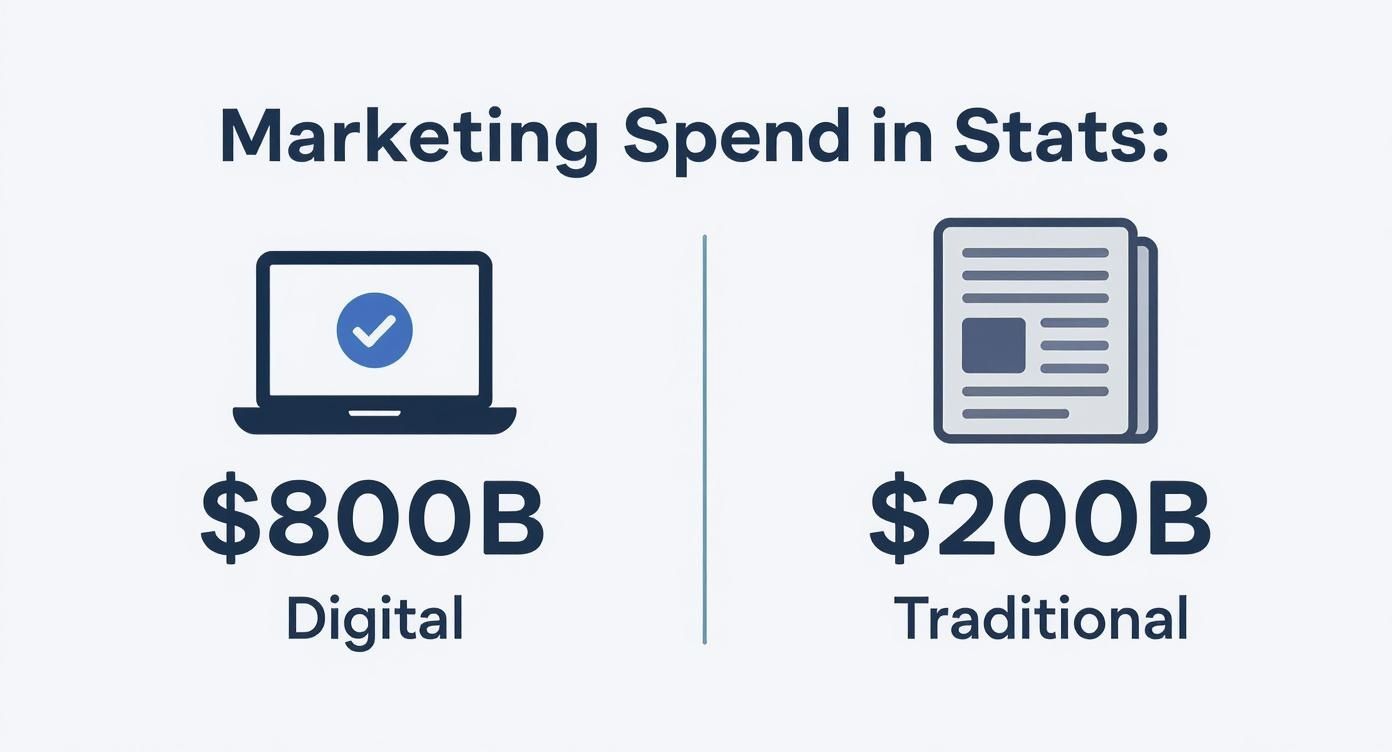
That 4-to-1 spending ratio favoring digital isn't just a trend; it's a clear signal from the market about where the most trackable and scalable results are coming from.
Crafting Your Custom Strategy
To build a plan that actually works, you need to start by asking some fundamental questions. Think of these as your compass. The answers will point you toward where every single marketing dollar will make the biggest splash.
- Who are you trying to reach? If your ideal customer is part of an older generation, don't sleep on traditional channels like local radio or print ads. But if you're going after a younger, digitally native crowd, you absolutely must have a strong social media and influencer game.
- What are you trying to accomplish? Is the main goal to get your name out there and build brand awareness? Or do you need to generate leads right now? A billboard is fantastic for the first goal, while a targeted search ad campaign is built for the second.
- What's your budget look like? Traditional marketing campaigns often demand a hefty upfront investment. Digital, in contrast, lets you start small, test things out, and scale up as you find what works, giving you a ton more flexibility.
The best marketing mix isn’t set in stone. It needs to breathe and adapt as your company grows, your objectives shift, and your audience’s behaviors change. You should always be testing, measuring, and moving your budget toward what’s actually driving a return.
Ultimately, your strategy needs to be dynamic. The discipline of figuring out which channels are truly moving the needle is a skill in itself. If you want to get more sophisticated with this, you can learn more about what marketing mix modeling is and see how it uses statistical analysis to fine-tune your spending across every channel. It’s the kind of data-first approach that takes the guesswork out of building a marketing plan that’s both synergistic and profitable.
Frequently Asked Questions
When it comes to digital vs. traditional marketing, a lot of questions come up. Business owners are often stuck trying to figure out where to put their money. Let's clear up some of the most common questions we hear.
Is Traditional Marketing Still Relevant Today?
Yes, absolutely—but its job has changed. While digital is king for hyper-specific targeting and tracking every dollar, traditional marketing is still a heavyweight champ for building massive brand awareness and a feeling of legitimacy. A 2024 report even found that consumers ranked newspapers as the #1 most trusted channel for advertising.
Think of traditional methods as the opening act that gets everyone talking. A witty billboard or a full-page ad in the right magazine can create a wave of buzz that your digital campaigns can then ride. The trick is to play to its strengths: broad visibility and building trust, not trying to get the same nitty-gritty data you'd expect from a digital ad.
How Can Small Businesses Affordably Start with Digital Marketing?
The best part about digital marketing is that you can start small and grow. You don't need a huge budget to make an impact, which is perfect for small businesses.
Here are a few ways to get going without breaking the bank:
- Local SEO: Claiming and optimizing your Google Business Profile is completely free. It's also one of the single most effective ways to show up for customers searching in your area.
- Content Marketing: A simple blog or a few short videos cost you more in time than money. This is how you build a reputation as an expert and draw in traffic naturally over time.
- Social Media: You don’t have to spend a fortune on ads. Just being active on the platforms where your customers hang out lets you build a real connection with them.
The smartest move is to pick one or two channels you can handle, test things out, and see what works. Once you find a winner, you can funnel some of the profits back in to do more of it.
What Is the Best Way to Measure a Blended Strategy?
Measuring a campaign that mixes both digital and traditional marketing means you have to look at direct results and more subtle indicators. Digital metrics are easy—tools can track every click, conversion, and your exact ROI. Measuring traditional marketing is a bit more creative, but it’s definitely doable.
For example, you can create a special landing page or a unique discount code just for your print ad or radio spot. That way, you can directly link website visits or sales to that specific campaign. You can also watch for spikes in "direct traffic" in your website analytics right after a TV or radio ad airs. Combining the hard numbers from digital with these directional clues from traditional gives you the full picture of how everything is performing together.
At ReachLabs.ai, we specialize in creating strategies that mix the best of both worlds to get you real, measurable growth. Discover how our team can build a custom marketing mix for your business.