
Growth hacking thrives on data-driven insights and rapid experimentation to unlock swift, sustainable growth. It blurs the lines between marketing, product tweaks, and analytics—all while keeping an eye on costs.
What Is Growth Hacking Anyway

Think of a lab scientist—only their tools are A/B tests, customer surveys, and usage metrics. Their mission? Figure out what moves the needle fastest, without dumping resources into guesswork.
They don’t launch massive campaigns on a hunch. Instead, they follow a tight feedback loop:
The Experiment Cycle
- Hypothesis: Draft a clear guess, like “If we streamline sign-up, conversion jumps by 15%.”
- Experiment: Run small-scale tests—often A/B splits—to validate the theory.
- Analysis: Dive into the numbers. Did sign-ups really tick up?
- Iteration: Double down on winners or scrap failures and start the next test.
This nimble approach forms the DNA of growth hacking.
Beyond Traditional Marketing
Regular marketing often centers on broad awareness—TV ads, sponsorships, big brand pushes. Growth hacking widens the lens, zeroing in on every stage of the user journey: acquisition, activation, retention, even referral.
A growth hacker is a person whose true north is growth. Everything they do is scrutinized by its potential impact on scalable growth.
That unwavering focus on a single north star metric makes all the difference. For startups and small teams strapped for cash, it’s a game-changer.
To see how these principles stack up against more conventional tactics, compare them with the best marketing strategies for small businesses and observe how scope and execution shift.
The Story Behind the Growth Hacking Movement
https://www.youtube.com/embed/daeq89BXLAU
To really get what growth hacking is all about, you have to look at where it came from. It wasn’t dreamed up in a boardroom; it was forged in the fast-and-furious world of Silicon Valley startups.
Back in 2010, the startup scene was exploding. Companies were trying to scale faster than ever before, and they realized they needed a completely new kind of marketer—someone obsessed with measurable, explosive growth, not just traditional brand-building.
A New Role for a New Era
Enter Sean Ellis, a guy who was instrumental in the early days of companies like Dropbox. He saw a major gap. He found that most traditional marketers just didn’t have the right mix of data skills and creativity that a lean startup desperately needed to survive and thrive.
So, in a now-famous blog post, Ellis gave this new approach a name: growth hacking. This wasn’t your typical marketing manager. He described a hybrid person, a unique blend of marketer, engineer, and data analyst. You can dig into the specifics of how this role came to be by checking out the history of growth hacking on Wikipedia.
This whole idea was a direct answer to the intense pressure startups were under. They had tiny budgets and a massive need to grow now. They simply couldn’t afford to pour money into long marketing campaigns with fuzzy, uncertain results.
A growth hacker is a person whose true north is growth. Everything they do is scrutinized by its potential impact on scalable growth.
This was a huge mental shift. The focus swung from big budgets to clever, data-driven experiments. The goal was to find what worked through relentless testing and tweaking, fundamentally changing how tech companies thought about getting and keeping users.
The Mindset That Powers Growth Hacking
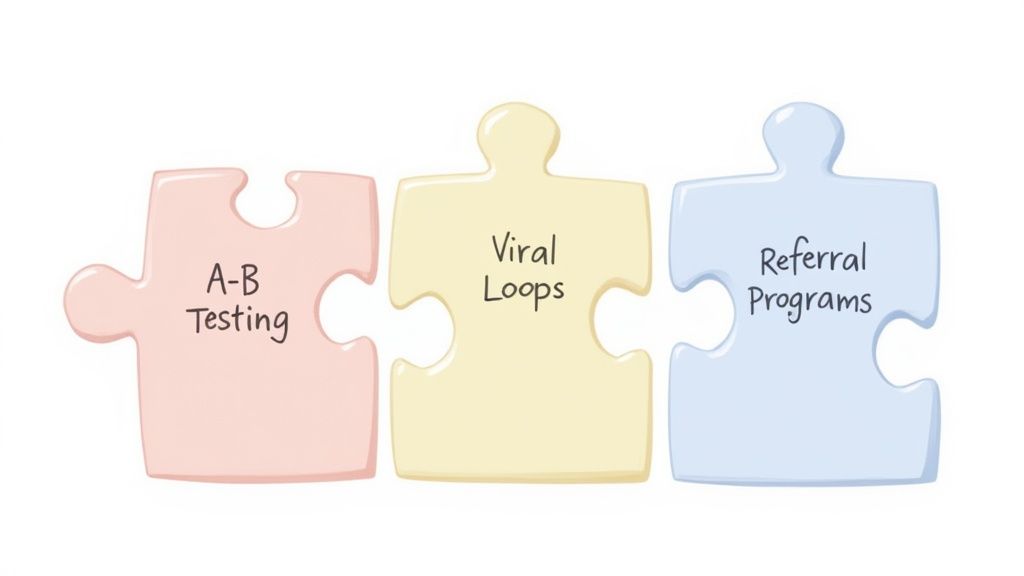
At its core, growth hacking isn’t about a specific tactic or secret trick. It’s a mindset—a deep-seated commitment to a never-ending cycle of experimentation. It’s about ditching decisions based on hunches or tradition and instead letting data call the shots. The entire culture shifts from “I think this will work” to “Let’s test it and see what the data says.”
This philosophy thrives on speed and agility. Forget spending months planning massive, high-risk marketing campaigns. Growth teams work in quick sprints, constantly generating ideas, prioritizing them based on their potential impact, and running small, controlled tests to get answers fast.
The name of the game is continuous optimization. Growth hacking is all about using hard numbers and constant testing to drive business growth, a key difference from more traditional marketing approaches. You can get more insights on this data-first approach on wayra.de.
From Ideas to Impact
So, what does this actually look like day-to-day? It’s a structured loop built for learning and improving, not just throwing random ideas at a wall. A growth team uses a methodical process to turn a hypothesis into a measurable result.
The goal isn’t to find one “silver bullet” that solves everything. It’s to build a predictable, repeatable engine for growth. This system breaks down into a few key steps:
- Ideation: This is where it all starts. The team brainstorms new growth ideas across the entire customer journey, from how people first hear about you to what keeps them coming back.
- Prioritization: Not all ideas are created equal. Using a framework like the ICE score (Impact, Confidence, Ease), teams rank their ideas to focus on experiments that are most likely to move the needle.
- Testing: Now it’s time to get real data. This means running controlled experiments, like A/B testing a headline on a landing page or offering a new feature to a small segment of users, to see what actually works.
- Analysis: Once a test is done, the team dives into the results. They’re looking to understand not just what happened, but why it happened. This is how raw data becomes a powerful insight for the next experiment.
This disciplined, high-tempo cycle is what allows companies to adapt quickly, fine-tune every part of their customer experience, and uncover the most efficient ways to scale. It’s a mindset built for discovery.
How Growth Hacking Differs From Traditional Marketing
People often wonder if growth hacking is just a flashy name for marketing. It isn’t. Although both aim to drive business growth, they take very different routes to get there.
Traditional marketing works with fixed budgets and leans on familiar channels—think paid ads or content campaigns—to build brand visibility over time. Its sweet spot is usually at the top of the funnel, where the focus is on attracting new leads.
A growth hacker sees the entire user journey. From the first click to everyday use and onward to sharing with friends, they blend creative experiments with product tweaks to spark rapid, measurable results.
A Focus On The Full Funnel
Here’s the real divide: A traditional marketer might hand off a lead once it enters the CRM. A growth hacker sticks around to refine every step that follows.
They often juggle roles in product, engineering, and data science to test small changes that add up fast:
- Optimize the onboarding process to boost activation rates
- A/B test product features for more daily user engagement
- Build a referral program straight into the product to drive viral growth
This hands-on, data-driven style is what makes growth hacking so distinct.
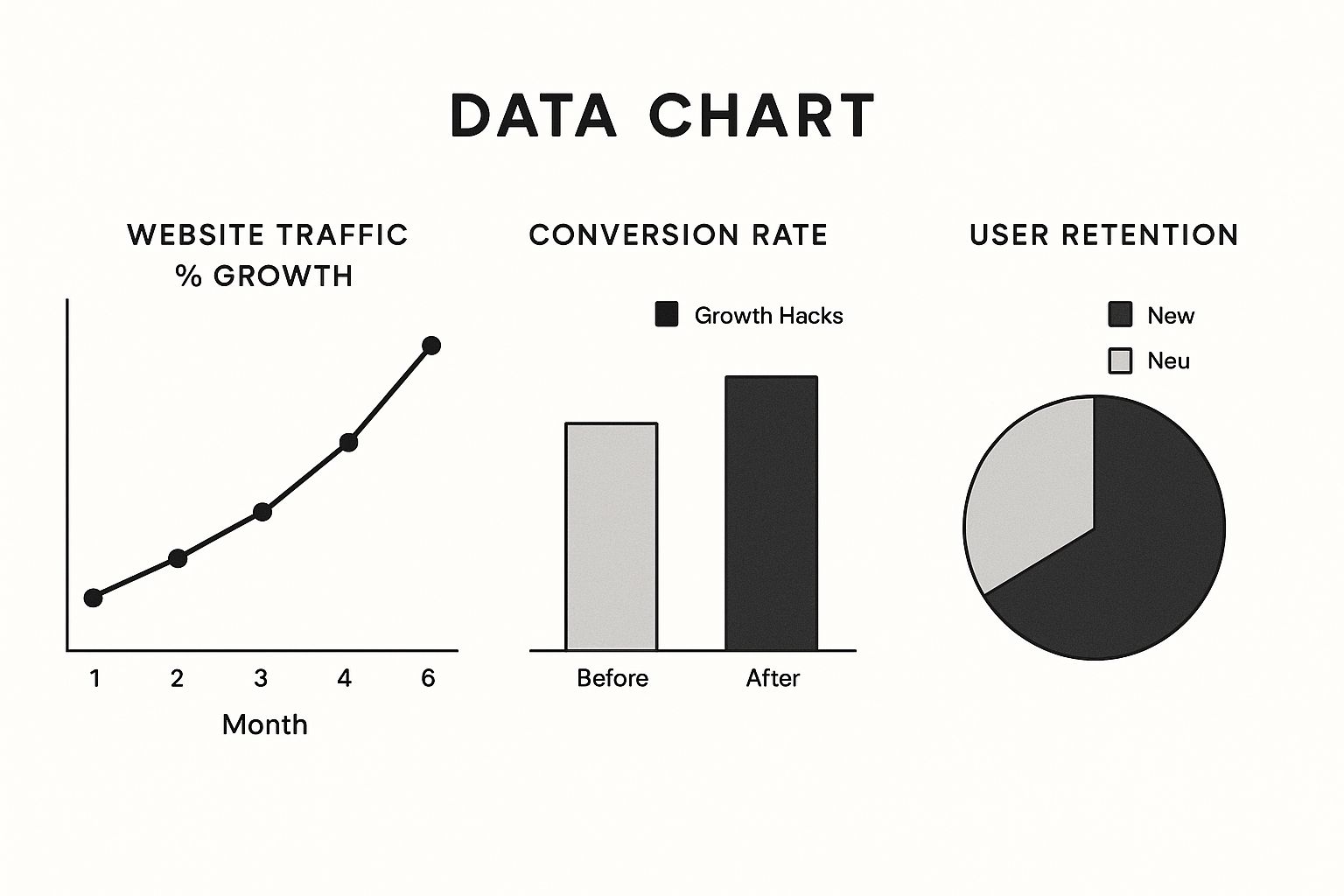
The graphic above illustrates how a string of targeted experiments can lift traffic, conversion rates, and user retention—all at once. That’s the heart of growth hacking: finding the most efficient path to scale, wherever your biggest opportunities lie.
Below is a quick comparison to highlight their core differences.
Growth Hacking vs Traditional Marketing A Quick Comparison
This table highlights the fundamental differences in approach, goals, and execution between growth hacking and traditional marketing.
| Aspect | Growth Hacking | Traditional Marketing |
|---|---|---|
| Mindset | Experiment first, scale fast | Plan campaigns, maintain brand consistency |
| Scope | Full user lifecycle—from acquisition to retention and referral | Primarily top-of-funnel: awareness and lead generation |
| Metrics | Data-driven metrics at every stage (activation, retention, virality) | Broad KPIs like reach, impressions, and overall brand lift |
| Team Roles | Multidisciplinary: product, engineering, analytics | Specialized: creative, media buyers, copywriters |
| Budget Approach | Flexible, reallocates funds to high-performing tests | Fixed budgets allocated to established channels |
| Speed | Rapid testing, quick iterations | Longer planning cycles, scheduled campaign launches |
Growth hacking digs deeper into every stage of the customer journey and moves at breakneck speed. Traditional marketing excels at building broad brand recognition, but growth hackers zero in on the experiments that drive measurable scale.
Famous Growth Hacking Success Stories in Action

It’s one thing to talk about the theory, but seeing growth hacking in the wild is where its genius truly clicks. Some of the biggest names in tech today didn’t get there with Super Bowl ads; they got there with clever, low-cost hacks that sidestepped traditional marketing altogether.
Let’s look at a few classic examples that show how a single smart experiment can completely change a company’s trajectory.
Hotmail: The Original Email Signature Hack
One of the earliest and still most brilliant examples comes from Hotmail. Back when email was a new frontier, they skipped expensive ad buys and instead embedded a simple, clickable signature into every single email sent from their platform.
It read: “P.S. Get your free email at Hotmail.”
Instantly, every user became a promoter. Each email they sent acted as a tiny, free, and incredibly effective ad. This one move helped Hotmail acquire millions of users with virtually zero marketing spend, proving that your product could also be your marketing channel.
Dropbox: Turning Storage into Shares
When Dropbox entered the scene, the cloud storage market was already getting noisy. They needed a way to cut through, and they did it with a masterclass in product-led growth.
The company built a two-way referral program right into its onboarding process. If you invited a friend to join, both of you received extra free storage space.
This wasn’t just a gimmick; it was a self-perpetuating growth engine. It worked because the reward—more storage—was directly valuable to the user. This simple incentive turned their customers into their best salespeople and skyrocketed signups by 60%. Dropbox exploded from 100,000 to 4 million users in just 15 months, all by baking marketing directly into the user experience.
Airbnb: Piggybacking on a Giant
In its early days, Airbnb had a classic startup problem: a great product but no audience. They needed to get their listings in front of people who were already looking for places to stay, but how? Their answer was bold, a bit cheeky, and pure growth hacking: Craigslist.
The team built a clever, unauthorized integration that allowed hosts to cross-post their Airbnb listing to Craigslist with a single click. This move instantly tapped into Craigslist’s massive, highly relevant audience without spending a dollar on advertising.
It was a brilliant technical workaround that solved their distribution problem overnight and is a perfect example of thinking outside the box to overcome common issues in small business marketing.
Common Questions About Growth Hacking
As more people hear about growth hacking, a few questions always seem to come up. It’s a field that blurs the lines between marketing, product, and data, so a little confusion is totally normal. Let’s tackle some of the most common ones head-on.
Getting these basics straight will help you see how this experimental, data-first approach can work in just about any business, from a two-person startup to a global corporation.
Is Growth Hacking Only for Startups?
Not anymore. It’s true that growth hacking got its start in the lean, fast-moving world of startups where every dollar and every minute counts. But the game has changed. Today, plenty of large, established corporations have their own dedicated growth teams.
These teams are brought in to launch new products, crack into new markets, or just find ways to get more out of their existing customer funnels. The core idea—running quick, data-backed experiments to find the most efficient way to grow—is a powerful tool for any business looking to scale.
The reality is, growth hacking isn’t about company size. It’s about building a culture that’s agile and hungry for data. It’s a mindset, not a startup-only trick.
This evolution means that even massive companies can adopt the focused, experimental strategies that once gave startups their edge.
What Skills Does a Growth Hacker Need?
A great growth hacker usually has what we call a “T-shaped” skillset. Imagine the letter T: the vertical bar represents deep expertise in one or two key areas, while the horizontal bar represents a broad, working knowledge across many different disciplines.
So, they might know a little bit about SEO, paid ads, and email campaigns, but be an absolute wizard at conversion rate optimization (CRO) and analytics. But beyond specific hard skills, a growth hacker is really defined by a few key traits:
- Deeply Analytical: They aren’t afraid of data. In fact, they live in spreadsheets and dashboards, constantly hunting for patterns and insights that others might miss.
- Creative Problem-Solvers: They’re the ones who come up with clever, unconventional solutions to tough growth challenges.
- Skilled Experimenters: They know how to design and run clean tests that produce real, actionable results. No guesswork allowed.
- Product-Oriented: They see the product itself as the single most important marketing tool and are always thinking about how to improve it to drive growth.
It’s this unique blend of analytical thinking and creative execution that really sets them apart.
How Does It Differ From Digital Marketing?
Here’s a simple way to think about it: digital marketing is the toolbox, while growth hacking is the blueprint for how to use those tools to build the entire house.
Digital marketing is often focused on executing campaigns within specific channels. Think running a Google Ads campaign, managing social media accounts, or building an email list. Success is usually measured with channel-specific metrics, like website traffic or lead volume.
Growth hacking, on the other hand, is a much broader methodology. It definitely uses those digital marketing tools, but its scope is way bigger. A growth hacker gets involved in product development, user experience, and customer retention strategies. It’s a holistic approach that looks at the entire customer journey, all with the singular goal of finding scalable and repeatable ways to grow the business. Our guide on content marketing for small business shows how even a single focused strategy can be part of this larger growth picture.
At ReachLabs.ai, we blend creative strategy with data-driven execution to build a powerful voice for your brand. Discover how our tailored approach can help you achieve your growth objectives at https://www.reachlabs.ai.