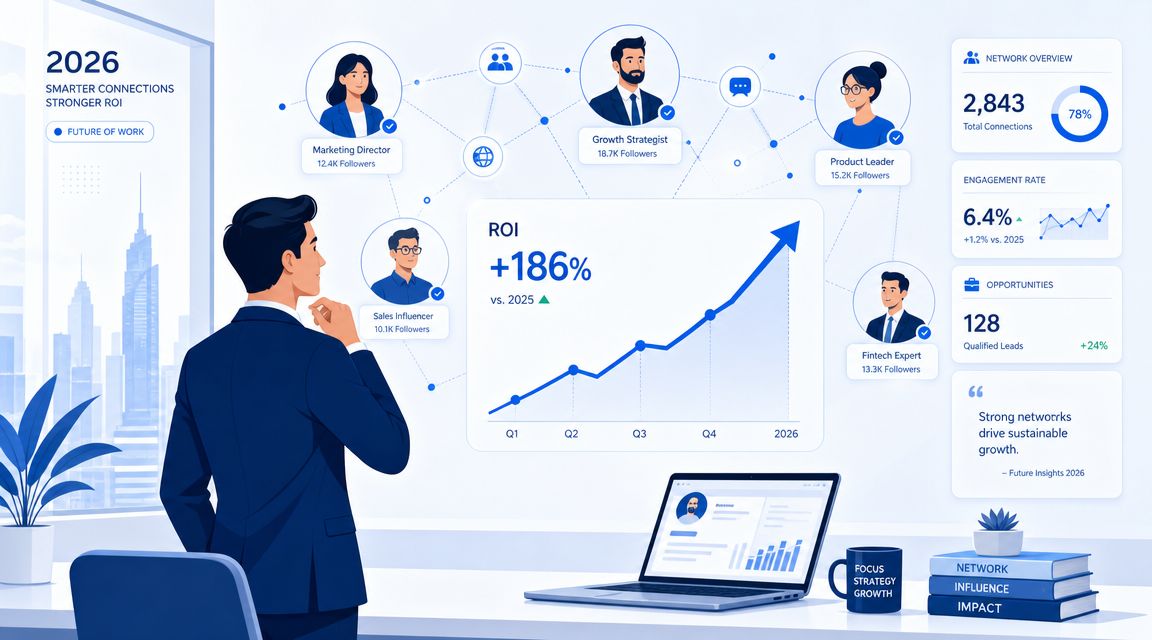
LinkedIn has about 1.3 billion members across 200 countries and territories, and in the U.S. 53% of its users are high-income earners while 18% are low-income according to Sprout Social's LinkedIn statistics roundup. For B2B teams, that changes the conversation. LinkedIn influencer marketing isn't just a visibility play. It's a way to put credible experts in front of the people who can approve budget, influence a buying group, or shortlist a vendor.
A common mistake teams make is treating LinkedIn like a softer version of consumer influencer marketing. They chase reach, post screenshots of engagement, and call it success. That's not enough in B2B. If a campaign doesn't connect to lead quality, sales conversations, and pipeline movement, it's just branded activity.
A strong influencer marketing LinkedIn program works very differently. You start with the commercial outcome. Then you choose the right creator type, shape the content around buyer questions, and build measurement into the campaign before the first post goes live. That's the difference between “we worked with some creators” and “this channel is producing revenue.”
Why LinkedIn Influencer Marketing Is a B2B Power Play
LinkedIn's scale matters, but its business value comes from audience intent. People open the platform to evaluate ideas, benchmark peers, and follow operators who can help them make better decisions at work. That makes influencer marketing on LinkedIn structurally different from creator programs on entertainment-first channels.
In B2B, attention only matters if it reaches people who can shape a deal. LinkedIn is one of the few places where creators can influence that process in public. A founder can frame a category problem. A consultant can validate a new approach. A practitioner can show how a tool fits into an existing workflow. Those signals travel farther than brand copy because buyers treat them as informed perspective, not house messaging.
Trust beats polish on LinkedIn
Trust carries more weight than production value here. Buyers are used to seeing polished brand content, and they know how to discount it. They respond differently to someone with direct experience, a clear point of view, and enough credibility to challenge conventional thinking.
That is why the strongest LinkedIn influencer campaigns usually look like expert distribution, not sponsorship dressed up as thought leadership. The creator's role is to add context, judgment, and relevance. If the post reads like an ad, performance drops. If it helps the audience understand a problem, compare options, or avoid a mistake, engagement quality improves and sales teams get a warmer path into the account.
On LinkedIn, the creator often isn't the media buy. The creator is the trust layer.
This channel also works best as part of a wider acquisition model. If you are comparing partnership structures, content economics, and where influencer marketing fits against other channels, this guide to marketing strategies for digital products is useful because it separates authority-building programs from direct-response ones.
The Strategic Upside: Qualified Attention
Qualified attention is the advantage. A good LinkedIn influencer program helps the right buyers notice your category, understand your point of view, and engage before they ever fill out a form.
That changes the economics of demand generation. Influencer content can raise response rates on paid promotion, give sales a credible asset to share, and improve conversion on mid-funnel offers because the market has already seen the message from a source it trusts. I have seen campaigns generate fewer raw leads than a standard lead magnet push and still produce more pipeline because the audience came in better informed and easier for sales to qualify.
This is also why LinkedIn influencer work pairs well with outbound and social selling. Teams that already run account-based programs often get stronger results when creator content is coordinated with a structured LinkedIn lead generation approach. The goal is not more activity. The goal is to reduce friction between first exposure, sales conversation, and revenue.
Crafting Your LinkedIn Influencer Strategy and Budget
A weak campaign usually fails before outreach starts. The team picks a creator, negotiates a post, and hopes the audience cares. A good campaign starts with the commercial question first. What business outcome should this influence?
A 2025 LinkedIn/Ipsos benchmark reported that 55% of B2B marketers already use influencer or creator marketing, while another 29% planned to adopt it within the next year. The same benchmark found that 76% of marketing leaders believe collaborating with creators builds brand authenticity, and brands using influencer marketing outperform non-users by up to 39% on customer engagement and brand awareness, as summarized by Foundation Inc.. That tells you two things. Adoption is already real, and authenticity is one of the core reasons teams invest.

Start with a pipeline goal, not a posting goal
The cleanest way to plan influencer marketing on LinkedIn is to choose one primary outcome and one secondary outcome.
- Pipeline outcome: Demo requests, event registrations, qualified form fills, or lead-to-opportunity progression.
- Trust outcome: Better response to sales outreach, stronger comments from the market, more credible category positioning.
- Content outcome: Reusable assets for paid social, email, landing pages, newsletters, and sales enablement.
If you try to make one campaign do everything, the content gets muddy. A creator can support awareness and conversion, but the campaign still needs one dominant job.
Pick a budget model that matches the partnership
B2B teams usually make one of two budgeting mistakes. They underfund strategy and measurement, or they overpay for one-off exposure that has no follow-through.
A simpler way to think about budget is by model:
| Model | Where it works | Trade-off |
|---|---|---|
| One-off activation | Product launch, webinar push, report distribution | Faster to launch, weaker long-term learning |
| Short campaign series | Testing themes, segments, or offers | Better for comparison, requires tighter coordination |
| Ambassador program | Category leadership, recurring demand capture | Stronger consistency, needs relationship management |
The spend itself is only one line item. You also need room for creative review, landing page support, paid amplification, internal approvals, reporting, and content reuse rights. If you skip those, the campaign may still run, but it won't scale well.
Decide when organic is enough and when paid matters
Organic creator posts work best when the influencer already has authority in the niche and the offer fits their audience naturally. That's often enough for founder audiences, specialized SaaS categories, consultants, and B2B services.
Paid amplification makes sense when you need controlled reach, tighter targeting, or repeatable distribution across a broader buying committee. In practice, the strongest setups often combine both. Let the creator publish in their voice first. Then amplify the content or repurpose it into ads, sponsored posts, or sales collateral once you know the message is landing.
Practical rule: If leadership expects pipeline impact, build the paid distribution plan before the campaign starts, not after the organic post performs “well enough.”
Finding the Right LinkedIn Influencers for Your Brand
The wrong way to source LinkedIn influencers is to sort by follower count and send messages to the largest names in your category. That logic imports consumer-platform habits into a professional network where buying decisions depend more on relevance and trust than scale alone.
Recent creator guidance emphasizes that the first 90 minutes after posting are critical, with engagement pods, first-degree connections, and DMs playing a major role in distribution, according to this LinkedIn creator discussion on YouTube. The useful takeaway isn't “game the algorithm.” It's that LinkedIn influence often depends on network activation, comment velocity, and peer credibility. A creator with a tightly connected professional audience can outperform a much larger account that draws passive engagement.
LinkedIn Influencer Archetype Comparison
| Influencer Type | Primary Value | Best For | Typical Cost |
|---|---|---|---|
| Employee advocates | Product knowledge and firsthand credibility | Category education, social proof, product explainers | Lower direct cash cost, higher internal coordination |
| Founders and executives | Vision, authority, and market perspective | Thought leadership, launch narratives, trust building | Varies widely |
| Niche industry experts | Deep subject matter trust | Mid-funnel education, webinars, reports, technical offers | Moderate to premium |
| Broad thought leaders | Reach and reputation transfer | Brand visibility, event promotion, category association | Often premium |
What to actually evaluate
Follower count tells you almost nothing by itself. Three better signals usually predict fit more accurately.
First, read the comments. Are people asking follow-up questions, sharing real experiences, disagreeing intelligently, or tagging colleagues? That's a healthier sign than a feed full of one-line praise and generic applause.
Second, inspect audience overlap. You want evidence that the creator's audience includes the job functions, industries, company profiles, or problem awareness levels that matter to your campaign. Many “big” creators often stumble here. They may be visible, but not visible to your buyers.
Third, look at topic discipline. Strong B2B creators tend to stay close to a lane. If someone alternates between hiring advice, startup memes, AI hot takes, personal motivation, and random lifestyle content, brand fit gets harder.
Choose authority over volume
The best LinkedIn creator for a cybersecurity offer may not be a famous tech personality. It may be a practitioner with a smaller but sharper audience of IT leaders and operations buyers. The best fit for an HR platform may be a consultant whose posts spark conversations among talent leaders, not a general business creator with a bigger following.
Use a shortlist process that includes:
- Audience fit: Job titles, industries, and problem context.
- Content style: Educational, contrarian, tactical, founder-led, analytical.
- Comment quality: Signs of peer-level engagement, not just likes.
- Commercial maturity: Can they follow a brief, hit deadlines, and disclose appropriately?
The strongest LinkedIn influencer doesn't just attract attention. They attract the kind of attention your sales team can use.
A practical sourcing stack
Teams can typically build a solid prospect list without specialized software at first. Start with LinkedIn search, your team's existing network, event speaker lists, newsletter contributors, podcast guests, and people already discussing the problem your product solves.
Then narrow aggressively. A short list of highly relevant creators is worth more than a long spreadsheet full of “possible fits.” On LinkedIn, fit compounds. Misalignment gets exposed fast.
Effective Influencer Outreach and Creative Briefing
Outreach usually fails for simple reasons. The message is generic, the offer is vague, or the brand sounds like it wants ad inventory rather than a real partnership. Good LinkedIn creators can spot that immediately.
The channel itself pushes you toward a better standard. Most LinkedIn influencer marketing advice still leans heavily on visibility, but it often misses the harder commercial question of how the work will prove value beyond impressions and likes. SmartBrief's coverage notes that marketers say credibility and trust are top influencer goals in 2025, which means the work has to be measurable, not just visible, in this discussion of LinkedIn influencer marketing's untapped opportunity.

Outreach that gets replies
The best first message is short, specific, and obviously written for that person. It should show you understand what they talk about, why their audience fits, and what the collaboration could look like.
Avoid these mistakes:
- Generic praise: “Love your content” isn't enough.
- Overexplaining your company: The creator doesn't need your full brand story in message one.
- Asking for ideas before commitment: Don't ask them to do strategy work for free.
- Hiding the commercial intent: If this is a paid collaboration, say so.
A better outreach note usually includes four things:
- A specific observation about their work.
- Why their audience aligns with your campaign.
- A simple collaboration concept.
- A clear next step.
If your team needs a more structured process for prospecting and contacting creators, this overview of influencer outreach fundamentals is a useful reference point.
We'd like to partner on a campaign around [topic], aimed at [audience], with a clear conversion asset behind it. Your recent posts on [specific theme] are close to the angle we want. If that sounds relevant, I can send a brief with scope, timeline, and compensation.
The creative brief should create clarity, not scripts
Many campaigns break when the brand writes a rigid document full of approved phrases and corporate framing. The creator responds with flat content because there was no room for a real point of view.
A strong brief gives direction without killing authenticity.
Brief structure that works: campaign objective, target audience, core message, non-negotiables, deliverables, timing, disclosure requirements, and measurement plan.
That last item matters more than many realize. If the post is supposed to drive event signups or demo interest, the creator should know what action the audience needs to take and what asset sits behind the content.
What belongs in the brief
Use a checklist, but don't write the whole thing in legal language.
- Campaign objective: Are you driving registrations, leads, trust, or category education?
- Audience definition: Be specific about the buyer, not just the market.
- Offer and CTA: What should people do after engaging?
- Key talking points: Provide themes, proof points, and positioning guardrails.
- Creative freedom: State what must be included, then leave room for the creator's style.
- Usage rights: Clarify whether you can reuse the content in ads, email, landing pages, or sales materials.
- Logistics: Timeline, review process, posting windows, and approvals.
- Compliance: Disclosure expectations and brand safety boundaries.
The best briefs feel like strategic alignment documents. The worst feel like scripts. LinkedIn audiences can tell the difference within a few lines.
Creating and Amplifying High-Impact LinkedIn Content
The most effective LinkedIn influencer content rarely looks like an ad. It looks like someone with real experience explaining a problem, showing a perspective, or surfacing a lesson the audience can use.
That's one reason creator-led posts keep outperforming brand-first publishing in professional categories. In one 2026 industry compilation, LinkedIn posts featuring industry creators generated 2.3× more engagement than traditional brand-published content, and 64% of B2B marketers reported stronger brand credibility when working with influencers, according to IQFluence's influencer marketing statistics roundup. The strategic lesson is straightforward. On LinkedIn, niche authority and audience fit matter more than raw audience size.

What strong LinkedIn creator content looks like
A founder might publish a text post about a recurring operational mistake they see in growing companies, then tie it to a report or webinar. A specialist might use a document carousel to break down a framework, then invite the audience to access the full asset. A consultant might record a short video that challenges a common assumption in the category and point people toward a demo or roundtable.
The common thread is usefulness. The post has a point. It teaches, reframes, or sharpens something the audience already cares about.
Formats that tend to work well include:
- Text-led posts: Strong for opinion, experience, and quick lessons.
- Document carousels: Good for frameworks, comparisons, and process education.
- Short video: Best when the creator has a clear speaking style and strong presence.
- Comment-led activation: Useful when the creator is good at driving discussion and follow-up.
Distribution should be designed, not improvised
Many teams stop at publication. That wastes the asset. If a post lands well, turn it into a small content system.
Repurpose it into email copy, quote cards, webinar promotion, sales follow-up assets, and paid social variants. Brief your sales team so they know when a creator post is live and can use it in active conversations. Ask employees to engage in ways that add substance, not noise. Real comments help more than forced reactions.
For teams building outbound alongside creator programs, practical LinkedIn message strategies for SDRs can help connect social engagement with actual conversations. That matters because creator content often warms the audience before direct outreach gets sent.
A helpful creative reference sits below. Watch how the stronger examples use an actual point of view instead of recycled brand language.
Keep the brand in the background, but not invisible
This is a balance issue. If the brand dominates, the content feels staged. If the brand disappears entirely, the campaign may generate discussion without commercial value.
The cleanest pattern is to let the creator lead with a real idea, then connect that idea to a resource, event, or product context naturally. The content should feel like it came from a person who believes the message, not a company trying to borrow credibility for a day.
Measuring True ROI from LinkedIn Influencer Marketing
LinkedIn often gets credit for engagement. Budget gets approved when it proves pipeline.
One industry review reports that 82% of B2B marketers say they see their greatest success on LinkedIn, and influencer programs can return about $5.20 per $1 spent, or roughly 420% ROI, according to Cherry Lane Media's B2B influencer marketing statistics roundup. The useful takeaway is not that every campaign will hit that return. It is that LinkedIn influencer marketing can produce revenue outcomes if measurement is built around buyer movement, not post activity.
A post with strong reach can still produce weak meetings, low-fit leads, and no opportunity creation. I see that gap often when teams treat reporting as a social media exercise instead of a revenue analysis. The fix is straightforward. Track how creator activity influences visits, conversions, sales acceptance, pipeline creation, and closed revenue.

Use a three-part measurement framework
A practical measurement model for influencer marketing LinkedIn programs has three layers. Each one answers a different business question.
Traffic attribution
Every creator activation needs its own UTM structure. Separate the source by creator, campaign, content format, and offer. If one influencer promotes a webinar and another promotes a report, those should never roll into the same bucket.
This is the baseline. Without clean traffic attribution, later reporting turns into guesswork.
Conversion capture
Send traffic to a destination that matches the post. If the creator talks about a hiring benchmark report, the click should land on that report page, not a generic solutions page or homepage. Message match affects conversion rate, and it also makes attribution cleaner when marketing ops reviews the path later.
Track the conversion event that matters for that offer. That might be a registration, download, demo request, or contact form. Then look at conversion rate by creator, not just total conversions, because volume without efficiency can hide a poor fit.
CRM and pipeline connection
At this stage, LinkedIn influencer programs either earn credibility or lose it.
Lead counts alone do not tell a finance team much. The useful question is whether creator-sourced or creator-influenced leads became qualified pipeline. Push campaign source data into your CRM, use naming conventions your sales team recognizes, and review both sourced and influenced opportunity creation. Last-click reporting usually undervalues LinkedIn because B2B buying cycles are long and creator content often shapes the shortlist before a buyer converts.
A serious report connects four levels in one view. Traffic. Conversion. Pipeline. Revenue.
What to include in the report
Good reporting helps leadership decide whether to continue, change, or scale the program. It should make trade-offs visible. Some creators drive cheaper leads but weaker opportunity rates. Others bring in fewer leads and much stronger deal quality. Both patterns are useful if the report shows them clearly.
Include:
- Creator performance by offer
- Landing page conversion rate by traffic source
- Lead quality feedback from sales
- Pipeline progression for sourced and influenced leads
- Opportunity and revenue contribution by campaign
- Content reuse value across paid, email, and sales enablement
- Recommended changes for the next campaign
For teams building a reporting model that ties creator activity to commercial outcomes, this guide to measuring influencer marketing ROI across pipeline and revenue is a useful reference.
Perfect attribution is rare in B2B. Decision-useful attribution is realistic. That standard is high enough to show whether your LinkedIn influencer program is generating attention, creating demand, and contributing to revenue.
If your team wants help building a LinkedIn influencer program that connects creator content to leads, pipeline, and reporting, ReachLabs.ai works across strategy, content, outreach, and campaign execution to support that process.