
Put simply, marketing operations (MOPs) is the strategic function that manages the people, processes, and technology behind the curtain, letting marketing teams run efficiently and prove their impact. It’s the engine room, making sure every creative campaign is executed perfectly and that you can measure the results.
Defining the Role of Marketing Operations
Think of your marketing department as a high-performance race car. Your creative and campaign teams are the drivers, focused on speed, strategy, and winning the race. Marketing operations is the expert pit crew and engineering team working tirelessly behind the scenes.
They're the ones who build the car, tune the engine (your MarTech stack), analyze performance data, and create seamless processes that let the driver focus only on the track ahead.
Without this operational backbone, marketing efforts quickly fall into chaos. Campaigns launch late, precious lead data gets lost somewhere between systems, and trying to prove ROI feels like guesswork. MOPs brings order to that complexity, turning marketing from a cost center into a predictable, revenue-generating machine.
The Shift to a Strategic Function
Not too long ago, marketing operations was seen as a tactical, back-office role—think managing email lists and pulling basic reports. That's all changed. The explosion of marketing technology and the relentless demand for data-driven decisions have pushed MOPs into a strategic powerhouse.
Today’s businesses know that operational excellence is a serious competitive advantage. This isn't just a feeling; the industry data backs it up. A 2023 survey revealed that a staggering 93% of B2B marketers see the marketing operations function as either important or critical to hitting their digital transformation goals. You can dive deeper into these critical marketing operations trends and see their impact for yourself.
A huge part of this shift comes from the incredible business process automation benefits MOPs brings to the table, driving both efficiency and strategic clarity. At the end of the day, MOPs is there to answer the one question every CEO asks: "Is our marketing investment actually working?"
To give you a clearer picture, let's break down the fundamentals with a quick overview.
Marketing Operations at a Glance
This table sums up the core components of MOPs, giving you a snapshot of who is involved, what they do, and why it's so critical for growth.
| Component | Description | Primary Goal |
|---|---|---|
| Who | MOPs professionals are the architects, engineers, and analysts of the marketing team. They bring a unique mix of technical, analytical, and strategic skills to the table. | Empower the entire marketing organization with the right tools, data, and workflows to succeed. |
| What | The function covers technology management, process optimization, data governance, performance measurement, and strategic alignment with business goals. | Create a scalable and efficient infrastructure that supports all marketing activities, from campaign execution to reporting. |
| Why | It exists to boost marketing efficiency, improve campaign effectiveness, ensure data quality, provide actionable insights, and show marketing's contribution to revenue. | Maximize the return on marketing investment (ROMI) and tie marketing efforts directly to bottom-line business growth. |
In short, MOPs provides the structure and intelligence that allows marketing creativity to thrive and deliver measurable results.
Understanding the Five Pillars of Marketing Operations
To really get what marketing operations is all about, we need to move past a simple definition and look at its core components. I like to think of it like building a house. You can't just throw up some walls and call it a day. You need a solid foundation, proper wiring, plumbing, and a master blueprint that makes sure everything works together. Marketing operations is that essential structure for your marketing department.
These five pillars are the functional areas where MOPs teams live and breathe. They're what allow them to build a marketing engine that's scalable, efficient, and—most importantly—accountable. If you let any one of these pillars crumble, the whole structure gets wobbly. You end up with wasted money, messy data, and a C-suite that questions marketing's value.
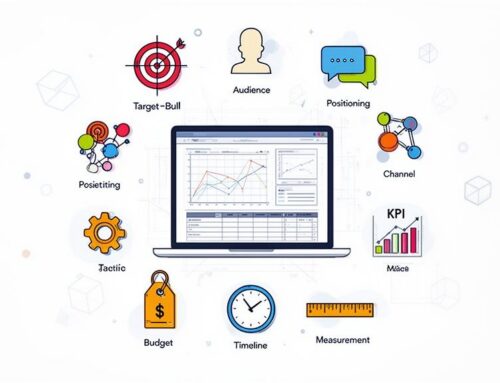
This framework shows how marketing operations acts as the central gear, connecting the people (Who), their functions (What), and the business goals (Why).
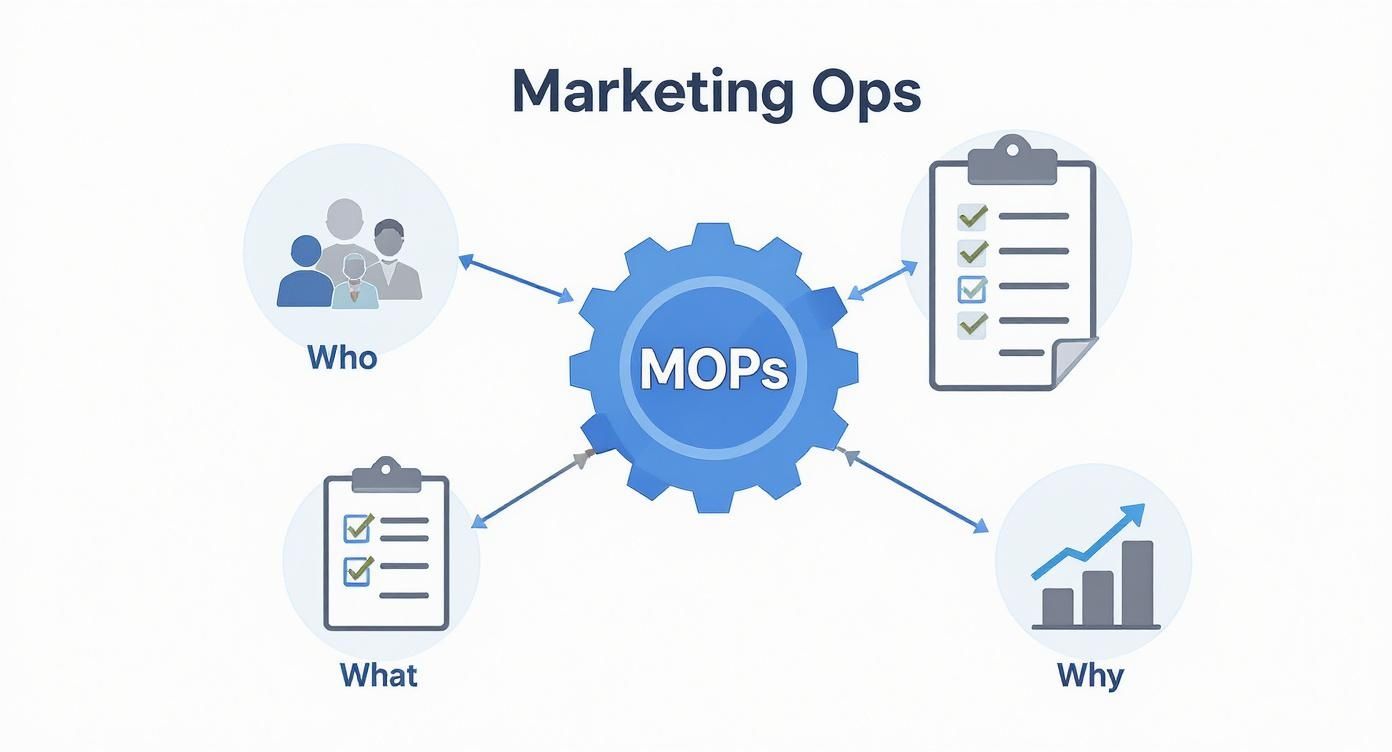
As you can see, MOPs isn't just a background support role; it's the strategic hub that aligns your people, processes, and results. Let’s break down each of these five pillars.
1. Technology Management
First up is Technology Management. Modern marketing runs on software—your Customer Relationship Management (CRM) system, your automation platform, your analytics tools, you name it. This collection of tools is your MarTech stack, and MOPs professionals are its architects.
Their job isn't just to go on a shopping spree for the latest shiny software. It's about making sure every tool has a clear purpose and plays nicely with the others. Without someone in charge, you end up with a tangled mess of redundant, underused, and disconnected platforms. MOPs makes sure the data flows correctly, so a new lead from your website instantly shows up in both your email platform and the sales team's CRM without anyone lifting a finger.
2. Process Optimization
Next, we have Process Optimization. This is all about creating repeatable, standardized workflows that stamp out chaos and boost efficiency. Picture trying to launch a major product campaign with no clear plan. The content team is working from an old brief, the digital ads team is targeting the wrong audience, and no one knows who's supposed to approve the final copy. It’s a nightmare.
Marketing operations prevents this by building and documenting standard operating procedures (SOPs) for everything from requesting a new campaign to handing off a hot lead to sales.
Key Takeaway: Good process optimization isn't about creating suffocating bureaucracy. It’s about building a clear, predictable "assembly line" for marketing. This frees up your creative and strategic folks to do high-impact work instead of getting bogged down in administrative headaches.
For example, a MOPs team might set up an automated workflow in a project management tool. When a campaign is requested, it automatically creates and assigns tasks to the copywriter, designer, and social media manager in the right order. Everyone knows what they need to do and when it's due. Simple.
3. Data Governance
The third pillar, Data Governance, is the art and science of keeping your data clean, compliant, and actually usable. Data is the fuel for modern marketing, but "dirty" data—stuff that's inaccurate, incomplete, or duplicated—can grind everything to a halt. Marketing to the wrong email address or having three different profiles for the same customer are classic signs of poor data governance.
MOPs sets the rules for how data is collected, stored, and used. This involves:
- Data Cleansing: Regularly scrubbing the database to remove duplicates and fix errors.
- Data Enrichment: Adding missing info to lead profiles (like job titles or company size) to make personalization possible.
- Compliance: Making sure all data practices follow regulations like GDPR and CCPA.
Without strong governance, your personalization efforts will fall flat, your analytics will be a lie, and you could face some serious legal fines.
4. Performance Analytics
While data governance makes sure your information is clean, Performance Analytics is about turning that information into real-world insights. This fourth pillar is where MOPs connects the dots between marketing activities and business results. MOPs pros are the ones building the dashboards and reports that answer the big, important questions.
They go way beyond vanity metrics like clicks and open rates. They focus on what the C-suite actually cares about, like:
- What's our marketing return on investment (ROI)?
- How many sales opportunities did that last campaign actually generate?
- What’s our lead-to-customer conversion rate on LinkedIn versus Google Ads?
This is the pillar that transforms marketing from a "cost center" into a proven revenue driver.
5. Strategic Alignment
Finally, the fifth and arguably most important pillar is Strategic Alignment. This is the glue that holds everything else together and connects it all back to the company's main objectives. Marketing operations is the bridge between marketing and other key departments—especially sales and finance.
They make sure marketing's goals aren't created in a vacuum. For example, MOPs will spearhead the creation of a Service Level Agreement (SLA) between marketing and sales. This document clearly defines what a "sales-qualified lead" is and maps out the exact process for the handoff. This kind of alignment gets rid of the friction and finger-pointing, ensuring both teams are working together to grow revenue. It makes the entire organization stronger.
Building Your Marketing Operations Dream Team
Let's get one thing straight: an effective marketing operations function isn't just one person trying to keep a dozen different software platforms from catching fire. It's about building a specialized team—your engine room—where each person brings a specific blend of technical savvy, analytical genius, and strategic thinking to the table. This is the crew that makes marketing efficient and proves its worth to the rest of the company.
But you don't need a huge team right out of the gate. The smart move is to add roles strategically as your company grows and things get more complex. A small startup might kick things off with a single, versatile MOPs manager who wears a few hats. A big enterprise, on the other hand, will have a whole department with specialists for every little thing. The key is knowing what core skills you need to cover.
The Foundational Roles
For most companies, a killer MOPs team is built on three core pillars of expertise. Think of these as the essential roles that form the foundation, whether they're filled by different people or handled by one or two jacks-of-all-trades in a smaller setup.
-
The Strategist (Marketing Operations Manager): This is the captain of the ship. They’re in charge of the day-to-day work, manage the team, and make sure all the tech and processes are actually helping achieve the bigger marketing goals. They’re the essential link between the MOPs team and the marketing leadership.
-
The Technologist (MarTech Specialist): Your technologist is the architect and mechanic of your entire marketing technology stack. Their world revolves around managing, integrating, and fine-tuning all your tools, from the CRM to your marketing automation platform. They're the ones making sure data flows smoothly and the systems don't crash.
-
The Analyst (Marketing Data Analyst): This is your storyteller—the person who translates raw numbers into a compelling narrative. The analyst builds the dashboards, tracks the KPIs, and ultimately answers the million-dollar question: "Is any of this marketing stuff actually working?" They deliver the proof that marketing is driving revenue.
How They All Work Together
So, how does this play out in the real world?
Imagine a new campaign is on the horizon. The Marketing Operations Manager kicks things off by mapping out the entire operational flow. They figure out how a lead will be captured, what happens to it next, and how it gets passed over to sales. They keep the whole project on track and aligned with the campaign’s goals.
Then, the MarTech Specialist gets their hands dirty with the technology. They build the landing page forms, set up the automated email sequences, and make sure every new lead is tagged correctly and synced perfectly with the CRM. If a tool breaks mid-campaign, they’re the first one on the scene to fix it.
Finally, once the campaign is live, the Marketing Data Analyst steps into the spotlight. They’re glued to the performance data, building reports that show the campaign's ROI and digging for insights that will make the next campaign even better. Their work helps the whole team make smarter decisions backed by actual data.
A classic mistake is hiring for one of these roles and expecting them to be a master of all three. While some MOPs pros are incredibly versatile, you'll only truly scale when you recognize that strategy, tech, and analytics are their own unique disciplines.
Scaling Your Team: From Startup to Enterprise
Building a team isn't something you do once; it's a journey. The structure will change as your business grows, shifting from generalists to a team of dedicated specialists.
Lean Team (Startup/SMB):
A small business usually starts with a single Marketing Operations Manager who does a bit of everything. They’re wrangling the most important tools, pulling basic reports, and trying to bring some order to the initial chaos. It’s all about creating the first foundational processes.
Growing Team (Mid-Market):
As you grow, that one MOPs manager inevitably becomes a bottleneck. Now’s the time to bring in your first specialists. You might hire a dedicated Marketing Automation Manager to handle the increasing complexity of lead nurturing, and a Marketing Data Analyst to start building out more sophisticated dashboards that tell a clearer performance story.
Scaled Team (Enterprise):
At the enterprise level, the MOPs team becomes a full-blown department, often led by a VP of Marketing Operations. The roles get hyper-specialized. You'll see titles like:
- MarTech Architect
- Campaign Operations Manager
- Lead Management & Database Administrator
This specialized structure gives the team the firepower to manage a massive global tech stack, support dozens of campaigns at once, and deliver deep analytical insights across the entire business. This is when marketing operations transforms from a support function into a true competitive advantage.
Designing Your Essential Martech Stack
If your marketing department is a high-performance race car, then your marketing technology (MarTech) stack is its engine. It’s the collection of software that powers everything you do—from attracting leads to delighting customers. Marketing operations pros are the expert engineers who design, build, and meticulously maintain this engine, ensuring all the parts work together in perfect harmony.
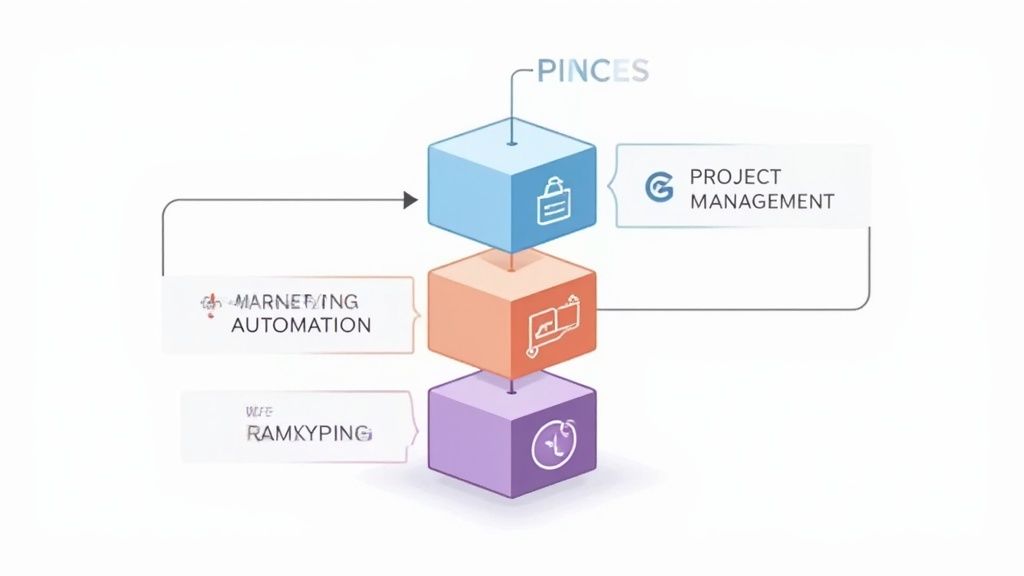
Building a stack isn't just about grabbing the latest shiny tools off the shelf. It’s a serious strategic exercise. You have to really dig into your business goals, your team's actual capabilities, and, of course, your budget. A slapped-together stack leads to nothing but wasted cash, frustrated teams, and data that’s all over the place. Get it right, though, and it becomes a powerful competitive advantage.
Core Components of a Modern Stack
While every company’s stack looks a bit different, most are built around a few non-negotiable categories of tools. Think of these as the foundational pillars holding up just about every modern marketing activity.
- Customer Relationship Management (CRM): This is the heart of your stack. It’s the central database for every piece of customer and prospect information, tracking every single interaction from website visits to sales calls. It creates a single source of truth that everyone can rely on.
- Marketing Automation Platform: This is your workhorse. It handles repetitive tasks at scale, like managing email campaigns, running lead nurturing sequences, and scoring potential customers. This is what lets you engage with thousands of people in a way that still feels personal.
- Analytics and Data Platforms: These tools are your eyes and ears. They’re tracking website traffic, campaign performance, and customer behavior, turning a flood of raw data into insights you can actually use to make smarter decisions.
- Project Management Software: This is what keeps the chaos at bay. It gives your team a central hub for managing tasks, collaborating on projects, and keeping campaigns on schedule. It's the key to staying organized as you grow.
When you start putting these pieces together, one of the first big decisions is picking the right CRM and marketing automation platforms. For many, this conversation quickly narrows down to choosing between Salesforce and HubSpot, two of the biggest players in the game. Getting a handle on their core differences is a critical first step for any MOPs team.
The Great Debate All-in-One vs Best-of-Breed
Once you know the functions you need to cover, the next question is how you're going to build it. This is where you run into two competing philosophies, and honestly, there's no single "right" answer. The best approach really depends on your company's specific situation.
One path is the "All-in-One" approach, where you buy into a single, integrated suite from one vendor (like HubSpot) that covers most of your bases. The other is the "Best-of-Breed" approach, which involves hand-picking the absolute best tool for each specific job and then connecting them all yourself. You can build effective marketing automation workflows with either setup, but the journey to get there is very different.
Key Consideration: The choice between these two strategies is one of the most significant decisions a marketing operations leader will make. It directly impacts budget, team skill requirements, and the long-term scalability of your marketing efforts.
Deciding between a unified platform and a custom-built stack is a classic MOPs dilemma. To help you weigh your options, let's break down how these two models compare on the factors that matter most.
MarTech Stack Strategy All-in-One vs Best-of-Breed
| Factor | All-in-One Platform (e.g., HubSpot) | Best-of-Breed (Specialized Tools) |
|---|---|---|
| Integration | Natively integrated, ensuring seamless data flow and a unified user experience right out of the box. | Requires manual integration, often using third-party connectors, which can be complex and costly to maintain. |
| Functionality | Offers a wide range of features but may lack the deep, advanced capabilities of specialized tools. | Provides best-in-class features for each specific function, allowing for greater power and customization. |
| Cost | Often more predictable with bundled pricing, but can become expensive as you add more contacts or premium features. | Can be more cost-effective initially by only paying for what you need, but costs can add up as you add more tools. |
| Ease of Use | Generally easier for teams to learn and use due to a single, consistent interface. | Requires users to learn multiple systems, which can slow down adoption and increase training needs. |
| Scalability | Can sometimes be limiting for large enterprises with highly complex or unique requirements. | Highly flexible and scalable, allowing you to swap out tools as your needs evolve without disrupting the entire system. |
Ultimately, it’s the job of marketing operations to make this strategic call. An early-stage startup might lean toward the simplicity of an all-in-one solution to get up and running quickly. On the other hand, a large enterprise with a skilled technical team may opt for the raw power and flexibility of a best-of-breed stack.
How Marketing Operations Proves Its Value with Data
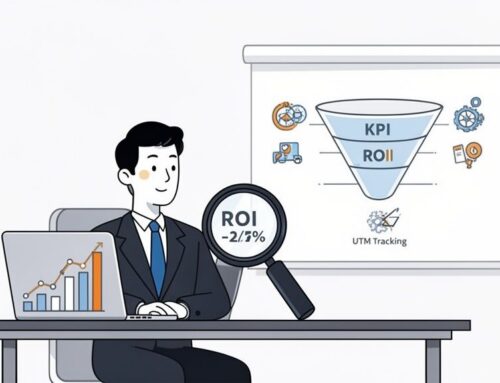
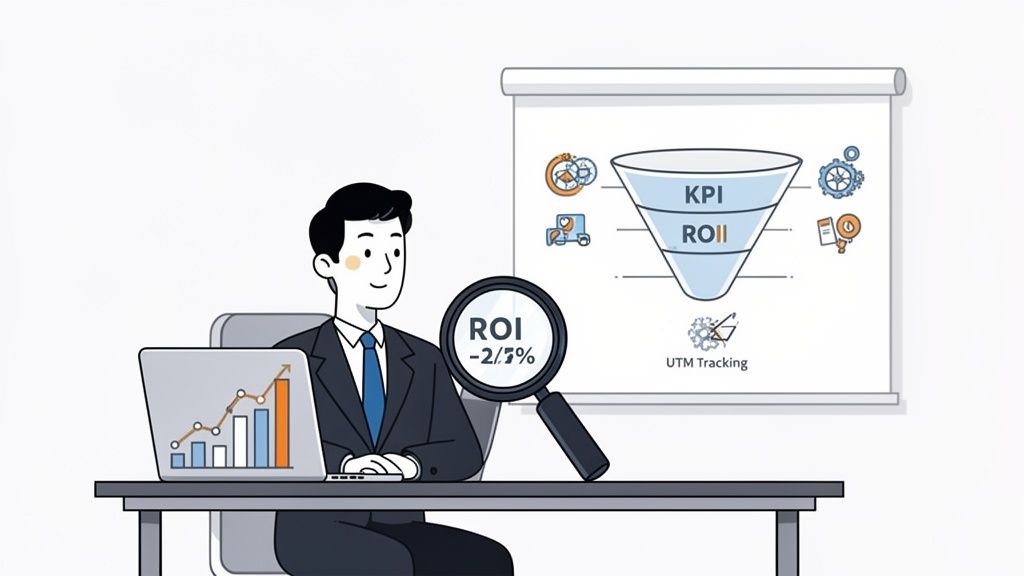
The C-suite always has one big question for marketing: “Is what you’re doing actually working?” It's the job of marketing operations to provide a clear, data-backed answer.
This isn’t about pointing to vanity metrics like social media likes or a spike in website traffic. MOPs builds a structured framework that connects every marketing action directly to business growth, proving its contribution in black and white. Think of it less like a spreadsheet full of numbers and more like a story that shows how daily tasks create high-level success. This is how marketing shifts from being seen as a cost center to a predictable revenue machine.
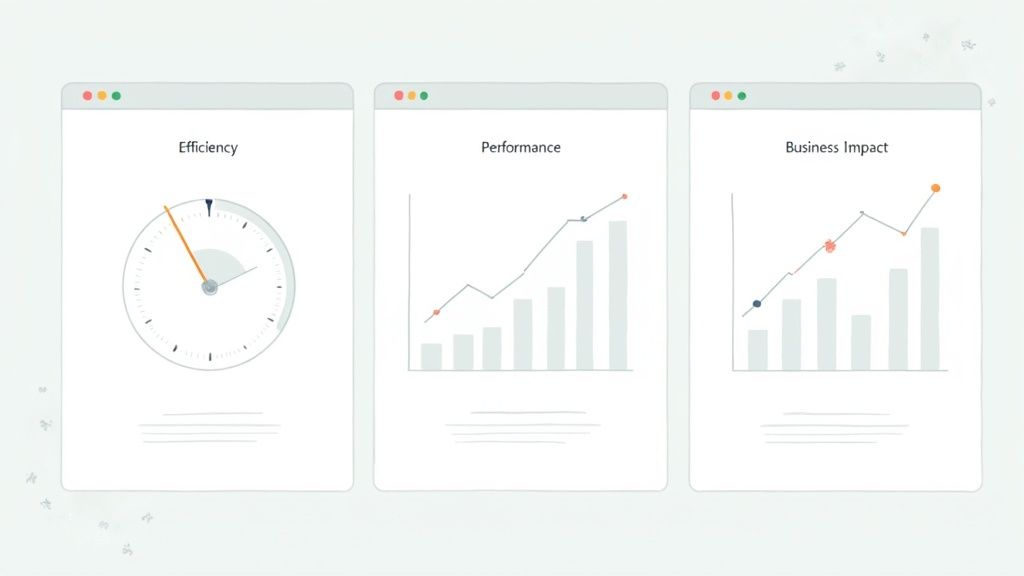
Tier 1: Operational Efficiency KPIs
The first layer of measurement looks inward. It answers the question, “How well is our marketing engine actually running?” These Key Performance Indicators (KPIs) are all about the speed, quality, and cost-effectiveness of the MOPs team itself. They’re like an early-warning system, flagging bottlenecks before they can derail a campaign.
You'll often see metrics like these:
- Lead Processing Speed: How long does it take for a new lead to get into the CRM and routed to a sales rep? A slow handoff means a lost opportunity.
- Campaign Launch Time: What’s the average turnaround from a campaign request to its go-live date? This reveals how agile and responsive your operations are.
- Data Quality Score: What percentage of your marketing database is accurate, complete, and free of duplicates? Clean data is the foundation for everything.
Tier 2: Marketing Performance KPIs
The second tier connects that internal efficiency to what the campaigns are actually achieving. This is where MOPs shows how its well-oiled machine drives tangible marketing results. We’re moving beyond just doing things and starting to measure how effective those things are. The question here is, “Are our campaigns hitting their goals?”
This is where you start tracking things like:
- Lead-to-Opportunity Conversion Rate: Of all the leads marketing brings in, how many actually become legitimate sales opportunities? This is a crucial indicator of lead quality.
- Marketing Qualified Lead (MQL) Velocity: How many qualified leads is the marketing team generating each week or month? This measures the pulse of your top-of-funnel efforts.
- Campaign ROI: For every dollar we put into a campaign, how much revenue came back out? This is the classic measure of profitability.
Getting these numbers right is make-or-break. Our guide on marketing performance metrics examples dives deeper into the specific KPIs that really tell you if your strategy is paying off.
Tier 3: Business Impact KPIs
This is the top tier, the one that really matters to the rest of the business. These metrics align everything marketing does with the company's ultimate goals. They’re the numbers that CEOs and CFOs want to see because they directly connect marketing investment to revenue and customer growth.
Key Takeaway: While efficiency and performance metrics are vital for internal tuning, business impact KPIs are what get marketing a strategic seat at the leadership table and secure its budget for the next year.
This tier is all about powerhouse metrics like:
- Marketing-Sourced Revenue: How much brand-new revenue can be directly traced back to marketing’s efforts?
- Customer Acquisition Cost (CAC): On average, what does it cost us to acquire a new customer through our marketing channels?
- Customer Lifetime Value (CLV): How much total revenue does an average customer generate during their entire relationship with our company?
Tracking these KPIs on well-designed dashboards is central to MOPs. In fact, metrics like lead velocity and clear campaign attribution are absolutely essential for running an efficient operation. By conducting regular audits and using the right automation tools, you can ensure your marketing engine isn't just running—it's driving the business forward.
A Practical Roadmap to Implement Marketing Operations
Trying to build a marketing operations function from the ground up can feel overwhelming. It's easy to get lost in a sea of tangled processes and disconnected tools. But you don't have to boil the ocean.
The trick is to think in phases. A structured roadmap transforms this massive project into a series of manageable steps. This approach lets you score some quick wins, build momentum, and earn the trust you'll need for bigger changes down the line.
It all starts with an honest look in the mirror. Before you can chart a course, you have to know where you stand.
Phase 1: Audit and Assess
The first step is a deep dive into your current people, processes, and technology. The goal isn’t perfection; it’s a clear, unvarnished picture of reality. You're on a mission to find the biggest pain points and the most promising opportunities.
Start by asking some tough questions:
- Technology: What tools are we actually using? Do they talk to each other? Where are our data silos hiding?
- Processes: What does it really take to launch a campaign around here? How are leads passed to sales, and where do they get stuck?
- People: Who owns our marketing systems? Do they have the skills and—just as important—the time to manage them effectively?
This audit will almost always uncover some low-hanging fruit. These are the quick fixes that can give you an immediate boost in efficiency and prove the value of having a dedicated operations focus.
Key Insight: Building a MOPs function is as much about people as it is about platforms. Start by solving a real, nagging problem for the marketing or sales team. This turns them into your biggest supporters from day one.
Phase 2: Define Goals and Design Workflows
Now that you have a clear map of the current landscape, you can set your destination. What specific, measurable goals will your new MOPs function chase? Maybe you need to slash lead response times, clean up your messy data, or finally get a clear report on campaign ROI. Your audit will tell you what matters most.
With your goals set, it's time to get on the whiteboard and redesign your core processes. Focus on the big ones first, like campaign execution and lead management. The idea is to create standardized, scalable workflows that anyone can follow. Our guide to marketing workflow management offers a great starting point for building these systems. This is where you turn your strategy into a repeatable, daily operational plan.
Phase 3: Implement and Iterate
Time to roll up your sleeves and get to work. Start putting your new workflows into practice and make targeted tweaks to your tech stack. The key is to start small. Pick one or two high-impact processes to overhaul first.
As you go, document everything, train the teams involved, and watch the results like a hawk.
More and more companies are waking up to the need for solid operations. A recent survey found that 76.3% of firms now assign analytics responsibilities to their marketing teams—a clear sign that MOPs is becoming central to how modern businesses operate. You can discover more insights about these marketing ops trends to see how others are adapting.
Once you’re live, the job isn’t done. Great operations are never "finished." Set up a regular cycle of review, gather feedback from your marketing and sales colleagues, and keep making small, iterative improvements. This ensures your MOPs function grows and adapts right alongside the business, continuously adding value.
Common Questions About Marketing Operations (Answered)
Even with the best roadmap, you're bound to have some questions as you start building out your marketing operations. Let's clear up a few of the most common points of confusion to help you connect the final dots.
Marketing Operations vs. Marketing Automation
This is a big one, and it's easy to see why people mix them up. The easiest way to think about it is like this: marketing automation is a tool, while marketing operations is the strategy and the team using that tool.
Think of a platform like HubSpot or Marketo—that's the automation software. It's the "what" that sends the emails, scores the leads, and runs the campaigns.
Marketing operations is the "who" and the "how." The MOPs team is responsible for choosing the right automation platform in the first place. They then design the workflows, make sure the data flowing into the system is clean and reliable, and ultimately measure whether any of it is actually working.
In short, marketing automation is a single piece of the puzzle. Marketing operations is the entire strategic function that makes sure all the pieces—including automation—fit together to create a successful, accountable marketing engine.
When Is It Time to Hire Your First MOPs Person?
For a growing business, this is a critical question. The answer isn't tied to a specific revenue milestone; it's about hitting a certain level of complexity where the operational cracks start to slow down your growth.
You'll know it's time when you start seeing these signs:
- Marketing and sales are constantly pointing fingers at each other over the quality of leads.
- You can't answer a simple question like, "Which marketing channel is actually bringing in customers?"
- Your team seems to spend more time wrestling with software and spreadsheets than actually marketing.
When these headaches become a daily reality, you've waited long enough. It's time to bring in a professional.
How Do Marketing and Sales Operations Work Together?
For a business to grow, marketing operations (MOPs) and sales operations (often called RevOps or Sales Ops) absolutely must work in lockstep. They are two halves of the same revenue coin, both focused on creating a smooth, efficient journey from a prospect's first click to a closed deal.
Their most critical point of collaboration is the lead handoff. Together, they define precisely what makes a lead "sales-ready." Then, they build the automated systems to get that lead into the hands of the right salesperson, instantly. This tight alignment gets rid of friction and ensures hot leads never fall through the cracks.
Ready to build a marketing engine that doesn't just run smoothly but also drives predictable growth? The team at ReachLabs.ai blends strategic thinking with hands-on execution to build and manage the operational foundation your business needs to scale. Learn how we can help you turn marketing into a true revenue driver at https://www.reachlabs.ai.