
Full-funnel marketing is a comprehensive strategy designed to engage with customers at every single stage of their journey with your brand. It starts the moment they first hear about you and continues long after they become a loyal advocate.
Instead of chasing isolated goals like just generating leads, this approach builds a continuous, relationship-driven experience. It’s about guiding people from that initial spark of discovery all the way to a confident decision and beyond.
Beyond The Buzzword: A New Way Of Thinking
Let's cut through the jargon. At its heart, full-funnel marketing is about building a real relationship with your customers. Think of it less like a rigid, one-way street and more like a continuous, evolving conversation.
So often, marketing teams work in silos. The social media team is focused on awareness, the content team is trying to get people to consider the product, and the sales team is all about closing the deal. This fractured approach can feel confusing and disjointed for the very people you're trying to attract.
Full-funnel marketing tears down those walls. It’s a philosophy built on the reality that a customer's path is rarely a straight line. They might see your brand on LinkedIn, read a blog post a week later, join a webinar, and finally make a purchase after seeing a well-timed ad. Every one of those touchpoints is a vital part of the story.
This unified view is critical because zeroing in on just one piece of the puzzle—like generating top-of-funnel leads—is a recipe for disappointment. Without a solid plan to nurture those leads, they simply go cold. And without a strategy to keep customers happy after the sale, you're just constantly trying to refill a leaky bucket.
The diagram below maps out the foundational stages of this journey, showing how a potential customer moves from initial awareness to the point of conversion.
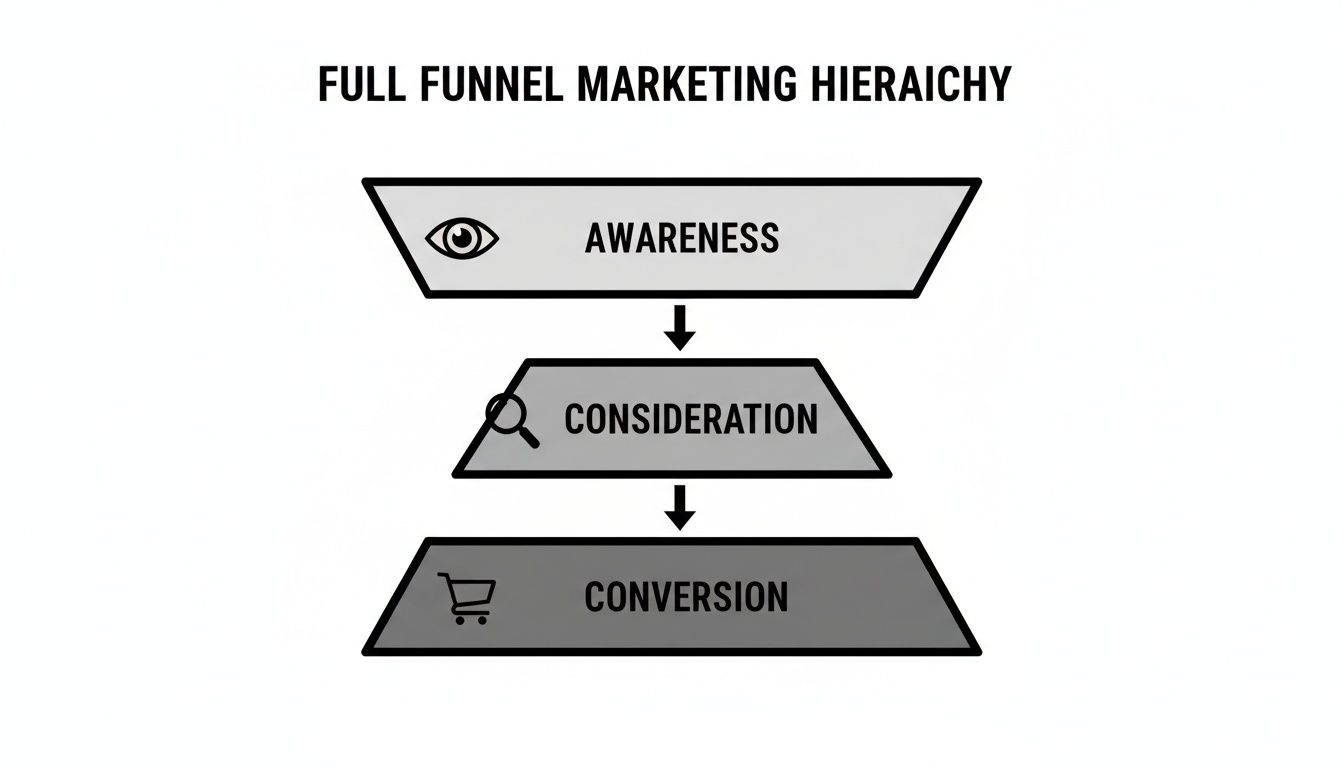
This visual helps clarify the progressive nature of the customer journey, where each stage logically builds on the last, creating a seamless path to purchase.
To get a clearer picture, let's break down the customer's mindset at each stage.
The Full Funnel Marketing Model at a Glance
| Funnel Stage | Primary Goal | Customer Mindset |
|---|---|---|
| Awareness | Introduce your brand and the problem you solve. | "I have a problem, but I'm not sure what the solution is yet." |
| Consideration | Showcase why your solution is the best fit. | "I'm researching different options and comparing solutions." |
| Conversion | Make it easy and compelling to buy. | "I'm ready to make a decision and choose a provider." |
| Retention | Deliver an amazing post-purchase experience. | "I made the right choice. This company really helps me succeed." |
| Advocacy | Turn happy customers into vocal promoters. | "This solution is fantastic. I want to tell others about it." |
This table neatly summarizes how the customer's thinking and your marketing goals should align at every step, creating a much more cohesive and effective experience.
Why A Holistic Approach Matters
When you adopt a full-funnel strategy, every part of your marketing suddenly starts working in harmony. Your awareness campaigns should naturally lead people into the consideration phase, and your conversion tactics should feel like the logical next step—not an abrupt sales pitch. This alignment builds trust and makes customers feel understood.
The main benefits are impossible to ignore:
- Increased Brand Cohesion: Your message stays consistent and helpful at every touchpoint, building a strong and memorable brand identity.
- Improved Conversion Rates: By giving prospects the right information at the right time, you guide them toward a confident purchase. You can dive deeper into structuring these interactions by exploring the different digital marketing funnel stages.
- Stronger ROI: A unified strategy means your marketing budget is spent more efficiently, delivering the most effective message to the right audience when it matters most.
- A Better Customer Experience: This approach is, by its very nature, customer-centric. It’s about anticipating needs and providing real value throughout the entire lifecycle.
A deep understanding of the customer's path is fundamental to full funnel marketing. This can be achieved through effective B2B customer journey mapping, which provides the blueprint for designing a successful strategy.
Ultimately, a full-funnel model is what drives real, sustainable growth—not just fleeting, one-off sales. It’s how you turn first-time customers into repeat buyers and, eventually, into passionate brand advocates who help fuel your future success.
The Awareness Stage: Making a Great First Impression
This is where it all starts. The customer journey begins long before someone knows they need your specific product. The awareness stage, often called the top-of-funnel (TOFU), isn't about pushing a sale. It’s about being genuinely helpful and positioning your brand as a credible, go-to resource in your space.
Think about it like this: someone is just starting to feel overwhelmed by their workload. They aren't Googling "project management software" yet. Instead, their searches are more general, like "how to be more productive at work" or "tips for managing a busy team." Your job is to show up in those exact moments with real answers, not a hard sell. This is your one shot to make a killer first impression.
At its core, a solid awareness strategy is about providing value with no strings attached. You're building goodwill and planting the seeds of brand recognition that will pay off down the line.
Key Tactics for the Awareness Stage
To grab attention at the very top of the funnel, your tactics need to be educational, entertaining, or even inspiring. The name of the game is broad reach and offering solutions to those early, problem-defining questions.
Here are a few tactics that work wonders:
- Informative Blog Posts: Well-written articles that answer common questions or dig into industry pain points instantly position you as an expert.
- Engaging Social Media Content: Think shareable infographics, quick educational videos, and posts that spark conversation. This is how you find new audiences organically.
- Search Engine Optimization (SEO): By optimizing your content for the keywords your audience actually uses, you make sure you’re visible right when they need you.
- Educational Videos and Webinars: Visuals are king for breaking down complex topics and putting a human face to your brand.
None of this is designed to get an immediate conversion. Instead, you're building a foundation of trust. When you're the one who helped someone understand their problem, you become the obvious first choice when they start looking for a solution. For a more detailed roadmap, you can explore various brand awareness strategies.
Measuring Success at the Top of the Funnel
Since you're not trying to close a deal here, the Key Performance Indicators (KPIs) for the awareness stage look a little different. You're measuring how well you’re reaching a wide audience and if your content is actually hitting the mark.
The goal here is to measure visibility and initial interest. You need to know if your message is getting to the right people and if it’s compelling enough to earn that first click or follow.
Key KPIs for this stage include:
- Impressions: This is your raw reach—the total number of times your content was shown to someone.
- Website Traffic: A jump in overall site visits, especially to your blog or resources section, is a great sign that your content is pulling people in.
- Social Media Reach & Engagement: Keep an eye on how many unique people see your posts and, more importantly, how many are liking, sharing, or commenting.
- Brand Mentions: Tracking how often your brand name pops up online is a solid indicator of growing recognition.
- New Users/Visitors: This metric in your analytics tells you exactly how many people are discovering you for the very first time.
By keeping a close watch on these TOFU metrics, you can get a clear picture of your awareness efforts. A strong performance here fills your funnel with an engaged audience, perfectly setting the stage for the next phases of their journey.
Stage 2: The Consideration Stage – From Curious to Convinced
Alright, you’ve made a great first impression. Now what? Your prospect is officially in the consideration stage, the middle of the funnel (MOFU). This is where the casual browser evolves into an active researcher. They know they have a problem, and they’re now seriously evaluating who can solve it—and you’re on their shortlist.
Your goal now shifts from broad-stroke awareness to building genuine trust and proving your value.
Think of it this way: the awareness stage was the open house where everyone was invited. The consideration stage is the private showing. You're now talking to the folks who are genuinely interested, answering their detailed questions, and showing them exactly why your solution is the perfect fit. Your job is to prove you’re not just an option, but the right option.
At this point, a prospect is armed with questions and is actively sizing you up against the competition. Your content needs to pivot from general education to specific, solution-focused guidance that speaks directly to their pain points and establishes your authority.
How to Win Them Over in the Middle of the Funnel
The middle of the funnel is all about nurturing the relationship you just started. This means providing deeper, more substantial content that helps prospects make an informed decision. Often, these assets are "gated" behind a simple form, requiring an email in exchange for access. This is the moment an anonymous visitor becomes a qualified lead.
Here are some of the most effective tactics for this stage:
- In-Depth Webinars: Host live or on-demand sessions that tackle a specific challenge your audience faces. Position your product or service as a key part of the solution, not just a sales pitch.
- Compelling Case Studies: Nothing builds trust like a real-world success story. Case studies show prospects, "People just like me succeeded with this," which is incredibly powerful social proof.
- Targeted Email Nurture Sequences: Set up a series of automated emails that drip valuable tips, resources, and insights over time. This keeps you top-of-mind and gently guides leads toward a decision without being pushy.
- Downloadable Guides & Whitepapers: These longer-form pieces let you go deep on a topic, cementing your expertise and giving prospects something tangible to walk away with.
A fascinating study on LinkedIn advertising effectiveness found that showing users multiple ad formats more than doubled conversion rates compared to using just one. This really drives home the power of a multi-touch approach during the consideration phase to build that crucial familiarity and trust.
These tactics are so effective because they aren’t aggressive sales pitches. They're generous offers of help and expertise. You're building confidence and earning the right to ask for the sale later on.
Measuring Success in the Consideration Stage
As your focus shifts from reach to real engagement, your KPIs need to follow suit. In the consideration stage, you’re not just counting eyeballs anymore; you’re measuring genuine interest and intent. Success is all about how well you capture lead information and keep those prospects engaged.
The metrics that matter most here are:
- Lead Magnet Downloads: How many people were intrigued enough by your ebook, whitepaper, or case study to trade their contact info for it?
- Webinar Attendance & Engagement: Don't just track sign-ups. Measure how many people actually showed up and, more importantly, how long they stuck around. High engagement is a massive buying signal.
- Time on Page & Bounce Rate: Are people spending significant time on your key pages, like features or pricing? If so, they’re seriously kicking the tires.
- Email Open & Click-Through Rates: These classic metrics tell you if your nurture sequences are hitting the mark and keeping your leads warm.
- Cost Per Lead (CPL): This is a bottom-line metric. It tells you exactly how much you're spending to acquire each new lead, helping you understand the efficiency of your middle-funnel campaigns.
Keeping a close eye on these KPIs gives you a clear picture of who’s moving down the funnel and how well your content is doing its job. A well-oiled consideration stage turns curious prospects into educated, confident buyers who are perfectly primed for the final step.
The Conversion Stage: Turning Interest into Action
You've guided your prospect from just knowing you exist to seriously considering you as a solution. Now comes the moment of truth—the bottom of the funnel, or BOFU. This is where all your hard work pays off, and a curious lead becomes a paying customer.
At this point, your prospect has done their research and narrowed down their options. Your job is to make choosing you the easiest, most confident decision they can make. It's about sealing the deal by removing any final ounce of friction or doubt.
Tactics That Get the "Yes"
The messaging here needs to be sharp, persuasive, and laser-focused on the final commitment. You're no longer just educating; you're actively helping someone make a decision. The best way to do that is by providing undeniable proof and taking the risk out of the equation.
Here are some of the most effective BOFU tactics:
- Live Product Demos: A personalized demo isn't just a feature tour; it's a chance for a prospect to see exactly how your product solves their specific problem.
- Free Trials or Samples: There’s no better sales pitch than letting your product speak for itself. A risk-free trial is often the final nudge someone needs.
- Powerful Testimonials and Reviews: Hearing from happy customers is incredibly reassuring. Social proof from people who were once in your prospect's shoes builds immense trust.
- Strategic Retargeting Offers: Re-engage prospects who are right on the edge—maybe they visited your pricing page—with a timely ad reminding them of your value or offering a small incentive.
These strategies work because they answer the final questions a buyer has, making the decision to commit feel both smart and safe.
Bottom-of-the-Funnel KPIs That Matter
Down here at the conversion stage, your metrics get very real, very fast. We’re not just tracking clicks anymore; we’re tracking dollars and cents.
This is where marketing proves its direct contribution to the bottom line. The focus shifts from generating leads to acquiring customers, and every metric is tied to the financial health of the business.
Your most critical BOFU metrics include:
- Conversion Rate: The big one. This is the percentage of leads who actually take the desired action, whether it's making a purchase or signing a contract.
- Cost Per Acquisition (CPA): How much does it cost, on average, to win a new customer? This metric tells you exactly how efficient your sales and marketing machine is.
- Return on Ad Spend (ROAS): For your paid campaigns, ROAS shows the revenue you generate for every dollar you spend on ads. A high ROAS means you've got a profitable playbook.
- Sales Cycle Length: Tracking the time it takes for a lead to become a customer helps you spot and fix any bottlenecks in the final decision-making process.
Monitoring these KPIs is essential. To close the loop and rescue potential revenue, effective abandoned cart email strategies are also a non-negotiable tool at this stage. By perfecting this final step, you don't just close more deals—you lay the groundwork for a lasting customer relationship.
The Loyalty Stage: Turning Customers Into Advocates
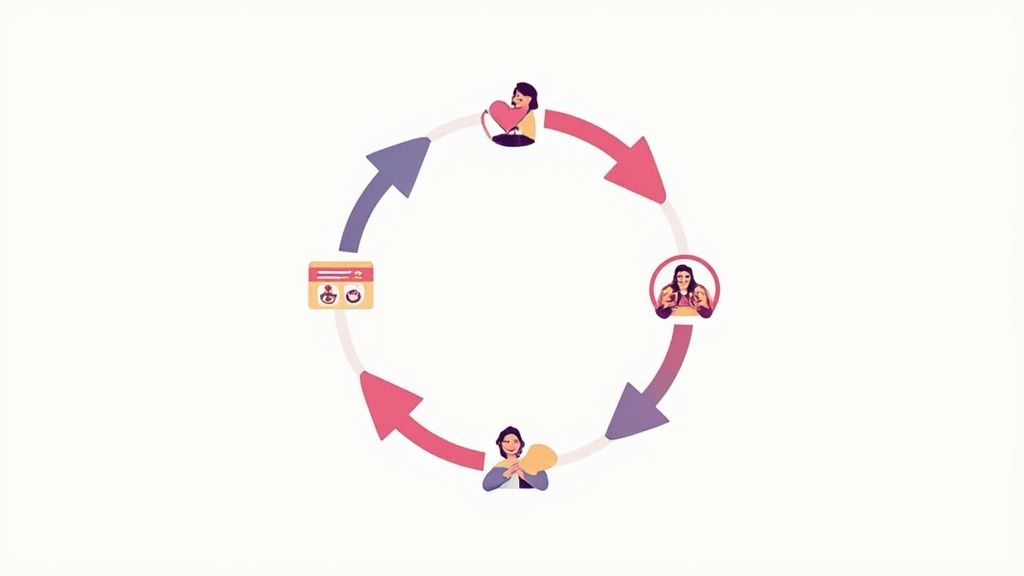
So, you’ve made the sale. Great job! But don’t pop the champagne just yet. The deal isn't the finish line—it's actually the starting block for the most crucial phase of full-funnel marketing. This is where a linear funnel beautifully transforms into a self-sustaining flywheel.
Happy customers don't just come back for more; they become your most powerful and authentic marketing channel. This creates a growth loop that powers your business from the inside out.
Many businesses fall into the trap of pouring all their resources into acquiring new customers while completely forgetting about the ones they've already won. But the loyalty and advocacy stage is where true, sustainable growth is born. It’s all about creating such a fantastic post-purchase experience that your customers evolve from simple buyers into enthusiastic brand ambassadors.
This final stage is proof that a holistic view of marketing pays off in a big way. The numbers don't lie. A Nielsen meta-analysis revealed that full-funnel strategies delivered up to a 45% higher ROI compared to campaigns that just focused on a single stage. You can dig deeper into how these full-funnel marketing strategies drive results on Think with Google.
Strategies That Build Lasting Loyalty
Keeping customers delighted after they've bought from you requires a proactive, thoughtful approach. You have to keep providing value long after that initial transaction is complete.
Here are some tried-and-true tactics to foster genuine loyalty:
- Personalized Onboarding: A smooth, tailored onboarding process is your first chance to make a great post-sale impression. It ensures new customers get the most out of your product right away, heading off frustration and churn before they start.
- Exclusive Loyalty Programs: Make your repeat customers feel like VIPs. Reward them with special perks, early access to new products, or exclusive content. It gives them a compelling reason to stick around.
- Proactive Customer Support: Don't just sit back and wait for problems to pop up. Reach out with helpful tips, check in on their progress, and make it ridiculously easy for them to get help when they need it.
- Community Building: Create a space—like a forum, a Slack channel, or a Facebook group—where customers can connect with each other and your team. This fosters a powerful sense of belonging.
These efforts show customers you're invested in their success for the long haul, not just in their initial purchase.
Key Metrics for Retention and Advocacy
How do you know if your efforts are actually working? You need to track the right KPIs—the ones that measure satisfaction and long-term value.
This is where you measure the real return on your customer experience. Strong numbers here signal a healthy, growing business with a loyal base that fuels your future acquisitions through powerful word-of-mouth.
The most important metrics for this stage include:
- Customer Lifetime Value (CLV): This number predicts the total revenue you can expect from a single customer over their entire relationship with you. A rising CLV is a direct sign that your loyalty strategy is hitting the mark.
- Net Promoter Score (NPS): Simply by asking, "How likely are you to recommend us?" NPS gives you a clear score for customer loyalty. Those "Promoters" are your future brand champions.
- Repeat Purchase Rate: This one is straightforward. It tracks the percentage of customers who come back to buy again. It’s a fundamental gut-check for customer satisfaction and product value.
- Customer Churn Rate: This is the percentage of customers who stop doing business with you over a set period. The main goal of any loyalty strategy is to keep this number as low as humanly possible.
By focusing on these strategies and metrics, you turn the traditional funnel into a powerful, self-perpetuating growth engine.
How to Measure Your Full-Funnel Strategy
Running a slick full-funnel marketing strategy is one thing, but actually proving it works? That’s a whole different ballgame. To do it right, you need a single, unified way to measure everything, connecting every tweet, click, and download to a real business result. It’s about getting your teams out of their traditional silos and rallying them around the same goals and metrics.
Your objective should be to map the entire customer journey—from that first time they see your ad on social media to the moment they become a loyal advocate making their fifth purchase. Without a solid measurement framework, you’re just guessing. You won't be able to connect the dots between your brand-building efforts at the top of the funnel and the sales happening at the bottom.
Unifying Your Analytics and KPIs
The first move is to create a single source of truth for all your data. The brand team can't just fixate on impressions while the performance team obsesses over cost-per-acquisition. Everyone needs to see the whole picture. This means integrating your analytics tools to get a seamless, holistic view of how people interact with your brand across every channel.
When you bring it all together, you start to see how each stage of the funnel feeds the next. You can finally track how a surge in blog traffic (Awareness) from two weeks ago is directly responsible for this week’s increase in demo requests (Conversion).
Tying your funnel metrics directly to business outcomes is non-negotiable. Companies that successfully align their brand and performance teams with unified measurement often see a 15–20% boost in marketing ROI. They achieve this simply by shifting budget to what’s working and optimizing the entire customer journey. Learn more about why every business needs a full-funnel marketing strategy on McKinsey.com.
This kind of data-driven alignment is how you prove that brand investments aren't just feel-good expenses—they’re essential for driving predictable, measurable growth.
Building a Practical Measurement Model
To get the most out of your marketing spend, you have to build a model that accurately assigns credit to each touchpoint along the customer’s path. This is where attribution modeling becomes your best friend. Instead of giving all the glory to the very last click before a purchase, a smart model spreads the credit across the entire journey.
A rock-solid measurement model needs these core components:
- Cross-Channel Tracking: You have to see the complete picture. Use tools like Google Analytics with consistent UTM tagging to track how users hop between your website, social media profiles, email campaigns, and paid ads.
- Stage-Specific KPIs: Assign primary and secondary KPIs for each stage. For Awareness, impressions are a good start, but for the Consideration stage, something like lead quality becomes far more important.
- Attribution Analysis: It's time to move past last-click attribution. Experiment with different models to figure out which channels are your best introducers, which ones are the key influencers, and which ones are your closers. For a much deeper look at this, read our complete guide on what is attribution modeling.
- Customer Lifetime Value (CLV): This is the ultimate report card. A great model tracks how your marketing contributes not just to the first sale, but to the total long-term value a customer brings to your business.
By connecting these dots, you graduate from just reporting on isolated channel performance. You can now tell a powerful story about how your full-funnel strategy creates real, tangible business impact, giving you the confidence to put your budget where it will truly make a difference.
Frequently Asked Questions
Even with a solid grasp of the concept, putting full-funnel marketing into practice can bring up some questions. Let's tackle a few of the most common ones that come up.
How Is Full-Funnel Different From a Traditional Funnel?
Think of a traditional marketing funnel as a one-way street focused almost entirely on getting new customers in the door. It's very linear: attract, convert, and you're done. Marketing might generate a lead and toss it over the wall to sales, with each team working in its own little world.
A full-funnel approach, on the other hand, is more of a continuous loop. It recognizes that the customer relationship doesn't end at the cash register. Instead, it extends into loyalty and advocacy, creating a cycle where happy customers become your best marketers. The biggest difference is its integrated, holistic view that smooths out the entire customer experience, from the first ad they see to the tenth time they buy from you.
Can Small Businesses Use Full-Funnel Marketing?
Definitely. You don't need a Fortune 500 budget to adopt a full-funnel mindset. The core principles are completely scalable. It’s not about having more resources; it's about being smarter with the ones you have.
For example, a small online boutique can easily apply this thinking:
- Awareness: Run targeted social media ads and write blog posts that show up in search results.
- Consideration: Post video try-on hauls and feature glowing customer reviews on product pages.
- Conversion: Make the checkout process dead simple and offer a no-questions-asked return policy.
- Loyalty: Send a handwritten thank-you note with the order and email a special discount for their next purchase.
The tools might be different, but the strategy of nurturing the customer at every step is exactly the same.
The core idea isn't about spending more money; it's about spending it smarter by understanding and serving the customer at every single stage of their relationship with your brand.
What Are the Biggest Implementation Challenges?
One of the toughest parts is simply breaking down internal silos. In many companies, the marketing team, sales team, and customer service team barely talk to each other. A true full-funnel strategy demands they collaborate, share insights, and rally around the same goals.
Another major challenge is measurement. If you're only looking at the last click before a sale, you're missing the huge picture of what got the customer there. It requires a shift toward more advanced attribution models that can properly credit all the different touchpoints along the journey.
Ready to build a powerful full-funnel strategy that creates real, sustainable growth? At ReachLabs.ai, our team specializes in creating integrated campaigns that guide customers from their first impression to becoming your biggest fans. Discover how our full-service approach can elevate your brand.