A growth strategy is the master plan for how your company will achieve meaningful, sustainable expansion. It’s not just a list of things to do; it's your North Star.
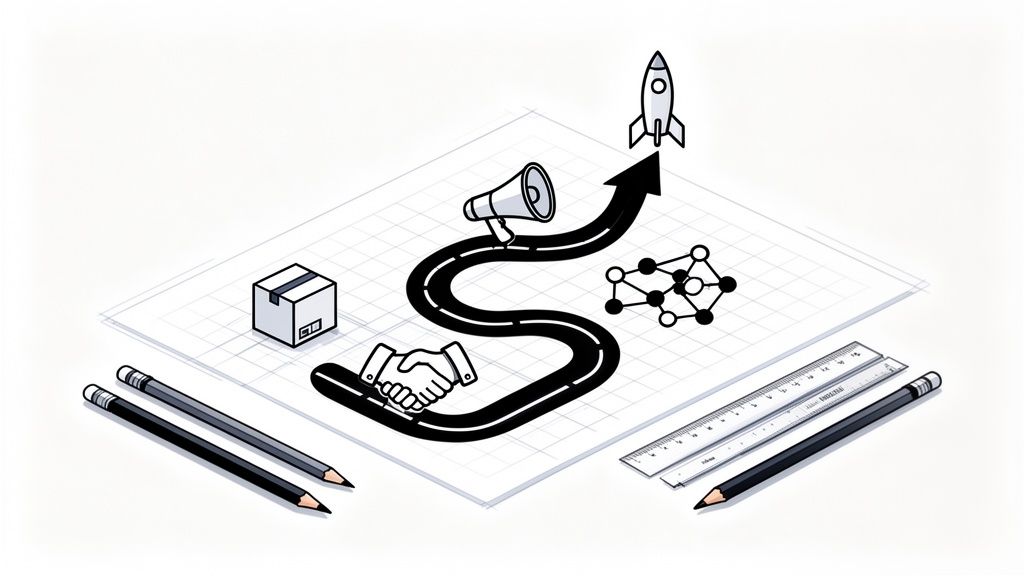
Think of it like a detailed roadmap for a cross-country trip. You have a final destination (your growth goals), and the strategy maps out the best routes, identifies potential roadblocks, and even points out scenic opportunities you might find along the way. This blueprint ensures everyone—from marketing and sales to product and engineering—is driving in the same direction.

What a Growth Strategy Actually Does
At its heart, a growth strategy answers one big question: "How will we grow our business deliberately and profitably for the long haul?" It forces you to look beyond the day-to-day chaos and focus on the bigger picture.
Without this kind of intentional plan, companies often get stuck in a reactive loop. They chase shiny objects and throw resources at scattered ideas that never really build on each other.
For instance, launching a new TikTok campaign is just an activity. But integrating that campaign into a broader, documented plan to win over a new Gen Z customer segment? That's a strategic move. The real difference is the intention and how it all connects. While some tactics might look like growth hacking, a strategy provides the essential framework that gives those tactics purpose. You can explore this difference in our guide on what is growth hacking.
The Four Pillars of Business Growth
Virtually every growth strategy you'll ever encounter is built on one or more of four fundamental pillars. Think of these as the primary ways a business can scale up. Understanding them helps you decide which path makes the most sense for you right now.
Here’s a quick overview of these foundational approaches.
| Pillar | Core Objective |
|---|---|
| Market Penetration | Sell more of your current products to your existing customers and market. |
| Market Development | Introduce your current products to a brand new market (e.g., a new country or demographic). |
| Product Development | Create new products to sell to your loyal, existing customer base. |
| Diversification | Launch new products into entirely new markets, creating fresh revenue streams. |
Each pillar represents a distinct strategic direction, from doubling down on what you know best to venturing into totally new territory.
A well-defined growth strategy ensures you're not just busy, but genuinely productive. It aligns your entire organization around specific, measurable goals, turning scattered efforts into a focused force for expansion. Ultimately, this plan is what separates businesses that grow by chance from those that grow by design.
The Four Engines of Business Growth

Once you've got the fundamentals down, it's time to choose the engine that will actually drive your growth. Think of these models as the operational heart of your company—the system that consistently attracts, converts, and keeps your customers. They aren't just abstract theories; they're the machinery you'll use to expand.
We can break these down into four main approaches. Each one puts a different team or asset in the driver's seat of the customer journey. The right choice for you will come down to a hard look at your product, its price tag, and who you're trying to sell to.
Product-Led Growth (PLG)
With Product-Led Growth (PLG), the product itself does the heavy lifting. It's the primary tool for acquiring, converting, and keeping customers. The whole philosophy is "try before you buy," baked right into the user experience. The idea is to make a product so good and so easy to get started with that it essentially sells itself.
This model lives and dies by a frictionless onboarding experience, usually powered by a freemium plan or a free trial. You deliver a "wow" moment so quickly that users can't help but become advocates, pulling in their colleagues and creating a natural, viral loop of new sign-ups.
Slack is the textbook example here. It waded into a fiercely competitive market and exploded by letting small teams sign up for free. Once it proved its worth within one team, it spread like wildfire across the entire company, paving the way for a paid enterprise deal. The product’s value was its own best salesperson.
Marketing-Led Growth (MLG)
In a Marketing-Led Growth model, the marketing department is front and center, tasked with creating a steady stream of qualified leads for the sales team. This entire strategy is built on creating valuable, helpful, or just plain interesting content that draws potential customers to you.
The goal is to build brand authority and trust well before someone is even thinking about buying. This is where tactics like SEO, content marketing, social media, and paid ads really shine.
- Lead Generation: The main objective is to capture attention with things like blog posts, webinars, or downloadable guides.
- Nurturing: Once you have their attention, you use marketing automation to guide them with useful information.
- Hand-off: When a lead is deemed "marketing qualified," they get passed over to the sales team to close the deal.
HubSpot wrote the playbook on marketing-led growth. They built a gigantic audience by offering free marketing tools and a world-class blog, establishing themselves as the resource in their space. This content engine is a lead-generation machine, constantly feeding their sales team high-quality prospects.
Sales-Led Growth (SLG)
Sales-Led Growth is the classic approach, and it’s still the king for high-ticket B2B products or complex enterprise software. In this world, your sales team is the primary engine for revenue. The whole model depends on skilled salespeople who can hunt down prospects, build genuine relationships, and guide them through a complicated buying process.
You absolutely need this model when your product is expensive, needs a lot of customization, or requires sign-off from multiple departments. The sales cycle is often long and feels more like a consultation than a pitch. It's a tough gig—recent data shows that average sales win rates can hover around a mere 21%, which just goes to show the level of skill it takes.
In a sales-led motion, the human relationship is everything. The salesperson's ability to understand a client's deep-seated problems and present the product as the precise solution is what closes the deal.
Salesforce perfected this model. While their marketing is top-notch, the company's empire was built on the back of a powerhouse sales organization that excels at closing massive, multi-year enterprise contracts.
Channel-Led Growth (CLG)
Finally, Channel-Led Growth is about scaling through others. This strategy involves building a network of external partners—think resellers, affiliates, agencies, or distributors—who sell your product for you. It's an incredibly effective way to expand your reach without ballooning your internal payroll.
This approach works wonders when you want to break into new markets or reach customer segments your own team can't touch efficiently. Success hinges on creating a partnership program where everyone wins, with clear incentives and rock-solid support for your partners. Just look at Microsoft; they built a global empire by empowering a massive network of partners to sell their software and services.
The Essential Components of a Winning Growth Plan
A powerful growth strategy isn't just a hopeful ambition; it's a well-oiled machine built from a set of clear, interconnected parts. Think of it like assembling a high-performance engine. You can't just toss a bunch of parts together and hope for the best. Each piece has to be chosen for a specific purpose and fitted perfectly to create a system that delivers real power and speed.
In the same way, a winning growth plan is built on a few core elements that give it structure, direction, and a way to measure what’s working. Without them, even the most brilliant ideas tend to lose steam. These components are what turn a vague wish for growth into an actionable, measurable roadmap for getting there.
Setting Clear and Actionable Goals
First things first: you need a destination. Vague ideas like “increase sales” aren't goals; they're wishes. To get real results, your goals need to be SMART—that is, Specific, Measurable, Achievable, Relevant, and Time-bound.
For instance, instead of saying "we need more users," a proper SMART goal sounds like this: "Increase monthly active users by 20% in the next six months by improving the onboarding conversion rate from 15% to 25%." See the difference? Now your team has a clear target, a deadline, and a specific lever to pull.
This simple exercise turns fuzzy objectives into concrete benchmarks. It gets everyone on the same page and gives you a clear definition of what success looks like.
Identifying Your Core Growth Metrics
Once you know where you’re going, you need a dashboard to track your progress. These are the key numbers that tell you if your engine is purring along or about to sputter out. The trick is to focus on just a handful of vital metrics instead of getting lost in a sea of data.
- Customer Acquisition Cost (CAC): How much do you spend, on average, to get a new paying customer?
- Customer Lifetime Value (LTV): How much revenue does a typical customer bring in over their entire time with you? For a healthy business, your LTV needs to be much higher than your CAC.
- Churn Rate: What percentage of your customers leave or cancel within a certain period? High churn is a silent killer of growth.
- Conversion Rate: What percentage of people take a key action you want them to, like signing up for a trial or buying a product?
These metrics give you an honest, data-backed snapshot of your business's health. They’re the early warning lights that tell you when it's time to tweak your approach or double down on what’s working.
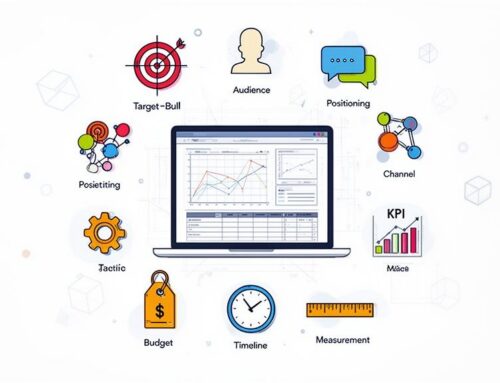
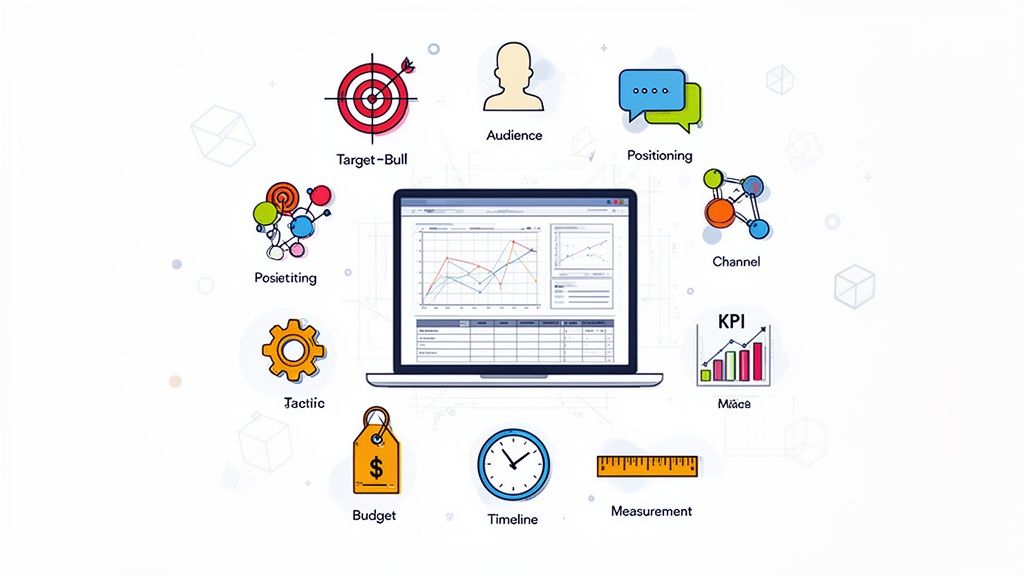
This visual shows how goals, metrics, and channels work together as a three-step process in any solid growth plan.

As you can see, a solid strategy always starts with clear goals, is measured by specific metrics, and is ultimately brought to life through carefully chosen channels.
Prioritizing Growth Channels
You can't be everywhere at once. A huge part of any growth strategy is deciding where to invest your time and money. Spreading your resources thinly across a dozen different channels is a classic recipe for mediocre results. The smart move is to identify the few channels that promise the biggest return for your specific business and go all-in on those.
For many, paid digital advertising is a cornerstone. The global digital ad market was valued at $350 billion in 2020 and is on track to hit $786.2 billion by 2026. This explosive growth shows just how powerful it can be as a channel, especially for agencies like ReachLabs.ai that specialize in it. You can explore more on the market for digital advertising agencies in the United States to get a better sense of the landscape.
A successful growth strategy is defined as much by what you choose not to do as by what you decide to pursue. Focus is your greatest asset.
Building a System for Experimentation
Growth is never a straight line; it's a messy process of learning and adapting. At the heart of it all is experimentation. The "build-measure-learn" loop is the engine that drives this process forward. You start with a hypothesis, build a small-scale test to check it, measure the results, and learn from what happened.
This systematic approach to testing—everything from ad copy and landing page designs to new product features—allows you to make decisions based on data, not just gut feelings. It replaces guesswork with real evidence and, most importantly, turns failures into valuable lessons. This constant cycle of testing and learning is what separates the companies that thrive from those that get left behind.
How to Build Your Growth Strategy Step by Step
Alright, you understand the components. Now, it's time to roll up your sleeves and actually build the thing. Crafting a solid growth strategy isn't some mysterious art form; it’s a disciplined process. It demands an honest look in the mirror, a deep understanding of your customers, and a relentless commitment to testing your assumptions.
This isn't about finding a magic bullet. It's about building a growth engine, piece by piece. Follow these steps to go from a blank page to a concrete, actionable plan that gets results.

Start with a Thorough SWOT Analysis
Before you can figure out where you're going, you need a brutally honest assessment of where you are right now. The classic SWOT analysis is perfect for this. It gives you a 360-degree view of your business by looking both inward and outward.
- Strengths: What are you genuinely great at? Maybe it’s your killer product, a beloved brand, or an unbelievably talented engineering team.
- Weaknesses: Where are the cracks? Be real with yourself. It could be gaps in your product features, a shoestring budget, or just plain poor brand recognition.
- Opportunities: What's happening out in the world that you can jump on? Think about new market trends, a competitor's stumble, or a new technology you can use.
- Threats: What could knock you off course? This might be a new competitor entering the scene, changing regulations, or a downturn in the economy.
Getting this down on paper gives you the clear-eyed perspective you need to make smart moves in the steps that follow.
Define Your Ideal Customer Profile
Stop trying to be everything to everyone. It's a recipe for failure. The most critical next step is to nail down your Ideal Customer Profile (ICP). This isn't just a vague persona; it's a detailed description of the exact company or person who gets incredible value from you—and gives you incredible value in return.
Go deep. What's their job title? What industry are they in? What are their biggest headaches and career goals? What other tools are they already using? When you know your ICP this well, you can focus every bit of your energy, messaging, and product development on delighting them.
Once you’ve got your ICP, map out their entire customer journey. What are all the steps they take, from the first inkling of a problem to becoming a die-hard fan of your solution? This map will show you exactly where you can step in to make their life easier and speed up growth.
Brainstorm and Prioritize Experiments
Now for the fun part. With a clear picture of your position and your customer, you can start cooking up ideas. Don't hold back—brainstorm growth experiments for every single stage of the customer journey, from awareness and acquisition all the way to revenue and referral.
But a long list of ideas is useless without a way to prioritize. A simple but powerful tool for this is the ICE score. You'll rate every idea on three things:
- Impact: If this works, how big of a deal will it be for our main goal?
- Confidence: How sure are we that this will actually work? (Based on data, experience, etc.)
- Ease: How much time, money, and effort will this take to launch?
Scoring your ideas like this helps you cut through the noise and immediately spot the low-hanging fruit: the high-impact, easy wins you feel good about. It takes the guesswork out of the equation.
The goal isn't to find one single "silver bullet" for growth. It's to build a repeatable system of experimentation that constantly uncovers small wins, which compound over time into massive results.
Create Your Growth Roadmap
Your prioritized list of experiments now needs a home. A Growth Roadmap turns your ideas into an actual plan. It’s a visual timeline that shows what you’re testing, when you’re testing it, and who’s on the hook for getting it done. This brings clarity to the whole team and keeps everyone pulling in the same direction.
This roadmap is a vital part of your strategy, much like the plans we cover in our guide on how to write a marketing plan. It should lay out the experiment details, timelines, necessary resources, and the specific metrics you’ll use to call it a win or a loss.
Establish a Feedback Loop
Finally, remember that a growth strategy isn't a static document you file away. It's a living, breathing plan that has to adapt. To make that happen, you need a consistent feedback loop.
Set up a regular meeting—usually weekly or bi-weekly—to review your progress. In these "growth meetings," your team will look at the results from the latest experiments, decide what to do with the winners, and pull the next set of tests from the roadmap. This cycle of building, measuring, and learning is what fuels sustainable, long-term growth.
Powerful Growth Strategies in Action
It’s one thing to talk about growth models in theory, but it’s another thing entirely to see them in the wild, powering real-world success. The most effective strategies often seem deceptively simple after the fact, blending a sharp insight with perfect execution.
By breaking down how some of today's biggest companies grew, we can start to see the patterns. Each story offers a powerful lesson, showing how different problems call for different playbooks. Let's look at how theory becomes reality.
Airbnb: Tapping Into an Existing Ecosystem
When Airbnb first launched, it faced the classic chicken-and-egg problem. To get travelers, they needed properties. To get properties, they needed travelers. With almost no money for advertising, the founders came up with a brilliant plan to piggyback on a platform that already had millions of users looking for a place to stay: Craigslist.
They built a simple, unofficial integration that let Airbnb hosts cross-post their listings to Craigslist with just one click. This move was a masterclass in clever market penetration.
- Instant Visibility: It immediately put Airbnb listings in front of a huge, highly relevant audience.
- Targeted Users: The people they reached were already open to renting from individuals, making them the perfect early adopters.
- Free Brand Building: Every Craigslist post linking back to Airbnb was a free ad, building brand awareness from the ground up.
This single tactic gave Airbnb the critical mass it needed to get its own marketplace off the ground, sparking a growth flywheel that's still spinning today.
Slack: Perfecting Product-Led Growth
Slack dove into a crowded market, but it grew at a dizzying pace by making the product itself the main driver of new business. The strategy was pure Product-Led Growth (PLG), anchored by a freemium model that made it incredibly easy to get started.
The tool was so good and so easy to use that small teams could sign up and see its value in minutes—no sales demo needed. Once one team was hooked, their colleagues in other departments saw the benefits, creating a natural viral spread inside the company. This bottom-up approach meant Slack grew organically until it became essential, leading to major enterprise deals.
You can find more ideas for expanding your own business in our guide on how to scale a small business.
Salesforce: Dominating Through Sales and Spectacle
Salesforce built its empire on a powerful Sales-Led Growth (SLG) model, a perfect fit for its complex and expensive CRM software. The company poured resources into building a top-tier sales team that knew how to navigate big companies and close massive, long-term deals.
But they didn't stop there. Salesforce paired its sales engine with a brilliant marketing strategy centered on its huge annual conference, Dreamforce. This event is more than just a sales pitch; it's an industry-defining spectacle. It builds a loyal community, showcases new features, and fills the sales pipeline with qualified leads for the year ahead.
A key growth strategy for modern agencies is to focus on in-demand digital services. For instance, the influencer marketing industry shot up from $1.7 billion in 2016 to $16.4 billion in 2022. During the same period, video uploads saw an 80% year-over-year spike in 2020.
These examples show how businesses can effectively grow with ecommerce and customer service, another powerful strategy that uses AI-driven support. The common thread is that each of these companies found a core growth engine and aligned the entire organization to make it hum.
Common Growth Strategy Pitfalls and How to Avoid Them
Even the most brilliant growth strategy can fall apart in the real world. A great plan on paper means very little if it can’t handle the pressure of actual execution. Knowing where most companies stumble is the first step to building a strategy that's resilient, adaptable, and actually works.
A lot of plans are dead on arrival because the goals are just too vague. Ambitions like "increase market share" or "get more customers" aren't real targets; they're wishes. Without specific, measurable goals, your team has no clear finish line and no way to tell if they’re even heading in the right direction. This kind of ambiguity just burns resources and kills momentum.
Another classic mistake is the “spray and pray” method. In a frantic attempt to be everywhere at once, companies stretch their budgets and teams thin across a dozen different channels. This lack of focus almost guarantees you’ll get mediocre results everywhere instead of making a real impact where it counts. A smart growth strategy is about making sharp, deliberate choices, not casting the widest possible net and hoping for the best.
The Acquisition and Retention Imbalance
One of the costliest errors I see is an obsession with acquiring new customers while completely ignoring the ones you already have. It’s an easy trap to fall into—the dopamine hit of new sign-ups feels like a win. But the data doesn't lie: acquiring a new customer can be five times more expensive than keeping an existing one.
When you ignore your current customers, you're essentially creating a leaky bucket. You’re pouring time, money, and energy into filling it up, but people are slipping out the bottom just as fast due to a clunky onboarding process, a lack of ongoing engagement, or weak support. Real, sustainable growth is built on a foundation of loyal customers, not a revolving door of first-time buyers.
A business that fails to focus on retention is like a runner who sprints the first mile of a marathon. They might look impressive for a moment, but they'll be out of gas long before they reach the finish line.
Overlooking Internal Alignment and Agility
A growth strategy isn't just a marketing document; it needs buy-in from the entire company. When your product, sales, and customer support teams aren't all on the same page, they end up working in silos. This disconnect causes internal friction and leads to a choppy, confusing customer experience that can sabotage your best efforts.
Finally, too many strategies are carved in stone. They're treated like sacred texts that can't be changed, even when the market is screaming for a pivot.
- Solution: Build flexibility into your plan from the very beginning.
- Action: Set up mandatory quarterly reviews to honestly assess what’s working and what’s a complete dud.
- Mindset: Be ready and willing to change your tactics based on what the data and your customers are telling you.
A plan that can't bend will eventually break. Whether it's a new competitor, a shift in consumer behavior, or an economic surprise, change is inevitable. The best growth strategies are living documents, constantly tweaked and improved through a cycle of testing, learning, and adapting to reality.
Frequently Asked Questions About Growth Strategy
As you start putting all these pieces together for your own business, a few common questions always seem to surface. It's totally normal. Let's tackle them head-on to clear up any confusion so you can move forward with confidence.
Think of this as a quick-fire round to make sure you've got the essentials down.
What Is the Difference Between a Growth Strategy and a Marketing Plan?
This is a big one, and the source of a lot of confusion. A marketing plan is all about how you're going to communicate with your market—think ads, content, social media, and SEO. It's a vital, but specific, set of actions owned by the marketing team.
A growth strategy is the bigger picture. It's the entire company's game plan for sustainable expansion. It weaves together product development, sales motions, customer service, and marketing into a single, unified effort. Your marketing plan is a critical part of your growth strategy, but it’s just one gear in a much larger machine.
How Often Should I Review My Growth Strategy?
Your growth strategy should be a living, breathing document—not a "set it and forget it" PDF that gathers dust. Plan to give it a major, top-to-bottom review at least once a year. This annual deep dive makes sure your big-picture goals are still relevant to where the market is headed.
But that doesn't mean you ignore it for 11 months. You should be checking in on your key metrics and experiment results far more frequently, usually on a monthly or quarterly basis.
A static plan is a failing plan. Regular, data-informed adjustments keep you nimble, allowing you to pounce on new opportunities or dodge threats without losing your North Star.
This dual rhythm—frequent tactical check-ins and less frequent strategic reviews—is the key to keeping your plan both stable and adaptable.
Can a Small Business Succeed Without a Large Budget?
Yes. One hundred percent, yes. A brilliant growth strategy is about being smart and targeted, not just about having the deepest pockets. Some of the most effective growth levers cost more in time and creativity than they do in cash.
Small businesses can punch way above their weight by focusing on high-impact activities that don't depend on a massive ad spend.
- Content & SEO: Creating genuinely helpful content that solves your customer's problems can become a lead-generation engine that works for you 24/7, for years to come.
- Community Building: Fostering a real sense of community around your brand—whether on social media or a private forum—creates loyal advocates who drive powerful word-of-mouth growth.
- Product-Led Growth: If your product is good enough to sell itself through a free trial or a freemium tier, it becomes your most powerful acquisition channel.
The secret is knowing your customer inside and out, then picking the channels where you can make the biggest splash. A sharp, focused strategy will always beat a huge budget that's spread thin and without purpose.
At ReachLabs.ai, we live and breathe this stuff. We build the data-driven marketing plans that become the engine of your company's growth strategy. We help you find the channels that actually move the needle and turn those insights into real, measurable results.
Discover how our full-service agency can build your growth engine.