So, what exactly is a digital strategy? It’s the high-level game plan that directs everything you do online to hit your business goals. It's not just a to-do list of marketing tasks; it’s the thoughtful 'why' behind every piece of content, every social post, and every ad campaign.
Think of it as the GPS for your business in the digital world. It gives you the destination and the best route to get there.
Defining Your Digital Blueprint

It’s a common mistake to think that just being online is the same as having a strategy. I see it all the time—companies are running social media ads, posting on their blog, and sending out emails. But without a unifying plan, these efforts are often siloed and disconnected from what the business actually needs to achieve.
That’s what’s known as a “tactical” approach. It’s like driving around without a destination in mind. Sure, you’re moving, but are you getting anywhere that matters?
A real digital strategy is what ties your company's core mission to your digital actions. It forces you to answer the tough, foundational questions before you pour time and money into marketing:
- What are we really trying to do here? (e.g., capture 15% more market share, or generate 500 qualified leads this quarter).
- Who are we talking to? (e.g., small business owners in the tech space who feel overwhelmed by their marketing).
- Where do these people hang out online? (e.g., they're active on LinkedIn and in specific industry forums, not TikTok).
- How will we know if this is working? (e.g., we'll track customer acquisition cost and lead-to-customer conversion rates).
Answering these questions first ensures every dollar spent and every hour worked is a deliberate step toward measurable growth.
Digital Strategy vs. Digital Marketing Plan
People often use these terms interchangeably, but they are fundamentally different. Your strategy is the "why" and "what," while your marketing plan is the "how." The strategy sets the direction; the plan details the steps.
To make this crystal clear, let's break it down.
Digital Strategy vs Digital Marketing Plan At a Glance
| Aspect | Digital Strategy | Digital Marketing Plan |
|---|---|---|
| Focus | The long-term vision and overarching business goals. The "Why." | The specific actions and channels used to execute the strategy. The "How." |
| Timeframe | Typically 1-5 years, reviewed annually. | Shorter-term, often quarterly or annually. |
| Scope | Broad, encompassing the entire business's digital presence. | Narrow, focused on specific campaigns, channels (SEO, PPC, email), and tasks. |
| Core Question | "What do we need to achieve and why?" | "What specific steps will we take to achieve it?" |
| Example | "Become the go-to thought leader for sustainable packaging in North America." | "Launch a 3-month content campaign on LinkedIn targeting C-level execs." |
Understanding this distinction is crucial. Without a solid strategy, your marketing plan becomes a collection of random tactics that probably won't deliver the results you're looking for.
The Bedrock of Your Online Presence
Your brand is the foundation for everything. Before you can build a digital strategy, you have to know who you are. This is why it’s so important to understand what brand development entails, as it defines how you show up and how people perceive you online.
Your brand dictates your tone of voice, visual identity, and the core values you communicate. It’s the consistent thread that runs through every tweet, blog post, and landing page. Even the visuals and messaging of your campaigns are guided by a separate but related plan; learning about a creative strategy can add another layer to your understanding here.
Ultimately, your digital strategy is the deliberate, well-thought-out plan that aligns your brand, business goals, and marketing actions into one powerful, cohesive force. It’s how you turn random digital noise into a focused engine for growth, ensuring that every click, share, and conversion serves a much larger purpose.
The Pillars of a Powerful Digital Strategy

Think of a great digital strategy like a sturdy building. It can't stand on a weak foundation. It needs strong, interconnected pillars supporting it. These pillars are the core components that work together to hold up your business goals, making sure your digital efforts are stable, smart, and actually drive growth.
Getting these pillars right is what separates random digital activity from a focused plan. It’s not a checklist; it's a system. Your understanding of the audience dictates the channels you use, and those channels determine the kind of content you need to create. Let's break down what these pillars look like in practice.
Deep Audience Understanding
Everything starts here. You have to know, really know, who you’re talking to. This is so much more than basic demographics. It's about getting inside their heads—understanding their values, their worries, what drives them, and the real problems they need solved.
This is where you build out your buyer personas. These aren't just generic profiles; they should feel like real people you know. When you understand your audience on this level, your message connects emotionally. You stop being just another company and start becoming a trusted resource.
Key Takeaway: A strategy built on guesses about your audience is a house of cards. But one built on genuine insight into what your customers actually need and want gives you a massive advantage.
Strategic Channel Selection
Once you know your audience inside and out, the next question is: where do you find them? A classic mistake is the "spray and pray" approach—trying to be on every single platform. It stretches your team thin and usually results in a lot of noise with very little impact.
The goal isn’t to be everywhere; it’s to be where it counts. You need strategic presence.
- Social Media: Are your people scrolling Instagram for visual inspiration? Are they networking on LinkedIn? Or are they in niche Facebook groups asking for recommendations?
- Search Engines: Think about the exact phrases they’re typing into Google. Showing up there with a solid SEO game plan puts you right in front of people who are actively looking for what you offer.
- Email: This is your direct line. It’s perfect for building relationships over time with valuable, personalized content that doesn't feel like spam.
- Content Platforms: Maybe they listen to podcasts on their commute or binge-watch how-to videos on YouTube. Be there.
Picking the right channels means your message lands in the right place, at the right time, when your audience is actually paying attention.
Cohesive Content and Messaging
Okay, you know who you're talking to and where you'll find them. Now, what are you going to say? This pillar is about creating a clear, consistent story that your audience can follow. Your content is how you tell that story.
This isn’t about just churning out blog posts. It’s about building a content architecture that serves a purpose at every step of their journey.
- Awareness: Content designed to grab attention and introduce your brand to new people (think helpful blog posts or eye-catching infographics).
- Consideration: Content that helps people weigh their options and shows why you're the best one (think detailed case studies, webinars, or comparison guides).
- Conversion: Content that gives them the final nudge to take action (think free trials, live demos, or glowing testimonials).
Your messaging has to feel the same everywhere, reinforcing who you are as a brand and building trust. Every piece of content should feel like part of a larger, more meaningful conversation.
Enabling Technology and Tools
No modern digital strategy runs without the right tech. This pillar is about choosing the software and tools that will help you execute, automate, and measure everything without giving you a headache. The right tech stack should make your job easier, not harder.
From marketing automation platforms that handle lead nurturing to analytics tools that show you what’s working, technology is the engine that brings your strategy to life. Many teams are finding out how to use AI in marketing to get an extra edge.
Meaningful Analytics and Measurement
Finally, the pillar that keeps everyone honest: data. Without it, you're just guessing. This is about defining what success actually looks like in hard numbers and then tracking the right things to see if you're getting there.
This means looking past vanity metrics like page views and likes. Instead, focus on Key Performance Indicators (KPIs) tied to real business outcomes, like customer acquisition cost (CAC) or customer lifetime value (CLV). A strong data-driven marketing strategy is what turns numbers into smart decisions.
The digital marketing industry is set to grow past $740 billion in 2024 and is expected to hit nearly $786.2 billion by 2026. These numbers show just how much businesses are relying on solid digital plans to stay competitive, especially when you consider that a whopping 93% of all website traffic comes from search engines. This data-first mindset lets you constantly learn and adapt, making sure your strategy stays sharp and effective.
Practical Frameworks for Structuring Your Strategy
A great idea without a clear structure is just a wish. To turn your digital ambitions into a concrete, organized plan, you need a framework. Think of frameworks as proven recipes for success—they give you the steps and ingredients to ensure your final strategy is coherent, comprehensive, and actually works.
Instead of staring at a blank page, these models provide a logical scaffolding to hang your ideas on. They help transform abstract business goals into a series of connected, manageable tasks. Let’s walk through three powerful frameworks that marketing pros use to build winning strategies day in and day out.
Map the Customer Journey
Before you can guide your audience, you have to understand the path they’re already taking. Customer Journey Mapping is a framework for visualizing every single touchpoint a person has with your brand, from the first flicker of a need to becoming a loyal fan. It’s all about seeing your business through their eyes.
This process forces you to sync your marketing actions with what your customer is actually feeling and doing. It helps you answer the big questions at each stage: What are they thinking? What are their pain points? What do they need from us right now?
A typical customer journey breaks down into these key stages:
- Awareness: The moment someone realizes they have a problem or need you might be able to solve.
- Consideration: The research phase, where they’re weighing your solution against others.
- Conversion: The point of purchase or sign-up, where they finally decide to take action.
- Loyalty: The post-purchase experience that decides if they’ll stick around.
- Advocacy: When a happy customer becomes a vocal supporter, sending new business your way.
By mapping this out, you can strategically place the right content on the right channel at the exact moment it’s most helpful. This creates a smooth, intuitive experience that feels less like marketing and more like helping.
Organize Actions with the RACE Model
While journey mapping is all about the customer’s perspective, the RACE Model is an action-oriented framework for organizing your own marketing activities. Developed by Smart Insights, it gives you a simple, four-step structure that covers the entire customer lifecycle.
RACE is an acronym that stands for:
- Reach: Building awareness and driving traffic to your website and social profiles. This is your top-of-funnel activity, powered by things like SEO, paid ads, and social media.
- Act: Encouraging visitors to interact with you once they arrive. This stage is all about generating leads with compelling content, clear calls-to-action, and a great user experience.
- Convert: Turning those interested leads into paying customers. Here, you focus on optimizing checkout, using remarketing, and nurturing leads with email automation to close the deal.
- Engage: Building long-term relationships that create repeat business and brand advocates. This is where customer service, personalized emails, and community management shine.
The RACE model provides a clear sequence for your digital strategy. It ensures you aren't just driving traffic (Reach) without a plan to turn that traffic into leads (Act) and then customers (Convert).
Set Clear Objectives with the 5S Model
So, how do you make sure your digital goals are directly tied to real business results? The 5S Model, created by PR Smith, helps you define what you actually want to achieve with your digital efforts. It’s a simple way to set goals that go beyond just making sales.
The 5S's are:
- Sell: Grow sales, either directly online or through wider distribution.
- Serve: Add value by giving customers extra benefits online, like helpful tools or better support.
- Speak: Get closer to customers by creating a two-way conversation.
- Save: Reduce costs through digital efficiency, like cutting down on print or support staff time.
- Sizzle: Extend the brand online to build engagement and top-of-mind awareness.
Using this model, a small e-commerce business might set a goal to Sell 15% more through its website, Serve customers with a new online sizing guide, and Speak with them via a monthly Q&A on Instagram. This framework ensures every part of your plan has a clear "why" behind it.
By focusing on these structured approaches, you can craft a strategy built for measurable results and sustained growth.
How Winning Digital Strategies Look in the Real World
Theory is great for a blueprint, but seeing what’s possible when a sharp digital strategy comes to life is where the real learning happens. A solid plan isn’t just about "being online"; it’s about making sure every single digital action you take is aimed at a specific, measurable business goal. When you get it right, the results speak for themselves.
Let’s step away from the concepts and look at some concrete examples. By breaking down how different businesses found their footing and achieved incredible success, we can see the core principles of a great digital strategy in action. Think of these as mini-playbooks that show how a clear plan can turn big challenges into major wins.
B2C Ecommerce: Building a Tribe, Not Just a Customer List
The Challenge: A new, direct-to-consumer sustainable fashion brand was getting lost in a sea of competitors. Their first attempts at generic social media ads were expensive, brought in few sales, and did absolutely nothing to build a loyal following.
The Strategy: Instead of just throwing more money at broad advertising, they switched to a community-first digital strategy focused squarely on Instagram and TikTok. Their entire goal was to forge a genuine connection with eco-conscious Gen Z shoppers by putting their brand's values and transparency front and center—not just their products.
This wasn't a single tactic but a layered approach:
- Real Partnerships: They teamed up with micro-influencers who were genuinely passionate about sustainability. These creators didn't just post ads; they told authentic stories about the brand’s ethical production process.
- Customer-Led Content: The brand launched a simple hashtag campaign, encouraging customers to share photos of themselves wearing the products. This created a powerful wave of social proof and made people feel like they were part of the mission.
- Interactive Community Building: They used Instagram Stories for live Q&As with the founders and ran polls letting their followers vote on upcoming colors. This small step fostered a huge sense of co-creation and ownership.
The Result: This shift in strategy completely changed their trajectory. Within a single year, they saw a 400% increase in organic social media engagement and a 75% boost in repeat customers. Their community didn't just buy from them; it became their most powerful marketing engine.
B2B SaaS: Dominating a Niche with Expertise
The Challenge: A B2B SaaS startup with a fantastic project management tool for creative agencies was basically invisible online. They were up against huge, established competitors and simply couldn't afford to outspend them on ads.
The Strategy: Their digital strategy was all about becoming the go-to authority on running a creative agency. They put all their energy into a potent mix of SEO and content marketing that provided immense value, aiming to attract highly qualified leads by solving their audience's biggest headaches.
A digital strategy is essentially the structured plan a company uses to achieve its goals using digital tools. With over 50% of marketing budgets now dedicated to paid media and new tech, a smart organic strategy can give you a massive competitive edge. For more context, check out these marketing statistics that show how mobile platforms are expected to capture 70% of ad spend by 2028.
The Result: It took time, but within 18 months, their blog was ranking on the first page of Google for money-making keywords like "agency profitability calculator" and "creative project workflow." This brought in a steady, predictable stream of organic traffic, leading to a 300% increase in qualified leads and slashing their customer acquisition costs by 50%.
Local Service Business: Owning the Neighborhood Search
The Challenge: A family-owned plumbing company was consistently losing jobs to big national chains and lead-gen sites that dominated the paid search results. They desperately needed a cost-effective way to get in front of local homeowners who were actively looking for their help.
The Strategy: They rolled out a digital strategy that was hyper-focused on one thing: local SEO. The entire plan was designed to make them the undeniable top choice in search results within their service area.
- Google Business Profile Mastery: They treated their Google Business Profile listing like gold, filling it out completely with high-quality photos, consistent information, and weekly updates.
- Effortless Review Generation: They set up a simple system to text every happy customer a link to leave a review. This quickly built up a five-star reputation that screamed trustworthiness.
- Neighborhood-Specific Content: They wrote helpful blog posts on their website that answered local questions, like "common plumbing issues in [City Name] homes," making them a relevant local resource.
The Result: Their laser-focused efforts worked wonders. They shot to the top of the Google Local Pack for their most important keywords, which led directly to a 60% increase in inbound service calls coming straight from search. Their online reputation became their best salesperson.
How to Build Your First Digital Strategy
Creating a digital strategy from scratch can feel like a massive undertaking, but it doesn't have to be. Forget the idea of a dense, 100-page business school thesis. Instead, think of it as a practical roadmap—a series of smart, connected decisions that guide all your online efforts toward a clear destination.
This process is all about turning vague goals into a concrete, actionable plan. We'll walk through a straightforward five-step framework that can take you from a blank page to a working strategy, making it manageable even for a solo entrepreneur or a small team.
Step 1: Anchor to Business Objectives and KPIs
Before you even think about social media channels or blog posts, you have to start with your core business goals. A digital strategy that isn't directly tied to what your business needs to achieve is just busywork. So, ask yourself the most important question: What does success look like a year from now?
Your answer needs to be specific and measurable. Fuzzy goals like "increase brand awareness" just won't cut it. You need something tangible:
- Goal: Increase qualified leads by 30% in the next six months.
- Goal: Boost customer retention rates by 15% this year.
- Goal: Reduce customer acquisition cost (CAC) by 20% by Q4.
Once you’ve locked in your main objective, you can define the Key Performance Indicators (KPIs) you’ll use to track progress. If your goal is generating leads, your KPIs might be landing page conversion rates, cost per lead, and the lead-to-customer ratio. This first step ensures every single decision you make from here on out serves a real business purpose.
Step 2: Analyze Your Audience and Competitors
With your goals set, it’s time to look outward. You need a deep, real-world understanding of two groups: the people you want to reach and the other businesses trying to get their attention. This isn't about guesswork; it's about good old-fashioned research.
First, get to know your target audience. Go beyond basic demographics and create detailed buyer personas. What are their biggest headaches? What gets them excited? Where do they hang out online, and whose advice do they trust? The more you know, the better you can craft a message that actually connects with them.
Next, it's time for some competitive analysis. Pinpoint your top three to five competitors and do a deep dive into their digital footprint.
- What channels are they most active on?
- What’s their core message?
- What are they great at? And more importantly, where are the cracks?
This isn’t about copying their playbook. It's about spotting the gaps in the market—the unanswered questions or underserved needs—that your brand is perfectly positioned to fill.
Step 3: Map Your Channels and Content Architecture
Now you can finally connect the "who" with the "what." Based on your audience research, pick the digital channels where you can most effectively reach your ideal customers. Trying to be everywhere at once is a classic recipe for burnout. It’s far better to focus on mastering one or two platforms where your audience is truly engaged.
This is especially true in a world where almost everything happens on a phone. Right now, 5.78 billion people globally use mobile phones, and a whopping 87% of those are smartphones. This mobile-first reality has to shape your choices, ensuring your strategy is built for how people actually consume information today. You can read more on this in this comprehensive 2025 global overview report.
With your channels chosen, you can start outlining your content architecture. This is your game plan for what you’ll say at each stage of the customer journey, from grabbing their attention to turning them into a loyal fan. Your content should act as a helpful guide, providing real value and building trust every step of the way.
Step 4: Allocate Your Budget and Resources
A strategy without resources is just a wish list. This step is where you get real about what you can invest, both in time and money. Your budget will determine the scale and scope of everything you do.
Break down your spending across a few key areas:
- Tools and Technology: What software will you need for analytics, email marketing, or social media management?
- Paid Media: Are you planning to run ads on platforms like Google or Facebook?
- Content Creation: Will you create content in-house, hire freelancers, or partner with an agency?
- Personnel: How much of your team's time can realistically be dedicated to this?
You have to be strategic here. If your budget is tight, focus on high-impact, low-cost activities like organic SEO and building a strong email list. The key is to make every dollar and every hour count.
Step 5: Execute, Measure, and Relentlessly Iterate
Alright, it’s time to put your plan into motion. But remember, the launch is just the beginning. A great digital strategy is a living document, not something you set in stone and forget. You need to build a feedback loop where you constantly execute, measure the results against your KPIs, and adjust based on what the data is telling you.
Set up a simple dashboard to keep an eye on your key metrics. Check in on your performance weekly and monthly.
Key Insight: Don't be afraid to fail. Seriously. Some of your initial ideas won't pan out, and that's okay. The goal is to learn quickly, double down on what’s working, and cut what isn’t. This agile, test-and-learn approach is what turns a good strategy into a great one over time.
This infographic breaks down a common strategic process, from challenge to results.
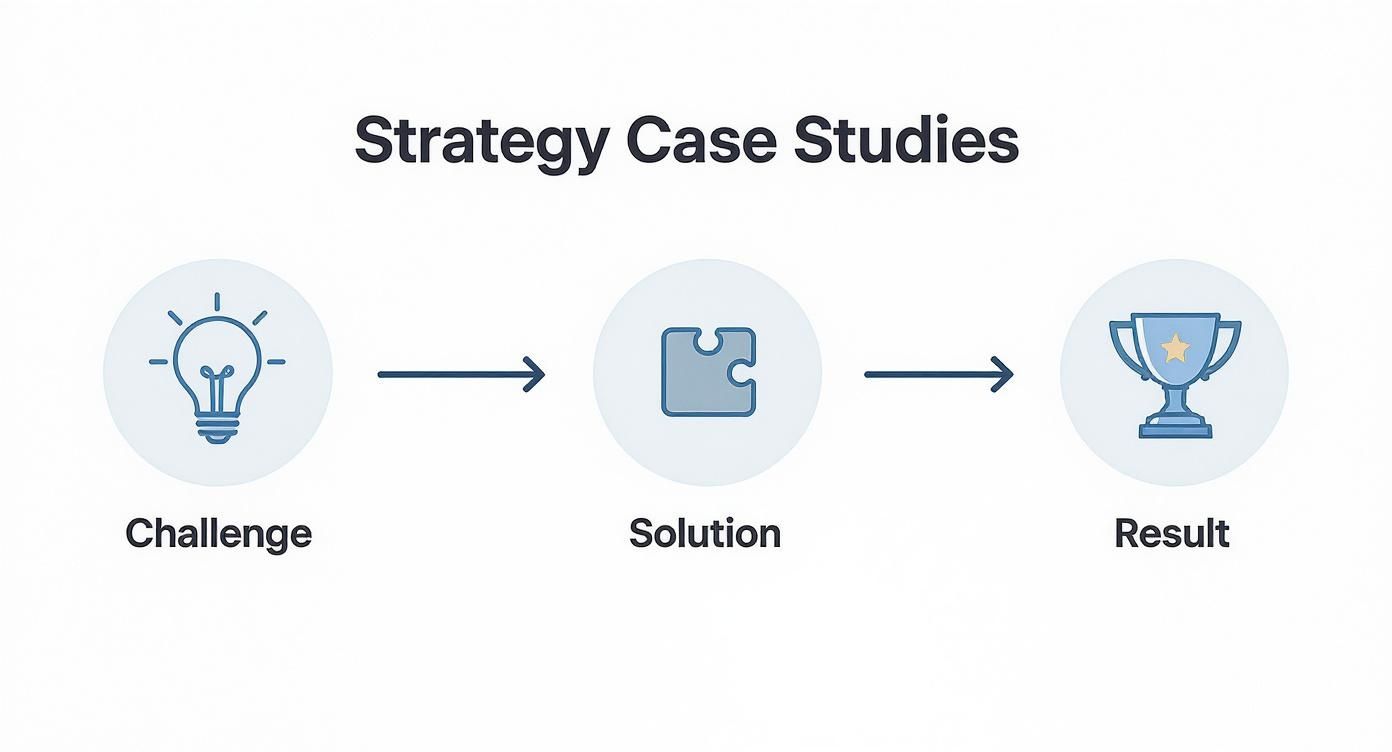
As you can see, a successful strategy always moves from identifying a core problem to implementing a targeted solution, which ultimately leads to a measurable win.
Common Questions About Digital Strategy
Once you start moving from theory to action, the real questions pop up. This is where the rubber meets the road, and getting a handle on these common challenges can make all the difference. Let’s tackle a few of the questions that almost always come up when teams start putting a digital strategy into practice.
Getting these right helps you build a plan that's flexible, effective, and actually tied to what your business needs to achieve.
How Often Should I Update My Digital Strategy?
Your digital strategy isn't a "set it and forget it" kind of document; it’s a living, breathing guide. Plan for a major review annually. This is your chance to zoom out, sync up with the coming year's business goals, and make big-picture adjustments based on what worked (and what flopped).
But the digital world doesn’t wait for your annual meeting. You should be checking in on your progress and tweaking your tactics much more frequently—think quarterly or even monthly. A competitor's bold move, a new social platform gaining steam, or a sudden shift in customer search behavior are all signals that you might need to adjust your course.
Best Practice: The smartest approach is a mix of both. The annual overhaul keeps your long-term vision on track, while quarterly check-ins ensure you're agile enough to jump on new opportunities and dodge emerging threats.
What Is the Biggest Mistake Businesses Make?
Hands down, the most common and costly mistake is chasing shiny objects—tactics without a strategy. It’s when a business starts running Facebook ads, launches a podcast, or dives into the latest TikTok trend just because it seems like the thing to do. These are just random acts of marketing, completely disconnected from a central "why."
This approach is a fantastic way to burn through your budget and your team's energy with very little to show for it. Without a plan holding everything together, you have no real way of knowing what’s working or how any of it contributes to revenue. You’re just busy, not productive.
A solid strategy turns those random acts into a coordinated campaign. It ensures every dollar spent and every hour worked is a deliberate step toward a specific, measurable business goal.
Can a Small Business Succeed Without a Big Budget?
Yes, 100%. In fact, a good digital strategy is even more crucial for a small business because it forces you to be smart and focused. It's not about outspending the big guys; it's about out-thinking them. You win by being clever, not by having the deepest pockets.
A lean but effective strategy usually leans into a few key areas:
- Owning a niche: Instead of trying to be everything to everyone, you become the absolute best solution for a very specific group of people.
- Dominating one or two channels: Rather than spreading yourself thin across every platform, you find where your audience really is and go all-in there, whether that’s with local SEO or a killer email newsletter.
- Building a rock-solid reputation: You can't buy genuine trust. Creating incredibly helpful content and delivering amazing customer service will do more for you than a massive ad budget ever could.
For a small business, success isn't about matching a competitor's ad spend. It's about understanding a specific customer better than anyone else and then showing up for them in a way that feels indispensable.
At ReachLabs.ai, we specialize in crafting and executing digital strategies that deliver tangible results. Let us help you build a plan that moves the needle for your business.