

Think of a brand strategist as the master architect behind a brand’s public identity. Their job is to dig deep into a business, its customers, and the competitive environment to craft a story that truly connects. This isn’t just about designing a cool logo or a catchy tagline; it’s about building the entire experience and perception of the brand from the ground up.
The Architect Behind Your Brand Identity
What gives a brand like Nike or Apple its undeniable presence and power? It’s not just that they make great products. It’s the result of a deliberate, carefully built brand strategy, and the brand strategist is the one holding the blueprints. They don’t just slap a new coat of paint on a business—they pour the foundation and draw up the plans for how the world will see and feel about it.
A strategist’s main goal is to answer a few critical questions: What does this brand truly stand for? Who are we talking to? And, most importantly, why should they care? To get to these answers, they have to wear a few different hats: part researcher, part psychologist, and part creative storyteller.
Blending Art and Science
The role is a fascinating mix of left-brain analysis and right-brain creativity. A strategist spends their time poring over market data, studying consumer behavior, and analyzing what competitors are doing to find that one golden insight. They’re looking for what makes a company genuinely different and then figuring out how to turn that difference into a concrete plan.
This process usually breaks down into a few key activities:
- Audience Analysis: Getting to know the ideal customer on a deep, almost personal level.
- Competitive Positioning: Finding that unique spot in the market where the brand can not only compete but thrive.
- Core Messaging Development: Writing the key messages and defining the brand voice that will show up in every email, ad, and post.
- Internal Alignment: Making sure everyone inside the company, from the CEO to the customer service team, understands and lives the brand promise.
A great strategist ensures that every single decision the company makes—from the products it creates to the content it shares—reinforces its core identity. That kind of consistency is what builds real trust and turns casual buyers into passionate fans.
Ultimately, a brand strategist builds the invisible structure that gives a brand its strength, focus, and direction. To see how all these pieces fit together in a real-world context, exploring a complete brand strategy framework can provide a clearer picture. Their work is what makes a brand not just visible, but memorable and meaningful.
The Core Responsibilities of a Brand Strategist

So, what does a brand strategist actually do all day? It’s a role that’s part detective, part psychologist, and part business visionary. They’re the ones responsible for defining a brand’s very soul and making sure that essence shines through in everything the company does.
Forget just logos and color palettes. A strategist’s job is to build the entire foundation a brand stands on, ensuring it connects with people on a real, human level. They are the glue that holds the brand’s story together across every department.
Diving Deep into Market Research
You can’t build a winning strategy in a vacuum. The first, and arguably most important, job is to become an absolute expert on the market. This means digging into the data to get a crystal-clear picture of industry trends, customer behavior, and what the competition is up to. Think of it as reconnaissance—gathering intelligence to find gaps in the market and opportunities to stand out.
This research phase is where it all begins. Key tasks often include:
- Audience Segmentation: Going beyond basic demographics to truly understand the ideal customer. What are their deepest frustrations? What do they secretly hope for? A strategist needs to know.
- Competitive Analysis: It’s not just about knowing who your competitors are. It’s about dissecting their strategies, identifying their weaknesses, and finding that unique slice of the market your brand can dominate.
- Trend Forecasting: A great strategist is always looking around the corner, anticipating cultural shifts and market changes before they happen. This keeps the brand relevant and ahead of the curve.
The goal isn’t just to collect data; it’s to find the story within the data—the actionable insights that will shape every decision that follows.
Defining the Brand’s Core Identity
Once they have a firm grasp on the outside world, the strategist turns their focus inward. Working with company leaders, they start to articulate the brand’s core identity. This is where they answer the big questions: What do we stand for? Why do we exist? What is our unique personality?
At its core, a brand strategist’s job is to make a company self-aware. They help it understand its unique value, articulate its story, and promise something to its audience that it can consistently deliver.
This process is about codifying the brand’s DNA. The strategist is responsible for shaping how the world perceives the company by crafting a powerful market position and a message that truly connects. This often results in detailed brand guidelines that cover everything from tone of voice to visual style, giving marketing teams a clear playbook to follow. To see how this all comes together, you can explore the brand strategist job description for a deeper dive.
Acting as the Central Brand Guardian
A brilliant strategy is worthless if it just collects dust in a shared drive. A huge part of the strategist’s role is to be the brand’s number one champion within the company. They are the keeper of the flame, ensuring the strategy is understood, embraced, and, most importantly, used by everyone.
This means they are constantly collaborating with other teams:
- Marketing Teams: To make sure every ad, social media post, and email campaign feels like it comes from the same brand.
- Product Development: To influence the creation of products and services that actually live up to the brand’s promise.
- Sales and Customer Service: To arm them with the right language to talk about the brand’s value in a compelling way.
By enforcing this consistency, the strategist helps build a cohesive and powerful brand experience. Every single touchpoint, from an Instagram ad to a customer support call, should reinforce the same core story, building the trust and loyalty that great brands are made of.
What It Takes: The Brand Strategist’s Skillset

So, what kind of person becomes a brand strategist? It’s not just about being a creative type or a data whiz; it’s about being a rare hybrid of both. Think of them as part-detective, part-artist. They have to be able to look at a spreadsheet and see a story, then turn that story into a plan that actually works.
This unique combination is what lets them bridge the often-massive gap between a company’s business goals and how the public actually sees them. A great strategist is endlessly curious about people, culture, and what makes us tick. But they also have the sharp business sense to turn those human insights into real, measurable growth. One minute they’re digging through consumer data, the next they’re brainstorming a brand’s core personality.
The Analytical and Hard Skills
Behind every great brand strategy, there’s a mountain of data. A top-notch strategist knows how to dig into market research, competitive analyses, and performance metrics to find the golden nuggets of insight that nobody else has seen.
Without this analytical foundation, a brand strategy is really just a collection of cool ideas—a house of cards with no real substance. Some of the most critical hard skills include:
- Data Analysis: The ability to make sense of quantitative and qualitative data is crucial. This is how you understand market trends, decode consumer behavior, and track brand performance.
- Market Research: It’s not enough to use existing data. Strategists need to be skilled in creating and running surveys, focus groups, and interviews to get fresh, powerful insights directly from the source.
- SEO and Digital Fluency: In today’s world, understanding how people find and perceive brands online is absolutely non-negotiable. This means having a solid grasp of how search engine optimization and content marketing really work.
The Creative and Soft Skills
If data tells you the “what,” it’s the creative and soft skills that uncover the “so what?” and inspire the “what if?” A strategist must be a fantastic storyteller, capable of weaving a narrative that connects with people on a deeply human level. This requires a ton of empathy, intuition, and a pretty vivid imagination.
These skills might be harder to quantify, but they’re every bit as important. They’re what transform a solid, data-driven plan into a brand that people genuinely love and feel loyal to.
A strategist’s true value lies in their ability to connect human insights with business goals. They must possess the empathy to understand a customer’s deepest needs and the communication skills to rally an entire organization around a shared vision.
This unique mix of abilities allows them to forge authentic, lasting bonds between a company and its audience.
To really break it down, here’s a look at the essential skills a brand strategist needs to master.
Essential Skills for a Brand Strategist
| Skill Category | Specific Skill | Why It’s Critical | Real-World Application Example |
|---|---|---|---|
| Analytical | Data Interpretation | To base strategic decisions on objective evidence rather than gut feelings or assumptions. | Analyzing sales data and customer feedback to pinpoint the most profitable audience segment for a new product launch. |
| Analytical | Competitive Analysis | To find a unique, ownable position in the market and avoid becoming just another “me-too” brand. | Deconstructing a competitor’s messaging to find a gap in the market that your brand can uniquely and authentically fill. |
| Creative | Storytelling | To forge an emotional connection with the audience and make the brand unforgettable. | Crafting a compelling founder’s story that embodies the brand’s core values, then weaving it across the website and social media. |
| Creative | Strategic Thinking | To see the big picture and ensure every single brand activity ladders up to long-term business goals. | Developing a multi-year brand architecture plan for a company that’s expanding into new international markets. |
| Interpersonal | Empathy | To genuinely understand the customer’s true needs, deepest fears, and secret desires. | Creating detailed customer personas that go way beyond simple demographics to capture the emotional drivers behind their buying decisions. |
| Interpersonal | Leadership & Communication | To get internal teams and key stakeholders aligned and excited about a unified brand vision. | Leading a workshop with the executive team to define the company’s core purpose and values, ensuring buy-in from every department. |
Ultimately, a strategist’s toolkit is a blend of science and art. Mastering these skills is what separates a good strategist from a truly great one who can build iconic brands.
Turning Insights Into a Cohesive Brand Strategy
After digging deep into research and analysis, the real work for a brand strategist begins: connecting all the dots. They take mountains of data, interview notes, and competitive intel and transform it all into a clear, powerful, and actionable plan. This is where the strategist stops being an investigator and becomes an architect, drawing up the blueprints for the brand’s future.
This isn’t about pulling a rabbit out of a hat. It’s a methodical process of turning abstract ideas about a brand’s purpose and audience into tangible elements that will define how it shows up in the world. For example, what happens to all those stakeholder interviews? A good strategist distills the dozens of different opinions into a single, unified brand purpose that everyone can get behind.
The Phased Approach to Strategy Formulation
A brand strategist rarely tries to do everything at once. Instead, they lead the company through a series of distinct phases, with each step building on the one before it. This ensures the final strategy is not only creative and inspiring but also rooted in solid research and tied directly to business goals.
This structured approach is the antidote to “fluffy” strategy—ideas that sound impressive in a boardroom but have no real-world impact. The journey typically unfolds in a few key stages:
- Discovery and Research: This is the foundation. It involves brand audits, stakeholder interviews, and market analysis to gather all the necessary intelligence.
- Strategy Formulation: Here, the strategist synthesizes the findings to nail down the brand’s core positioning, messaging pillars, and personality.
- Creative Expression: This is where the strategy becomes visible and audible, coming to life through logos, color palettes, and tone of voice guidelines.
- Implementation and Measurement: The final phase is all about rolling out the new strategy and establishing the key metrics needed to track its performance.
A great brand strategy is a living document, not a static report filed away on a server. It acts as a North Star, guiding every decision from product development to marketing campaigns and ensuring consistency over the long haul.
This systematic process is what turns raw data into a compelling brand identity. For a more detailed look at this entire journey, our complete guide on developing a brand strategy breaks it down step-by-step.
From Core Values to a Visual Identity
So, what does this look like in the real world?
Imagine a tech startup. After dozens of interviews, the strategist identifies three core values: simplicity, innovation, and accessibility. These values now become the filter for every decision that follows.
Next, they tackle the brand voice. Based on the value of “simplicity,” the strategist determines the brand should sound helpful and straightforward, ditching the complex technical jargon. This single decision will shape all future website copy, social media posts, and even customer support scripts.
Finally, they oversee the creation of a visual style guide that brings all three values to life. This might mean choosing clean fonts, a minimalist color palette, and intuitive icons that feel both innovative and accessible.
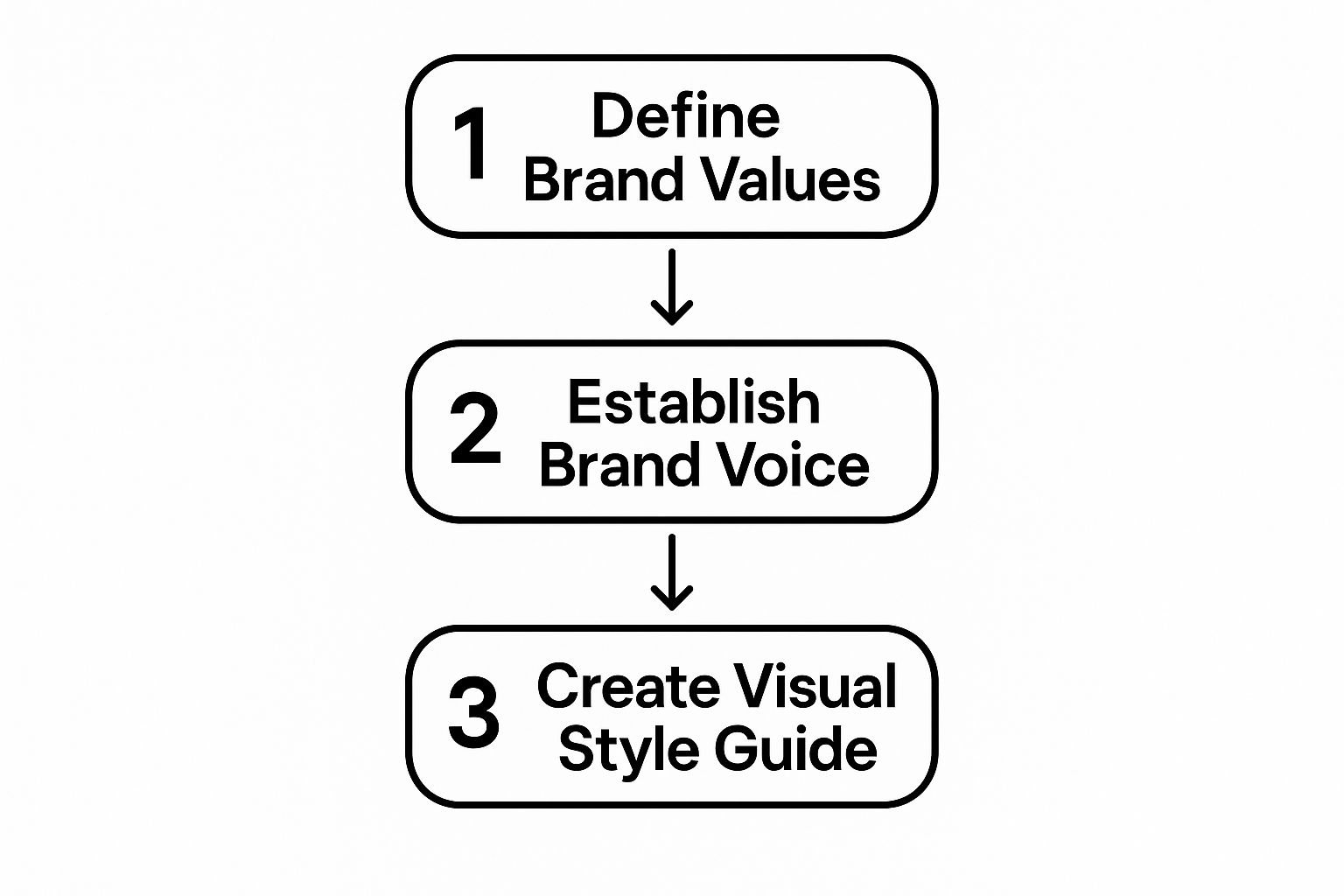
As you can see, each step flows logically from the last, making sure the final brand is a true and consistent reflection of its core strategy. This is how a strategist builds a brand that isn’t just memorable, but genuinely authentic.
Measuring the Impact of Brand Strategy

A brilliant brand strategy feels great, but it has to do more than just tell a good story. It needs to be a real business asset that delivers a tangible return. So, how do you measure something as squishy as “brand”? This is where a strategist truly shines—by connecting the dots between the brand’s performance and actual business outcomes.
They look past vanity metrics like social media likes and dig into the real indicators of brand health. A strategist knows their job isn’t done when the strategy launches. It’s an ongoing loop of measuring, analyzing, and tweaking to prove the brand’s value and guide its growth over the long haul.
Key Indicators of Brand Performance
To show a strategy is actually working, a brand strategist zooms in on a few key areas. Each one gives a different piece of the puzzle, blending perception with performance to paint a full picture of the brand’s impact.
Think of these metrics in a few main buckets:
- Brand Awareness: This is all about familiarity. Is your brand even on the radar of your target audience? A strategist will track things like share of voice (how often your brand is mentioned versus competitors) and brand recall (do people think of you first when they need what you sell?).
- Brand Perception: This gets into the feels. How do people feel about your brand? Using tools for customer sentiment analysis and tracking the Net Promoter Score (NPS) helps reveal if the brand story is landing the way it was intended.
- Customer Loyalty: This tells you if you’re building real relationships, not just making one-off sales. Key numbers here include customer retention rates and Customer Lifetime Value (CLV), which tie brand affinity directly to long-term revenue.
Connecting Brand to the Bottom Line
At the end of the day, the most important job is tying all this brand work directly to financial results. A strategist uses data to draw a straight line from a strong brand to consumer behavior, increased revenue, and a solid competitive edge.
They prove their case by tracking metrics like market share growth and increased sales velocity. This shows that brand strategy isn’t just a cost center—it’s an investment that pays for itself over and over again.
A brand strategist proves their worth by translating abstract concepts like ‘brand love’ into concrete financial gains. They build a clear, data-backed narrative that shows executives exactly how a strong brand drives a healthier bottom line.
This constant measurement process is what allows them to show ROI and make smart adjustments to the strategy as the market changes. Properly tracking these numbers is a discipline in itself. If you want to dive deeper into the nitty-gritty, it’s worth exploring the details of how to measure brand equity. This just goes to show that building a brand isn’t a one-and-done project; it’s a dynamic, ongoing process of strategic refinement.
Common Questions About Brand Strategists
Even after you get a handle on their main responsibilities, some questions about brand strategists tend to pop up. It’s totally normal. People often wonder where they fit into the bigger picture of a business, how much they cost, and what you actually get from them.
Let’s clear up some of that confusion. Answering these questions will help if you’re a business owner thinking about hiring one, or even if you’re a professional looking to step into the role yourself.
Strategist vs. Marketing Manager
This one comes up all the time. It’s easy to see why people mix up a brand strategist and a marketing manager, since their work definitely overlaps. But their core focus is fundamentally different.
Here’s a simple way to think about it:
- A brand strategist is the architect. They draw up the master blueprint for the entire structure, defining the core identity, its place in the market, and the big-picture story. They figure out the permanent “why” behind the brand.
- A marketing manager is the general contractor. They take that blueprint and bring it to life. Their job is to manage the “how” and “when”—running the campaigns, managing the channels, and executing the daily tactics that get the brand in front of people.
One sets the long-term vision; the other activates that vision through concrete marketing efforts.
What Does It Cost to Hire a Strategist?
There’s no single price tag. The investment in a brand strategist really depends on their experience, the scope of the project, and how you decide to work with them.
A great strategist is an investment in your brand’s future, but bad strategy often costs just as much as good strategy. The key is finding a partner who can deliver real, measurable results, not just impressive-sounding ideas.
Generally, you’ll see a few common ways to hire one:
- Freelance Projects: For a specific, one-off need like a brand workshop or a messaging guide, you could be looking at anywhere from a few thousand to tens of thousands of dollars.
- Agency Retainers: If you’re looking for ongoing strategic guidance, putting an agency on retainer is a more significant, long-term investment in your brand’s health and growth.
- Full-Time Salaries: Bringing a strategist in-house is a major commitment. Their salary will reflect the senior, high-impact nature of their role in shaping where the company is headed.
Do Small Businesses Really Need One?
Okay, so maybe a full-time, in-house strategist isn’t in the budget for a lot of small businesses. That’s fair. But the thinking that a strategist brings to the table? That’s non-negotiable for any business that wants to grow.
Every business, no matter how small, needs a clear and consistent brand.
You can start small by defining your target audience, figuring out your unique value proposition, and nailing down your core messaging. When you’re ready for a more structured approach, hiring a freelance strategist for a foundational project can be a game-changer. It gives you a strong direction to guide your growth without the commitment of a full-time salary.
What Does a Strategist Actually Deliver?
One of the most concrete things you’ll get from a brand strategist is a comprehensive “Brand Guidelines” document. Some people call it a “Brand Bible.” Whatever you call it, this is the official playbook that ensures everyone in the company is telling the same story.
This guide is your brand’s single source of truth and usually includes:
- The brand’s mission, vision, and core values.
- Detailed personas of your ideal customers.
- A defined brand personality and tone of voice.
- Key messaging pillars and the brand positioning statement.
- High-level guidance for the brand’s visual identity.
At ReachLabs.ai, we know that a powerful strategy is the bedrock of all successful marketing. Our team of specialists goes beyond generic plans to deliver data-driven insights and creative solutions that make your brand’s voice heard and drive real growth. Learn how we can build a strategy that moves the needle for your business.