

If you want to promote your website without spending a dime, your first move should always be mastering search engine optimization (SEO). Think of it as the foundation of your entire online presence. By dialing in your site’s structure and content, you’re essentially rolling out the welcome mat for search engines like Google, making it incredibly easy for them to find, understand, and ultimately, rank your pages.
This is how you build a sustainable flow of free, organic traffic that works for you 24/7.
Build Your Foundation with On-Page SEO

Before you even think about sharing links on social media or writing a guest post, you have to get your own house in order. That’s what on-page SEO is all about. It’s the art of optimizing the elements on your website so that search engines—and the people using them—can instantly grasp what your content is about.
Get this right, and every other promotional effort you make will be ten times more effective. A well-optimized site is a magnet for the right kind of visitors.
The numbers don’t lie. Organic search drives a massive 94% of all clicks on Google, with paid ads scrambling for the remaining 6%. That statistic alone shows just how powerful a strong organic presence can be.
Master Keyword Research
This is where it all begins. Keyword research isn’t just about finding popular terms; it’s about getting inside your audience’s head. You need to uncover the exact words and phrases they type into Google when they’re looking for answers, products, or services that you offer.
When you nail this, you can create content that speaks directly to their needs. For example, a local bakery in Brooklyn shouldn’t just aim for the term “bakery.” That’s way too broad. They’d have much more success targeting phrases like “best sourdough bread in Brooklyn” or “vegan birthday cakes near me.”
These longer, more specific phrases are called long-tail keywords. They usually have less competition and attract people who are much closer to making a decision. You can find these gems using free tools like Google Keyword Planner or by simply looking at the “People also ask” section on a Google search results page. Honestly, learning https://www.reachlabs.ai/how-to-find-the-best-keywords/ is one of the most valuable skills you can develop.
Key Takeaway: Don’t just chase volume. Focus on search intent. Ask yourself, “What is this person really trying to accomplish with their search?” Answering that question is the secret sauce to attracting an audience that actually converts.
Optimize Your Core On-Page Elements
Once you’ve got a solid list of keywords, it’s time to put them to work. You need to strategically weave them into key areas of your website. This is how you send clear signals to search engines about what each page is about, helping them rank your content for the right queries.
Here are the most important spots to focus on:
- Title Tags: This is the clickable headline that shows up in Google’s search results. It needs to be catchy, include your main keyword, and stay under 60 characters so it doesn’t get cut off. A great title for our bakery might be: “Custom Vegan Birthday Cakes in Brooklyn | [Bakery Name]”.
- Meta Descriptions: This is the little summary under your title in the search results. While it’s not a direct ranking factor, a killer meta description convinces people to click on your link instead of someone else’s. Make it a snappy preview of your page that includes your keyword and a clear call to action.
- Headings (H1, H2, H3): Your headings give your content structure, making it much easier for people (and search engines) to scan and understand. Your page title should always be your one-and-only H1 tag, and it should feature your primary keyword. Use H2s and H3s to break down your content into logical sub-sections.
- Internal Linking: This is just a fancy way of saying “linking to other pages on your own site.” When you link from one blog post to another relevant one, you help search engines discover more of your content and see how it all fits together. For instance, a post on cake decorating techniques should absolutely link to your product page for custom cakes.
By methodically checking these boxes for every page, you’re giving search engines a crystal-clear map of your site, which dramatically improves your odds of ranking for the terms that will actually grow your business.
Create Content People Actually Want to Find
With your on-page SEO in place, it’s time to focus on what really drives free promotion: exceptional content. This is the engine of your entire strategy. It’s not about just churning out articles; it’s about creating resources that solve real problems for the people you want to attract.
The best ideas don’t come from a brainstorming session in a sterile conference room. They come from listening. Your job is to become an expert listener in the digital spaces where your ideal audience hangs out.
Find the Content Ideas Your Audience is Begging For
Stop guessing and start observing. Your potential customers are constantly talking about their frustrations, questions, and interests on forums, social media, and Q&A sites.
Let’s say you run a website that sells sustainable home goods. Instead of writing a generic post like “5 Eco-Friendly Products,” you could jump into a subreddit like r/ZeroWaste. You’ll likely find people asking specific questions: “How can I actually compost in a small apartment?” or “What’s a good, plastic-free alternative to my kitchen sponge?”
These aren’t just questions—they’re ready-made content topics with a built-in audience.
- Forums and Q&A Sites: Places like Reddit and Quora are goldmines. Search for your niche and sort by the most popular or upvoted questions. Those are the topics people care most about.
- Social Media Groups: Join relevant Facebook and LinkedIn groups. Lurk for a bit and pay close attention to the questions that pop up over and over again. That’s a clear signal of a widespread need.
- Competitor Comments: Take a look at the comments section on a top-performing article from a competitor. What are people still asking? What did the author miss? That gap is your opportunity to create something better and more complete.
This “listen-first” approach ensures that every piece of content you create is directly addressing a known pain point, making it far more likely to get read and shared.
Don’t Just Write Blog Posts
A standard blog post is a fantastic start, but if that’s all you’re creating, you’re leaving a ton of promotional power on the table. People consume information differently; some love to read a deep dive, while others prefer a quick-glance visual or a step-by-step checklist.
Exceptional content is the only truly sustainable way to promote your website for free. It’s a long-term asset that keeps attracting links, shares, and traffic for years, paying you back long after you hit ‘publish.’
Think about how different formats serve different promotional goals. A huge “how-to” guide is perfect for capturing search engine traffic, but a colorful infographic is built to be shared across social media.
This is a great place to start thinking about the kinds of content that can really move the needle for you. The table below breaks down a few effective types, their main benefit, and where they tend to perform best.
Effective Content Types for Free Promotion
This table outlines different types of content, their primary promotional benefits, and the ideal platforms for sharing them to maximize free reach.
| Content Type | Primary Benefit | Best Platforms for Sharing |
|---|---|---|
| In-Depth Guides | Establishes authority and ranks for competitive keywords. | Your blog, LinkedIn, industry forums. |
| Checklists | Provides quick, actionable value and is highly shareable. | Pinterest, Instagram Stories, email newsletters. |
| Infographics | Simplifies complex data and attracts backlinks and social shares. | Pinterest, Twitter, guest posts. |
| Case Studies | Builds trust by showing real-world results and success stories. | Your website’s sales pages, LinkedIn, email outreach. |
By mixing up your content formats, you not only keep your existing audience engaged but also give your promotional efforts more fuel to work with—all without spending a dime.
Build Your Foundational “Pillar” Content
The ultimate play here is to create pillar content. Think of this as the single, most comprehensive resource on a major topic in your field. While a regular blog post might be “5 Tips for Better Coffee,” a pillar page would be “The Ultimate Guide to Brewing Coffee at Home,” covering everything from bean origins and grinding techniques to every brewing method imaginable.
These massive guides become powerful, long-term assets. They naturally attract links from other websites, consistently rank for high-value keywords, and act as a central hub you can link out from in smaller, related posts. Honestly, creating just one or two of these a year can have a bigger impact than dozens of shorter articles.
This is precisely why blogging is still a beast for free promotion. Consistently publishing high-quality content can boost website visits by up to 3.5 times compared to sites that rarely post. With over 600 million blogs out there, standing out requires giving people incredible value. Pillar content does exactly that. To get a broader perspective, you can check out more website trends and statistics on UserGuiding.com.
Engage with Online Communities and Social Media

Here’s a truth that often gets missed: your audience is already out there. They’re gathered in online communities, talking about the exact problems you can solve. Instead of shouting into the void, the smartest way to promote your site for free is to simply join those conversations.
This isn’t about spamming your links. It’s about becoming a genuinely helpful, trusted member of the community. The goal is to provide so much value that people get curious about who you are and what you do. When you shift from “promotion” to “participation,” you build real relationships that drive meaningful, long-term traffic back to your website.
Find Where Your Audience Lives Online
Before you can add to the conversation, you have to find it. Don’t spread yourself thin trying to be everywhere at once. Your mission is to find the digital watering holes where your ideal customers hang out and become a valued member in just a few of them.
So, where do you start? Just think like your customer. If you sell handmade guitar pedals, you won’t find your people in a Facebook group for accountants. You’ll find them geeking out in subreddits like r/guitarpedals or on dedicated forums for musicians.
Here are a few prime locations to check out:
- Niche Subreddits: Reddit is a goldmine of hyper-focused communities. There’s a subreddit for pretty much every hobby, industry, and interest you can imagine. Use its search function to find communities related to your field and just listen for a while. See what questions people are asking.
- Industry-Specific LinkedIn Groups: For anyone in the B2B space, LinkedIn groups are fantastic. Joining groups in your field lets you connect with peers, answer professional questions, and slowly build your reputation as an expert.
- Active Facebook Communities: Search Facebook for groups centered around your topic. A personal trainer, for instance, could find a ton of potential clients by joining groups for marathon runners or people just starting their fitness journey.
- Quora and Other Q&A Sites: People go to platforms like Quora to get answers. By providing thoughtful, detailed responses in your area of expertise, you can build credibility surprisingly fast.
Give Value Before You Ask for Anything
Once you’ve found the right communities, your number one rule is this: don’t sell. Seriously. The fastest way to get ignored (or even banned) is to show up and immediately start dropping links to your website.
Your first job is to just be helpful. Answer questions. Offer advice based on your experience. Share what you’ve learned and cheer on other members when they succeed. This “value-first” approach is how you build trust. Over time, people will start to recognize your name as the go-to person for that topic.
I once saw the founder of a small project management SaaS do this brilliantly. He spent months on Quora, genuinely answering every question he could find about team productivity. He never pitched his product. Instead, he just put a simple, non-salesy link to his site in his bio. People were so impressed with his free advice that they clicked through on their own, and that’s how he landed his first 100 paying customers.
How to Share Your Website Without Being Spammy
Okay, so after you’ve put in the time and established yourself as a helpful voice, you can start to subtly point people toward your website. The key is to always be relevant and contextual. Your link should feel like a natural extension of the conversation, not a commercial break.
For example, say someone in a gardening forum asks for advice on getting rid of aphids. If you’ve written an in-depth guide on that exact topic, it’s completely natural to say something like, “I’ve had a lot of success with insecticidal soap. I actually wrote a detailed post outlining a few organic methods that might help you out.”
This works because you’re directly solving their problem. You can dig deeper into these kinds of promotional tactics in our guide to content marketing for small businesses, which shows you how to turn helpful content into a real traffic-driving asset. At the end of the day, the secret is always making it about them, not you.
Build Authority Through Guest Blogging and Collaborations
https://www.youtube.com/embed/U8hAYrrNSsE
Getting your own site in order is a critical first step, but the real magic happens when you start borrowing someone else’s audience. Guest blogging and strategic collaborations are your ticket to building authority, earning powerful backlinks, and opening up brand new streams of referral traffic.
Instead of just waiting for people to stumble upon your website, this approach puts you directly in front of an established, relevant audience. Think of it like being invited as a keynote speaker at a conference you didn’t have to organize.
Find Your Ideal Guest Blogging Opportunities
The goal isn’t just to find any blog that accepts guest posts. You’re looking for the right ones. A single, well-placed guest post on a respected site in your niche is worth more than ten articles on random, low-traffic blogs.
Start by mapping out where your ideal customers hang out online. What blogs are they reading? Which industry leaders do they follow? These are your targets.
Here’s how you can unearth these golden opportunities:
- Smart Google Searches: Go beyond basic searches. Use specific queries like
your niche + "write for us"oryour keyword + "guest post guidelines"to find sites actively looking for new voices. - Competitor Backlink Analysis: Peek at your competitors’ homework. Use a free backlink checker to see where they’re getting links. If a quality site has linked to them, there’s a good chance they’d be open to a great guest post from you, too.
- Social Media Scouting: Jump on Twitter or LinkedIn and search for hashtags like #guestpost or #journorequest in your field. You’ll often find editors and site owners publicly looking for experts to contribute.
Once you have a list, do a quick quality check. Are people actually commenting and sharing the articles? A lively community is a sure sign your post will get in front of real, engaged readers.
Craft a Pitch They Can’t Refuse
Popular blog editors are drowning in emails. Most are generic, lazy pitches that get deleted in seconds. To cut through that noise, your pitch needs to be personal, professional, and laser-focused on the value you bring to their audience.
My Golden Rule: Never, ever start with “Dear Editor.” Take a minute to find the name of the blog editor or content manager. It’s a small detail that shows you’ve actually done your homework and aren’t just spamming a template.
Keep your pitch short and sweet, but make sure it hits these three points:
- Show You’re a Reader: Start by mentioning a specific article you liked on their blog. This instantly proves you’re familiar with their work and not just a random stranger.
- Pitch Concrete Ideas: Don’t just say, “I’d love to write for you.” Offer 2-3 unique, compelling headline ideas that are a perfect fit for their readers. Briefly explain the angle for each.
- Flash Your Credentials: Why should they trust you? Briefly explain what makes you the right person to write about this topic. Link to one or two of your best-published articles to showcase your writing chops.
This approach respects the editor’s time and instantly frames you as a professional partner, not just another person begging for a link.
Look Beyond the Traditional Guest Post
Guest blogging is a fantastic tool, but it’s not the only one in the shed. Other types of collaboration can be just as powerful for getting your name out there without spending a dime.
Start reaching out to others in your industry to explore opportunities like:
- Podcast Interviews: Being a guest on a relevant podcast puts your voice and expertise directly into the ears of a highly engaged and targeted audience.
- Expert Roundups: These are articles that collect quotes and insights from multiple experts on one topic. Contributing is a low-effort way to get your name, your business, and a link featured on an authoritative site.
- Webinar Co-Hosting: Team up with a business that serves a similar audience (but isn’t a direct competitor) to host a free webinar. You both get to cross-promote to each other’s audiences and generate new leads.
Every one of these tactics works on the same core principle: you’re tapping into the trust and reach of an established platform to build your own authority and drive curious, qualified people back to your website.
Future-Proof Your Free Promotion Strategy
Let’s be honest: the free promotion tactics that worked wonders a few years ago are losing their edge. The digital ground is always moving, and if you want your efforts to keep paying off, you have to think about what’s next.
This isn’t about jumping on every new, shiny trend. It’s about spotting the real, fundamental shifts in how people find information and making sure you’re there to meet them. By getting a handle on emerging channels like voice and visual search now, you can build a serious advantage over the competition.
Start Talking Like Your Customers (Literally)
People don’t type “best pizza Brooklyn” into a smart speaker. They ask a question, just like they would to a friend: “Hey, what’s the best place to get a slice of pizza near me?” This move toward natural, conversational language is a massive, and free, opportunity.
To tap into this, your content needs to become a question-and-answer machine. Think about the exact questions your audience is asking and structure your content to answer them directly.
- Rethink Your Headings: Instead of a generic H2 like “Our Services,” try something like “What Services Do We Offer for Small Businesses?” It perfectly mirrors a potential voice search query.
- Build a Killer FAQ Page: A well-crafted FAQ page is a voice search goldmine. Each question is a chance to rank for a specific, long-tail query.
- Lose the Jargon: Write like a human. A conversational, natural tone is far more likely to get picked up and served as an answer by AI assistants.
Getting the technical side right is just as important. Here’s a look at how on-page foundational work stacks up against off-page authority building—both are critical for showing up in new search formats.
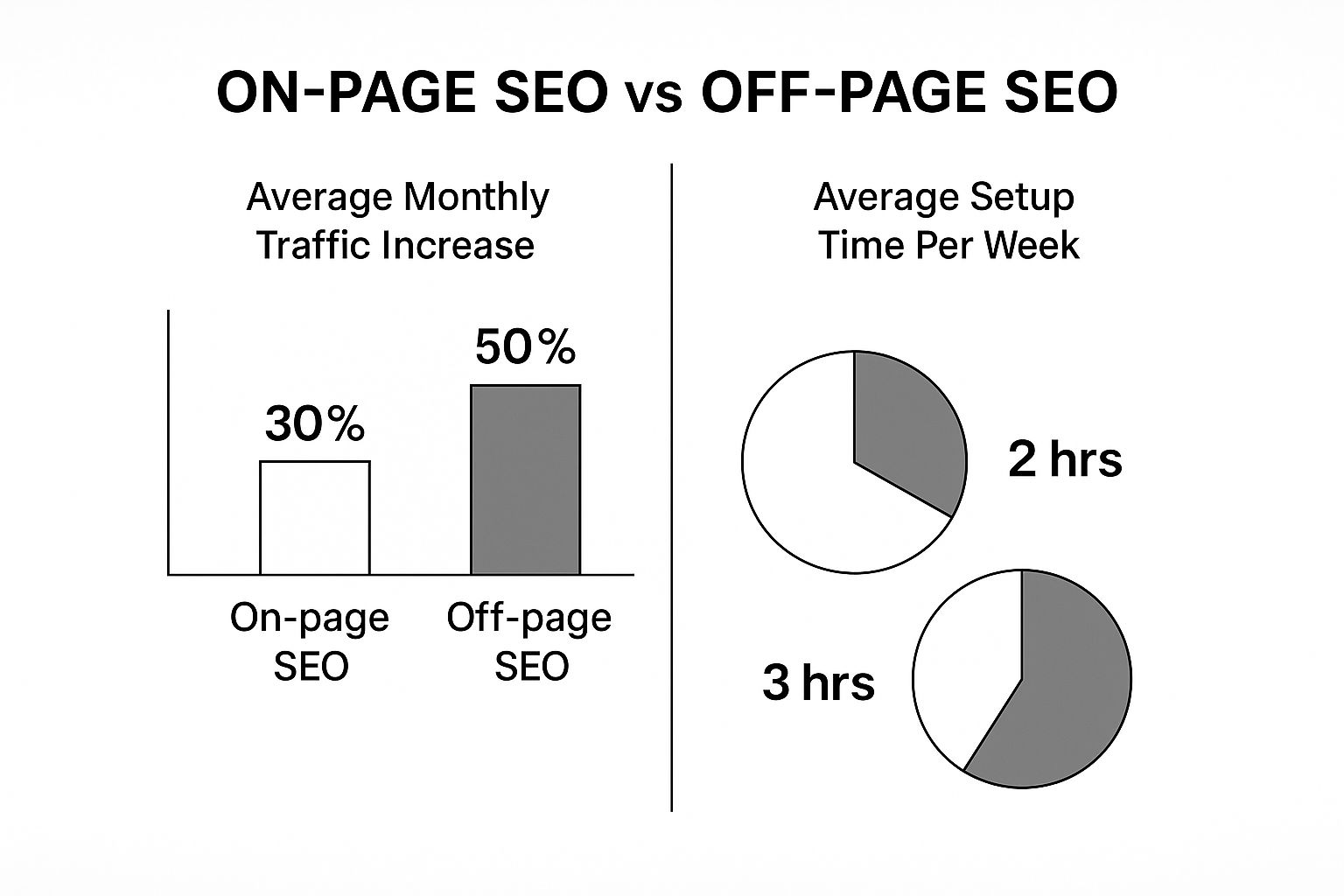
The numbers don’t lie. While solid on-page SEO gives you a great starting boost, off-page strategies like earning backlinks are what really move the needle for traffic. This authority is exactly what you need to stand out in the new world of AI-driven search.
Adapt to How People See and Discover Content
The days of relying solely on traditional search are over. For instance, referrals from AI chatbot platforms recently shot up by over 2,100% in just nine months. At the same time, 69% of all search traffic is now driven by less competitive long-tail keywords. This is a clear signal that AI-powered discovery is a channel you can’t afford to ignore.
And it’s not just about text. Visual search is a wide-open frontier. People are using tools like Google Lens to search with their phone’s camera. If you sell physical products or operate in a visual niche, optimizing your images can unlock a completely new stream of visitors.
My Go-To Tip: Don’t neglect your image file names and alt text. Instead of
IMG_1234.jpg, name the fileblue-suede-running-shoes.jpg. For the alt text, be descriptive: “A pair of blue suede running shoes on a white background.” This gives search engines the context they need to show your image to the right people.
Adapting your promotional strategy for the future means more than just a few technical tweaks; it’s about staying in sync with how people actually behave online.
To help visualize this shift, here’s a quick comparison of old-school tactics versus the new approaches you should be considering.
Adapting to New Promotion Channels
| Tactic | Traditional Approach | Emerging Approach |
|---|---|---|
| SEO | Focusing on short, high-volume keywords. | Optimizing for long-tail, conversational queries and Featured Snippets. |
| Content | Writing generic blog posts. | Creating FAQ pages, how-to guides, and content that directly answers questions. |
| Visuals | Using stock photos with default file names. | Optimizing high-quality, original images with descriptive file names and alt text for visual search. |
| Discovery | Relying on Google’s main search results. | Gaining visibility in AI chatbots, voice search results, and image-based search engines. |
Staying ahead of these changes is what separates a strategy that thrives from one that just survives.
For a deeper look into more forward-thinking promotional tactics, I highly recommend exploring these 10 potent small business growth strategies for 2025. By preparing for these shifts now, you’re building a foundation that will keep your free promotion efforts paying off for years.
Common Questions About Free Website Promotion
Jumping into the world of free website promotion always brings up a few big questions. It’s completely normal to feel a bit overwhelmed at first. I’ve been there.
This section is designed to tackle those common “what ifs” and “how longs” head-on. We’ll cut through the noise and give you some straight answers based on real-world experience. Getting clear on these points will give you the confidence to move forward without constantly second-guessing your strategy.
How Much Time Does Free Promotion Actually Take to Show Results?
This is the big one, isn’t it? The honest answer is that it’s a marathon, not a sprint. Unlike paid ads that can switch on traffic like a light, free methods like SEO and content marketing are all about building momentum. You’re creating a long-term asset, not just renting temporary eyeballs.
For a completely new website, you can realistically expect to see the first trickles of organic traffic from your SEO work within three to six months. That initial period is when Google is busy crawling, indexing, and trying to figure out what your site is all about and whether it can be trusted.
Expert Insight: It’s so easy to get discouraged in those first few weeks when it feels like you’re shouting into the void. Don’t. Consistent effort is everything. The work you put in during month one—nailing your title tags, publishing a killer blog post—is what lays the foundation for real growth in month six and beyond.
With So Many Options, Which Free Method Should I Focus On First?
It’s easy to get paralyzed by choice. My advice? Start by focusing on the powerful duo of on-page SEO and high-quality content creation. These two are the absolute bedrock of every other promotional activity you’ll do.
Here’s why this combination is so effective right out of the gate:
- It builds your foundation. Without a well-optimized site and genuinely useful content, any traffic you drive from social media or online communities will just bounce. You need a solid, compelling destination to send them to.
- It creates a compounding effect. One fantastic blog post can pull in traffic for years. Every new article you publish adds to that momentum, slowly building a powerful, self-sustaining traffic engine.
- It targets people who are already looking for you. By creating content that solves specific problems, you attract visitors who are actively searching for your solutions. These are the people most likely to become customers or loyal followers.
Once you’ve built up a solid base of 5-10 well-optimized, valuable articles, then you can start thinking about promoting that content in online communities and through guest blogging.
Can I Really Compete with Big Brands Without a Budget?
Yes, you absolutely can. You’re never going to outspend them, but you can definitely outsmart and out-hustle them. Big brands are often slow-moving and can struggle to connect with their audience on a human level. That’s your opening.
Here’s how smaller sites can win:
- Go Niche with Long-Tail Keywords: Big companies almost always chase the broad, high-volume keywords. You can find gold by targeting super-specific, long-tail phrases they completely ignore. Instead of “running shoes,” think “best trail running shoes for narrow feet.”
- Build a Real Community: Get in the trenches. Engage directly with people on social media and in forums. Reply to every comment and answer every question personally. That’s a level of connection a massive corporation just can’t replicate at scale.
- Be More Authentic: Share your story—the good, the bad, and the ugly. People connect with other people, not with faceless logos. Your unique voice is your biggest competitive advantage.
The goal isn’t to play their game and lose. It’s to create a new game where you get to set the rules.
How Do I Know if My Free Promotion Efforts Are Working?
If you’re not measuring, you’re just guessing. You need to know what’s working so you can do more of it. The good news is, you don’t need expensive tools to get started. Google Analytics and Google Search Console are both completely free and give you everything you need.
To avoid getting lost in the data, just focus on these key performance indicators (KPIs) at first:
- Organic Traffic: Is the number of visitors finding you through search engines going up month-over-month? This is your #1 sign that SEO is working.
- Keyword Rankings: Check Google Search Console to see if you’re starting to show up for your target keywords. Are your average positions improving?
- Referral Traffic: Are you getting visitors from other websites? This shows that your guest posts, forum comments, or other outreach efforts are paying off.
- User Engagement: In Google Analytics, look at metrics like “Average engagement time.” If people are sticking around to read your stuff, it means your content is hitting the mark.
Checking these simple metrics regularly will give you a clear picture of your progress and help you make smart, data-backed decisions to improve your strategy.
Ready to stop guessing and start growing? The experts at ReachLabs.ai build data-driven marketing strategies that get real results. Let us help you elevate your brand’s voice and turn your website into a powerful growth engine. https://www.reachlabs.ai