

In a competitive market, a marketing plan is more than a document; it’s your strategic blueprint for capturing attention and driving sustainable growth. Many businesses either skip this crucial process or create plans too vague to be effective. This often leads to wasted resources, inconsistent messaging, and significant missed opportunities. A truly powerful marketing plan is built on distinct, interconnected components that work together to transform ambitious goals into measurable results.
This guide will deconstruct the essential components of a marketing plan, providing a clear, step-by-step roadmap to build a strategy that not only reaches your audience but resonates deeply with them. We’ll move beyond abstract theory, offering actionable insights and practical examples to help you craft a plan that is both comprehensive and immediately useful. Each section is designed to be a building block, ensuring your final strategy is cohesive, data-driven, and perfectly aligned with your business objectives.
By understanding how these elements fit together, you gain a powerful framework for making smarter decisions. You will learn to define your position in the market with precision, set clear and attainable goals, and allocate your budget for maximum impact. Whether you’re a startup founder creating your first marketing outline or a seasoned professional refining an existing strategy, mastering these core components will empower you to navigate your market with confidence. Let’s start building your blueprint for success.
1. The 30,000-Foot View: Crafting a Compelling Executive Summary
The executive summary is arguably the most critical of all the components of marketing plan. It acts as a condensed, high-level snapshot of your entire strategy. Although it appears first in the document, it should always be written last, as its purpose is to distill every other section into a powerful, concise narrative.
This is the first, and sometimes only, section that busy executives, investors, or stakeholders will read. Its primary function is to quickly communicate the plan’s core logic, key objectives, and anticipated return on investment, securing buy-in and setting a confident, strategic tone for the rest of the document. A compelling summary respects the reader’s time while generating excitement and demonstrating a clear path to success.
Why It’s an Essential Component
The executive summary frames the entire marketing plan, providing immediate clarity on your vision. Without it, decision-makers are forced to piece together your strategy from disparate sections, risking confusion and a lack of support. It transforms a detailed document into an accessible strategic tool.
Key Insight: Think of the executive summary as a movie trailer for your marketing plan. It must highlight the most exciting parts, establish the core conflict (the market problem), and promise a rewarding conclusion (business growth) without giving away every detail.
Real-World Examples
- Dollar Shave Club: The executive summary for their launch plan likely focused on disrupting the overpriced razor market. It would have emphasized the direct-to-consumer subscription model, the target audience of budget-conscious young men, and the projected low customer acquisition cost via viral video marketing.
- Airbnb: For their international expansion into Europe, the summary would have centered on a strategy of localization. It would highlight plans to build a community-centric platform, adapt listings to local cultures, and overcome regulatory hurdles, forecasting rapid market penetration and user growth.
Actionable Tips for Implementation
To ensure your executive summary is effective, follow these best practices:
- Start with a Hook: Begin with a powerful opening statement that defines the market opportunity or the problem your plan solves.
- Synthesize, Don’t Summarize: Avoid simply listing section headers. Instead, weave the key points into a cohesive story that connects your goals, strategies, and expected outcomes.
- Quantify Your Goals: Include specific, high-level metrics. State your primary objectives, such as “Increase market share by 15% within 18 months” or “Achieve a 5:1 return on ad spend.”
- Keep it Brief and Scannable: Limit the summary to one or two pages at most. Use bullet points, bold text, and clear headings to make it easy for readers to absorb key information at a glance.
2. Setting the Stage: The Situation Analysis (SWOT)
The situation analysis is the foundational diagnostic step among the components of marketing plan. It provides a comprehensive assessment of your company’s internal and external environment, most commonly through the SWOT framework: Strengths, Weaknesses, Opportunities, and Threats. This component lays the groundwork for all subsequent strategic decisions by providing an honest, data-backed view of the landscape.
This analysis combines hard quantitative data (market share, sales figures) with qualitative insights (brand perception, customer feedback) to create a complete picture of where your business stands. Its primary function is to identify the critical internal and external factors that will influence your marketing strategy, allowing you to build on strengths, address weaknesses, capitalize on opportunities, and mitigate threats before they become major problems.
This concept map visualizes how internal factors like strengths and weaknesses connect with external opportunities to inform strategic business decisions.
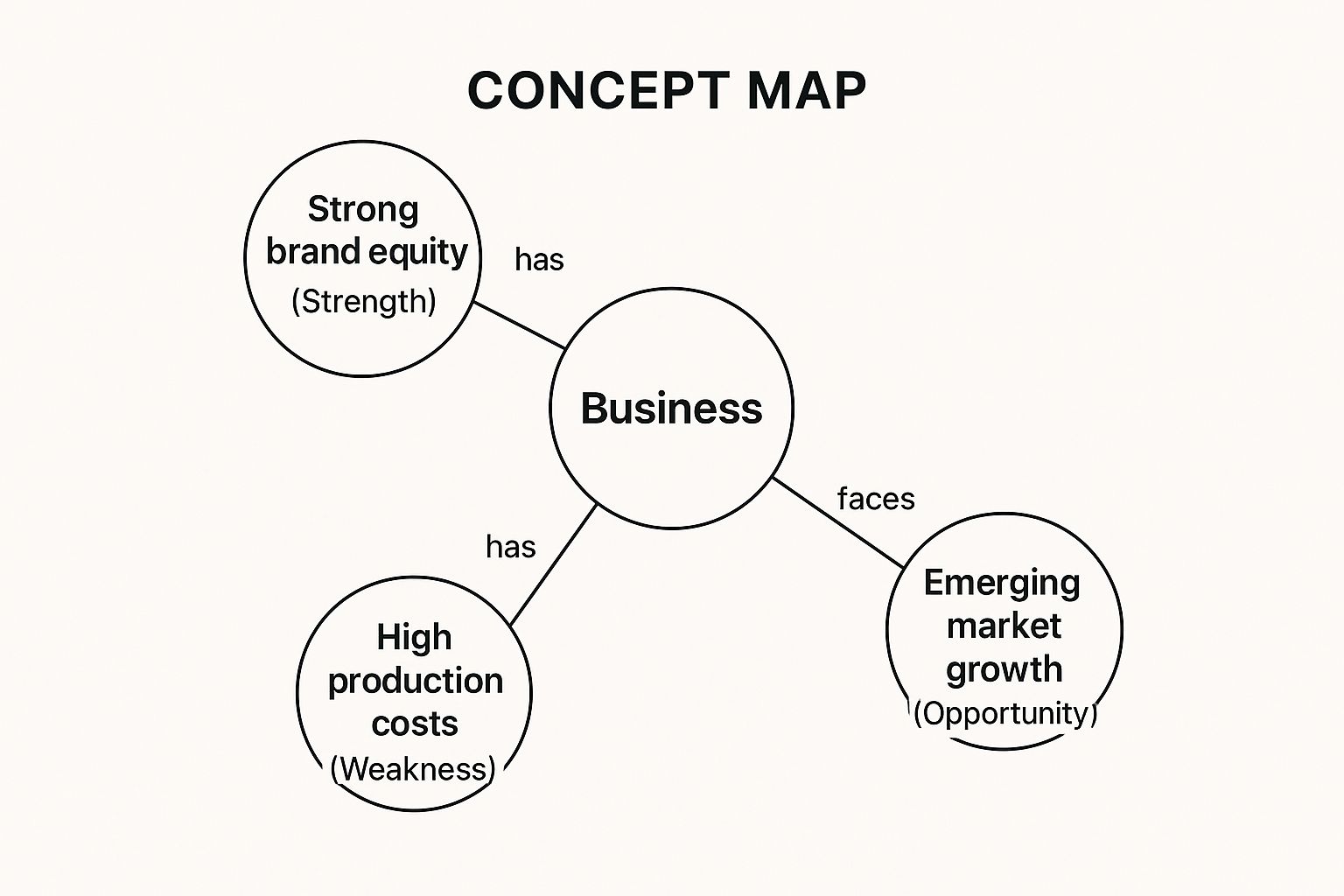
The visualization illustrates how a business can decide to leverage its strong brand equity (a Strength) to pursue emerging market growth (an Opportunity), while being mindful of its high production costs (a Weakness).
Why It’s an Essential Component
Without a thorough situation analysis, a marketing plan is built on assumptions rather than reality. It’s like planning a journey without looking at a map or checking the weather. This section ensures your strategy is grounded, realistic, and tailored to the specific challenges and opportunities your business faces, preventing wasted resources on misguided initiatives.
Key Insight: A situation analysis isn’t just a list of facts; it’s about connecting the dots. The real value comes from understanding how your internal strengths can be used to seize external opportunities, or how internal weaknesses make you vulnerable to external threats.
Real-World Examples
- Netflix: A situation analysis in the late 2000s would have identified its DVD-by-mail logistics (Strength) but also the rising threat of digital streaming (Threat). Recognizing the opportunity in high-speed internet adoption (Opportunity), Netflix strategically pivoted, transforming its business model and dominating the new market.
- Tesla: Tesla’s initial analysis revealed a major market gap (Opportunity) for high-performance, desirable electric vehicles, a segment ignored by legacy automakers focused on compliance cars. They leveraged their innovative battery technology (Strength) to target the luxury market first, building brand prestige before addressing more accessible price points.
Actionable Tips for Implementation
To conduct an effective situation analysis, follow these best practices:
- Use Multiple Data Sources: Don’t rely solely on internal data. Incorporate market research reports, competitor analysis, customer surveys, and industry trend analyses for a 360-degree view.
- Involve Cross-Functional Teams: Gather insights from sales, customer service, product development, and finance. A salesperson on the front lines will have a different and valuable perspective on competitors than a C-suite executive.
- Focus on Actionable Insights: The goal isn’t just to collect data but to derive meaning from it. For every point in your SWOT, ask “So what?” How does this fact inform our strategy?
- Update It Regularly: Markets, competitors, and consumer behaviors are constantly changing. Your situation analysis is a living document that should be revisited at least annually or before any major strategic shift.
3. The Bullseye: Defining Your Target Market
Identifying your target market is one of the most fundamental components of a marketing plan. This section moves beyond a vague notion of “our customers” to build a detailed, data-driven portrait of the specific groups of consumers most likely to need and buy your product or service. A precise target market definition underpins all subsequent marketing efforts, from messaging and channel selection to product development.
This component involves a deep analysis of demographics (age, income, location), psychographics (lifestyle, values, attitudes), and behavioral patterns (purchasing habits, online activity). The goal is to create rich, multi-dimensional buyer personas that feel like real people, allowing your team to craft strategies that resonate on a personal level. Without a clearly defined target, marketing becomes a costly guessing game.
Why It’s an Essential Component
Defining your target market ensures your marketing resources are spent efficiently, reaching the people who are most receptive to your message. It prevents you from wasting budget on broad, untargeted campaigns that yield low returns. This focus allows for hyper-personalized messaging that speaks directly to a consumer’s specific needs, pain points, and motivations, dramatically increasing conversion rates.
Key Insight: Your target market isn’t just “everyone.” It’s a specific group whose problems you are uniquely positioned to solve. The tighter your focus, the more powerful your marketing becomes. Trying to be everything to everyone is the fastest way to be nothing to anyone.
Real-World Examples
- Peloton: Their plan didn’t target general fitness enthusiasts. It precisely targeted affluent, time-constrained professionals who value high-end experiences and community. Every aspect of their marketing, from the sleek hardware to the celebrity instructors, is designed to appeal to this specific niche.
- Slack: Instead of targeting all businesses, Slack focused on the collaboration pain points felt by knowledge workers and tech-savvy teams. Their marketing highlighted the inefficiency of email and positioned Slack as the central “digital HQ,” a message that resonated deeply with this specific segment.
- Spotify: Spotify targets music discovery enthusiasts and passionate playlist creators. Its algorithm, curated playlists like “Discover Weekly,” and social sharing features are all built to serve this audience’s desire for a personalized and ever-fresh listening experience.
Actionable Tips for Implementation
To build a robust target market definition, follow these proven steps:
- Combine Quantitative and Qualitative Data: Use analytics tools, surveys, and market reports for quantitative insights. Supplement this with qualitative research like customer interviews, focus groups, and social listening to understand the “why” behind the numbers.
- Create Detailed Buyer Personas: Go beyond basics. Give your personas names, photos, job titles, goals, and challenges. The more detailed you are, the easier it is for your team to empathize with them. For a comprehensive guide, learn how to create powerful buyer personas.
- Validate Your Assumptions: Don’t rely solely on internal brainstorming. Get out and talk to actual and potential customers to confirm that your personas accurately reflect their reality.
- Consider Primary and Secondary Segments: Identify your primary “bullseye” target but also define valuable secondary audiences. This allows you to create tiered campaigns that capture a wider market without diluting your core message.
- Update Personas Regularly: Markets evolve, and so do customers. Revisit and refine your buyer personas at least annually to ensure they remain accurate and relevant to your strategic goals.
4. Setting the Compass: Marketing Objectives and Goals
After analyzing your market and defining your audience, the next crucial step is to set your marketing objectives and goals. This component translates broad business ambitions into specific, measurable outcomes that your marketing efforts will strive to achieve within a defined timeframe. These are not vague aspirations; they are the concrete targets that guide your strategy and provide clear benchmarks for measuring success.
This is where frameworks like SMART goals (Specific, Measurable, Achievable, Relevant, Time-bound) become invaluable. By setting clear objectives, you create a North Star for every campaign, content piece, and ad spend. It transforms marketing from a cost center into a measurable driver of business growth, ensuring every action is purposeful and aligned with the company’s ultimate vision.
Why It’s an Essential Component
Without clear objectives, your marketing plan is just a collection of activities with no direction. Objectives provide the criteria against which all results are measured, allowing you to calculate ROI, justify budgets, and make data-driven decisions. They are one of the most vital components of marketing plan because they connect your daily marketing tasks to high-level business outcomes.
Key Insight: Think of your business goal as a destination (e.g., “become the market leader”). Your marketing objectives are the specific coordinates and checkpoints on the map (e.g., “increase market share by 10% in 12 months”) that ensure you are on the right path to get there.
Real-World Examples
- HubSpot: To solidify its position as a thought leader in inbound marketing, a key objective was likely to increase organic traffic by 40% year-over-year. This clear, measurable goal would have directly guided their content strategy, SEO efforts, and keyword targeting.
- Zoom: During its push for enterprise adoption, a primary objective might have been to achieve 50% brand awareness among Fortune 500 IT decision-makers within two years. This goal would shape their PR, targeted advertising, and event marketing strategies.
Actionable Tips for Implementation
To set effective marketing objectives and goals, follow these best practices:
- Align with Business Goals: Ensure every marketing objective directly supports a broader company goal. If the business wants to increase revenue, a marketing objective could be “generate 500 marketing-qualified leads per month.”
- Use Historical Data: Base your targets on past performance to ensure they are realistic and achievable. If your lead generation grew by 15% last quarter, a goal of 20% is ambitious but grounded in data.
- Cover the Full Funnel: Set objectives for different stages of the customer journey, from awareness (e.g., website traffic, social reach) to conversion (e.g., leads, sales) and retention (e.g., customer lifetime value).
- Review and Adjust Quarterly: The market changes quickly. Revisit your goals every quarter to assess performance, pivot your strategy if needed, and ensure they remain relevant to the business’s needs.
5. Marketing Strategy and Positioning
Marketing strategy and positioning are where you define how your brand will compete in the marketplace and occupy a distinctive place in your customers’ minds. This component is the strategic heart of your plan, outlining your unique value proposition, competitive differentiation, and the core message that will guide all subsequent marketing activities.
This section translates your market research and business goals into a clear, actionable game plan. It answers the fundamental questions: Who are we? Who are our customers? Why should they choose us over the competition? A well-defined strategy ensures that every tactic, from a social media post to a national ad campaign, works in concert to build a strong, consistent, and memorable brand identity.
Why It’s an Essential Component
Without a clear strategy and positioning, your marketing efforts will be scattered, inconsistent, and ineffective. This component acts as the strategic compass for your entire marketing plan, ensuring that all tactical decisions are aligned and purposeful. It prevents you from wasting resources on activities that don’t reinforce your core brand promise and helps you cut through the noise of a crowded market.
Key Insight: Positioning is not what you do to a product; it is what you do to the mind of the prospect. The goal is to create a unique and valued space in the customer’s consciousness, making your brand the obvious choice for their specific needs.
Real-World Examples
- Volvo: For decades, Volvo has built its entire marketing strategy around the core position of “safety.” Every ad, feature, and piece of communication reinforces this idea, making them the default choice for safety-conscious families.
- Southwest Airlines: Southwest positioned itself as the low-cost, no-frills, and friendly airline. This strategy informed everything from their operational model (using a single aircraft type) to their fun-loving brand personality, differentiating them from legacy carriers.
- Apple: Apple’s positioning is centered on “premium innovation and user-centric design.” This strategy justifies their premium pricing and has cultivated a fiercely loyal customer base that values aesthetics, simplicity, and being part of an innovative ecosystem.
Actionable Tips for Implementation
To develop a powerful marketing strategy and positioning statement, follow these steps:
- Base it on Genuine Strengths: Your positioning must be authentic. Identify what your business genuinely does better than anyone else and build your strategy around that verifiable advantage.
- Test Your Concepts: Don’t assume you know how customers will perceive your brand. Use surveys, focus groups, or A/B testing to validate your positioning concepts with your target audience.
- Ensure Long-Term Sustainability: A strong position isn’t a short-term campaign; it’s a long-term commitment. Choose a position that you can own and defend for years to come. For a deeper dive into crafting a lasting brand identity, explore these brand positioning strategies on reachlabs.ai.
- Create Resonant Messaging: Translate your positioning into a memorable and emotionally compelling message. This core message should be easy to understand and consistently communicated across all channels.
6. The Engine Room: Defining Your Marketing Mix and Tactics
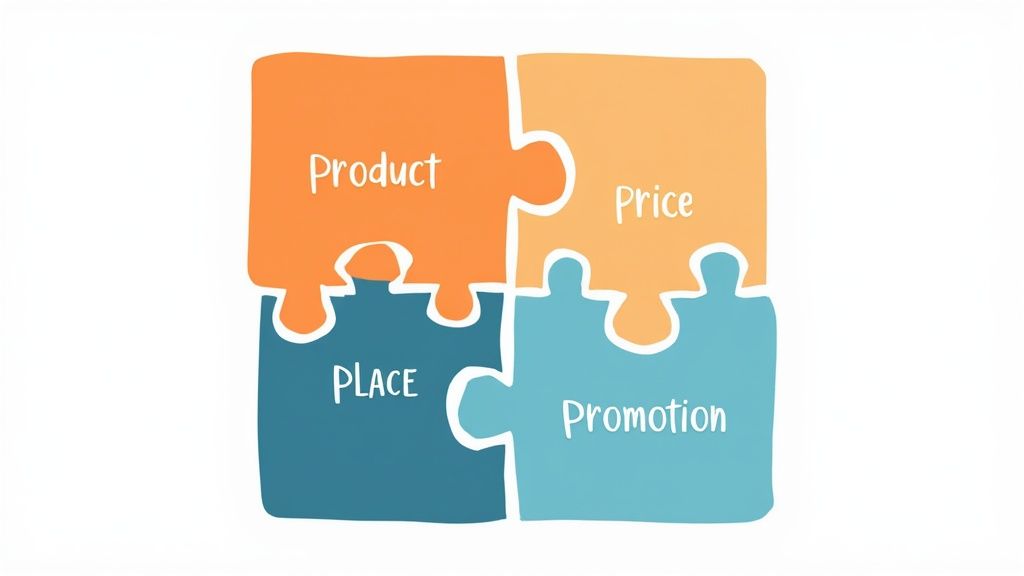
After setting your high-level strategy and goals, the marketing mix and tactics section is where the plan gets operational. This is one of the most hands-on components of marketing plan, detailing the specific activities, channels, and tools you’ll use to bring your strategy to life. It translates broad objectives into a concrete action plan, traditionally organized around the 4Ps (Product, Price, Place, Promotion) or the expanded 7Ps for service-based businesses.
This component is the engine room of your entire marketing operation. It provides the day-to-day, week-to-week roadmap that your team will follow. It specifies what you will do, where you will do it, how much it will cost, and how you will promote your offerings, ensuring that every tactical action is directly aligned with your strategic goals. Without this section, a marketing plan remains a collection of ideas with no clear path to execution.
Why It’s an Essential Component
This section bridges the gap between strategy and execution. It ensures resources are allocated effectively and that all marketing efforts are cohesive, consistent, and working toward the same objectives. It provides the clarity needed for team members to understand their roles and for leadership to track progress against tangible activities.
Key Insight: Think of your marketing strategy as the destination on a map. The marketing mix and tactics are the turn-by-turn directions, specific vehicle choices, and planned refuelling stops that ensure you actually arrive at your destination efficiently and on budget.
Real-World Examples
- Coca-Cola: The “Share a Coke” campaign was a masterclass in tactical integration. The Product was customized with names, the Promotion spanned TV ads, social media (#ShareACoke), and in-store displays, and the Place (distribution) ensured these bottles were available globally in high-traffic retail locations.
- Red Bull: Their marketing mix heavily favors unconventional Promotion tactics. Instead of traditional ads, they create and sponsor extreme sports events and produce high-quality content (films, documentaries), positioning the brand as a lifestyle rather than just a drink. This content marketing is distributed through their own digital Place (Red Bull TV) and social channels.
Actionable Tips for Implementation
To build a robust marketing mix and tactical plan, follow these guidelines:
- Prioritize Channels: Don’t try to be everywhere. Use your audience research to identify the channels where your target customers are most active and engaged, and focus your resources there first.
- Ensure Message Consistency: Your brand voice, value proposition, and key messages must be consistent across all touchpoints, from a social media post to a TV commercial, to build brand recognition and trust.
- Integrate Online and Offline: Create seamless customer journeys. Use QR codes in print ads to drive online traffic, or use geo-targeted digital ads to promote in-store events for maximum impact.
- Plan for Timing: Align your tactical calendar with seasonal trends, industry events, and major holidays. Launching a campaign at the right moment can dramatically amplify its results.
7. Budget and Resource Allocation
A marketing plan without a budget is merely a wish list. The budget and resource allocation section is where strategy meets reality, detailing the financial and human capital required to bring your vision to life. This critical component of a marketing plan provides a granular breakdown of costs by channel, campaign, and time period, ensuring that every dollar spent is a deliberate investment toward your objectives.
This section translates your strategic goals into a concrete operational roadmap. It addresses not only advertising spend but also staffing needs, technology subscriptions, agency fees, and other essential overheads. By clearly defining how resources will be deployed, you create a framework for accountability, performance measurement, and strategic agility, preventing waste and maximizing impact.
Why It’s an Essential Component
Without a formal budget, marketing efforts become chaotic and unsustainable. This section enforces financial discipline, aligns marketing activities with overall business goals, and provides a clear benchmark for measuring return on investment (ROI). It forces you to make strategic trade-offs, prioritizing the most impactful initiatives and justifying every expenditure.
Key Insight: Treat your budget not as a restrictive ceiling but as a strategic allocation of fuel. Each dollar is a unit of energy directed toward a specific growth engine. The goal is to allocate fuel to the engines that generate the most momentum for the entire business.
Real-World Examples
- P&G: A consumer goods giant like Procter & Gamble might formalize a budget that allocates 60% of its media spend to digital channels (programmatic, social, search) and 40% to traditional media (TV, print), with specific sub-budgets for each major brand based on its market share and growth potential.
- Salesforce: Known for its blockbuster Dreamforce event, Salesforce allocates a significant portion of its marketing budget to experiential marketing. This line item would include venue costs, speaker fees, technology, and staffing, justified by the high value of leads and partnerships generated.
- Warby Parker: As a direct-to-consumer pioneer, Warby Parker’s budget would heavily prioritize investments in its e-commerce platform, supply chain technology, and customer experience software. These are non-ad-spend resources crucial to its marketing and sales model.
Actionable Tips for Implementation
To build a robust and realistic budget, follow these best practices:
- Use Data as Your Foundation: Base your budget on historical performance data, industry benchmarks, and competitor spending. Avoid guesswork by using what you know works.
- Build in a Contingency Fund: Allocate 10-15% of your total budget to a contingency fund. This provides the flexibility to seize unexpected opportunities or pivot away from underperforming campaigns without derailing your entire plan.
- Track and Optimize Continuously: Don’t just set your budget and forget it. Implement a system for tracking spending and ROI on a monthly or quarterly basis, reallocating funds from low-performing areas to high-performing ones. This is a core tenet of effective marketing resource management.
- Account for All Costs: Go beyond just ad spend. Include salaries, software subscriptions (e.g., CRM, analytics tools), agency retainers, and content creation costs to get a true picture of your total marketing investment.
7 Key Components Comparison
| Item | Implementation Complexity 🔄 | Resource Requirements ⚡ | Expected Outcomes 📊 | Ideal Use Cases 💡 | Key Advantages ⭐ |
|---|---|---|---|---|---|
| Executive Summary | Low – summary writing after plan completion | Low – requires synthesis of existing data | Clear snapshot of marketing plan, secures stakeholder buy-in | Presenting to executives and investors | Quick understanding, focuses planning, secures funding |
| Situation Analysis (SWOT) | Medium to High – requires data collection and analysis | High – needs cross-functional input, diverse data sources | Comprehensive market and internal insights; identifies risks/opportunities | Strategic decision foundation, competitor assessment | Objective foundation, early risk/opportunity identification |
| Target Market Definition | Medium – research and persona development | Medium – requires research tools and methods | Detailed customer personas, better targeting, improved ROI | Audience segmentation, tailored messaging | Precise targeting, guides product and channel decisions |
| Marketing Objectives and Goals | Low to Medium – goal setting frameworks | Low – uses existing data and strategic input | Measurable marketing targets aligned with business goals | Planning measurable outcomes and resource allocation | Clear focus, accountability, links marketing to business |
| Marketing Strategy and Positioning | Medium – strategic articulation and testing | Medium – strategy sessions, customer feedback needed | Strong brand positioning and differentiation | Brand building, competitive market positioning | Competitive clarity, consistent messaging, brand equity |
| Marketing Mix and Tactics | High – detailed planning of channels and campaigns | High – multi-channel resources, coordination | Coordinated marketing execution across channels | Campaign execution, operational marketing management | Execution roadmap, integrated campaigns, accountability |
| Budget and Resource Allocation | Medium – detailed financial and resource planning | High – budgeting, staffing, vendor coordination | Realistic plans with ROI projections and cost control | Resource management, campaign funding approval | Accurate ROI tracking, cost control, stakeholder buy-in |
From Plan to Performance: Activating Your Strategy for Success
You’ve journeyed through the seven core components of a marketing plan, from the high-level Executive Summary to the granular details of your Budget and Resource Allocation. Assembling these elements into a cohesive document is a critical strategic exercise, providing clarity, direction, and a unified vision for your team. But the true test of any plan lies not in its creation, but in its execution and evolution.
A marketing plan is not a static artifact to be filed away and forgotten. It is a living, breathing roadmap designed to guide your daily actions while adapting to the dynamic landscape of your market. The initial document represents your best-laid plans based on current data and assumptions, but its real power is unleashed when it becomes a tool for active management, continuous learning, and strategic agility.
The Plan as a Dynamic Engine for Growth
Think of your marketing plan as the engine of a high-performance vehicle. Each component, from the Situation Analysis to the Marketing Mix, is a vital part that must work in concert with the others. However, an engine requires fuel, maintenance, and a skilled driver to navigate the road ahead.
- Fueling with Data: Your metrics and KPIs are the fuel. Regularly tracking performance against the SMART goals you established is non-negotiable. This data tells you what’s working, what’s failing, and where you need to reallocate resources for maximum impact.
- Performing Regular Maintenance: Revisit your plan on a consistent schedule, perhaps quarterly or semi-annually. Is your SWOT analysis still relevant? Have new competitors emerged? Has your target audience’s behavior shifted? This “maintenance” ensures your strategy remains sharp and effective.
- Navigating with Agility: The market will inevitably throw curveballs. A competitor’s surprise campaign, a new social media platform, or an unexpected economic shift can render parts of your plan obsolete. A dynamic approach allows you to pivot your tactics without abandoning your core strategy and objectives. This adaptability is what separates thriving brands from those that get left behind.
Bridging the Gap Between Strategy and Reality
The most brilliantly conceived strategy is worthless without effective implementation. Your plan provides the “what” and the “why,” but your team’s daily efforts provide the “how.” The detailed tactics and budget sections are where your strategic vision connects with on-the-ground reality.
This connection is where many plans falter. To avoid this, ensure every tactical action is directly tied back to a specific marketing objective. For example, if a goal is to increase lead generation by 20%, every blog post, ad campaign, and social media update should be evaluated on its ability to contribute to that specific outcome. This creates a culture of accountability and purpose-driven marketing.
Key Takeaway: The value of a marketing plan is not measured by its perfection on day one, but by its ability to guide, inform, and adapt over time. Treat it as a compass that keeps you heading toward your strategic North Star, even when you need to detour around obstacles.
Mastering these seven components of a marketing plan equips you with a powerful framework for success. It transforms marketing from a series of disjointed activities into a strategic, measurable, and results-oriented function of your business. By embracing your plan as a dynamic guide, you empower your organization to not just compete, but to lead. You build a foundation for sustainable growth, create a stronger connection with your customers, and ultimately, turn your ambitious vision into tangible business achievements.
Feeling overwhelmed by the data and analytics required to fuel your marketing plan? ReachLabs.ai can help. Our AI-powered platform automates lead generation and provides deep market insights, empowering you to refine your target audience and measure tactical effectiveness with unparalleled precision. Visit ReachLabs.ai to see how you can transform your plan into a high-performance growth engine.