
A strategic marketing plan is really just a roadmap. It's the process of figuring out your business goals, taking a hard look at where you stand in the market, and then laying out a clear path to connect with your customers. This isn't about chasing the latest marketing trend; it’s about building a long-term, sustainable edge over the competition.
Building a Foundation for Real Growth
Before you even think about designing an ad or scheduling a social media post, your marketing strategy needs to be firmly rooted in what the business is trying to achieve. Too many marketing plans fall flat because they're built in a silo, completely disconnected from the company's bigger mission. The best strategies I've seen always start by translating those lofty business ambitions into concrete marketing objectives.
This means getting specific. Forget vague goals like "increase brand awareness." Instead, define exactly what success looks like. For example, if the company's main objective is to break into a new geographic market, a smart marketing goal would be to "generate 500 qualified leads from that new region within the next six months." Tying marketing efforts directly to business outcomes like this ensures every dollar you spend is actually pushing the company forward.
Performing a No-Nonsense Situation Analysis
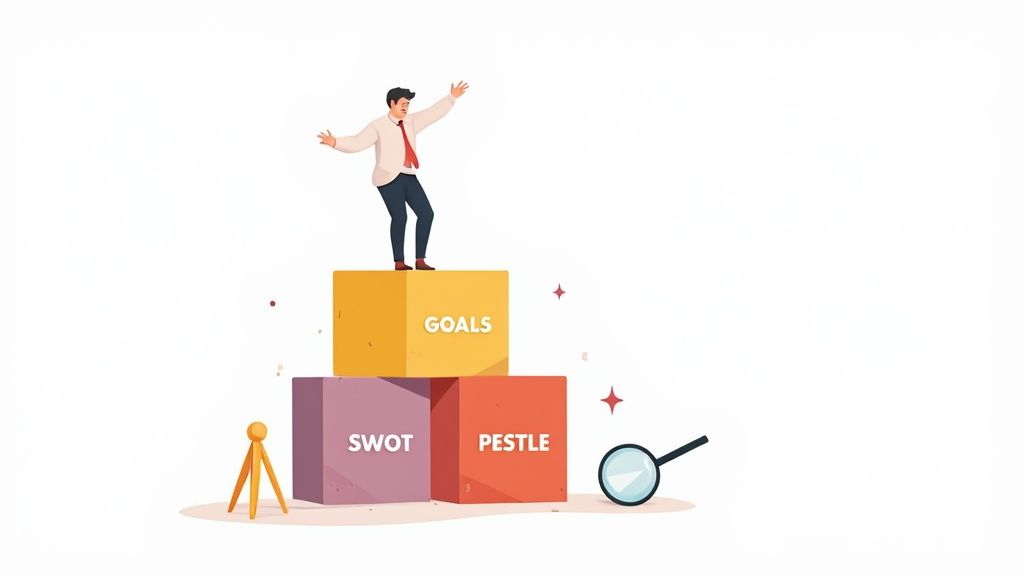
With your objectives set, it's time for a reality check. You need an honest, unfiltered look at your current position. This isn't a time for wishful thinking—it's about a clear-eyed assessment of where you are right now. This is where classic frameworks like SWOT and PESTLE analysis are incredibly helpful.
A SWOT analysis is your go-to for looking both inside and outside the company:
- Strengths: What are we genuinely great at? (Think: a killer brand reputation, unique proprietary tech.)
- Weaknesses: Where are we falling short internally? (Maybe a tiny budget or a stretched-thin team.)
- Opportunities: What's happening out there that we can jump on? (A new market opening up, a competitor fumbling the ball.)
- Threats: What external challenges could trip us up? (New government regulations, a sudden shift in what customers want.)
This foundational step forges that critical link between the company's goals and the marketing plan designed to hit them.
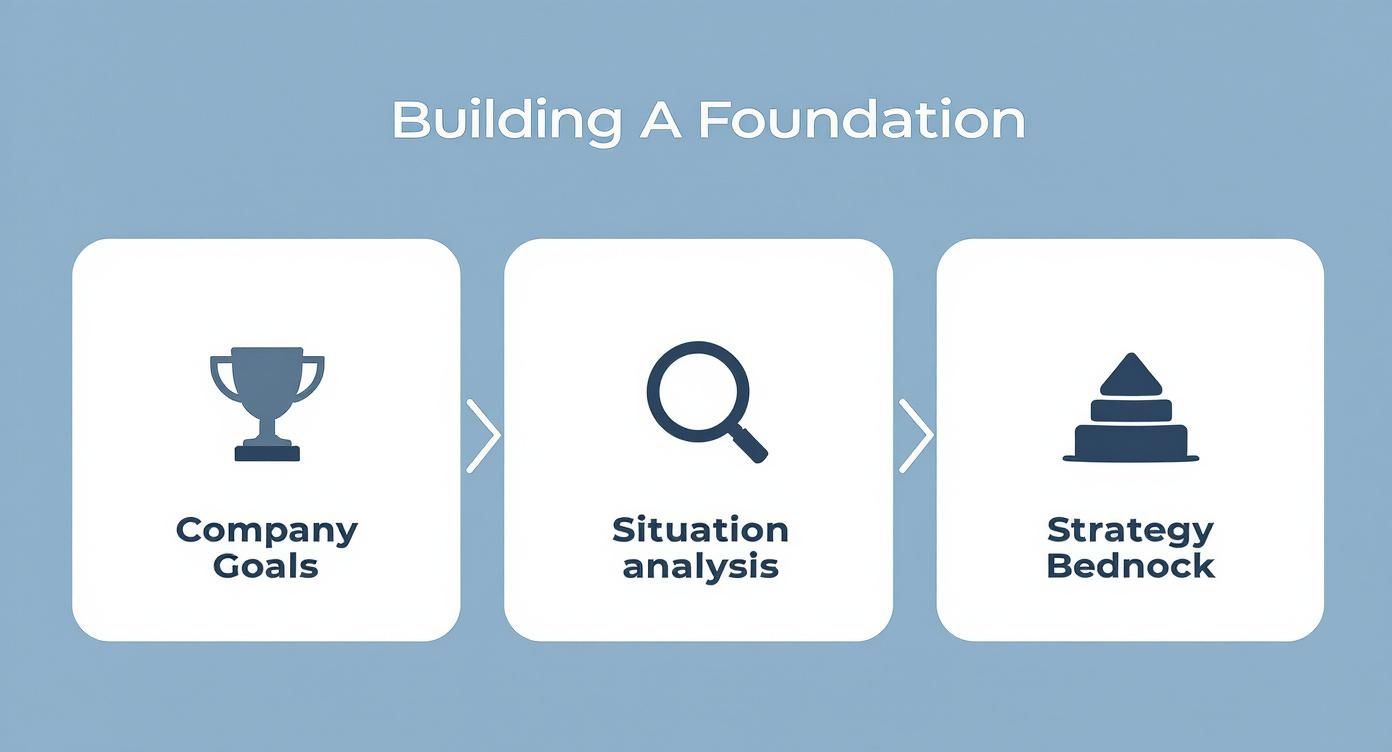
As you can see, this process is about taking those broad company goals and refining them through rigorous analysis to create a solid strategic bedrock for everything that follows.
Understanding the Strategic Context
Running this kind of analysis gives you the context needed to make smart choices. A tech startup, for instance, might realize its biggest strength is its innovative product, but its key weakness is that nobody knows who they are. That single insight points them in the right direction: their marketing should lean heavily on product demos and customer testimonials to build credibility, rather than blowing the budget on a massive, expensive brand campaign.
This deliberate, systematic approach isn't new. Strategic marketing planning has its roots back in the 1950s, growing from simple budget rundowns into more complex, long-range planning by the 1960s. This evolution was driven by companies needing to look beyond their annual financial cycles to keep growing. Then, the economic pressures of the 1970s forced businesses to get even more sophisticated, which gave rise to the modern strategic planning we see today. Unlike older methods that just extrapolated from past performance, this new way of thinking introduced the idea of spotting "weak signals" to get ahead of market shifts. You can find more on this history and its evolution on Raider Pressbooks.
Key Takeaway: A thorough situation analysis isn't just a box to check. It's the diagnostic tool that tells you exactly where to focus your time and money for the biggest impact. It stops you from chasing tactics that don't solve your real problems or seize your best opportunities. By grounding your plan in reality, you make sure every single move you make is intentional and has a purpose.
Uncovering Your Ideal Customer and Market
Alright, with your internal business goals locked in, it’s time to shift your focus outward. Great marketing isn't about shouting into a void and hoping someone hears you. It’s about starting a meaningful conversation with the right people. To do that, you need an almost personal understanding of your ideal customer and the world they live in.
This is where we move past gut feelings and into methodical research. You’ll map out the competitive landscape—not just to list your rivals, but to spot the strategic gaps they’ve left wide open. Think of it as finding the unspoken frustrations and unmet needs that your brand is uniquely built to solve.
Conducting Practical Market Research
Market research sounds like a huge, expensive headache, but it doesn't have to be. Your real goal is to gather tangible data to inform your strategy, not to write a doctoral thesis. A fantastic and straightforward framework for this is the PEST analysis. It helps you get a handle on the big-picture, macro-environmental factors that could impact your business from the outside.
PEST forces you to look at four key areas:
- Political: How could government policies, new regulations, or political stability shake up your industry?
- Economic: What’s happening with inflation, consumer spending habits, or exchange rates that might affect your customers' buying power?
- Social: Are there cultural trends, demographic shifts, or lifestyle changes that are influencing your audience?
- Technological: What new technologies are shaping customer expectations or creating new opportunities in your market?
A PEST analysis keeps you from getting blindsided. Let’s say you sell eco-friendly products. The growing social trend toward sustainability is a massive tailwind. At the same time, new government regulations on recyclable materials could be a major hurdle. Getting a clear view of these dynamics is fundamental to building a marketing plan that can weather any storm.
Crafting Buyer Personas That Feel Real
Once you have a grip on the market, it’s time to zoom in on the person you’re actually trying to reach. This is where you move from abstract data to building out detailed buyer personas. If you're new to this, a great first step is learning how to create detailed buyer personas that feel like real people, not just a list of attributes.
A truly useful persona goes way beyond basics like age or job title. It gets into the psychographics—their goals, their biggest challenges, their core motivations, and their most persistent pain points. For a more structured approach, our guide on how to identify your target audience can walk you through it.
A great buyer persona should read like a story about a real person. You need to know what keeps them up at night and what their biggest professional dreams are. That empathy is what lets you create messaging that actually lands.
For example, don't just settle for "Marketing Manager, 35-45." Dig deeper and bring someone to life:
Persona Example: "Strategic Sarah"
- Role: Director of Marketing at a mid-sized B2B tech company.
- Goals: She desperately needs to prove the ROI of her team's efforts to the C-suite and generate more qualified leads for her hungry sales team.
- Challenges: She's drowning in data from a dozen different tools and can't seem to create a simple report that tells a clear story. The pressure to hit aggressive growth targets with a tight budget is immense.
- Motivations: Efficiency is her north star. She's actively looking for tools or processes that make her team more effective without overcomplicating things.
This level of detail is a game-changer. When you know "Strategic Sarah" is struggling to prove ROI, you can stop talking about your product's features and start showing her exactly how it creates the clear, compelling reports her CEO wants to see. Suddenly, you're not selling software—you're offering a direct solution to her biggest headache. This deep customer understanding is the engine that will power your entire marketing strategy.
Crafting Your Strategy and Core Message

Alright, you've done the homework. You know the market landscape and have a sharp picture of your ideal customer. Now, it's time to shift gears from analysis to action. This is where we make the tough, deliberate choices about how you're going to compete—and win.
It all starts by translating those big-picture business goals into focused, actionable marketing objectives. A vague ambition like "grow our online presence" is a recipe for wasted effort because you can't measure it. We need to get specific.
The best way to do this is with SMART objectives: Specific, Measurable, Achievable, Relevant, and Time-bound. This simple framework forces you to be brutally clear and connects every marketing dollar you spend to a real business outcome.
From Vague Goals to SMART Marketing Objectives
Turning a fuzzy goal into a SMART objective is like swapping a compass for a GPS. One gives you a general direction; the other gives you a precise destination and a deadline. It gives your team a finish line they can actually see.
Here's how that transformation looks in practice:
| Vague Goal | SMART Objective |
|---|---|
| "Increase brand awareness." | "Increase organic brand name searches by 30% and social media mentions by 50% in the next six months." |
| "Get more leads." | "Generate 250 new marketing-qualified leads (MQLs) from our webinar series in Q3." |
| "Be seen as an industry leader." | "Secure 15 high-authority backlinks and get published in 3 major industry publications by the end of the year." |
See the difference? Now your team knows exactly what they're aiming for and when they need to hit the target.
Defining Your Unique Value Proposition
With your objectives set, you have to answer the most important question in marketing: Why should a customer choose you over anyone else?
The answer is your Unique Value Proposition (UVP). This isn't just a catchy slogan; it's the core promise of value that you alone can deliver. It’s the very heart of your strategic advantage.
Ask yourself this: If your company vanished tomorrow, what specific, irreplaceable value would your customers lose? The answer is the key to your UVP. A powerful one clearly articulates:
- Relevancy: How you solve a customer's specific problem.
- Quantified Value: The concrete benefits you deliver (think numbers!).
- Differentiation: Why you're the only real choice.
For example, a project management tool's UVP isn't "we help you manage projects." It's something much stronger, like: "We help marketing teams cut project delivery times by 25% by automating client approvals." That's a specific promise a competitor isn't making.
Expert Tip: Your UVP needs to be front and center on your homepage and woven into every major marketing campaign. It should be the first thing a potential customer gets about your brand.
Articulating Your Market Positioning and Core Message
Your UVP is the foundation for your market positioning—the specific piece of real estate you want to own inside your customer's mind. You can't be everything to everyone, so you have to choose. Are you the most affordable? The most luxurious? The easiest to use? The most innovative?
This is where the classic "marketing mix" framework, often called the Four Ps (Product, Price, Place, and Promotion), becomes incredibly useful. First popularized in the 1950s and 1960s, it helps you make sure all your strategic elements are working together to cement that desired position in the market.
Once your positioning is locked in, you can build out your core messaging. This isn't a single line but a whole hierarchy of messages that tells your story consistently, no matter the channel. Creating a solid brand messaging framework ensures that whether someone sees a social media ad, reads a blog post, or talks to a salesperson, they get the same clear and compelling story.
To bring it all to life, it's critical to understand what is a content marketing strategy because that's your execution playbook. This alignment ensures every single piece of content reinforces your positioning and nudges your audience closer to helping you achieve those SMART objectives. This phase is all about making smart choices and building a unified story that makes you the obvious winner.
Turning Your Strategy Into a Real-World Action Plan
Let's be honest, a brilliant marketing strategy that just sits in a PowerPoint deck is worthless. It’s a collection of great ideas, nothing more. The real work—the part that actually gets results—begins when you translate that high-level vision into a concrete, day-to-day action plan.
This is where you build the bridge between your big-picture goals and the actual emails, ads, and blog posts your team will create. It's about making deliberate choices and deciding exactly where to put your time, money, and creative energy to get the biggest bang for your buck. Without this step, even the sharpest strategy gets lost in the noise of daily tasks and competing priorities.
Choose Your Channels: Meet Your Customers Where They Are
Your ideal customers are already out there, scrolling through feeds, listening to podcasts, and asking for recommendations in online communities. Your job isn't to drag them somewhere new; it's to show up where they're already hanging out.
One of the most common mistakes I see is teams trying to be everywhere at once. It’s a recipe for burnout and diluted impact. Instead, you need to get laser-focused on the channels that give you a direct line to your buyer personas.
Think about it this way: if you're targeting "Strategic Sarah," a data-obsessed B2B marketing director, your channel mix should mirror her daily routine.
- LinkedIn: This is her professional turf. It’s the perfect spot for sharing in-depth articles and case studies. You can also run highly targeted ad campaigns that speak directly to her job title and the specific challenges she's facing.
- SEO & Content Marketing: Sarah isn’t waiting for you to find her; she's actively searching for solutions. By creating genuinely helpful guides and blog posts optimized for terms like "marketing ROI reporting" or "lead generation dashboards," you catch her at the exact moment she needs you most.
- Industry Webinars: She’s busy but makes time to learn from experts and peers. Hosting or sponsoring a webinar on a topic she truly cares about is a powerful way to establish your credibility and generate high-quality leads.
In this scenario, throwing money at TikTok or Snapchat would be like shouting into the wind. The goal is to match the channel to your audience's behavior, not just chase the latest trend.
Put Your Money Where Your Goals Are: Budget Allocation
Once you know where you're going to play, you have to decide how to fund it. A marketing budget isn't just a spreadsheet of expenses; it’s a financial expression of your strategic priorities.
There are a few different ways to approach this, but one of the most practical is the objective-and-task method. You start with a clear goal (e.g., "generate 250 marketing-qualified leads in Q3") and then work backward to figure out the cost of every single task required to hit that number. This method forces accountability by tying every dollar spent to a specific, measurable outcome.
Your budget is your strategy in black and white. If your top priority is generating leads with content, then the lion's share of your budget should go to content creation, SEO, and promotion—not a splashy, expensive brand campaign.
Map It Out: Your Marketing Calendar
This is where your action plan truly comes to life. A marketing calendar is so much more than a social media schedule; it's the comprehensive timeline for every major campaign, initiative, and piece of content your team will touch. It’s the single source of truth that keeps everyone aligned and pulling in the same direction.
How far out should you plan? While some companies try to map out five years, those plans often become obsolete in today's fast-moving markets. Many experienced leaders find a three-year strategic plan hits the sweet spot—it provides a clear long-term vision but is still flexible enough to adapt. You can dig deeper into choosing the right strategic timeline on SME Strategy's blog.
Your calendar should be detailed enough to include:
- The Big Rocks: What are the major campaigns for each quarter? Think product launches, seasonal promotions, or major industry events.
- Content Pipeline: List out the specific blog posts, videos, and case studies, along with their target publication dates.
- Channel Cadence: Plan your email newsletters, social media themes, and the flight dates for your paid ad campaigns.
- Who and When: Assign a clear owner and a firm deadline for every single task. No more ambiguity.
This calendar becomes a living document, transforming your strategy from an abstract idea into a concrete, week-by-week execution guide. It’s the ultimate tool for keeping everyone accountable and ensuring that every small task you complete is a deliberate step toward achieving your most important goals.
Measuring Performance and Optimizing for Success

Here's a hard truth: a marketing plan isn't a masterpiece you frame and hang on the wall. It’s a living document—a roadmap you need to be constantly checking, challenging, and updating. If you don’t have a system to measure what’s working, you're just guessing.
This final part of the strategic marketing planning process is where the rubber meets the road. We’re going to build a solid framework for measurement. The point isn’t to create pretty charts for a presentation; it’s to dig up real insights that tell you where to double down, when to pivot, and how to get better every single day.
Establishing Your Key Performance Indicators
First things first, you need to identify the Key Performance Indicators (KPIs) that actually matter. It's incredibly easy to get distracted by vanity metrics like page views or social media followers. They might make you feel good, but they don't pay the bills.
Instead, every single KPI you track must tie directly back to the SMART objectives you set earlier.
For example, if one of your main goals is to generate more leads, your number one KPI is the number of marketing-qualified leads (MQLs). From there, secondary metrics like landing page conversion rates and your cost per lead give you the context you need to see if your funnel is healthy and efficient.
Key Takeaway: Think of your KPIs as the vital signs for your marketing plan. They should tell you at a glance if you're on track to hit your big-picture goals. If a metric doesn't help you make a decision, it's just noise.
To help you connect your goals to meaningful data, here’s a quick look at how you can align common marketing objectives with the right KPIs.
Matching KPIs to Your Marketing Goals
This table matches common marketing goals to relevant KPIs for effective performance tracking.
| Marketing Goal | Primary KPI | Secondary KPI |
|---|---|---|
| Increase Brand Awareness | Organic Search Impressions | Social Media Reach & Mentions |
| Generate New Leads | Marketing Qualified Leads (MQLs) | Cost Per Lead (CPL) |
| Improve Customer Retention | Customer Lifetime Value (CLV) | Churn Rate |
| Drive Website Conversions | Conversion Rate | Cost Per Acquisition (CPA) |
This is just a starting point, but it shows how to move from a high-level goal to the specific numbers that prove you're making progress.
Creating Dashboards and Reporting Routines
With your KPIs locked in, you need an easy way to see them without spending hours pulling reports. A central marketing dashboard is your best friend here. Tools like Google Analytics or HubSpot are fantastic, but even a well-built spreadsheet can do the job.
The trick is to keep it focused. Your dashboard should give you a high-level view you can digest in five minutes, not an encyclopedia of data you have to wade through.
Next, set up a regular reporting rhythm. Maybe it’s a quick weekly team huddle or a more detailed monthly review. This routine accomplishes two critical things:
- It creates accountability. When everyone knows the numbers are being reviewed, the team stays focused on what truly matters.
- It keeps you agile. You have dedicated time baked into your schedule to analyze what's happening and make smart adjustments on the fly.
In these meetings, the most important question you can ask is why. MQLs are down 10%? Why? Social engagement is through the roof? Why? The numbers tell you what happened; your team's job is to figure out the story behind them.
From Measurement to Optimization
Tracking performance is just one side of the coin. The real magic happens when you use that data to make your strategy better. After all, the ultimate scorecard for any marketing campaign is its financial impact. If you want to get into the nitty-gritty, our guide on how to calculate marketing ROI gives you a clear framework for tying activities to revenue.
Think of optimization as a continuous loop: analyze the data, form a hypothesis, make a change, and measure what happens.
Let's walk through a real-world scenario. Your dashboard shows that blog posts on "advanced project management techniques" get tons of traffic but almost no MQL conversions. At the same time, articles about "team collaboration software" get less traffic but have a sky-high conversion rate.
- Analysis: The high-traffic topic is attracting the wrong crowd—probably students or freelancers. The lower-traffic topic, however, is hitting your ideal customer (business teams) right between the eyes.
- Hypothesis: If we create more content around "team collaboration" and put some promotion budget behind it, our total MQLs will shoot up.
- Action: You shift your content calendar. You greenlight a new series of articles, a webinar, and an e-book all centered on team collaboration.
- Measurement: You closely track the MQLs from this new content cluster over the next 30-60 days to see if your hypothesis was right.
This constant cycle of testing, learning, and refining is what separates great marketing teams from the ones that get left behind. It turns your plan from a static document into a dynamic strategy that actually gets smarter over time.
Answering Your Top Marketing Planning Questions
Even after you’ve dotted every 'i' and crossed every 't', a few nagging questions about your marketing plan can pop up. It happens to everyone. Let’s walk through some of the most common ones I hear from fellow marketers and get you some clear, practical answers.
How Long Should a Marketing Plan Be?
Forget the myth that a marketing plan needs to be a hundred-page doorstop. For most small to mid-sized companies, that’s just overkill. The sweet spot is usually around 15-25 pages.
The real goal here is usability, not length. You’re building a practical guide for your team, something they can reference daily—not a novel that gets filed away and forgotten. Make it detailed enough to offer clear direction but streamlined enough that it doesn’t become a burden to use.
A great strategic marketing plan is a living document, not a historical artifact. It needs to be flexible enough to adapt as you learn and as the market shifts. Think of it as a roadmap, not a stone tablet.
How Often Should We Revisit Our Strategy?
The old "set it and forget it" mentality is a recipe for failure in today's market. Things just move too fast. But how often you review your plan really depends on what part of it you're looking at.
I’ve found a two-tiered rhythm works best:
- Quarterly Check-ins: This is your time for a tactical review. Look at your progress against key KPIs and see what adjustments are needed. Is a specific channel underperforming? Maybe it's time to reallocate that budget to a campaign that's knocking it out of the park.
- The Annual Deep Dive: Once a year, it's time to go bigger. This is where you pull out your SWOT analysis, dust off your buyer personas to see if they still hold up, and make sure your high-level marketing goals are still perfectly aligned with where the business is headed.
This approach keeps you agile and responsive week-to-week while making sure your long-term vision stays on course.
How Do I Get Leadership Buy-In on the Plan?
Getting the green light from the C-suite can feel like the final boss battle, but it’s a fight you have to win. The secret? Stop talking like a marketer and start talking like a business owner. They care about revenue, ROI, and business growth.
Frame your entire presentation around those outcomes. Instead of saying, "We're going to boost social media engagement," try this: "This plan is forecasted to drive $2 million in new sales pipeline by doubling down on our highest-converting channels." See the difference?
To really seal the deal, make sure your pitch includes:
- A Direct Line to Business Goals: Draw a clear, undeniable line from each of your marketing objectives to a larger company goal.
- Hard Numbers: Back it all up with data. Use your past performance, industry benchmarks, or market data to project a tangible return on investment.
- The 'What Ifs': Show you've thought ahead by outlining potential risks and your contingency plans. This builds confidence and shows you're a true strategic partner.
When you present a solid business case instead of a simple to-do list, you’re no longer just asking for a budget. You’re demonstrating how marketing will drive the company forward. That shift is what gets plans approved.
Ready to turn your strategic vision into measurable results? The team at ReachLabs.ai specializes in building and executing data-driven marketing plans that deliver real growth. Let's build your roadmap to success together.