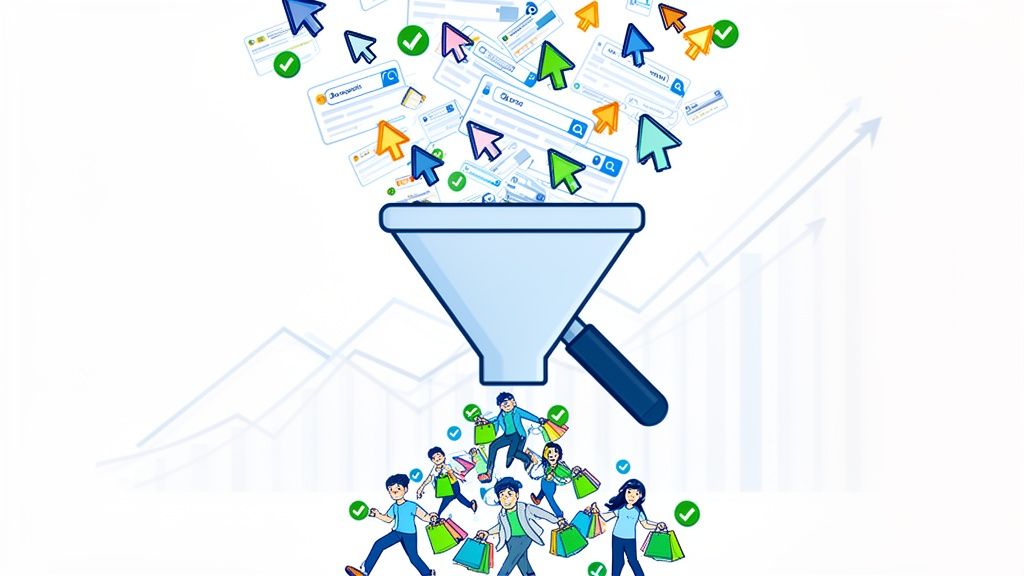
SEO lead generation is the process of using search engine optimization to attract visitors who are actively looking for a solution and turning them into qualified prospects. By ranking for keywords that signal a real need, you build a steady pipeline of customers who are already in the market for what you sell. It’s one of the most effective and cost-efficient marketing strategies out there.
Why SEO Is Your Best Bet for High-Quality Leads
In a world filled with "buy now" ads and short-lived social media trends, SEO has proven itself to be the most reliable engine for generating top-tier leads. This isn't about getting a bunch of random traffic to your site. It’s about attracting the right people—the ones who are already searching for what you offer. Unlike interruptive ads that disrupt someone's day, a solid SEO strategy makes your brand the go-to answer the exact moment a potential customer needs one.
Smart companies are doubling down on organic search because it gets them directly in front of people with intent. When someone types "best accounting software for small business" into Google, they’re not just window shopping; they're in evaluation mode. Being the first result they see at that critical moment is the heart of effective SEO lead generation.
It's a pull strategy, not a push. You're drawing in prospects who are already seeking you out, which makes for a much warmer conversation.
The Power of Intent-Driven Marketing
The real genius of SEO is how it connects with customers based on their specific needs. Instead of paying to interrupt their day, you’re offering a helpful solution right when they're asking for it. This creates a completely different dynamic from the get-go—one built on trust and expertise, not on being a nuisance.
The data backs this up. Did you know that a whopping 57% of B2B businesses say they get more leads from search engines than from any other channel? This single statistic shows just how powerful organic search is for driving high-quality leads. For marketers and small business owners, making SEO a priority isn't just a good idea; it's essential for growth.
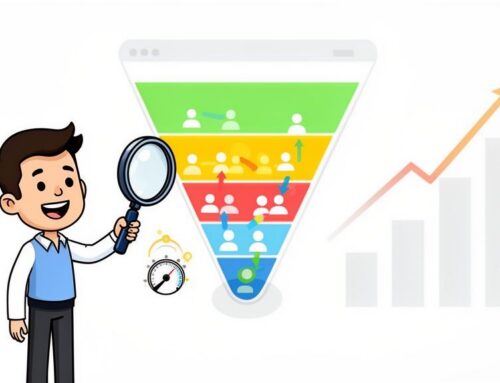
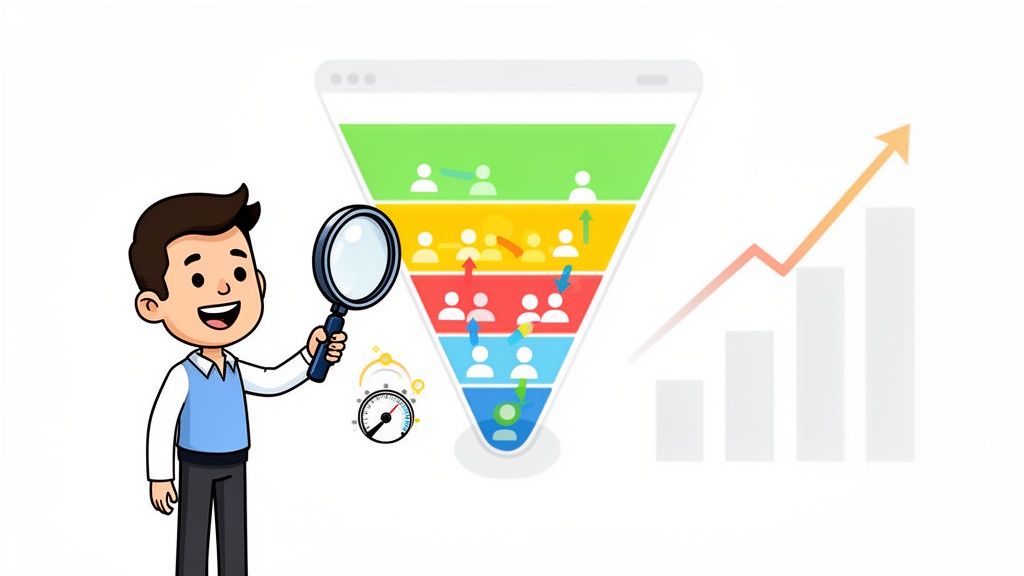
This simple flowchart breaks down the path from a user's search to a business conversion.

As you can see, a winning SEO strategy always starts with understanding user intent. From there, you create targeted content that guides them straight to conversion.
Comparing Lead Generation Channel Effectiveness
Not all lead sources are created equal. Some channels are great for broad awareness, while others excel at driving immediate action. This table breaks down the key differences, showing why SEO is so effective for generating high-quality leads.
| Channel | Primary Strength | Typical Lead Quality | Reported B2B Effectiveness |
|---|---|---|---|
| SEO | Intent-Driven | High to Very High | 57% of businesses report it as their top source |
| PPC Ads | Immediate Visibility | Medium to High | Effective for targeted, short-term campaigns |
| Social Media | Brand Awareness | Low to Medium | Better for top-of-funnel and community building |
| Email Marketing | Nurturing | Varies (Warm to Cold) | Strong for existing audiences, less for new leads |
| Content Syndication | Reach & Volume | Low to Medium | Often requires significant lead filtering |
While a multi-channel approach is smart, the data consistently shows that the leads coming from organic search are often the most qualified and ready to engage because they initiated the search themselves.
Building a Long-Term Business Asset
Here’s the best part: unlike paid ads, where your visibility vanishes the second you stop paying, the content and authority you build through SEO become a lasting business asset. A well-optimized blog post or landing page can keep generating leads for months, or even years, after you hit publish.
SEO is the only marketing channel that offers compounding returns. The work you do today not only brings in leads tomorrow but also strengthens your entire digital foundation for the future.
This compounding effect is what makes investing in SEO & SEM services so valuable. To dig deeper into the comprehensive benefits, it's worth exploring the true value of SEO for your business. Getting this right isn’t just another marketing task; it's a fundamental requirement for serious, long-term success.
Mapping Keywords to Your Customer's Journey

Truly effective SEO lead generation isn’t about chasing keywords with the highest search volume. It’s about getting inside your customer’s head. You have to understand the specific problem they're trying to solve at every single step of their journey. This is the crucial shift from just gathering terms to strategically mapping them to what your buyer actually needs.
Too many businesses fall into the trap of targeting broad, high-volume keywords, hoping to open the traffic floodgates. But what good is traffic if it doesn't convert? That's just a vanity metric. Real success comes from attracting visitors who are ready to engage, and that requires a much smarter approach.
The Three Core Stages of Search Intent
To get this right, you need to align your keywords with your customer's path. A deep dive into B2B Customer Journey Mapping is a fantastic starting point. From my experience, almost every search query falls into one of three buckets, each representing a different level of awareness and readiness to buy.
Informational Intent (Top of Funnel): Here, people are just looking for answers. They have a problem or a question, but they aren't thinking about buying anything yet. Think searches that start with "how to," "what is," or "why," like "how to do small business bookkeeping."
Commercial Intent (Middle of Funnel): Now they're aware of potential solutions and have moved into research mode. They're actively comparing different options. Keywords will often include modifiers like "best," "review," "comparison," or "alternative." A search like "best accounting software for small business" shows they’re weighing their choices.
Transactional Intent (Bottom of Funnel): This is the money stage. The user is ready to make a move. Their searches become highly specific and action-oriented, featuring words like "buy," "pricing," "demo," or "free trial." Someone Googling "QuickBooks free trial" is about as hot a lead as you can get.
Knowing these stages is the bedrock of any keyword strategy built for leads. It directly informs the kind of content you need to create and the call-to-action you should present.
Uncovering Keywords That Actually Drive Leads
Your real mission is to uncover the long-tail keywords that scream commercial and transactional intent. Sure, these phrases have lower search volume, but the people who use them are worlds more qualified and much closer to converting.
Take a keyword like "CRM." It's informational, incredibly broad, and fiercely competitive. Now consider a long-tail phrase like "CRM for real estate agents with lead tracking." The person searching for that has a very specific need and is actively looking for a tailored solution. That’s a lead in the making.
The most profitable keywords for SEO lead generation are rarely the ones with the highest search volume. They are the ones with the highest intent. Focus on the specific problems your ideal customers are trying to solve.
Start by brainstorming the real-world problems your product solves. Then, fire up your keyword research tools and look for the questions, comparisons, and phrases people are using to find answers. If you want a more detailed process for this, our guide on how to find the best keywords walks you through it step-by-step.
Building Your Keyword-to-Content Map
Once you've got your list of high-intent keywords, don't just let them sit in a spreadsheet. The next step is to organize them into a concrete content plan. You're building a map that connects a specific keyword to a specific piece of content.
Here’s a simple framework I use to keep things organized:
| Intent Stage | Keyword Example | Content Type | Primary Goal |
|---|---|---|---|
| Informational | "how to improve team productivity" | Blog Post or Guide | Educate & Build Trust |
| Commercial | "Asana vs Trello comparison" | Comparison Page or Review | Guide & Influence Decision |
| Transactional | "project management software demo" | Landing Page or Product Page | Capture Lead Information |
Following a system like this ensures every article, guide, or landing page you create has a clear purpose in your sales funnel. It turns your keyword research from a messy list into a powerful, actionable roadmap for attracting, nurturing, and converting the right kind of prospects. This is how you build an SEO lead generation machine that's both repeatable and scalable.
Building Landing Pages and Content That Actually Convert

Getting the right people to your website is a huge win, but it’s only half the battle in SEO lead generation. All that traffic is just potential energy. Your real job is to turn that potential into something tangible: a qualified lead. This is where your content and landing pages step into the spotlight.
Every piece you create needs to be engineered with a single, obsessive focus on conversion. From the headline all the way down to the button, every element must work together to nudge your visitor toward taking that next step.
Crafting Lead Magnets People Genuinely Want
A lead magnet is your secret weapon. It’s a high-value resource you give away for free in exchange for an email address. Think of it as an ethical bribe that turns a casual browser into an interested prospect. A generic "sign up for our newsletter" just doesn't work anymore. Your offer needs to be so good people feel like they’re getting away with a steal.
Here are a few types of lead magnets that I've seen deliver great results time and time again:
- In-depth Guides or Ebooks: Solve a major problem for your audience. A 5,000-word guide on "The Complete Checklist for Your First B2B Content Strategy," for example, is far more compelling than a short blog post.
- Original Research or Data Reports: If you have unique industry data, package it into an exclusive report. This immediately positions you as an authority and gives people insights they can't get anywhere else.
- Interactive Tools or Calculators: A free tool, like a "Marketing ROI Calculator," offers instant, personalized value. These are lead-capture machines.
- Webinar Recordings or Video Courses: A recorded masterclass is a fantastic asset. It lets people learn on their own schedule while you capture a high-quality lead.
The trick is to match the lead magnet directly to the user's search intent. If they searched for "best accounting software," a guide titled "A Buyer's Guide to Choosing Accounting Software" is the perfect next step for them.
The Anatomy of a High-Converting Page
Once you've got a killer lead magnet, you need a dedicated landing page to showcase it. A landing page isn't like your homepage, which is full of distractions. It’s minimalist and hyper-focused on one thing: getting that conversion.
An effective page is a symphony of several key elements. It starts with a magnetic headline that grabs attention and speaks directly to the visitor's pain point. This is followed by persuasive copy that sells the benefits of your offer, not just the features. What will they actually achieve by downloading your guide?
Don’t just take my word for it. When you consider that 35% of marketers identify SEO as their top source for high-scoring leads—beating referrals and paid ads—you realize just how critical this is. You can dig into more stats on how top marketers generate leads effectively.
A landing page is not a place for exploration; it's a place for decision. Remove every distraction—navigation menus, sidebars, and unnecessary links—that doesn't directly contribute to the user taking your desired action.
Social proof is another non-negotiable. Sprinkling in testimonials, client logos, or snippets from case studies builds instant trust and melts away hesitation. A visitor is far more likely to hand over their email if they see that others have done it and had a great experience.
Nailing Your Forms and Calls-to-Action
Finally, let’s get to the make-or-break elements: the call-to-action (CTA) and the form.
Your CTA button needs to use clear, action-oriented language. Ditch the boring "Submit" button. Instead, try something specific that reinforces the value, like "Get My Free Guide" or "Start My Free Trial."
The form itself is where so many leads go to die. Keep it brutally short. Only ask for the information you absolutely need. For a top-of-funnel offer, a name and email is usually plenty. Every extra field you add introduces friction and gives people an excuse to leave.
If you want to go deeper, check out our guide on creating a high-converting landing page that turns visitors into real customers. By pairing a fantastic lead magnet with a meticulously designed landing page, you create a powerful engine for turning your hard-earned traffic into a predictable stream of business.
Build Authority with Digital PR and Link Building

You can create the most compelling, conversion-ready content in the world, but it won't generate a single lead if no one ever finds it. After you’ve put in the work to build your core content assets and landing pages, you have to get out there and promote them. This is where you build the authority and trust that both Google and your future customers look for.
Forget the old-school, spammy tactics of begging for links. Today, building authority is all about creating genuine relationships and offering real value. It’s a mix of strategic digital PR and targeted link building, designed to get your content in front of the right people and earn traffic from sources they already trust.
Kick Off a Digital PR Campaign
Digital PR is the art of earning high-quality backlinks by pitching your best content—think original research, data studies, or comprehensive guides—to journalists, bloggers, and industry publications. The trick is to find a newsworthy angle in your content and tell a story around it.
For example, we worked with a B2B SaaS client who had compiled a fascinating data report on remote work productivity. We identified journalists who were actively covering the future of work and gave them exclusive access to the findings. The campaign was a huge success, landing features in major business publications. This drove a flood of high-authority backlinks and, more importantly, a wave of qualified leads who now saw our client as the go-to expert.
This works because you’re not just asking for a link; you're giving them a great story their audience will care about.
The Power of Smart Guest Blogging
Guest blogging has evolved. It's no longer just a numbers game for backlinks. Now, it's a powerful tool for tapping into new, perfectly aligned audiences and cementing your expertise in a field. The real goal is to find the blogs your ideal customers are already reading, then contribute an article so insightful that readers can't help but click back to your site to learn more.
When you’re hunting for guest post opportunities, zero in on these factors:
- Audience Fit: Does the site’s readership mirror your ideal customer profile?
- Site Credibility: Is the site respected by search engines and its readers? Look at its Domain Authority or overall reputation.
- Real Engagement: Do people actually comment on and share the articles?
A single, well-placed guest post on an industry-leading blog can drive more qualified leads than 100 links from irrelevant directories. It's all about quality, not quantity.
Building authority isn't a one-and-done project. It’s a continuous cycle of creating value and nurturing relationships. Every high-quality backlink you earn is a vote of confidence that tells search engines—and potential customers—that you're a voice worth listening to.
It's hard to overstate how critical an active promotion strategy is. Just look at the numbers: SEO drives over 1,000% more traffic than organic social media. With 53.3% of all website traffic coming from organic search, it’s the undisputed king of lead generation channels. The problem? A staggering 66% of pages have zero backlinks, which means they're effectively invisible to Google. Diving into these SEO statistics really drives home why proactive promotion is non-negotiable.
Writing Outreach Emails People Actually Read
So many link-building efforts die right in the inbox. Why? Because the outreach is terrible. Generic, copy-paste emails get deleted on sight. If you want to succeed, your outreach needs to be personal and immediately show the value you're offering.
A simple structure that consistently gets results looks like this:
- The Personal Touch: Start by showing you’ve done your homework. Reference a specific article they recently published.
- The Value Proposition: Get straight to the point. Briefly explain why your resource is a perfect fit for their audience.
- The Asset: Make it easy for them. Include the direct link to your content.
- The Soft Ask: Instead of demanding a link, simply suggest it could be a helpful resource for their readers.
By focusing on these relationship-first tactics, you're not just chasing links. You're building a strong, defensible brand presence that fuels a predictable and profitable SEO lead generation engine for years to come.
6. Measure and Optimize Your Lead Funnel
Getting traffic to your site is just the beginning. The real work starts when you turn that traffic into a predictable pipeline of qualified leads. Your SEO lead generation strategy isn't a one-and-done project; it’s a living, breathing system that needs constant attention and fine-tuning. This is how you close the loop and transform good results into truly great ones.
Think of it like this: you wouldn’t just play a song once and call it finished. You’d record it, listen back, and tweak every single note until it’s perfect. That’s the core idea behind Conversion Rate Optimization (CRO), which is all about systematically improving the percentage of visitors who take the action you want them to take—like filling out a form and becoming a lead.
Setting Up Your Measurement Framework
Before you can fix what's broken, you need to know what's working. While analytics can feel overwhelming, your goal is simple: track every single lead back to its origin. The best place to start is with Google Analytics 4 (GA4).
Your first job is to define what a "win" looks like by setting up conversion goals. A conversion is any meaningful action a user takes on your site, from submitting a contact form to clicking a "Call Now" button. In GA4, you can track these as "Events." For example, a classic setup is to create an event that fires whenever someone lands on your "thank you" page, which only happens after they've filled out a form.
Once this is in place, you gain incredible clarity. You can finally get real answers to business-critical questions:
- Which specific blog posts are driving the most demo requests?
- Does our "compare X vs. Y" page convert better than our "features of X" page?
- What percentage of organic traffic from mobile users actually becomes a lead?
This data moves you beyond gut feelings and into a world of actionable facts. It shows you exactly where to focus your energy for the biggest return.
Running Simple A/B Tests to Boost Conversions
With your tracking in place, you can start making data-backed improvements through A/B testing. It sounds technical, but the concept is straightforward: you create two versions of a page (an 'A' version, the original, and a 'B' version, with one change), then show each to different segments of your audience to see which performs better.
You don't need a huge, complicated testing platform to get started. Just focus your A/B tests on the high-impact elements of your key lead generation pages. It’s often the smallest tweaks that produce the most significant gains.
"Metrics don't lie, people do. Dig deep into your data to truly understand what's driving results and where opportunities for improvement lie. But don’t let analysis paralysis stifle what really moves the needle, which is to get things done!" – Draven McConville, Founder of Klipboard.io
This is a fantastic point. Data is your guide, but it's action that ultimately creates results. Start with simple but powerful tests.
A/B Testing Ideas for Your Lead Generation Pages
Here’s a table with some practical ideas to get you started. The key is to test one thing at a time so you can be sure what caused the change in performance.
| Element to Test | Variation A (Control) | Variation B (Hypothesis) | Potential Impact |
|---|---|---|---|
| Headline | "Our Project Management Software" | "Stop Missing Deadlines Forever" | Grab more attention by focusing on the visitor's primary pain point instead of the product feature. |
| CTA Button | "Submit" | "Get My Free Guide Now" | Increase clicks by making the button copy specific, value-driven, and less generic. |
| Form Length | Name, Email, Phone, Company | Name, Email | Reduce friction and form abandonment by removing non-essential fields for top-of-funnel offers. |
| Social Proof | No testimonials on the page | Add three customer testimonials | Build trust and credibility, reassuring hesitant visitors that they are making a good decision. |
By methodically testing one element at a time, you can isolate what really works and apply those learnings across your entire site. This data-driven feedback loop is what separates a stagnant campaign from a scalable, profitable growth engine that consistently delivers qualified leads for your SEO lead generation efforts.
Got Questions About SEO Lead Gen? We’ve Got Answers.
Let's tackle some of the most common questions that come up when you're building out an SEO strategy for lead generation. If you've been wondering about timelines, budgets, or how B2B differs from B2C, these quick answers should clear things up.
How Long Does It Really Take to Get Leads From SEO?
This is the big one, isn't it? Everyone wants to know when the leads will start rolling in. The honest answer is that SEO is a long game. While you might get lucky with a few quick wins, building a reliable SEO lead generation machine takes time—usually somewhere between 4 to 12 months to see a consistent flow of quality leads.
So, what makes the timeline shift? A few key things:
- Your Industry: Trying to rank for "personal injury lawyer" in a major city? You’re in for a tougher, longer fight than someone targeting a niche B2B software category.
- Your Starting Point: A brand-new website is starting from ground zero. An established domain with some history and authority has a serious head start.
- Your Commitment: SEO isn't a "set it and forget it" channel. It demands a steady rhythm of creating content, earning links, and making technical improvements.
In those first 1-3 months, you're looking for signs of life. Things like an increase in organic traffic (even if small), better rankings for some longer, more specific keywords, and just generally more visibility in search. The truly valuable, high-intent leads start showing up once you've built enough authority to compete for the more competitive, commercially-focused terms.
Is B2B and B2C SEO for Leads Actually Different?
Yes, absolutely. While the fundamentals of SEO don't change—keywords, content, links—the strategy and execution for B2B (business-to-business) versus B2C (business-to-consumer) are worlds apart. It all comes down to the customer journey, which is completely different for each.
B2B SEO is all about the long, considered purchase. The sales cycle can take months, and you're trying to win over multiple decision-makers. The goal is to build unwavering trust and position your company as the go-to authority. This means your content needs to be substantial and educational. Think:
- In-depth white papers that dissect a complex industry problem.
- Original data studies that offer fresh insights nobody else has.
- Detailed case studies that prove you can deliver results for clients.
The keywords here are often very specific, technical, and aimed at solving a business-level problem, like "enterprise logistics management software."
On the other hand, B2C SEO often has a much shorter path to conversion. The purchase decision is more emotional and immediate. Your content is designed to connect with a broader audience and push them toward a direct action, like a purchase or a sign-up. This is where you see product reviews, "how-to" blog posts, and influencer content shine. It's all about tailoring your strategy to the unique way your specific customer thinks and buys.
Can I Actually Do SEO Lead Generation on a Shoestring Budget?
You absolutely can. While throwing money at the problem can definitely speed things up, a powerful SEO lead generation strategy is completely possible on a small budget. You just have to trade cash for cleverness and sweat equity. The key is to be relentlessly focused.
Instead of trying to rank for everything, zero in on a specific niche where you can realistically become a trusted voice. Focus your energy on creating one or two phenomenal "pillar" pieces of content—truly comprehensive guides on your most important topics—instead of churning out a dozen mediocre blog posts.
With a small budget, your most valuable asset is your time. Dedicate it to manual, personalized outreach for link building instead of expensive PR campaigns. A single, well-earned link from a respected industry blog is worth more than a hundred low-quality directory links.
Also, lean heavily on powerful free tools. Google Search Console and Google Analytics 4 give you an incredible amount of data to guide your strategy without costing a penny. Ultimately, success on a tight budget comes down to focus, patience, and consistency.
How Is AI Changing the Game for SEO Lead Gen?
Think of AI as a powerful co-pilot, not the pilot. It's an incredible tool for accelerating your work and handling the tedious stuff, freeing you up to focus on what really matters: strategy and creativity. It's not a magic bullet that replaces human expertise.
For SEO lead generation, AI is a game-changer in a few specific areas:
- Keyword Research: AI tools can tear through massive amounts of data to find untapped long-tail keywords and group them by user intent—a task that used to take days can now take minutes.
- Content Ideation & Creation: AI can be a fantastic brainstorming partner, helping you generate outlines or even produce a rough first draft. This lets your writers focus on adding the unique insights, stories, and expertise that make content truly great.
- Lead Qualification: Think of AI-powered chatbots. They can work 24/7, answering basic questions from website visitors and qualifying them as leads before they ever talk to a human salesperson.
But here's the crucial part: human oversight is non-negotiable. AI-generated content on its own often feels sterile and lacks the unique brand voice and personal anecdotes that build real trust. The marketers who are winning right now are the ones who masterfully blend AI's efficiency with a human's strategic mind and creative touch.
Ready to turn your SEO efforts into a predictable stream of qualified leads? At ReachLabs.ai, our team of specialists combines data-driven strategy with world-class execution to build marketing engines that drive real growth. Discover how our collective approach can elevate your brand by visiting us at https://www.reachlabs.ai.