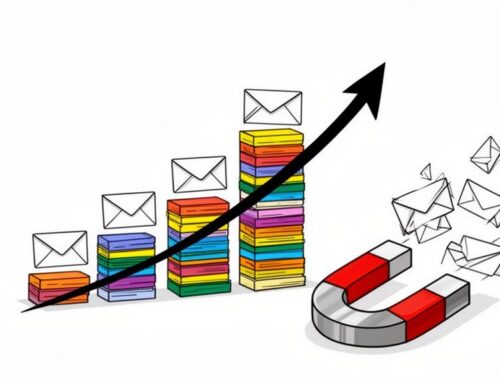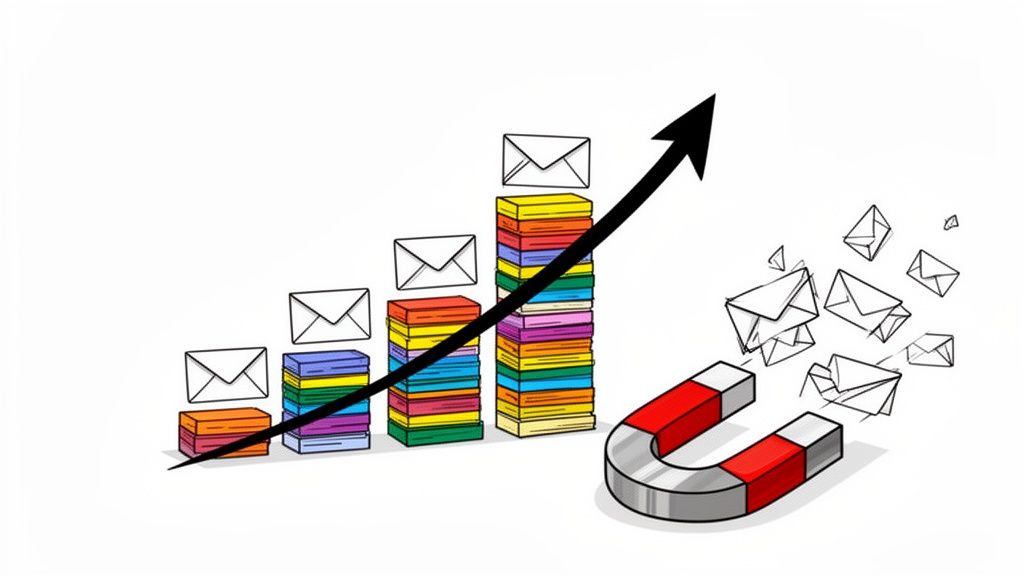
Imagine you had someone on your team whose only job was to listen to every customer comment online—the good, the bad, and everything in between—and respond to each one thoughtfully. That’s the heart of review management services: a complete system for monitoring, engaging with, and actively generating customer feedback to build a rock-solid digital reputation. It’s a function that draws a straight line from online reviews to your bottom line.
What Are Review Management Services?

Think of these services as your brand’s digital front desk. Not too long ago, "reputation management" was just a fancy term for damage control—a panicked scramble to put out fires after a bad review popped up. That mindset is completely obsolete now. Today, modern review management is all about being proactive and strategic.
Instead of just waiting for feedback to show up, these services build a process to go out and get it. This completely changes the game, turning your online profiles from static billboards into dynamic conversations with your customers. It’s about building a positive narrative, one review at a time.
Your Reputation's Watchful Guardian
Your brand’s reputation isn’t just built on word-of-mouth anymore. It lives and breathes across dozens of websites, from Google and Yelp to industry-specific forums and social media channels. A single negative comment has the power to sway hundreds of potential customers before they ever talk to you.
This is exactly where a dedicated service comes in. Its job is to pull this sprawling, messy conversation into one central place, giving you a single command center. The whole point is to make sure that no customer comment, good or bad, ever falls through the cracks. This consistent engagement shows you’re listening, which is one of the fastest ways to build trust and loyalty. For a deeper dive into the hands-on tactics, exploring some effective online reputation management tips can show you what this looks like in practice.
The market itself tells the story of how critical this has become. The online reputation management services market, valued at USD 6.5 billion in 2024, is expected to skyrocket to USD 12.5 billion by 2035. That explosive growth shows just how serious businesses are about shaping their digital perception.
Key Takeaway: Good review management isn't about hiding from criticism. It’s about amplifying your fans, engaging constructively with detractors, and treating all feedback as a priceless tool for business improvement.
Turning Feedback into Fuel for Growth
A smart review management strategy doesn't just protect your brand—it actively grows it. When you systematically encourage happy customers to share their stories, you create an undeniable wave of positive social proof. That’s a huge deal, because a steady stream of recent, positive reviews directly impacts your business in several ways:
- Local SEO: Search engines like Google reward businesses with a high volume of positive reviews, pushing them higher in local search rankings.
- Customer Trust: New prospects are far more likely to choose a company with a proven track record of making customers happy.
- Conversion Rates: A high star rating on your Google Business Profile or a product page can be the final nudge someone needs to make a purchase.
Ultimately, these services take scattered customer opinions and turn them into clear, actionable insights. They help you spot weak points in your operations, recognize your star employees, and find out what your customers really value. You can learn more about the direct benefits of online reputation management in our guide. It creates a powerful feedback loop: customer comments lead to improvements, and those improvements lead to even more great reviews.
The Core Features That Power Modern Review Management

To really get what makes review management services tick, you have to look under the hood at the technology. These aren't just simple alert systems. They're powerful platforms built to collect, analyze, and act on what your customers are saying—all at a scale that would be impossible to handle manually.
Let's break down the essential features that transform customer opinions from random noise into a serious business asset.
The first, and most foundational, feature is review aggregation. Think about the chaos of trying to monitor Google, Yelp, Facebook, and a dozen other industry-specific sites one by one. Aggregation pulls every review from every platform that matters into one clean dashboard. It’s the difference between having mail sent to a single inbox versus scattered all over town.
This central hub means you never miss a comment, which is critical for the timely responses that customers now expect. More importantly, it gives you a complete, at-a-glance snapshot of your entire online reputation.
Automated Review Generation
Getting ahead of your reputation means proactively building it, not just reacting to it. That's where automated review generation campaigns come in. These tools set up a system to ask for feedback at the perfect moment, like right after a customer makes a purchase or a service call ends.
A huge part of this is knowing how to get more online reviews efficiently and ethically, and modern services make it surprisingly simple.
- Trigger-Based Requests: The system can connect to your CRM or POS software to automatically send a review request via email or SMS following a key customer action.
- Targeted Campaigns: You can launch campaigns asking for feedback from specific customer groups, helping you generate social proof for a new product or in a new location.
- Multiple Channels: These requests can go out through whatever channel your customer is most likely to use, whether that’s a quick text, an email, or even a QR code on a receipt.
For instance, a dental practice could set up an automated SMS to go out 24 hours after a patient's appointment. That one simple step can dramatically boost the flow of fresh, positive reviews that new patients depend on when choosing a dentist.
Sentiment Analysis and Reporting
So, you've gathered all this feedback. Now what? You can't possibly read thousands of reviews and spot trends on your own. This is where AI-powered sentiment analysis really shines. The software scans the actual words in each review to automatically classify the feedback as positive, negative, or neutral.
This technology goes way beyond just counting stars; it understands human language and context. It pinpoints recurring keywords and themes, turning a messy flood of text into crystal-clear business intelligence.
This analytical power helps you zoom out and see the big picture. For example, a restaurant chain might discover the word "slow" keeps popping up in negative reviews for three specific locations. That insight points directly to a service or training issue that management can now fix with precision.
Advanced reporting then displays all this data on an intuitive dashboard. You can track the metrics that matter over time, such as:
- Overall Star Rating: Your average score across all platforms.
- Review Volume: The total number of new reviews you're getting each month.
- Sentiment Score: The breakdown of positive, negative, or neutral reviews.
- Response Rate: A measure of how quickly and consistently your team is replying to customers.
These reports make it easy to show the direct impact of your efforts. They prove how your reputation is improving and highlight exactly where you can do even better. When you combine aggregation, generation, and analysis, you get a complete system for building and protecting your brand's most valuable asset: its reputation.
How to Measure Your Review Management ROI
Putting money into review management is a big move. And like any business investment, you have to be able to prove it’s working. Measuring the return on investment (ROI) here isn't just about feeling good about your brand—it’s about drawing a straight line from your reputation to your revenue.
The impact shows up in two ways: immediate financial gains and the kind of long-term brand strength that fuels sustainable growth. When you can point to specific, data-backed improvements, justifying the cost becomes a simple conversation. It starts by looking at the numbers that directly affect your bottom line, like website traffic, lead conversions, and sales.
Connecting Reviews to Revenue
The clearest way to measure your ROI is to tie your online reputation directly to financial results. A higher star rating doesn't just look pretty; it actively pulls customers through your door—whether physical or digital.
You can see this play out every day in local search. When someone is looking for a nearby product or service, businesses with lots of positive reviews and high ratings pop right off the page.
Here’s what that looks like in a typical Google search for a local business:
As you can see, those star ratings are impossible to ignore. They grab your attention and instantly signal quality and trust before a user even makes a click. This boost in visibility leads directly to more website visits and more phone calls, which are the first steps toward a sale.
From there, you can start tracking the conversion rate of that traffic. Dig into your website analytics. Are visitors who come from local search results converting into leads or sales at a higher clip as your reviews improve? A lift in that specific conversion rate is a dead giveaway that your review management efforts are paying off.
Key Performance Indicators to Track
To build a solid case for your strategy, you need to keep an eye on a few Key Performance Indicators (KPIs). Think of them as the vital signs for your brand's reputational health. They provide the hard data you need to prove your strategy is working.
Most review management platforms will give you a dashboard to make this easy. The most important KPIs to watch are:
- Review Volume: This is the total count of new reviews you’re getting. A steady increase shows that your review generation efforts are effective and that you're staying relevant to search engines.
- Average Star Rating: Your overall score across all the big review sites. The goal is a consistent upward trend, because even a fractional improvement can have a massive impact.
- Response Rate and Time: This tracks how many reviews you respond to and how fast you do it. A high response rate and quick turnaround show customers you're listening and that you care.
- Sentiment Analysis: This KPI goes deeper than just stars by analyzing the words people are using. Is the language in your reviews positive, negative, or neutral? Tracking this gives you a much richer understanding of customer satisfaction.
These metrics all work together. A rising sentiment score, for example, should lead to a higher average star rating and, in turn, more website traffic and sales. For a more detailed look at the math behind this, check out our guide on how to calculate marketing ROI.
Tangible and Intangible Returns
The financial impact of a well-executed review strategy is clear. We’ve seen businesses in competitive industries like hospitality use expert management to lift their review scores from 3.5 to 4.5 stars. That kind of jump has directly led to revenue increases of 15-20%. It’s a powerful testament to the financial return.
But the benefits don't stop with your bank account. The "soft" returns are just as valuable and build long-term brand equity. We're talking about stronger brand trust, deeper customer loyalty, and priceless operational insights.
When you truly listen to customer feedback, you get a free source of market research. That feedback can guide everything from product development and service improvements to employee training, creating a fundamentally stronger business from the inside out.
Choosing the Right Review Management Partner
Picking a partner for your review management services is a big deal for your brand's reputation. This isn't just about choosing some software; it's about committing to a strategy. The right choice will feel like a natural fit for your team's workload, budget, and where you want to go. Get it wrong, and you could end up wasting money and missing out on valuable customer insights.
Ultimately, you have two main roads to choose from. You can either use a Do-It-Yourself (DIY) software platform or team up with a managed agency. Each path has its own perks and is built for different kinds of businesses. Your decision here will define how you listen to your customers and turn their feedback into a real driver for growth.
DIY Software vs. Managed Agency
Think of DIY software as being handed a professional toolkit. You get a dashboard that pulls in all your reviews, gives you reports, and even offers templates to help you ask for more feedback. This route is perfect for businesses that have someone on the marketing team with the time and know-how to handle the daily tasks of responding to customers and digging into the data.
A managed agency, like ReachLabs.ai, is a different ballgame. They essentially become your reputation team. This is the ideal choice if you don't have the people or the specific expertise to run a full-on review strategy in-house. An agency provides more than just the software; they bring the experts who will manage it for you, from writing thoughtful, personalized responses to finding strategic gold in your customer feedback.
So, how do you decide? This flowchart can help you think through which option makes the most sense based on your resources and goals.

As you can see, the choice often comes down to what you value more: hands-on control and a lower upfront cost (DIY), or expert execution that saves you time (managed agency).
Outsourcing this kind of work is becoming more and more common. The managed services market is booming, and while North America is currently the biggest player, the Asia Pacific region is catching up fast. Businesses are realizing the value of handing complex tasks to specialists who can deliver extra services like sentiment analysis. In fact, some agencies help their clients cut down on reputation-related emergencies by up to 40% just through proactive monitoring.
To help you weigh your options, here’s a straightforward comparison between the two models.
DIY Software vs. Managed Agency Services Comparison
| Factor | DIY Software Platform | Managed Agency Service (e.g., ReachLabs.ai) |
|---|---|---|
| Cost | Lower monthly subscription fees. You pay for the tool. | Higher investment. You pay for the tool, the team, and the strategy. |
| Time Investment | High. Your team is responsible for all monitoring, responding, and analysis. | Low. The agency handles the day-to-day workload, freeing up your team. |
| Expertise Required | Moderate to High. Requires knowledge of best practices for review response and data analysis. | Low. You're hiring the expertise, so your team doesn't need to be specialists. |
| Control | Full control. Your team manages every interaction and campaign directly. | Collaborative control. You set the strategy and guidelines, the agency executes. |
| Strategy | You build it. The software is a tool; the strategy comes from your team. | Included. The agency develops, executes, and refines the strategy for you. |
| Best For | Businesses with a dedicated in-house marketing team and a desire for hands-on management. | Businesses that lack the time or in-house expertise, or want to scale quickly with proven methods. |
Ultimately, there's no single "best" answer—only what's best for your business right now.
Your Vendor Selection Checklist
When you start looking at potential partners, it's easy to get overwhelmed by flashy features and convincing sales pitches. To make a smart decision, you need to focus on what will actually make a difference for your business. Use this checklist to ask the right questions and compare your options fairly.
Integration Capabilities: How well does the platform play with the tools you already use? A service that connects to your CRM, POS system, or other business software is a game-changer. It can automate getting reviews and link feedback directly to customer accounts, making the data much more powerful.
Reporting and Analytics Depth: Don't settle for just star ratings. A great partner will give you deep insights into sentiment trends, common keywords, and response times. Always ask for a demo of their reporting dashboard to see if the information is clear and gives you ideas you can act on.
Scalability: Will this solution be able to keep up as you grow? Whether you plan to open new locations, launch new products, or enter new markets, your review management partner should be able to scale their services without causing you headaches.
Support and Strategy: What happens after you sign the contract? For DIY software, look for excellent customer support and plenty of tutorials. For an agency, dig into their strategic process. A true partner will work with you to set goals and adjust the plan based on what the data is telling them.
Key Takeaway: The best partner is one whose service fits your day-to-day reality. Don't buy a powerful DIY tool if you don't have the time to master it, and don't hire an agency if you want to personally approve every single review response.
This decision-making process is a lot like choosing any other key marketing partner. For more advice on finding the right fit, check out our guide on how to choose a digital marketing agency. By carefully thinking through these factors, you can find a review management service that doesn't just protect your reputation but actively turns it into one of your biggest strengths.
How an Agency Amplifies Your Review Strategy

Think of it this way: having the right software for review management services is like owning a set of professional-grade chef's knives. They’re sharp, precise, and absolutely essential. But without a skilled chef, they’re just expensive tools sitting in a block. An agency, like ReachLabs.ai, is that expert chef—the one who turns raw ingredients into a Michelin-star meal.
That’s the real difference between just having a tool and having a dedicated team. Software gives you the platform to see what people are saying and respond. An agency, on the other hand, acts as your strategic partner, figuring out how to turn those reviews into a growth engine for your entire business.
From Responding to Repurposing
Of course, an agency starts with the fundamentals. They'll make sure every single review gets a timely, professional, and on-brand response. But where they really start to earn their keep is by connecting the dots between your online reputation and your business goals. A great agency doesn't just see a five-star review; they see a powerful marketing asset waiting to be used.
Let's say a happy customer leaves a glowing review praising your product’s durability. Your team is busy, so they might just leave a quick "thank you" and move on.
An agency team sees an opportunity. They immediately start thinking about how to leverage that piece of social proof.
- Create Social Media Content: They’ll take that fantastic quote and spin it into a sharp-looking graphic for your Instagram feed or a compelling testimonial for a Facebook ad.
- Inform Website Copy: If they notice a pattern—lots of people mentioning durability—they’ll make sure that benefit is front and center in your website messaging.
- Fuel Sales Enablement: The best reviews get packaged up and handed to your sales team, giving them concrete proof points to use when talking with new prospects.
Suddenly, customer feedback isn’t just a passive score. It becomes an active, working part of your marketing efforts. An agency is constantly looking at your reputation data and asking, "How can we use this to win more business?"
A Collaborative Brain Trust
One of the biggest upsides of partnering with an agency is gaining access to a whole team of specialists. When you manage reviews in-house, it often lands on one person's plate—a marketer or business owner who's already stretched thin. An agency brings a whole crew to the party.
Your review data becomes the central hub of intelligence that feeds multiple strategies at once.
- The SEO Specialist notices customers keep asking about a specific feature. They use that insight to build a keyword strategy targeting that exact topic, knowing it's what real buyers are searching for.
- The Content Writer takes those frequently asked questions and turns them into an SEO-friendly blog post or a detailed FAQ page, solving customer problems while building your search ranking.
- The Brand Strategist analyzes sentiment trends over time. This helps them spot which brand strengths to lean into and which weaknesses need to be addressed, guiding the entire brand story.
At an agency like ReachLabs.ai, we don’t operate in silos. Our teams talk to each other constantly, turning insights from your reputation into a unified strategy that software alone can't deliver. It’s all about creating a feedback loop where the customer's voice actively shapes and improves your marketing.
This collaborative model means the value you get from your reviews goes way beyond the platforms they were written on. It drives content, sharpens your SEO, and refines your brand message, which is how you truly maximize the ROI on your review management services.
Ultimately, bringing on an agency isn't just about outsourcing a task; it's about upgrading your strategic horsepower. You get the expertise, the creative thinking, and the cross-departmental execution needed to turn a good reputation into a serious competitive advantage. They don't just manage your reviews—they amplify them.
Frequently Asked Questions About Review Management
Jumping into the world of review management services brings up a lot of questions. We get it. It can feel like a big move, but it's more straightforward than you might think. We've heard just about every question there is, so here are the ones that come up most often, with straight-to-the-point answers from our experience.
Our aim here is to cut through the noise and give you the confidence to decide what's right for your business.
How Quickly Can I Expect to See Results?
You'll see some changes almost right away. The first thing a professional service does is bring a sense of order to your current reviews, making sure every customer gets a prompt, on-brand response. This immediate engagement shows everyone—past and future customers—that you're listening.
Within the first 1-2 months, you'll likely start to feel a shift in customer sentiment. When your team is consistently responding to feedback and solving problems, the public conversation about your brand naturally starts to become more positive.
The bigger, more impactful results take a little more time to build.
- Review Volume: It usually takes about 3 months for a proactive campaign to really get rolling and bring in a steady stream of new reviews.
- SEO and Lead Generation: This is where the magic really happens. Seeing a real lift in your search rankings and getting more leads from your reputation usually takes 3-6 months. That's the time it takes for search engines to recognize and reward your growing authority.
Think of it as building a foundation. The initial work is about setting things up correctly, but the long-term strategy is what creates lasting, sustainable growth.
Is It Ethical to Ask Customers for Reviews?
Yes, 100%—as long as you do it the right way. Major platforms like Google actually encourage businesses to ask for reviews. The golden rule is that you can never offer incentives for a positive review. That's a fast track to violating platform policies and, more importantly, breaking customer trust.
The right way is to simply make it easy for all your customers to share their honest experience, good or bad.
The best practice is to ask for feedback from every customer in a neutral, systematic way. This isn't about cherry-picking happy people; it's about opening a line of communication through email, SMS, or even a simple QR code on a receipt.
A good review management service helps you build that neutral system. The goal is to get a true picture of customer satisfaction, not to artificially inflate your rating.
Can Negative Reviews Be Removed?
In most cases, no. If a negative review is a genuine account of a customer's experience and doesn't break any platform rules, it's there to stay. Honestly, trying to wipe your profile clean of any criticism isn't just a losing battle; it looks suspicious to potential customers.
The real power is in how you respond.
- Respond Professionally: A public, thoughtful reply that acknowledges the issue and offers a solution can turn a negative into a positive. It shows everyone that you care and take responsibility.
- Flag Inappropriate Content: A service will help you spot and report reviews that are against the rules—things like spam, fake reviews, or personal attacks. These are the ones that have a real chance of being removed by the platform.
- Bury It in Positives: The most powerful strategy of all is to simply generate so many authentic, positive reviews that the occasional negative one loses its impact. When one bad review is sitting in a sea of hundreds of glowing ones, it barely registers.
Is It Too Early for Review Management If I Have No Reviews?
Not at all—in fact, it’s the perfect time to start. A blank slate is a huge advantage. You get to build your reputation from the ground up, the right way, instead of trying to repair a damaged one.
Starting early means you're in control from day one. A review management service can set up a generation strategy right away, making sure your very first reviews are positive and set a strong precedent. You're building a foundation of social proof that will start attracting customers immediately.
It’s always easier and cheaper to build a great reputation from the start than to do damage control later. Think of it as preventative care for your brand.
Ready to turn your customer feedback into a powerful growth engine? The expert team at ReachLabs.ai integrates review management into a complete marketing strategy, amplifying your best reviews to drive real business results. Learn how we can build and protect your brand’s reputation.