When we talk about personal branding for executives, we're not talking about vanity projects or becoming an "influencer." It’s the intentional process of building your reputation as a credible, influential authority in your field. This has shifted from a nice-to-have skill to a core leadership function, one that directly shapes your company's reputation, attracts top talent, and builds investor confidence.
It's about making leadership visible and trusted.
Why Executive Personal Branding Is No Longer Optional

Not long ago, a strong corporate brand was all that mattered. Leaders could comfortably operate behind the curtain, letting the marketing department manage the public story. That era is definitively over.
Today’s stakeholders, from customers to your next star employee, expect authenticity and a human connection. They don’t just buy from a logo; they buy into the people steering the ship. This shift makes an executive's personal brand an indispensable part of modern leadership. An invisible executive is a massive missed opportunity. A visible, trusted leader, on the other hand, becomes a powerful strategic asset.
To give you a clearer picture, here are the core components that make up a strong executive brand. Think of these as the foundational pillars you'll be building on.
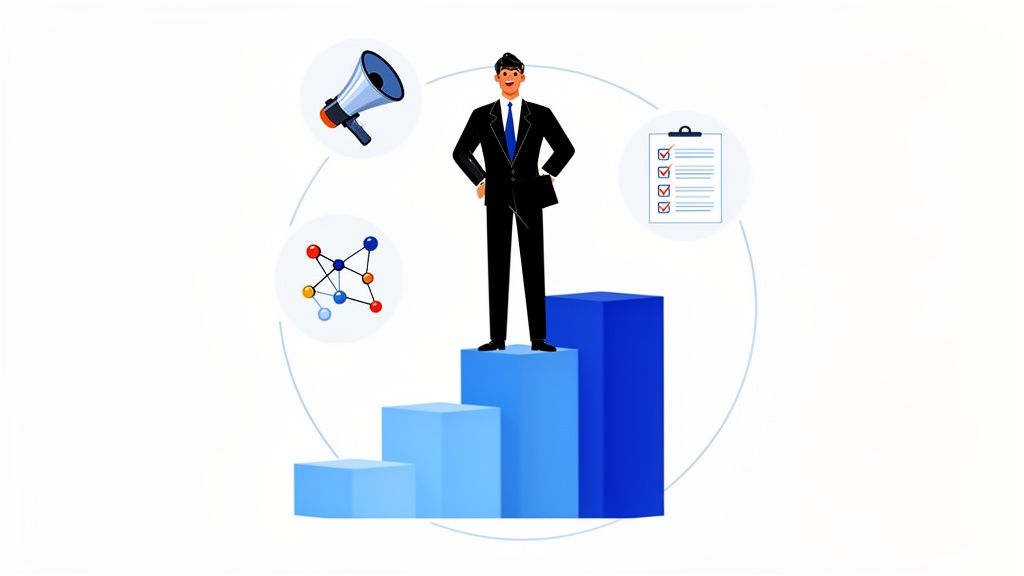
Core Pillars of Executive Personal Branding
| Pillar | Objective | Primary Channel Example |
|---|---|---|
| Thought Leadership | Establish expertise and shape industry conversation. | Publishing articles on LinkedIn or industry journals. |
| Network & Community | Build relationships with peers, clients, and talent. | Engaging in meaningful discussions and speaking at events. |
| Vision & Narrative | Articulate a clear, compelling story for the future. | Sharing company milestones and personal insights via posts. |
| Authenticity & Trust | Create a genuine connection with your audience. | Showing the human side of leadership, including challenges. |
Each of these pillars works together to create a brand that not only represents you but also elevates the entire organization.
The Tangible Business Impact
Let's look at a scenario I've seen play out time and time again. Imagine two competing tech firms fighting for the same enterprise clients and top-tier engineers.
- CEO A is a ghost online. Their LinkedIn profile is a dusty, static resume. They never share an opinion or engage with anyone in their industry. The company's marketing is polished but feels completely impersonal.
- CEO B actively shapes her personal brand. She consistently shares sharp analysis on LinkedIn about market shifts, posts behind-the-scenes stories celebrating her team, and appears on industry podcasts to talk about where the field is headed.
Now, when a potential client researches both, who do they see? A faceless corporation or a company led by a passionate, forward-thinking expert? When a top engineer is weighing offers, do they choose the silent leader or the one they already follow and admire? The choice is almost always clear.
"For decades, we were trained to let the corporate brand do the talking. We now know that's a flawed strategy. Your people want to hear from you, your investors want to see your vision, and your customers want to know who is behind the products they use. The single greatest shift is from corporate-only messaging to leader-led communication."
The Undeniable ROI of a Leader's Voice
The data backs this up without question. A staggering 82% of people are more likely to trust a company when its senior leaders are active on social media. This shows a direct line from an executive's personal brand to the company's credibility. Another study found that 57% of consumers say that visible and authentic leadership is a key factor in their purchasing decisions. You can see how a leader's presence builds consumer trust in more detail.
A well-defined executive brand delivers real, measurable returns across the business:
- Enhanced Company Reputation: A trusted leader’s voice makes the entire organization more credible and resilient, especially during a crisis.
- Improved Talent Acquisition: Top performers want to work for and learn from inspiring, visible experts. Your brand becomes a powerful recruiting magnet.
- Increased Investor Confidence: Investors feel more secure backing leaders who clearly communicate their vision and demonstrate deep industry authority.
- Higher Sales and Lead Quality: A leader who is a known entity warms up the market, making it far easier for sales teams to get a foot in the door.
Ultimately, investing in your personal brand isn't an exercise in ego. It's a strategic business decision that drives clear, compelling results for your company and your career.
Defining Your Executive Brand Identity
Before you write a single post or book a speaking gig, you have to do the foundational work. So many executives skip this part, and it shows. They end up with a personal brand that feels scattered, inauthentic, or worse, just like a corporate brochure.
Let’s get one thing straight: this isn't about creating a fake persona. It’s about excavating the expertise, values, and unique point of view you’ve built over your entire career. Your job title is temporary. Your company will change. Your authentic brand is what stays with you, opening doors no matter where you go.
Find Your Authentic Brand DNA
Getting this right means looking inward before you project outward. You can't outsource authenticity. It's a non-negotiable first step, and honestly, it’s where the real power comes from.
Take some time to really dig into these questions. Don't just jot down the first thing that comes to mind. Your answers are the bedrock of your entire strategy.
- What are the three topics you could talk about for hours with genuine authority? Go beyond your day-to-day responsibilities. Think about the unique intersections of your knowledge. Are you the finance leader who is also an expert on remote team culture? The marketing chief who got their start in engineering? That’s where the gold is.
- Where do you push back against the status quo in your industry? A strong point of view is a brand accelerant. Where do you disagree with the common wisdom? What trends do you see that others are missing? Don’t be afraid to have an edge.
- What are your non-negotiable leadership values? Think about the principles that have guided your toughest decisions. These values are the true core of your brand, influencing how you lead, communicate, and build trust.
When you answer these honestly, patterns emerge. You start to see the common threads that define who you are as a leader. This is what separates a genuine executive brand from a shallow marketing exercise.
Map Your Key Audiences
Once you have a clearer sense of your message, you need to think about who you’re talking to. And here’s a secret: it’s not just about customers. An executive’s brand has to resonate with several distinct groups, and each one is listening for something different.
- Potential Hires: The best talent isn’t just looking for a paycheck; they want to work for leaders who inspire them. They’re listening for your vision and a real sense of your leadership style.
- Industry Peers & Partners: This group isn't impressed by fluff. They’re looking for credible experts who can spark an intelligent conversation and move the industry forward.
- Investors & Board Members: This audience needs to see confidence and a clear path to results. Your personal brand can reinforce the authority and vision they’re betting on.
- Customers & Clients: People buy from people they trust. Your brand adds a human layer that a corporate logo simply can't, creating a much deeper connection.
Think about how your core message needs to be framed for each of them. You’re not changing what you stand for, but how you communicate it to address their specific needs. For a deeper look at this foundational work, you can learn more about how to build a personal brand in our comprehensive guide.
Craft Your Executive Brand Mission Statement
The final piece of this initial phase is to pull everything together. You need to distill your identity, value, and impact into a sharp, clear "Executive Brand Mission Statement." This isn't a public tagline. Think of it as your internal compass, a private gut-check to keep every piece of content, every comment, and every interview perfectly aligned.
A great mission statement weaves together three key elements:
- Your Core Identity: Who you are.
- Your Unique Value: What you offer.
- Your Intended Impact: Why it matters.
Here’s an example in action: "To use my 20 years of experience in supply chain logistics to challenge outdated industry practices, guiding fellow leaders toward more sustainable and tech-forward solutions that build resilient, future-proof organizations."
This statement is your filter. Before you hit "publish" or accept an invitation to speak, ask yourself: "Does this support my mission?" It’s the simple guardrail that ensures you build a credible and memorable executive brand over the long haul. And as you solidify this identity, remember that your visual presence matters, too. Professional imagery, like AI headshots tailored for executives, can be a powerful tool for visually reinforcing the authority you're building.
Building Your Content Blueprint
Once you’ve nailed down your brand identity, the real work begins: turning that strategy into action. This is where so many executives get it wrong. They fall into the "more is better" trap, thinking that posting constantly is the only way to stay relevant.
That approach is a fast track to burnout. It dilutes your message and leaves you exhausted. The goal isn't to create a mountain of content; it's to make an impact. Forget high-frequency, low-value posts. It's time to focus on creating fewer, more powerful pieces that genuinely reflect your expertise.
The Secret Weapon: The Pillar Content Model
A much smarter, more sustainable strategy is what we call the Pillar Content model. It’s pretty simple, really. You create one major, in-depth piece of thought leadership—your "pillar"—and then you slice and dice it into smaller assets for different platforms. This lets you maximize the reach of your best ideas without chaining yourself to your desk.
So, what does a pillar piece look like? It could be:
- A deep-dive, 2,000-word article analyzing a critical industry shift.
- A long-form interview on a well-respected industry podcast.
- The keynote presentation you delivered at a major conference.
- An expert webinar where you break down a complex new framework.
This core asset is the source of truth for your content. Everything else flows from it, which keeps your messaging tight and consistently reinforces your authority. It’s all about working smarter.
Before you even think about writing that first pillar, remember that it's the final step in a deliberate process. You have to do the foundational work first.

As you can see, great content doesn’t just happen. It’s built on a solid foundation of auditing where you are, mapping who you need to reach, and defining exactly what you stand for.
From One Pillar to a Month of Content
Let’s see this in action. Imagine a Chief Operating Officer in the logistics industry writes a 2,000-word pillar article titled, "The Future of AI in Logistics: Moving Beyond Automation to True Intelligence."
From that one piece of work, her team can spin out a full month's worth of content.
Five Unique LinkedIn Posts:
- An introductory post sharing a powerful quote from the article and linking to the full piece.
- A text-only post that takes a contrarian angle from the article (e.g., "Here’s why most logistics firms are getting AI implementation all wrong.").
- A carousel post that visually breaks down a key framework or data point.
- An engagement-focused post asking a provocative question tied to the article's theme.
- A behind-the-scenes look at the research or inspiration that led to the article.
Three Short-Form Videos:
- A 60-second "talking head" video for LinkedIn and X (formerly Twitter) summarizing the core argument.
- A short, animated clip illustrating a surprising statistic from the piece.
- An excerpt from a webinar where she presented the article's main ideas.
One High-Value Twitter Thread:
- A 10-tweet thread that unpacks the article’s key takeaways into easily digestible points.
With this system, one big push becomes a steady stream of visibility. You stay top-of-mind and on-message without the constant pressure to create something new from scratch.
Quality Over Quantity Is the New Rule
This strategic shift isn’t just a theory; it’s what’s actually working right now. By 2026, personal branding for executives has moved decisively away from random, high-volume posting. Gen X CEOs, in particular, are leading the charge by prioritizing fewer, more thoughtful communications.
We’ve seen that leaders who tried daily posting quickly found it diluted their core message and led to burnout. The smart play is sustainable visibility: one insightful LinkedIn post a week, a long-form article bimonthly, or a single meaningful podcast interview each month. You can read more about these CEO branding trends on Entrepreneur.com.
By focusing your energy on creating one exceptional piece of pillar content, you establish a strong foundation of authority. Repurposing it ensures you maintain a powerful and consistent presence without sacrificing your most valuable asset—your time.
Ultimately, your content plan has to be built for the long haul. The goal isn’t to become a full-time influencer. It's to be a highly visible and respected leader in your field. The pillar model gives you the framework to do just that.
Get Your Voice Heard on the Right Channels
Having a brilliant content plan is one thing, but it’s a wasted effort if the right people never see it. The real magic happens when you shift from just creating content to strategically amplifying it.
This isn't about shouting from every rooftop. It's about being a consistent, valuable voice in the specific places where your audience is already paying attention. Forget the old broadcast model; we’re moving toward a smarter system of engagement, networking, and targeted outreach.
Make LinkedIn Your Leadership Hub
For any modern executive, LinkedIn is home base. It's no longer just a digital resume—it's your personal stage for communicating your vision and expertise. Your activity there directly shapes how clients, partners, and top talent see you.
But just posting content isn't enough. You have to actively participate in the conversation.
- Engage Strategically: Spend 15 minutes a day leaving thoughtful comments on posts from other leaders in your industry. A sharp, insightful comment can often get you more visibility than your own post.
- Optimize Your Profile: Your headline is your billboard. Ditch the generic job title. Instead of "CEO at Acme Corp," try something like, "CEO at Acme Corp | Helping B2B SaaS companies scale recurring revenue." It immediately tells people what you do.
- Showcase Wins: Don't be shy about featuring team successes, company milestones, and media mentions. It frames you as a leader who builds and celebrates a winning organization.
Nailing your LinkedIn presence is foundational. For a deeper dive, our guide on how to build a personal brand on LinkedIn has you covered.
Where Should You Focus Your Efforts?
Choosing the right channels can feel overwhelming. The key is to align your time commitment with your primary goals. Are you looking to build deep relationships with a niche audience, or are you aiming for broad visibility? This table breaks down the most common executive channels to help you prioritize.
Executive Channel Strategy Comparison
| Channel | Primary Goal | Time Commitment | Best For |
|---|---|---|---|
| Thought Leadership & Networking | Medium (3-5 hours/week) | Building professional authority and connecting with peers, partners, and clients. | |
| Speaking Gigs | High-Impact Authority | High (per event) | Establishing yourself as a go-to expert and connecting with a live audience. |
| Podcasts | Niche Audience Reach | Low-to-Medium (per appearance) | Sharing deep expertise with an engaged, targeted audience in a conversational format. |
| Media/PR | Credibility & Broad Reach | High (requires outreach) | Gaining third-party validation and reaching audiences outside your immediate network. |
Ultimately, a mix of these is ideal, but starting with a strong focus on one or two (like LinkedIn and podcasts) is a smart way to begin without getting spread too thin.
Go Beyond Your Social Feed
While LinkedIn is your hub, true industry authority is often built on more traditional platforms. Think speaking engagements, industry podcasts, and articles in trade publications. These opportunities are powerful because they come with built-in credibility.
The trick is to be targeted and professional with your outreach. Generic pitches are a waste of everyone's time.
I've used variations of this email template to land podcast interviews, and it works because it's simple, respectful, and shows you've done your homework.
Subject: Guest Idea for [Podcast Name]: [Your Specific Topic]
Hi [Host's First Name],
I'm a huge fan of [Podcast Name]—especially the recent episode with [Guest Name]. Your conversation about [Specific Point] was spot on.
Based on your audience's interest in [Audience Interest], I thought a discussion on [Your Topic] might be a great fit. I have a unique perspective on [Your Unique Angle] and could share actionable insights on:
- Insight 1 (e.g., A common mistake companies make in this area)
- Insight 2 (e.g., A surprising trend we're seeing)
- Insight 3 (e.g., A practical takeaway for your listeners)
For context, I'm the [Your Title] at [Your Company]. You can find some of my thinking on this here: [Link to your best article or video].
Let me know if that sounds interesting. Either way, keep up the fantastic work.
Best,
[Your Name]
It shows you're a fan who wants to provide genuine value, not just someone looking for a platform.
Build Your Circle of Influence
Here's a truth about personal branding: you can't do it alone. The most effective way to grow your reach is to cultivate a network of peers who can amplify your work, and you, theirs.
Think of it as a collaboration, not a competition. When a trusted leader in your space shares your article or recommends you for a speaking spot, it carries far more weight than any self-promotion. It’s powerful social proof that turns your solo effort into a community-driven conversation.
This shift toward individual voices is more than just a trend; it’s a fundamental change in how influence is built. In fact, personal branding is growing 25% faster than corporate branding, according to recent analysis. This data, highlighted in a report by ESight Solutions, shows that executives are becoming the new power players for visibility, often with far more reach and engagement than official company channels.
By mastering your hub on LinkedIn, making smart moves into external media, and building a supportive network, you create a system that ensures your insights don't just get published—they get seen by the people who matter.
Measuring Your Impact and Protecting Your Brand

As an executive, your time is your most guarded asset. You can’t afford to invest it in a personal branding strategy without knowing if it’s actually working. The classic mistake I see leaders make is getting caught up in "vanity metrics"—things like follower counts and post likes. They feel good, but they don't really tell you if your brand is making a business impact.
To see the real picture, we have to look past those surface-level numbers. The goal is to connect your growing visibility directly to tangible outcomes for your company and your career. It’s about shifting from chasing social validation to creating real business value.
Focus on KPIs That Actually Matter
So if likes and follows aren't the main goal, what should be on your dashboard? You or your team should track a handful of key performance indicators (KPIs) that prove the return on your effort. Don't get bogged down in daily fluctuations; a monthly or quarterly check-in is plenty.
Here are the metrics I tell my clients to obsess over:
- Inbound Leads from Your Profile: How many qualified partnership or sales inquiries are coming through your LinkedIn DMs? Are people referencing your content when they reach out? This is the clearest line you can draw from brand to revenue.
- Media and Speaking Invitations: Are you getting more organic requests to speak at conferences, join a podcast, or contribute to an industry article? This is a huge signal that your authority is growing.
- Share of Voice (SOV): How often are you being mentioned in the important conversations around your core topics, especially compared to your peers? This shows your influence is expanding beyond your immediate network.
- High-Quality Network Growth: Forget just counting followers. Are you connecting with people from your target companies, C-suite peers at key accounts, or the VCs you want to know? Quality over quantity, always.
A rising follower count is nice, but a message from a dream client saying, "I've been following your posts on AI in logistics and would love to talk," is the real prize. That's the conversion from visibility to opportunity.
If you’re looking for a more detailed framework, our guide on how to measure social media ROI can give you some added structure for your tracking. The whole point is to build a clear, data-backed story of how your personal brand is fueling business growth.
Navigating Compliance and Crisis
Building a brand is one thing; protecting it is another. As a leader, your personal voice and your company's reputation are linked, and that requires a smart, proactive game plan.
Your first stop should be a transparent conversation with your legal and communications teams. This needs to happen before you start posting consistently. Get a clear understanding of the company's social media policies and establish guardrails. This isn't about asking for permission on every post, but about aligning on the topics you'll own and the boundaries you won’t cross.
You also have to be ready for negative feedback. Sooner or later, someone will disagree with you or leave a critical comment. The key is to handle it with grace. Never, ever get into a public shouting match. A simple, "I appreciate you sharing a different perspective" is often all it takes. For anything more heated, move the conversation offline immediately.
Have a Simple Crisis Plan in Your Back Pocket
Finally, every executive with a public profile needs a basic crisis plan. This doesn't have to be some 50-page binder. Think of it as a simple "what if" protocol for when a potential reputation threat emerges, whether it’s personal or tied to the company.
Your plan should cover three simple things:
- A Monitoring System: How will you find out about a brewing issue before it explodes?
- Key Stakeholders: Who is on your speed dial? This list should include your Head of Comms, legal counsel, and CEO.
- A "Pause" Protocol: Have a pre-agreed plan to halt all scheduled social media posts. The last thing you want is an upbeat post going live in the middle of a crisis, making you look tone-deaf.
Building a strong personal brand opens incredible doors, but it also comes with real responsibility. For a deeper look into protecting your public image, it’s worth exploring resources on Online Reputation Management For Executives. A proactive approach ensures all the authority you've worked so hard to build remains a powerful asset, even when challenges pop up.
Common Questions About Executive Personal Branding
Okay, let's talk about the elephant in the room. You're a busy executive, and the idea of "personal branding" probably brings up some very practical questions and maybe a healthy dose of skepticism.
I get it. Before committing, you need to know what you’re really signing up for. Let's cut through the noise and address the concerns I hear most often from leaders just like you.
How Much Time Does This Realistically Take?
This is always the first question, and the honest answer is: it depends entirely on your ambition. There’s no single magic number, but we can break it down.
If you’re aiming for a solid, foundational presence, plan on 2-3 hours per week. For more aggressive growth and establishing yourself as a genuine thought leader, you’re looking at something closer to 4-5 hours weekly.
But here’s the key: that doesn’t mean you are doing all the work for five hours. The smart way to manage this is by integrating it into your existing rhythm and delegating the heavy lifting.
- Block out the time. Treat it like any other critical meeting. Thirty minutes every morning to review content ideas and engage with comments on LinkedIn is a great start.
- Let your team execute. Your role is to be the source of the ideas, not the person uploading videos. Your assistant or a dedicated team can handle scheduling posts, chopping up a keynote into shareable clips, and tracking what’s working.
This is about smart delegation, not abdication. Your voice and insights remain at the center, but you're not bogged down in the day-to-day mechanics.
Can a Brand Be Authentic if a Team Manages It?
This is a big one. Can you maintain authenticity if you're not personally typing out every single post? The answer is a clear yes—but only if you get the workflow right.
Authenticity isn’t about who physically hits the "post" button. It’s about where the ideas, the voice, and the stories come from. They have to come from you.
Think of it this way: as an executive, you set the company’s vision, but you don’t write every line of marketing copy yourself. Your personal brand works the same way.
The secret is a simple partnership: You are the strategist; your team is the amplifier. You provide the raw material—your unique insights, opinions, and experiences—and they refine, package, and distribute it in a way that’s true to your voice.
This model is the only way to scale your presence without sacrificing the very thing that makes it valuable: you.
What Are the Biggest Mistakes Executives Make?
I’ve seen leaders stumble on this path, and it’s almost always for the same few reasons. If you can sidestep these common pitfalls, you're already ahead of the game.
The most glaring error is outsourcing your soul. Some leaders hire a generic ghostwriter who doesn't get their voice, and the result is bland, corporate-speak content that falls completely flat. Your audience is smart; they can spot a fake from a mile away.
Another huge mistake is building a brand that clashes with your company. Your personal platform should be an extension of your company's mission, not a competing narrative. When your personal brand is at odds with your business, it just creates confusion and undermines both.
Finally, the fastest way to kill momentum is with inconsistency and radio silence. Posting five times one week and then disappearing for a month makes you look flaky. And if you just broadcast content without ever replying to comments, you’re giving a speech, not starting a conversation. Real engagement means showing up and participating.
At ReachLabs.ai, we partner with executives to build and scale their personal brands the right way—authentically and effectively. Our team helps you turn your expertise into a powerful, consistent presence that drives real impact.