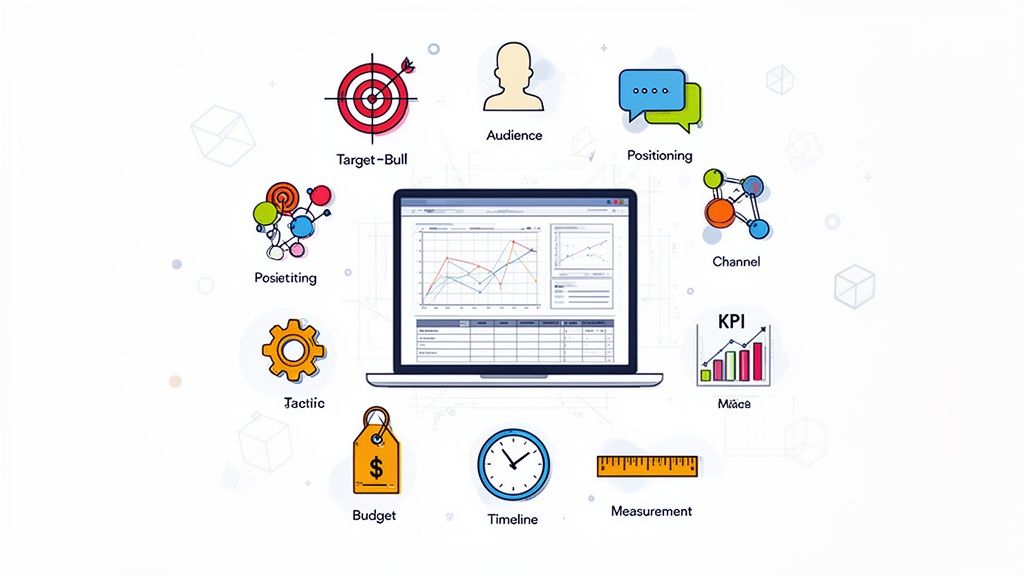

Building a successful business without a marketing plan is like trying to build a house without a blueprint. You might end up with something, but it’s unlikely to be sturdy, efficient, or what you truly envisioned. A comprehensive marketing plan is the strategic roadmap that guides every decision, campaign, and dollar spent, ensuring all efforts are aligned toward a common, measurable goal. It’s the critical tool that transforms reactive guesswork into a calculated, proactive strategy, systematically turning potential into profit. Without this foundational document, even the most creative campaigns can miss the mark, wasting valuable resources and time.
This guide provides a definitive breakdown of the essential parts of a marketing plan. We will move beyond abstract theory to deliver a comprehensive, ordered list of every component you need. For each part, you'll find clear definitions, actionable steps, practical examples, and the specific metrics required to measure success. We will dissect the ten core elements, from the high-level Executive Summary to the granular details of your Implementation Plan.
Think of this article as your master checklist for building a marketing engine that drives real results. You will learn not just what to include, but how to develop each section to create a cohesive, powerful, and executable strategy. Whether you're a startup founder sketching out your first go-to-market approach or a seasoned marketer refining your annual strategy, mastering these components is the first and most important step toward achieving predictable, scalable growth. Let’s dive into the anatomy of a plan that works.
1. Executive Summary
The Executive Summary is the gateway to your entire marketing plan. It’s a concise, high-level overview designed to give stakeholders a complete picture of your strategy without requiring them to read every page. Think of it as the elevator pitch for your plan; it must be compelling enough to secure buy-in and clear enough to stand on its own. Although it appears first, it should always be written last, after all other parts of a marketing plan are finalized.
This section synthesizes your research, goals, and planned activities into a digestible narrative. It provides a snapshot of the market opportunity, the core business objectives your marketing will support, a summary of key strategies, and the expected financial outcomes, including projected return on investment (ROI).

Actionable Implementation
To craft an effective executive summary, focus on clarity and impact. Distill the most critical information into a powerful, brief document.
- Micro-Template:
- Mission: State your marketing mission in one sentence. "Our goal is to increase market share by 15% among millennial consumers through targeted digital campaigns."
- Key Objectives: List 2-3 primary, quantifiable goals (e.g., increase lead generation by 40%, boost customer retention by 25%).
- Strategic Highlights: Briefly mention the core strategies you will use (e.g., content marketing, influencer partnerships, paid social media).
- Financial Projections: Include top-line numbers like the total marketing budget and projected ROI.
- Real-World Example: A SaaS company's executive summary might highlight its goal to acquire 5,000 new enterprise clients in the next fiscal year. It would briefly mention its strategy of leveraging account-based marketing and attending key industry trade shows, along with a projected 5:1 ROI on a $500,000 marketing budget.
Key Insight: The Executive Summary isn't just a summary; it's a persuasive tool. Use it to build confidence and demonstrate a clear path from investment to results before decision-makers even see the detailed tactics.
2. Market Analysis and Research (including Competitor Analysis)
Market Analysis and Research is the foundational stage where you map the terrain of your industry. It’s a deep dive into the market landscape, customer behaviors, and competitive forces that will shape your strategy. This analysis ensures your marketing efforts are grounded in reality, not assumptions, providing the data-driven insights needed to identify opportunities and mitigate risks. It’s one of the most critical parts of a marketing plan because it dictates your positioning and go-to-market approach.
This section systematically evaluates everything from market size and industry trends to customer demographics and psychographics. A significant component is a thorough competitor analysis, where you dissect your rivals' strategies, strengths, weaknesses, and market positioning. Companies like Netflix used this research to pivot from DVD rentals to streaming, identifying a massive, unmet consumer need for on-demand convenience.

Actionable Implementation
To build a robust market analysis, combine quantitative data with qualitative insights. The goal is to create a 360-degree view of your operating environment that directly informs your marketing decisions.
- Micro-Template:
- Market Overview: Define the market size, growth rate, and key trends. "The global SaaS market for project management is valued at $5.3B and is projected to grow 14% annually."
- Customer Profile: Detail your ideal customer demographics, needs, and pain points.
- SWOT Analysis: List your internal Strengths and Weaknesses and external Opportunities and Threats.
- Competitor Snapshot: Name 3-5 key competitors and summarize their primary strengths and weaknesses. A comprehensive competitor analysis framework can guide this process.
- Real-World Example: Airbnb’s market analysis identified a gap left by the traditional hotel industry. They recognized travelers were seeking authentic, local experiences at varied price points. Their competitor analysis revealed hotels’ weaknesses: standardized offerings and high operational costs. This insight allowed them to position themselves as a unique, community-driven alternative. For an in-depth competitor analysis, exploring the best competitor research tools can provide valuable insights into rival strategies.
Key Insight: Your market analysis isn't just a report; it's a strategic compass. Use it to find the uncontested market space where your brand can thrive and to anticipate competitive moves before they happen.
3. Target Audience and Buyer Personas
Your Target Audience and Buyer Personas are the foundation upon which your entire marketing strategy is built. This section moves beyond broad market segments to create detailed, semi-fictional profiles of your ideal customers. It involves deep analysis of demographic, psychographic, and behavioral data to ensure every marketing message, piece of content, and campaign resonates deeply with the people most likely to buy from you. These personas transform abstract data into relatable human stories.
Understanding these profiles is one of the most critical parts of a marketing plan because it dictates everything from your brand voice to your channel selection. Without a clear picture of who you're talking to, your marketing efforts will be generic, unfocused, and ineffective. A well-defined persona helps you step into your customer's shoes and address their specific needs, pain points, and motivations.

Actionable Implementation
To build effective personas, combine quantitative data with qualitative insights. Use analytics, surveys, and customer interviews to create a complete picture.
- Micro-Template:
- Background: Job title, career path, family life (e.g., "Marketing Manager at a mid-sized tech firm, married with two young children").
- Demographics: Age, gender, income, location.
- Goals & Challenges: List primary professional or personal goals and the pain points that prevent them from achieving them.
- Where They Learn: Identify their trusted sources of information (e.g., specific blogs, social media platforms, industry publications).
- Quotes: Include a real quote from a customer interview that captures their mindset. "I need a solution that saves me time and integrates with the tools I already use."
- Real-World Example: Mailchimp masterfully targets small business owners and entrepreneurs. Their personas likely include profiles like "Sarah the Solopreneur," a creative who needs simple, intuitive marketing tools to grow her online shop without a dedicated marketing team. This focus informs their user-friendly interface and encouraging brand voice.
Key Insight: Buyer personas are not static documents. They should be living profiles that you update annually or whenever you notice a significant shift in the market or your customer base. Base them on real data, not assumptions, to maintain their strategic value.
4. Value Proposition and Positioning
Your value proposition and positioning statement form the strategic core of your brand's identity. This crucial component of your marketing plan articulates the unique value you deliver to customers and carves out a distinct space for you in the marketplace. It answers the fundamental question: "Why should a customer choose you over the competition?" This isn't just a slogan; it's a clear, concise promise of the benefits customers will receive.
This section defines your brand’s competitive advantage and how you want it to be perceived. A strong positioning strategy, popularized by Al Ries and Jack Trout, ensures that all your marketing activities communicate a consistent and compelling message. Properly defining this is essential, as it guides everything from copywriting and visual design to channel selection, making it one of the most foundational parts of a marketing plan.
Actionable Implementation
To define your value and position, you must deeply understand your audience's needs and your competitors' weaknesses. The goal is to find an unoccupied, desirable, and defensible spot in the customer's mind.
- Micro-Template:
- Value Proposition Formula: For [Target Customer] who [has a specific need], [Your Brand/Product] is the [Product Category] that provides [Key Benefit/Unique Differentiator].
- Positioning Statement: Craft a 1-2 sentence internal statement that captures this. "For environmentally conscious commuters, Tesla is the premium electric vehicle that delivers cutting-edge technology and luxury performance without compromise."
- Key Differentiators: List 2-3 unique features or benefits that support your position (e.g., sustainable luxury, superior battery technology, autonomous driving features).
- Proof Points: Note key evidence to support your claims (e.g., industry awards, customer testimonials, performance data).
- Real-World Example: Dollar Shave Club positioned itself against giants like Gillette by focusing on convenience, value, and an irreverent brand personality. Its value proposition was simple: get high-quality razors delivered for a few bucks a month. This clear, benefit-driven positioning disrupted an entire industry.
Key Insight: A powerful value proposition focuses relentlessly on customer benefits, not just product features. Customers buy solutions to their problems, not a list of technical specifications. Make the "what's in it for me" crystal clear.
5. Goals and Objectives
The Goals and Objectives section is where your high-level business ambitions are translated into specific, measurable marketing targets. This component serves as the rudder for your entire strategy, providing clear direction and a benchmark for success. Without well-defined objectives, your marketing efforts risk becoming disconnected activities rather than a cohesive engine for growth. This is one of the most critical parts of a marketing plan because it ensures every tactic is purposeful and accountable.
This section defines what you aim to achieve, by how much, and by when. It moves beyond vague aspirations like "increase sales" to concrete targets, such as "generate 500 marketing-qualified leads per month in Q3." By establishing clear key performance indicators (KPIs) from the outset, you create a framework for tracking progress, justifying your budget, and demonstrating the tangible value of your marketing initiatives to the organization.
Actionable Implementation
To define effective goals, use a proven framework like SMART (Specific, Measurable, Achievable, Relevant, Time-bound) to ensure clarity and focus. Align every marketing objective directly with a broader business goal.
- Micro-Template:
- Business Goal: State the overarching company objective. "Increase total company revenue by 20% this fiscal year."
- Marketing Objective (SMART): Define the specific marketing goal that supports it. "Increase website conversion rates from 2% to 3.5% by the end of Q4 to support the revenue goal."
- Key Metrics: List the primary KPIs to track. (e.g., Conversion Rate, Cost Per Acquisition, Customer Lifetime Value).
- Timeline: Assign a clear start and end date for the objective. "October 1, 2024 – December 31, 2024."
- Real-World Example: An e-commerce brand wants to improve customer loyalty. Its SMART objective could be: "Increase the customer retention rate from 75% to 85% within 12 months by implementing a new loyalty program and personalized email marketing campaigns." This goal is specific, measurable, relevant to business health, and time-bound.
Key Insight: Your goals are not just targets; they are decision-making filters. When evaluating a new tactic or channel, ask a simple question: "Does this directly help us achieve one of our core objectives?" If the answer is no, it's a distraction.
6. Marketing Strategies and Tactics
This section is the heart of your plan, detailing the specific actions you will take to achieve your objectives. Marketing strategies are the high-level approaches you'll use to connect with your target audience, while tactics are the individual channels and methods that bring those strategies to life. This is where you move from the "what" and "why" to the "how," outlining the mix of digital, traditional, and social channels you will leverage.
Your strategies define the path, while your tactics are the footsteps you take along it. For instance, a strategy might be to establish industry authority, supported by tactics like publishing blog posts, hosting webinars, and securing guest speaking opportunities. Detailing these parts of a marketing plan ensures every activity is purposeful and aligned with your overarching goals. For developing effective approaches, reviewing robust content marketing strategy examples can provide valuable insights.
Actionable Implementation
To build this section, select a mix of channels that aligns with your audience's behavior and your campaign objectives. Don’t try to be everywhere; focus on where you can make the most impact.
- Micro-Template:
- Strategy 1 (e.g., Increase Brand Awareness):
- Tactic: Run paid social media campaigns on Instagram and LinkedIn.
- Tactic: Partner with micro-influencers in our niche.
- Tactic: Secure press mentions through targeted PR outreach.
- Strategy 2 (e.g., Generate High-Quality Leads):
- Tactic: Develop gated content (e-books, whitepapers) promoted via SEO.
- Tactic: Host monthly educational webinars.
- Tactic: Launch a targeted Google Ads campaign for high-intent keywords.
- Strategy 1 (e.g., Increase Brand Awareness):
- Real-World Example: Slack's strategy of product-led growth is executed through tactics like a freemium model that encourages organic adoption, content marketing that educates users on productivity, and community-building efforts to foster advocacy. This integrated approach turns product users into marketing assets.
Key Insight: Your strategies and tactics should not operate in silos. An effective plan integrates multiple channels to create a cohesive customer journey, where each touchpoint reinforces the others and moves the prospect closer to conversion.
7. Budget and Resource Allocation
The Budget and Resource Allocation section is the financial blueprint of your strategy, detailing exactly how funds will be distributed across various marketing activities. This is where your strategic goals meet financial reality, ensuring every dollar is assigned a purpose and is accountable for generating returns. It’s one of the most critical parts of a marketing plan because it provides the necessary framework for execution, prevents overspending, and aligns marketing investments with business priorities.
This section translates your ambitious goals into a practical, actionable spending plan. It outlines allocations for different channels, campaigns, technology, and personnel, providing a clear justification for the required investment. A well-defined budget not only secures necessary funding but also empowers your team to operate efficiently within set financial boundaries.
Actionable Implementation
To build a robust budget, you must ground your allocations in data and strategic priorities. Use historical performance to inform future spending while leaving room for innovation and adjustments.
- Micro-Template:
- Total Budget: State the total marketing budget for the period (e.g., quarter or year).
- Channel Allocation (%): Break down the budget by percentage for each primary channel (e.g., Paid Ads, Content/SEO, Events, Technology).
- Initiative Allocation ($): Assign specific dollar amounts to key campaigns or initiatives (e.g., Q3 Product Launch Campaign: $50,000).
- Contingency Fund: Set aside a percentage (typically 10-15%) for unforeseen opportunities or challenges.
- Real-World Example: A B2B technology company might allocate its $1M annual budget as follows: 35% to industry events and sponsorships ($350k), 30% to digital marketing including PPC and SEO ($300k), 20% to content creation and distribution ($200k), and 15% to public relations and marketing automation tools ($150k). This allocation directly supports its goal of generating enterprise leads and building brand authority.
Key Insight: Your budget isn't just a list of expenses; it's a statement of your strategic priorities. The 70/20/10 rule is a powerful guide: allocate 70% to proven, high-performing strategies, 20% to promising new tactics, and 10% to bold experiments.
8. Marketing Calendar and Timeline
The Marketing Calendar and Timeline is the operational blueprint that turns your strategy into a series of coordinated actions. It’s a detailed schedule outlining precisely when and where specific campaigns, content releases, and promotional activities will be executed. This critical component ensures every part of your team works in sync, prevents resource conflicts, and maintains a consistent, engaging presence across all customer touchpoints. It transforms abstract goals into a tangible, day-by-day roadmap for execution.
This timeline is one of the most practical parts of a marketing plan, as it forces you to think through dependencies and lead times. It provides a visual representation of your entire marketing year, allowing you to strategically place high-impact campaigns around key industry events, seasonal trends, and product launches while ensuring a steady drumbeat of activity in between.

Actionable Implementation
To build an effective marketing calendar, you must balance long-term planning with short-term flexibility. Map out major initiatives first, then fill in the gaps with ongoing activities.
- Micro-Template:
- Theme/Campaign: Name the overarching initiative (e.g., "Q4 Holiday Sale," "New Feature Launch").
- Key Channels: List the platforms involved (e.g., Email, Instagram, Google Ads, Blog).
- Timeline: Define start and end dates, including a pre-launch phase (e.g., "Pre-launch Buzz: Nov 1-15," "Launch: Nov 16-Dec 24").
- Key Assets: Specify the required creative assets (e.g., video ads, landing page, email sequence, blog posts). For more specific guidance on this, learn more about how to create a content calendar on reachlabs.ai.
- Real-World Example: A SaaS company's calendar would schedule a new product feature launch for Q2. It would block out two weeks in March for pre-launch webinars and influencer outreach, the first week of April for the official launch announcement via email and social media, and the rest of April for follow-up case studies and paid ad campaigns targeting trial sign-ups.
Key Insight: Your marketing calendar is a living document, not a static plan. Build in flexibility to pivot or capitalize on trending topics and unexpected opportunities. Regularly review and adjust it monthly to ensure it remains aligned with your real-time performance data and market dynamics.
9. Measurement, Analytics, and Reporting
Measurement, Analytics, and Reporting is the framework that holds your entire strategy accountable. This critical component moves marketing from an art to a science, providing the data needed to track performance, justify expenditures, and make intelligent, data-driven decisions. It is the feedback loop that tells you what’s working, what isn’t, and where to allocate resources for maximum impact. Without this, even the most creative campaigns are just shots in the dark.
This section of your plan outlines the specific Key Performance Indicators (KPIs) you will monitor, the tools you will use to collect data (like Google Analytics or HubSpot), and the reporting cadence you will follow to communicate results to stakeholders. It directly connects your day-to-day activities to your overarching business goals, making it one of the most essential parts of a marketing plan for demonstrating ROI and securing future budgets.
Actionable Implementation
To build a robust measurement framework, define what success looks like first, then choose the tools and processes to track it. Avoid vanity metrics and focus on data that informs action.
- Micro-Template:
- Primary KPIs by Goal: Link metrics directly to objectives. For a lead generation goal, track Cost Per Lead (CPL), Lead-to-Customer Conversion Rate, and Customer Acquisition Cost (CAC).
- Analytics Tools: List your technology stack (e.g., Google Analytics for web traffic, Salesforce for sales cycle data, Mixpanel for user behavior).
- Reporting Schedule: Define the frequency and audience (e.g., weekly internal team review of campaign metrics, monthly KPI dashboard for leadership, quarterly ROI report for executives).
- Tracking Protocol: Specify your standards, such as a consistent UTM parameter structure for all campaigns. For a deeper understanding, learn more about effective marketing campaign tracking.
- Real-World Example: An e-commerce brand's measurement plan would track metrics like Average Order Value (AOV), Customer Lifetime Value (CLV), and cart abandonment rate. They would use dashboards in Google Analytics and their e-commerce platform (like Shopify) to review performance daily, making real-time adjustments to ad spend and promotional offers based on the data.
Key Insight: Great measurement isn't about collecting the most data; it's about collecting the right data. Focus on metrics that directly correlate with revenue and business growth to transform your marketing department from a cost center into a profit driver.
10. Implementation Plan and Team Responsibilities
The Implementation Plan is where your strategy transforms into concrete action. It’s a detailed roadmap that breaks down your marketing initiatives into specific tasks, assigns ownership, sets timelines, and allocates resources. This section ensures that every team member knows exactly what they are responsible for, preventing ambiguity and ensuring accountability across all parts of a marketing plan. Without a clear implementation plan, even the most brilliant strategy will fail due to poor execution.
This component bridges the gap between high-level goals and day-to-day operations. It clarifies dependencies between tasks, outlines communication protocols, and provides a clear framework for project management. By defining who does what by when, you create a system that is transparent, coordinated, and geared for successful execution.
Actionable Implementation
To build an effective implementation plan, focus on clarity, detail, and assigning clear ownership for every single task.
- Micro-Template:
- Initiative: Content Marketing Campaign for Q3.
- Tasks & Deadlines:
- Blog Post Calendar (July 1): Content Writer
- Write 8 Blog Posts (July 1-31): Content Writer
- Design Social Graphics (August 5): Graphic Designer
- Schedule Social Posts (August 10): Social Media Manager
- Key Responsibilities:
- Marketing Manager: Overall campaign success and reporting.
- PPC Specialist: Manage ad spend for content promotion.
- Data Analyst: Track engagement and lead conversion metrics.
- Real-World Example: A B2B tech company launching a new software feature would use a project management tool like Asana or Trello. The plan would detail tasks for the Product Marketing Manager (messaging development), the Content Writer (blog posts and a whitepaper), and the PPC Specialist (LinkedIn ad campaign), with specific deadlines and dependencies clearly mapped out for a synchronized launch.
Key Insight: The Implementation Plan is the engine of your marketing strategy. Using a framework like a RACI (Responsible, Accountable, Consulted, Informed) matrix can eliminate confusion and empower your team by clarifying everyone's role in the successful execution of the plan.
Top 10 Marketing Plan Components Comparison
| Component | 🔄 Implementation complexity | ⚡ Resource requirements | 📊 Expected outcomes (⭐) | 💡 Ideal use cases |
|---|---|---|---|---|
| Executive Summary | Low — concise synthesis of full plan; writing skill required | Low — single author, minimal time | Quick executive alignment and buy‑in; ⭐⭐⭐⭐ | Stakeholder briefings, funding pitches, board summaries |
| Market Analysis and Research (including Competitor Analysis) | High — extensive data collection and interpretation | High — research budget, tools, analysts | Market opportunities, threats, benchmarks; ⭐⭐⭐⭐ | New market entry, strategic pivots, competitive positioning |
| Target Audience and Buyer Personas | Medium — segmentation and persona development | Medium — surveys, interviews, analytics | Better targeting and messaging; higher conversion; ⭐⭐⭐⭐ | Campaign targeting, content personalization, product‑market fit |
| Value Proposition and Positioning | Medium — strategic workshops and testing | Low–Medium — brand team, customer feedback | Clear differentiation and pricing justification; ⭐⭐⭐⭐ | Brand launches, re‑positioning, pricing strategy |
| Goals and Objectives | Low–Medium — SMART framing and alignment | Low — leadership input, baseline data | Measurable targets and accountability; ⭐⭐⭐ | KPI alignment, performance tracking, OKRs |
| Marketing Strategies and Tactics | High — multi‑channel planning and coordination | High — cross‑functional teams, campaign budgets | Channel reach, conversions, scalable campaigns; ⭐⭐⭐⭐ | Campaign execution, channel mix optimization |
| Budget and Resource Allocation | Medium — financial planning and trade‑offs | Medium — finance collaboration, historical data | Optimized spend and ROI comparisons; ⭐⭐⭐ | Annual planning, campaign funding decisions |
| Marketing Calendar and Timeline | Medium — scheduling and coordination | Low–Medium — PM tools, content resources | Timely execution and consistent engagement; ⭐⭐⭐ | Campaign scheduling, product launches, seasonal planning |
| Measurement, Analytics, and Reporting | High — attribution, data quality, modeling | High — analytics tools, dashboards, analysts | Actionable insights and ROI proof; ⭐⭐⭐⭐ | Optimization, budget reallocation, executive reporting |
| Implementation Plan and Team Responsibilities | Medium — role mapping and workflows (RACI) | Medium — team time, project management tools | Clear accountability and on‑time delivery; ⭐⭐⭐ | Operational execution, cross‑team coordination, task ownership |
From Plan to Performance: Activating Your Marketing Strategy
You have now journeyed through the 10 essential parts of a marketing plan, from the high-level Executive Summary to the granular details of your Implementation Plan. Each component, from Market Analysis and Target Audience Personas to your Budget and Measurement framework, serves a critical purpose. Together, they transform a collection of ambitious ideas into a structured, actionable roadmap for sustainable business growth.
The true power of this framework isn't in its completion, but in its activation. A marketing plan collecting dust on a shelf is a missed opportunity. Its value is unlocked when it becomes a living, breathing guide that informs every decision, from the copy on your next social media post to your quarterly budget allocation. Think of it less as a static map and more as a dynamic GPS, constantly recalibrating based on real-time data and market feedback.
Key Takeaways: From Blueprint to Action
To truly leverage the insights from this article, focus on these core principles:
- Integration is Non-Negotiable: The components are not isolated silos. Your Target Audience profile directly influences your Value Proposition, which in turn dictates your Marketing Strategies and Tactics. A change in one area must ripple through the others, ensuring your plan remains cohesive and internally consistent.
- Data is Your Co-Pilot: Intuition has its place, but data-driven decisions are what separate successful campaigns from expensive guesses. Your Measurement and Analytics section is the engine of your plan’s evolution. It tells you what’s working, what isn’t, and where to pivot for maximum impact.
- Agility Over Rigidity: The market doesn't stand still, and neither should your plan. Schedule regular reviews-monthly for tactics, quarterly for strategy-to assess performance against your Goals and Objectives. Be prepared to reallocate your budget, adjust your timeline, and test new channels based on what the data reveals.
Your Actionable Next Steps
With a clear understanding of the parts of a marketing plan, your next move is to put theory into practice. Don't let the scope of the task lead to paralysis. Instead, approach it methodically.
- Start with an Audit: Before building anew, assess what you already have. Do you have documented buyer personas? Is there a clear value proposition? Identify the gaps in your current strategy using the 10 components as your checklist.
- Prioritize and Build: You don't need to perfect every section overnight. Begin with the foundational elements: your Market Analysis, Target Audience, and Goals. These pillars will provide the strategic direction needed to flesh out the remaining parts of your plan.
- Assign Ownership: A plan without owners is a plan destined to fail. Use the Implementation and Team Responsibilities section to assign clear accountability for each tactic and key performance indicator. When everyone knows their role, execution becomes seamless.
Ultimately, mastering these components empowers you to move beyond reactive marketing and into the realm of proactive, strategic growth. It provides the clarity to say "no" to distracting opportunities and the confidence to invest heavily in what works. By building and diligently executing a comprehensive marketing plan, you are not just creating campaigns; you are building a predictable engine for revenue and a resilient brand that can thrive in any market.
Feeling overwhelmed by the sheer scope of building and executing a winning strategy? The team at ReachLabs.ai specializes in transforming these complex parts of a marketing plan into a cohesive, data-driven growth engine for your business. Let our experts handle the heavy lifting, from market research to campaign execution, so you can focus on what you do best. Visit us at ReachLabs.ai to learn how we can build your roadmap to measurable success.