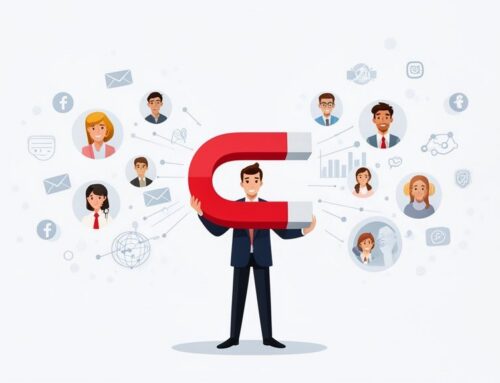
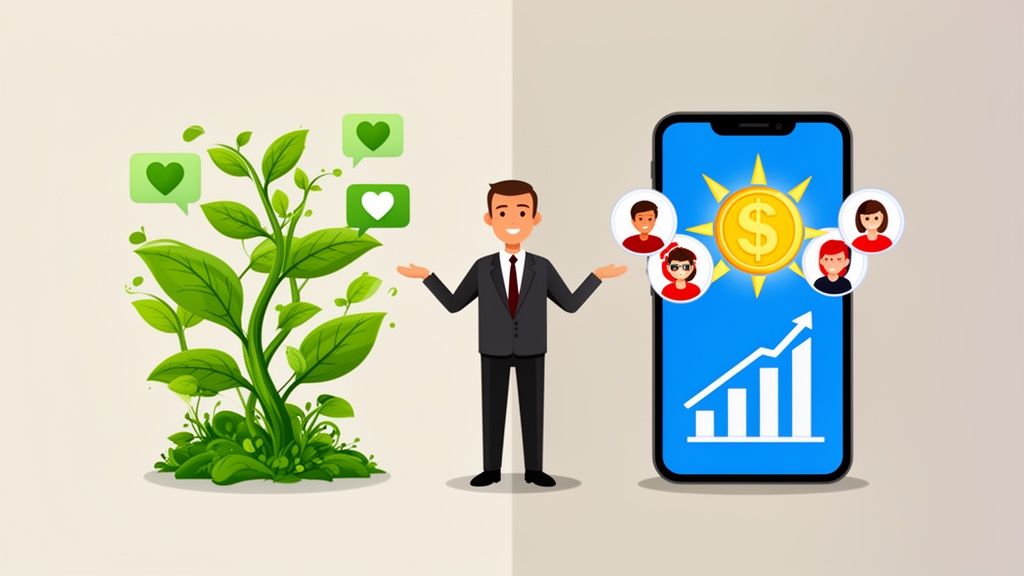
The real conversation around organic vs. paid social media isn't about picking a side. It's about knowing when to use each tool. Think of it this way: organic social is your brand's personality—it builds trust and community over the long haul. Paid social is the turbo-boost, giving you immediate, targeted reach to generate leads and drive sales. In today's climate, you can't just rely on one; you need both working in harmony.
The New Social Media Reality
If you were marketing on social media a decade ago, things were a lot simpler. You built a following, posted content, and most of your followers saw it. Those days are long gone. The game has completely changed, thanks to algorithms that now heavily favor paid content and posts from friends and family over brand updates.
This shift means we have to be smarter. The hard truth is that organic reach has cratered. Most brand pages on major platforms only see about a 5 to 7 percent organic reach rate. That means if you have 10,000 followers, your non-promoted post might only land in front of 500-700 of them. This reality check makes it crystal clear: a modern strategy has to blend consistent organic efforts with a smart paid media budget to get seen.
Quick Comparison Organic vs Paid Social Media At a Glance
To really get a handle on this, it's helpful to see the two approaches laid out side-by-side. They serve different purposes but are incredibly powerful when they support each other. Getting these core differences is the first step to building a truly effective, integrated strategy. Our guide on what organic social media is offers a deeper look into the foundational principles.
| Attribute | Organic Social Media | Paid Social Media |
|---|---|---|
| Primary Goal | Build brand trust, foster community, and nurture relationships. | Drive conversions, generate leads, and achieve rapid reach. |
| Cost Structure | No direct ad spend; costs are in time, labor, and creative tools. | Direct ad spend is required; budget is scalable. |
| Audience | Primarily reaches existing followers and their networks. | Targets specific new audiences based on detailed demographics. |
| Timeline | Long-term strategy focused on gradual, sustainable growth. | Short-term focused, designed for immediate, measurable results. |
| Content Focus | Value-driven, authentic content (educational, entertaining). | Action-oriented, promotional content with clear calls-to-action. |
As you can see, this isn't an either/or debate. It's about when and why you use each one. Organic is the foundation—it’s how you build a genuine connection. Paid is the megaphone—it ensures the right people hear your message at exactly the right moment. And if you need expert help managing that megaphone, services like Done For You Ads can take the weight off your shoulders.
Comparing Key Strategic Differences
The whole organic vs. paid social media debate isn't about picking a winner. It's about knowing which tool to use for which job. Think of it this way: organic social is like building your brand's house, brick by brick. It’s the foundation. Paid social is like throwing a massive house party and sending out invitations to thousands of specific guests. You need both the house and the party to really make an impact.
Each approach serves different business goals and operates on its own timeline. Organic is your long game—a slow, steady investment in brand equity and trust. Paid is your accelerator, built for hitting specific, short-term targets. This decision tree is a great way to visualize how your main objective, whether it's building authority or driving sales, points you toward one path or the other.
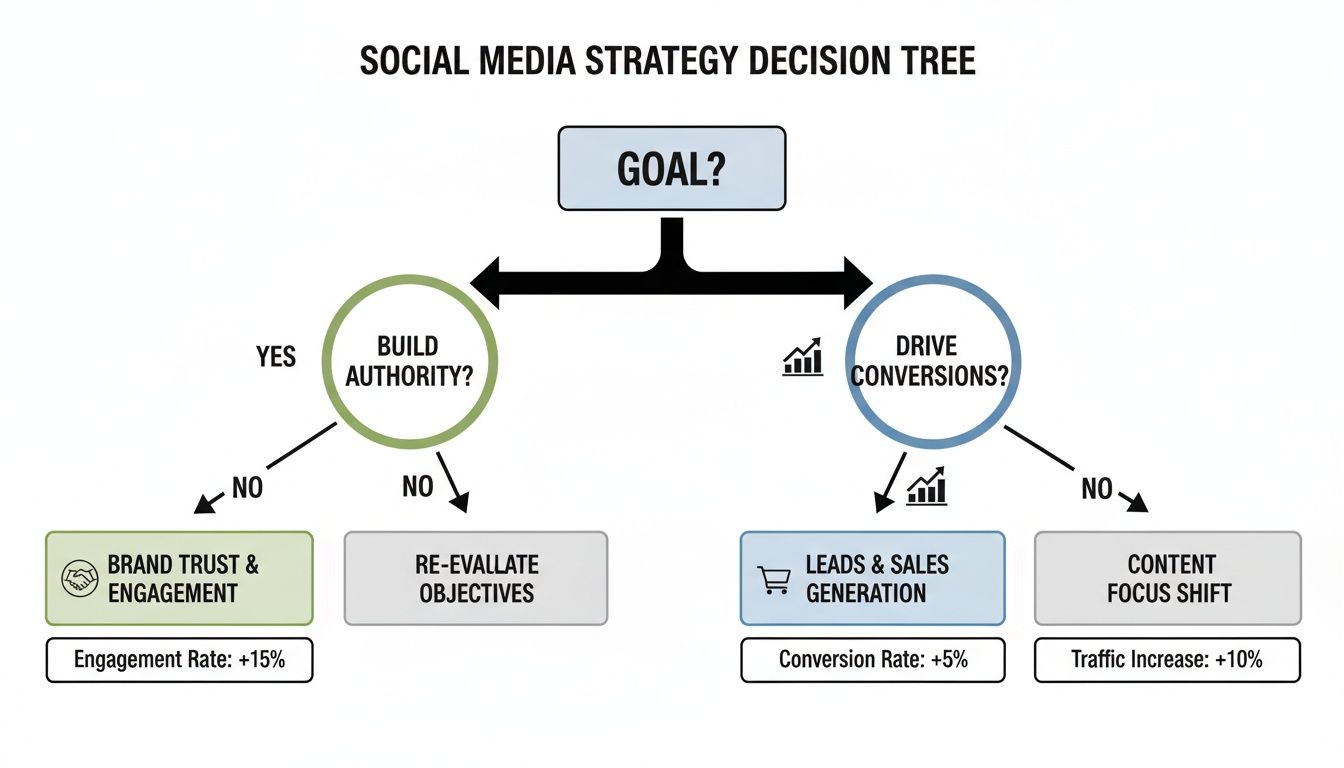
As you can see, the path splits clearly. Organic work is fundamental for establishing your voice and community, with success measured by engagement. Paid campaigns, on the other hand, are engineered to turn that interest into action—things you can count, like leads and sales.
Goals and Timelines
When you stack organic and paid social against each other, the biggest divide is in their goals and the speed at which you see results. Organic is a marathon, not a sprint. The whole point is to cultivate a real community, define your brand’s personality, and build trust that lasts.
You measure success here over months, even years, by looking at things like follower growth, engagement rates, and how people feel about your brand. It's the consistent, patient work of sharing valuable stuff that isn't just one big sales pitch.
Paid social works on a totally different clock. It’s built to get you quick, measurable wins. Need to generate leads for an upcoming webinar? Drive sales for a new product? Get a flood of traffic to a landing page? Paid campaigns can deliver highly targeted people almost instantly.
Key Insight: Organic social builds an audience; paid social activates it. Organic nurtures the relationships that make your paid ads more powerful because they're hitting an audience that already knows and trusts you.
Cost and Resource Allocation
It’s easy to think of organic social as "free," but that's a dangerous misconception. Sure, you're not paying for ad space, but it comes with some serious hidden costs in time, talent, and tools.
Organic Cost Breakdown:
- Time and Labor: This is the big one. It takes hours upon hours of planning, creating content, managing the community, and digging into the analytics.
- Creative Tools: Subscriptions for design software like Canva or Adobe, video editing apps, and scheduling platforms like Buffer all have a price tag.
- Talent: A good social media manager isn't cheap. You’re paying for expertise, and that's a real cost.
Paid social has a much clearer price tag—you pay the platform directly to show your ads. The budget can be scaled up or down and is directly tied to how many people you reach. But don't forget, you still have costs beyond the ad spend, like creating the ad visuals and paying someone to manage the campaign. You can dive deeper into building smart campaigns in our guide to social media advertising strategies.
The real difference comes down to how you track the return. The ROI on organic is often indirect, showing up in long-term brand health and customer loyalty. Paid ROI is direct and easy to calculate with metrics like Return On Ad Spend (ROAS) and Cost Per Acquisition (CPA).
Audience Targeting and Reach
This is where organic and paid social truly go their separate ways. Your organic reach is pretty much capped at your existing followers and maybe a few of their friends if your content gets shared. You’re talking to a room full of people who already opted in.
That’s fantastic for deepening relationships but not so great for reaching brand-new customers at scale. Your growth is at the mercy of algorithms, hashtags, and shares—all of which can be wildly unpredictable.
Paid social, in contrast, hands you a megaphone and a laser pointer. You can step way outside your follower bubble to reach entirely new groups of people based on incredibly specific criteria.
Examples of Paid Targeting Parameters:
- Demographics: Zero in on users by age, gender, location, language, or even their job title.
- Interests: Find people based on their hobbies, the pages they follow, and the posts they interact with.
- Behaviors: Target users based on their online shopping habits, what device they’re on, or recent life events like getting engaged.
- Retargeting: Serve ads directly to people who have already visited your website, added an item to their cart, or watched one of your videos.
This kind of surgical precision means your budget isn’t wasted on people who don't care. You’re spending money to reach individuals who are most likely to be interested in what you have to offer, which makes paid social an absolutely essential tool for growth.
Measuring Success and Attributing Real Value
Figuring out what "success" looks like for organic and paid social requires two completely different mindsets and toolkits. They both drive business, no doubt, but they take very different roads to get there. If you can't measure each one accurately, you can't prove its value or make smart decisions about where to put your money.
With organic, you're playing the long game. Success is all about the health of your community and the influence of your brand's voice. It's less about the immediate sale and more about building a loyal following that genuinely trusts you and wants to hear from you.
Paid social, on the other hand, is a direct-response discipline. It’s all about immediate, clear financial returns. Every single dollar you spend is tied to a specific, measurable action, giving you a near-instant read on performance. The numbers are clean, direct, and tied straight to revenue.
Defining Your Key Performance Indicators
The first step to getting this right is picking the right Key Performance Indicators (KPIs) for each channel. If you mix them up, you’ll end up with a muddled picture of what’s actually working. You wouldn't judge a world-class sprinter on their marathon time, right? Same logic applies here.
For your organic efforts, you need to focus on metrics that truly reflect audience connection and brand health. These numbers tell you if your content is actually hitting the mark and building a real community.
Essential Organic Social Metrics:
- Engagement Rate: This is your pulse check. It shows how many people are actually interacting with your content (likes, comments, shares, saves) relative to your audience size. It's the most honest measure of content quality.
- Community Growth: A steady, authentic increase in followers is a clear sign that your content is attracting the right people and your brand's influence is expanding.
- Brand Sentiment: This is a bit more qualitative but incredibly important. Are the comments and mentions about your brand positive, negative, or just neutral? This tells you how people feel about you.
Paid social KPIs are a different beast entirely—they're all about efficiency and profitability. These metrics tell you in no uncertain terms if your ad spend is delivering real business outcomes. You can learn more about tying these efforts directly to revenue in our guide on how to measure social media ROI.
Critical Paid Social Metrics:
- Return On Ad Spend (ROAS): This is the big one. For every dollar you put into ads, how many dollars in revenue are you getting back? It’s the ultimate measure of profitability.
- Cost Per Acquisition (CPA): How much does it cost you, on average, to get a new customer through your ads? Knowing this number is vital for scaling profitably.
- Click-Through Rate (CTR): This shows what percentage of people who saw your ad actually clicked on it. It’s a great way to gauge whether your creative and copy are compelling enough to stop the scroll.
Building a Practical Attribution Framework
One of the biggest headaches in the organic vs. paid debate is attribution—figuring out who gets the credit for a conversion. A customer might see your paid ad on Monday, follow you organically on Tuesday, browse your posts for a week, and then finally buy through an email link. So, which channel was responsible?
The Attribution Trap: A classic mistake is giving all the credit to the last click, which is usually a paid ad. This completely ignores the vital groundwork laid by organic content—the posts that built the initial trust and awareness that made the final click happen in the first place.
To get a more realistic view, you need a simple framework that traces the customer’s entire journey. Using a few key tools can help you see how organic and paid work together to guide someone from prospect to customer.
Tools for Better Attribution:
- UTM Parameters: Think of these as little tracking codes you add to your URLs. They tell your analytics software exactly where a visitor came from. You can create unique UTMs for every paid campaign and even for specific links in your organic posts to get a crystal-clear picture of your traffic sources.
- Platform Pixels: Installing a tracking pixel from Meta (for Facebook and Instagram) or TikTok on your website is non-negotiable. It allows the platforms to track conversions that happen after someone sees or clicks on your ad, giving you the data you need to optimize your campaigns for what actually works.
Building an Integrated Social Media Strategy
The whole "organic vs. paid" debate completely misses the point. They aren't rivals fighting for your budget; they're two sides of the same coin. The smartest brands I've seen treat them as a single, powerful marketing engine where one hand washes the other. It’s about creating a symbiotic relationship, where your organic efforts make your paid ads smarter, and your paid ads make your organic reach bigger.
Think of it like this: your organic social is where you build trust and community. It’s your home base, where you define your brand’s personality and share real value without constantly asking for the sale. Paid social is the megaphone. It takes the best of what you've built on your home turf and blasts it out with surgical precision to the exact people you want to reach.
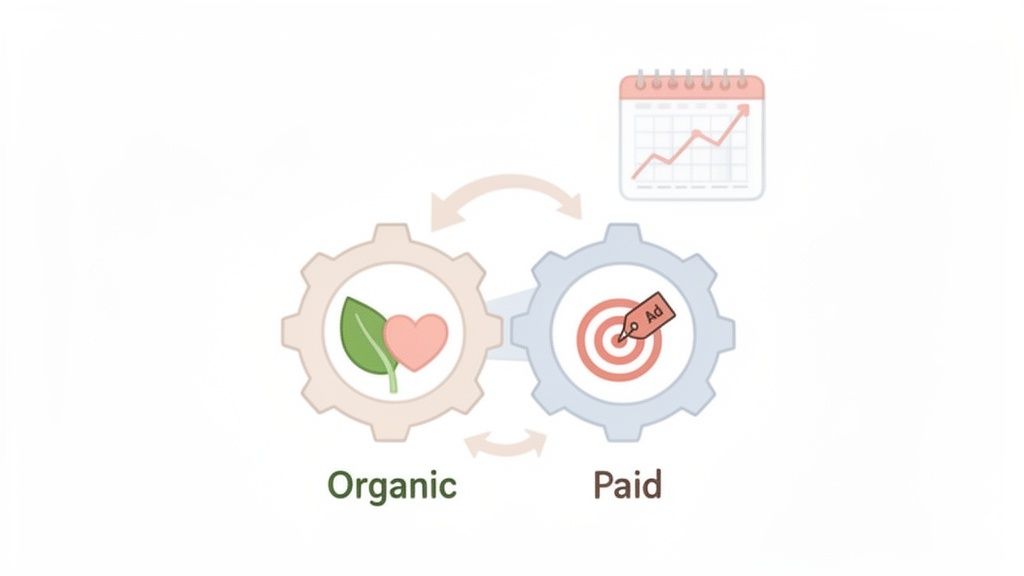
This feedback loop is where the real magic happens. Your organic content gives you raw, unfiltered data on what your audience actually cares about. Your paid campaigns then give you the fuel to pour on those fires, scaling your successes and growing your organic community faster than you ever could on your own.
Creating a Synergistic Marketing Engine
Making this work requires a mental shift. Stop thinking of them as two separate channels with two separate to-do lists. Instead, see them as a continuous cycle where insights from one directly feed the strategy for the other. To really succeed, you need to master both organic tactics and paid ad strategies and know when to use each.
One of the simplest and most effective ways to start is by using your organic feed as a low-cost testing lab. Pay close attention to your engagement metrics. Which posts are getting the most shares, comments, and saves? This isn't just about feeling good; it’s your audience telling you exactly what they want to see.
Key Insight: Your top-performing organic posts aren't just successful content—they are pre-validated ad concepts. Promoting a post that already has proven engagement dramatically lowers your risk and almost always leads to a higher Return On Ad Spend (ROAS).
This simple process creates a powerful, repeatable cycle:
- Publish Organically: Consistently share valuable, interesting content to build and nurture your community.
- Identify Winners: Dig into your analytics and find the posts with the highest engagement rates.
- Amplify with Paid: Put ad spend behind these proven winners to get them in front of a much wider, targeted audience.
Following this workflow ensures you’re only spending money on content you already know works. It’s the most efficient way to use every single ad dollar.
Leveraging Paid Ads for Organic Growth
While organic content can fuel paid success, the street goes both ways. A huge mistake I see people make is thinking paid ads are only for direct conversions. Yes, they’re great for that, but they're also an incredible tool for jump-starting your organic community growth.
For instance, you can run targeted ad campaigns with the sole objective of growing your followers. By serving these ads to lookalike audiences based on your most engaged fans, you can attract new people who are highly likely to be interested in your organic content for the long haul.
This strategy is a game-changer for new brands or businesses trying to crack a new market. It provides that initial momentum needed for your organic strategy to grab hold and start building on its own.
The Power of Integrated Retargeting
Retargeting is where the synergy between organic and paid really shines. Your organic content warms people up and builds that crucial familiarity and trust. When someone likes, comments, or watches a video you posted, they're raising their hand and signaling interest.
This is a golden opportunity. You can create custom audiences in your ad platforms made up of people who have recently engaged with your organic posts. Then, you serve them highly relevant paid ads designed to move them to the next step—maybe a free trial, a product demo, or a special offer.
This approach is so effective because you're not shouting at strangers. You're talking to people who already know you and have shown they're interested. It perfectly bridges the gap between community building and closing the sale.
Your Implementation Checklist for a Balanced Strategy
Knowing the difference between organic and paid social is one thing; putting it all into practice is another. Let's walk through how to actually build a strategy that works, moving from theory to real-world execution. This isn't just a list—it's a roadmap for creating a social media machine that drives real growth.
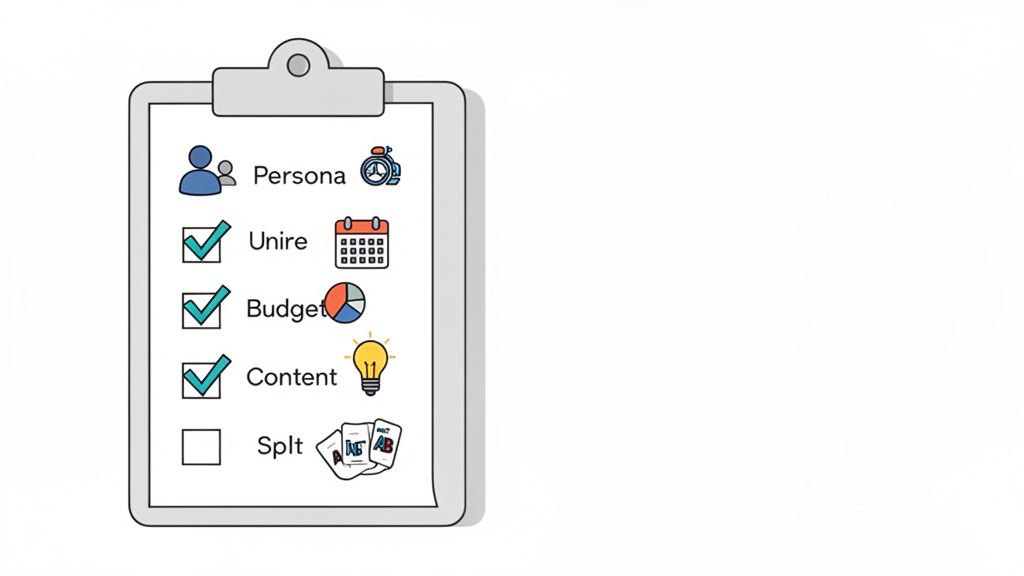
Stage 1: Foundational Planning
Before you write a single post or boost a campaign, you need to get your foundation right. Skipping this part is like building a house on sand—it’s a surefire way to waste time and money later.
Define Separate, Measurable Objectives: What does success actually look like for each channel? Be specific. Your organic goal might be to increase follower count by 15% in Q3 or hit a 4% average engagement rate. Paid goals are usually tied directly to revenue, like generating 50 qualified leads per month or achieving a 3x Return On Ad Spend (ROAS).
Develop Detailed Audience Personas: Don't just settle for "women, 25-40." Dig deeper. What are their real pain points? What motivates them? Where do they hang out online? A single persona can be approached in two ways: engage them organically with helpful, top-of-funnel content, and then run targeted paid ads that solve their specific, immediate problem.
Stage 2: Content and Budget Allocation
With your goals and audience locked in, it's time to map out your content and figure out where the money goes. This is where organic and paid start working together, creating a system where each side lifts the other up.
Create a Unified Content Calendar: Your calendar should lay out both your organic posts and your paid campaigns. Think about how content can be repurposed. For instance, a series of organic posts breaking down a complex topic can easily be bundled into a handy e-book, which you then promote with paid ads. It creates a smooth, logical journey for your audience.
Determine Your Initial Budget Split: There's no single perfect ratio, but a great starting point is the 80/20 rule: 80% of your social media budget goes toward paid ads, while the other 20% is invested in high-quality tools and resources to support your organic efforts. You can always adjust this based on what the performance data tells you.
Key Takeaway: Organic social media is never truly "free." That 20% allocation needs to cover essentials like good creative tools, scheduling software like Buffer or Hootsuite, and, most importantly, the human hours needed for community management and creating great content.
Stage 3: Execution and Optimization
Now it’s time to launch. But remember, execution without optimization is just guessing. This final stage is all about putting your plan into action, measuring everything, and constantly tweaking your approach based on real data.
Select Your Essential Tools: Give your team the right tech. At a minimum, you'll need a solid scheduling tool for organic consistency. For paid, you'll live inside the native ad managers like Meta Business Suite or LinkedIn Campaign Manager to track every penny and its return.
Establish a Simple A/B Testing Framework: Never assume you know what will perform best. Get in the habit of constantly testing different parts of your paid campaigns. It doesn't have to be complicated.
- Ad Creative: Pit a video against a static image.
- Ad Copy: Test a short, punchy headline against a longer, story-driven version.
- Call-to-Action (CTA): See what works better—"Learn More" or "Shop Now"?
By following this checklist, you stop thinking in terms of "organic vs. paid" and start building a single, integrated system where every part works together to grow your business.
Frequently Asked Questions About Organic and Paid Social Media
If you're trying to wrap your head around organic and paid social media, you're not alone. Marketers and business owners constantly grapple with these questions. Let's tackle some of the most common ones to help you sharpen your strategy.
Can I Really Get by With Just an Organic Strategy?
The short answer? It’s incredibly tough these days. Back in the day, you could post something and be reasonably sure most of your followers would see it. Those days are long gone.
Today, organic reach on platforms like Facebook and Instagram is in the basement, often hovering between a measly 5% and 7%. Think about that: for every 100 people who chose to follow you, only five or seven might see your post. That makes an organic-only approach a shaky foundation for anything that requires consistent results, like generating leads or driving sales.
An organic-only game plan is fantastic for building a genuine community, honing your brand's voice, and taking care of your existing customers. But if you need predictable growth or immediate action, it just won't cut it.
The Verdict: For almost any business serious about growth, a hybrid strategy isn't just a good idea—it's essential. Use paid ads to put rocket fuel behind your best organic content and get in front of fresh, targeted audiences. Combining the two is the only reliable way to see a meaningful return on your efforts.
As a Small Business, How Much Should I Actually Budget for Paid Social?
There's no magic number here. A better approach than just picking a figure out of thin air is to tie your budget directly to your goals.
Try working backward. Let’s say you want to generate 20 new leads this month. If you look at your data and see that a lead typically costs you about $25, you have a logical starting point for your budget.
A Quick Goal-Based Budget Calculation:
- Your Target: 20 leads per month
- Your Estimated Cost Per Lead (CPL): $25
- Your Starting Monthly Budget: 20 leads × $25/lead = $500
As a general rule of thumb, many businesses allocate 10-20% of their total marketing budget to paid social. But when you're starting out, it’s smart to begin with a smaller test budget. Give it a month or two. See which ads, audiences, and platforms are actually working. Once you've found your winners, you can scale up your spending with confidence, knowing your money is going to the channels that deliver the best return on ad spend (ROAS).
Which Social Media Platform Is the Best for a Hybrid Strategy?
The "best" platform is wherever your customers are hanging out. The goal is to pick a place where your organic and paid efforts can feed off each other naturally.
Every platform has its own vibe and purpose, so the right choice really depends on who you're trying to reach and what you're selling.
Matching the Platform to Your Business:
For B2B Companies: LinkedIn is almost always the answer. The whole platform is designed for professional networking and thought leadership. You can build authority with great articles and company news, then layer in highly specific ads that target people by job title, industry, or company size. It’s a goldmine for quality leads.
For B2C E-commerce & Visual Brands: Your best bet is usually Instagram and Facebook. These platforms are all about visuals. You can build a stunning brand organically with Reels, Stories, and beautiful photos, while their powerful ad tools let you target customers based on their interests and behaviors to drive sales directly.
For Brands Targeting a Younger Crowd: TikTok is the place to be. Organic success there is all about jumping on trends and creating authentic video content that doesn't feel like an ad. Then, you can use paid campaigns to boost a video that's starting to take off or to target users who are engaging with similar content.
At the end of the day, the strongest hybrid strategies are built on the platforms where your audience already lives. The key is to create organic content they genuinely want to see and run paid ads that feel like a helpful and relevant extension of that experience.
At ReachLabs.ai, we live and breathe this stuff. We create integrated marketing strategies that blend data-driven paid campaigns with authentic organic content to help brands grow. Find out how our full-service approach can build a powerful, balanced strategy for your business at https://www.reachlabs.ai.