

A powerful marketing plan is not just a document; it's a strategic blueprint that guides every decision, campaign, and investment. Without a clear structure, even the most creative efforts can feel like shots in the dark, yielding unpredictable and often disappointing results. The secret to sustainable, predictable growth lies in understanding each essential marketing plan component and how they interlock to create a cohesive, data-driven strategy.
Whether you're a startup seeking funding, a small business aiming for scalable growth, or an established brand looking to optimize your approach, mastering these foundational elements is non-negotiable. A well-defined plan aligns your team, justifies your budget, and provides a clear benchmark against which to measure success. It transforms abstract goals into an actionable roadmap, ensuring that every dollar spent and every hour worked contributes directly to your most important objectives.
This comprehensive guide will break down the eight fundamental pillars of a winning marketing plan. We will move beyond theory and provide the practical details you need to build a robust strategy from the ground up. You will find actionable examples, prioritization guidance, and key metrics for each critical marketing plan component, empowering you to build a plan that not only looks good on paper but delivers tangible, measurable results for your business. Let's dive into the components that will build your blueprint for unstoppable growth.
1. Executive Summary
The Executive Summary is the cornerstone of any strategic document, serving as a concise, high-level overview of your entire marketing plan. Although it appears first, it should be the last marketing plan component you write. Its purpose is to provide busy stakeholders, from C-suite executives to potential investors, with a snapshot of your objectives, core strategies, and anticipated outcomes without requiring them to read the full document. It sets the stage, establishes credibility, and is critical for securing initial buy-in.
For an agency like ReachLabs.ai, this section is particularly vital. It's where they articulate the client’s current market position, distill complex challenges into clear problems, and introduce their integrated, data-driven approach. A compelling summary demonstrates a deep understanding of the client’s business and aligns everyone around a unified vision for success.
Why It's an Essential Marketing Plan Component
The Executive Summary acts as both a gateway and a standalone document. If it fails to capture attention and communicate value, the detailed work in the rest of the plan may never be reviewed.
- Secures Stakeholder Buy-in: Executives often lack the time to delve into every detail. A powerful summary gives them the confidence to approve your proposed strategy and budget.
- Provides Clarity and Alignment: It ensures all teams, from sales to product development, understand the marketing department’s primary goals and how they contribute to the broader business objectives.
- Acts as a Quick Reference: It serves as a go-to document for anyone needing a quick reminder of the marketing strategy's core elements, mission, and key performance indicators.
Actionable Tips for Implementation
To craft an Executive Summary that commands attention, follow these best practices:
- Write It Last: Once you've finalized every other section of your marketing plan, distill the most critical information into a powerful, condensed narrative.
- Focus on Key Metrics: Replace vague statements with concrete figures. Instead of "increase brand awareness," use "achieve a 25% increase in social media engagement and a 15% lift in direct website traffic in Q3."
- Keep It Concise: Aim for one to two pages maximum. Use clear, direct language and avoid industry jargon that non-marketing executives might not understand.
- Highlight the 'Why': Clearly state the business problem or opportunity your plan addresses. Frame your strategy as the definitive solution. For agencies, this is the place to underscore your unique value proposition, such as how ReachLabs.ai combines proprietary analytics with creative execution to deliver superior ROI.
2. Market Analysis & Competitive Landscape
The Market Analysis and Competitive Landscape section is the investigative core of your marketing plan. It provides the essential context and data-driven foundation for all subsequent strategies. This marketing plan component involves a deep dive into your industry, including market size, growth trends, customer behaviors, and, crucially, a thorough examination of your competitors. It's about understanding the environment you operate in to identify opportunities, anticipate threats, and carve out a unique space for your brand.
For a data-centric agency, this analysis is non-negotiable. It's where they justify strategic recommendations, moving beyond assumptions to build a plan rooted in verifiable market realities. By benchmarking against competitors and understanding industry trends, businesses can pinpoint market gaps and determine where marketing investments will generate the highest returns. This analysis ensures your strategy is not developed in a vacuum but is instead a direct response to the real-world competitive environment.
Why It's an Essential Marketing Plan Component
A robust market analysis prevents costly missteps and aligns your strategy with genuine market opportunities. It is the difference between guessing what customers want and knowing what they need and how your competitors are failing to provide it.
- Identifies Opportunities and Threats: It uncovers "white-space" opportunities, such as underserved customer segments or competitor weaknesses, while also flagging potential market threats like new entrants or shifting consumer preferences.
- Informs Strategic Positioning: Understanding how competitors position themselves allows you to define a unique and compelling brand position that resonates with your target audience and differentiates you from the crowd.
- Justifies Strategic Decisions: This analysis provides the evidence needed to secure budget and stakeholder support. Data on market size and growth trends can validate the potential ROI of your proposed marketing initiatives.
Actionable Tips for Implementation
To conduct a market and competitive analysis that yields powerful insights, follow these steps:
- Use a Mix of Research: Combine primary research (customer surveys, interviews) with secondary sources (industry reports, government data). This provides a holistic view of the market.
- Leverage Digital Tools: Employ tools like SEMrush, Ahrefs, and SimilarWeb for detailed competitive benchmarking. Analyze their website traffic, keyword strategies, backlink profiles, and social media performance.
- Create a SWOT Analysis: For each major competitor, document their Strengths, Weaknesses, Opportunities, and Threats. Focus specifically on weaknesses that your business can exploit.
- Stay Current: Markets are dynamic. Plan to update your analysis at least quarterly to stay ahead of shifts in technology, consumer behavior, and competitive tactics. An agency like ReachLabs.ai would continuously monitor these trends for their SaaS clients to adapt strategies in real-time.
3. Target Audience & Buyer Personas
Defining your Target Audience is the process of identifying the specific group of consumers most likely to want your product or service. Going a step further, Buyer Personas are detailed, semi-fictional representations of your ideal customers based on market research and real data. This foundational marketing plan component moves your focus from a faceless crowd to relatable individuals, ensuring every marketing decision is made with the customer in mind. It dictates everything from messaging and tone to channel selection and content strategy.

For an agency like ReachLabs.ai, this is where strategy begins. By leveraging demographic and psychographic data, they can build highly accurate client profiles that inform every aspect of a campaign. Understanding an audience’s pain points, goals, and decision-making habits prevents wasted marketing spend and ensures resources are precisely targeted at high-value prospects who are ready to convert.
Why It's an Essential Marketing Plan Component
Without a deep understanding of who you're talking to, your marketing messages are likely to fall on deaf ears. Defining your audience and personas is the difference between shouting into the void and having a meaningful conversation.
- Enables Personalization: It allows you to tailor your messaging, content, and offers to the specific needs and motivations of different audience segments, dramatically increasing relevance and engagement.
- Improves Channel Strategy: Knowing where your ideal customers spend their time online (e.g., LinkedIn, TikTok, industry forums) helps you allocate your budget to the most effective channels.
- Guides Product Development: Insights gathered from personas can highlight unmet needs or frustrations, providing valuable feedback that can inform future product features and improvements.
Actionable Tips for Implementation
To build personas that truly guide your strategy, move beyond basic demographics and uncover the human element.
- Conduct Real Interviews: Don't rely on assumptions. Talk to your best customers, prospects, and even your sales team to gather firsthand insights into their goals, challenges, and buying processes.
- Focus on 3-5 Primary Personas: Avoid creating too many personas, which can dilute your focus. Concentrate on the core segments that represent the bulk of your target market.
- Map Out Pain Points and Objections: What problems are they trying to solve? What stops them from buying? Addressing these directly in your marketing will build trust and overcome barriers.
- Humanize Your Personas: Give them a name, a job title, and a photo. For agencies like ReachLabs.ai, sharing these relatable profiles across teams ensures everyone, from copywriters to ad specialists, maintains a consistent, customer-centric focus.
4. Marketing Goals & Key Performance Indicators (KPIs)
Marketing Goals define what you aim to achieve, while Key Performance Indicators (KPIs) are the specific metrics you use to track progress toward those goals. This component translates high-level business objectives into tangible marketing outcomes, creating a framework for accountability and data-driven optimization. By setting clear, measurable targets, you transform your marketing strategy from a set of activities into a results-oriented engine for growth.
For an agency focused on data, like ReachLabs.ai, this is a non-negotiable marketing plan component. It's how they demonstrate campaign impact, justify investment, and pivot strategies based on real-time performance. Goals must be SMART (Specific, Measurable, Achievable, Relevant, Time-bound), ensuring every marketing action is purposeful and directly contributes to the bottom line.
Why It's an Essential Marketing Plan Component
Without clear goals and KPIs, your marketing efforts are just shots in the dark. This section provides direction, proves value, and enables continuous improvement.
- Ensures Strategic Alignment: It directly connects marketing activities to broader business objectives, like revenue growth or market expansion, ensuring everyone is working toward the same ultimate purpose.
- Enables Performance Measurement: KPIs provide the hard data needed to evaluate success. You can definitively answer whether your campaigns are working and by how much.
- Drives Accountability and Optimization: When goals are defined, teams are accountable for hitting them. Tracking KPIs allows for agile adjustments, reallocating budget from underperforming channels to those delivering the best ROI.
Actionable Tips for Implementation
To set goals and KPIs that truly drive performance, follow these guidelines:
- Use the SMART Framework: Ensure every goal is Specific (e.g., "increase MQLs"), Measurable ("by 20%"), Achievable (based on historical data), Relevant (to revenue), and Time-bound ("in Q4").
- Distinguish Goals from KPIs: A goal is the outcome (e.g., improve customer retention). The KPIs are the metrics that track it (e.g., churn rate, customer lifetime value).
- Balance Leading and Lagging Indicators: Track lagging indicators like revenue (outcomes) and leading indicators like website traffic or email open rates (activities that predict outcomes).
- Focus on Impactful Metrics: Avoid vanity metrics like raw follower counts. Prioritize KPIs that directly influence revenue, such as Customer Acquisition Cost (CAC), Conversion Rate, and Monthly Recurring Revenue (MRR) for SaaS companies.
- Set Tiered Targets: Establish monthly or quarterly milestones to track progress toward larger annual goals. This makes the objective less daunting and allows for regular course correction. For instance, an e-commerce brand might track Average Order Value (AOV) and cart abandonment rate weekly to optimize for a quarterly revenue target.
5. Marketing Channels & Tactics
Marketing Channels & Tactics are the specific platforms and methods you will use to deliver your brand’s message to your target audience. This is the implementation-focused section where strategy becomes action. It details how you will reach, engage, and convert potential customers, whether through digital ads, content marketing, social media engagement, or direct outreach. It is an essential marketing plan component that connects your goals with real-world execution.
This section is where an agency’s diverse expertise, like that of ReachLabs.ai, truly shines. It’s about creating a synergistic mix of channels tailored to where your audience spends their time. A modern plan often uses an omnichannel approach, ensuring a consistent and integrated brand experience across every touchpoint, from a LinkedIn sponsored post to a follow-up email sequence.
Why It's an Essential Marketing Plan Component
Without a clear channel and tactics plan, even the most brilliant strategy will fail due to a lack of execution. This section translates your "what" and "why" into the "how" and "where."
- Ensures Efficient Resource Allocation: It directs your budget and team's efforts toward the platforms with the highest potential for ROI, preventing wasted spend on ineffective channels.
- Creates a Cohesive Customer Journey: A well-integrated channel mix guides prospects seamlessly from awareness to conversion, reinforcing your messaging at each stage.
- Provides a Roadmap for Execution: It gives your marketing team a clear, actionable plan, detailing what activities to perform, on which platforms, and when.
Actionable Tips for Implementation
To build a powerful and effective channel strategy, focus on precision and integration:
- Prioritize Based on Audience Behavior: Start with 3-5 core channels where your target audience is most active and engaged. For a B2B SaaS client, this might mean focusing on LinkedIn, targeted webinars, and industry-specific publications.
- Integrate, Don't Isolate: Ensure your messaging is consistent across all channels while adapting the format to fit platform norms. A message from a webinar should align with the content shared on social media and in email newsletters.
- Test and Learn: Allocate a small portion of your budget to experiment with new channels. If a new platform shows promise, you can scale your investment. If not, you can cut it without significant loss.
- Leverage Specialized Expertise: Instead of relying on generalists, consider specialists for each key channel. As demonstrated by ReachLabs.ai, having dedicated experts for paid media, SEO, and content creation leads to superior execution and results.
- Explore Modern Tools: When selecting your marketing channels and tactics, it's beneficial to explore modern tools. For an in-depth look at leveraging AI, refer to the Chatbots for Marketing Your Ultimate Guide from ChatbotGen.
6. Content Strategy & Calendar
Your Content Strategy defines what stories you will tell, why they matter to your audience, and how they will be delivered across various channels. This critical marketing plan component moves beyond ad-hoc posts, creating a cohesive narrative that builds authority and nurtures customer relationships. It outlines your content pillars, formats, topics, and a publishing schedule, ensuring every piece of content serves a strategic purpose.
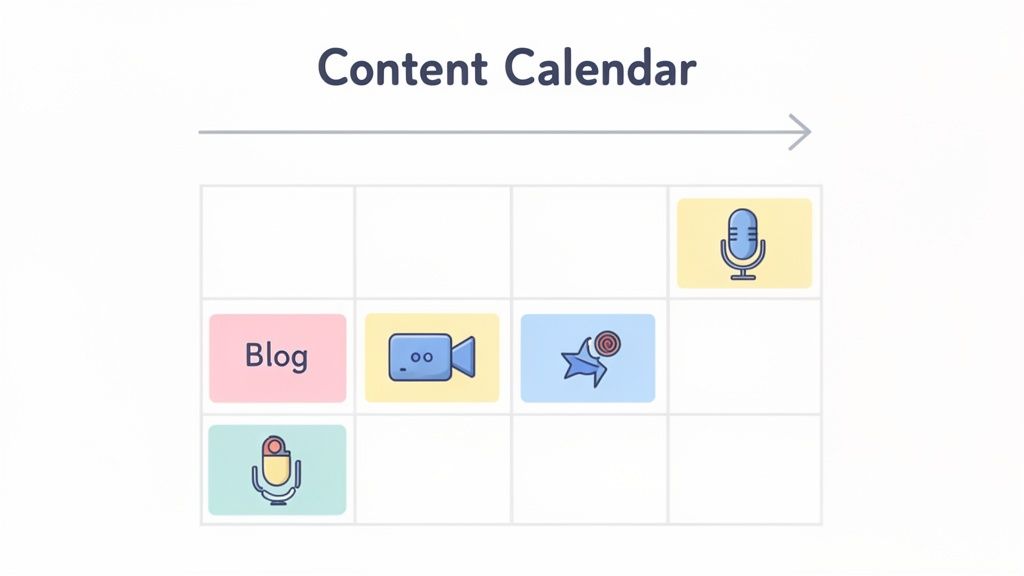
For an agency like ReachLabs.ai, content is the bridge connecting a brand’s value proposition to its target audience’s needs. Whether crafting investor pitch decks, personal brand narratives for executives, or SEO-driven blog posts, a robust strategy ensures consistency and impact. A well-managed content calendar prevents last-minute scrambling and allows for strategic alignment with campaigns, product launches, and industry events.
Why It's an Essential Marketing Plan Component
Without a content strategy, your marketing efforts are just noise. This component provides the substance that attracts, engages, and converts your audience.
- Builds Authority and Trust: Consistently publishing high-quality, valuable content positions your brand as a credible expert in your field, fostering trust with potential customers.
- Drives Inbound Traffic and Leads: Strategic content optimized for search engines (SEO) attracts organic traffic, while compelling resources like ebooks and webinars generate qualified leads.
- Supports Every Stage of the Buyer's Journey: Content can be tailored to address audience needs at the awareness, consideration, and decision stages, guiding them smoothly through the funnel.
Actionable Tips for Implementation
To build a content engine that drives results, focus on strategic planning and consistent execution:
- Establish Content Pillars: Define 3-5 core themes that align with your audience’s interests and your business goals. For example, a SaaS company’s pillars might be "Productivity Hacks," "Team Collaboration," and "Future of Work."
- Map Content to the Buyer Journey: Create different types of content for each stage. Use blog posts and social media for awareness, case studies and webinars for consideration, and demos or free trials for the decision stage.
- Plan with a Calendar: Use a content calendar to plan topics, formats, and distribution channels at least one to two months in advance. This ensures a steady flow of content and allows for strategic campaign integration.
- Repurpose and Amplify: Maximize the value of each content piece by repurposing it. Turn a detailed blog post into an infographic, a series of social media tips, a short video, or a podcast segment.
- Measure What Matters: Track key performance indicators like organic traffic, engagement rates, conversion rates, and time on page. Use these insights to understand what resonates with your audience and refine your strategy.
7. Budget Allocation & Resource Planning
Budget Allocation & Resource Planning is the marketing plan component that translates your strategic vision into a financial and operational reality. This section meticulously details how you will distribute monetary and human resources across various channels, campaigns, and tools. It serves as the financial blueprint for execution, ensuring every dollar and every team member is aligned with your overarching business objectives and is deployed for maximum impact.
This component is where strategy meets accountability. It forces you to make calculated decisions, prioritizing high-potential initiatives while managing costs. For an agency like ReachLabs.ai, this process is critical for demonstrating fiscal responsibility to clients. It outlines a clear, cost-effective roadmap that focuses on results-driven strategies, ensuring investments in areas like content and paid media are directly tied to lead generation and measurable ROI.
Why It's an Essential Marketing Plan Component
A well-defined budget prevents resource waste and ensures your marketing engine has the fuel it needs to run effectively. It provides the structure required to execute your plan with financial discipline and strategic foresight.
- Ensures Financial Viability: It aligns marketing activities with the company's financial realities, preventing overspending and ensuring long-term sustainability.
- Drives Strategic Prioritization: By allocating funds, you are forced to prioritize the tactics and channels most likely to deliver results, such as focusing on proven channels like LinkedIn advertising for a B2B SaaS company.
- Enables Performance Measurement: It sets a baseline for measuring the financial return on marketing investment (ROMI), allowing you to see which initiatives are profitable and which need re-evaluation.
Actionable Tips for Implementation
To create a budget that is both realistic and effective, consider these practical steps:
- Base Your Budget on Clear Models: Use established methods like allocating a percentage of annual revenue (typically 5-12%) or using unit economics like a Customer Acquisition Cost (CAC) multiplier to set a defensible top-line number.
- Allocate Strategically: Distribute funds based on proven performance. For instance, an e-commerce business might allocate the majority of its budget to paid social and search ads that have a track record of driving sales, while dedicating a smaller portion to experimental channels.
- Build in a Contingency Fund: Set aside 10-15% of your total budget for unexpected opportunities or to double down on a campaign that is performing exceptionally well. This provides crucial flexibility.
- Plan for People and Tools: Your budget isn't just for ad spend. Account for fixed costs like salaries, marketing automation software, and analytics tools, as well as variable costs like freelancer fees and content production. A clear resource plan identifies the team and expertise needed to bring the strategy to life.
8. Implementation Timeline, Milestones, Measurement & Optimization
A strategy without a clear execution plan is merely an idea. This marketing plan component translates your objectives and tactics into a concrete, time-bound roadmap. It breaks down large initiatives into manageable phases, assigns deadlines to specific deliverables, and establishes a system for tracking progress and optimizing performance. This combined approach ensures accountability, coordinates efforts across teams, and builds a framework for continuous improvement based on real-world data.
This section is where theory meets practice. It outlines not just what will be done, but when and how success will be measured and refined. By setting clear milestones for campaign launches or content creation schedules, you prevent bottlenecks and keep the entire team aligned. Simultaneously, defining your analytics and optimization loop from the outset ensures that every action is a learning opportunity, enabling agile adjustments that maximize ROI.
Why It's an Essential Marketing Plan Component
This component provides the operational backbone of your marketing plan, ensuring that your strategic vision is executed efficiently and effectively. Without it, even the best strategies can falter due to poor coordination, missed deadlines, and an inability to adapt to market feedback.
- Creates Accountability and Visibility: A detailed timeline with assigned owners for each task ensures everyone knows their responsibilities. Project management tools like Asana or Monday.com can make this process transparent.
- Enables Proactive Management: By mapping out dependencies, you can identify potential roadblocks before they derail your campaigns. Building in buffer time for reviews and unexpected delays is a critical part of this.
- Drives Continuous Improvement: Establishing a measurement and optimization framework from the start turns your marketing into a data-driven engine. It moves you from "we think this will work" to "we know this works because the data shows it."
Actionable Tips for Implementation
To build a robust timeline and measurement system, focus on clarity, realism, and agility:
- Work Backwards from Key Dates: Identify your final deadline, such as a product launch or seasonal campaign, and map out all preceding steps (e.g., content creation, ad design, technical setup) to create a realistic schedule.
- Define Clear Milestones: Break down large projects into smaller, measurable achievements. For example, a campaign launch could have milestones like "Creative Concept Finalized," "Ad Copy Approved," and "Tracking Pixels Implemented."
- Set Up Analytics Before Launch: Ensure all tracking tools, like Google Analytics 4, and dashboards are fully configured and tested before any campaign goes live. This prevents data loss and allows for immediate performance review.
- Establish a Reporting Cadence: Decide on a regular schedule for reviewing performance (e.g., weekly during a launch, monthly for ongoing campaigns). Once your campaigns are live, continuous monitoring is crucial. A key part of this involves understanding how to measure content performance to ensure your efforts are yielding the desired results and identify areas for optimization.
- Focus on Actionable Insights: Don't just collect data; analyze it to answer critical questions. Use A/B testing on ad copy and landing pages, but wait for statistical significance before declaring a winner. Document all learnings to inform future strategies.
8-Point Comparison of Marketing Plan Components
| Component | 🔄 Implementation complexity | ⚡ Resource requirements | 📊 Expected outcomes | Ideal use cases | ⭐ Key advantages / 💡 Tip |
|---|---|---|---|---|---|
| Executive Summary | Low — concise synthesis of plan | Low — primarily stakeholder time | Snapshot of objectives, ROI estimates, alignment | Investor pitches, executive buy-in, kickoff docs | Quickly orients stakeholders; 💡 write last, keep to 1–2 pages |
| Market Analysis & Competitive Landscape | High — data collection and synthesis | High — research tools, analysts, paid reports | TAM, trends, competitor gaps, strategic validation | Market entry, repositioning, budget justification | Provides data-driven foundation; 💡 combine primary + secondary data |
| Target Audience & Buyer Personas | Medium — interviews + segmentation work | Medium — analytics, customer interviews | Clear targeting, improved messaging, higher conversion | Campaign targeting, personalization, influencer outreach | Reduces wasted spend; 💡 interview real customers and update regularly |
| Marketing Goals & KPIs | Medium — alignment + analytics setup | Medium — dashboards, tracking tools | Measurable targets, accountability, optimization signals | Performance campaigns, reporting to stakeholders | Enables data-driven decisions; 💡 set SMART goals and mix leading/lagging metrics |
| Marketing Channels & Tactics | High — coordination across platforms | High — specialists, creative production, ad spend | Multi-touch reach, diversified conversions | Omnichannel launches, scaling customer acquisition | Flexible and testable mix; 💡 prioritize 3–5 channels to start |
| Content Strategy & Calendar | Medium–High — planning + production workflows | High — writers, designers, tools, production time | SEO gains, thought leadership, steady engagement | Brand building, inbound lead gen, nurturing funnels | Builds long-term authority; 💡 plan 2–3 months ahead and repurpose content |
| Budget Allocation & Resource Planning | Medium — forecasting and trade-offs | Variable — finance input, tools, talent costs | Optimized spend, ROI visibility, prioritized initiatives | Annual planning, CFO approvals, resource-constrained teams | Ensures disciplined investment; 💡 include 10–15% contingency and track monthly |
| Implementation Timeline, Milestones, Measurement & Optimization | High — dependencies, testing, reporting cadence | High — PM tools, analytics stack, cross-team effort | On-time launches, iterative improvements, clear ownership | Complex campaigns, multi-agency coordination, iterative tests | Drives accountability and learning; 💡 build buffers and assign clear owners |
From Plan to Performance: Your Next Steps
You've just navigated the comprehensive blueprint for marketing success. We've dissected each critical marketing plan component, moving from the high-level strategic vision of the Executive Summary and Market Analysis to the tactical precision of your Content Calendar and Measurement frameworks. The journey through these eight pillars-from understanding your audience to allocating your budget-is not just an academic exercise; it's the foundational work required to build a resilient, goal-oriented marketing engine.
The core takeaway is that these components are not isolated silos. A deep understanding of your Target Audience informs your Content Strategy. Your Marketing Goals dictate the KPIs you track. Your Budget Allocation directly impacts which Channels and Tactics are feasible. This interconnectedness is what transforms a collection of ideas into a cohesive, powerful strategy. A plan built on this integrated framework moves beyond hopeful guesses and into the realm of predictable, data-driven results.
Turning Knowledge into Actionable Strategy
Mastering each marketing plan component is about creating a living document, not a static report that gathers dust. The market shifts, competitors evolve, and consumer behavior changes. Your marketing plan must be agile enough to adapt.
Here are your immediate, actionable next steps to bring this guide to life:
- Audit Your Current State: Where does your existing plan (or lack thereof) have gaps? Use the components we've discussed as a checklist. Are your Buyer Personas based on recent data or old assumptions? Is your Competitive Landscape analysis current? Start by identifying your weakest link.
- Prioritize a Single Component: If you're a small business or a team with limited resources, don't try to perfect everything at once. Perhaps your most significant opportunity lies in clearly defining your Marketing Goals & KPIs. Focusing intently on solidifying just one component can create a powerful ripple effect across your entire strategy.
- Schedule a "Living Document" Review: Block out time on your calendar-monthly or quarterly-to explicitly review and update your marketing plan. This is non-negotiable. During this review, analyze your performance against your KPIs and ask: What's working? What's not? What needs to change based on our latest data?
The True Value of a Meticulously Crafted Plan
Ultimately, the value of a well-defined marketing plan isn't the document itself; it's the clarity, alignment, and accountability it creates. It ensures every team member, every dollar spent, and every piece of content created is pushing in the same direction, toward the same clearly defined goals. It removes ambiguity and empowers your team to make smarter, more confident decisions.
By embracing each marketing plan component with diligence, you are not just planning campaigns. You are building a sustainable system for growth, a strategic asset that will serve as your North Star in the complex and ever-changing landscape of modern marketing. You are moving from reactive tactics to proactive, strategic execution that drives real business impact. Take this framework, make it your own, and start building the future of your brand today.
Feeling overwhelmed by the sheer scope of executing a comprehensive marketing plan? ReachLabs.ai specializes in transforming strategic blueprints into tangible results by providing the expert teams needed to manage every marketing plan component, from market analysis to campaign optimization. Let us help you bridge the gap between planning and profitable growth at ReachLabs.ai.