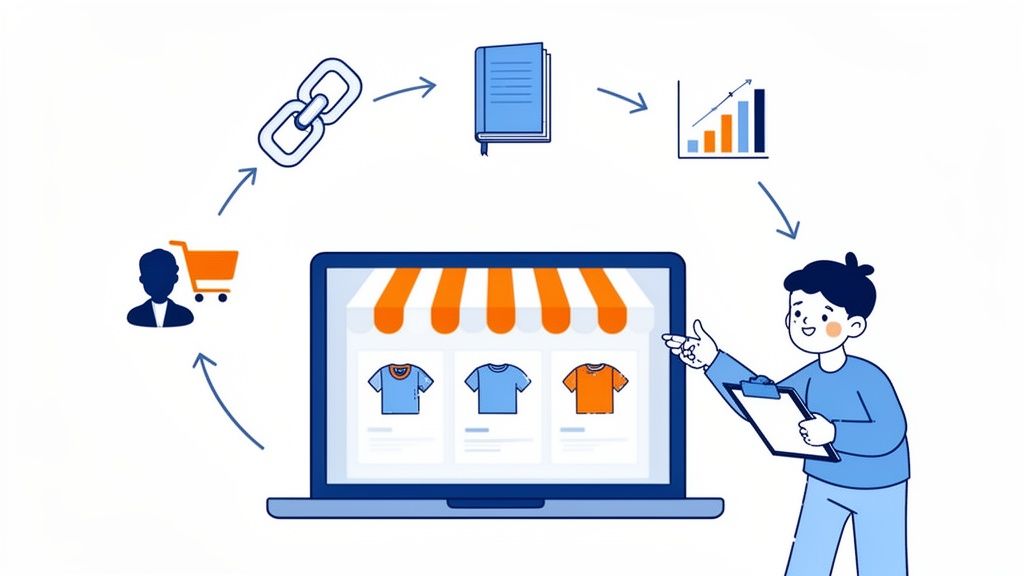
When we talk about link building for e-commerce, we're really talking about earning powerful recommendations from other websites. Each backlink pointing to your online store is like a vote of confidence, telling Google that your product and category pages are the real deal—authoritative and trustworthy. This process is fundamental to boosting your visibility, driving high-quality traffic, and, most importantly, making more sales.
Why Links Are Your Ecommerce Growth Engine
You could have the most beautifully designed online store with the best products on the market, but without authority, it’s just another voice lost in the crowd. This is a common frustration for so many e-commerce brands. A great website isn't enough if search engines don't see it as credible. A smart, consistent link-building strategy is what separates an invisible store from an influential one.
Don't think of backlinks as just another technical SEO task to check off a list. They are the bedrock of sustainable, long-term growth. Every high-quality link you earn signals to Google that your content—whether it's a category page for "men's hiking boots" or a deep-dive guide on brewing the perfect espresso—offers genuine value.
The Clear Path From Links to Revenue
The connection between a strong backlink profile and a healthy bottom line is undeniable. More quality links lead directly to higher rankings for the commercial keywords that your customers are actively searching for. To really appreciate the lasting impact here, it’s helpful to understand what organic search traffic is. Unlike paid ads, which vanish the moment you stop paying, the traffic you earn from solid SEO is a compounding asset.
This creates a powerful, self-reinforcing growth loop:
- More Traffic: Better rankings mean more shoppers find you through search.
- Stronger Credibility: Links from respected sites build trust before a user even clicks through to your store.
- Higher Sales: When qualified visitors who already trust your brand land on your site, they are far more likely to buy.
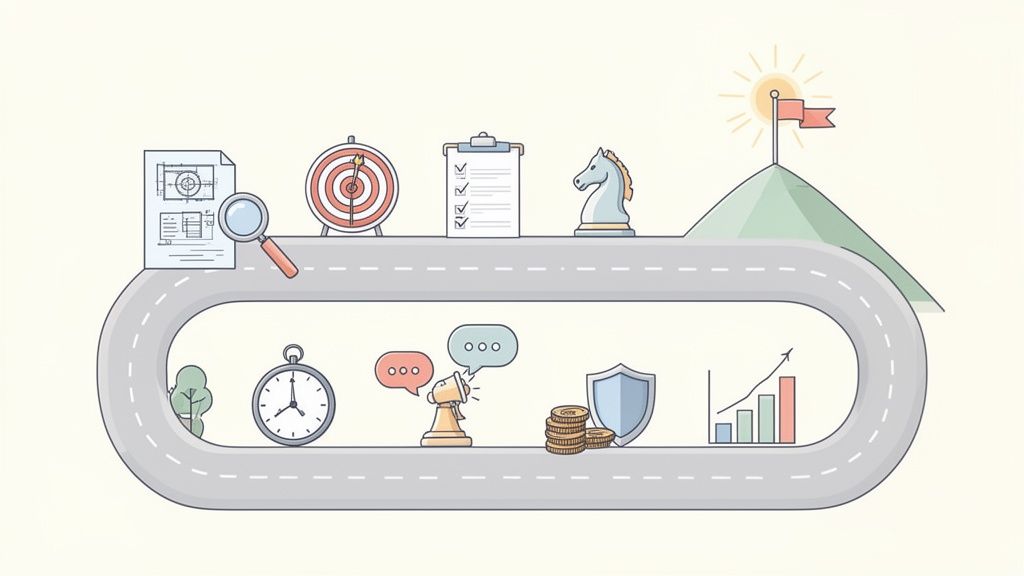
This simple infographic breaks down the powerful flow from earning links to growing your revenue.
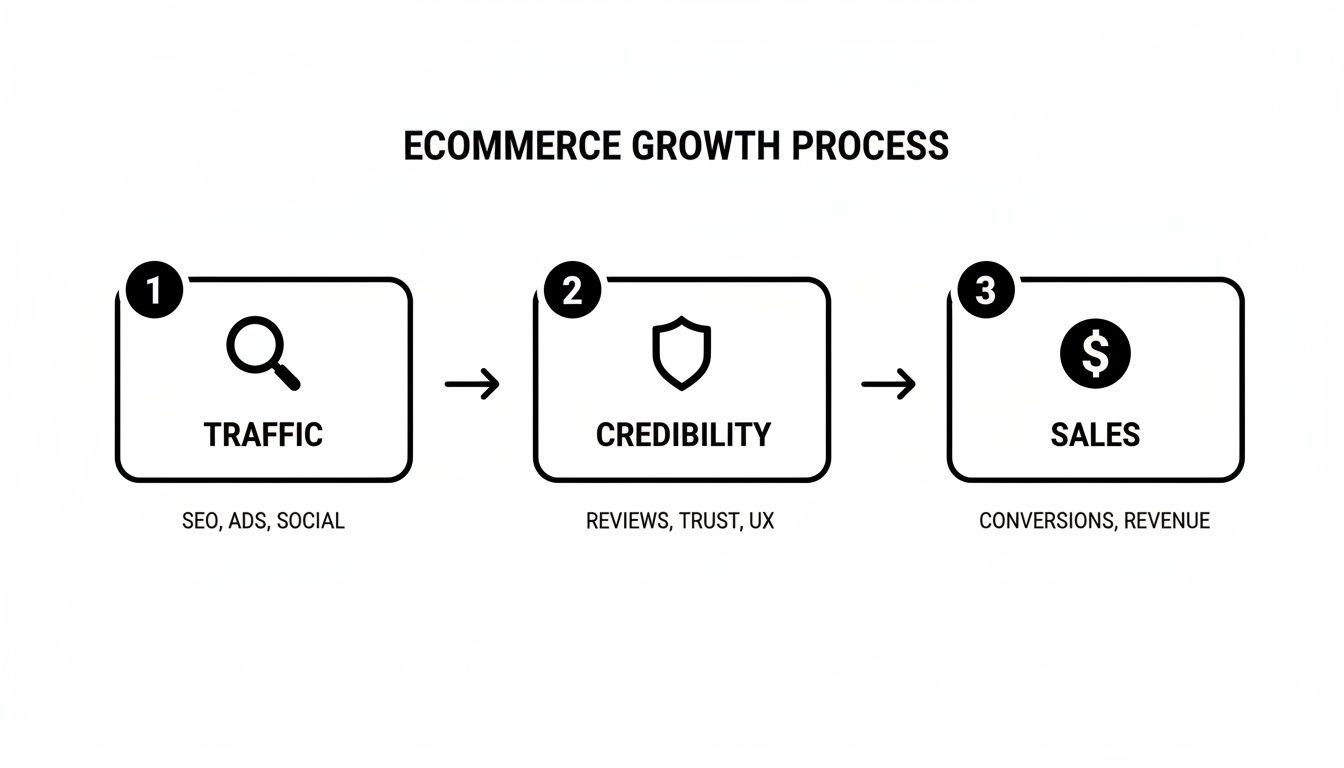
As you can see, it all starts with attracting traffic. That traffic builds the credibility you need, which ultimately drives sales.
To put this into perspective, I've seen countless stores go from struggling to get by to becoming market leaders, and the turning point was almost always a dedicated link-building effort. This table breaks down the core components that make it all work.
Core Pillars of Ecommerce Link Building
| Pillar | Description | Primary Goal |
|---|---|---|
| Strategic Planning | Identifying high-value pages (category, product, content) that will drive the most revenue and traffic when they rank higher. | Focus effort on pages that directly impact the bottom line. |
| Linkable Assets | Creating compelling content—like buying guides, original data, or interactive tools—that people naturally want to link to. | Attract high-quality, relevant backlinks organically. |
| Targeted Outreach | Building genuine relationships with journalists, bloggers, and industry experts to earn placements on their sites. | Secure authoritative links that pass trust and relevance. |
| Technical Foundation | Ensuring your site is technically sound with a smart internal linking structure and proper schema markup to maximize link equity. | Amplify the power of every external and internal link. |
Each pillar supports the others. Without a solid plan, your outreach will be scattered. Without great assets, you'll have nothing to promote. It all has to work together.
By focusing on acquiring relevant, authoritative links, you are not just ticking an SEO box. You are actively building a moat around your business that competitors will find difficult to cross. It's an investment in long-term visibility and profitability.
Ultimately, link building for an e-commerce brand is about more than just rankings. It's about cementing your store's reputation as the go-to authority in your niche. This foundational strength ensures that no matter how search algorithms change, your site will remain a resilient and dominant force, consistently attracting customers ready to buy.
Choosing Where to Build Your Links
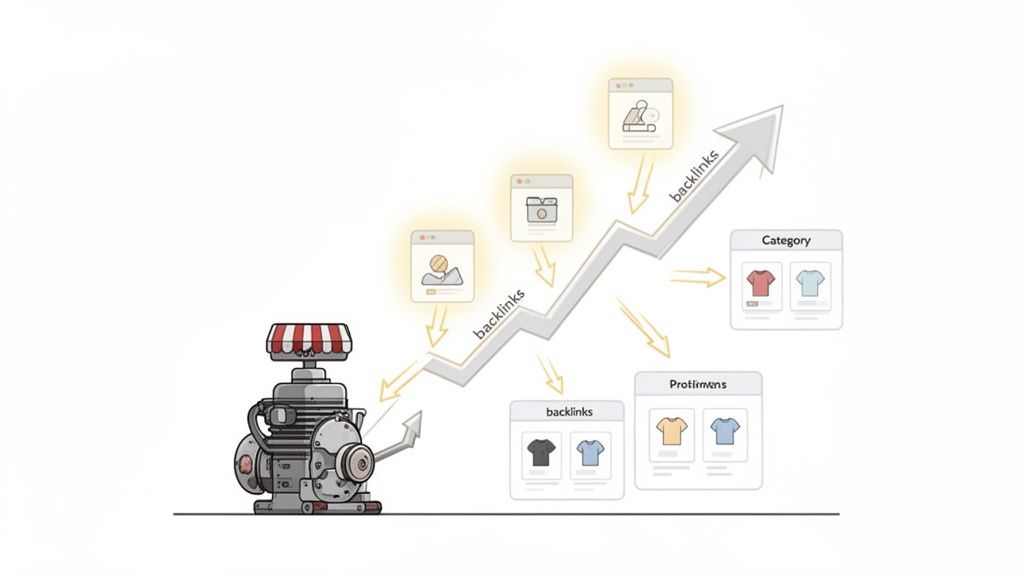
Before you even think about sending that first outreach email, you need a plan. The single biggest mistake I see e-commerce brands make is pointing every single new link at their homepage. It feels like the right thing to do, but it’s a classic rookie error that leaves a ton of revenue on the table.
Sure, homepage links build overall domain authority, but that’s a blunt instrument. We want surgical precision. The goal is to build links that directly boost the pages that make you money.
Prioritizing Your Commercial Pages
Think about your website like a real estate portfolio. Some properties have way more earning potential than others. Your job is to identify those high-value assets and invest your link-building budget there.
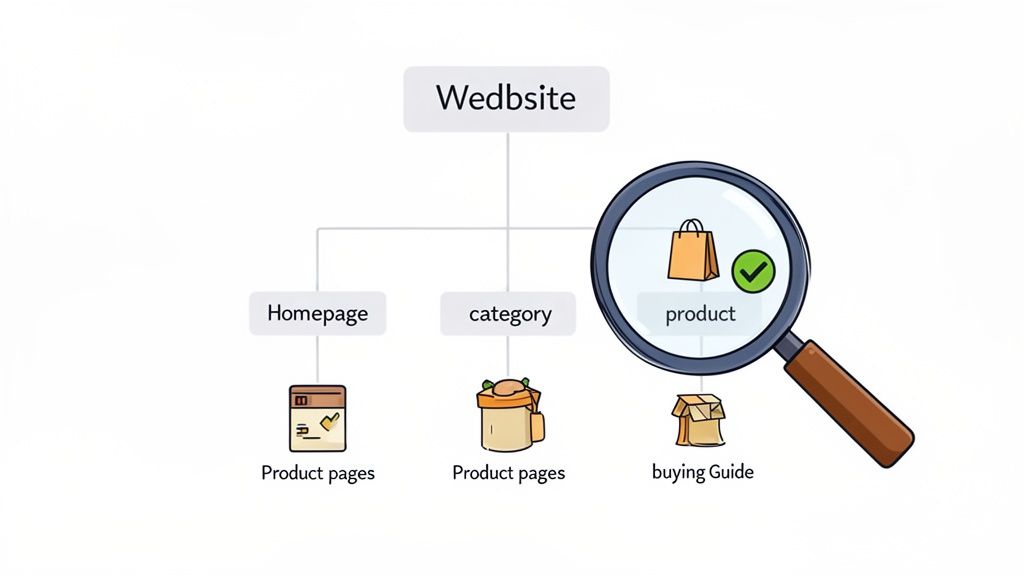
For an e-commerce site, this almost always boils down to two types of pages:
- Key Category Pages: These are your money-makers, the hubs for your main product lines (think "women's running shoes" or "espresso machines"). Getting these pages to rank for broad, high-traffic keywords is how you drive massive, qualified traffic. A single good link to your "Men's Hiking Boots" category is worth ten to your homepage when it comes to driving actual sales.
- High-Converting Product Pages: Do you have a hero product that sells like crazy but is stubbornly stuck on page two of Google? That's a golden opportunity. Pushing a popular, high-margin product from position 12 to position 3 can have a direct and immediate impact on your bottom line.
To find these pages, get your hands dirty in Google Analytics and Google Search Console. Look for pages with high conversion rates or those hovering just outside the top 10 for keywords with clear buying intent.
The Power of Linking to Informational Content
Here's the thing: directly asking a blogger to link to your product page can feel spammy and overly commercial. Most will say no. This is where you have to get clever by creating "linkable assets."
Instead of begging for a link to your "organic dog food" product page, you create an amazing resource like "The Ultimate Guide to Canine Nutrition." This kind of in-depth, genuinely helpful content is something other sites want to link to because it makes them look good.
This two-step process is the secret sauce. First, you earn high-quality external links to your guide. Then, you use strategic internal links within that guide to pass all that juicy authority over to your most important product and category pages.
It's a win-win. You build powerful links without being pushy, and you still channel that authority precisely where it needs to go.
Using SEO Tools for Smart Prioritization
This isn't a guessing game. SEO tools are your best friend for finding the lowest-hanging fruit. They help you spot which pages already have some momentum and just need a little nudge to hit the big time.
For instance, you can use the Ahrefs SEO Toolbar to quickly check the stats on a URL. You'll see its Domain Rating (DR), URL Rating (UR), and how many backlinks it currently has.
By running this analysis on your key pages, you can pinpoint what we call "striking distance" opportunities. These are pages with a decent URL Rating that could realistically jump to page one with just a handful of new, high-quality links. This data-driven approach turns a scattergun effort into a targeted, efficient campaign that actually gets results.
Creating Assets People Actually Want to Link To
Here’s a hard truth about link building: nobody wants to link to your product page. Trying to convince a blogger or journalist to do so usually feels like a thinly veiled sales pitch.
Effective link building isn't about asking for links; it's about earning them. The secret is to create something so genuinely useful that other site owners feel compelled to share it. This is the entire philosophy behind creating a linkable asset.
When you shift your focus from "link to my product" to "here's a resource your audience will love," the entire dynamic changes. Your outreach becomes a helpful heads-up, not a request. This makes the whole process feel more natural and, frankly, far more successful.
Think Bigger Than a Basic Blog Post
When I say "linkable asset," I'm not talking about another 500-word blog post. We’re aiming to create the definitive, go-to resource for a specific topic in your niche—the kind of content that makes someone say, "Wow, this is everything I needed to know."
Yes, this requires a real investment of time and effort upfront. But the payoff is immense. A single, high-quality asset can pull in dozens of authoritative links over years, continuously funneling authority and traffic back to your store. The data doesn't lie.
Top-ranking pages have 3.8 times more backlinks than those in positions 2-10. I once worked with an outdoor gear brand that saw a 78% traffic increase to key category pages in just six months. How? They built two core assets: an exhaustive "Hiking Backpacks Guide" and a data-driven study on "Solo Female Hiking Trends." These pieces got picked up by major outdoor blogs, driving tons of qualified traffic. You can dig into more of this data by exploring current link-building statistics and trends.
Actionable Ideas for E-commerce Linkable Assets
The best linkable assets are either incredibly useful, deeply informative, or uniquely entertaining. They serve a real purpose. Let's get practical and move past the generic advice.
-
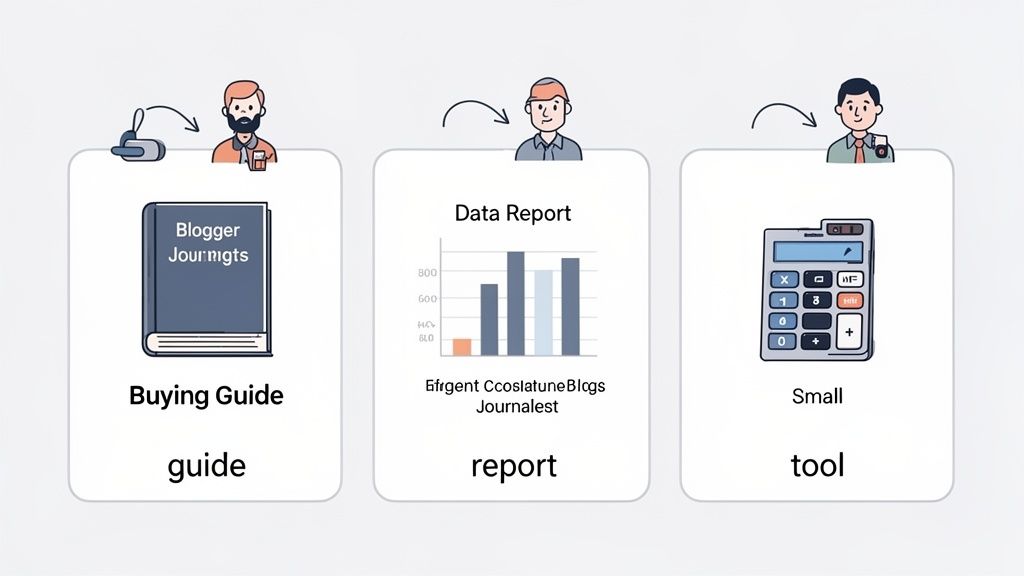
The Ultimate Buying Guide: Don't just list product features. Create an in-depth guide that walks a potential customer through their entire decision-making journey. If you sell cameras, a guide like "Choosing Your First Mirrorless Camera"—covering sensor sizes, lens types, and budget tiers—is exactly what photography bloggers want to link to.
-
Interactive Tools & Calculators: Utility is a powerful link magnet. A coffee bean store could build a "Coffee Grind Size Calculator" that helps users find the perfect setting for their specific brewer (French press, AeroPress, etc.). It’s simple, solves a real problem, and is highly shareable.
-
Original Data & Research: This is a goldmine for links. Survey your customers or analyze your own sales data to uncover fresh trends. A fashion retailer could publish a report on "The Rise of Sustainable Fabrics in 2024," complete with sharp infographics. Journalists and industry bloggers love citing original data, and they will almost always link back to the source.
Key Takeaway: Stop asking what you want to promote. Start asking what their audience genuinely needs. A valuable asset is the bridge between those two things, making the link a natural fit for their content.
Connecting Your Assets to Your Commercial Goals
Creating a fantastic asset is only the first half of the job. The end goal is still to sell more products. This is where a smart internal linking strategy becomes your superpower, connecting your high-authority informational content to your money-making pages.
Let's go back to that "Coffee Grind Size Calculator." Imagine it earns a link from a major coffee publication. That link passes a ton of authority to the calculator page on your site.
From that page, you can now add contextual internal links. Something like, "For a coarse grind, we recommend our Sumatran Dark Roast," which points directly to the product page. This two-step process is a core part of a bigger picture, which you can read more about in our guide on content marketing for business growth.
This approach lets you build powerful, relevant links to non-commercial content while strategically funneling all that link equity to the pages that actually drive your revenue. It's the most sustainable way to build a backlink profile that truly supports your bottom line.
Time to Get the Word Out: Outreach and Digital PR
So you've built an incredible piece of content. That's fantastic, but you're only halfway there. Now, you’ve got to get it in front of the right people—the bloggers, journalists, and editors who can give your work the audience it deserves. This is where smart outreach and a bit of digital PR turn your great content into powerful backlinks.
The old "spray and pray" email blast is dead. Forget about it. The real secret is building genuine connections and making it incredibly obvious why your resource is valuable. Your outreach shouldn't feel like a request; it should feel like you're giving them a helpful tip that makes their job easier.
Finding the Right People to Contact
Before you even think about writing an email, you need to build a solid prospect list. We're talking about a hand-picked group of websites and people whose audience is a perfect match for yours. Always, always choose quality over quantity.
Your best bets will usually fall into one of these buckets:
- Niche Bloggers & Influencers: These are the die-hard experts in your space. Getting your coffee gear guide featured on a respected home-brewing blog is gold because you know the readers are already interested.
- Industry News & Publications: These are the big, authoritative voices. A mention here doesn't just send traffic; it builds serious credibility for your brand.
- Shoulder Niches: Think outside the box. If you sell blenders, a fitness blog writing about healthy smoothies is a perfect fit. They serve a related audience that could be very interested in what you offer.
A great starting point is to use SEO tools to see who’s already linking to your competitors' guides and articles. That’s your low-hanging fruit. If a site linked to a rival's post, they’ve already proven they’re interested in the topic. Your job is to show them why yours is better.
Writing Emails That People Actually Read
We’ve all seen bad outreach. Our inboxes are graveyards for impersonal, me-first emails. To cut through that noise, you have to be different. Personalization and a value-first approach aren't optional; they're the only way this works. If you're new to this, it's worth learning how to write cold emails that get replies to get the fundamentals down.
A solid outreach email that gets results usually follows a simple formula:
- The Personalized Hook: Start by showing you've done your homework. Mention a specific article you liked or a recent project of theirs. It immediately proves you're not a spam bot.
- The Value Prop: Get to the point. Quickly explain why your resource is a great fit for their audience. Frame it around them, not you.
- The Soft Ask: Make it easy for them to say yes. Instead of demanding a link, try something like, "Thought this might be a useful addition for your readers," or "Could be a good fit for your resources page."
This approach helps you build relationships, not just a list of links. You become a helpful peer, not just another person with their hand out.
Leveling Up with Digital PR
While personalized emails are your bread and butter, digital PR is how you land the kind of high-authority links you can't get any other way. It’s all about making your brand newsworthy.
According to one study, 48.6% of SEO experts rated digital PR as their most effective link-building tactic, generating an average of 15.58 links each month. It can be an investment, but the return is often well worth it.
A fantastic tool for this is Help a Reporter Out (HARO). It’s a free service connecting journalists looking for expert sources with people like you. By providing a sharp, insightful response to a relevant query, you can get your brand—and a killer backlink—featured in major publications.
Don't be surprised by the rising investment in quality outreach. With the average cost of a backlink climbing to $508, the game is getting more competitive. Even so, 78.1% of SEO pros say their campaigns deliver a satisfying ROI. This just goes to show that while link building for ecommerce isn't cheap, it's one of the best investments you can make for long-term growth and authority.
Finding Link Opportunities Hiding in Plain Sight
Your competitors have already spent a ton of time and money building links. Think of it as a public roadmap, showing you exactly what works in your niche. Why start from scratch when you can learn from their successes (and failures)?
Analyzing their backlink profiles is one of the most efficient things you can do. You’re not just finding random websites; you’re uncovering sites that have already proven they’re willing to link to a business just like yours. These aren't cold leads—they're the lowest-hanging fruit you'll find.
The Link Gap Analysis: Your Secret Weapon
The heart of this entire strategy is what's called a link gap analysis. It sounds technical, but the idea is refreshingly simple: find the websites that link to two or more of your competitors, but not to you.
This simple exercise instantly reveals a "gap" in your backlink profile and hands you a priority list of sites to target.
Imagine you sell high-end kitchen knives. You pop your top rivals into a tool like Ahrefs or Semrush and see that three major food blogs all feature two of your competitors in their "Best Chef Knives of 2024" roundups. That’s your golden ticket. It tells you those bloggers are actively looking for authoritative sources on that exact topic. This kind of strategic insight is a core part of any effective competitor analysis framework for your business.
Look Beyond the URL: What Kind of Links Are They Getting?
Getting a list of domains is just the first step. The real gold is in understanding the context behind those links. What kind of content is earning them links? What's the angle? This is how you reverse-engineer their entire strategy.
When you export a competitor's backlink profile, don't just look at the list of websites. Start categorizing the links to spot patterns. Are they getting most of their traction from:
- Product Reviews: Influencers and media outlets reviewing their flagship products.
- Guest Posts: In-depth articles they've written for industry publications.
- Resource Pages: Being included on "Best Gear" or "Helpful Tools" lists.
- "How-To" Guides: Getting cited as a source in detailed instructional content.
When looking at a competitor's links, it's crucial to identify the most common types. This helps you figure out which strategies are working best in your niche so you can prioritize your own efforts.
Common Link Types to Identify in Competitor Analysis
| Link Type | What It Is | Why It's Valuable |
|---|---|---|
| Product Reviews | A blogger, publication, or influencer writes a dedicated post about one of your competitor's products. | These are high-intent links that drive qualified traffic. They often come from trusted sources and act as powerful social proof. |
| Guest Posts | The competitor contributes an article to another website, usually with a link back to their own site in the bio or content. | Shows you which publications are open to contributions and gives you an idea of the topics that resonate with their audience. |
| Resource/Link Pages | Your competitor is listed on a page titled "Best [Product Category] Tools" or "Useful [Industry] Resources." | These are pure, editorially given links. Getting on these pages positions your brand as a go-to authority in the space. |
| Mentions in Roundups | Being featured in list-style articles like "Top 10 Gifts for Dads" or "The Ultimate Holiday Gift Guide." | These are fantastic for seasonal traffic and sales. Identifying these early gives you a target list for your own PR pushes. |
| Niche Directories | Listings in high-quality, industry-specific directories (not spammy, general ones). | A quick way to secure relevant, foundational links that signal to Google what your business is about. |
Understanding these patterns is like being handed your competitor's marketing playbook.
By identifying the types of links your competitors earn most often, you're not just finding websites to contact—you're uncovering their entire link-building strategy. If they're crushing it with product reviews, you know where to focus your energy.
From Analysis to Action Plan
Once you've done your homework, the path forward becomes incredibly clear. You should have a concrete list of high-priority websites to contact and a proven angle for your pitch.
If a rival got a great link by providing an infographic to a popular blog, maybe you can create a more current, better-designed version and offer it as an update. If they're consistently showing up in holiday gift guides, you now have your outreach list ready to go months before the holiday rush.
This kind of strategic espionage removes the guesswork from link building. You can stop throwing ideas at the wall and start focusing your precious time on tactics that are already winning in your market.
How to Measure Your Link Building ROI
Look, link building takes serious time, money, and effort. You can't just throw links at a wall and hope something sticks. You have to be able to prove it’s actually moving the needle. When we talk about measuring the return on investment (ROI), we're not just counting up the number of links you got this month. We need to focus on the numbers that actually matter to your business.
For any ecommerce store, the true test of a link building campaign shows up in tangible results. Are your key category pages actually climbing up the search results? Are more people finding those pages through organic search? And the million-dollar question: are those visitors buying stuff?
The KPIs That Actually Matter
To show real, concrete value, you’ve got to track the right Key Performance Indicators (KPIs). These are the metrics that bridge the gap between your SEO work and the company's bottom line, making it a no-brainer to keep investing in your strategy. For a deeper dive into the numbers, it's worth understanding how to calculate marketing ROI more broadly.
Here’s what I always keep a close eye on:
-
Keyword Ranking Improvements: Get a solid rank tracking tool and watch your target keywords like a hawk. Are the pages you're building links to finally breaking onto page one? That’s your first signal that things are working.
-
Organic Traffic Growth: Jump into Google Analytics and isolate the organic traffic going to your target pages. If you see a 15% lift in organic traffic to a key category page three months into a campaign, that's a huge win and something you can definitely report on.
-
Referral Traffic and Conversions: Don't sleep on the direct traffic a great link can send. I always track not just how many people click through from the linking site, but what their conversion rate is. I've seen a single, well-placed link on a niche blog drive thousands in sales.
-
Domain Authority (DA) or Domain Rating (DR): Yes, these are third-party metrics from tools like Moz or Ahrefs, but they’re still useful. Watching your site's overall authority score creep up over time is a good high-level check on the health of your campaign.
A successful link building campaign tells a simple story with data: We built these links, which led to higher rankings, which drove more organic traffic, and ultimately resulted in more sales for the store.
By zeroing in on these core metrics, you can stop talking about link building as some mysterious SEO task and start presenting it as what it is: a proven strategy for growing your ecommerce revenue.
Answering Your Top Ecommerce Link Building Questions
Even with the best-laid plans, link building can feel a bit murky. Questions always pop up. It’s totally normal to wonder if you’re doing things right, especially when you’re just starting out.
Let’s tackle some of the most common questions I hear from ecommerce brands. Getting these answers straight will help you move forward with confidence and make sure your efforts are actually paying off.
How Long Does This Actually Take?
Ah, the million-dollar question. The honest, no-fluff answer is that it depends, but patience is non-negotiable. You might see a trickle of referral traffic from a new link right away, but the real prize—a noticeable jump in your organic rankings and traffic—usually takes somewhere between three to six months.
What makes that timeline so variable? A few things:
- Your Starting Point: If your site is brand new, you're building authority from scratch. An established store with some history has a head start and will likely see results faster.
- How Tough Your Niche Is: Trying to rank for "women's running shoes" is a marathon in a very crowded field. Ranking for "hand-stitched leather dog collars" is more of a sprint—less competition means quicker wins.
- The Pace of Your Campaign: The more high-quality links you can consistently earn each month, the faster you'll build momentum.
The best way to think about link building is as a long-term investment, not a quick hack. Your efforts build on each other, and the value truly compounds over time. Stick with it.
Should I Link to My Homepage or Deeper Pages?
This isn't an either/or situation. The smartest approach is a balanced one that builds a natural-looking and genuinely powerful backlink profile.
Think of it this way: Homepage links are all about boosting your site's overall domain authority. They lift the entire ship. But if you want to make sales, you need to point links directly at your category and top product pages.
These "deep links" are incredibly valuable. They signal to Google that these specific pages are authorities on their subject, which is exactly what you need to rank for those crucial, high-intent keywords that drive ready-to-buy traffic.
What are the Biggest Mistakes I Need to Avoid?
It’s easy to get sidetracked and make mistakes that can set you back for months. The absolute worst thing you can do is buy a package of cheap, spammy links from totally irrelevant sites. It might seem like a shortcut, but it’s a direct path to a Google penalty, and clawing your way back from one of those is a nightmare.
A few other common blunders I see all the time:
- Obsessing over the homepage and completely ignoring key category and product pages.
- Not bothering to create any interesting, link-worthy content and then wondering why no one will link to them.
- Blasting out generic, copy-paste outreach emails that scream "I don't know who you are." These get deleted on sight.
Always, always prioritize the quality and relevance of a link over just racking up numbers. That’s how you build a powerful, penalty-proof backlink profile that actually helps you grow.
Ready to stop guessing and start growing? ReachLabs.ai develops data-driven link building strategies that build real authority and drive measurable revenue for ecommerce brands. Learn how we can help you dominate your niche.