You're probably seeing the same pattern every week. Marketing celebrates a healthy stream of new leads. Sales opens the CRM, clicks into a few records, and starts complaining almost immediately. Half the contacts aren't a fit. Some are students, vendors, or competitors. Others look promising on paper but disappear the moment a rep asks a basic discovery question.
That friction usually isn't a people problem. It's a process problem.
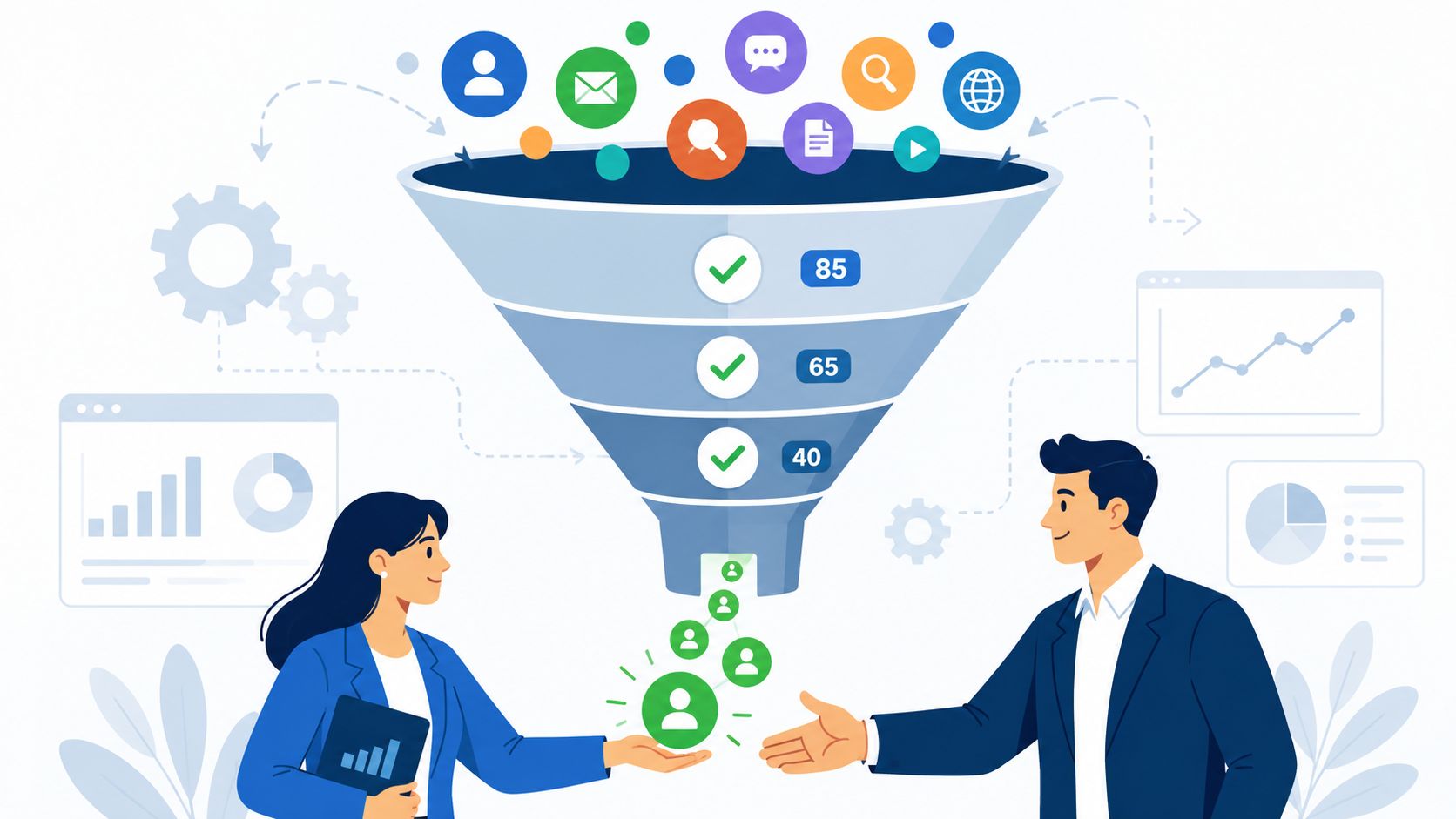
A solid lead qualification process fixes that by answering two questions early. First, does this lead match the kind of company and buyer you can help? Second, are they showing enough real intent to justify sales time right now? When those questions get answered consistently, sales stops chasing ghosts, marketing stops defending vanity conversions, and the pipeline gets a lot cleaner.
Why Your Sales Team Hates Your Leads
Sales rarely hates leads. Sales hates bad surprises.
A rep blocks time for outreach, reviews an “MQL,” writes a personalized email, makes the call, and then learns the company is too small, in the wrong market, outside the target geography, or nowhere near a buying decision. That's not just annoying. It steals time from real opportunities.
A widely cited CSO Insights figure says 68% of B2B organizations struggle with lead conversion because of poor qualification, which is why qualification is one of the most impactful points in the funnel, according to Default's breakdown of lead qualification. The practical takeaway is simple. Many teams don't lose deals because the product is weak. They lose momentum because they move leads forward without enough evidence of fit, need, authority, budget, or timing.

The real cost of sloppy qualification
When qualification is loose, the damage shows up in everyday operations:
- Reps stop trusting inbound leads. They respond slower because they assume most new records are junk.
- Marketing optimizes for the wrong outcomes. Form fills and ebook downloads look good in reports, but they don't tell you whether revenue is likely.
- The CRM fills with noise. Once that happens, routing, forecasting, and follow-up all get harder.
- Good leads get buried. A high-fit buyer can sit untouched because the queue is clogged with low-value names.
This is why lead qualification isn't just a sales tactic. It's a shared operating system between teams.
If you want a useful companion read on the organizational side, this guide to marketing and sales alignment is worth reviewing before you redefine handoffs. Qualification breaks when teams use different definitions for the same funnel stage.
What a better system looks like
The fastest fix is not “send fewer leads.” It's to create a repeatable filter.
The best SMB setups use a simple sequence. Marketing applies an initial screen for fit. Sales then validates intent and buying context through real conversation. That split matters because automation is good at fast pattern matching, while humans are better at spotting nuance.
Practical rule: Don't ask sales to determine whether a lead belongs in your market. Ask sales to determine whether that lead is ready to buy.
That first screen gets much stronger when your data is cleaner. If your forms only capture partial records or your CRM is full of missing firmographics, invest some time in better marketing data enrichment methods and tools. The goal isn't more data for its own sake. It's enough context to stop routing obvious poor-fit leads to reps.
Once you build that discipline, sales conversations change. Reps stop opening calls with “So, what does your company do?” and start with sharper questions about urgency, pain, stakeholders, and next steps. That's when leads start feeling sales-ready instead of merely captured.
Designing Your Lead Qualification Criteria
Most companies start with vague language. They say they want “better leads,” “decision-makers,” or “companies with budget.” That sounds sensible, but it's unusable in day-to-day operations. Your team needs criteria specific enough to route, score, and challenge.
The simplest way to build that structure is to separate qualification into two buckets. One bucket covers who the lead is. The other covers what the lead is doing.

Start with fit, not activity
Before you look at clicks, page visits, or webinar attendance, define your ideal customer profile clearly. That usually includes:
- Company profile: Industry, geography, company size, and business model
- Buyer profile: Job title, team function, influence level, and likely ownership of the problem
- Operational fit: Whether your onboarding, pricing, service model, and contract structure match how that company buys
A lead can show plenty of activity and still be wrong for the business. That's why fit comes first.
Lead qualification has moved from ad hoc judgment into structured methodology, and frameworks like BANT, CHAMP, and MEDDIC are now standard references in modern sales teams, as outlined in Revenue Grid's guide to sales lead qualification. BANT remains the classic model because it focuses on budget, authority, need, and timeline. For SMBs, that's still useful, but only if you treat it as a thinking tool rather than a rigid script.
Use frameworks as prompts, not law
Here's a practical way to use the main frameworks:
- BANT works well when you need quick clarity on whether a conversation deserves rep time.
- CHAMP is helpful when your buyers often start with pain but don't yet know budget or process.
- MEDDIC or MEDDIC-style thinking helps when deals involve multiple stakeholders or longer evaluation cycles.
A small business doesn't need a giant enterprise playbook. It needs a short list of questions reps will use.
Good qualification criteria should make your team more consistent, not more bureaucratic.
A useful starting matrix often includes questions like these:
| Qualification area | What to define |
|---|---|
| ICP fit | Which industries, company types, and geographies are in or out |
| Buyer relevance | Which titles are direct buyers, influencers, or non-buyers |
| Problem match | Which pains your offer solves well, and which it doesn't |
| Buying readiness | What signs indicate urgency or active evaluation |
| Sales feasibility | Which leads your team can realistically close and service |
Layer in intent after fit is confirmed
Once fit is clear, behavioral signals become far more valuable. A pricing-page visit from a strong-fit account means something. The same visit from a poor-fit account often means very little.
Useful signals usually include actions such as:
- Demo requests
- Repeat website visits
- Return visits to solution or pricing pages
- Replies to outbound messages
- High-engagement event participation
- Multiple touches from the same account
This is also where channel context matters. Inbound and outbound leads shouldn't always be judged the same way. If you're refining source-based expectations, this overview of sales strategies for business growth gives a practical lens on how different motions create different buying signals.
A short explainer can also help your team align on common language before you operationalize criteria:
The mistake to avoid is overcomplicating the model at the start. Build criteria your team can defend in a weekly pipeline review. If nobody can explain why a lead qualified, the model is too fuzzy. If everyone needs a flowchart to use it, the model is too complex.
Building a Practical Lead Scoring Model
Criteria become useful when they turn into action. That's where scoring comes in.
A workable scoring model lets you sort leads by priority without asking your team to debate every record manually. It gives marketing a clear threshold for when a lead deserves attention, and it gives sales context before the first touch.
The easiest scoring model for an SMB uses two signal types:
- Explicit signals, which come from known facts like company size, role, or geography
- Implicit signals, which come from observed behavior like demo requests, repeat visits, or replies
Keep the model simple enough to survive contact with reality
Many scoring models fail because they try to be perfect. Don't build a spreadsheet monster. Build a decision aid.
A practical first version usually has three layers:
- Fit score based on firmographics and role
- Intent score based on activity
- Disqualification flags that block routing no matter how active the lead looks
Here's a starter template you can adapt.
| Category | Criteria | Points |
|---|---|---|
| Firmographic fit | Target industry | High |
| Firmographic fit | Target geography | High |
| Firmographic fit | Outside ICP | Negative |
| Contact role | Decision-maker or strong influencer | High |
| Contact role | Unclear relevance | Low |
| Behavior | Demo request | High |
| Behavior | Repeat visits to key pages | Medium |
| Behavior | General content engagement | Low |
| Behavior | No meaningful activity after first conversion | Negative |
| Sales readiness | Clear project or problem stated | High |
| Sales readiness | Vague curiosity only | Low |
Notice what's missing. There's no false precision.
For most SMBs, exact point values matter less than relative weight. A demo request should count more than a blog visit. A strong ICP match should outweigh shallow engagement. A clear disqualifier should stop routing even if the lead looks busy.
Decide what qualifies a handoff
The threshold isn't just a score. It's a rule.
For example, a lead might only move forward if it has:
- Strong fit plus moderate intent
- Moderate fit plus very strong intent
- No major disqualifiers
- Enough context for a rep to personalize outreach
That last point matters more than many teams realize. If the rep can't tell why the lead qualified, the score won't earn trust.
A scoring model should answer one question fast. “Why should a salesperson talk to this lead now?”
If you want a deeper breakdown of frameworks and implementation choices, this guide on what lead scoring is and how teams use it is a useful reference for setting thresholds and weighting signals.
What usually goes wrong
The common scoring mistakes are predictable:
- Everything gets points. Then all activity looks equally meaningful.
- Fit is underweighted. This floods sales with busy but irrelevant contacts.
- No negative logic exists. Leads can pile up points while still being bad opportunities.
- The model never changes. Teams keep scoring behaviors that don't correlate with actual progress.
A better approach is to treat the score as a prioritization tool, not a verdict. It should tell your team where to look first. The final decision still belongs to a human, especially when the account is strategically important or the buying motion is more complex.
Implementing Your Process with Automation and Handoffs
A frequent point of failure for lead qualification processes arises from this: The criteria make sense. The scoring model looks clean. Yet, once real leads start moving, there's no consensus on when automation should decide versus when a human should step in.
The strongest SMB process is a two-stage workflow. An automated fit screen handles the first pass. A sales rep or SDR handles the second.
An effective qualification workflow typically works this way: first, an automated fit screen checks ICP match across factors like company size, industry, and geography in seconds; second, an SDR runs a live discovery conversation to validate budget, authority, timeline, and specific needs, as described in Launch Leads' lead qualification workflow. That split reduces wasted manual effort because only leads that clear the fit gate move directly to sales.

Stage one uses automation to filter, not to close
Your marketing automation platform or CRM should do the boring work quickly:
- Capture lead data from forms, chats, ads, and inbound requests
- Check fit rules against ICP fields
- Apply scoring logic based on known and observed signals
- Route records into the correct queue
- Nurture non-ready leads instead of forcing a sales touch too early
That's the right place for automation. It's fast, consistent, and unemotional.
It's also where progressive profiling helps. You don't need to ask for every detail on the first form. Collect what you need to judge basic fit, then gather deeper context later through additional touchpoints or conversation.
If you're mapping the systems side of this workflow, this piece on lead nurturing automation is useful for thinking through how qualified-but-not-ready leads should be handled after they miss the immediate sales threshold.
Stage two uses people to validate buying reality
Automation can tell you a lead looks promising. It can't reliably tell you whether there's an active buying motion behind the activity.
That's why the handoff matters so much. When a rep receives a qualified lead, they should get more than a name and company. They should receive:
| Handoff field | Why it matters |
|---|---|
| Source | Shapes expectations for context and urgency |
| Fit summary | Shows why the account matches the ICP |
| Key behaviors | Highlights what triggered qualification |
| Recent timeline | Helps the rep time outreach correctly |
| Suggested next action | Gives the rep a starting point |
Once the rep engages, the goal is to confirm intent through live discovery. Not every qualified lead will convert into an opportunity. That's fine. The point is to avoid sending obvious non-opportunities into that expensive stage.
The handoff should feel like a continuation of context, not a reset to zero.
Write the rules down
Most handoff failures happen because the process lives in tribal memory instead of documentation.
Your team needs a lightweight service agreement that covers:
- What counts as a qualified lead
- How quickly sales should respond
- What happens when sales rejects a lead
- Which rejection reasons are allowed
- How rejected leads return to nurture
Without those rules, marketing assumes sales ignores leads, and sales assumes marketing sends junk. Both can be partly right.
The practical fix is boring but effective. Define the handoff fields, response expectations, rejection reasons, and recycle logic in writing. Then review rejected leads together. That's where the process gets sharper fast.
Measuring Success and Optimizing Your Process
A lead qualification process earns trust when it improves decisions over time. That only happens if you review outcomes, not just activity.
Many SMBs look at lead volume first because it's visible. That's usually the wrong starting point. Volume tells you how much entered the system. It doesn't tell you whether the system is working.

Watch the conversion points that reveal quality
The most useful review focuses on stage movement and sales feedback. Track things like:
- MQL to sales acceptance
- Sales acceptance to real opportunity
- Lead rejection reasons
- Sales cycle patterns for accepted leads
- Closed-won patterns among previously qualified leads
You don't need a complex analytics stack to start. A disciplined CRM review and a recurring meeting can uncover most of the friction.
The question behind every metric is the same. Did your process send the right leads to the right people at the right time?
Review deals, not just dashboards
One of the most practical habits is to study your recent closed-won business and compare it against your current model. Industry guidance on qualification refinement recommends analyzing recent wins, looking for correlations in title, company attributes, and timing signals, then recalibrating scoring on a regular basis based on actual conversion patterns rather than intuition. That keeps your criteria grounded in buying reality.
A useful review cadence often includes:
- Pull a sample of recent won deals
- Identify common fit traits
- Look for repeated behavioral signals
- Compare those against current scoring weights
- Remove rules that add noise
- Add rejection insights from sales
If your best customers wouldn't qualify under your current model, the model is wrong.
This kind of review also exposes thresholds that are too high or too low. If strong accounts sit in nurture too long, the process is too strict. If sales keeps rejecting “qualified” leads for the same reasons, the process is too loose.
Use AI carefully, not blindly
Qualification is becoming more dynamic. Highspot says modern qualification now includes fit, intent, authority, timing, pain, budget, and buying signals, and it explicitly notes the use of AI agents in prospect evaluation and behavior-based re-qualification in its modern guide to lead qualification. That matters because buyer readiness doesn't stay fixed. A quiet lead can become active. An active lead can cool off.
Used well, AI can help your team:
- Update scores in near real time
- Spot changes in buying behavior
- Flag re-engaged accounts
- Surface patterns humans might miss
Used poorly, it can cause overreaction to shallow engagement. A single pricing-page visit shouldn't force an immediate sales sprint if the account is weak or the contact lacks relevance.
The best use of AI in SMB qualification is as a signal amplifier, not a substitute for judgment. Let it prompt review. Don't let it make the final call alone.
Common Questions About Lead Qualification
What should you do with good-fit leads that aren't ready yet
Don't throw them away, and don't force sales to keep poking them.
Good-fit but low-readiness leads belong in a nurture track. Keep them in view with relevant follow-up based on their pain, use case, or role. The key is to preserve context so that when buying signals strengthen, the lead returns with history attached instead of re-entering as a cold record.
Should qualification criteria change by lead source
Yes, but the core ICP standard shouldn't.
An inbound demo request and an outbound reply don't carry the same context. Inbound often brings stronger short-term intent but less rep control. Outbound may start colder, yet still be valuable when the account fit is excellent. Adjust how you interpret behaviors by source, but keep the definition of a good account consistent.
If you want an additional perspective on building a repeatable system, this walkthrough on building a qualification framework is a useful complement to your internal process design.
What is the fastest way to get sales buy-in
Bring sales into the rules before launch.
If marketing creates the model alone, reps will treat it like another reporting exercise. If sales helps define fit, rejection reasons, and handoff requirements, adoption improves fast. Reps trust what they helped shape.
A few habits help immediately:
- Review rejected leads together so patterns become visible
- Use sales language in definitions so criteria feel practical
- Show why each qualified lead was routed so the logic is transparent
- Change the model when evidence says it should change so the process stays credible
Qualification doesn't need to be complicated. It needs to be shared, documented, and reviewed often enough that both teams believe it reflects reality.
If your team is generating leads but still struggling to turn them into sales-ready opportunities, ReachLabs.ai can help you design the systems behind the pipeline. From ICP definition and scoring logic to automation, nurture flows, and sales handoff strategy, ReachLabs.ai builds practical demand generation programs that reduce wasted effort and improve lead quality.