
For a small business, influencer marketing isn't just another buzzword—it's a powerful way to build real trust and connect with the right customers, even without a massive ad budget. It’s all about partnering with creators whose followers are your ideal audience, letting their authentic recommendations drive your sales. Think of it as the new word-of-mouth, and it’s how small brands can punch way above their weight.
Why Influencer Marketing Is a Game-Changer for Small Businesses

Let's be honest, the whole idea of "influencer marketing" can feel intimidating, like it’s a game reserved for big-name brands with bottomless budgets. But what if it's actually your most effective, budget-friendly tool for growth? This guide is designed to cut through that noise and show you exactly how authentic creator partnerships can level the playing field.
This strategy builds immediate trust and connects you with niche audiences in a way that traditional ads just can't anymore. Picture a local coffee shop selling out of a new blend after a post from a neighborhood foodie. Or a handmade jewelry brand gaining national attention from a single, passionate fashion creator. That’s the power of modern word-of-mouth, and it’s completely within your reach.
Authentic Connections in a Skeptical World
Let's face it: customers are tired of being sold to. They scroll right past disruptive ads and are looking for genuine recommendations from people they actually trust. This is exactly where influencer marketing shines for small businesses.
When a creator shares their honest, positive experience with your product, it doesn't land like an ad. It feels like a trusted tip from a friend. That authenticity is your secret weapon. It sidesteps the skepticism people naturally have toward brand messaging and builds an instant connection. For a small business, that kind of social proof is pure gold for building credibility and a loyal community.
"Instead of shouting into the void with traditional ads, influencer marketing lets you join a conversation that's already happening. You're not interrupting—you're being introduced by a trusted voice."
Driving Real Business Results
The benefits here go way beyond just getting your name out there. A well-planned campaign can directly boost your bottom line. With the right strategy, you can hit tangible goals that genuinely move the needle for your business.
Here’s what you can actually achieve:
- Boost Sales and Revenue: Drive direct purchases by giving influencers unique discount codes and affiliate links.
- Drive Targeted Website Traffic: Bring highly relevant, ready-to-buy visitors to your online store or key landing pages.
- Generate High-Quality Leads: Capture valuable customer information to nurture future sales.
- Increase Social Engagement: Grow your follower count and spark real conversations around your brand.
The numbers don't lie. The influencer marketing industry is on track to hit a global valuation of around $32.55 billion by 2025. This isn't just a fleeting trend; it's a core marketing strategy, with 84% of brands calling it highly effective.
Even better for small businesses, brands typically see a $4.12 return for every $1 spent on Instagram influencer campaigns. It's a powerful proposition for growth. You can dive deeper into the strategic https://www.reachlabs.ai/benefits-of-influencer-marketing/ in our detailed article.
This guide is your practical, no-fluff roadmap, built specifically for the goals and budgets of small businesses.
Laying the Groundwork for a Killer Campaign
Jumping into influencer outreach without a plan is like navigating without a map—you'll get lost, waste resources, and end up frustrated. A truly successful campaign starts with a solid foundation, and that foundation is built on crystal-clear goals. This initial legwork is what separates partnerships that pop from ones that flop.
Forget about fuzzy goals like "get more followers" or "boost engagement." Those are nice side effects, but they're vanity metrics that don't pay the bills. You need to aim for specific, measurable outcomes that actually move the needle for your business.
First Things First: What’s the Point?
Before you even think about an influencer's handle, you have to answer the big question: What, exactly, do I want this campaign to accomplish? Your answer will shape every single decision that follows, from who you partner with to the kind of content you create together.
You need to think in terms of real business results. Here are a few examples of what solid, actionable goals look like for a small business:
- Move a specific product: "I want to increase online sales of our new cold brew concentrate by 20% over the next 30 days."
- Generate high-quality leads: "My goal is to collect 150 new email sign-ups for our weekly recipe newsletter through an influencer-hosted giveaway."
- Get more eyes on your website: "Let's boost referral traffic from Instagram to our new summer collection landing page by 30% this month."
- Bring people through the door: "We need to drive 50 new customers to our bakery using a unique in-store discount code shared by a local food blogger."
See the difference? Each goal is specific and has a number attached. That clarity is how you'll know, without a doubt, if your campaign actually worked.
Who Are You Trying to Reach?
Okay, you've got your goal. Now, who are you talking to? You can't find the right influencer if you don't know whose audience you need to get in front of. This is where building a detailed customer avatar is an absolute game-changer.
Go way beyond the basics like age and location. You need to get into their heads.
- What are their passions and hobbies outside of work?
- What other brands do they genuinely love and follow?
- What's a problem in their life that your product solves?
- Where do they really spend their time online? Is it TikTok, Instagram Reels, niche blogs, or somewhere else?
Let's say you sell sustainable, handmade yoga mats. You aren't just targeting "women, 25-40." You're targeting someone who values craftsmanship, follows wellness creators who talk about mindfulness, and probably shops at brands like Patagonia or buys from local artisans. Getting this specific makes finding an influencer who speaks their language so much easier.
Think of your customer avatar as your North Star. It guides you to the right voice who can deliver your message to the exact people ready to listen and act.
Let’s Talk Money: Setting a Realistic Budget
Now for the budget. One of the biggest myths I see with small businesses is the idea that you need a fortune to get started in influencer marketing. Not true. You can get incredible results by being smart and strategic with your spending.
Your budget will ultimately be shaped by your goals and how you decide to pay your creator partners. There are a few common models, and you can absolutely mix and match to find what works for you.
- Product Gifting (Seeding): This is a fantastic way to dip your toes in. You send free products to influencers, hoping they’ll share them. It’s most effective with nano-influencers or when your product is really high-value and desirable.
- Flat Fee: Simple and clean. You agree on a one-time payment for a specific list of deliverables, like one Instagram post and three Stories. This makes budgeting a breeze.
- Affiliate/Commission: This is a pure performance play. You give the influencer a unique link or discount code, and they earn a cut of every sale they drive. It’s low-risk for you since you only pay for results.
- Hybrid Model: A real fan favorite. This combines a smaller flat fee with a commission on sales. The influencer gets some guaranteed cash, and you get a partner who is genuinely motivated to drive sales.
As you map all of this out, reviewing some essential influencer marketing best practices will help you avoid common pitfalls and set yourself up for long-term success. With your goals locked in, your audience defined, and your budget set, you've officially built the strategic foundation you need to move forward with confidence.
How to Find the Right Influencers for Your Brand
The success of your entire influencer marketing campaign really boils down to finding the right partners. This isn't just a numbers game where you chase the biggest follower counts; it’s about finding genuine brand advocates whose audience is a perfect match for your ideal customer. For a small business, this is where the magic happens.
Forget the celebrities and mega-influencers. Your most powerful allies are often the creators with smaller, yet fiercely loyal, communities. We're talking about nano-influencers (1,000–10,000 followers) and micro-influencers (10,000–50,000 followers). They deliver incredible value because their recommendations feel like advice from a trusted friend, not a slick advertisement.
This visual really drives home the point, showing just how much more efficient and impactful this approach can be compared to old-school advertising.
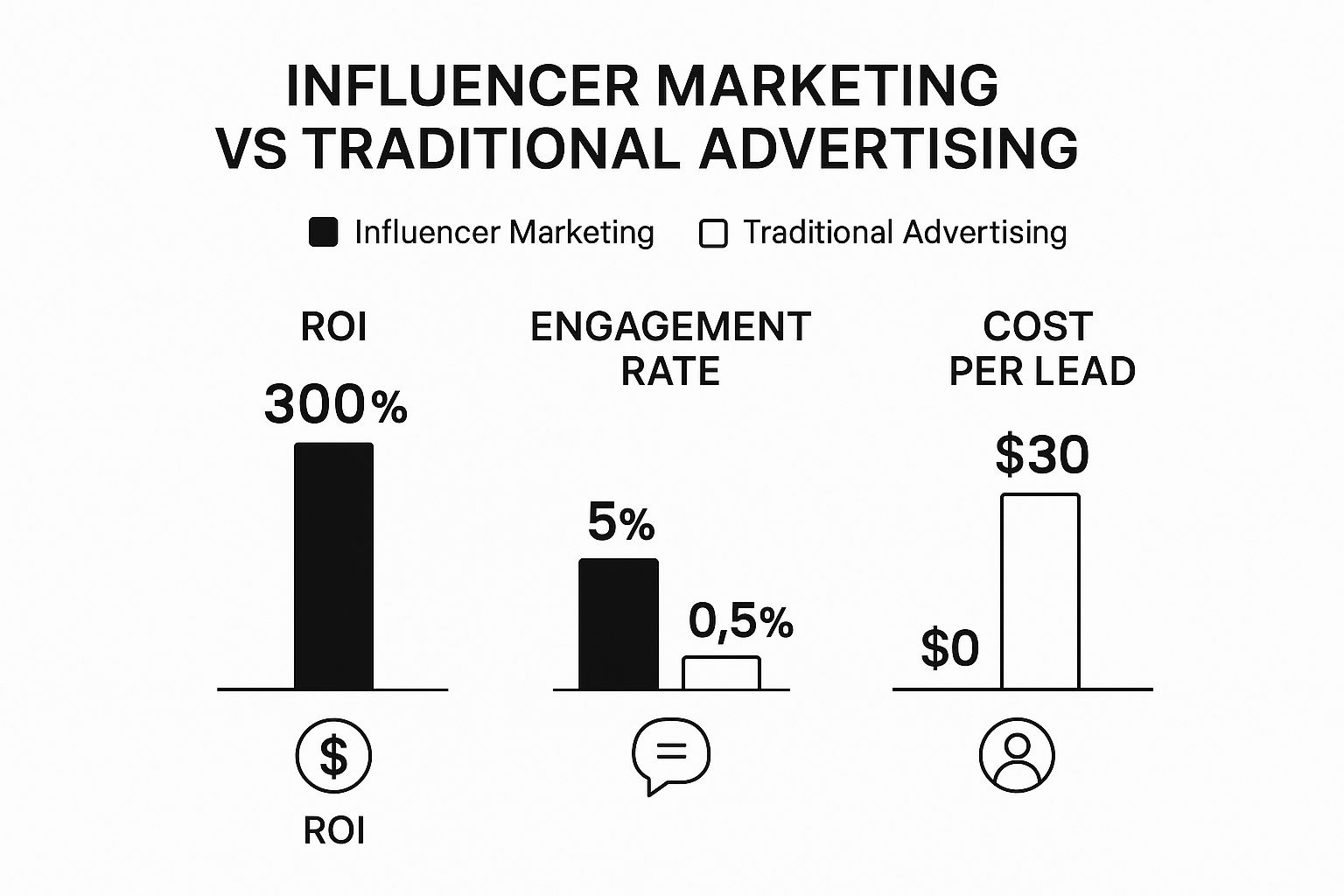
The data doesn't lie. When you see higher ROI, better engagement, and a lower cost to get a new customer, it becomes pretty clear why so many small businesses are betting on authentic creator partnerships.
To help you decide where to focus your budget, it's useful to see the different tiers side-by-side. Each has its own strengths, but for small businesses, the sweet spot is often in the nano and micro categories.
Influencer Tier Comparison for Small Businesses
| Influencer Tier | Follower Range | Typical Cost | Best For |
|---|---|---|---|
| Nano | 1k – 10k | Product Gifting / $10 – $100 | Hyper-niche markets, local businesses, building initial buzz with high trust. |
| Micro | 10k – 50k | $100 – $500 | Driving targeted conversions, high-engagement campaigns, cost-effective reach. |
| Mid-Tier | 50k – 500k | $500 – $5,000 | Scaling brand awareness while maintaining solid engagement. |
| Macro | 500k – 1M | $5,000 – $10,000+ | Broad awareness campaigns, reaching a massive, more general audience. |
| Mega | 1M+ | $10,000++ | Celebrity endorsements, massive brand announcements (often out of reach for SMBs). |
As you can see, you don't need a massive budget to get started. The key is to pick the tier that aligns with your specific campaign goals, whether that's building trust in a small community or driving sales in a targeted demographic.
Where to Actually Find These Influencers
So, where are these perfect partners hiding? Often, they're right under your nose, already active in the communities you want to reach. You just need to know where to look. You don't need expensive platforms; some of the best methods are completely free and just require a bit of smart digging.
Here are a few practical places to start your search:
- Dive into Hyper-Specific Hashtags: Forget generic tags like
#foodie. If you sell vegan protein powder, you should be searching tags like#veganrecipeshareor#plantbasedrunner. The creators using these are speaking directly to your people. - Explore Local Geotags: This is a goldmine for brick-and-mortar businesses. Search the location tag for your city, your neighborhood, or even your own shop. You’ll find local creators who can drive real foot traffic.
- Analyze Your Competitors' Followers: Take a look at who is consistently liking and commenting on your competitors' posts. These are engaged users in your niche, and many are budding influencers themselves.
Vetting Potential Partners Like a Pro
Once you've got a list of potential influencers, it's time for the most important step: vetting. This is all about quality control. A slick media kit doesn’t tell the whole story, and you need to make sure you're partnering with someone professional, authentic, and truly a good fit for your brand.
Your goal here is to spot red flags before you even send that first outreach email. An influencer's follower count is just one small piece of the puzzle. What matters so much more is the quality of their engagement, their audience demographics, and the work they've done before.
A great influencer partnership is about shared values, not just shared audiences. Look for creators who genuinely reflect your brand’s mission and ethos. Their authenticity will shine through and resonate far more deeply with their followers.
Here’s a quick checklist to run through as you evaluate each candidate:
- Analyze Their Engagement Quality: Don't just glance at the number of likes. Read the comments. Are they real conversations or just a string of fire emojis from bots? Authentic engagement has substance.
- Scrutinize Their Follower List: Use a free tool to run a quick audit for fake followers. A high percentage of sketchy accounts is a huge red flag that they've likely bought their audience.
- Review Past Brand Collaborations: How do they handle sponsored content? Look for creativity, professionalism, and clear FTC disclosures (like
#ador#sponsored). If their feed is just one ad after another, their recommendations probably don't carry much weight. - Confirm Audience Demographics: This is non-negotiable. Ask for a screenshot of their audience analytics directly from their Instagram or TikTok profile. You have to verify that their followers' age, gender, and location match your ideal customer. Don't just take their word for it.
More and more small businesses are leaning into this strategy. In fact, micro- and nano-influencers are set to make up 75.9% of the influencer base on Instagram in 2024. These creators often pull in engagement rates up to 5-10 times greater than mega-influencers, a massive advantage for brands trying to connect with a specific market.
By focusing on these smaller, highly-engaged creators and vetting them properly, you can build powerful partnerships that don't break the bank. To dig even deeper, check out our full guide on how to find micro-influencers who can genuinely grow your brand.
Building Real Partnerships: How to Nail Your Influencer Outreach
That first message to an influencer? It's your one and only shot to make a good impression. If you send a generic, copy-and-pasted DM, you can bet it’s getting ignored or deleted. But a thoughtful, personalized message can open the door to a fantastic partnership.
The key is to show you’ve actually done your homework. This isn't about spamming inboxes; it's about starting a real conversation. You need to prove you appreciate their content, get their audience, and see a genuine fit for your brand. This first touchpoint sets the tone for the entire relationship.
The First Message That Actually Gets a Reply
Before you even think about hitting 'send,' put yourself in their shoes. Top creators are constantly bombarded with requests. Your message has to cut through that noise by being personal, quick to read, and focused on what's in it for them.
Here’s what a great first message always includes:
- A real connection: Mention a specific post, video, or Story of theirs you actually liked. Show them you're a follower, not a robot trawling for partners.
- A quick intro: Briefly say who you are and what your business is all about.
- Why it's a fit for their audience: Explain why you think a collaboration makes sense for the people who follow them. How does your product solve a problem they have or fit their lifestyle?
- An easy next step: Keep the ask simple. Something like, "Let me know if you'd be open to chatting more about it," is perfect.
Your goal with the first message isn't to land a deal; it's just to get a "yes" to a conversation. Think of it as asking for a coffee date, not a marriage proposal.
Negotiating a Deal That Works for Everyone
So, you got a reply! Now the conversation turns to the nuts and bolts. For a small business, this is where you can get creative, especially if your budget is tight. You have a lot more to offer than just cash.
Don't assume every influencer wants the same thing. The right compensation model really depends on your goals and what you can bring to the table.
Smart Compensation Models for Small Businesses:
- Product Gifting (aka Seeding): This is a great starting point, especially if you have a high-value product. Once you know who you want to work with, figuring out how to send PR packages that truly stand out is a game-changer. It works best when your product’s retail value is high and it's a perfect match for the creator’s niche.
- Affiliate Commissions: This is a pure performance model that carries almost zero risk for you. You give the influencer a unique discount code or trackable link, and they earn a cut of every sale they bring in. It's an incredible way to make sure you're only paying for real results.
- The Hybrid Deal: My personal favorite. This approach combines a smaller upfront fee with a solid affiliate commission. The fee shows you respect the creator's time and effort, while the commission gives them a powerful reason to go all-in on driving sales.
Always, Always Get It in Writing
Once you’ve shaken hands on the details, it’s time to make it official. A simple, clear agreement protects both you and the influencer by making sure everyone is on the same page. No surprises, no misunderstandings.
You don't need a lawyer to draft a 20-page legal document. Just make sure your agreement clearly covers the essentials:
- The Deliverables: Get specific. How many posts, Stories, or reels? On which platforms?
- Key Deadlines: When are drafts due? When does everything go live?
- Content Usage Rights: This is a big one. Spell out how you can use their content. Can you feature it on your website, in email newsletters, or in paid social ads?
- FTC Disclosure: You must require them to follow FTC guidelines with clear tags like #ad or #sponsored. This is a non-negotiable legal requirement.
- Payment Details: How much are they being paid and when?
A straightforward contract shows you're a professional and sets your partnership up for a smooth, successful campaign.
Managing Your Campaign and Measuring What Matters
Getting your influencer campaign live is a great feeling, but don't pop the champagne just yet. The launch is just the starting line. The real work—and the real results—come from how you manage the partnership and track what's happening. This is where you shift from hoping for a return to actually proving it.
Successful campaign management is a bit of a balancing act. You need to give clear direction to keep the message on-brand, but you absolutely have to give the creator space to be themselves. The minute you try to control every word, you kill the authenticity that made you want to work with them in the first place. Stifled creativity just leads to content that feels like a stiff, corporate ad.
Setting the Stage with a Clear Brief and Calendar
Your two most valuable tools for a smooth campaign are a solid creative brief and a simple content calendar. Think of them not as tools for micromanagement, but as tools for alignment. They get everyone on the same page and eliminate nasty surprises down the road.
A creative brief is just a one-page guide that lays out the essentials. It should feel helpful, not like a list of demands.
Here’s what a simple, effective brief should cover:
- The Big Goal: One clear sentence on what success looks like. (e.g., "Drive 100 sales of our new skincare serum.")
- Key Talking Points: Just two or three non-negotiable things you need them to mention. Keep it short so they can weave it into their own story.
- Call to Action (CTA): What, exactly, do you want people to do? ("Use code TINA15 for 15% off," or "Tap the link in my bio to shop.")
- Dos and Don'ts: Any hard-and-fast rules, like avoiding competitors or specific phrases.
The content calendar is your shared timeline. It keeps everyone on schedule. Honestly, a simple Google Sheet works perfectly. Just list out the key dates for content drafts, when you'll provide feedback, and the final go-live posts. This simple step saves a world of last-minute stress.
Demystifying Your Campaign Tracking
So, how do you really know if the campaign is working? You have to track it. If you’re just looking at likes and comments, you might as well be throwing your money away. You need hard data that connects what the influencer is doing to what's happening in your business.
The two most powerful, non-negotiable tools for this are UTM parameters and unique discount codes.
- UTM Parameters: These are just little tags you add to the end of a URL. When someone clicks the influencer's link, your Google Analytics can see exactly where that person came from. It lets you track traffic, how long they stayed on your site, and—most importantly—any sales that came directly from that influencer.
- Unique Discount Codes: This is the most straightforward way to track sales. Give each influencer their own code (like
SARAH10orMIKE15). Every time a customer uses that code at checkout, you know precisely who sent them.
Setting up proper tracking isn't an optional step—it's the only way you can definitively answer the question, "Did this investment actually grow my business?" Without it, you're just guessing.
The industry gets this. Roughly 80% of companies are planning to either maintain or increase what they spend on influencers through 2025. This confidence comes from new tools that make managing campaigns and measuring performance easier than ever, which is great news for small businesses. In fact, about 66.4% of marketers say they’re getting better results now thanks to these tech improvements. You can dig into more of this data in the latest research from Hype Auditor.
Calculating Your True Return on Investment
Once the campaign wraps up and you’ve got the numbers, it’s time to calculate your return on investment (ROI). This is the bottom-line metric that tells you, plain and simple, if you made money.
The basic formula is pretty straightforward:
(Revenue from Campaign - Total Campaign Cost) / Total Campaign Cost * 100 = ROI %
Let’s run through a quick, real-world example. Say you run a small coffee company.
- Total Campaign Cost: You paid an influencer a $300 fee and sent them $50 in free coffee. Your total cost is $350.
- Revenue from Campaign: Their unique discount code,
COFFEE15, was used on 25 orders, which brought in $900 in sales. - ROI Calculation:
($900 - $350) / $350 * 100 = 157%
An ROI of 157% is a home run. It proves the partnership was a financial win. Learning how to run this simple calculation is crucial, and you can dive into more advanced techniques in our guide on measuring influencer marketing ROI. This kind of math is what turns influencer marketing from a hopeful expense into a predictable, scalable way to grow your business.
Got Questions About Influencer Marketing? We’ve Got Answers.
Jumping into influencer marketing for the first time can feel like you're navigating a maze. You’ve probably got a dozen questions swirling around, from how much this is all going to cost to what happens if a campaign doesn't work out. It's completely normal.
Let's cut through the noise and tackle the most common questions I hear from small business owners. My goal here is to give you straightforward, no-fluff answers so you can move forward with confidence.
How Much Should I Actually Pay an Influencer?
This is the million-dollar question, isn't it? The honest answer is: it depends. There's no universal price list, which can be frustrating but also works in your favor as a small business. Rates are all over the place and depend on an influencer's follower count, how engaged their audience is, your niche, and what you’re asking them to do.
As a general starting point, for nano-influencers (1,000–10,000 followers), you might begin with gifting a product or paying a small fee, often somewhere in the $25–$150 range per post. When you look at micro-influencers (10,000–50,000 followers), those rates typically jump to $150–$600+ for a single piece of content. The best first step is to just ask for their media kit, which will lay out their standard pricing.
Here's a pro tip for small businesses on a tight budget: pitch a hybrid payment model. Offer a modest upfront fee plus a solid affiliate commission for any sales they generate. This shows you value their time while also protecting your cash flow and giving them a real incentive to drive results.
It’s a win-win that connects their compensation directly to the performance you need to see.
What Are the Legal Rules I Need to Worry About?
If you only remember one thing from this section, make it this: disclosure is non-negotiable. The Federal Trade Commission (FTC) has very clear guidelines on endorsements, and they require sponsored content to be clearly marked as an ad. This protects everyone involved—you, the creator, and the audience.
The influencer has to use obvious disclosures like #ad or #sponsored.
- These tags can't be buried at the end of a long list of hashtags or hidden behind a "read more" button. They need to be easily visible.
- A vague "Thanks to [Your Brand]!" doesn't cut it. The language has to be crystal clear.
Make sure your influencer agreement explicitly states that following current FTC guidelines is their responsibility. This puts the obligation on them and helps shield your business from any potential legal headaches.
Can I Reuse the Content an Influencer Creates?
Only if you have it in writing. By default, the creator owns the copyright to the photos and videos they produce for your campaign. If you want to use that content on your own channels, you have to negotiate for the rights to do so. This is a massive detail that needs to be sorted out in your contract from day one.
Most basic agreements might only give you permission to repost their original content on your social media accounts. If you want more, you need to spell out the specific usage rights.
For example, do you want to use their content for things like:
- Your website's homepage or product pages?
- Your email newsletters?
- Your paid social media ads?
Getting broader usage rights will almost certainly add to the cost, but think of it as a long-term investment. You're building a library of authentic, high-quality user-generated content that you can tap into for months, getting way more value out of a single collaboration.
What Do I Do If a Campaign Bombs?
First off, take a deep breath. It happens. Not every campaign is going to be a home run, especially when you're just getting your feet wet. The key is to see it as a learning experience, not a failure. Dig into the data to figure out why it fell flat.
Was your call-to-action confusing? Did the creative just not connect with that specific audience? Maybe the discount code wasn't compelling enough to get people to click. Use your analytics to find the weak spot.
Then, have a real conversation with the influencer. Be transparent. Share what the data is telling you and ask for their take. They know their audience better than anyone. It might turn out that a small tweak to the caption or a different type of photo could have made all the difference. Work together to figure it out, and you’ll make your next campaign—whether it's with them or someone else—that much smarter.
Ready to stop guessing and start building powerful, data-driven influencer campaigns? The team of experts at ReachLabs.ai can help you find the right creators, manage your partnerships, and measure the results that actually matter. Elevate your brand's voice and see real growth by visiting https://www.reachlabs.ai to learn more.