

It’s easy enough to write down the formula for social media ROI: you take your total return, subtract your investment, divide it by that same investment, and multiply by 100 to get a percentage. The real work, the part that separates the pros from the beginners, is figuring out what that ‘return’ actually is. It’s certainly not just likes and shares.
Moving Beyond Likes to Real Revenue
If you’ve ever had to justify your social media budget with an engagement report, you know the feeling. It’s tough. You’re trying to connect the dots between all the activity you’re generating and tangible results like actual sales or qualified leads. This is a common struggle that often leads to budget cuts and a lot of head-scratching from leadership about what social media is really doing for the business.
The secret is to stop chasing vanity metrics and start focusing on value metrics. Of course, it’s nice to see likes, shares, and new followers rolling in—it shows people are paying attention. But those numbers don’t tell the whole story, and they definitely don’t show how your work is hitting the bottom line. To do that, you need a framework that ties every single post, campaign, and conversation back to a specific business goal.
From Vanity Metrics to Value Metrics
Let’s get practical. Imagine one of your posts goes viral, racking up 100,000 likes. Amazing, right? But what if it resulted in zero clicks to your website? Now, compare that to a small, targeted ad that only got 50 clicks but led to five new customers. The viral post was a vanity win; it looked great on the surface. The ad, however, was a value win—it directly contributed to revenue. That’s the distinction that matters when you’re proving your worth.
This disconnect isn’t just something you’re feeling; it’s a huge pain point across the industry. The 2025 Sprout Social Index™ found that while an overwhelming 97% of senior marketing leaders are confident they can communicate the value of social media, only a mere 30% of marketers feel they can measure its ROI effectively. That’s a massive confidence gap. Why does it exist? Because metrics like impressions and click-through rates don’t automatically translate into dollars and cents. You can dig into this more in the full Sprout Social report.
To close that gap, you have to draw a straight line from your social strategy to financial results.
To truly understand ROI, we need to reframe how we think about success. The metrics that feel good aren’t always the ones that drive business growth. It’s time to shift our focus from surface-level engagement to metrics that measure real business impact.
| Shifting from Vanity Metrics to Value Metrics |
| :— | :— |
| Vanity Metric (What It Shows) | Value Metric (What It Measures) |
| Follower Count: You have a large audience. | Lead Generation: How many potential customers did social media bring in? (e.g., form fills, downloads) |
| Likes & Reactions: People engaged with a post. | Conversion Rate: What percentage of website visitors from social media took a desired action? (e.g., made a purchase) |
| Impressions & Reach: How many people saw your content. | Customer Acquisition Cost (CAC): How much did it cost to acquire a new customer through social channels? |
| Shares & Retweets: Your content was amplified. | Customer Lifetime Value (LTV): What is the total revenue generated from customers acquired via social media? |
By focusing on the right column, your reports stop being about activity and start being about impact. This is the language that executives understand and value.
The core principle is simple: If an activity doesn’t contribute to a business objective—whether it’s generating leads, increasing sales, or improving customer retention—it shouldn’t be a primary focus of your ROI measurement.
Building Your ROI Framework
So how do you build a framework that actually works? It all starts by putting a dollar value on your social media goals.
Let’s say a key goal for you is lead generation. First, you need to figure out what a lead is actually worth to the business. If a lead from LinkedIn typically turns into a customer with an average lifetime value (LTV) of $2,000, and your sales team closes 10% of those leads, then a single lead is worth $200. Simple as that.
Once you assign these values, the whole game changes. Every form fill, demo request, or newsletter sign-up that comes from your social media efforts now has a clear monetary value attached. Your reporting transforms from a simple summary of what you did into a powerful demonstration of the financial impact you’re making, making those budget conversations a whole lot easier.
Set Goals That Actually Drive Business Value

Before you even think about cracking open an analytics dashboard, the real work of measuring social media ROI begins. It all starts with setting crystal-clear goals that are directly tied to what the business actually cares about: profitability.
If you don’t have a specific target, you’re just throwing content at the wall and hoping something sticks.
Vague goals like “increase engagement” or “grow our following” feel productive, but they’re vanity metrics. They don’t provide a solid foundation for calculating a financial return, which makes it nearly impossible to justify your budget or prove your worth to stakeholders. The conversation needs to shift from fuzzy aspirations to concrete, bottom-line outcomes.
The trick is to anchor every single one of your social media efforts to a specific business result. Are you trying to generate more qualified leads? Drive direct sales? Or maybe cut down on customer churn? Each of these missions demands a totally different strategy and a unique set of metrics.
Connect Social Goals to Business Objectives
Every social media goal you set should be a direct reflection of a larger company objective. There’s no room for disconnect. If the sales department is under pressure to hit a quarterly revenue target, your social goal shouldn’t be about getting more likes—it should be about feeding them sales-qualified leads or driving direct e-commerce conversions.
Think of it this way: your social media activities are the tactics, but the business objective is the mission. When they aren’t in sync, you’re just burning time and money on activities that don’t move the needle where it really counts.
Here’s how you can start mapping your social media goals to what the rest of the company is trying to achieve:
- Business Goal: Increase revenue by 15% this quarter.
- Social Media Goal: Generate $50,000 in direct sales from Instagram Shop campaigns in the next three months.
- Business Goal: Shorten the sales cycle for new leads.
- Social Media Goal: Source 50 qualified demos for the sales team from LinkedIn lead gen forms this quarter.
- Business Goal: Improve customer retention and loyalty.
- Social Media Goal: Reduce customer support ticket response times by 20% by addressing common questions via Twitter within one hour.
This kind of alignment ensures that every post, every reply, and every campaign you launch serves a real strategic purpose. For a deeper dive, our guide on proven ways to improve marketing ROI offers more strategies for connecting your marketing activities to tangible financial results.
Use the SMART Framework for Clarity
The SMART framework has been around forever for one simple reason: it works. It forces you to get out of the clouds and create an actionable plan that’s easy to track and measure.
Let’s break down what a truly SMART social media goal looks like in practice.
- Specific: Don’t just say “more website traffic.” Get precise. Aim to “increase traffic to our new product landing page.”
- Measurable: Slap a number on it. “Increase traffic by 25% from social media referrals.”
- Achievable: Be honest with yourself. If you’re getting 100 site visitors a month right now, shooting for 10,000 next month is just setting your team up to fail.
- Relevant: Does this goal actually matter? Does driving traffic to that specific page support a major sales initiative? It has to.
- Time-bound: Give yourself a deadline. “Increase traffic by 25% within the next 60 days.”
Here’s a real-world example: Imagine a B2B SaaS company wants to use social media for lead generation. A vague goal is “Get more leads from LinkedIn.” That’s not helpful.
A SMART goal is: “Generate 75 marketing-qualified leads (MQLs) by promoting our new ebook through targeted LinkedIn sponsored content campaigns, maintaining a cost per lead under $50, by the end of Q3.”
This level of detail isn’t just about clarifying your mission; it hands you the exact metrics you’ll need to watch to see if your investment paid off. When you define what success looks like this clearly from day one, calculating your return becomes a simple matter of comparing your results to your original targets.
Choose Metrics That Actually Mean Something

Alright, you’ve got your business goals locked in. Now comes the fun part: figuring out how to actually measure your progress. This is where we shift from the big-picture “what” to the nitty-gritty “how.” The key performance indicators (KPIs) you pick have to be a direct reflection of those goals. If they aren’t, you’ll just end up with a spreadsheet full of data that looks impressive but doesn’t tell you a thing about your financial impact.
Let’s be honest, it’s easy to get hooked on vanity metrics. Seeing follower counts rise or a post get a ton of likes feels good, but that immediate gratification doesn’t pay the bills. To get a real handle on social media ROI, you have to look past those surface-level numbers. This means focusing on concrete business outcomes by linking social media activities to sales performance through things like revenue attribution and conversion tracking.
What you measure depends entirely on what you’re trying to achieve. Let’s dig into how you can align your KPIs with some common business objectives.
Tying Metrics to Sales and Revenue
If your main goal is to drive sales straight from social media, your metrics need to follow the money. This is the most direct way to calculate ROI because it’s all about hard numbers.
Here’s what you should be tracking:
- Social Media Conversion Rate: This is the big one. It’s the percentage of people who click from a social channel and then actually complete a purchase or sign-up. It tells you how effective your content really is at convincing people to act.
- Revenue from Social Channels: Using a tool like Google Analytics, you can see exactly how much sales revenue is coming from platforms like Instagram, Facebook, or Pinterest. This shows you where your most valuable customers are hanging out.
- Average Order Value (AOV): Keep an eye on the AOV for customers coming from different social platforms. You might find that customers from Pinterest spend 15% more per order than those from Twitter. That’s a signal telling you where to invest more of your budget.
For instance, an e-commerce brand running an Instagram Shop campaign should be tracking the total revenue generated from their shoppable posts and the conversion rate of people who click on them. It creates a clean line from a social post straight to a sale.
Your goal isn’t just to track metrics; it’s to track the right metrics. The right metric is any data point that directly answers the question, “Did this social media activity help us achieve our financial objective?”
Measuring Your Lead Generation Engine
For a lot of B2B companies, social media is all about filling the top of the sales funnel. It’s not about an immediate sale but about generating high-quality leads for the sales team to nurture. When that’s the goal, your metrics shift from dollars to the potential value of a new customer.
Focus on these lead generation metrics:
- Cost Per Lead (CPL): This is absolutely critical for ROI. Just take your total campaign spend and divide it by the number of leads you got. This tells you exactly how efficient your social efforts are.
- Lead-to-Customer Conversion Rate: This one is huge. Of all the leads you generated from social, how many of them actually became paying customers? This metric helps you understand the quality of your leads, not just the quantity.
- Form Fills and Gated Content Downloads: These are tangible actions. Every webinar registration or ebook download represents a new prospect entering your pipeline.
Think about a B2B software company using LinkedIn to promote a new whitepaper. They would track the number of downloads (form fills), but they wouldn’t stop there. They’d follow those new leads through their CRM to see the ultimate lead-to-customer conversion rate. You need that full-funnel view to get an accurate ROI number.
How to Put a Value on Brand Awareness
Brand awareness often gets labeled a “soft” goal, but you can absolutely assign real value to it. While it might not lead to a sale today, a strong brand presence lays the groundwork for all future sales.
Here’s how you can measure it:
- Share of Voice (SOV): This metric tells you how much of the online conversation in your industry is about your brand versus your competitors. Tools that track brand mentions can help you calculate this.
- Audience Growth Rate: Don’t just stare at your raw follower count. Track the rate of growth month over month. A steady, healthy growth rate shows that your brand is staying relevant and interesting.
- Website Traffic from Social: A key part of building awareness is simply getting people to discover you. A jump in referral traffic from your social channels is a clear sign that your content is successfully pulling people into your orbit.
When you connect these kinds of metrics to your specific goals, you’re building a solid framework for measuring social ROI that goes way beyond just counting likes and shares.
Build Your Tracking and Attribution Framework
How do you connect a casual “like” on Instagram to a customer hitting “buy” on your website? It’s not magic—it’s about building a solid tracking framework. This is the technical backbone of your entire social media ROI strategy. Without it, you’re just guessing.
Essentially, this framework is your system for following a user’s journey, from their first click on a social post all the way to a final conversion. When set up right, every lead, sale, and sign-up gets credited to the right source, giving you the clean data you need to prove your impact.
We create this digital trail using a combination of simple link tagging and more advanced on-site tracking tools.
The image below shows how different social media activities flow through tracking tools to generate tangible financial results.
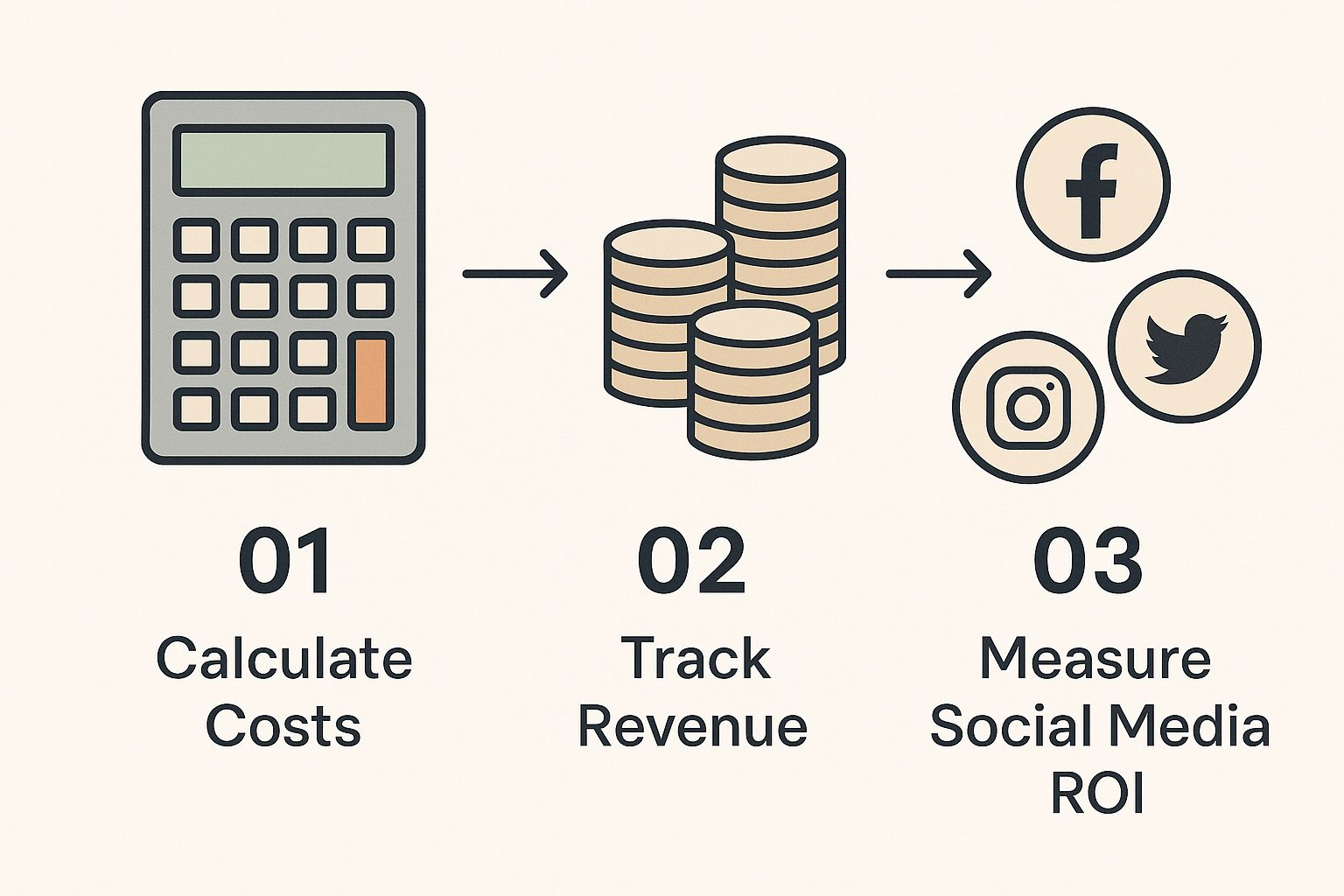
Think of this as the bridge between your social efforts and your revenue. The tracking tools are what make the connection possible, turning clicks and comments into measurable ROI.
Master UTM Parameters for Clear Traffic Data
The simplest, most powerful tool in your tracking arsenal is the Urchin Tracking Module, or UTM parameter. These are just small snippets of text added to the end of a URL that tell your analytics platform exactly where a visitor came from.
It’s like putting a unique name tag on every person who walks through your digital door. Instead of seeing a generic wave of “social media traffic” in Google Analytics, you can pinpoint performance down to a specific campaign, an individual post, or even the link in your bio.
A properly tagged link might look like this:
yourwebsite.com/product?utm_source=linkedin&utm_medium=social&utm_campaign=q3_promo
This tells you the visitor came from:
- Source: LinkedIn
- Medium: Social Media
- Campaign: The Q3 Promotion
Using UTMs consistently is non-negotiable for accurate ROI measurement. It’s the difference between saying “social media worked” and knowing for a fact that “our Q3 LinkedIn promo generated $15,000 in sales.”
Install Tracking Pixels to Monitor On-Site Actions
While UTMs tell you where users came from, tracking pixels tell you what they did after they arrived. A pixel is a tiny piece of code you install on your website that sends data back to social platforms.
The most common ones you’ll hear about are the Meta Pixel (for Facebook and Instagram) and the TikTok Pixel. These little spies monitor specific user actions, or events, like:
- Viewing a product page
- Adding an item to the cart
- Starting the checkout process
- Completing a purchase
This data is gold. It doesn’t just help you measure direct conversions; it also lets you build powerful retargeting audiences. For instance, you can create a campaign that specifically targets people who added a product to their cart but never finished checking out.
By connecting the dots between someone seeing your ad on social media and then making a purchase on your site, tracking pixels close the attribution loop and make direct revenue tracking possible.
Understand Marketing Attribution Models
Okay, so your tracking is in place. Now for the tricky part: who gets the credit for the sale? A customer journey is rarely a straight line. They might see a Facebook ad, click a Google search result a week later, and finally buy after getting an email promotion. This is where marketing attribution comes into play.
Attribution models are the set of rules you use to assign value to each touchpoint. The model you choose can drastically change the perceived ROI of your social media channels.
Here are the most common models:
- First-Touch Attribution: The very first channel a customer interacted with gets 100% of the credit. This is fantastic for understanding which channels are best at generating initial awareness.
- Last-Touch Attribution: The final channel a customer touched before converting gets all the credit. It’s the easiest to track but often undervalues the channels that did the hard work earlier in the journey.
- Multi-Touch Attribution: This is where things get interesting. Credit is distributed across multiple touchpoints, using models like linear, time-decay, or data-driven. These give you a much more holistic view of how your channels work together.
Choosing the right model depends on your business goals and sales cycle. To really get into the weeds, this guide on marketing attribution can provide valuable insights. For most businesses, though, a multi-touch model will offer the truest picture of how your social media efforts contribute to the bottom line, even when they aren’t the final click.
Calculating and Communicating Your Social Media ROI
You’ve set your goals and have your tracking framework dialed in. Now comes the moment of truth: connecting the dots to calculate the actual financial return from all your hard work on social media. This is where you transform raw data into a compelling story about the impact you’re making.
The basic formula for social media ROI is pretty straightforward on the surface:
ROI = [(Revenue – Investment) / Investment] x 100
While the math itself is simple, the real work is in accurately defining what goes into the ‘Revenue’ and ‘Investment’ buckets. Nailing these figures is the secret to a credible and powerful ROI calculation.
Tallying Up Your Total Social Media Investment
To get a true measure of your ROI, you have to look past the obvious costs. Your total investment is way more than just what you spend on ads. A truly comprehensive calculation includes every single resource you’ve poured into your social media strategy.
Make sure you’re accounting for all of these moving parts:
- Ad Spend: This is the most direct cost—what you pay to run paid campaigns on platforms like Meta, TikTok, or LinkedIn.
- Content Creation: Think about everything from graphic design and video production to the time spent writing copy. If you’re working with an agency or freelancers, their fees go here. If your team handles it, calculate the cost based on the time they spend.
- Team Salaries: You need to calculate the portion of your team’s salaries dedicated to social media. For instance, if your social media manager spends 75% of their time on social, you need to include 75% of their salary in your investment cost.
- Tools and Software: Don’t let those monthly or annual subscriptions for scheduling platforms, analytics software, and design tools slip through the cracks. They add up.
If you miss any of these pieces, you’ll artificially inflate your ROI, giving you a skewed and unreliable picture of your actual performance.
Capturing the full scope of your investment is non-negotiable. An incomplete cost analysis undermines the credibility of your entire ROI report and can lead to poor strategic decisions down the road.
Attributing Revenue and Unlocking True Value
Alright, let’s talk about the ‘Revenue’ side of the equation. This number represents the total monetary value your social media activities have generated. Because you set up a solid tracking framework earlier, you can now directly attribute sales and conversions back to specific channels and campaigns.
When you’re calculating revenue, be sure to look at these key sources:
- Direct Sales from Social: This is the easiest one. Use your analytics to track every purchase made by users who clicked a link from one of your social channels. It’s the clearest form of revenue attribution.
- Value of Leads Generated: Not every conversion is an immediate sale, and that’s okay. You can assign a monetary value to leads based on your historical data. For example, if you know a lead from LinkedIn has a 10% chance of becoming a $5,000 customer, then each of those leads is worth $500 to your business.
- Customer Lifetime Value (LTV): A single purchase is just the beginning of the story. A more sophisticated approach incorporates the LTV of customers you’ve acquired through social media. A customer who makes an initial $50 purchase but has an LTV of $500 delivers a much higher return than that first sale suggests. This perspective is especially critical for understanding the ROI of content marketing, where the real goal is often about building long-term relationships, not just one-off sales.
The scale of social media advertising is just massive. In 2025, businesses are on track to spend an incredible $276.7 billion on social ads. With that kind of money on the line, getting your ROI calculation right is non-negotiable. The average ROI for these campaigns often lands around 250%, meaning for every $1 spent, companies generate $2.50 in revenue—a powerful testament to what a well-run social strategy can do. You can find more paid social ROI statistics to see how you stack up.
Putting It All Together: A Practical Example
Let’s walk through a quick, real-world scenario. Imagine an e-commerce brand just wrapped up a month-long Instagram campaign to launch a new product.
Investment Calculation:
- Ad Spend: $500
- Content Creation (freelance designer): $300
- Social Media Manager’s Time (estimated portion of salary): $200
- Total Investment: $1,000
Revenue Calculation:
- Using UTM tracking and their Meta Pixel, they directly attributed $5,000 in sales to this specific campaign.
Now, let’s just plug those numbers into our formula:
ROI = [($5,000 – $1,000) / $1,000] x 100
ROI = [$4,000 / $1,000] x 100
ROI = 400%
With that one number, you can walk into any meeting and confidently report that for every dollar invested in the campaign, the business generated four dollars back. That’s the kind of clear, data-driven communication that builds trust and gets budgets approved.
Common Social Media ROI Questions Answered
Even with the best framework in hand, some tricky questions always seem to pop up when it’s time to actually calculate your social media ROI. I’ve been there. Let’s tackle a few of the most common hurdles marketers face, so you can move past the gray areas and build a report that truly tells the whole story.
Getting a handle on these scenarios is about more than just following a formula—it’s about genuinely understanding the value your social media efforts bring to the table.
How Can I Measure the ROI of Organic Social Media?
This is the big one, isn’t it? Measuring the return on organic social media—where you’re not putting direct ad spend behind a post—can feel like trying to catch smoke. It’s tough, but absolutely doable. The trick is to assign a real, tangible monetary value to the actions your organic content drives.
Think of every link you share as part of a mini-campaign. Start using UTM parameters on every single URL you post organically, whether it’s in your bio, a story, or a regular post. This is non-negotiable. It allows you to hop into a tool like Google Analytics and see exactly how much website traffic came directly from your non-paid efforts.
Once you can see the traffic, you can track conversions for the goals you’ve set up, like someone signing up for a newsletter or requesting a demo.
Here’s how to put a dollar figure on it. Let’s say you look at your historical data and find that 1 in every 20 newsletter subscribers eventually becomes a customer with a lifetime value of $1,000. Simple math tells you each new organic sign-up is effectively worth $50.
This approach flips abstract engagement into a concrete “Return” figure. You can even get creative and factor in cost savings. For example, how many customer support issues did you solve in DMs instead of through a more expensive call center? Add it all up, and you’ve got a defensible return to weigh against your investment in time, tools, and content.
What Tools Are Essential for Tracking Social Media ROI?
Flying blind is not an option. While you can scrape by with the basics, having the right tech stack is what gives you a full-funnel view of performance, from the very first touchpoint to the final sale.
If you’re serious about tracking, your toolkit needs these core components:
- Google Analytics: This is your home base for tracking what happens after the click. It shows you website traffic, user behavior, and goal completions that started on social media. It’s where all that UTM data comes to life.
- Native Platform Analytics: Don’t overlook the data inside platforms like Meta Ads Manager or LinkedIn Campaign Manager. They give you invaluable insights into on-platform performance, like ad reach and engagement, that you can’t get anywhere else.
- Social Media Management Platforms: I can’t imagine doing this job without a tool like Sprout Social or Hootsuite. They pull all your data from different channels into one place, which streamlines reporting and saves an incredible amount of time.
- CRM Software: The final piece of the puzzle is your CRM. A platform like HubSpot or Salesforce is what lets you connect the dots, tracking leads all the way through the sales funnel and attributing revenue back to the social post that started the conversation.
This combination of tools lets you draw a straight line from a social media click to a signed contract. That’s the kind of ROI proof that gets noticed.
How Often Should I Measure and Report on Social Media ROI?
There’s no single “right” answer here—the ideal reporting rhythm depends entirely on your business cycle and the kind of campaigns you’re running. The goal is to establish a cadence that makes sense for your strategy.
For most day-to-day social media work, a monthly report is the sweet spot. It’s just enough time to collect meaningful data and spot trends, but not so long that you let an underperforming campaign burn cash for weeks on end. It’s the perfect balance of being reactive and strategic.
Of course, you need to be flexible.
- For short-term campaigns (think a flash sale or a product launch), you should be checking key metrics daily. Once it’s over, do a full ROI analysis immediately.
- Quarterly and annual reports are for the big picture. This is where you analyze long-term performance, justify your budget for the next year, and make high-level tweaks to your overall strategy.
The most important thing? Be consistent. Whatever cadence you choose, stick with it. This creates a historical baseline that makes it much easier to spot what’s working, what’s not, and prove the cumulative value your social media investment delivers over time.
At ReachLabs.ai, we build data-driven marketing strategies that connect every single action to a measurable business outcome. If you’re ready to stop guessing and start proving the true financial impact of your marketing, let’s talk.