Think of a full-service digital marketing agency as your company's outsourced growth department. Instead of you having to find and manage a separate specialist for SEO, another for paid ads, and yet another for content creation, this model brings one integrated team under a single roof to run your entire digital playbook.
What Is a Full Service Digital Marketing Agency
Let's use an analogy. Say you're building a custom home. You could act as your own general contractor, hiring and managing the plumber, the electrician, the framer, and the painter. You'd spend your days coordinating schedules, mediating disputes, and hoping their individual work comes together. It's a massive headache.
The smarter move is to hire a general contractor. They manage all the specialists, making sure the plumbing, wiring, and foundation all follow a single, cohesive blueprint.
A full-service digital marketing agency is that general contractor for your online presence. It doesn't just offer a list of services; it delivers a strategically integrated solution where every marketing channel works in concert with the others.
The Power of a Unified Strategy
The real magic isn't just having experts in different fields available; it's how their efforts compound. Insights from your SEO team's keyword research should absolutely inform what your content team writes about. That new blog post then becomes a powerful asset for your email marketing, which can be amplified further with highly targeted social media ads.
This creates a powerful growth loop that you just can't get when hiring separate, siloed providers. You move from a collection of disjointed tactics to a cohesive engine built for growth. A deeper look into what a digital marketing agency does shows how these connected services build on each other to create incredible momentum.
A true full-service partnership is about strategic alignment, not just a long menu of services. It’s the difference between having a bunch of talented musicians and having a conductor who turns them into a symphony orchestra.
Moving Beyond Juggling Vendors
For most marketing leaders, managing a handful of niche agencies and freelancers quickly becomes a full-time job. Communication gets messy, strategies clash, and it's impossible to figure out who is accountable for what. When a campaign underperforms, the blame game starts. The SEO team points a finger at the web developers, and the paid media team complains about the landing page copy.
Centralizing all of this with a full-service agency offers a much cleaner path forward:
- Streamlined Communication: You have a single, dedicated point of contact who understands the entire picture.
- Total Accountability: One partner is ultimately responsible for delivering on the overall business goals and ROI.
- Operational Efficiency: Shared data, insights, and project management tools mean less wasted time and money.
This integrated model gets rid of the friction and finger-pointing. It lets you focus on running your business, confident that your marketing partner is executing a unified strategy designed for one thing: real, measurable growth.
The Core Services That Power Your Digital Growth
Think of a true full-service digital marketing agency less like a vendor and more like a high-performance pit crew for your business. It’s not just a random collection of services; it's a team of specialists working in sync, where every action is timed perfectly to propel you forward.
To really get it, you have to look under the hood at the core components. Each service has its own job, but the real magic happens when they’re integrated—feeding insights and wins back and forth to each other. That’s how you get results that siloed, one-off tactics could never achieve.
This diagram gives you a quick visual of how key disciplines like SEO, paid ads, and content all connect back to a central agency hub.
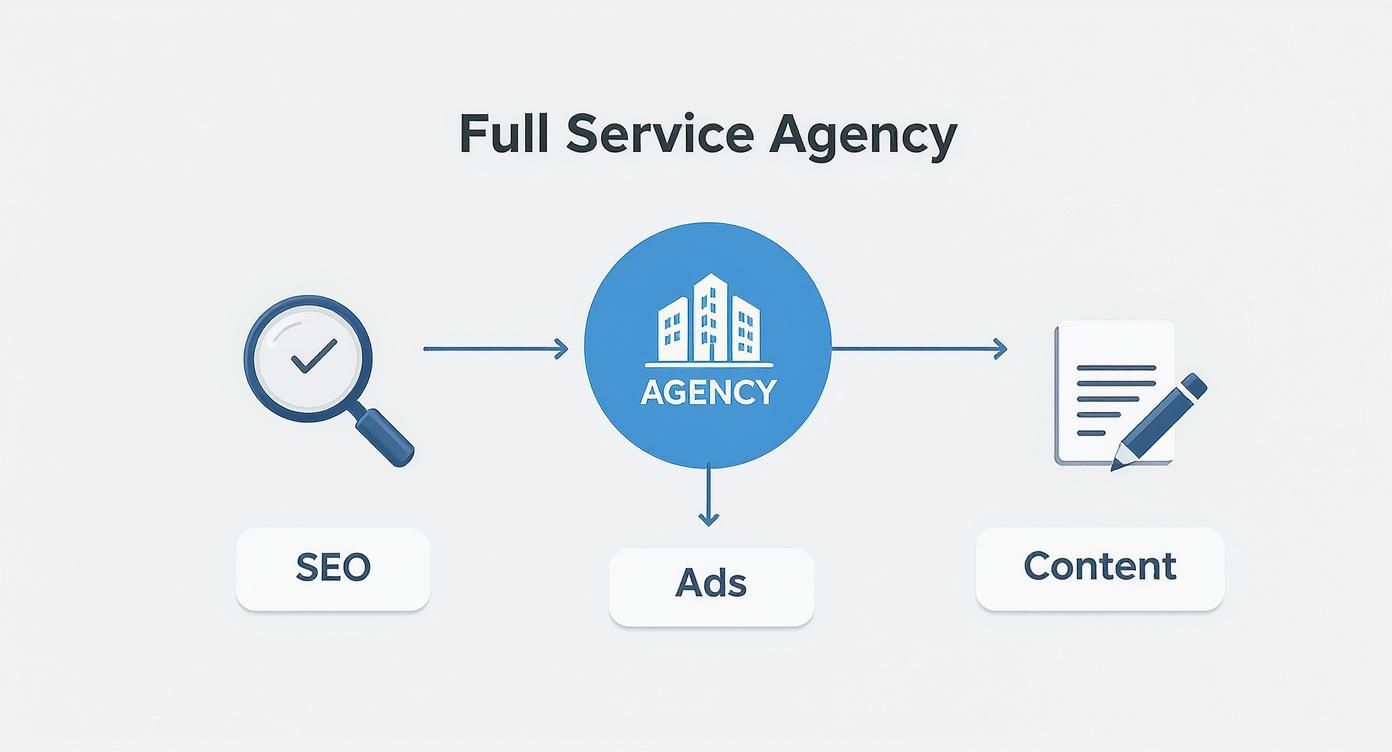
They aren't separate departments. They're collaborative parts of a single, cohesive plan to grow your business.
Search Engine Optimization (SEO): The Foundation
SEO is the digital equivalent of building your store in the best part of town. It’s the long-game strategy that makes sure customers find you naturally, right when they're searching for the exact solutions you offer. If you skip SEO, you're essentially invisible to a massive chunk of your market.
But it’s so much more than just plugging in a few keywords. A solid SEO strategy covers all the bases:
- Technical SEO: This is the nuts and bolts. We’re talking about making sure your website is easy for search engines to crawl and understand—things like site speed, mobile-friendliness, and having a secure connection.
- On-Page SEO: Here, we optimize individual pages with great content, the right keywords, and clear metadata. It's how you tell Google exactly what each page is about.
- Off-Page SEO: This is about building your reputation online. We earn trust and authority through high-quality backlinks and mentions from other respected websites in your industry.
Good SEO isn't a quick fix; it's a sustainable asset that keeps generating traffic and leads month after month, creating a solid foundation for everything else you do.
Paid Media and PPC: Driving Immediate Traffic
If SEO is the long-term investment, paid media—including Pay-Per-Click (PPC) ads—is your express lane to immediate, high-intent traffic. This is how you put your message directly in front of potential customers at the precise moment they’re ready to buy.
Platforms like Google Ads or social media advertising give you incredible precision. You can target people based on their demographics, what they're interested in, what they search for, and even if they've visited your site before. You're not just casting a wide net and hoping for the best; you're using a laser to find the people most likely to become customers.
Plus, the data from PPC campaigns gives you instant feedback on which messages and offers are working, which is priceless information you can funnel right back into your SEO and content strategies.
Content Marketing: Building Trust and Authority
Content marketing is how you prove you know your stuff. It’s the engine that builds trust, establishes your brand as the go-to expert, and nurtures relationships with people long before they’re even thinking about making a purchase.
Content is the currency of modern marketing. It's how you answer your audience's questions, solve their problems, and earn their trust, turning passive browsers into loyal customers.
And we're not just talking about blog posts. A complete content plan could involve all sorts of things:
- Educational Articles and Guides: Answering the common questions your customers have and positioning your brand as a helpful resource.
- Case Studies and Whitepapers: Offering in-depth proof that you can deliver real results.
- Video Content: A fantastic way to engage people on a more personal level and break down complex topics. In fact, video marketing is pretty much non-negotiable now, and this video marketing guide for small businesses is a great place to start.
Creative Services and Social Media Management
Your creative is the face of your brand. It’s the visuals, the words, the feeling people get when they interact with you. This covers everything from graphic design and branding to the copy on your website and the videos you produce. It’s all about creating a consistent, memorable brand experience everywhere you show up.
Social media management takes that creative and puts it to work building a community. It’s not about just scheduling posts and walking away. It’s about starting conversations, listening to what people are saying, and building genuine relationships that turn followers into fans. These platforms are also the perfect place to amplify the content you've created for your SEO efforts, driving even more traffic back to your site.
The Strategic Edge of a Truly Integrated Approach
Knowing the list of services a full-service agency offers is just the start. The real magic—and the real ROI—comes from understanding why these services are so much more powerful when they work together. Choosing an integrated agency isn't just a matter of convenience; it's a strategic move that makes your marketing efforts compound over time.
Think about it this way: trying to manage multiple specialist agencies is like asking a dozen different contractors to build a house without a single, shared blueprint. The plumber might do great work, and the electrician might be top-notch, but if their plans don't align, you'll end up with outlets in the wrong places and pipes where walls should be. The same thing happens in marketing.
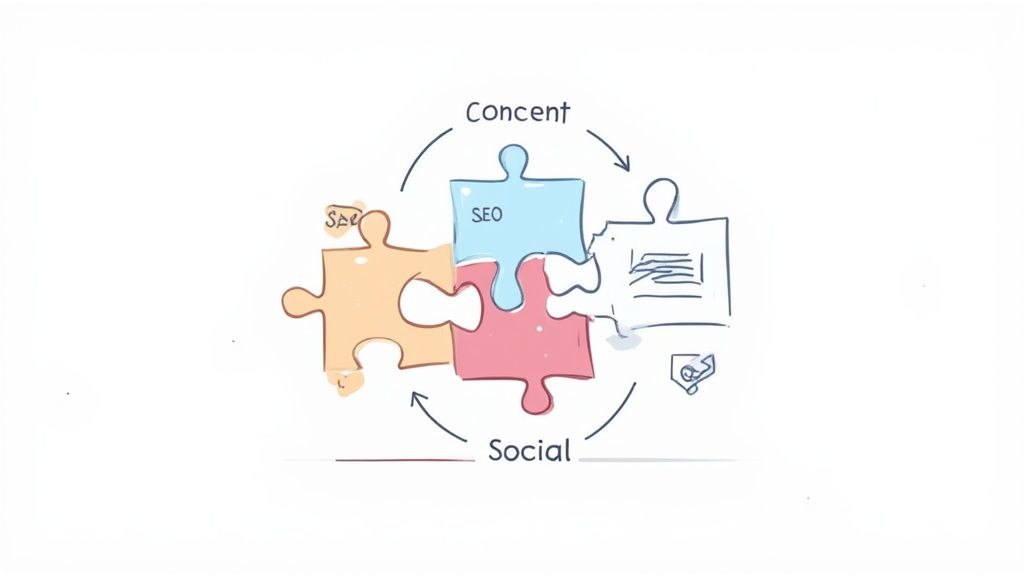
When you bring everything under one roof, you gain three huge advantages that directly boost your bottom line: strategic cohesion, streamlined operations, and undeniable accountability.
Creating Real Strategic Cohesion
This is the big one. Strategic cohesion means every single marketing activity—from a keyword choice for an SEO article to the creative on a social media ad—is pulling in the same direction. It’s all part of one unified game plan.
In a disjointed setup, your SEO team could be chasing long-tail keywords while your PPC agency is burning cash on broad, expensive terms. The result? A messy, confusing customer experience and a lot of wasted money.
An integrated approach creates a powerful feedback loop. The paid media team sees which ad copy converts best in real-time and feeds that data to the SEO team to sharpen up meta descriptions. The social media team notices a surge in questions about a specific feature, which tells the content team exactly what their next blog post should be about.
This synergy gets rid of the all-too-common problem of marketing "silos" where different teams are essentially competing with each other. Instead, they’re collaborating, sharing data, and working toward the only goal that matters: growing your business. You can see a deeper dive into this concept in our guide to building an integrated marketing strategy.
Gaining Major Operational Efficiency
Let's be honest, juggling multiple agencies is a massive time sink. You're constantly bouncing between separate meetings, trying to decipher different reporting dashboards, and getting lost in endless email threads just to keep everyone on the same page. It’s not just frustrating; it's incredibly inefficient.
A full-service digital marketing agency cuts through all that noise.
- One Point of Contact: You have a single, dedicated contact who knows your entire marketing picture inside and out. No more repeating yourself in four different meetings.
- Centralized Tools: The agency uses one set of tools for analytics, project management, and reporting. Everyone is working from the same data, the same "single source of truth."
- Less Admin for You: You get back countless hours you would have spent playing telephone between vendors, which you can now invest back into running your business.
This streamlined process means more of your marketing budget actually goes into marketing, not into paying for the friction of managing a complicated roster of partners.
Establishing Clear Accountability
What happens when a campaign misses its targets in a multi-vendor setup? The finger-pointing begins. The paid media team blames the website's clunky landing pages for bad conversion rates. The web designer says the traffic quality was poor to begin with.
With a single agency partner, there’s nowhere to hide. One team owns the results, period. This clear line of accountability gives the agency every reason to ensure all the channels are working in perfect harmony.
If something isn’t working, they own the problem and the solution. They can quickly diagnose the issue and deploy the right specialists—whether it’s creative, SEO, or paid media—to fix it. This leads to faster course corrections and, ultimately, much better results for you.
How To Choose The Right Agency Partner
Picking a full-service digital marketing agency is a huge decision, one that can genuinely make or break your company's growth trajectory. The market is crowded with options, which is both a blessing and a curse. The real trick is to look past a simple menu of services and find a team that acts as a true partner—one that gets your vision and has the chops to execute a strategy that brings it to life.
This isn’t about hiring another vendor. It’s about building a partnership. The right agency becomes a seamless extension of your own team, bringing in specialized skills and a fresh perspective that you just can't get from the inside. Get it right, and you'll see real results. Get it wrong, and you're looking at wasted budgets, missed opportunities, and a whole lot of frustration.
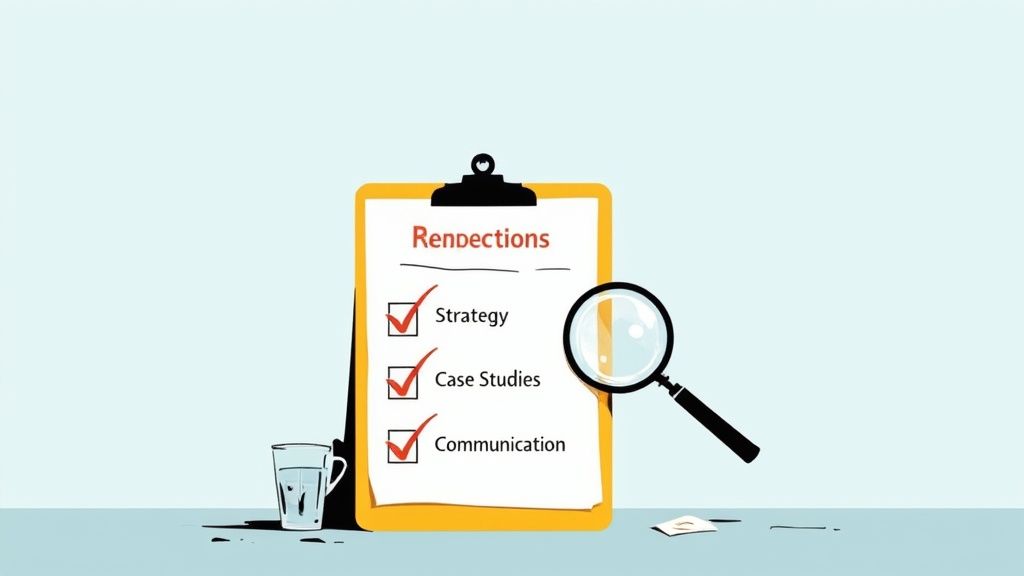
To make a smart choice, you need a game plan. That means knowing what to look for, what questions to ask, and which red flags should send you running.
Key Questions To Ask Potential Agencies
Before you even think about signing a contract, you have to do some digging. A few sharp, direct questions can reveal a lot about an agency's strategic thinking, their level of transparency, and their overall vibe. Any agency worth its salt will welcome the scrutiny.
Here are the must-ask questions for your shortlist:
-
"How will you measure success for our campaigns?" Listen for answers that go deeper than flimsy metrics like "likes" or "impressions." A great partner will immediately start talking about business-critical KPIs like customer acquisition cost (CAC), conversion rates, and return on ad spend (ROAS).
-
"Can you show us case studies from clients in a similar industry or with similar challenges?" Past performance is one of the best predictors of future success. They don't need to be an expert in your exact micro-niche, but they absolutely must show they understand your market's dynamics.
-
"What does your communication and reporting process look like?" The best agencies have a clear and consistent rhythm for communication—weekly calls, monthly performance reports, a real-time dashboard. You need total transparency and a single point of contact who knows your account inside and out. For a deep dive, check out our complete guide on how to choose a digital marketing agency.
-
"Who will be working on our account?" This is critical. You need to know if you'll be working with the senior-level pros you met in the sales pitch, or if your account is going to be handed off to a junior team. Understanding the team structure is non-negotiable. For new businesses, this guide to choosing the best digital marketing agency for startups offers more tailored advice.
Understanding Agency Pricing Models
Figuring out how agencies charge can feel like navigating a maze. It's a massive industry—the U.S. market for digital advertising agencies hit $58.2 billion in 2025, with over 60,000 businesses in the mix. That competition has spawned a bunch of different pricing structures. Getting a handle on them is key to finding a fit for your budget and goals.
Choosing an agency isn't about finding the cheapest option. It's about finding the best value—the intersection where expertise, service, and cost align to produce the highest possible return on investment.
Most agencies lean on one of a few common pricing models. Here’s a quick breakdown to help you compare your options.
Agency Pricing Models Explained
| Pricing Model | How It Works | Best For | Potential Drawback |
|---|---|---|---|
| Monthly Retainer | You pay a fixed fee each month for an agreed-upon scope of ongoing work (e.g., SEO, content, social media). | Businesses needing continuous, long-term marketing support and predictable budgeting. | Scope creep can be an issue if the initial agreement isn't crystal clear. |
| Project-Based | A one-time, flat fee for a specific, well-defined project with a clear start and end date, like a website redesign. | Companies with a single, clear objective and a defined budget for that specific initiative. | Not ideal for ongoing marketing needs; once the project is done, the work stops. |
| Performance-Based | The agency's payment is tied directly to hitting specific metrics, like a percentage of revenue or a fee per lead. | Companies that can track results precisely and want to directly link marketing spend to outcomes. | Can be complex to set up and track; less common because it shifts all risk to the agency. |
Understanding these models helps you walk into negotiations with confidence, knowing what to expect and which structure aligns best with your business objectives.
Red Flags To Watch Out For
Knowing what to avoid is just as important as knowing what to look for. Some tell-tale signs can expose an agency's inexperience, lack of transparency, or a focus on fluff over actual results.
Keep your eyes peeled for these red flags during your vetting process:
- Guaranteed Rankings: This is the oldest trick in the book. No one can guarantee a #1 spot on Google. SEO algorithms and competitors are constantly changing, and any agency making that promise is a huge red flag.
- A "Secret Sauce" Mentality: If they’re cagey about their strategies or won't explain their process, they're hiding something. Real partners are open books, happy to teach you what they're doing and why.
- One-Size-Fits-All Packages: Your business is unique. Your marketing strategy should be, too. Run from any agency pushing a generic, cookie-cutter package without first doing a deep dive into your specific goals.
- Lack of Clear Reporting: If they can't clearly explain how they'll track and report on performance, it’s a good sign they don't have a data-driven bone in their body.
Choosing the right agency takes time and serious due diligence. But the payoff is immense—a partnership with a great full-service digital marketing agency can become the engine that fuels your growth for years to come.
The Future of Full Service Agencies
https://www.youtube.com/embed/a40YkQDSIrk
The traditional model for a full-service digital marketing agency is changing—fast. What worked even five years ago is quickly becoming obsolete as technology completely redraws the map of what’s possible. The future isn't about simply tacking on more services; it's about delivering smarter, faster, and more precise results.
Agencies on the front foot are ditching reactive strategies and leaning into proactive, even predictive, marketing. This evolution is really being driven by two massive forces: artificial intelligence and a shift toward more flexible, specialized team structures. Put them together, and you get a new kind of agency built to deliver much better outcomes.
AI isn't some far-off concept anymore; it's here now, and it's weaving its way into every part of a campaign. Full-service agencies are adopting AI to supercharge what they can offer. The AI marketing industry hit a global value of $47.32 billion by 2025, and it's projected to shoot past $107.5 billion by 2028. With a staggering 88% of marketers already using AI tools daily, it's clear agencies are seeing major boosts in both efficiency and performance.
The Rise of the Specialist Hub Model
The old agency model was often built around generalists—people who knew a little bit about a lot of things. That approach gave you breadth, but it often missed the deep, niche expertise you need to actually win in a crowded market. Today's most effective agencies are built more like a specialist hub.
This model gives you the strategic oversight you'd expect from a full-service partner, but it's backed by dedicated teams of true experts in their respective fields—SEO, paid media, creative, analytics, you name it.
Think of it as having access to a team of world-class surgeons. Each one is a master of their specific field, but they all collaborate on a single, unified treatment plan to grow your business.
This setup gives you the best of both worlds: the big-picture strategy of an integrated agency paired with the tactical, in-the-weeds knowledge of a boutique firm.
Data Culture and Proactive Strategies
What fuels this new structure is a data-first culture. AI and advanced analytics aren't just for looking back at what happened last month. They're now being used for predictive modeling and personalizing experiences at a scale we couldn't imagine before.
Here’s a look at how this plays out in the real world:
- Predictive Audience Modeling: AI can sift through thousands of data points to pinpoint the audiences most likely to convert before you even spend your first ad dollar.
- Automated Campaign Optimization: Machine learning algorithms can adjust ad bids, A/B test creative, and move budgets around in real-time—far faster and more accurately than any human could.
- Hyper-Personalized Content: AI makes it possible to create and serve up content that’s perfectly matched to an individual's past behavior and preferences, which naturally drives up engagement and conversion rates.
By combining a team of dedicated experts with a powerful, data-driven toolkit, the full-service digital marketing agency of the future doesn't just run your campaigns. It gets ahead of market shifts and drives growth with a level of precision that was once impossible.
Frequently Asked Questions
Thinking about bringing on a marketing partner? It's a big decision, and you probably have a lot of questions. Let's clear up some of the most common ones we hear from businesses just like yours.
How Much Does A Full Service Agency Cost?
There's no simple answer here, because a good agency doesn't sell a one-size-fits-all product. The cost really comes down to your specific goals, how big your company is, and the exact services you need to get the job done.
Most agencies work on a monthly retainer, which can be anywhere from a few thousand dollars for a smaller company to tens of thousands for a business needing a comprehensive, multi-channel strategy. The important thing is finding a partner who builds a custom plan for you, so you're only paying for activities that directly contribute to your bottom line.
When Is The Right Time To Hire An Agency?
You'll know it's time when you feel like you're juggling too many moving parts. If you're spending more time trying to get your SEO person, your ad guy, and your social media freelancer on the same page than you are on actual strategy, that's a huge red flag. An agency brings all of that under one roof.
If your growth has stalled and your current marketing feels like you're just spinning your wheels, that's the perfect moment to bring in a strategic partner to get things moving again.
Another clear sign is when your internal team is just too swamped to keep up. The rules for Google Ads and social media algorithms change constantly, and if you don't have someone dedicated to staying on top of it, you're going to fall behind.
What Kind Of Results Can I Expect?
This is a great question, and the answer depends on the channel. It's crucial to set the right expectations from the start.
- Paid Media (PPC): This is your fast-track. You should start seeing traffic and leads roll in within the first 30-60 days as campaigns go live and get their initial round of tweaks.
- SEO & Content Marketing: This is the long game. Think of it as building an asset. You'll see small wins early on, but the real, sustainable traffic and authority take 6-12 months to build.
A trustworthy full service digital marketing agency will define clear KPIs for every channel they manage. They’ll provide reports that don't just show clicks and impressions, but connect their work directly to what you really care about: leads, sales, and revenue.
Ready to see how a team of specialists can build a cohesive strategy for your brand? The experts at ReachLabs.ai integrate data-driven insights with creative execution to deliver measurable growth. Learn more and book a consultation on the ReachLabs.ai website.