Trying to market your business without a plan is a bit like setting off on a road trip with no map. You'll burn a lot of gas, take a lot of wrong turns, and probably end up somewhere you didn't want to be. It’s chaotic, expensive, and almost never gets you to your destination.
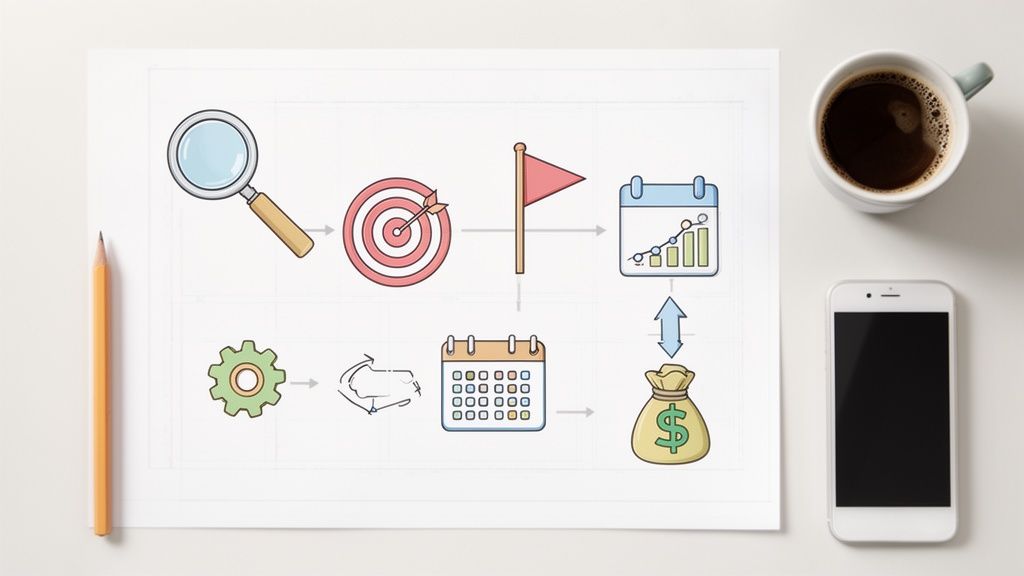
The elements of a marketing plan are the 10 essential stops on your roadmap. They cover everything from understanding the terrain (market analysis) and picking your destination (goal setting) to budgeting for gas (budgeting) and checking your progress (measurement). This framework turns random marketing activities into a cohesive, goal-driven strategy.
Your Blueprint for Sustainable Growth
So many businesses fall into the same trap: they throw money at marketing—a little social media here, some ads there—with no real strategy connecting it all. A solid marketing plan is the antidote to that scattered, cash-burning approach. Think of it less as a rigid, unchangeable document and more as a dynamic blueprint for building a strong, resilient brand.
When you break down your marketing into these core components, you create a powerful system where every piece reinforces the others. Your high-level strategy dictates your daily tactics, and those tactics are designed to hit specific, measurable goals. This is how you shift from being reactive and just "doing marketing" to proactively driving real growth.
This guide will walk you through the 10 essential elements that make this alignment possible. The diagram below shows how it all fits together, moving from big-picture thinking down to on-the-ground execution.
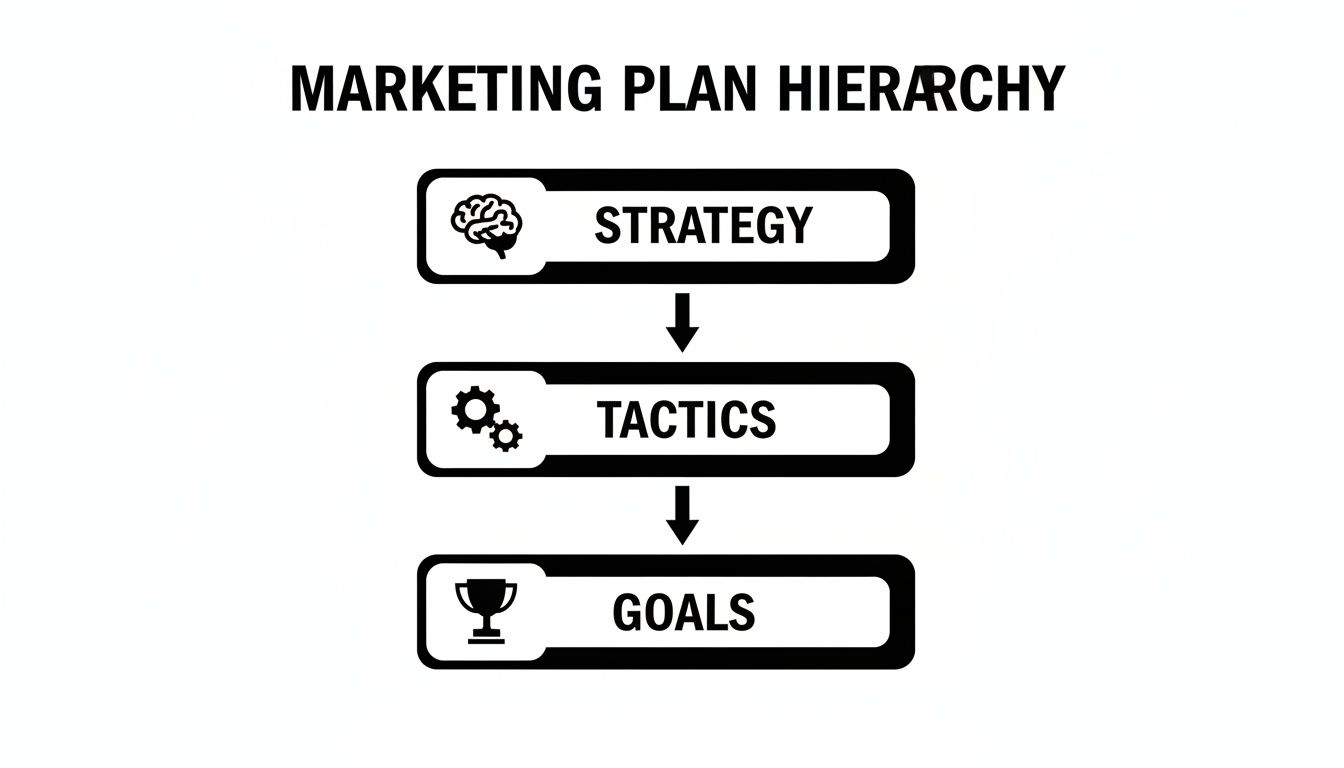
The key takeaway here is that your overarching strategy (the why) has to drive your tactics (the how) if you ever hope to hit your goals (the what).
For a quick reference, here’s a look at the 10 core elements we'll be exploring.
The 10 Core Elements of a Marketing Plan at a Glance
| Element | Core Purpose |
|---|---|
| 1. Executive Summary | Provides a high-level overview of the entire plan for quick stakeholder review. |
| 2. Market Research | Grounds your strategy in real-world data about the industry, competitors, and trends. |
| 3. Target Audience | Defines precisely who you're trying to reach, from demographics to pain points. |
| 4. Positioning & Messaging | Clarifies your unique value and how you'll communicate it to your audience. |
| 5. Goals & KPIs | Sets clear, measurable objectives to define what success looks like. |
| 6. Marketing Strategies | Outlines the broad approaches you'll use to achieve your goals (e.g., content marketing). |
| 7. Marketing Tactics | Details the specific actions and channels you'll use to execute your strategies. |
| 8. Budget | Allocates financial resources to different strategies and tactics. |
| 9. Timeline | Maps out when key activities will be completed to keep everything on track. |
| 10. Measurement & Governance | Establishes how you'll track progress, optimize, and manage the plan. |
This table serves as a handy checklist as you build out each piece of your plan.
From Vision to Actionable Steps
A great plan does more than just sit on a shelf. It forces you to connect every single marketing activity—every blog post, every ad campaign, every email—back to a concrete business objective. Suddenly, every dollar and every hour you spend has a purpose.
It’s the crucial difference between guessing what might work and knowing exactly what steps you need to take to move the needle. That kind of clarity gives your team the confidence to execute with purpose.
Frankly, the process of building the plan is often just as valuable as the final document itself. If you're ready to dig in and build this foundation for predictable success, check out our complete guide on how to write a marketing plan.
2. Building Your Foundation with Market Analysis
Every great marketing plan starts with a deep breath and a hard look around. Before you can figure out what you’re going to do, you have to understand the world you’re stepping into. This is your market analysis—sometimes called a situation analysis—and it's all about gathering the intel you need to make smart moves. It’s what separates strategy from guesswork.
Think of it this way: a general would never send troops into battle without knowing the terrain, the enemy's numbers, and the strength of their own army. Your market analysis is that battlefield map. It grounds every single decision you make in solid evidence, not just a gut feeling.
Unpacking Your Strategic Position
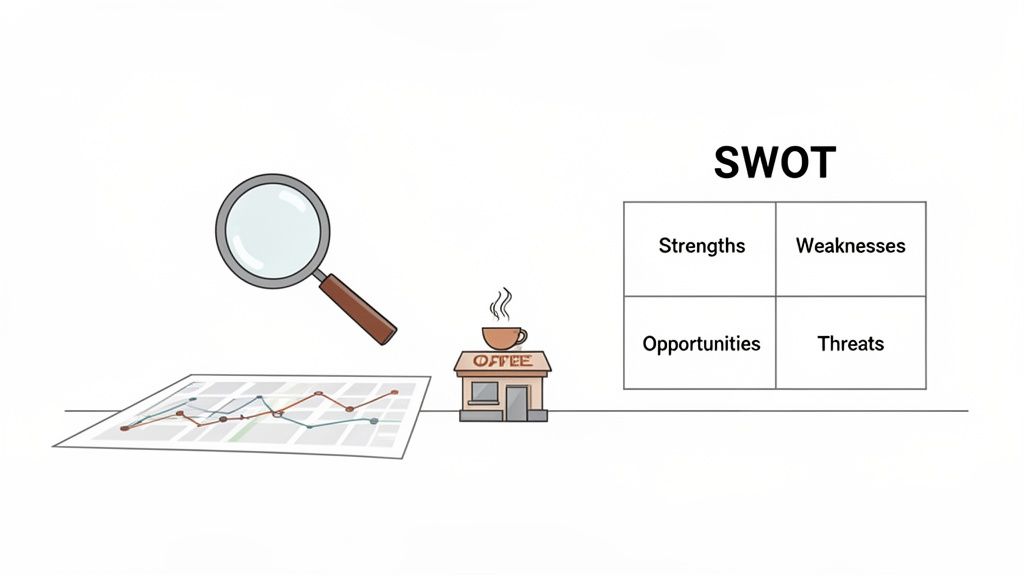
One of the most powerful tools for this job is the classic SWOT analysis. It’s a simple framework that helps you organize your findings into four critical areas, giving you a complete, 360-degree view of where you stand.
SWOT forces you to look at both the good and the bad, inside and outside your company:
- Strengths (Internal): What’s your secret sauce? Maybe it's a killer brand reputation, a patented technology, or an insanely loyal customer base. These are the assets you'll lean on.
- Weaknesses (Internal): Where are the cracks? This is where you get brutally honest. It could be a shoestring budget, a clunky website, or gaps in your team's skills. Knowing this is the first step to fixing it.
- Opportunities (External): What's happening out there that you can jump on? Think about new market trends, a competitor fumbling the ball, or a new social media platform your audience is flocking to.
- Threats (External): What’s keeping you up at night? This could be new competitors popping up, changing government regulations, or a shift in how people buy things in your industry.
By laying everything out in these four buckets, you start to see the connections. A weakness isn't just a problem; it's a priority. An opportunity isn't just a cool trend; it’s your next big play.
From Analysis to Actionable Insights
This is where the rubber meets the road. Let’s go back to our local coffee shop example. Through their market analysis, they discover that remote work is becoming permanent for a huge chunk of the local population. That’s a massive opportunity.
Suddenly, they're not just selling coffee. They're selling a "third place" for people to escape their home office. This one insight, born from good research, can shape their entire marketing plan.
They might create a special "work from the cafe" loyalty program, rearrange their seating to add more power outlets, or run targeted ads aimed at people living within a five-mile radius. See how that works? The research ensures that every other part of the plan—from the target audience to the budget—is perfectly aligned to seize that opportunity. It all starts here.
5. Setting Your Goals and Success Metrics
Once you’ve mapped out the market and know who you’re talking to, you need to decide where you're going. A marketing plan without clear goals is just a collection of random activities—a ship sailing without a rudder. You'll definitely be busy, but you won't be making any real progress. This step is all about turning big-picture business dreams into concrete marketing objectives.
It's easy to confuse business goals with marketing goals, but they're not the same. A business goal might be to "increase annual revenue by 20%." The marketing goal that supports this would be something like, "generate 500 new marketing qualified leads (MQLs) in Q3 to feed the sales pipeline." See the difference? The marketing goal is a direct lever you can pull to hit the business target.
Historically, this is where a lot of marketing plans fall apart. It's shocking, but recent studies show that 84% of CMOs admit they struggle to pull off a cohesive strategy, and only 15% are planning more than three years out. This points to a huge problem with short-term, reactive thinking. You can dig into more of these challenges by checking out what recent industry surveys have uncovered.
Crafting Objectives with the SMART Framework
To give your goals some real teeth, they need to be SMART. This isn't just a trendy acronym; it’s a framework that forces you to get specific and cut out all the vague fluff.
- Specific: Nail down exactly what you want to achieve. Don't just say "more website traffic." Instead, aim for "increase organic traffic to our blog by 25%."
- Measurable: How will you know you've won? Attach a number to it, like "generate 1,000 new email subscribers."
- Achievable: Be ambitious, but don't set yourself up for failure. Look at your budget, your team's bandwidth, and what you've managed to do in the past.
- Relevant: Your goal has to matter. Make sure it directly contributes to a bigger business objective, like growing revenue or capturing more market share.
- Time-bound: Give it a deadline. A phrase like "by the end of Q4" creates a sense of urgency and a clear finish line.
Think of a well-crafted SMART goal as your North Star. It keeps your team aligned, helps you decide what to work on first, and gives everyone a clear, shared picture of what success actually looks like.
Identifying Your Key Performance Indicators
If your goals are the destination, then Key Performance Indicators (KPIs) are the mile markers along the highway telling you if you're on the right road and making good time. These are the specific metrics you’ll watch to see how you're tracking against your objectives. It’s also important to separate your primary metrics from your secondary ones.
Primary KPIs are the headliners—they're directly tied to your main objective. If your goal is lead generation, your primary KPI would be Cost Per Lead (CPL) or Customer Acquisition Cost (CAC). These numbers tell you the bottom-line story of whether you're meeting your core goal efficiently.
Secondary metrics are your supporting cast. They provide crucial context and color to the story your data is telling. Think of things like click-through rate (CTR), website engagement rate, or social media shares. While they aren't the main event, a sudden dip in these can be an early warning sign that a part of your strategy is starting to wobble. Together, primary and secondary KPIs give you the full picture of your performance.
3. Who Are You Talking To? Pinpointing Your Ideal Customer
If you try to market to everyone, you’ll end up connecting with no one. It’s a classic mistake, but one that’s easy to avoid. This is one of the most critical parts of your marketing plan because it’s where you stop shouting into a crowded stadium and start having a real conversation with the people who actually want to hear from you.
Getting laser-focused on your ideal customer is about more than just basic demographics like age or location. A truly powerful customer profile, what we often call a buyer persona, gets into the psychology of your audience. You need to understand their motivations, their biggest headaches (their pain points), and how they act when they're looking for a solution like yours.

Go Beyond the Basics to Get Real Insight
To build a persona that actually works, you need to answer questions that paint a complete picture of a real person. Think of yourself as a detective building a profile—you're gathering intelligence from different angles to understand who they are and what makes them tick.
A solid profile should cover:
- Demographics: Start with the basics—age, job title, income, and where they live. This sets the scene.
- Psychographics: Now for the interesting part. What do they value? What are their personal or professional goals? What keeps them up at night?
- Pain Points: What specific problems are they wrestling with that you can solve? Nailing this is the foundation for any message that resonates.
- Buying Behavior: Where do they hang out online? Do they trust influencer reviews, read industry blogs, or rely on word-of-mouth from peers?
When you have these detailed personas, every piece of marketing you create—from a quick social media post to a detailed email nurture sequence—speaks directly to the right person, in their language, at just the right moment.
B2B vs. B2C: A Tale of Two Customers
The kind of detail you need depends heavily on who you're selling to. A B2C fashion brand, for instance, might be all about lifestyle, social media habits, and emotional triggers. Their persona could be "Sustainable Sarah," a 28-year-old graphic designer who values ethical production and follows specific eco-influencers on Instagram.
On the other hand, a B2B software company’s persona is a different beast entirely. They might target "Manager Mark," a 45-year-old Head of Operations. His profile wouldn’t care much about his weekend hobbies; it would focus on his professional pain points, like clunky workflows, pressure from above to cut costs, and the hoops he has to jump through to get budget approval from the CFO.
Mark’s buying journey involves reading case studies, sitting through webinars, and looking for free trials. Understanding this distinction is absolutely fundamental. For a much deeper look at this, check out our complete guide on how to identify your target audience.
Here at ReachLabs.ai, we use data to help businesses build these precise customer profiles, making sure your marketing budget is always aimed at the right people.
4. Crafting Your Core Strategy and Messaging
Alright, you’ve figured out who you’re talking to and what you want to accomplish. Now for the fun part: building the strategic bridge that connects the two. This is where you shift from research and analysis into the art of persuasion.
This is arguably the most critical part of your entire marketing plan. It’s where you define the core ideas that will drive every single ad, email, and social post you create.
So many marketers get this wrong. They jump straight to tactics—running a Facebook ad, writing a blog post, sending an email blast. But tactics without strategy are just noise. Strategy is the high-level thinking, the “what” and the “why” behind your actions. It’s the difference between blindly throwing darts and having a clear plan to hit the bullseye every time.
The Three Pillars of a Powerful Strategy
A solid marketing strategy really boils down to three core pillars. Get these right, and you’ll have the clarity and direction needed to execute flawlessly. Think of it as answering the three fundamental questions your customer is subconsciously asking.
- Market Positioning: Where do you fit in the customer's mind compared to everyone else?
- Value Proposition: Why should they pick you over all the other options?
- Brand Messaging: What consistent story are you going to tell them everywhere they see you?
Let's use an example. Imagine a sustainable shoe brand. Their positioning might be "the most transparent and ethically produced sneaker for the conscious consumer." Notice it’s not just about style; it’s about a core value system that sets them apart from the big, mass-market players. This single idea shapes every decision they make.
A strong strategy is the glue that holds your marketing together. It ensures every tweet, blog post, and ad campaign works in harmony toward a single, unified goal, creating a consistent and memorable brand experience.
This is how you avoid the disjointed, chaotic marketing efforts where it feels like your social media team and your email team have never met.
Defining Your Unique Value Proposition
Your value proposition isn't a catchy slogan. It's a clear, concise promise of the unique benefit you deliver and why you're the best choice to solve your customer’s problem. It has to hit their primary pain point head-on.
For our sustainable shoe brand, a great value proposition might be: "We provide stylish, comfortable footwear made from recycled materials, giving you a way to look good while making a positive impact on the planet." See how powerful that is? It directly connects a feature (recycled materials) to a tangible benefit (positive impact) that their specific audience truly cares about.
Ensuring Consistent Brand Messaging
Finally, brand messaging is where you translate your positioning and value prop into the actual words you’ll use. This covers everything from your tone of voice and key talking points to the stories you share.
Consistency here is absolutely non-negotiable. Studies have shown that presenting a brand consistently across all platforms can increase revenue by up to 23%.
Your messaging should always be:
- Clear: Cut the jargon. Speak like a human your audience can understand.
- Consistent: The vibe on your website must match your social media, ads, and sales calls.
- Compelling: You need to spark an emotional connection and align with your audience's values.
At ReachLabs.ai, we help businesses lock in these strategic pillars. We dig into the data to carve out a unique market position and then craft messaging that doesn't just grab attention—it builds genuine, lasting brand loyalty.
Choosing Your Marketing Channels and Tactics
Alright, you've got your strategy locked in. Now comes the fun part—turning that high-level vision into the day-to-day actions that will actually move the needle. This is where we get into the nitty-gritty of marketing tactics (what you do) and marketing channels (where you do it).
Think of it this way: if your strategy is the destination on a road trip, your tactics are the specific turns you make to get there. Taking a wrong turn—like advertising on the radio to an audience that only streams podcasts—is a surefire way to waste gas and get nowhere fast. You have to be where your customers are.
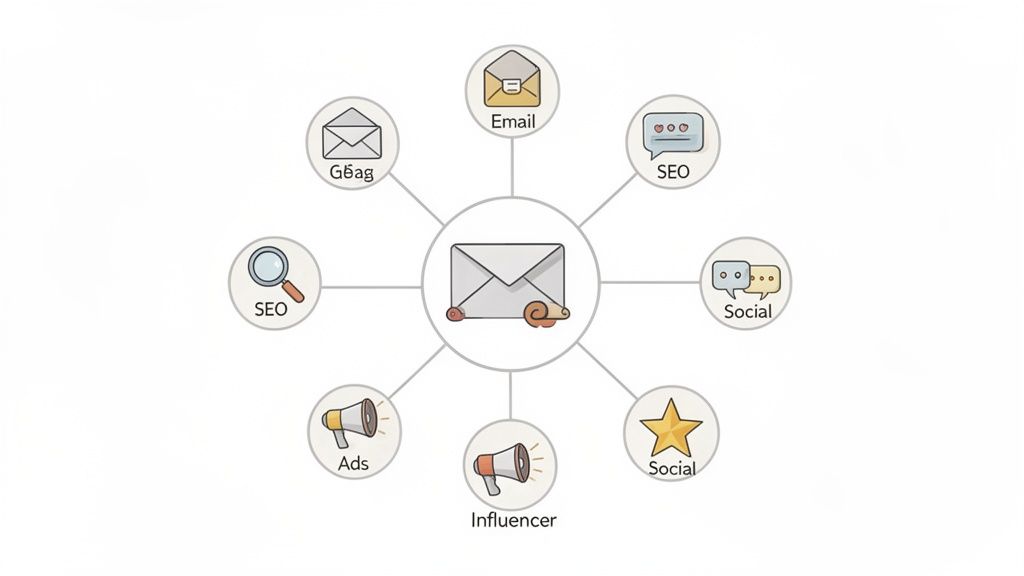
Matching Channels to Your Audience and Goals
The secret to picking the right channels isn't some closely guarded industry secret. It's about looking at the homework you've already done. Those buyer personas and SMART goals you created? They're your compass.
Are you selling to B2B professionals? Then a heavy-hitting LinkedIn content strategy and targeted email outreach will likely crush it, while a TikTok dance challenge will probably fall flat. Is your goal to generate leads, like, yesterday? Pay-per-click (PPC) ads will deliver immediate traffic, whereas a slow-burn SEO strategy won't give you that instant gratification.
Here are a few common channels and where they shine:
- Content Marketing & SEO: This is your long game. It's perfect for building real authority and organically attracting customers who are actively searching for what you offer. Think of it as a marathon focused on creating genuinely helpful blog posts, guides, and videos.
- Social Media Marketing: The best way to build a community, get your brand name out there, and talk directly with your customers. The platform you choose (say, Instagram versus LinkedIn) hinges entirely on your persona research.
- Pay-Per-Click (PPC) Advertising: Need speed? This is it. PPC is ideal for driving immediate traffic and leads when you need to test an offer or fill seats for a webinar. You get fast, measurable results.
- Email Marketing: Still one of the most powerful tools in the box for nurturing relationships and driving repeat business. It’s your direct line to your most loyal followers, allowing for personalized messages that build true loyalty.
A rookie mistake is spreading yourself too thin trying to be everywhere at once. A core part of an effective marketing plan is to choose 2-3 primary channels to absolutely master before you even think about expanding.
Bringing Tactics Together in a Coordinated Campaign
Individual tactics are good, but they become unstoppable when they work in harmony.
Let's say a company is launching a new software product. Instead of just firing off a single email and hoping for the best, a coordinated, multi-channel campaign would look something like this:
- Pre-Launch: An email teaser series to their existing list to start building buzz.
- Launch Week: A blitz of activity—influencer partnerships on Instagram, targeted Google Ads for high-intent keywords, and a comprehensive blog post that breaks down the product's benefits.
- Post-Launch: Smart retargeting ads to follow up with website visitors who didn't convert, plus a live webinar to showcase a product demo.
This integrated approach creates a wave of momentum, making sure your message hits people from multiple angles and really sticks. To pull this off, you'll need the right tools; check out some of the best content creation tools for social media to help streamline your workflow.
Organizing Your Execution with a Calendar
To keep all these moving parts from descending into chaos, a marketing calendar is non-negotiable. It's a simple but essential schedule that maps out what gets published, on which channel, and when. This creates clarity for your team and ensures you maintain a consistent, professional presence.
At ReachLabs.ai, we live for turning a great strategy into flawless execution. Our teams build data-backed tactical plans, pinpoint the best channels for your audience, and manage the entire campaign calendar to make sure every piece of your marketing plan is executed with precision.
9. Measurement & Optimization: Turning Data into Growth
A marketing plan isn't a "set it and forget it" document. Think of it less as a static map and more as a dynamic GPS, constantly recalculating the best route based on real-time feedback. This final, critical piece is what brings your plan to life, creating a powerful feedback loop that separates guessing from knowing.
This is the control panel for your marketing engine. Without the right gauges, you’re flying blind. You need to know what’s working, what’s not, and why. This section is all about building that dashboard before you launch, ensuring every effort and every dollar is accountable.
The Measure, Analyze, Optimize Loop
The secret to sustainable growth isn't a single brilliant idea; it's a simple, repeatable cycle: Measure, Analyze, Optimize. This process is the engine of continuous improvement, turning past performance into future success. Data is no longer just a report you look at monthly; it's the foundation of your entire strategy.
Marketers are drowning in data, and the best ones are learning to swim. One report found that marketers are now working with 230% more data than just a few years ago, and the number of data queries they run has shot up by 50%. This proves that modern marketing isn't just creative—it's deeply analytical.
This means having the right tools in your belt from the start. We're talking about platforms like Google Analytics, your CRM, and native social media analytics. These are the sources that feed your growth cycle. To get the most out of them, it's vital to learn how to measure marketing effectiveness.
Data isn't just for looking backward at what you did; it's the raw material for making smarter, more profitable decisions tomorrow. Every metric tells a story about your audience and your strategy.
Take a simple A/B test on an email subject line—this is the loop in miniature.
- Measure: You send Version A to 50% of your list and Version B to the other 50%, tracking the open rate for each.
- Analyze: Version B gets a 15% higher open rate. The data is clear.
- Optimize: You adopt the winning style for future email campaigns, instantly improving performance.
This small tweak, when repeated across every tactic and channel, creates massive, compounding gains over time. To see what specific numbers you should be watching, take a look at our comprehensive list of marketing performance metrics examples.
Got Questions About Marketing Plans? We’ve Got Answers.
Even with the best guide in hand, putting a marketing plan into practice always brings up a few questions. It's totally normal. Let's tackle some of the most common ones that pop up when you're in the thick of it.
How Often Should I Update My Marketing Plan?
Think of your marketing plan less like a stone tablet and more like a living roadmap. It needs to adapt to the terrain. For most businesses, a two-part rhythm works best:
- The Big Annual Overhaul: Once a year, set aside time for a complete, top-to-bottom review. This is where you'll sync your marketing plan with the company's bigger goals for the year ahead.
- Quarterly Tune-Ups: Every three months, do a lighter check-in. Look at your KPIs, see what’s hitting the mark and what’s not, and don’t be afraid to adjust your tactics.
And of course, sometimes the world throws you a curveball. A new competitor crashes the party, a major industry shift happens, or customer behavior changes overnight. When that happens, you don't wait for the next quarterly review—you pull out the plan and adapt right away.
What’s the Difference Between a Marketing Plan and a Marketing Strategy?
This is a classic—and it’s a great question because getting it right is fundamental. The two are often used interchangeably, but they are not the same thing.
Let's use a travel analogy.
Your marketing strategy is your destination. It's the big-picture "why" and "where." For example: "We're going to become the go-to brand for busy professionals who value healthy, convenient meals." It’s the vision.
Your marketing plan is the detailed itinerary. It’s the "how," "who," "when," and "how much." It lists the specific routes you'll take (tactics), the money you'll spend (budget), and the milestones you'll hit along the way (timeline). It's the step-by-step guide to making the vision a reality.
Can a Small Business Get Away With a Simpler Plan?
Yes, absolutely. In fact, you should simplify it. The ten elements we've discussed are building blocks, not a rigid ten-commandment-style list. A small business or a one-person show can create a lean, mean, one-page marketing plan that is incredibly effective.
Just focus on the absolute essentials: Who is your customer? What makes you different? What’s the one big thing you want to achieve this quarter? Pick three simple tactics to get you there, assign a realistic budget, and choose a handful of metrics to watch. The goal isn't a long document; it's a documented plan.
At ReachLabs.ai, we live and breathe this stuff. We take these core elements and turn them into a powerful, cohesive engine that drives real growth. Our team builds plans based on solid data and then executes them with the precision needed to see a genuine impact on your bottom line.
See how we can build your blueprint for success at https://www.reachlabs.ai.