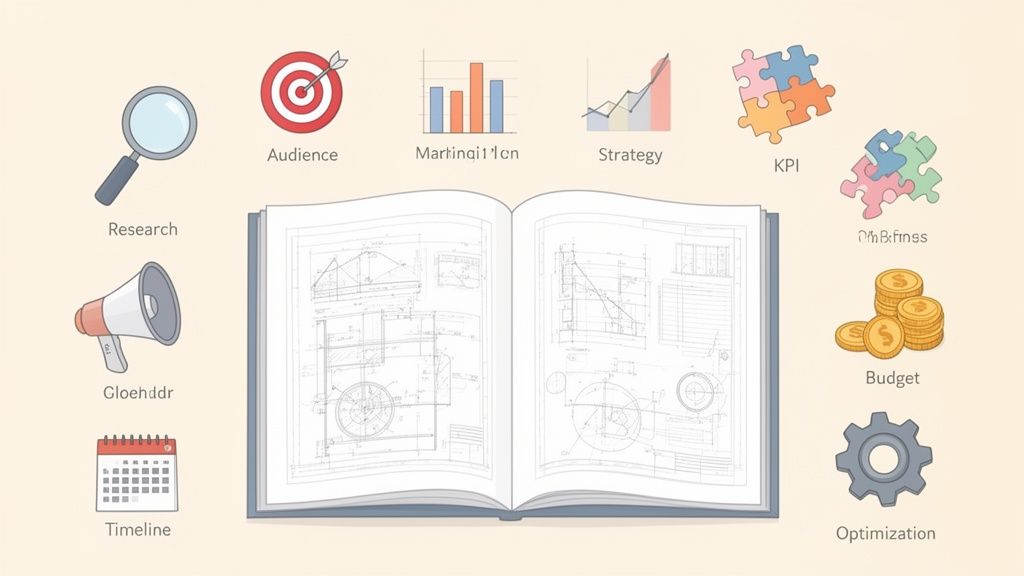
Don't think of your marketing plan as some dusty document that sits on a shelf. It's the living, breathing blueprint for how your business is going to grow. This is the strategic guide that makes sure every dollar you spend and every hour your team works is actually pushing you closer to your real business goals. The essential elements of a marketing plan always cover the same core ground: market research, defining your target audience, setting goals and KPIs, nailing down your strategy, budgeting, and figuring out how you'll measure success.
Your Blueprint for Sustainable Growth
Honestly, a solid marketing plan is the closest thing you'll get to predictable success. Without one, you're just throwing things at the wall—a bunch of expensive guesses with no real direction or way to know what's working. A good plan takes your big-picture business objectives and breaks them down into a concrete, day-to-day action plan. It gives you the clarity to get your team on the same page, justify your budget requests, and ultimately prove a return on your investment.
This guide is designed to be that comprehensive blueprint for you. We're going to walk through every fundamental element of a rock-solid marketing plan, piece by piece, turning your vision into a practical game plan. You'll see how all these components fit together to build a powerful growth engine for your business.
The Core Pillars of a Marketing Plan
Every winning plan I've ever seen is built on three foundational pillars: figuring out where you are, deciding where you want to go, and then mapping out the route to get there. This simple structure is what separates being busy from being productive.
- Goals: This is your "why." It's about defining what success actually looks like in clear, measurable terms. This step alone prevents a ton of wasted effort on things that don't move the needle.
- Actions: This is your "how." Here, you'll detail the specific tactics, channels, and campaigns you're going to run to hit those goals.
- Growth: This is your "what"—the tangible result of it all. It’s the outcome you can point to when your actions successfully hit your goals, whether that’s measured in revenue, market share, or brand recognition.
This diagram shows you exactly how a central plan connects these three critical pieces—your goals, your actions, and the growth that follows.
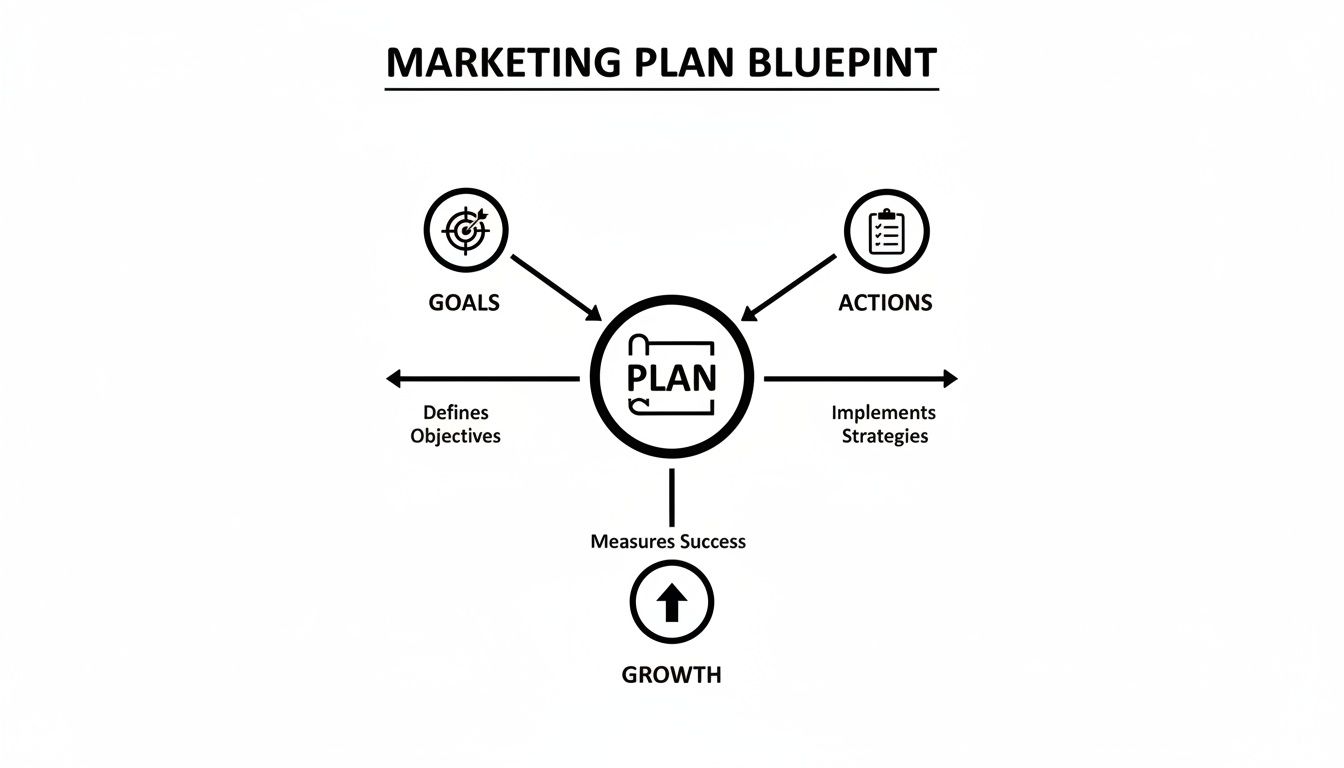
What this really drives home is that a plan isn't just a to-do list. It's a complete system where your strategic goals dictate the actions you take, which in turn produce measurable growth. It’s all connected.
A marketing plan forces you to think critically about your position in the market. It's anchored in research, analyzing market trends, understanding competitor tactics, and deeply profiling your ideal customers.
At the end of the day, this blueprint gives you direction and helps you stay proactive. It lets you anticipate changes in the market, spot new opportunities, and handle risks before they become full-blown problems. It’s what keeps your marketing machine running smoothly and pointed toward long-term, sustainable success.
Building on Bedrock with Market Research
Every great marketing strategy starts with a deep dive into the world around you, not just a sudden stroke of genius. This is where you swap out guesswork for hard facts, laying the foundation for everything that comes next. Skip this step, and you’re essentially flying blind.
Think of market research as your map and compass. It shows you your current location, where your competitors are camped out, and the terrain—both treacherous and promising—that lies ahead. The whole point is to paint a clear, unvarnished picture of your industry and where you fit into it. This ensures your plan is grounded in reality, not wishful thinking.
Uncovering Insights with a SWOT Analysis
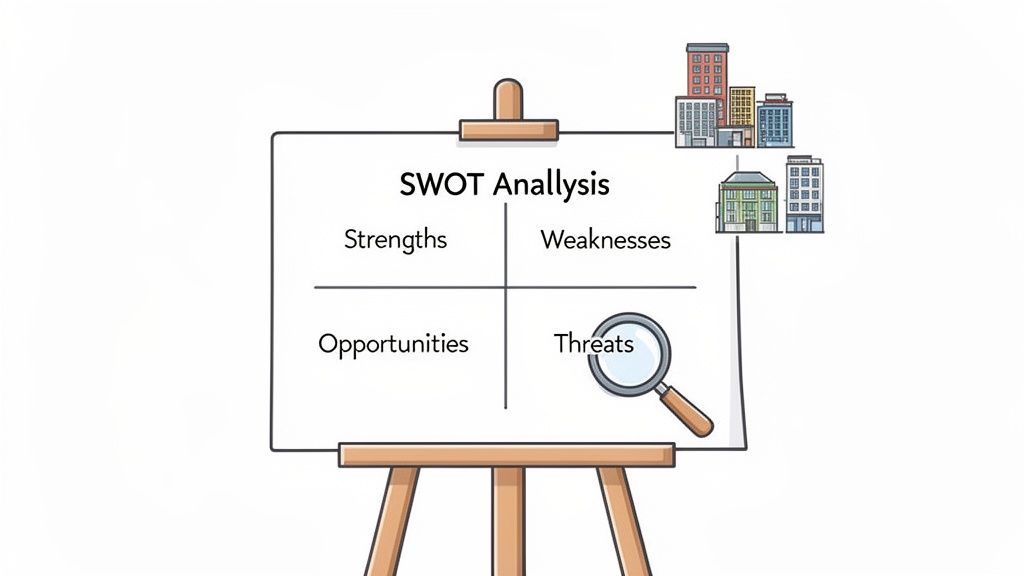
A classic place to start this exploration is with a SWOT analysis. It's a simple framework, but don't let that fool you—it’s incredibly powerful for getting an honest look at your company's internal health and the external forces at play. It's really just a structured way to get your thoughts organized.
- Strengths (Internal): What are you genuinely great at? Maybe it’s a stellar brand reputation, some killer proprietary tech, or a team that’s been in the trenches for years.
- Weaknesses (Internal): Where are the cracks? Now’s the time for brutal honesty. A tiny marketing budget, a missing feature in your product, or just plain low brand awareness all go here.
- Opportunities (External): What trends can you ride? Look for things like customer groups no one is serving well, a competitor's public stumble, or a new social media platform that's catching fire.
- Threats (External): What could trip you up from the outside? This is where you list new players entering the market, changing government rules, or a looming economic downturn.
Doing this kind of analysis feels a lot like a marketing audit—you're taking a full inventory of where you stand. If you want to dig in deeper on that front, you can learn more about how to conduct a full marketing audit in our guide.
Dissecting the Competitive Landscape
Once you have a clear picture of your own situation, it’s time to turn the binoculars on your competition. You’re not operating in a vacuum, so understanding what your rivals are up to is absolutely critical for carving out your own space. A key part of this involves analyzing their every move, a process now often supercharged by advanced competitor AI analysis tools.
This isn't just about making a list of competitors. It's about dissecting their entire playbook. What messages are they pushing? How do they price their products? What channels are they all over? What are their customers saying in reviews? Your goal is to find the gaps—the places where they’re vulnerable and you can shine.
By identifying a competitor's weakness, you uncover a strategic opportunity. If their customer service is notoriously slow, your marketing can scream about your lightning-fast support. If their product is missing a critical feature, you make yours the hero.
This kind of market analysis has never been more important. The shift to digital is a tidal wave, with some forecasts showing that digital channels will gobble up to 75% of the nearly $1.87 trillion global ad spend by 2025. This means understanding trends isn't just nice to have; it's essential for survival. This intelligence is what turns your plan from a static document into a real strategic weapon.
2. Who Are You Talking To? Defining Your Audience and Market Position
If you try to market to "everyone," you'll end up connecting with no one. It’s a classic mistake, and it leads to bland, forgettable messaging that just becomes part of the background noise. This is probably one of the most important parts of your entire marketing plan because it’s where you shift from just shouting into the void to having a real conversation.
It's all about figuring out exactly who your ideal customer is and how you want your brand to be seen by them.
Think of it like being a really good gift-giver. You wouldn't buy the same thing for your cousin who loves vintage vinyl and your uncle who's obsessed with fly-fishing. You'd think about their unique passions, what they truly need, and what would genuinely make them happy. Marketing is the same thing. The more specific you get with your audience, the more your message feels like that perfect, thoughtful gift.
Building Detailed Buyer Personas
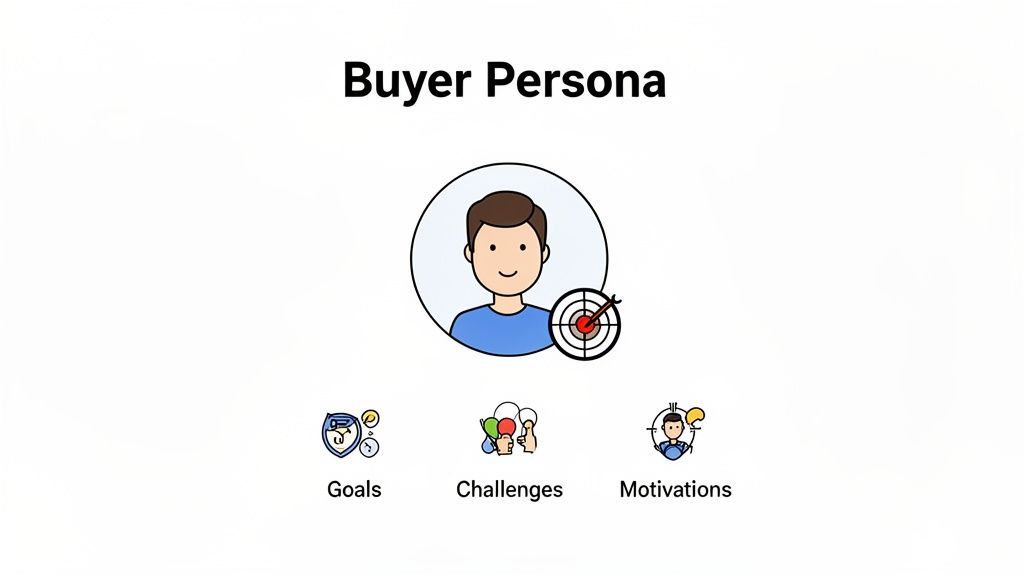
First things first: you need to get past basic demographics. Knowing a customer's age and location is fine, but it doesn't tell you why they would ever choose you. To get that deep understanding, you need to build buyer personas. These are essentially character sketches of your ideal customers—not real people, but based on real data and insights.
These profiles go way beyond the surface to explore the human side of your audience:
- Goals: What are they trying to accomplish at work or in their personal life? What does success look like for them?
- Challenges: What’s standing in their way? What are the nagging problems or "pain points" they complain about?
- Motivations: What really drives their decisions? Is it saving money, gaining status, or saving time?
- Watering Holes: Where do they hang out online? Which blogs do they read, what social media platforms are they on, and who do they follow for advice?
Creating these isn't a guessing game. It takes real work, like digging into your current customer data, interviewing your best clients, and analyzing online conversations. If you're ready to dive in, our guide on how to create buyer personas is a great place to start.
To help you visualize what this looks like, here’s a simple example of a buyer persona for a B2B software company.
Sample Buyer Persona for a B2B SaaS Company
| Attribute | Description for 'Marketing Manager Mary' |
|---|---|
| Role | Marketing Manager at a mid-sized tech company |
| Demographics | 35 years old, lives in a major city, Master's degree |
| Goals | Increase lead quality, prove marketing ROI to her boss |
| Challenges | Juggling too many platforms, small team, tight budget |
| Motivations | Earning a promotion, being seen as an innovator |
| Watering Holes | LinkedIn, listens to marketing podcasts, follows industry blogs |
Even this basic outline gives you a much clearer picture than just "B2B marketers." You can already imagine the kind of content and messaging that would resonate with Mary.
Carving Out Your Niche in the Market
Once you know exactly who you're talking to, the next step is figuring out how to stand out. Let's be honest, your market is probably crowded. This is where brand positioning becomes your best friend. It’s the deliberate act of claiming a unique and valuable spot in your customer's mind.
Your positioning is anchored by your unique value proposition (UVP). This isn't just a clever tagline. It’s a crystal-clear statement that answers one simple question from your ideal customer's perspective: "Why should I pick you over all the other options?" A solid UVP is the foundation for all your marketing messages.
A strong UVP connects your customer's biggest problem directly to your unique strength. It makes you the obvious and best solution for them.
For example, let’s say your buyer persona is a small business owner who feels completely overwhelmed by social media. A weak UVP would be, "We sell social media management services." A much stronger one would be, "We give small business owners back 10 hours a week by managing their social media and guaranteeing engagement growth."
See the difference? One is a bland description of a service. The other is a direct solution to a painful problem. This kind of clarity ensures every ad, email, and social media post you create actually connects with the people you want to reach, turning your marketing plan into a powerful tool for growth.
5. Setting SMART Goals and Measurable KPIs
Alright, you've done the homework on your market and you know your audience inside and out. Now comes the critical part: defining what winning actually looks like. A marketing plan without clear goals is like a road trip without a destination—you’re just burning gas.
This is where you stop wishing and start planning. We do that by setting SMART goals. It’s a classic for a reason. This framework takes fuzzy ideas like "get more leads" and forges them into sharp, actionable objectives.
The acronym—Specific, Measurable, Achievable, Relevant, and Time-bound—is your filter. It forces you to get crystal clear on what you're trying to do, why you're doing it, and when it needs to be done. Without it, you're just throwing ideas at the wall and hoping something sticks.
From Vague Wishes to Specific Objectives
Let's see this in action. The classic vague wish is "we need more leads." That's not a goal; it's a hope. Let's run it through the SMART filter to give it some real teeth.
Here’s how each piece of the framework brings your goal into focus:
- Specific: Don't just say "more leads." Get precise. Are we talking about marketing qualified leads (MQLs) from organic search, or are we after demo requests from our paid campaigns? The more specific, the better.
- Measurable: How will you know you've succeeded? Slap a number on it. Instead of "increase leads," your goal becomes "increase leads by 30%." Now you have a finish line.
- Achievable: Aim high, but stay grounded in reality. A 30% jump might be a fantastic stretch goal. Trying for a 300% increase could just demoralize the team when it doesn't happen.
- Relevant: Does this goal actually matter to the business? If the company is focused on breaking into a new European market, a goal to increase local brand awareness in North America might not be the best use of resources.
- Time-bound: Every goal needs a deadline. "Increase MQLs by 30% in Q3" creates a sense of urgency and a clear window for execution.
A well-crafted SMART goal transforms a vague wish like 'get more leads' into a powerful objective: 'Increase marketing qualified leads (MQLs) from organic search by 30% in the third quarter.'
Connecting Goals to Key Performance Indicators
Once you've set your SMART goals, you need a way to check if you're actually making progress. That’s the job of Key Performance Indicators (KPIs). These are the specific metrics you’ll watch every day, week, and month to see if you're on the right track.
Think of it this way: Your SMART goal is the destination on your GPS. Your KPIs are the gauges on your car's dashboard—the speedometer, the fuel gauge, the engine temp. They're the real-time data points telling you if you're actually going to get there on time and in one piece.
For our goal of increasing MQLs, some essential KPIs would be:
- Website Conversion Rate: What percentage of our visitors are actually turning into leads?
- Cost Per Lead (CPL): How much are we spending to get each one of those new leads?
- Lead-to-Customer Ratio: How many of these leads eventually become paying customers? This tells you about lead quality.
- Organic Traffic Growth: Are more people finding us through search engines?
This is what accountability looks like in a marketing plan. Tracking these KPIs gives you the hard data to show what's working, justify your budget, and make smart, on-the-fly adjustments. Without KPIs, you’re just guessing.
6. Building Your Core Marketing Strategy and Tactics
Okay, you've got your SMART goals locked in. Now for the fun part: figuring out exactly how you're going to get there. This is where we bridge the gap between your big-picture vision and the day-to-day work that makes it happen.
Many people toss around the terms "strategy" and "tactics" like they're the same thing, but they're not. Getting this right is absolutely essential, as this is one of the most critical elements of a marketing plan.
Think of your marketing strategy as the overall game plan. It’s your long-term approach to winning, answering the big question: "How will we achieve our goals?" On the flip side, marketing tactics are the specific plays you run—the individual campaigns and actions that bring that strategy to life.
A strategy without tactics is just a wish. And tactics without a strategy? That’s just being busy for the sake of it. You need both, working in perfect sync.
From Big Picture Strategy to Daily Actions
Let's make this real. A strategy isn't a single to-do item; it's a guiding philosophy. For instance, your business might decide on one of these common strategic approaches:
- Inbound Marketing: The plan here is to pull customers in by creating valuable content and experiences they actively seek out.
- Account-Based Marketing (ABM): This strategy involves focusing all your marketing and sales energy on a handpicked list of high-value target accounts.
- Content Marketing: Here, the strategy is to build unwavering brand authority and trust by consistently creating and sharing genuinely helpful content.
Once you’ve picked your strategic path, the tactics become much clearer. If you've committed to a content marketing strategy, your next step is to outline the specific activities that will get the job done. This is where you’ll need to create a content strategy that maps out exactly what you'll produce.
For example, your tactics might look like this:
- Tactic 1: Publish two SEO-focused blog posts every week.
- Tactic 2: Host one deep-dive educational webinar each month.
- Tactic 3: Post daily on LinkedIn and actively engage with our community.
See how each tactic is a concrete, measurable step? They all directly support the broader content marketing strategy, which, in turn, helps you crush those SMART goals.
Your strategy is the "why" behind your marketing—the core philosophy guiding your decisions. Your tactics are the "how"—the specific, measurable actions you take every day to make that philosophy a reality.
Using the 4 Ps to Organize Your Tactics
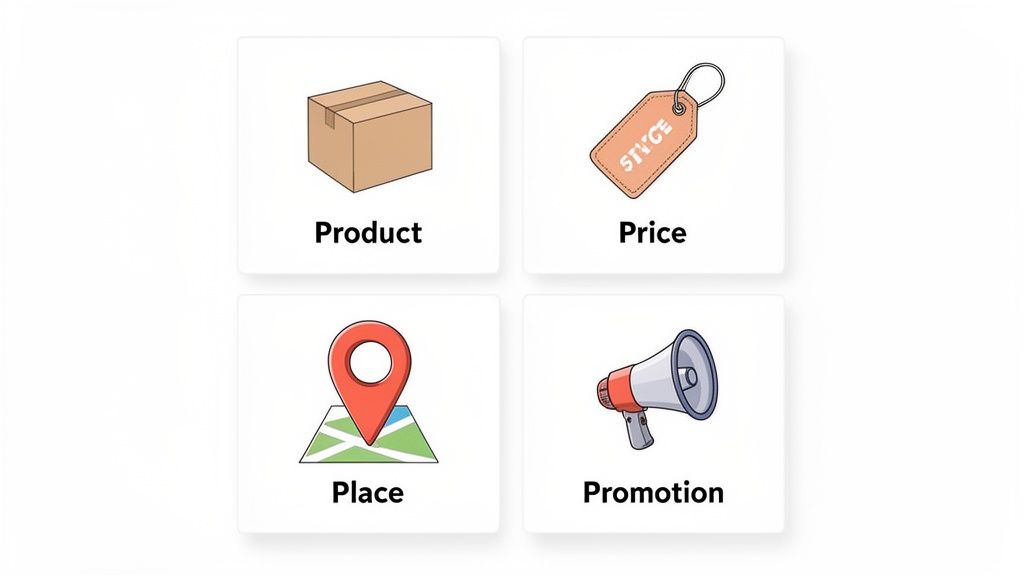
A timeless way to make sure you've covered all your tactical bases is the 4 Ps of Marketing: Product, Price, Place, and Promotion. It's a simple but incredibly powerful framework for organizing your actions.
Product
This is the actual thing you're selling, whether it's a physical good or a service. Your tactics here are all about how you present it. Think about its features, branding, packaging, and the entire customer experience. What makes your product the absolute best choice for your ideal customer?
Price
This is what a customer gives in exchange for your product. Pricing tactics go way beyond the sticker price; they include discounts, payment plans, and shaping the perceived value. Your pricing has to match your brand positioning. Are you the premium, luxury option? The budget-friendly choice? A 20% introductory discount is a perfect example of a specific pricing tactic.
Place
This is all about where and how customers can find and buy your product. If you sell a physical item, this is your distribution network. If it’s a digital product, it’s about the platforms you sell on and the online channels you use. A tactic here might be to launch an exclusive partnership with a major online retailer to expand your reach.
Promotion
This is what most people think of when they hear "marketing." Promotion covers all the tactics you use to communicate with your audience. We're talking advertising, PR, email campaigns, and social media. This is the section where you'll detail the specific campaigns and initiatives designed to get your message in front of the right people at just the right moment.
8. Allocating a Realistic Budget and Resources
Let's be honest: even the best-laid marketing plans are just wishful thinking without the money to back them up. This is where your budget comes in, and it's easily one of the most critical parts of your entire plan. It's the practical, numbers-driven reality check that transforms ambitious ideas into executable tasks.
Your budget isn’t just a pile of cash. It's a detailed blueprint that maps out how you'll use all your resources—from money and software to your team's time—to hit your goals. Get it wrong, and you'll either burn through cash on channels that don't deliver or starve your most promising initiatives right when they need support.
How to Build Your Budget
There's no magic formula for setting a marketing budget; what works for a startup won't work for an enterprise. The right model for you depends entirely on your industry, company size, and how aggressively you want to grow. Most businesses, however, land on one of two popular approaches.
- Percentage of Revenue: This is the simplest method. You just earmark a set percentage of your company's revenue for marketing. A B2B company might set aside 5-10%, while a competitive B2C brand could push that figure up to 15-20% or more. It’s straightforward but can be limiting.
- Objective-and-Task: This is the most strategic approach, and the one we recommend. You start with your goals, figure out exactly what tactics you need to use to achieve them (e.g., run X ad campaigns, publish Y blog posts), and then add up the costs. This way, your spending is directly tied to a specific outcome.
The stakes for getting this right are massive. Global advertising and marketing spend is projected to hit an incredible $1.87 trillion by 2025. With nearly $777 billion of that going to digital ads alone, you can't afford to just guess where your money should go. For more on this, check out the global marketing spending data from Statista.
Breaking Down Your Budget by Channel
Once you have your total budget, it's time to get granular. The next step is to break that top-line number into specific line items. This is where you assign every dollar a job, making it easy to track performance and calculate your return on investment (ROI). Sometimes, these constraints are a good thing—they force you to get creative and find cost-effective solutions.
A good budget breakdown will typically include expenses like:
- Ad Spend: The money set aside for paid platforms like Google Ads, LinkedIn Ads, or social media campaigns.
- Technology & Tools: The subscription costs for your marketing automation, SEO tools (Ahrefs, Semrush), and analytics software.
- Content Creation: Budgets for hiring freelance writers, video producers, graphic designers, or working with a content agency.
- Personnel: The salaries and overhead for your in-house marketing team.
Think of your detailed budget as an accountability partner. It forces you to ask, "Is this expense really going to drive growth?" It shifts the mindset from just spending money to strategically investing it.
Ultimately, your budget is more than just a spreadsheet. It’s the tool that empowers your team to execute the plan flawlessly. To get a more detailed look at this process, we've put together a guide on marketing budget allocation best practices.
Frequently Asked Questions About Marketing Plans
Even with a comprehensive guide, questions always pop up when it's time to put theory into practice. Let's tackle some of the most common hurdles that business owners and marketers face when building out the elements of a marketing plan. Getting these answers straight can save you a ton of headaches down the road.
How Often Should I Update My Marketing Plan?
Think of your marketing plan less like a stone tablet and more like a living, breathing document. It's not something you create once and then file away forever. It’s your strategic GPS, and it needs to recalibrate as the terrain changes.
A light review every quarter is a smart move. This is your chance to quickly check in on your KPIs, see if your initial assumptions are holding true, and make minor course corrections. Maybe one social media channel is delivering amazing results while another is falling flat—this is when you'd shift your ad spend.
Then, once a year, it's time for a major overhaul. This is where you zoom out to look at the big picture. You'll want to conduct fresh market research, re-evaluate your core business objectives, and make sure your entire strategy is still pointed in the right direction for the year ahead.
What Is the Most Important Element of a Marketing Plan?
Every piece of the plan is connected, but if you had to pick the absolute bedrock, it would be market research and a crystal-clear definition of your target audience. Everything else—your goals, your messaging, your channels—is built on this foundation.
Without a deep, genuine understanding of your customers and the world they operate in, you're just guessing. Your strategies and creative ideas will be based on assumptions, which is a perfect recipe for wasted money and missed connections.
You can have the most brilliant creative campaign and a massive budget, but if you don't truly know who you're talking to or what their world looks like, it simply won't land. Get this part right, and every other step becomes exponentially more effective.
How Do I Create a Plan with a Small Budget?
A tight budget doesn't mean you can't have an effective plan. It just means you have to be laser-focused and incredibly resourceful. The trick is to stop trying to do everything and instead prioritize a few high-impact, low-cost strategies.
Instead of spreading your limited cash across a dozen different channels, your plan should zero in on the one or two places where your ideal customer spends most of their time. For many businesses, this means leaning into tactics with a great return on investment, like:
- Content Marketing: Creating genuinely helpful blog posts, guides, or videos that attract organic traffic over the long term.
- SEO: Optimizing your website for the specific keywords your customers are already typing into Google.
- Email Marketing: Building and nurturing a direct relationship with your audience through their inbox.
In a way, a small budget is a gift. It forces you to be disciplined and ensures every single dollar is put to work.
Ready to build a marketing plan that actually gets results? ReachLabs.ai blends expert talent with data-driven insights to create strategies that elevate your brand and drive real growth. Stop guessing and start executing with a team of specialists. Discover how our full-service marketing agency can help you today.