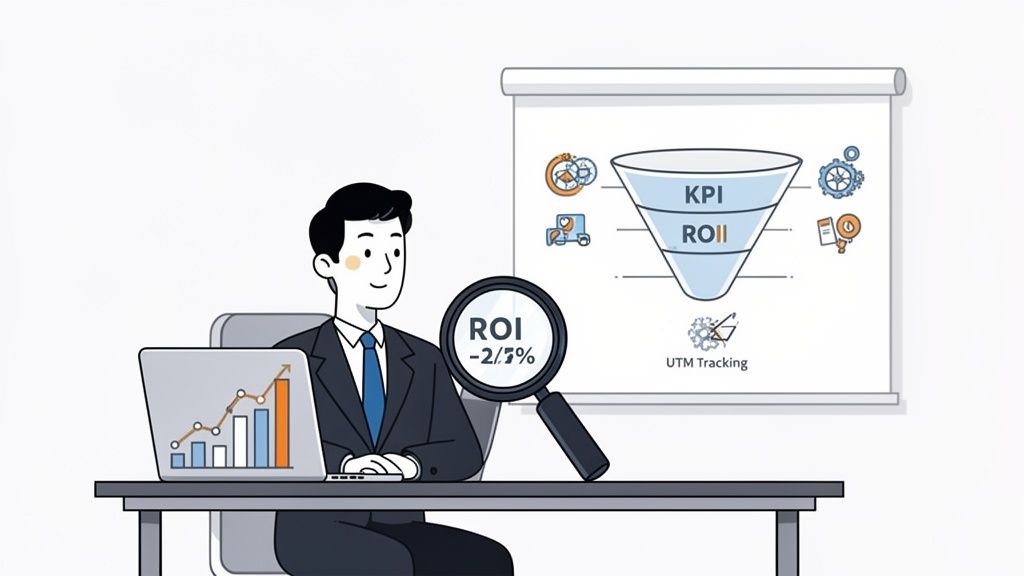
Instead of relying on guesswork, a data-driven digital marketing agency makes every decision based on cold, hard evidence. Performance metrics and analytics are the bedrock of every campaign, guiding the strategy from start to finish.
It’s like the difference between navigating with a rusty old compass versus a modern GPS. One points you in a general direction based on a hunch; the other uses precise, real-time data to map out the fastest, most efficient route to your destination.
What Is a Data Driven Digital Marketing Agency?

Let's use an analogy. A traditional agency can be like a talented chef who cooks from memory. They have great instincts and a feel for what works, but the results aren't always consistent. A data-driven agency, on the other hand, is a master chef who follows a precise recipe, measures every ingredient to the gram, and uses a thermometer to ensure perfect results every single time. Every step is deliberate and repeatable.
This approach transforms marketing from an art form built on assumptions into a science grounded in proof. Campaigns aren't launched because they "feel right." Instead, these agencies meticulously analyze customer behavior, dissect market trends, and live and breathe performance data to build strategies designed for success.
Moving Beyond Guesswork to Growth
At its core, a data-driven agency believes every marketing action must be measurable and accountable. This means they're obsessed with the numbers that actually matter to your business goals—not just the vanity metrics that look good on a report.
They don't just tell you about website traffic; they show you how that traffic turns into paying customers. They don't just count your social media followers; they track which of those followers become your most valuable clients. This sharp focus on tangible outcomes has a direct and powerful impact on your bottom line.
A few key principles drive everything they do:
- Evidence Over Opinion: Every strategy is rooted in data, whether it’s from deep market research, competitor analysis, or learnings from past campaigns.
- Continuous Optimization: Campaigns are never "set it and forget it." They are constantly monitored, A/B tested, and tweaked based on real-time feedback to squeeze out better results.
- Customer-Centric Focus: By digging into user data, these agencies develop a deep understanding of what customers truly want, need, and struggle with. This allows for truly personalized marketing that resonates.
- Accountability and Transparency: Results are laid out in clear, straightforward reports that draw a direct line from marketing activities to revenue growth.
A data-driven agency fundamentally changes the role of your marketing budget. It’s no longer just an expense; it becomes a predictable investment. By doubling down on what’s proven to work, they make sure every dollar is spent driving measurable returns.
The Real-World Impact
Picture an e-commerce store losing sales because shoppers are abandoning their carts. A traditional agency might throw a generic discount at the problem or suggest a new ad campaign. A data-driven agency, however, starts by digging into the analytics.
They might discover that 90% of cart abandonments happen on mobile devices at a specific point in the checkout flow. Armed with that insight, they could run an A/B test with a simplified, one-click mobile checkout form. This small, data-informed change could lead to a significant increase in completed purchases and revenue—a far smarter solution than a costly, shot-in-the-dark campaign. That’s the kind of precision a data-driven partner brings to the table.
How a Data-Driven Agency's Workflow Actually Gets Results
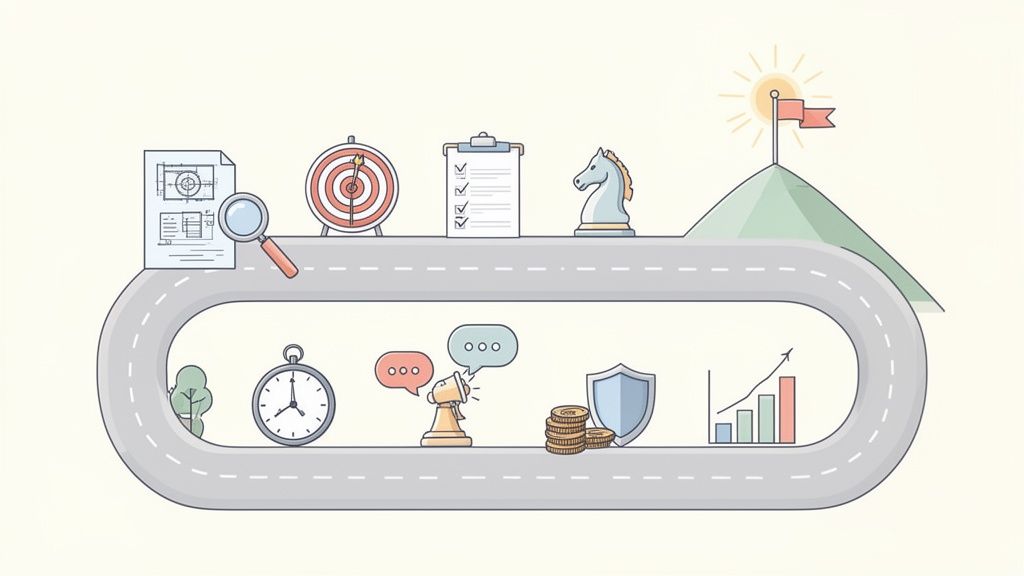
A truly data-driven agency doesn't just rely on random flashes of creative genius. Instead, it operates on a systematic, repeatable workflow. Think of it less like an art project and more like a high-performance engine, where every cycle refines the process and makes the whole machine run smarter and faster.
This approach is all about turning raw numbers into real revenue. It’s a five-stage loop that continuously builds on itself, creating momentum and delivering compounding returns on your marketing spend.
Stage 1: Data Collection and Aggregation
It all starts with gathering the raw materials. A top-tier agency casts a wide net, pulling in data from every place a customer might interact with your brand. This isn't just about surface-level metrics like website visits; it's about mapping the entire customer journey, from the first ad they see to the final thank-you page after a purchase.
To do this right, they need to collect actionable data from several sources:
- Website Analytics: Watching how users behave on your site—what pages they visit, how long they stay, and what paths lead to a sale.
- CRM Data: Digging into customer history, purchase frequency, and lifetime value to figure out who your best, most profitable customers really are.
- Ad Platform Metrics: Keeping a close eye on click-through rates, cost per acquisition, and return on ad spend across platforms like Google and Meta.
- Social Listening Data: Tapping into online conversations about your brand and your competitors to get a real-time pulse on market sentiment.
This isn’t just data for data's sake. This comprehensive collection is the bedrock on which every strategic decision is built.
Stage 2: Insight Analysis and Discovery
Once all the raw data is in, the real work begins: turning it into something useful. Numbers on a spreadsheet are meaningless until someone can interpret them and tell a story. This is where sharp analysts and strategists step in to find the patterns, anomalies, and hidden opportunities.
For instance, the data might show that while your Facebook ads bring in tons of traffic, visitors from organic search have a 3x higher conversion rate and spend 50% more per order. That single insight is a game-changer. It tells you exactly where to double down on your efforts for the biggest impact. It’s the difference between knowing what happened and truly understanding why.
Stage 3: Strategy Creation and Planning
Those hard-won insights are what fuel the strategy. With a deep understanding of what's actually working, the agency can build a precise, evidence-based plan. This isn't about vague goals like "let's do more SEO." It's about getting hyper-specific.
A data-driven strategy isn’t a mission statement; it’s a detailed blueprint. It outlines the specific channels to target, audiences to engage, messages to deploy, and KPIs to measure—all backed by the data discovered in the previous stage.
This planning phase is also where automation comes into play to make execution seamless. You can see how these systems work in our guide on marketing automation workflows. For anyone curious about the business side of things, this guide on How To Start A Digital Marketing Agency offers a great look at how these operations are structured.
Stage 4: Campaign Execution and Iteration
Now it's time to bring the strategy to life. Campaigns are launched, content gets published, and ads go live. But for a data-driven agency, this isn't the finish line—it’s the start of the next feedback loop. The moment campaigns are active, fresh data starts pouring in.
The team monitors performance in real-time, ready to make adjustments on the fly. They might A/B test ad headlines, tweak landing page layouts, or shift budget from an underperforming channel to one that's crushing it. This agile, iterative process is what really sets data-driven marketing apart.
This forward-thinking model is why digital marketing continues to expand so rapidly. Globally, digital ad spend now makes up 67% of total advertising budgets, and the market is projected to hit $786.2 billion by 2026. You can find more on this trend over at IBISWorld.com. This massive growth highlights the industry-wide shift toward marketing that is measurable, accountable, and built to perform.
The Essential Toolkit for Data-Driven Marketing
To really make a data-first strategy sing, a modern agency needs more than just smart people—it needs a powerful tech stack. This toolkit is the command center where raw data is gathered, crunched, and turned into strategic insights that actually grow the business.
Think of these tools less like individual software programs and more like an interconnected system built for peak performance. Each tool has a specific job, kind of like the different instruments in an orchestra. When a skilled conductor—in this case, the agency—brings them all together, they create a powerful, unified result. Understanding this toolkit is key to seeing the real value an agency brings to the table.
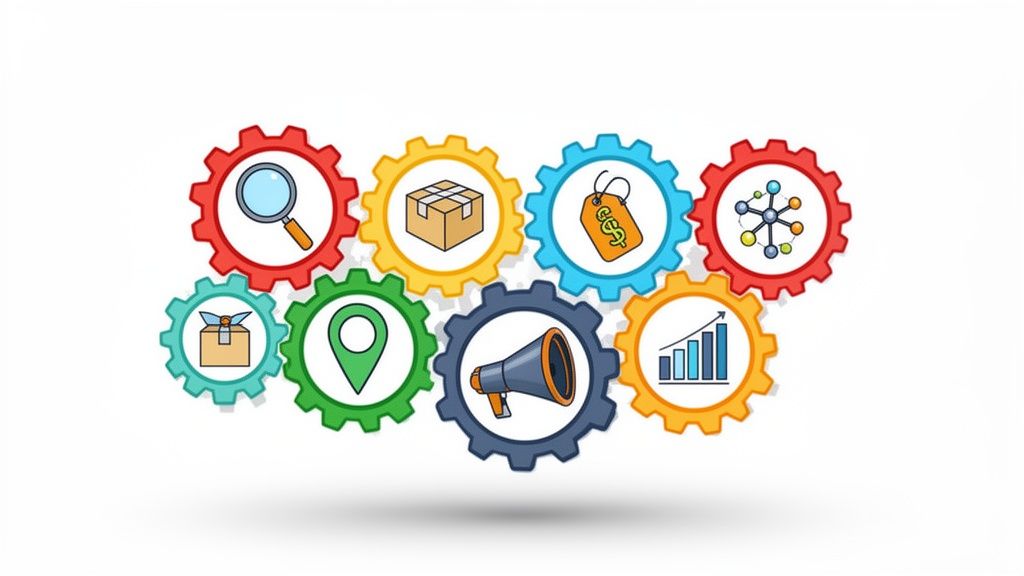
The visual below breaks down the simple yet powerful workflow these tools support, moving from data collection to analysis and, finally, to execution.

This loop isn't a one-and-done process. It’s a continuous cycle where every action and its results inform the next step, creating a constant state of improvement.
Analytics Platforms: The Eyes and Ears
Analytics platforms are the absolute bedrock of any data-driven operation. They are your eyes and ears online, tracking every single digital interaction a customer has with your brand. Tools like Google Analytics 4 (GA4) are non-negotiable for monitoring website traffic, user behavior, and how well your campaigns are actually converting.
But it’s about more than just counting page views. A true data-driven digital marketing agency uses these platforms to get answers to the tough questions:
- Which channels are bringing in the best leads, not just the most traffic?
- At what specific point are people giving up and leaving our sales funnel?
- What articles, videos, or pages get our most valuable customers excited?
Without this foundational layer of data, you’re essentially flying blind.
SEO and SEM Tools: The Compass for Visibility
If analytics platforms are the eyes, then Search Engine Optimization (SEO) and Search Engine Marketing (SEM) tools are the compass. They give you the direction you need to navigate the crowded search engine results pages and make sure your brand is seen by the right people at the exact moment they’re looking for a solution.
This is where platforms like SEMrush, Ahrefs, and Moz become indispensable. An agency leans on them to perform deep keyword research, peek behind the curtain at competitor strategies, track search rankings, and diagnose technical SEO problems that might be dragging a website down. On the paid search side, they help squeeze every drop of value out of ad budgets.
These tools don't just spit out data; they provide a competitive roadmap. By understanding what your audience is searching for and how competitors are trying to reach them, an agency can carve out a clear path to the top.
Marketing Automation and CRMs: The Central Nervous System
This is where all the data points come together. Marketing automation platforms and Customer Relationship Management (CRM) systems like HubSpot or Salesforce act as the central nervous system for the entire marketing machine. They stitch together a complete picture of each customer, which makes truly personal and scalable communication possible.
It's in this integration that the real magic happens. With these systems, an agency can:
- Nurture Leads: Automatically trigger targeted email sequences based on a user's behavior, gently guiding them from casual interest to a confident purchase.
- Score and Prioritize Leads: Use data to identify which prospects are hot and ready to talk, so sales teams can focus their energy where it counts most.
- Personalize the Customer Experience: Serve up dynamic website content or tailored offers based on a user’s past interactions and known interests.
For teams that are heavy on social, finding the Best Tools to Analyze Instagram Reels in Bulk for Agencies is another crucial part of building out a modern toolkit.
Data Visualization Tools: Making Sense of It All
Finally, with mountains of data coming in from all these sources, it’s incredibly easy to get lost in a sea of spreadsheets. That’s why data visualization tools like Tableau, Looker Studio, or Power BI are so important. They turn complex datasets into clear, intuitive, and interactive dashboards. If you're curious about what these look like, check out these marketing dashboard examples.
These dashboards make it possible for everyone—from the marketing specialist running the campaign to the CEO in the boardroom—to understand performance at a glance. Instead of handing over a 50-page report filled with raw numbers, an agency can present a visual story of what’s working, what isn’t, and where the next big opportunity is hiding. That clarity is what allows for swift, confident, data-backed decisions.
Focusing on KPIs That Actually Drive Business Growth
In marketing, it’s all too easy to get caught up in numbers that look great on a report but don’t actually move the needle for your business. We call these vanity metrics—things like social media likes, page views, and follower counts. Sure, they might give you a nice little ego boost, but they rarely tell you anything meaningful about your company's health.
A true data-driven digital marketing agency understands the critical difference between being busy and being effective. They deliberately shift the conversation away from these surface-level stats to focus on Key Performance Indicators (KPIs) that are directly tied to your revenue and profitability.
Think of it this way: a flashy paint job on a car might turn heads, but what really matters is its engine performance, fuel efficiency, and safety rating. One is about looking good; the other is about getting you where you need to go safely and efficiently. A data-driven approach is all about what’s under the hood.
Moving from Impressions to Impact
The main job of a data-driven partner is to draw a straight line from every marketing dollar you spend to a tangible business outcome. This isn’t guesswork; it’s a disciplined process of tracking the numbers that reflect the real financial health of your company. Instead of chasing fleeting online chatter, they concentrate on metrics that signal real, sustainable growth.
Let's break down the KPIs that a business-focused agency will live and die by:
- Customer Acquisition Cost (CAC): Simply put, this is what it costs you in sales and marketing to land a new customer. A lower CAC means you’re running an efficient growth machine.
- Customer Lifetime Value (CLV): This number predicts the total profit you can expect from any given customer over the entire course of your relationship. A high CLV tells you you're attracting the right kind of loyal customers who keep coming back.
- Return on Ad Spend (ROAS): For every dollar you put into advertising, how many dollars in revenue do you get back? This metric cuts straight to the chase and tells you if your ad campaigns are actually profitable.
These three metrics are the holy trinity of data-driven marketing. A healthy business is one where the CLV is much, much higher than the CAC. When an agency starts optimizing your campaigns, their primary goal is to widen that gap—drive down acquisition costs while pushing customer value up.
A focus on these core KPIs completely changes the conversation. You stop asking, "How many likes did our post get?" and start asking, "How did that post lower our CAC and attract more high-CLV customers?"
A Clear Comparison: Vanity vs. Value
To really see the difference, it helps to put these metrics side-by-side. One group measures clicks and eyeballs, while the other measures cold, hard business results. A good agency will keep an eye on both, but they’ll always anchor their strategy—and their own success—to the KPIs that matter to your bottom line.
Here’s a look at some common vanity metrics compared to the actionable KPIs a true data-driven partner will prioritize. This distinction helps you have more strategic conversations about what's actually driving profit.
Vanity Metrics vs Actionable Business KPIs
| Vanity Metric (Looks Good) | Actionable KPI (Drives Business) |
|---|---|
| Website Traffic/Page Views | Conversion Rate (What percentage of visitors take a desired action?) |
| Social Media Followers/Likes | Customer Acquisition Cost (CAC) (How much does it cost to get a new customer?) |
| Email Open Rate | Customer Lifetime Value (CLV) (How much is a customer worth over time?) |
| Impressions/Reach | Return on Ad Spend (ROAS) (Are we making money from our ad campaigns?) |
| Time on Page | Lead-to-Customer Rate (How many leads are actually turning into sales?) |
Once you start looking at your marketing through the lens of that right-hand column, you see it for what it is: a predictable growth engine, not just a creative expense. Every campaign, every piece of content, and every ad suddenly has a clear, measurable financial purpose.
This laser focus is what separates a good agency from a great one. They aren't in the business of making noise; they're in the business of making you money. They know that a campaign that generates 10 high-value leads with a low CAC is infinitely more valuable than one that gets 10,000 likes but zero sales. That’s the entire philosophy behind a genuine data-driven partnership.
How to Choose the Right Data-Driven Partner
Choosing a marketing agency is one of the biggest growth decisions your company will make. This isn't just about outsourcing tasks; it's about finding a strategic partner who is genuinely invested in your bottom line. When you're looking for a data-driven digital marketing agency, you have to cut through the sales pitches and get to the core of how they actually operate.
The right partner doesn't just talk about data—they live and breathe it. You'll see it in everything they do, from how they onboard new clients to the way they report on campaign performance. Their entire process should be built on a foundation of measurable results and constant, data-backed adjustments.
This approach is no longer a nice-to-have. The marketing world has made a definitive shift toward strategies that can be measured and proven. In fact, digital marketing services are on track to account for 61.58% of all global agency revenue by 2025. This shows the overwhelming demand for agencies that can connect every single action to a tangible result—a specialty that firms like ReachLabs.ai were built for. For a closer look at this industry trend, the complete marketing agencies market report from Mordor Intelligence offers a deep dive.
Scrutinize Their Track Record and Case Studies
Your first move should be to examine their past work. Any decent agency will be happy to show you their wins, but you need to look past the fancy logos. Ask for detailed case studies that are packed with real numbers and clear, specific outcomes.
Be wary of vague claims like "we boosted brand awareness." That’s a red flag. You're looking for concrete, quantifiable results that tie directly back to business goals.
As you review their portfolio, try to find answers to these questions:
- What was the original problem? Was the client struggling with a high customer acquisition cost (CAC), a poor conversion rate, or attracting low-quality leads?
- What was the strategy? How did the agency use data to pinpoint the core issue and build a solution?
- What were the results? Look for hard numbers. Things like "we decreased CAC by 30% in six months" or "we boosted ROAS from 2:1 to 5:1."
- Can I speak to this client? The ultimate proof is a happy customer. Ask for references and have a real conversation about what it was like working with them.
A truly great agency won't just show you a highlight reel. They’ll be able to walk you through the entire story—from the initial problem to the data-backed solution and the profitable result.
A strong case study is a story told with data. It should clearly demonstrate how the agency identified a challenge, used analytics to build a strategy, and executed a campaign that delivered measurable financial returns.
Evaluate Their Data Analysis and Reporting Process
How an agency handles data tells you everything. A true data-driven partner won't just email you a monthly PDF filled with confusing charts. They will provide clear, actionable insights and maintain total transparency in their reporting.
During your conversations, dig into their methodology. You need to understand exactly how they collect data, what tools they use, and—most importantly—how they turn all those raw numbers into smart, strategic recommendations.
This is where you can separate the pretenders from the genuine experts. For a more detailed walkthrough of the vetting process, our guide on how to choose a digital marketing agency offers even more questions you should be asking.
Ask the Tough, Specific Questions
The interview stage is your opportunity to really test their expertise. Don’t be afraid to put them on the spot with challenging, scenario-based questions. How they respond will reveal the depth of their strategic thinking and their commitment to a data-first mindset.
Here are a few essential questions to ask any potential data-driven digital marketing agency:
- How do you attribute revenue across multiple marketing channels? This tests their understanding of a complex customer journey and their ability to give credit where it's due.
- Walk me through a time you used data to turn a failing campaign into a success. This shows you their real-world problem-solving skills and how they adapt when things aren't working.
- What is your process for A/B testing, and how do you decide what to test? Their answer should be systematic and start with a hypothesis informed by data, not just a guess.
- How do you differentiate between a vanity metric and a real business KPI in your reporting? This question ensures you're both aligned on what "success" actually looks like.
- Which data analytics and visualization tools are you most proficient with and why? This helps you gauge their technical capabilities and whether their tech stack fits your needs.
The quality of their answers—the specifics, the confidence, and the relentless focus on business outcomes—will give you the clearest picture of what kind of partner they will be. A great agency will welcome these tough questions and meet them with detailed, intelligent responses.
The ReachLabs.ai Approach to Data-First Marketing

It’s one thing to understand the theory behind data-first marketing, but seeing it in action is where it all clicks. At ReachLabs.ai, we’ve built our entire agency around a simple, powerful belief: specialist execution gets better results. Period.
That’s why we run as a collective. Instead of asking a single person to be a jack-of-all-trades, we assemble a team of deep experts for each specific part of your campaign. An SEO veteran manages your organic strategy, a PPC pro fine-tunes your ad spend, and a conversion-focused copywriter crafts your landing pages. Everyone brings their A-game, and the final result is far more precise and impactful.
A Unified, Data-Driven Strategy
As a data-driven digital marketing agency, we operate in a constant feedback loop. We don’t just launch campaigns and hope for the best; we build growth engines that are designed to get smarter over time. Every action we take generates data that informs the very next step.
Here’s a look at how our specialist-driven model puts this into practice:
- Lead Generation Campaigns: We live in a cycle of testing and refining. By keeping a close eye on lead quality, conversion rates, and cost per acquisition, we can quickly shift budgets and tactics to the channels that are actually delivering qualified prospects.
- Creative Services: Design and copy aren't about guesswork. We A/B test everything—ad creative, headlines, calls-to-action—to find out what your audience genuinely responds to. This means our creative work doesn't just look good; it consistently performs.
- Influencer Marketing: We pick partners based on real audience analytics, not just vanity metrics like follower counts. We dig into engagement rates, audience demographics, and past performance to find influencers whose followers are a perfect match for your ideal customer.
This integrated approach means your marketing spend is always directed toward what's proven to work. By letting the data make the final call, we cut out the waste and focus every dollar on driving real revenue growth.
The Collective Advantage
Working with the ReachLabs.ai collective means you get a dedicated team of specialists who are truly obsessed with their craft, all pointed toward your business goals. Our model is agile, efficient, and built from the ground up to deliver returns you can actually measure. We see ourselves as a true partner, focused on moving the needle by making data the most valuable player on the team.
Frequently Asked Questions
Stepping into a partnership with a data-driven agency is a big move, and it's smart to have questions. Here are some of the most common ones we hear from business leaders, with straight-up answers to help you decide if it's the right fit for you.
How Long Until I See Results?
This is the big one, right? While some tactical tweaks can create a bit of a spark in the first 30-60 days, the real, meaningful results—like a stronger return on ad spend (ROAS) or a lower customer acquisition cost (CAC)—start to take shape over 3-6 months.
Think of it like this: the first couple of months are for gathering the right ingredients and testing the recipe. The following months are when we perfect the formula and scale up production for sustainable, long-term growth.
What Kind of Reporting Should I Expect?
Forget static PDF reports filled with vanity metrics. You should expect a live, customized dashboard showing the KPIs that actually matter to your business.
A great data-driven partner won't just dump numbers on you. Their reports will tell a story, offering clear analysis on what worked, what didn't, and why. Most importantly, they'll give you actionable recommendations that tie directly back to your bottom line.
The whole point of reporting isn't just to look back at what happened. It's to understand why it happened and lay out the exact next steps to make things even better. That clarity is what separates a true data-driven agency from the rest.
Is This Approach More Expensive?
The upfront investment might look similar to what you’d pay for traditional marketing services, but the real value is in the efficiency you gain over time. A data-driven approach is laser-focused on one thing: return on investment.
By methodically cutting the fat—the ad spend that isn’t working—and doubling down on the channels that are proven to deliver, your budget works much harder. It’s not about spending more; it's about making every single dollar count.
Ready to stop guessing and start growing? At ReachLabs.ai, we build specialized teams to execute data-first strategies that deliver measurable results. See how our collective approach can drive your success.