Content marketing often produces more leads at a lower cost than outbound. The bigger mistake is assuming that result comes from publishing more. It comes from running content with the same discipline used for paid acquisition, sales development, and revenue operations.
That is where B2B teams get stuck.
They create articles, webinars, case studies, and LinkedIn posts as separate requests instead of one coordinated system. Marketing measures output. Sales asks for one-off assets. Leadership wants pipeline impact. Without shared goals, clear ownership, and a distribution plan, content becomes busy work with weak commercial value.
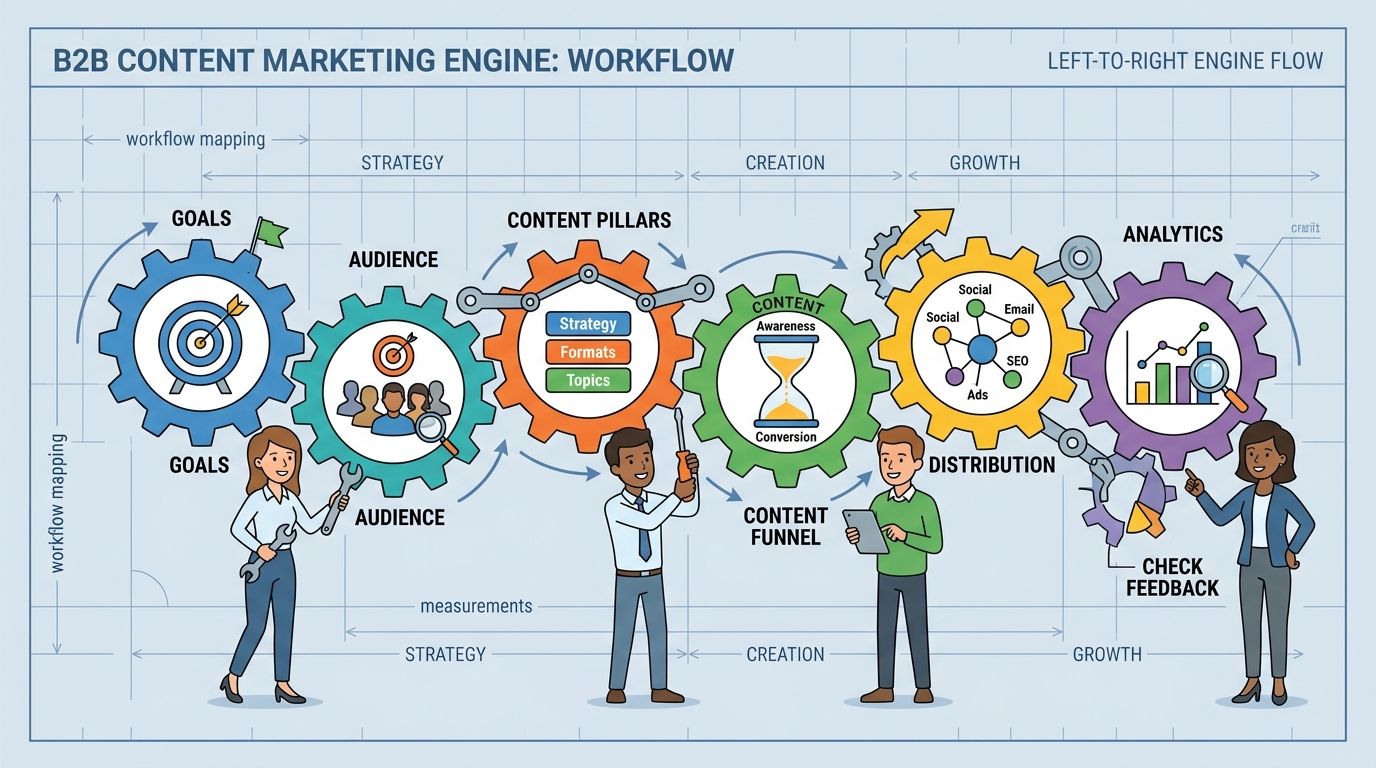
A strong B2B content marketing strategy connects those moving parts. It ties audience insight, positioning, search demand, campaign planning, sales enablement, and measurement into a single operating model. That operating model matters because content does more than attract attention. It shapes category understanding, supports deal progression, and gives revenue teams assets they can reuse across the funnel.
We've observed a consistent pattern with high-growth teams at ReachLabs.ai. Performance improves when content planning starts with revenue questions, not publishing cadence. Which accounts are in-market? Which objections stall deals? Which themes deserve repeated coverage because they influence pipeline, not just traffic?
That shift changes content from a calendar function into a pipeline acceleration system. It also creates the part many guides miss. Governance. The best programs do not rely on isolated wins from a strong writer or a motivated demand gen manager. They define who owns strategy, how topics get prioritized, how assets move into campaigns and sales workflows, and how results are reviewed against revenue targets.
Why a B2B Content Strategy Is Your Greatest Growth Lever
A large share of B2B buying decisions is shaped before a sales conversation ever happens. That reality changes the role of content. It is not a publishing function. It is part of how your company gets shortlisted, trusted, and chosen.
The companies that grow efficiently treat content as a revenue system. The companies that struggle treat it as a queue of requests. One team publishes articles, hosts webinars, and ships sales collateral. The other builds assets that support the same buyer journey, reinforce the same positioning, and create measurable influence on pipeline.
That distinction matters because B2B content has a long half-life when it is planned correctly. A strong strategy turns each asset into something the business can reuse across search, paid distribution, outbound follow-up, sales conversations, and nurture flows. One well-scoped piece can support multiple stages of demand generation. One weak piece usually dies after the launch post.
Strategy creates compounding assets
The advantage is compounding. Content keeps producing value when it is built to serve a defined commercial job, then distributed and reused with discipline.
A strong B2B content marketing strategy produces assets that keep working after launch:
- Search assets that capture demand from category, problem, and comparison queries
- Nurture assets that answer objections across a buying committee
- Sales assets that help reps follow up with substance, not generic check-ins
- Trust assets that make your company look familiar before outreach begins
At ReachLabs.ai, the pattern is consistent. Programs create better pipeline outcomes when content is managed like operating infrastructure, not campaign decoration. That means clear topic ownership, shared definitions of success, and a plan for how each asset moves into distribution and sales use. Many teams never build that layer, which is why they produce a lot without getting proportional revenue impact.
Practical rule: If a content piece cannot influence pipeline, support sales conversations, or strengthen market positioning, it should fall down the priority list.
What works and what fails
What works is usually simple and disciplined. A narrow ICP. Topic clusters tied to real buying questions. Editorial standards that protect message quality. A feedback loop with sales so content reflects live objections from the market. Regular reviews to update pieces that still attract the right audience but no longer match the current product story.
What fails is predictable too. Broad personas create vague content. Thought leadership with no distribution plan gets praised internally and ignored by buyers. Gating every asset reduces reach before trust is established. Reporting on traffic alone makes weak programs look healthy while pipeline quality stays flat.
The trade-offs are real. Open access helps category education and demand capture. Gated assets can help qualification when the offer is strong enough. Search content creates durable inbound value, but decision-stage content often has a faster effect on active opportunities. A strategy forces those choices early, so the team can invest where content will move revenue, not just fill the calendar.
That is why a B2B content strategy becomes a growth lever. It gives the team a shared operating system for deciding what to create, where to distribute it, how to measure it, and who owns results when the goal is pipeline acceleration.
Laying the Foundation Goals Audience and Positioning
Most content problems start before the first draft. They start when a team hasn't agreed on what content must do, who it must persuade, and why the market should trust this company over the dozen alternatives saying similar things.

Start with business goals, not content goals
“Publish more” isn't a goal. “Increase visibility” isn't enough either. A useful content goal ties directly to a commercial outcome. In practice, most B2B teams need content to do one or more of four jobs:
- Create demand capture by ranking for high-intent searches and converting the right visitors.
- Improve pipeline quality by attracting accounts that fit the ICP and filtering out poor-fit leads.
- Accelerate sales by giving buyers and reps decision-stage material they can readily use.
- Support expansion and retention with onboarding, adoption, and category education.
The mistake is trying to weight all four equally from day one. Early-stage teams usually need focus. Mature teams can support a broader portfolio.
A simple strategic brief should answer these questions:
| Decision area | What to define |
|---|---|
| Primary outcome | Pipeline creation, deal acceleration, retention support, or category authority |
| Revenue motion | Inbound, outbound-assisted, product-led, partner-led, or account-based |
| Conversion path | Demo request, consultation, webinar registration, newsletter, or sales conversation |
| Measurement owner | Marketing, RevOps, demand gen, content lead, or shared ownership |
Build an ICP that reflects how deals actually get bought
Most personas are too soft to guide content decisions. “Marketing manager at a mid-sized SaaS company” doesn't tell a strategist what to publish. You need operational detail.
Define your ideal customer profile around real buying conditions:
- Company fit: Industry, business model, complexity, and urgency of the problem
- Role mix: Economic buyer, daily operator, technical evaluator, and executive sponsor
- Buying triggers: New budget, headcount pressure, system change, growth slowdown, compliance pressure
- Blocking objections: Integration concerns, internal bandwidth, migration risk, pricing friction
- Evidence needed: ROI framing, implementation clarity, social proof, competitive differentiation
The best content teams don't write for a persona. They write for a buying situation.
That shift matters because the same title can behave very differently depending on context. A VP at a fast-growing software company evaluates risk differently than a VP at a services firm with a smaller internal team. Good strategy accounts for that.
Position around expertise, not generic helpfulness
Helpful content is everywhere. Buyers don't reward generic helpfulness. They reward relevant expertise.
Your positioning should sit at the intersection of three things:
- What your buyers actively need help understanding
- What your company can explain with unusual depth
- What your competitors still cover in a shallow or promotional way
A good test is whether a reader could remove your logo and still recognize the point of view. If not, the content probably lacks a distinct position.
Positioning also keeps content from drifting into soft thought leadership. Strong B2B content has a clear stance. It names trade-offs, explains what not to do, and gives buyers language for making internal decisions.
The foundation document every team needs
Before production starts, document these items in one place:
- Audience definition
- Commercial priorities
- Messaging boundaries
- Proof points and approved claims
- Primary content themes
- Sales handoff rules
- Update cadence for core assets
That document becomes the operating reference for writers, strategists, subject matter experts, designers, and sales. Without it, teams improvise. Improvisation looks creative, but in B2B content it usually creates inconsistency.
Building the Content Engine Pillars Formats and Funnels
A content engine doesn't start with formats. It starts with topic ownership. If your team keeps asking whether the next asset should be a blog post, webinar, or guide, you're deciding too late. The first decision is which topics deserve sustained investment because they can influence qualified demand.

Build content pillars around buyer problems and commercial intent
A content pillar is a strategic theme you want your brand associated with. It should be broad enough to support multiple assets but specific enough to matter to your ICP. Examples vary by category, but the pattern is the same: pillar topics should align with pain, urgency, and solution evaluation.
At the planning stage, pressure-test each pillar with four questions:
- Does the topic map to a real business problem?
- Does it attract the right buyer, not just broad traffic?
- Can your team add original insight, frameworks, or operational detail?
- Can the topic support awareness, consideration, and decision-stage assets?
If the answer is no to two or more, the pillar is weak.
Match each topic cluster to search intent
As a consequence, many teams leave revenue on the table. They do keyword research, but they don't separate informational curiosity from commercial evaluation. That's a costly mistake.
Companies that map content to explicit search-intent clusters see average lead-to-opportunity conversion lifts of 25–40% versus unsegmented campaigns, according to Power Digital's B2B content marketing best practices. The reason is straightforward. Content performs better when it matches the buyer's actual level of intent.
A practical intent map looks like this:
| Intent cluster | What the buyer is trying to do | Best-fit content |
|---|---|---|
| Informational | Understand a problem or framework | Educational articles, explainers, checklists, guides |
| Commercial | Compare approaches or vendors | Comparison pages, use-case content, webinars, case studies |
| Transactional | Make a near-term decision | Demo pages, ROI tools, implementation content, pricing-adjacent assets |
This is also where selective gating matters. Keep broad educational content open so it can rank, earn trust, and circulate. Reserve forms for assets with clear buying value such as templates, calculators, or deep operational playbooks.
Turn one pillar into a multi-format asset stack
A strong pillar should produce an asset family, not a single post. One foundational piece can support multiple formats for different stages and channels.
For example, a pillar on attribution or pipeline visibility could become:
- A long-form article for educational discovery
- A webinar for live explanation and objection handling
- A comparison sheet for evaluation-stage buyers
- A short LinkedIn post series for awareness and reach
- A sales one-pager for rep follow-up
- A gated worksheet or template for lead capture
That asset stack is where efficiency starts to show up. Teams don't need more random ideas. They need better extraction from each strategic idea.
A useful outside perspective on this shift is Busylike's piece on AI content for marketing leaders, especially if your team is trying to scale production without lowering editorial quality.
Here's a short explainer worth sharing with teams that need alignment on funnel thinking before they build:
Format should follow buying friction
Not every stage needs the same level of depth. Use format as a response to the question the buyer is asking.
Awareness formats
Use these when the buyer is naming the problem or exploring unfamiliar territory.
- Search-focused articles that answer a precise question clearly
- Short videos that simplify a concept or challenge
- Founder or expert posts that sharpen category perspective
Consideration formats
At this stage, evaluation begins. Buyers need help comparing paths, not more general education.
- Webinars for nuanced explanation
- Case studies when a prospect needs proof and context
- Downloadable frameworks that help internal alignment
Decision formats
At this point, buyers need confidence that the choice is safe and actionable.
- Implementation guides
- ROI calculators
- Security, onboarding, or migration explainers
- Sales-ready battlecards and stakeholder summaries
Content should answer the next decision, not just the next question.
When teams build around pillars, intent, and friction, the funnel stops feeling forced. Buyers move because the content is useful at each step.
Smarter Distribution and Amplification Channels
Most B2B teams underperform in distribution, not creation. They invest heavily in the asset, then rely on one social post, one newsletter mention, and hope. That approach wastes good work.
The distribution model that performs best is coordinated across owned, earned, and paid channels. Each channel plays a different role. Owned channels convert and nurture. Earned channels build trust and discoverability. Paid channels amplify what already has strategic value.
LinkedIn is the default starting point for B2B
For B2B, LinkedIn isn't optional in most categories. LinkedIn is used by 96% of B2B marketers for content distribution, and 80% of all social media B2B leads originate from LinkedIn alone, according to Reboot's content marketing statistics summary.
That doesn't mean every company should pour budget into LinkedIn ads immediately. It does mean your organic and paid distribution plans should assume LinkedIn is a core professional channel unless your audience clearly behaves elsewhere.
The channel mix that usually works
A practical distribution model looks like this:
| Channel type | Primary job | Typical assets |
|---|---|---|
| Owned | Convert, nurture, educate | Website hub, blog, email, webinar archive, sales sequences |
| Earned | Build visibility and authority | Organic search, partner mentions, guest appearances, social sharing |
| Paid | Expand reach around proven assets | Sponsored posts, retargeting, search campaigns, account-based promotion |
The trade-off is simple. Owned channels take time but create compounding value. Paid channels create speed but can become expensive if they aren't anchored to strong assets and clear downstream metrics.
Repurposing beats constant reinvention
A single high-value asset should spawn weeks of distribution material. If you publish a strong guide, don't ask the team for a fresh topic the next day. Extract from what already exists.
One pillar asset can become:
- Executive summary posts for LinkedIn
- Email angles segmented by persona or industry
- Quote cards and short clips for social and sales outreach
- A webinar talking track
- Follow-up content answering objections raised during promotion
That's the discipline many teams miss. They confuse distribution with reposting. Real amplification means adapting the same strategic idea to the channel, audience, and stage.
For teams refining that mix, ReachLabs.ai has a practical breakdown of content distribution channels that's useful when deciding where owned, earned, and paid should each carry weight.
If the asset matters, build a distribution plan before you publish it. After publication is too late.
Where companies usually go wrong
The common errors aren't complicated:
- Over-indexing on paid before the message and landing experience are proven
- Using social as a broadcast outlet instead of adapting content to platform behavior
- Ignoring email even though it remains one of the strongest owned channels for nurture
- Failing to equip sales with repurposed content for account follow-up
Strong distribution is operational, not inspirational. It needs a launch checklist, owner, timeline, and success criteria. If nobody owns amplification, the content asset usually underperforms no matter how well it was written.
From Content to Pipeline Advanced Demand Generation
Traffic is useful. Engagement is useful. Neither is the point. Pipeline is the point.
That's where B2B content strategy needs a sharper standard. Content should create buying momentum. It should help accounts move from interest to qualification, from qualification to sales conversation, and from conversation to opportunity with less friction.

Gating should follow value and intent
The old debate about gated versus ungated content is usually oversimplified. The better question is whether the content has enough decision-making value to justify a form.
Open access works best for discovery and trust-building. Gated assets work best when the buyer expects to receive something materially useful in return, such as a template, assessment, calculator, research pack, or implementation framework.
The wrong move is gating general education. That limits visibility and often captures low-intent contacts. The right move is selective gating tied to ICP signals and commercial relevance.
Lead magnets should help someone do real work
The most effective B2B lead magnets don't just “educate.” They reduce effort for a buyer. They give a team language, a model, or a working asset they can use internally.
High-value examples include:
- Diagnostic templates for evaluating maturity or readiness
- ROI models for internal business cases
- Comparison frameworks that help shortlist vendors
- Implementation checklists that reduce fear around adoption
- Research summaries that support executive alignment
These assets convert better because they support an active buying job.
Orchestrate campaigns across channels and assets
Demand generation emerges from connecting isolated content. The highest-performing B2B programs don't treat a webinar, email sequence, LinkedIn campaign, and sales follow-up as separate tactics. They coordinate them around the same accounts, the same theme, and the same commercial objective.
Leading B2B marketers who integrate LinkedIn, email, and webinars into coordinated account-based campaigns report 20–30% shorter sales cycles and 15–25% higher deal sizes versus siloed tactics, according to Improvado's B2B content marketing analysis.
A simple orchestration pattern looks like this:
- Publish a cornerstone asset around a commercially relevant problem.
- Promote it on LinkedIn with persona-specific angles.
- Invite engaged contacts to a webinar that expands on the topic.
- Route post-webinar engagement into segmented nurture based on role and interest.
- Equip sales with follow-up content specific to the account's likely objections.
That sequence works because each touchpoint does a different job. The article builds awareness. The webinar deepens trust. The nurture sequence qualifies interest. Sales follow-up turns context into conversation.
Sales enablement is part of content strategy
Many content teams stop too early. If your content isn't helping sales answer objections, support champions, or clarify implementation, it's missing one of its highest-value uses.
A content library for sales should include:
| Asset type | Sales use |
|---|---|
| Short case studies | Credibility for similar accounts |
| Comparison sheets | Framing alternatives without generic pitching |
| One-page explainers | Helping internal champions summarize the solution |
| Objection-response assets | Addressing risk, timing, integration, or ROI concerns |
For teams building AI-supported workflows into campaign execution and content operations, it's worth reviewing what's possible with a Claude Opus 4 8 integration, especially when you're trying to connect research, drafting, and analysis into a more usable production environment.
A pipeline-driven content program doesn't stop at lead capture. It arms sales with the exact asset needed to move the next conversation forward.
Nurture sequences should reflect buying behavior
Basic drip sequences underperform because they assume time equals intent. It doesn't. Someone who downloaded a checklist may be early-stage. Someone who attended a webinar, visited comparison content, and returned to a product page is signaling something very different.
Your nurture logic should account for:
- Role and likely buying concerns
- Topic consumed
- Depth of engagement
- Stage signals from visits, replies, registrations, and repeat activity
When content, distribution, nurture, and sales follow-up operate as one system, pipeline becomes a much more realistic outcome.
Measurement Technology and Budgeting
If your dashboard ends at impressions, clicks, and pageviews, you don't have a content measurement system. You have an activity report.
A useful B2B content dashboard tracks whether content attracts the right audience, creates engagement with buying value, and contributes to movement through the funnel. The stack doesn't need to be oversized, but it does need to connect content signals to CRM and pipeline data.
Measure by funnel role, not by platform vanity
Different assets do different jobs. Don't judge them all with one metric.
A practical measurement model separates content into roles:
- Discovery assets should be judged on qualified traffic, search visibility, and assisted conversions
- Evaluation assets should be judged on engagement depth, return visits, registrations, and progression to hand-raise moments
- Decision assets should be judged on opportunity influence, sales usage, and movement in active deals
That structure keeps teams from overvaluing traffic and undervaluing sales utility.
For a useful KPI framework, this guide to content performance metrics is a solid reference point when you're deciding what belongs on an executive dashboard versus a working team dashboard.
Build a stack that supports action
The exact tools vary, but the categories are consistent:
| Stack layer | What it should do |
|---|---|
| Analytics | Track traffic, engagement, and pathing |
| SEO platform | Monitor rankings, topics, internal links, and content gaps |
| CRM and automation | Connect content interactions to lead stages and opportunities |
| Project management | Keep briefs, reviews, owners, and publish dates organized |
| BI or reporting layer | Combine campaign, content, and pipeline data into one view |
For content operations and evaluation, teams comparing platforms may find this roundup of B2B content marketing tools for 2026 useful because it frames tools by workflow, not just by feature list.
Budget for owned assets before overfunding amplification
This is the trade-off many firms need to confront. A 2024 benchmark report found that the share of B2B content budgets allocated to paid acquisition grew to 49% on average, yet lead conversion rate from paid channels dropped by 17%, according to Market Veep's B2B content strategy benchmark discussion. The lesson isn't that paid is bad. The lesson is that paid works best when it amplifies strong owned assets instead of compensating for weak ones.
A healthier budgeting sequence is:
- Fund core assets first such as pillar pages, case studies, webinars, and sales content.
- Support measurement and workflow tools so teams can learn and iterate.
- Use paid selectively around proven assets, launches, retargeting, and account-specific campaigns.
Budgeting gets easier when every spend category answers one question: does this increase pipeline contribution, or just increase activity?
The teams that improve fastest are rarely the ones spending everywhere. They're the ones that can see which content themes, formats, and channels move qualified demand, then reallocate quickly.
Operationalizing Your Strategy Governance and Launch Playbook
Strategy often breaks at the handoff point. The plan is sound, but nobody owns updates. Sales doesn't trust the material. Product reviews come in late. Legal slows approvals. Writers fill gaps with assumptions because there's no content governance model. As a result, good strategy gets diluted.

Governance is a revenue issue, not an admin task
This part gets overlooked because it sounds operational. It is operational. It's also commercial.
Only 34% of B2B organizations have a documented content governance process, yet those with formal governance report 46% higher content effectiveness and 2.3x faster approval cycles, according to Pipeline360's guidance on strategy and demand. That makes sense. Teams move faster when ownership is clear and reviews don't restart from zero every time.
A governance model should define:
- Who sets themes and priorities
- Who owns briefs
- Who reviews for factual accuracy
- Who approves brand and legal concerns
- Who updates aging assets
- Who closes the loop with sales feedback
Without those rules, content decays fast. Even strong assets become risky if they're outdated, inconsistent, or disconnected from current positioning.
Create a cross-functional content council
The content team shouldn't operate alone. The strongest operating model is a small council with recurring participation from marketing, sales, product, and customer-facing leaders.
That group should handle a focused set of decisions:
| Function | What they contribute |
|---|---|
| Marketing | Theme ownership, campaign alignment, distribution planning |
| Sales | Objections, call language, late-stage content needs |
| Product | Accuracy, roadmap context, technical nuance |
| Customer success | Adoption friction, retention content ideas, FAQs |
A team structure guide like this content marketing team structure resource can help when responsibilities are currently spread across generalists and nobody has true editorial ownership.
The playbook every team should document
A working content playbook doesn't need to be complicated. It needs to be usable. At minimum, document these sections:
Editorial standards
Capture tone, voice, proof rules, formatting expectations, and review criteria. This prevents endless subjective edits and makes quality more repeatable.
Workflow stages
Map the steps from idea to published asset. Include owner, deadline, and approval rule for each stage. If no one knows whether an article is waiting on SME review or design input, production slows immediately.
Asset taxonomy
Define your asset types and naming conventions. Separate pillar assets, campaign assets, sales enablement assets, and lifecycle content so reporting stays clean.
Refresh policy
Core assets need scheduled review. Industries change, products change, positioning changes. Content should have a maintenance owner, not just a publication date.
Strong governance doesn't make content rigid. It makes quality repeatable.
A practical 90-day launch rhythm
If you're rebuilding your B2B content marketing strategy, don't try to operationalize everything at once. A phased launch works better.
Days 1 to 30
- Clarify strategy with ICP, themes, goals, conversion paths, and governance owners
- Audit existing assets to identify what to keep, refresh, merge, or retire
- Pick a small number of strategic pillars tied to demand and sales conversations
- Build templates for briefs, outlines, review checklists, and reporting
Days 31 to 60
- Publish cornerstone assets for your top themes
- Launch a distribution rhythm across email, LinkedIn, and sales follow-up
- Create at least one decision-stage asset that sales can use immediately
- Set dashboard baselines for engagement, conversions, and influenced pipeline
Days 61 to 90
- Review performance by theme and stage
- Interview sales on what content helped and what stalled
- Refine gating and nurture paths
- Schedule quarterly governance reviews so the system keeps improving
The key is to launch a repeatable operating rhythm, not a one-time burst of production. Teams that win with content aren't publishing harder. They're learning faster, aligning better, and maintaining assets with discipline.
If your team needs help turning content from a publishing calendar into a pipeline system, ReachLabs.ai works on B2B content strategy, distribution planning, campaign execution, and the operational layer that keeps content aligned with revenue.