Website copywriting isn't just about filling a page with words. It's the art and science of writing persuasive text that nudges visitors to take a specific action—whether that’s buying a product, booking a demo, or joining your email list.
Think of it as a blend of psychology, creativity, and SEO. The real goal is to connect with your reader on a human level, solve their problem, and ultimately, turn them from a passive browser into an enthusiastic customer.
Building Your Foundation for High-Converting Copy
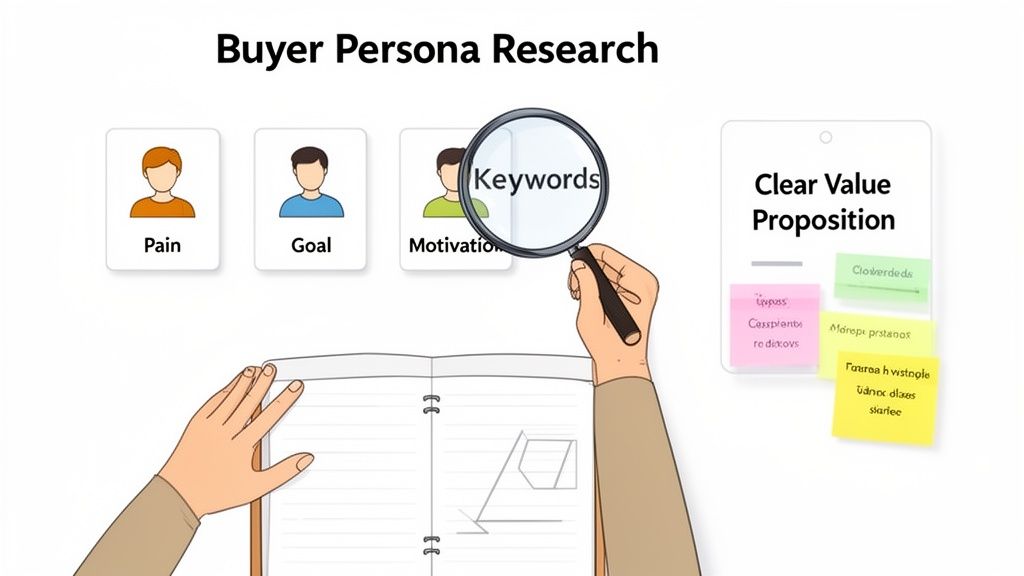
Before you even think about writing a headline, the best copywriters are deep in research mode. This foundational work is non-negotiable. It's where you stop guessing what your audience wants and start using real data to inform every word you write.
Great copy isn't about using fancy words; it's about deeply understanding the person on the other side of the screen. This initial groundwork ensures every product description, every bullet point, and every call-to-action resonates with your audience's needs and the language they use to search online. It’s the difference between shouting into an empty room and having a genuine conversation with your ideal customer. If you're serious about this, it's worth diving deep into mastering copy for websites that convert.
Creating Practical Buyer Personas
A buyer persona is your north star. It’s a detailed, semi-fictional profile of your ideal customer, built from market research and actual customer data. This goes way beyond basic demographics like age or job title. A truly useful persona gets into the head of your customer, capturing their real-world problems and what truly motivates them.
To build a persona that actually helps you write better copy, dig into these questions:
- What are their biggest pain points? What specific frustrations keep them up at night that your product or service can fix?
- What are their primary goals? What are they trying to achieve, and how can you help them get there faster?
- What language do they use? Listen to how they talk on social media, in forums, or on review sites. Use their words, not yours.
- Where do they hang out online? Which blogs, influencers, or communities do they trust for information?
For instance, a vague persona like "Marketing Mary, 35" is useless. Instead, get specific with "Growth-Focused Marketer Megan." Megan isn't just a number; she's overwhelmed by manual reporting, she’s struggling to prove ROI to her boss, and her main goal is to find a tool that saves her 10 hours a week. Now that's a person you can write for.
Analyzing Your Competitors
Looking at your competition isn’t about stealing their ideas—it’s about finding your own unique angle. Dive into their websites and analyze their copy. What’s their core message? What benefits do they hammer home? Who are they clearly trying to talk to? Most importantly, look for the gaps.
Don't just look at what your competitors say; look at what they don't say. The unaddressed pain points and overlooked benefits are often your biggest openings to differentiate your brand and capture market share.
This analysis is crucial for positioning. If everyone else is screaming about being the "cheapest," you have a golden opportunity to be the "most reliable," "easiest to use," or "highest quality" choice. This strategic positioning needs to be woven into every single word you write.
Once you’ve done this foundational work, you’ll have a clear value proposition—a simple, powerful statement explaining the unique benefit you deliver. With your persona, competitive insights, and value proposition locked in, you’re finally ready to write copy that doesn't just inform, but truly connects and converts.
Nailing Your Core Message and Brand Voice
Once you’ve really dug into who your audience is, you’re ready to build the two cornerstones of your website copy: your core message and your brand voice. These aren’t just marketing buzzwords; they’re what turn a random collection of words on a page into a consistent, memorable, and persuasive experience for anyone who stops by.
Your core message is the one big idea you want to own in your customer’s mind. It's the "why" that drives your business, boiled down to a simple, powerful statement. Think of it as the North Star for all your content—it’s not just a tagline, but the foundation that ensures every page, from your homepage to your checkout, tells the same story.
Finding Your Authentic Brand Voice
Your brand voice is simply the personality your business shows through its words. It’s not about what you say, but how you say it. A consistent voice is a trust-builder. It makes your brand feel human and relatable, not like a disjointed website where a different person wrote each page.
To pin down your voice, ask yourself a few questions:
- If my brand walked into a room, who would it be? A wise, trusted mentor? A witty and clever friend? A buttoned-up, formal expert?
- How do I want people to feel when they read my copy? Should they feel inspired, secure, entertained, or deeply understood?
- What kind of language actually connects with my audience? Does technical jargon build credibility in my industry, or will simple, straight-to-the-point language win the day?
Once you have a feel for it, write it down. A simple chart with adjectives is a great start (e.g., "Playful, but not goofy," or "Confident, but not arrogant"). This little document is invaluable for keeping everyone on your team on the same page. If you want to go deeper, we've got a whole guide on what brand voice is and how to develop one.
Using Frameworks to Build Persuasive Arguments
Copywriting frameworks aren't meant to be rigid, cookie-cutter rules. They’re battle-tested psychological structures that help you organize your message to have the biggest impact. They work because they guide your reader through a journey—both logical and emotional—that makes your case far more convincing.
Think of them like a recipe. You still need great ingredients (all that research you did), but the framework gives you the steps to put it all together perfectly. Two of the most reliable and versatile frameworks out there are AIDA and PAS.
The AIDA Framework (Attention, Interest, Desire, Action)
AIDA is a classic for a reason. It’s perfect for landing pages, product pages, and just about any situation where you need to warm up a reader.
- Attention: Snag them immediately with a headline they can't ignore or an opening line that stops their scroll.
- Interest: Keep them hooked. Share a fascinating fact, poke at a relevant pain point, or introduce a benefit they didn't know they needed.
- Desire: This is where you pivot from "interesting" to "I need this." Show them exactly how their life or work will be better with your solution. Testimonials, social proof, and vivid descriptions are your best friends here.
- Action: Don't leave them hanging. Tell them exactly what to do next with a clear and compelling call-to-action (CTA).
AIDA in the wild: Imagine a fitness app homepage. It grabs Attention with "Finally, a Workout That Fits Your Life." It builds Interest by showing how its AI customizes plans. It sparks Desire with powerful before-and-after stories. And it drives Action with a big, bold "Start Your Free 7-Day Trial" button.
The PAS Framework (Problem, Agitate, Solution)
The PAS framework is pure gold because it cuts right to the heart of your customer's pain points. It's incredibly powerful for sales pages and ads where you're solving a specific, urgent problem.
- Problem: State the problem. Show them you get it, right from the first sentence.
- Agitate: Now, gently twist the knife. Dig into the frustrations, the consequences, and the sheer annoyance of that problem. Make the pain feel real and present.
- Solution: Ride in on a white horse. Introduce your product as the clear, obvious, and perfect way to make all that pain disappear.
By mastering your voice and leaning on these proven frameworks, you're doing more than just writing. You’re architecting a message that is designed to connect, persuade, and ultimately, convert.
Writing for Your Website, Page by Page
Think of your website like a physical store. The homepage is the front window display, your product pages are the well-organized aisles, and the 'About Us' page is the friendly chat you have with the owner. Each part has a different job to do, and the words you use need to be tailored for that specific purpose.
If you treat every page the same, you’ll end up with a confusing mess. Let's break down how to approach the copy for your most important pages, ensuring each one pulls its weight.
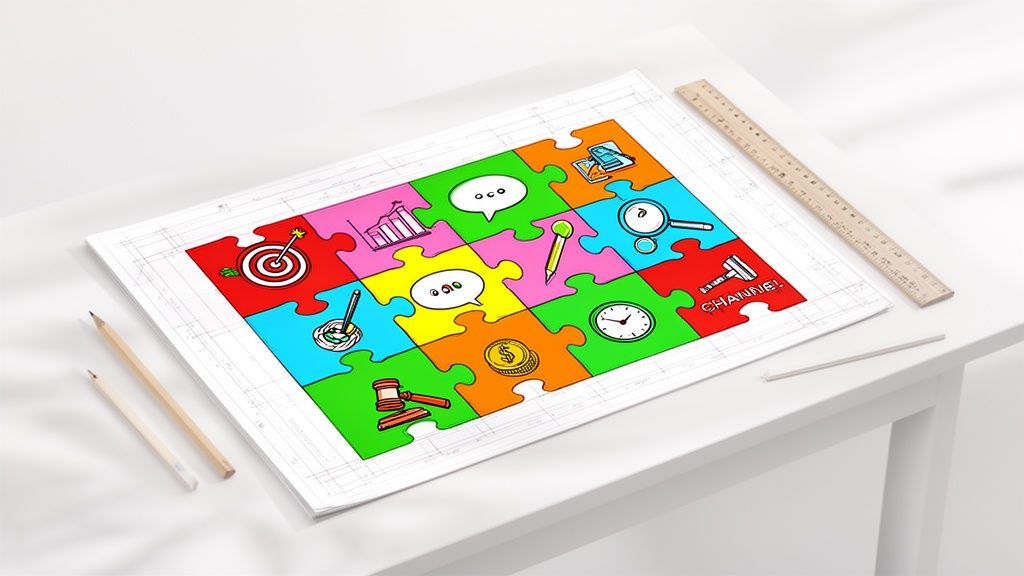
This all stems from a cohesive communication strategy. You can't just write in a vacuum; your message, voice, and story need to work together.
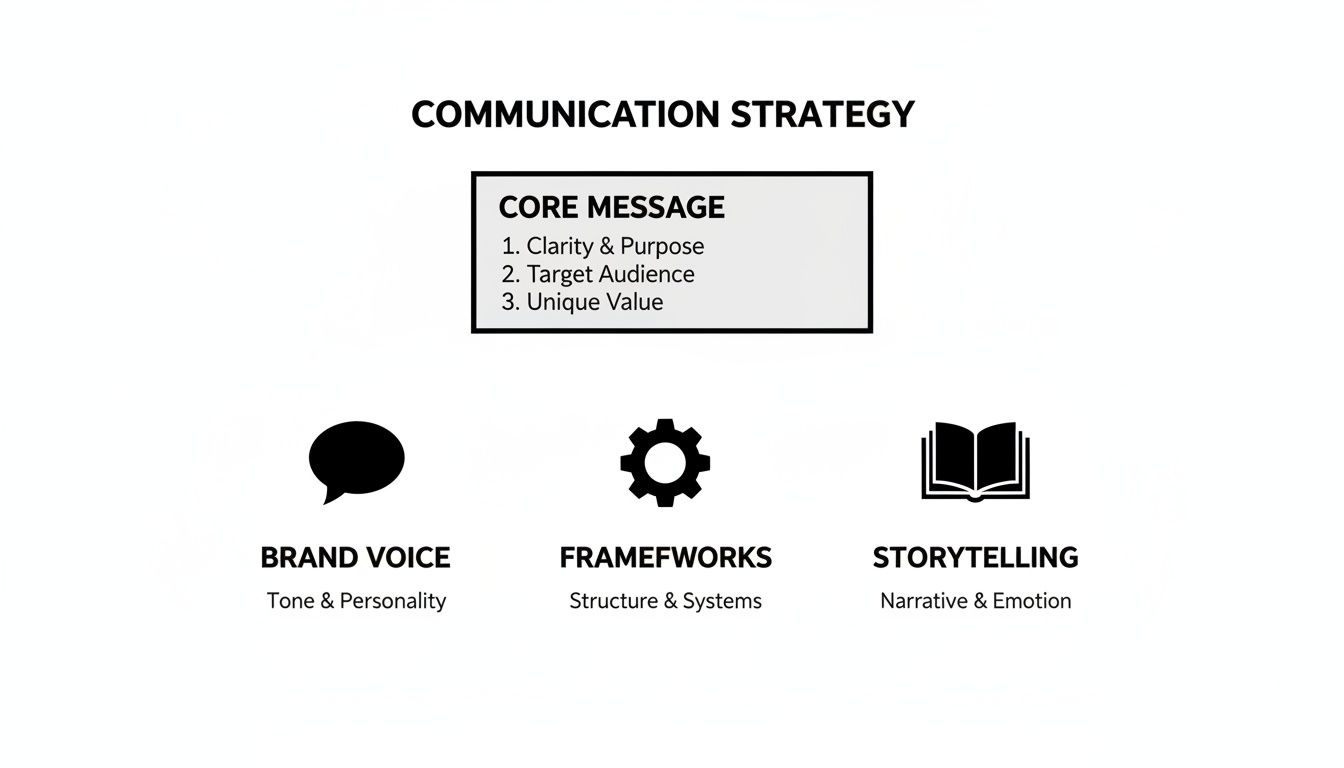
As you can see, a solid plan helps you deliver your core message effectively, no matter which page a visitor lands on first.
Nailing the Homepage Copy
Your homepage is your first, and often only, chance to make an impression. You have about 3-5 seconds to convince a visitor they’re in the right place. The goal here is instant clarity and connection. They need to know what you do and why it matters to them, fast.
Focus everything on the section "above the fold"—what someone sees before they scroll. It absolutely must have:
- A Killer Headline: Don't get cute or clever here. Be direct. Instead of a vague tagline like "Engineering a Better Future," say something concrete like, "Automate Your Invoicing and Get Paid Twice as Fast."
- A Supportive Subheading: Use this to elaborate slightly on the headline's promise or to call out your specific audience.
- A Can't-Miss Call-to-Action (CTA): This button needs to pop. Use action-driven text like "Get Your Free Demo" or "Start Your Free Trial."
Once you've hooked them, the rest of the page can build on that initial promise. Use short, scannable sections to introduce key benefits, flash some social proof (like client logos or a killer testimonial), and maybe even tackle a common objection head-on.
Writing Product and Service Pages That Actually Sell
This is where the magic happens. Your product and service pages are where a curious visitor decides to become a paying customer. The single biggest mistake I see here is companies listing features instead of selling benefits.
Nobody cares about your "one-click export" feature. They care about what it does for them.
Connect every feature to an outcome. Don't just say your software has a feature; tell them it "saves your team an hour of tedious reporting every single week."
A simple structure that works time and again:
- Open with a headline that solves their problem.
- Follow up with a short paragraph that shows you understand their pain.
- Use benefit-focused subheadings and bullet points to break down the value.
- Sprinkle in social proof—reviews, ratings, case studies—to build confidence.
- Close with a clear, strong CTA that asks for the sale.
For example, a marketing agency’s service page shouldn't be titled "Our SEO Services." It should be "Stop Guessing and Start Growing with Data-Driven SEO." See the difference? One describes, the other solves.
Building Real Trust on Your About Us Page
So many businesses waste their About Us page with a boring, chronological history of the company. Let me be blunt: nobody cares. This page isn't really about you—it's about why your story should matter to your customer.
This is your prime opportunity to build a human connection. Ditch the corporate timeline and tell a story instead.
- Start with your "Why": What problem frustrated you so much that you had to start this business?
- Introduce the "Who": Show off your team's personality, not just their job titles. What makes them tick?
- Explain your "How": What do you do differently? What are the core values that guide your work?
This is where you build loyalty. You get to show the passion and personality behind the logo, turning a simple transaction into a real relationship.
Designing Landing Pages for One Goal: Conversion
A landing page is a specialist. It has one job and one job only: to get the visitor to take one specific action. That's it. No distractions, no navigation to other parts of your site, just a laser-focused path to conversion.
Because of this, landing page copy needs to be brutally efficient. There's zero room for fluff. A high-performing page usually sticks to a proven formula: a powerful, benefit-driven headline, scannable bullet points, irresistible social proof, and a single, glaringly obvious CTA.
We actually wrote an entire guide on this. For a much deeper look, check out our tips for creating a high-converting landing page that gets results.
To help you keep all this straight, here's a quick cheat sheet for the essential copy elements on your most important pages.
Essential Copy Elements for Key Website Pages
This table breaks down the must-have copywriting components for your website's core pages. Use it as a checklist to make sure each page is set up to achieve its primary goal and effectively guide your visitors.
| Page Type | Primary Goal | Key Copywriting Elements |
|---|---|---|
| Homepage | Make a strong first impression, establish credibility, and guide users to the next step. | Clear value proposition, benefit-driven headline, compelling subheadline, prominent primary and secondary CTAs, social proof (testimonials, logos), and a brief overview of services/products. |
| Product/Service Page | Persuade and convert interested visitors into customers by detailing a specific offer. | Focus on benefits over features, address customer pain points, use high-quality images/videos, include detailed descriptions, show social proof (reviews, ratings), and provide a clear, strong CTA. |
| About Us Page | Build trust and humanize your brand by sharing your story, mission, and values. | Engaging brand story (the "why"), introduction to the team, clear articulation of your mission and values, and a behind-the-scenes look at your company culture. |
| Landing Page | Convert traffic from a specific campaign (e.g., ads, email) into leads or sales. | One clear goal, a single compelling CTA, a headline that matches the ad source, concise and benefit-oriented copy, trust signals (badges, testimonials), and a frictionless form/checkout process. |
By thinking strategically about each page's unique purpose, you can ensure your entire website works as a cohesive system—one that not only informs visitors but actively persuades them to take action and grow your business.
Balancing SEO Needs with a Great User Experience
The best website copy pulls off a delicate tightrope walk. On one side, you have the data-driven demands of search engines like Google. On the other, you have the very human needs of the person actually reading your content. Succeeding here means pleasing both masters at once.
This isn’t about choosing between SEO and a great user experience; it’s about making them work together. You can’t just cram a page full of keywords and hope for the best. That old-school approach might get you a click, but a visitor who lands on robotic, unreadable content will bounce immediately. That sends a clear signal to Google that your page isn't helpful.
The real goal is to create content that is discoverable and genuinely persuasive when a person arrives.
Weaving Keywords in Naturally
Think of keywords not as clunky terms you have to force in, but as guideposts. They confirm to both users and search engines that they've found the right information. Your primary keyword should absolutely appear in key places, but it needs to feel like it belongs there.
Here are the most important spots to place your main keyword:
- Your H1 Title Tag: This is your big signal to search engines. It should be the first thing a crawler sees and should clearly state the page's topic.
- The First 100 Words: Introduce your topic early on to immediately establish relevance for your readers and for Google.
- In at Least One H2 Subheading: Breaking your content into sections with keyword-relevant subheadings helps with both scannability and SEO.
- Throughout the Body Copy: Sprinkle your keyword and related terms where they make sense, but never sacrifice clarity for the sake of keyword density.
For example, let's say your keyword is "small business accounting software." A clunky, stuffed sentence would be: "Our small business accounting software is the best small business accounting software for your needs." A much more natural approach is: "Choosing the right small business accounting software can feel overwhelming, but our platform simplifies the entire process." See the difference?
Prioritizing Readability and Scannability
Let's be honest: people don't read websites; they scan them. Your job is to make your copy as easy to skim as possible. If a visitor is met with a wall of dense text, their eyes will glaze over and they'll likely hit the back button.
As you structure your copy, remember that improving readability is a direct line to keeping people engaged, which is key if you want to understand how to reduce bounce rate.
The secret to great web copy is making it look inviting before a single word is even read. Strategic use of white space, short paragraphs, and clear headings makes your content feel less like a chore and more like a conversation.
Here’s how to make your copy instantly more scannable:
- Keep Paragraphs Short: Stick to a maximum of 1-3 sentences per paragraph. This creates visual breaks and makes your points much easier to digest.
- Use Impactful Subheadings: Headings (like H2s and H3s) act as a roadmap for your content. A scanner should be able to get the gist of your page just by reading them.
- Leverage Bullet Points: When you need to list benefits, features, or steps, bullet points are your best friend. They break up the text and draw the eye to key information.
Writing Headlines That Grab Attention and Clicks
Your headline is your first impression, and it carries immense weight. Websites armed with clear, compelling headlines achieve a 25% higher conversion rate, proving that the first few words can make or break everything.
A great headline has to do two things at once: include your target keyword for SEO and spark curiosity or urgency for the reader.
Instead of a generic title like "Our Marketing Services," try something that speaks to a real benefit, like "Marketing Services That Turn Clicks Into Customers." It includes the keyword phrase while also making a powerful promise.
By mastering this balance, you create copy that not only ranks well but also delivers a truly compelling user experience that actually converts.
Time to Test and Refine: How to Make Good Copy Great
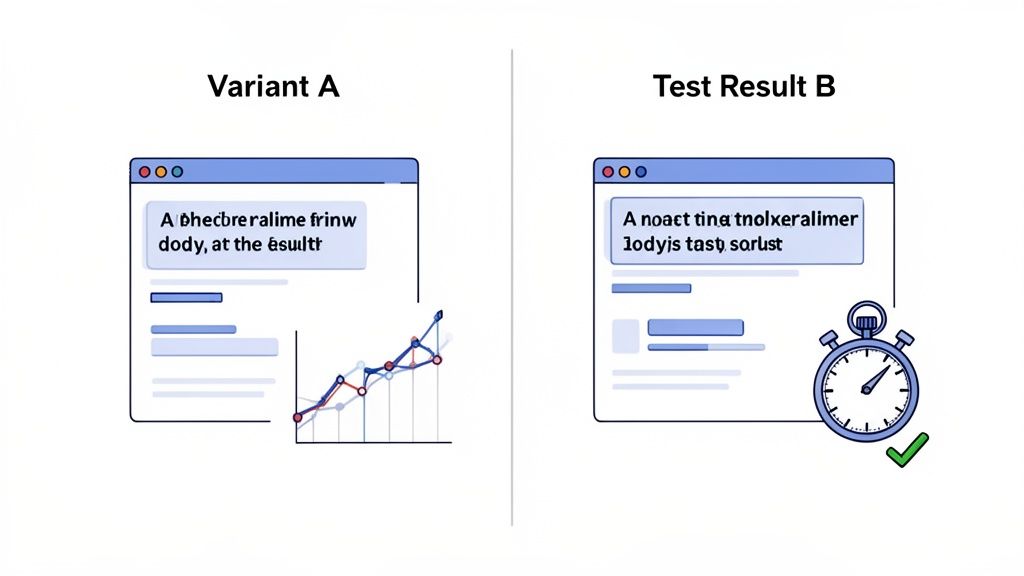
Hitting "publish" on your new website copy feels great, but the job isn't quite done. Think of that first draft as a solid, well-researched hypothesis. It’s your best guess at what will connect with your audience. The real magic happens when you stop treating your words as set in stone and start treating them as living elements you can test and improve.
This is where you step into the world of conversion rate optimization (CRO). It’s how you shift from guesswork to data-backed decisions that grow your business. It's the difference between a "good enough" website and a high-performance conversion machine.
And it’s a big deal. The global copywriting market is expected to hit USD 27.96 billion in 2025, surging to USD 42.83 billion by 2030. That explosion shows just how much businesses are banking on effective copy to drive growth.
A/B Testing: Your Secret Weapon
A/B testing (or split testing) is the single most powerful tool in a copywriter’s refinement toolkit. The idea is wonderfully simple: you show two versions of a page to your audience—let's call them A and B. The only difference between them is one specific copy element you want to test.
By splitting your traffic between the two, you can see exactly which version performs better. It takes the "I think this will work" out of the equation and replaces it with "I know this works."
So, what should you test? Start with the high-impact stuff:
- Headlines: Pit a benefit-driven headline against one that pokes at a pain point.
- Calls-to-Action (CTAs): Does "Start Your Free Trial" outperform "Create Your Account"?
- Value Props: Try articulating your core benefit in a completely different way.
- Button Text: You'd be surprised how much a simple change from "Submit" to "Get My Free Guide" can matter.
The golden rule here is to test one thing at a time. If you change the headline and the button copy, you'll never know which change was responsible for the lift (or the drop) in conversions. Your results will be a mess.
Imagine a SaaS company testing two headlines. Version A is "The #1 Project Management Tool for Agencies." Version B is "Tired of Missed Deadlines? Get Your Projects Under Control." By tracking demo requests from each version, they'll get a crystal-clear picture of which message truly clicks with their target audience.
A Simple Framework for Running Tests
You don't need a PhD in data science to get started. A simple, repeatable process is all it takes to start gathering priceless feedback on your copy.
Here's the loop:
- Form a Hypothesis: It starts with an educated guess. For example: "I believe changing our CTA from 'Learn More' to 'View Demo' will increase clicks because visitors at this stage are looking for a product tour, not more reading."
- Create Your Variation: Make that one, single change. Tools like Google Optimize or built-in features on platforms like Unbounce make this easy.
- Run the Test: Let it run long enough to reach statistical significance. This is crucial—it ensures your result isn't just a random fluke from a small sample size.
- Analyze the Results: Did your new version win, lose, or was it a tie? The data will tell the story.
- Implement or Iterate: If you have a clear winner, push it live to 100% of your audience. If not, take what you learned, form a new hypothesis, and go again.
What to Actually Measure in Google Analytics
To know if your copy is working, you have to know what to look for. Your Google Analytics account is a treasure trove of data that tells you how people are really interacting with your words.
Keep your eye on these key performance indicators (KPIs):
- Conversion Rate: This is the big one. Are more people doing the thing you want them to do?
- Bounce Rate: A high bounce rate is a red flag. It often means your headline and intro copy failed to convince people to stick around.
- Time on Page: If people are only spending a few seconds on a page with 1,000 words of copy, they aren't reading it. This tells you your content isn't engaging enough.
- Goal Completions: Are your specific goals—like newsletter signups or contact form submissions—trending up or down? This directly measures the effectiveness of your CTAs and surrounding copy.
By checking these metrics regularly, you can spot weak points in your copy and generate a constant stream of new ideas for your next A/B test. For a deeper dive into turning more visitors into customers, check out these essential conversion rate optimization tips.
Got Questions About Website Copywriting? We’ve Got Answers.
Even the best guides leave you with a few lingering questions. It's totally normal. Here are a few of the most common ones I hear from clients and in workshops, with some straight-to-the-point answers to help you get unstuck.
How Long Should My Website Copy Be?
The classic (and most honest) answer is: as long as it needs to be to get the job done, and not a single word longer.
There really isn't a magic number. I’ve seen landing pages convert like crazy with just 300 words, while in-depth service pages often need 1,500 words or more to walk a skeptical reader through every feature and overcome every objection.
Instead of chasing a word count, focus on value. Is every single sentence pulling its weight? Have you answered all the questions a potential customer might have? The goal is to be thorough enough to persuade but concise enough to keep people reading.
What’s the Difference Between Web Writing and Copywriting?
People throw these terms around interchangeably, but there’s a subtle yet important difference.
Copywriting is the big-picture craft of writing to sell or persuade. It covers everything—print ads, email campaigns, sales letters, you name it. Its core purpose is to drive a specific action.
Web writing is a specialized slice of copywriting designed for the screen. It takes all those persuasive principles and filters them through the lens of how people actually behave online. This means factoring in user experience (UX), the need for scannability, and the ever-present demands of search engine optimization (SEO). A great web writer knows you aren't reading every word; you're scanning. They build their pages with that reality in mind.
Can I Just Use AI to Write My Website Copy?
Look, AI can be a fantastic assistant. It’s great for busting through writer's block, brainstorming angles, or even spitting out a rough first draft. But letting it write your final copy? That's a gamble I wouldn't take.
AI-generated content almost always feels a bit…off. It lacks a unique brand personality, can't tell a compelling personal story, and struggles to make the genuine emotional connection that turns a visitor into a customer.
AI is a phenomenal mimic. It can rehash what's already been said a thousand times. But it can't create a truly original narrative or share an authentic experience that makes your brand stick. That human touch is what separates you from competitors using the exact same prompts.
Use AI as a tool to get you started, but never let it replace your own expertise and voice. That’s your real competitive advantage.
How Often Should I Update My Website Copy?
Think of your website as a living, breathing part of your business, not a "set it and forget it" brochure. A good rule of thumb is to give your copy a thorough review at least once a year.
That said, some events should trigger an immediate update:
- You've launched a new product or updated a service: Your copy needs to reflect what you're actually selling, right now.
- Your target audience has shifted: If you're talking to a different kind of customer, your messaging needs to change, too.
- The numbers look bad: If a page has a sky-high bounce rate or a conversion rate in the gutter, it's a clear signal that the copy isn't working. Time to start testing something new.
Ready to stop guessing and start seeing real results? The expert team at ReachLabs.ai blends data-driven strategy with compelling storytelling to create website copy that converts. Let's find your brand's true voice and make it heard. Discover our full-service marketing solutions.