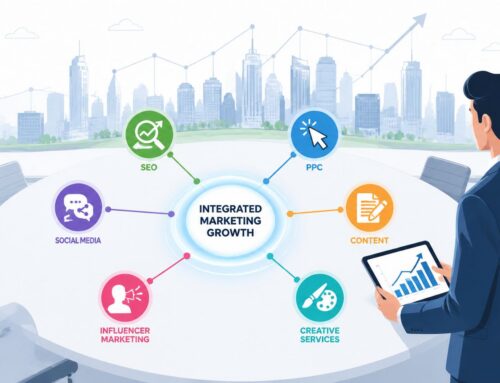

A marketing plan is more than just a document; it’s the roadmap that turns your business ambitions into real, measurable growth. It’s what separates scattered, hopeful tactics from a unified, focused strategy. Think of the core components of a marketing plan as the interconnected parts of a high-performance engine, all working together to drive you forward.
Why Your Business Needs a Marketing Blueprint

Trying to grow a business without a solid marketing plan is like trying to build a house without a blueprint. You might get a few walls up, but the foundation will be shaky, the rooms won't connect properly, and the whole thing is likely to collapse. A marketing plan is that essential blueprint—it gives every single campaign and action a clear purpose.
This guide is designed to get you out of the "let's try this and see what happens" mindset and into intentional, data-driven action. We'll break down the nine fundamental components that every robust and actionable plan needs. In a crowded market, a well-crafted strategy isn't just nice to have; it's essential for survival and growth.
Aligning Teams and Justifying Budgets
Without a documented plan, it's easy for departments to drift into their own worlds. Sales pursues one type of lead, product builds a feature for another, and marketing is sending a completely different message. This siloed approach leads to confusion and wasted money. A clear plan gets everyone—from the C-suite to the interns—rowing in the same direction.
A thoughtful strategy brings focus to your work. A data-driven one helps you learn, adapt, and grow as you go. These core components give your strategy the structure and insight it needs to make a real impact.
A detailed plan is also your single best tool for getting the budget you need. When you can show exactly how every dollar will be used to achieve specific, measurable results, the conversation shifts. Marketing stops looking like a cost center and starts being seen for what it is: a critical engine for revenue.
The Nine Core Components
In this guide, we're going to dive deep into the nine core components that make up a powerful marketing plan. You'll see how they all connect to create a single, unified strategy. The goal is to give you a clear framework you can start using right away. For a high-level overview of the entire process, you can get a better sense of how to write a marketing plan and see where these pieces fit.
Here’s what we'll cover:
- Business Context: Where you are now and where you're headed.
- Target Audience: Who you're actually talking to.
- Goals & KPIs: What success looks like, in plain numbers.
- Positioning & Messaging: Your unique story and why it matters.
- Channels & Tactics: The specific actions you'll take.
- Content Plan: The fuel for your marketing engine.
- Budget & Resources: What it will take to get it done.
- Measurement & Reporting: How you'll track progress and prove ROI.
- Timeline & Governance: Who does what, and when.
The 9 Core Components of a Modern Marketing Plan
A great marketing plan is so much more than a glorified to-do list. It’s the strategic blueprint that connects every single action you take back to a real business goal. Think of it like a conductor's score for an orchestra—each instrument has a specific part to play, but their true power comes alive when they work together in perfect harmony.
This is what it takes to succeed in today’s market. The industry’s growth alone tells the story. In 2024, global revenue from advertising and marketing agencies hit a massive $418 billion, a huge jump from $391 billion just the year before. That number shows just how much businesses rely on solid plans to connect their digital tactics, creative work, and data-driven insights into a single, powerful strategy.
So, let's break down the nine essential pieces that make a marketing plan actually work.
1. Situation Analysis: Where You Stand
Before you can figure out where you’re going, you need to know exactly where you are. A situation analysis is your "You Are Here" map. It’s an honest, clear-eyed look at your internal strengths and weaknesses (think SWOT analysis) and the external opportunities and threats brewing in your market.
This step forces you to ask the tough questions. Who are our main competitors, and what are they nailing? What market trends could give us a boost or knock us off course? Getting real answers here provides the foundation for every other decision you’ll make.
2. Target Audience and Personas: Who You Serve
You can't be everything to everyone. The most effective marketing feels like a one-on-one conversation, speaking directly to a specific group of people who share a common problem or passion. This is where you define your ideal customer with laser focus, going beyond basic demographics to understand their psychographics—what motivates them, what keeps them up at night, and what they truly want to achieve.
Creating detailed buyer personas brings this data to life. Instead of just targeting "small business owners," you invent "Startup Sarah." She's 32, building her company from the ground up, and is constantly fighting the clock. She needs software that’s efficient and can grow with her. See how much easier it is to talk to Sarah? That focus makes your message resonate.
3. Marketing Goals and KPIs: What Success Looks Like
Goals like "increase brand awareness" are wishy-washy, impossible to track, and pretty much set up to fail. This component is all about turning broad business objectives into SMART goals—Specific, Measurable, Achievable, Relevant, and Time-bound. These are your north stars.
And for every goal, you need Key Performance Indicators (KPIs) to know if you're on track.
- Goal: Increase qualified leads by 20% in Q3.
- KPIs: Number of marketing qualified leads (MQLs), conversion rate from lead to MQL, cost per MQL.
- Goal: Improve customer retention by 10% over the next year.
- KPIs: Customer churn rate, customer lifetime value (CLV), repeat purchase rate.
4. Brand Positioning and Messaging: Your Unique Story
In a crowded market, how you say something is just as important as what you're selling. Your brand positioning carves out your unique space in your customer's mind. It's the simple, powerful answer to the question: "Why should I choose you over all the other options?"
Your messaging is how you bring that position to life. It includes your value proposition, your brand voice, and the core story you tell everywhere. Getting this right ensures that every tweet, blog post, and email sounds like it’s coming from the same brand and reinforces the same big idea.
A brand's position is its promise to the customer. Consistent messaging is how that promise is delivered, building trust and recognition with every interaction. This is the heart of your communication strategy.
5. Channels and Tactics: The How and Where
Okay, you know your goals and who you're talking to. Now it's time to decide where the conversation will happen. This component lays out the specific channels you’ll use to reach your audience—like SEO, social media, email marketing, or PPC—and the tactics you'll use on each one. The trick is to show up where your ideal customers are already spending their time.
An integrated approach is everything. Your channels can't be lonely islands; they need to work together to amplify your message. For example, you could run paid social ads to boost a top-performing blog post that’s already optimized for search, capturing attention from two different angles. If you want to see how this is structured in the real world, a good social media marketing plan template can provide a fantastic blueprint.
6. Content Strategy: The Value You Provide
Content is the fuel for your entire marketing engine. A content strategy is your plan for what you’ll create, why you’re creating it, and how it will help your audience at every stage of their journey. This is what separates random acts of content from a purposeful system built to attract, engage, and convert customers.
Your strategy should map out key content themes or topic clusters, the formats you'll use (blogs, videos, webinars, etc.), and a production schedule to keep it all on track.
7. Budget and Resources: Fueling the Engine
An idea without a budget is just a daydream. This is the nuts-and-bolts component where you allocate the money and people needed to make your plan happen. It breaks down everything from ad spend and software subscriptions to freelance help and your team's salaries. A clear budget keeps your plan grounded in reality and gives you a baseline for measuring your return on investment (ROI).
8. Measurement and Analytics: Proving It Works
You can't improve what you don't measure. This is where you define how you’ll track performance, analyze the data, and report back on your progress toward your KPIs. It involves setting up your analytics tools (Google Analytics, for example), creating dashboards to visualize the data, and establishing a regular reporting schedule. This feedback loop is what allows you to make smart adjustments based on what's actually working, not just what you think is working.
9. Execution Timeline: The Action Plan
Finally, the timeline pulls everything together into a clear, actionable roadmap. It breaks your entire strategy down into specific tasks, assigns them to team members, and sets firm deadlines. This governance structure creates accountability and keeps everyone moving in the same direction, turning your strategic document into a living, breathing guide for your team.
Before we move on, let's quickly recap these nine pillars. Each one builds on the last, creating a comprehensive and connected strategy.
The 9 Core Components of a Marketing Plan at a Glance
| Component | Purpose | Key Question to Answer |
|---|---|---|
| 1. Situation Analysis | To establish a clear starting point by assessing internal and external factors. | Where are we right now? |
| 2. Target Audience | To define exactly who you are trying to reach with laser focus. | Who are we talking to? |
| 3. Goals & KPIs | To set measurable targets that define what success looks like. | What do we want to achieve? |
| 4. Positioning & Messaging | To craft your unique story and value proposition in the market. | Why should they choose us? |
| 5. Channels & Tactics | To select the specific platforms and methods you'll use to reach your audience. | How and where will we reach them? |
| 6. Content Strategy | To plan the value-driven content that will attract and engage your audience. | What will we create to help them? |
| 7. Budget & Resources | To allocate the financial and human capital needed for execution. | What will it take to make this happen? |
| 8. Measurement | To track performance and prove the return on your marketing investment. | How will we know if it's working? |
| 9. Execution Timeline | To create an actionable roadmap with tasks, owners, and deadlines. | What is the step-by-step plan? |
With these nine components in place, you've moved from simply "doing marketing" to executing a well-oiled strategic machine.
1. Business Context: Know Where You Stand
Before you can figure out where you're going, you need a brutally honest look at where you are right now. This is your "You Are Here" map for the marketing world. We call this a situation analysis, and it's the foundation of any solid marketing plan. Without it, you're just guessing.
Think of it like a detective building a case. You're gathering clues about your own company and the world it operates in. This isn't just about listing facts; it's about connecting the dots to see the full picture. Getting this right ensures your goals, messaging, and tactics are all grounded in reality, not wishful thinking.
This first step sets the stage for everything else to come.
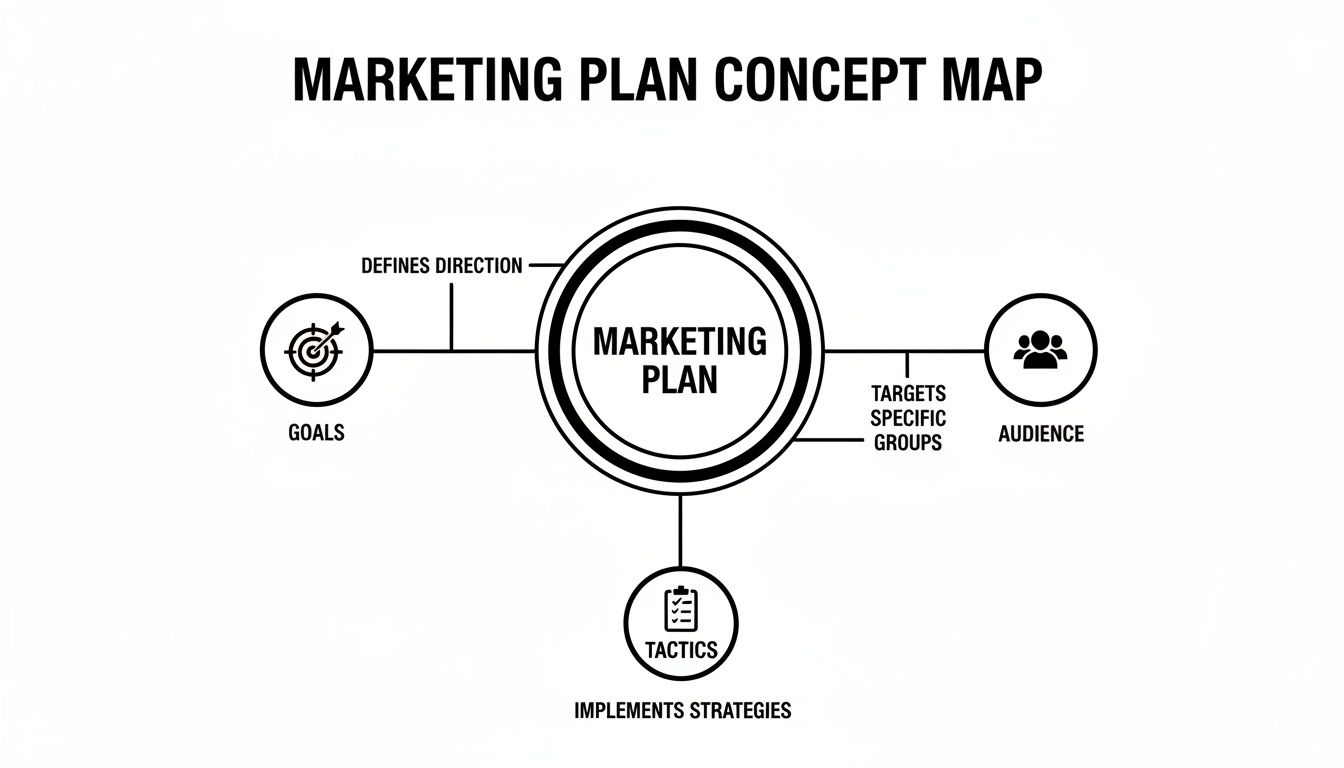
As you can see, a successful plan starts with a deep understanding of your audience and your current situation. That understanding informs your goals, which then dictates the specific tactics you'll use to win.
The Classic SWOT Analysis (But Done Right)
The most common tool for this is the SWOT framework: Strengths, Weaknesses, Opportunities, and Threats. But here's the secret: its power isn't in just filling out the boxes. The real magic happens when you use it to find strategic insights.
-
Strengths (Internal): What’s your secret sauce? Maybe it's a proprietary technology, a killer team, or a brand people genuinely love. For example, a huge strength could be your company's 95% customer satisfaction rate. That's a powerful asset.
-
Weaknesses (Internal): Where are the cracks? Be honest. Is your website clunky? Is your brand a bit of a ghost online? Acknowledging your weak spots is the only way you can start to fix them.
-
Opportunities (External): What’s happening out in the world that you can jump on? This could be a new social media trend, a competitor fumbling the ball, or a change in what customers want.
-
Threats (External): What could trip you up? This is where you list new competitors, scary regulations, or market trends that aren't in your favor.
A situation analysis isn’t about judging past performance; it’s about preparing for future success. It turns a bunch of unknown variables into a clear assessment of your risks and advantages, giving your strategy a solid launchpad.
Digging into your competitors is a huge part of this. To get a real advantage, many marketers are now using competitor AI analysis tools. These can surface deep insights into what rivals are doing, helping you spot both threats and opportunities with a lot more clarity.
Get to Know Your Customer (Really Well)
Once you've mapped the competitive landscape, it's time to zoom in on the most important person in the room: your customer. Great marketing speaks to individuals, not to a faceless crowd. This is where buyer personas come in.
A persona is basically a character sketch of your ideal customer, built from real data and research. It's not just about demographics like age and location.
A truly useful persona digs into:
- Goals & Motivations: What are they trying to accomplish? What gets them out of bed in the morning?
- Challenges & Pain Points: What keeps them up at night? What problems are you uniquely positioned to solve for them?
- Communication Preferences: Where do they hang out online? Do they prefer quick videos or in-depth articles?
When you create these detailed personas, you stop thinking about "the market" and start thinking about "Sarah, the busy project manager." It suddenly becomes much easier to write copy that connects, pick the right social media channels, and create content that she'll actually find helpful.
A good https://www.reachlabs.ai/competitor-analysis-framework/ will also show you how your rivals talk to their "Sarahs," giving you a chance to find a different, more effective angle.
Ultimately, your situation analysis and buyer personas are the bedrock of your entire marketing plan. They ensure every single decision you make from here on out is smart, strategic, and focused on the customer.
3. Setting Your North Star: Goals and Messaging
Now that you have a solid grasp of your business and who you're talking to, it's time to decide where you're actually going. Lofty ambitions like “grow the brand” or “get more sales” feel good to say, but they’re useless for building a real strategy. You can't measure them, and you certainly can't build a plan around them.
Think of it like planning a road trip. You wouldn’t just get in the car and “drive west.” You’d pick a specific city, a destination. In marketing, that destination is defined by SMART goals—goals that are Specific, Measurable, Achievable, Relevant, and Time-bound. This simple framework is what turns a fuzzy wish into a concrete target.
For instance, a vague goal like "get more leads" becomes a powerful SMART goal when reframed: "Increase qualified leads from organic search by 15% in Q3." See the difference? Now you have a specific target, a way to measure it, a deadline, and a direct link back to revenue.
Defining Your SMART Marketing Goals
This is the moment where you connect your marketing activities directly to the company's bottom line. It’s arguably the most important step for proving your team’s value and justifying your budget. Every single thing you do—from one social media post to a massive campaign—should be in service of hitting these goals.
Here’s a quick breakdown of how to think about each part:
- Specific: What, exactly, do you want to accomplish? "Increase website traffic" isn't specific. "Increase organic traffic to our blog by 20%" is.
- Measurable: How will you know when you’ve won? Name the metric. Is it leads, conversion rate, or customer lifetime value?
- Achievable: Be ambitious, but don't set yourself up for failure. Your goal should stretch your team, not break it.
- Relevant: Does this goal actually matter to the business? If you hit it, will it contribute to a larger company objective?
- Time-bound: Give yourself a deadline. "By the end of the year" or "within 90 days" creates the urgency needed to get things done.
With your destination locked in, you now need to figure out how you'll talk to people along the way. In a market flooded with noise, having a great product isn’t enough. You need a voice that cuts through and truly connects. This is the art of brand positioning and messaging.
Crafting Your Brand Voice and Message
Think of brand positioning as claiming your unique spot on a crowded stage. It's the simple, immediate answer to the question, "Why should I pick you over everyone else?" Your messaging is the script you use to deliver that answer, again and again, across every single channel. It's your personality, your promise, and your story.
The heart of all this is your value proposition. This is a short, punchy statement explaining the benefit you provide, who you provide it for, and what makes you the best choice.
Your brand message is the consistent thread that weaves through every email, blog post, and ad. It’s what makes your audience feel like they know you, trust you, and want to be a part of your story.
To nail down a message that sticks, focus on these three things:
- Define Your Brand Voice: Who are you? A wise mentor? A quirky friend? A rock-solid, dependable partner? Your tone needs to match your brand's personality and click with your customer personas.
- Craft a Clear Value Proposition: What is the single biggest promise you make to your customers? State it clearly and confidently.
- Develop Key Talking Points: Create a short list of the core ideas that support your value proposition. These become the building blocks for all your future content.
By combining clear, measurable goals with a distinct and authentic brand message, you create a powerful North Star for your marketing. This dual focus ensures your work is not just strategically sound but also emotionally resonant, driving both performance and real human connection.
5. Channels & Tactics: Where Your Marketing Comes to Life
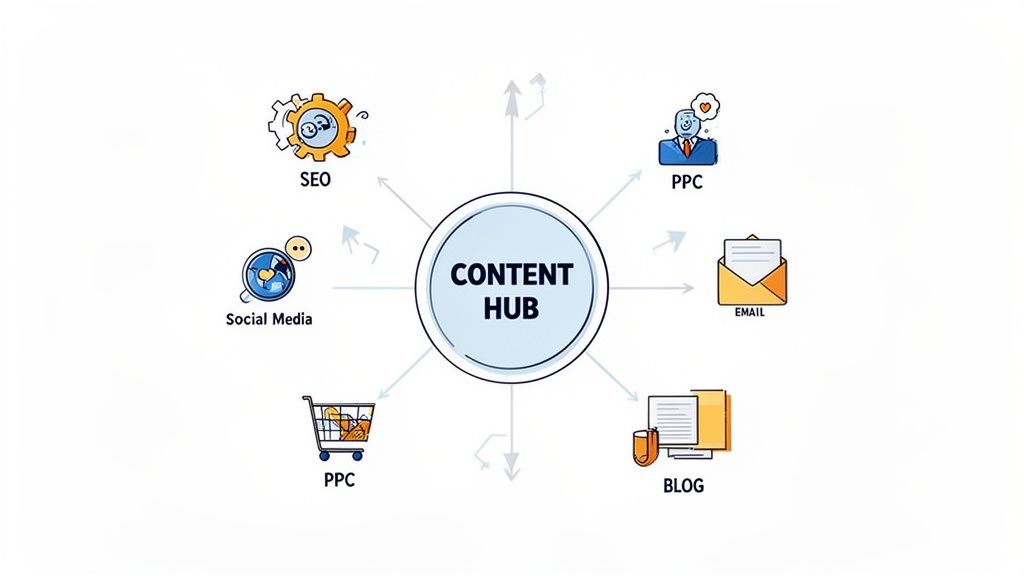
Alright, you’ve set your goals and you know exactly who you’re talking to. Now it's time to get down to the brass tacks—this is where your strategy stops being a document and starts becoming a living, breathing part of your business. We're talking about the specific channels you’ll use to reach your audience and the content that will power those conversations.
Think of your channels as different highways leading to your ideal customer. Your job is to pick the roads they actually drive on. You wouldn't put up a billboard on a deserted country lane, right? In the same way, you don't want to pour your budget into a social media platform your audience couldn't care less about.
The real magic happens when you meet your customers where they are and create a seamless experience across those different highways. Your channels shouldn't operate in silos; they need to work together.
Choosing Your Marketing Battlegrounds
Picking your channels isn't a guessing game. It's a strategic decision that flows directly from the audience personas and goals you’ve already defined. A B2B software company might find its goldmine on LinkedIn and through a robust SEO strategy, while a fashion brand will likely see explosive growth on Instagram and TikTok.
Let's be clear: a modern marketing plan is a digital-first plan. The numbers don't lie. Digital marketing services accounted for a whopping 62.26% of agency revenue in 2024, and the global market is on track to hit an estimated $452.96 billion in 2025. With digital ad spend projected to reach $777 billion in 2025, ignoring these avenues is like trying to compete with a horse and buggy. You can dig deeper into these marketing agency trends to see the full picture.
Here’s a quick rundown of the big players and their roles:
- Search Engine Optimization (SEO): This is your long game. It’s all about capturing traffic from people actively looking for the solutions you offer. SEO is how you build a sustainable pipeline of high-intent leads without paying for every click.
- Pay-Per-Click (PPC) Advertising: Need results now? PPC gives you instant visibility. It’s perfect for targeting hyper-specific keywords, A/B testing your messaging, and driving traffic to a landing page for quick conversions.
- Social Media Marketing: This is where your brand’s personality shines. Social media is hands-down the best place to build a community, engage in real conversations, and show the human side of your business.
- Email Marketing: Your email list is a direct line to your most engaged followers. It's the ideal channel for nurturing leads, announcing new products, and turning one-time buyers into loyal fans.
The smartest strategies don't just use these channels—they weave them together. A fantastic blog post (SEO) can be supercharged with paid ads (PPC), shared across your social channels, and delivered directly to your email subscribers. That's how you get exponential reach and impact.
This integrated approach is the absolute core of an effective marketing plan.
6. Content Plan: The Fuel for Your Marketing Engine
If channels are the highways, then content is the vehicle carrying your message. A content strategy is your blueprint for creating and sharing valuable, relevant, and consistent material that pulls your audience in and keeps them coming back. This isn't about constant sales pitches; it's about creating genuine value.
A brilliant way to organize your efforts is the topic cluster model. Here's how it works: you create a comprehensive "pillar" page on a broad topic, then surround it with several in-depth "cluster" articles that dive into specific subtopics, all linking back to the main pillar. This structure not only makes it easy for your audience to learn, but it also signals your expertise to search engines, giving your SEO a serious boost.
Your content plan should have something for customers at every step of their journey:
- Awareness Stage: At the top of the funnel, people are just realizing they have a problem. Your content should answer their early questions with things like "how-to" guides, checklists, and introductory blog posts.
- Consideration Stage: Now they’re actively researching solutions. This is where you offer more depth with case studies, product comparison guides, and webinars to help them weigh their options.
- Decision Stage: They're ready to buy, but they need a final nudge. Content like free trials, live demos, and detailed pricing pages can help seal the deal.
By mapping your content to the customer journey, you’re always delivering the right information at the right time. This is how you build trust and guide people smoothly toward becoming happy customers.
7. Budgeting and Measurement: Fueling Your Strategy and Proving It Works
A brilliant marketing plan with an empty fuel tank is just a document full of good intentions. This is where we get real. Budgeting and measurement are the operational core of your plan—it's how you fund the engine and install the dashboard to see how fast you're going.
Without a realistic budget, your plan is destined to fail. It's the grounding force that connects your big ideas to what's actually possible. On the flip side, without clear measurement, you're just flying blind. You have no way of knowing what's a high-impact investment versus an expensive distraction.
How to Allocate Your Marketing Budget
Figuring out how much to spend can feel like a shot in the dark, but there are a few established models that can bring some much-needed clarity. The whole point is to shift from guesswork to intentional investment. A structured approach also makes it a hell of a lot easier to get buy-in from leadership.
There are two main ways people tackle this:
-
Percentage of Revenue: This is probably the most common starting point. You simply dedicate a set percentage of your company's revenue (either from last year or what you're projecting for this year) to marketing. It’s straightforward and keeps your spending in line with business performance.
-
Objective and Task-Based: I'm a big fan of this one because it's built from the ground up. You start with your goals (like "generate 500 qualified leads this quarter") and then calculate the cost of all the specific tactics and tasks required to get there. It directly ties every dollar you spend to a result you want.
If you want to go deeper on this, we've got a complete guide to marketing budget allocation best practices that breaks down these models and more.
Moving Beyond Vanity Metrics to Real KPIs
Once you know what you're spending, you have to decide how you'll measure success. It's incredibly easy to get caught up in "vanity metrics"—things like social media likes or total website visitors. They look good on a chart and might make you feel busy, but they rarely connect directly to what the business actually cares about: growth.
The trick is to zero in on Key Performance Indicators (KPIs) that show you're making real progress toward your SMART goals.
Think of your KPIs as the gauges on your marketing dashboard. They tell you if the engine is running smoothly, overheating, or needs a tune-up. Watching the right gauges is the only way to make smart adjustments based on performance, not just activity.
So, instead of just reporting on page views, you should be tracking metrics like:
- Customer Acquisition Cost (CAC): How much do we have to spend to get one new customer?
- Customer Lifetime Value (CLV): What’s the total revenue we can expect from a customer over their entire relationship with us?
- Marketing Qualified Leads (MQLs): How many good-fit leads is marketing actually generating for the sales team?
- Conversion Rate: Of all the people who see our offer, what percentage actually take the action we want them to?
Tracking these numbers is non-negotiable, especially when you consider that global ad spending is on track to hit a massive $1.14 trillion in 2025. And with 75.2% of that cash flowing into digital channels, a rock-solid measurement plan is the only way to make sure your investment isn't just lost in the noise. This fierce competition is exactly why every component of your marketing plan has to be dialed in. Remember, this plan isn't a "set it and forget it" document—it's something you have to constantly review and tweak based on what the data is telling you.
Got Questions About Marketing Plans? We’ve Got Answers.
Even the best roadmaps can leave you with a few questions at the crossroads. Let's tackle some of the most common ones that pop up when you're in the thick of building and executing a marketing plan.
How Often Should I Update My Marketing Plan?
Think of your marketing plan as a living, breathing document—not something you carve in stone and forget about. A quarterly check-in is the sweet spot. It's the perfect cadence to look at your progress, see what the data is telling you, and tweak your tactics accordingly.
That said, you’ll want to do a major, top-to-bottom strategic review once a year. This is your chance to zoom out and account for bigger shifts—changes in the market, new company objectives, or evolving customer habits. This annual overhaul makes sure your entire plan, from your audience profile to your budget, is still pointing you toward the right destination.
Your quarterly reviews are like a ship's captain making small adjustments to the rudder to stay on course. The annual review is when you pull out the maps to make sure you're still sailing toward the right continent.
What’s the Single Most Important Part of the Plan?
This is a tough one because all nine components really do work together. But if I had to pick, the absolute foundation is a crystal-clear understanding of your Target Audience and your Marketing Goals. Everything else is built on top of these two pillars.
Without knowing exactly who you’re trying to reach and what you’re trying to accomplish, every other decision is just a shot in the dark. Your messaging, the channels you pick, the content you create—it all becomes guesswork. Get these two right, and you give every other part of your plan a clear purpose and direction.
Can I Actually Create a Marketing Plan with a Tiny Budget?
Yes, and you absolutely should. In fact, a marketing plan becomes more crucial when you're working with a tight budget. The whole point of planning is to make sure every dollar and every minute you spend is aimed at what will make the biggest difference.
Your plan won't be filled with Super Bowl ads, but it will be laser-focused. A smaller budget just means you'll lean more heavily into strategies that have a high long-term payoff.
- Content and SEO: Creating helpful articles that attract the right people through search.
- Community Engagement: Building real relationships with your audience on social platforms.
- Email Marketing: Nurturing the leads and customers you already have.
A solid plan ensures that even a small budget can work strategically and powerfully.
Pulling all the pieces of a modern marketing plan together takes expertise and a dedicated team. At ReachLabs.ai, we specialize in turning these components into a unified strategy that delivers real, measurable growth. Let's build your blueprint for success together.