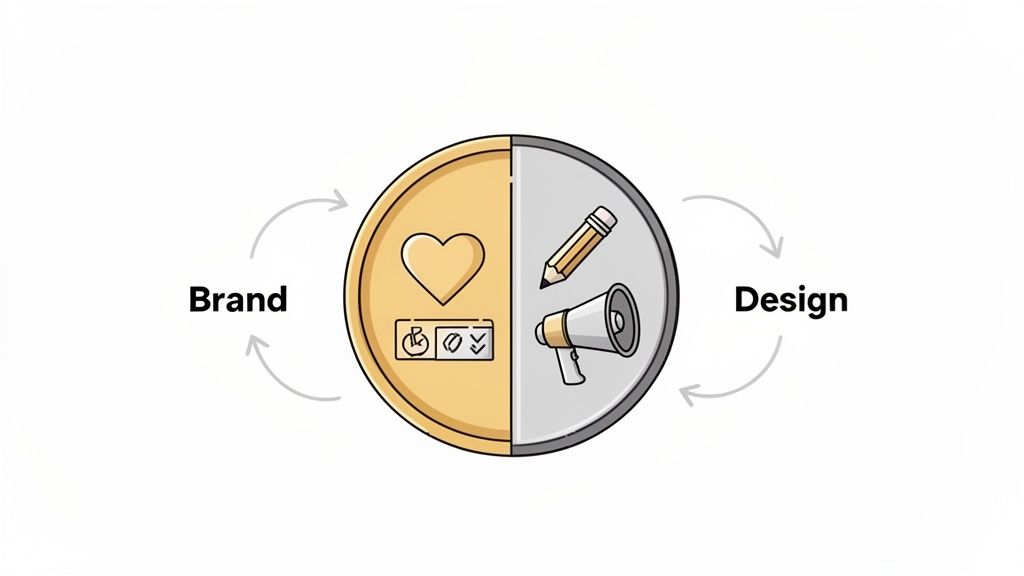
It's a common mistake to use the terms branding and design interchangeably. I see it all the time. But the truth is, they're two distinct, yet deeply connected, parts of a much larger strategy. Think of them as two sides of the same coin.
Branding is the why. It’s the soul of your company—your core identity, the promise you make to your customers, and the personality that shines through everything you do. Design, on the other hand, is the how. It’s the visual language that takes that identity and makes it real and tangible for your audience.
The Vital Relationship Between Branding and Design
Let's break it down with an analogy. Your brand is the very essence of your business. It's your mission, your core values, and the emotional gut feeling you want people to have when they think of you. It's the invisible stuff that builds trust and loyalty. Without a solid brand strategy, a business is just floating aimlessly.
Design is the physical body that gives that soul a presence in the real world. It turns all those abstract brand ideas into concrete experiences that people can see, touch, and hear.
This includes all the touchpoints your audience interacts with:
- Your logo: The most immediate symbol of your brand.
- Your website: Your digital front door, telling your story 24/7.
- Marketing materials: From social media posts to sales decks, they all need to speak the same brand language.
- Product packaging: The first physical handshake a customer has with your product.
Strategy Before Style
One of the biggest blunders a company can make is diving headfirst into designing a logo or a website without first locking down the brand strategy. That's like trying to build a house without a blueprint. Sure, you might end up with something that looks okay, but it won't have a solid foundation or a clear purpose. It simply won't resonate or last.
Effective design isn’t about making things pretty. It’s about making the brand’s strategy visible. Every color, font, and image should be a deliberate choice that reinforces who you are and what you stand for.
This is where the magic happens—when strategy and style align. A high-end watch brand will use clean lines, elegant fonts, and a muted color palette to signal luxury and precision. A brand making organic baby food will use soft, earthy colors and playful illustrations to convey nature and care.
These aren't random aesthetic choices; they are the direct visual expression of the brand's core strategy. When you truly grasp this connection, you can begin to shape what is brand perception and build a business that people remember and trust. It's this powerful synergy that turns a company into a household name.
Branding Is Your Strategic Foundation
It’s easy to think of branding as the fun, creative stuff—picking a logo, a slick color scheme, or a cool font. But that’s putting the cart way before the horse. Those visual elements are the tip of the iceberg; real branding is the massive, strategic foundation hidden beneath the surface.
At its core, branding is about defining who you are as a company. It’s the soul of your business. It answers the big, foundational questions: Why do we exist? What do we believe in? What promise are we making to our customers? Without clear answers here, your design is just decoration, lacking any real purpose or direction.
The Four Pillars of Your Brand Strategy
Think of building your brand like developing a character in a great story. For an audience to really connect with that character, they need to know what drives them, what they stand for, and what makes them tick. The same goes for your brand.
-
Mission Statement: This is your character’s purpose in the here and now. It’s a straightforward declaration of what you do, who you do it for, and your unique approach. A mission for a local bakery might be, "To create moments of joy for our community through handcrafted, artisanal pastries." It's practical and immediate.
-
Vision Statement: This is your character’s big dream—the ultimate destination. Your vision is aspirational. It paints a picture of the future you’re working to create and gives your whole team something to rally behind. It’s the North Star that guides you.
-
Core Values: These are the non-negotiable beliefs that guide every single action. Your core values are the heart of your company culture. Whether it’s radical honesty, relentless innovation, or a deep commitment to sustainability, these principles must be genuine and lived out every day.
-
Brand Personality: This is how your character shows up in the world. It’s their voice, their style, their vibe. Are you rugged and dependable like a pair of Timberland boots, or are you sleek and elegant like a Chanel perfume? Defining this makes your brand feel human and relatable.
Don't mistake this for a fluffy corporate exercise. This is a hard-nosed business asset. The collective value of the top 5,000 global brands recently jumped from $11 trillion to over $13 trillion—that's a growth of more than 20%. Strong brands drive serious financial results because they forge real connections. In fact, 76% of people say they'd rather buy from a brand they feel connected to. You can dig into more fascinating branding statistics on Digital Silk.
"A brand is the set of expectations, memories, stories and relationships that, taken together, account for a consumer’s decision to choose one product or service over another."
This quote nails it. The strategy comes first because you are intentionally building the memories and relationships that design will later bring to life.
Your Brand as a Strategic Blueprint
Once you’ve defined these pillars, they become your strategic blueprint. Suddenly, decisions get a whole lot clearer across the entire business.
Your mission guides your marketing campaigns. Your core values shape who you hire. Your brand personality dictates the tone of every email, social media post, and customer service call. It creates a consistent, predictable experience that builds trust over time.
When customers know exactly who you are and what you stand for—because you show them, again and again—they become loyal. This foundation doesn't just make your design work better; it makes it meaningful. It ensures every visual you create isn't just a pretty picture, but a true and powerful reflection of your brand's soul.
Design Gives Your Brand a Visual Voice
If your brand strategy is the soul of your business, then design is the body that gives it a physical presence in the world. It’s the hands-on, creative work that takes your brand’s abstract values and turns them into a visual system people can actually see, touch, and connect with. This is the moment your brand’s personality stops being an idea on a whiteboard and starts becoming a real experience.
Think about it: without design, your brand strategy is just an internal document. It's a collection of powerful ideas with no bridge to your audience. But great design ensures that every single visual touchpoint—from your website to your business cards—sends the right message instantly, long before a customer ever reads a single word.
Translating Brand Values into Visuals
Every design choice is a strategic one, and it needs to echo your brand's core personality. This isn't about chasing trends or picking colors you happen to like. It's about building a consistent visual language that reinforces who you are and what you stand for.
When done right, the combination of these elements creates an immediate, gut-level impression.
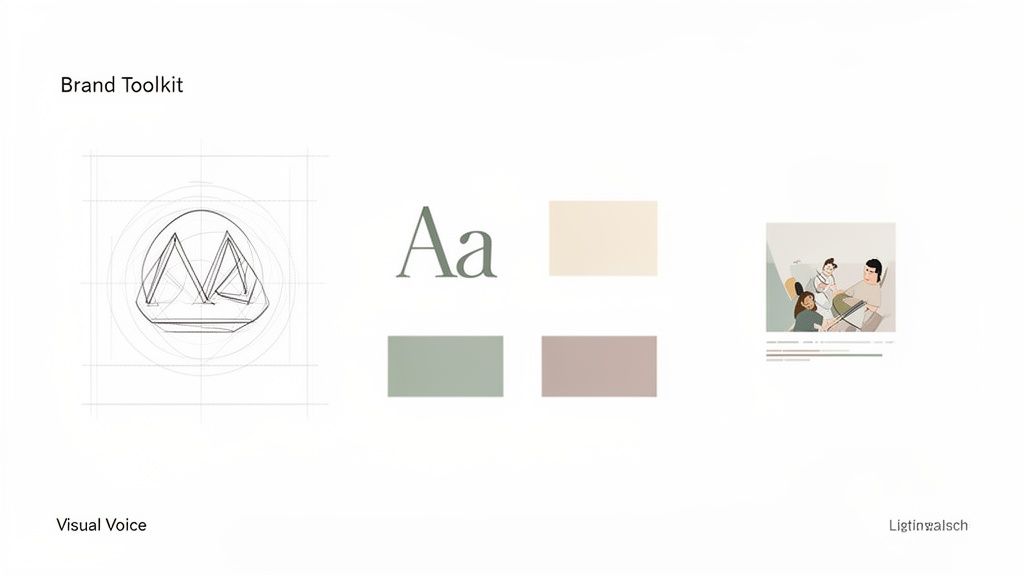
- Logo Creation: This is your brand's most compact and recognizable symbol. A tech startup might use a simple, geometric logo to signal modernity and efficiency. An artisan bakery, on the other hand, could use an intricate, hand-drawn logo to evoke a sense of tradition and craft.
- Typography: Believe it or not, fonts have personalities. A bold, sans-serif font like Helvetica feels strong and clear, making it a natural fit for a financial institution. A flowing script font feels personal and elegant, perfect for a wedding photographer's portfolio.
- Color Psychology: Colors trigger powerful, often subconscious, emotional responses. Blue is a classic for communicating trust and stability (which is why you see it everywhere in finance and tech), while green suggests health, nature, and growth. Your color palette sets your brand's emotional tone in a split second.
- Imagery: The photos, illustrations, and videos you use set the entire scene. A fitness brand will likely use dynamic, high-contrast images of athletes in motion, while a luxury travel company would lean into serene, aspirational landscapes that make you want to book a flight.
All of these pieces have to work together as a unified system. To see how they come together in practice, check out our guide to graphic design for branding.
Design Systems in Action
Let’s make this concrete. Imagine a direct-to-consumer coffee brand that built its strategy around authenticity, comfort, and sustainability. How would their design system bring that to life?
First, they might choose a logo with a handcrafted feel, maybe incorporating a subtle illustration of a coffee bean or a leaf. Their color palette would probably lean into warm, earthy tones—think deep browns, soft creams, and forest greens—to create a natural, comforting vibe. For their typography, they could pair a friendly, rounded serif font for headlines with a clean, readable sans-serif for body copy, striking a balance between warmth and clarity.
Finally, their website and social media feeds would be filled with photos of misty coffee farms and cozy morning rituals, steering clear of sterile, boring product shots.
This cohesive approach ensures every visual element is telling the same story, reinforcing that brand promise of comfort and authenticity at every single turn. Getting the visuals right is a huge part of the puzzle, and it works hand-in-hand with how people interact with your brand. A good starting point is understanding UX vs UI and how both disciplines contribute to a seamless brand experience.
"Great design is not just what it looks like and feels like. Great design is how it works."
This insight gets to the heart of it. Design's true power lies in its function. It’s the tool that makes your brand strategy accessible, understandable, and memorable for the people you want to reach. A well-designed visual identity doesn't just look pretty; it works hard to build recognition, foster trust, and make you stand out in a ridiculously crowded marketplace.
How Brand Strategy Guides Every Design Choice
This is where the rubber meets the road—connecting your big-picture brand strategy to the nitty-gritty of design execution. It's also where so many businesses get it wrong. They get a spark of inspiration for a new logo or a website refresh and dive headfirst into design, completely skipping the foundational work.
What you end up with is something that might look pretty but doesn’t mean anything. It’s a classic case of putting the cart before the horse, or in this case, picking out the throw pillows before you've even poured the foundation for the house. To build a brand that actually sticks, every single design choice has to flow directly from a crystal-clear strategy.
Let’s walk through how to make that happen. A structured process turns design from a subjective free-for-all into a powerful business tool. It ensures every color, font, and photo has a job to do, all working together to create a brand that people instantly recognize and trust.
The Brand Discovery and Strategy Workflow
The journey from a vague idea in your head to a living, breathing visual identity follows a very deliberate path. It all starts with some serious soul-searching and collaborative workshops—long before anyone opens up Figma or Adobe Illustrator. This groundwork is absolutely non-negotiable if you want to build a brand with substance.
Here's what that process usually looks like:
-
Brand Discovery Workshops: This is square one. You get all the key players in a room—from the C-suite to the marketing team—and you dig deep. The whole point is to unearth the brand’s true purpose, its core values, its personality, and exactly who you're trying to talk to.
-
Competitive Analysis: You can't stand out if you don't know what you're standing against. This step is all about scoping out the competition. What do their brands look and feel like? What visual territory are they owning? This analysis helps you spot the gaps and find your own unique space to play in.
-
Strategy Formulation: All those juicy insights from discovery and analysis get boiled down into a formal brand strategy document. Think of this as your brand’s constitution. It lays out your mission, vision, values, brand voice, and messaging pillars that will guide every decision from here on out.
Strategy must always come before style. A beautiful design that communicates the wrong message is a failure. An effective design, however simple, that perfectly communicates the brand's core strategy is a success.
Laying this strategic foundation means that when it’s time to design, you aren't just throwing things at the wall to see what sticks. Instead, you're making creative choices guided by a clear set of principles, which makes the final result infinitely more powerful and aligned with your actual business goals.
From Strategy to a Visual Identity Guide
Once your strategy is locked in, the next move is to translate all that thinking into a tangible visual identity system. This is where designers take the strategic blueprint and give it a face. The end result? A comprehensive brand style guide.
This guide is your single source of truth for everything visual. It’s the playbook that ensures total consistency across every single place your brand shows up, whether it’s a quick Instagram post, a major sales deck, or your website’s homepage.
A solid visual identity guide will always cover:
- Logo Usage Rules: Crystal-clear instructions on how the logo should (and should not) be used. This includes minimum sizes, clear space requirements, and approved variations for different backgrounds.
- Color Palette: The official primary and secondary colors, complete with their specific values (HEX, RGB, CMYK) so they look the same everywhere.
- Typography System: The specific fonts for headlines, body copy, and captions, along with rules for size and hierarchy to keep everything readable and on-brand.
- Imagery Style: Guidelines for photography and illustration that fit the brand’s personality. Are you going for energetic and bold, or something more calm and minimalist?
- Brand Voice and Tone: While not purely visual, this is crucial. It tells copywriters how to write in a way that sounds like the brand, ensuring the words and the visuals are telling the same story.
To make the distinction even clearer, think of the process as two distinct phases with different goals.
Branding Strategy vs Design Execution
| Phase | Core Question | Key Activities | Primary Output |
|---|---|---|---|
| Branding Strategy | Who are we and why do we matter? | Workshops, research, competitive analysis, stakeholder interviews. | A Brand Strategy Document (mission, vision, values, positioning, voice). |
| Design Execution | How do we express who we are visually? | Logo design, color palette development, typography selection, style exploration. | A Brand Style Guide (logo usage, colors, fonts, imagery style). |
This table neatly separates the "why" from the "what." Strategy is about defining your identity; design is about expressing it.
Ultimately, a brand style guide empowers your entire organization—and any freelancers or agencies you work with—to apply the brand correctly every single time. And that consistency is what builds trust and recognition with your audience. It’s the secret sauce that makes a brand feel cohesive and reliable.
The Business Impact of Cohesive Design
Let's get one thing straight: investing in cohesive branding and design is far more than just a facelift. It’s a strategic play that hits the bottom line, hard. When every touchpoint—from your website to your packaging—presents a consistent and professional face, you start building the most valuable asset in business: trust.
Trust is what turns a one-time buyer into a lifelong fan. A predictable, high-quality experience every time someone interacts with your brand makes them feel secure. This consistency quietly signals reliability, making them choose you over a competitor and stick around for the long haul.
Standing Out in a Crowded Market
In a marketplace overflowing with noise, a well-defined brand carves out a space that is uniquely yours. Differentiation isn't just a buzzword; it's a survival tactic. Cohesive design acts as your flag, instantly communicating who you are, what you stand for, and why you’re the only real choice.
This clarity doesn't just help you connect with your ideal audience; it gives you the leverage to command a premium. When customers perceive your brand as higher quality and more trustworthy, they’re often happy to pay more for what you offer.
The ripple effects of strong branding and design don’t stop with customers, either. A clear and inspiring brand mission energizes your internal team, giving them a shared purpose to rally around. It cultivates a stronger company culture and makes your organization a magnet for top talent.
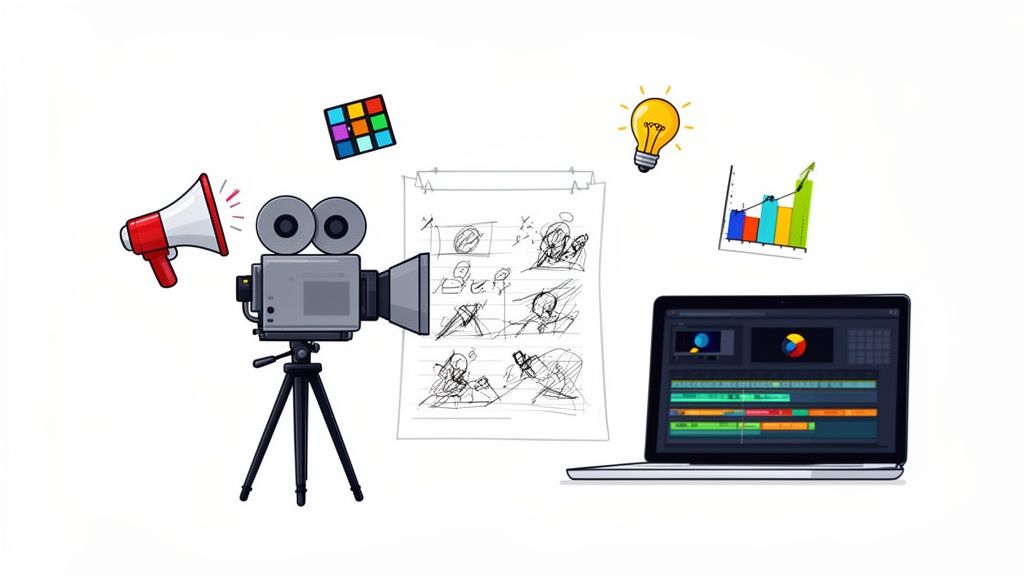
The image below breaks down the typical workflow, showing how this kind of strategic thinking is translated into tangible, impactful design.
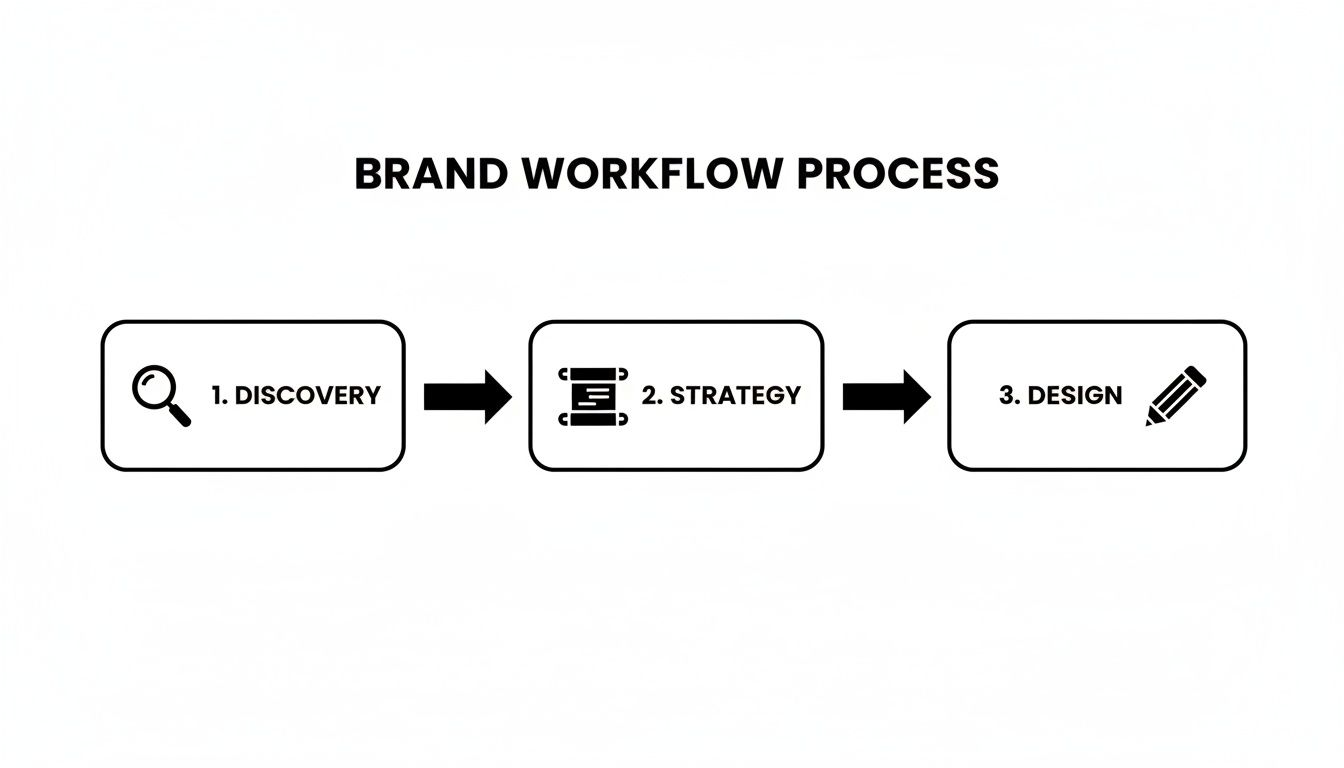
As you can see, this isn't about guesswork. It’s a methodical process that ensures every design element is rooted in a solid strategic foundation, moving from discovery to design with purpose.
Measuring the Tangible Returns
The connection between a strong brand and a healthy balance sheet isn't just a theory—it’s backed by cold, hard data. Companies that put real effort into their brand see measurable returns that can completely redefine their place in the market.
A powerful brand is a significant business asset. It generates demand, secures future earnings, and creates a lasting connection with the people who matter most to your success.
Just look at NVIDIA. Their brand value skyrocketed by an astonishing 116%, marking the largest single surge in the 25-year history of Interbrand's Best Global Brands report. That’s the kind of power that reshapes an entire industry. The benefits are felt across the board, too, with top retail brands seeing a 42% value increase and media brands growing by 34%.
But what's the secret sauce? It’s connection. A staggering 38.7% of brand lift comes directly from recall, which kicks in after just 5 to 7 consistent impressions. You can dig into more data on how leading companies are pulling this off over at The Branding Journal.
The evidence is undeniable. Branding and design are not just line items on a budget; they are powerful engines for growth. They build equity, foster loyalty, and deliver a serious return on investment. When you start treating your brand as a core business asset, you're not just designing a logo—you're building a legacy.
Your Action Plan for Better Branding and Design
Knowing the theory is one thing, but getting results is all about execution. Now it’s time to take what we've discussed about branding and design and put it to work for your business. This section is your roadmap—a clear, step-by-step guide to building or sharpening your brand with intention.
Think of this as your toolkit for implementation. We’ll kick things off by looking inward with a brand audit, then we'll nail down your strategy, and finally, we'll turn all of that into a practical guide your whole team can actually use. Remember, building a strong brand is a marathon, not a sprint. Let's get started.
Start with a Brand Audit
Before you can figure out where you're headed, you have to be brutally honest about where you are right now. A brand audit is simply a deep-dive into your brand's current standing, both in the market and in the minds of your customers.
This means gathering feedback and taking a hard look at all your existing materials to spot what's working, what's falling flat, and where you're sending mixed signals. It’s the foundational step that gives you the clarity to make smart decisions instead of just guessing.
Here’s a simple checklist to get you going:
- Review Your Visuals: Pull together everything you’ve got—logos, marketing collateral, social media pages, your website. Do they all look like they came from the same company? Do they feel like your brand?
- Analyze Your Messaging: Read your website copy, old blog posts, and recent ads. Is your voice consistent? Are you clearly communicating what makes you different and what you stand for?
- Survey Your Customers: Go straight to the source and ask your customers what they think. What words come to mind when they think of you? How do they see you compared to the competition?
- Evaluate Your Market Position: Take an objective look at your competitors. How does your branding and design measure up? Where are the gaps you can own?
This audit will give you a baseline for your brand's health. It shines a light on your strengths, your weaknesses, and the biggest opportunities waiting for you.
Define Your Core Strategy
Once your audit is done, you're ready to build a real strategy. This is where you formalize your brand’s purpose, values, and personality. Get your team in a room and hammer out the answers to these core questions.
- Why do we exist? (Your Mission)
- What future do we want to create? (Your Vision)
- What principles guide our actions? (Your Core Values)
- If our brand were a person, what would they be like? (Your Brand Personality)
Your brand strategy is your compass. It ensures every decision—from product development to marketing campaigns—is aligned with your core identity, creating a cohesive and authentic experience for your audience.
Create a Practical Brand Style Guide
Finally, you have to translate your high-level strategy into a practical tool people can use every single day. That tool is a brand style guide. It’s the official rulebook that keeps everyone on the same page, ensuring consistency everywhere your brand shows up.
To make sure your action plan is solid, using an essential brand guidelines template is a huge help for maintaining consistency. Your guide needs to be thorough but simple enough for anyone to follow, empowering everyone from designers to marketers to represent the brand correctly.
If you want to dive deeper, you can learn how to create brand guidelines in our dedicated article. This is how you stop reacting and start intentionally shaping your company's future.
Got Questions About Branding and Design? We’ve Got Answers.
Even with the best plans in place, you're bound to run into questions when you start digging into branding and design. It’s totally normal. Think of this section as a quick-reference guide to help you tackle the most common hurdles with confidence.
We'll cover everything from figuring out a realistic budget to what a redesign timeline actually looks like, giving you the straightforward answers you need to move forward.
How Much Should We Really Budget for Branding?
There’s no one-size-fits-all answer here, but for most small businesses, a realistic starting budget for a solid branding project is somewhere between $2,500 and $15,000. This ballpark figure usually gets you the essentials: a proper brand strategy session, a professional logo, and a basic style guide to keep things consistent.
Of course, the final number really comes down to what you need. A simple logo update will land on the lower end of that scale. But if you’re looking at a full-blown rebrand—complete with a new website, all new marketing materials, and deep customer research—you'll be at the higher end, or even beyond. The key is to stop thinking of it as a cost and start seeing it as an investment in your company's future.
Good branding isn’t just an expense; it’s an asset that grows in value. Investing properly now saves you from expensive, confusing rebrands later and pays off in customer trust and a stronger position in the market.
What’s the Real Difference Between a Brand and a Visual Identity?
This is a mix-up we see all the time. Let’s clear it up with a simple analogy. Your brand is your company’s personality—it's the whole vibe, your reputation, and the gut feeling people have when they think of you. It’s the why you do what you do.
Your visual identity, on the other hand, is the outfit your brand wears. It’s the collection of all the tangible things people see that represent your personality. This includes your:
- Logo
- Color palette
- Fonts (typography)
- Photography and illustration style
So, your visual identity is the look that helps people recognize your brand instantly. It's a hugely important piece of your brand, but it’s not the whole story.
How Long Does a Rebrand Actually Take?
A true rebranding project isn't something you can knock out over a weekend. For most small and medium-sized businesses, you should plan for a timeline of about three to six months. That might sound like a lot, but it gives everyone the time needed to dig deep into the strategy, explore creative ideas without rushing, and roll everything out smoothly.
Here’s a rough breakdown of how that time is spent:
- Discovery & Strategy (4-6 weeks): This is the foundation. It involves workshops, market research, and a hard look at your competitors.
- Visual Identity Design (6-8 weeks): Now the creative work begins. This is where concepts for the logo, colors, and fonts are developed and polished.
- Asset Creation & Rollout (4-8 weeks): Finally, the new identity is applied to everything from your website and social media profiles to your business cards.
Trying to cram this into a shorter timeline almost always leads to a paint job, not a real solution. Taking a measured, strategic approach ensures the final result isn't just pretty—it's built to last.
Ready to build a brand that truly connects with people and drives results? The team at ReachLabs.ai blends sharp, data-backed strategy with world-class design to create brands that make a real impact. Let's build something unforgettable. https://www.reachlabs.ai