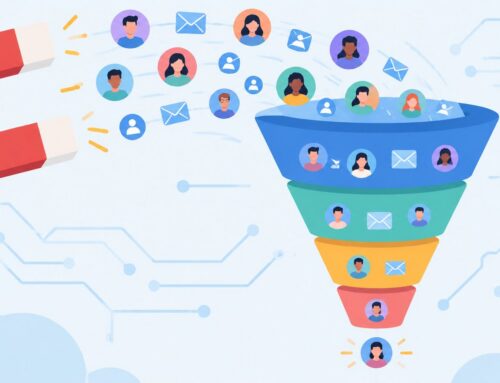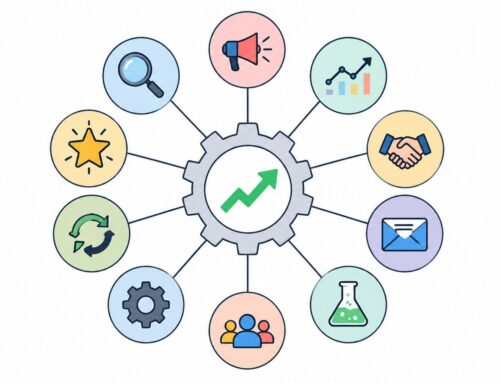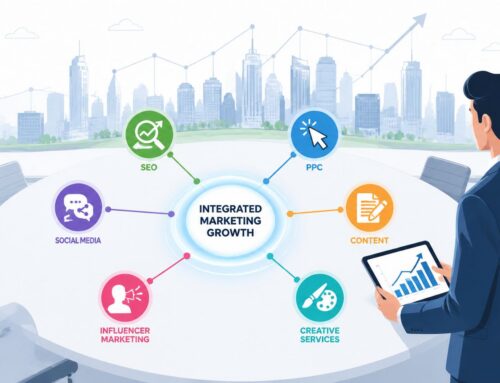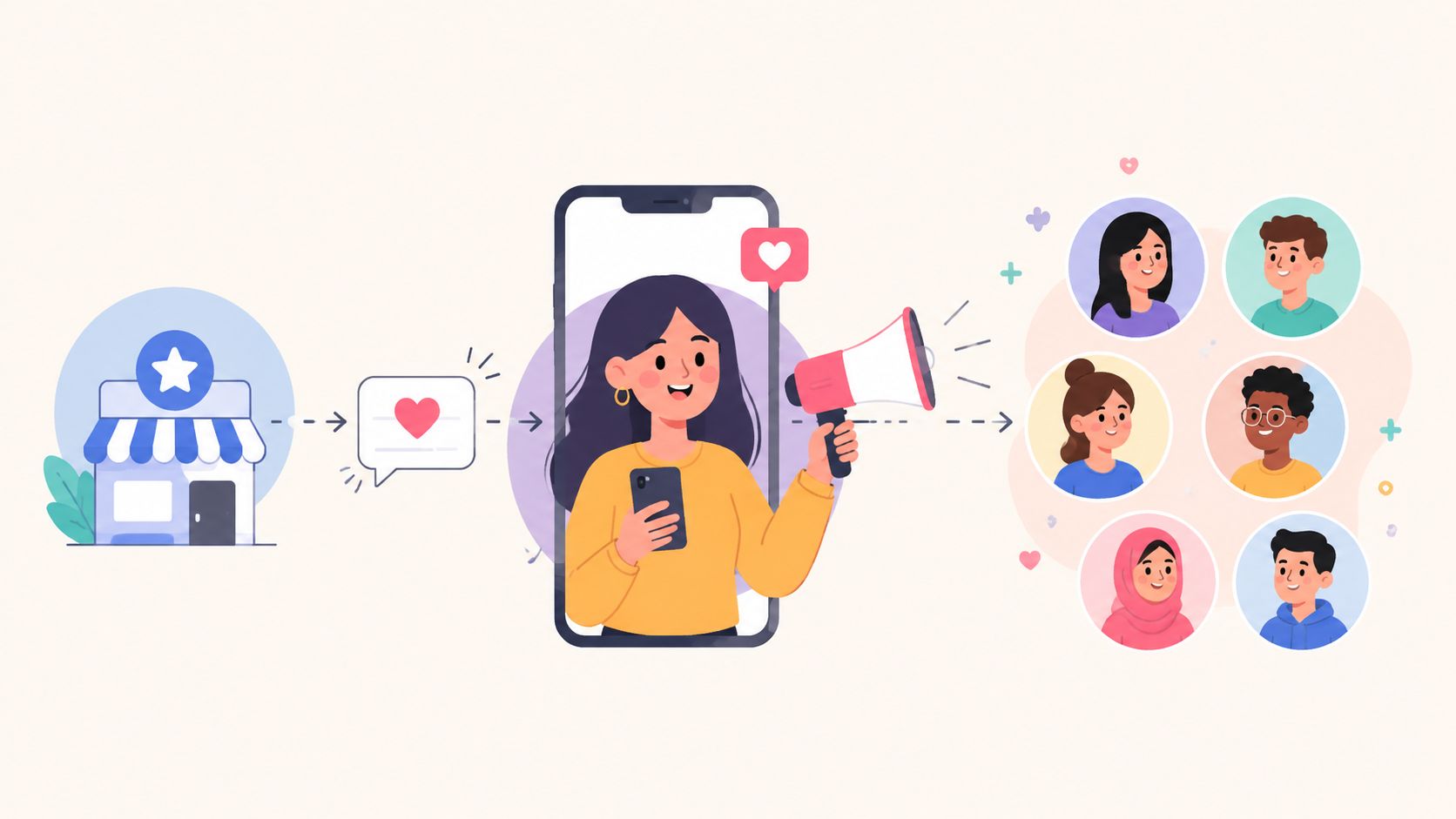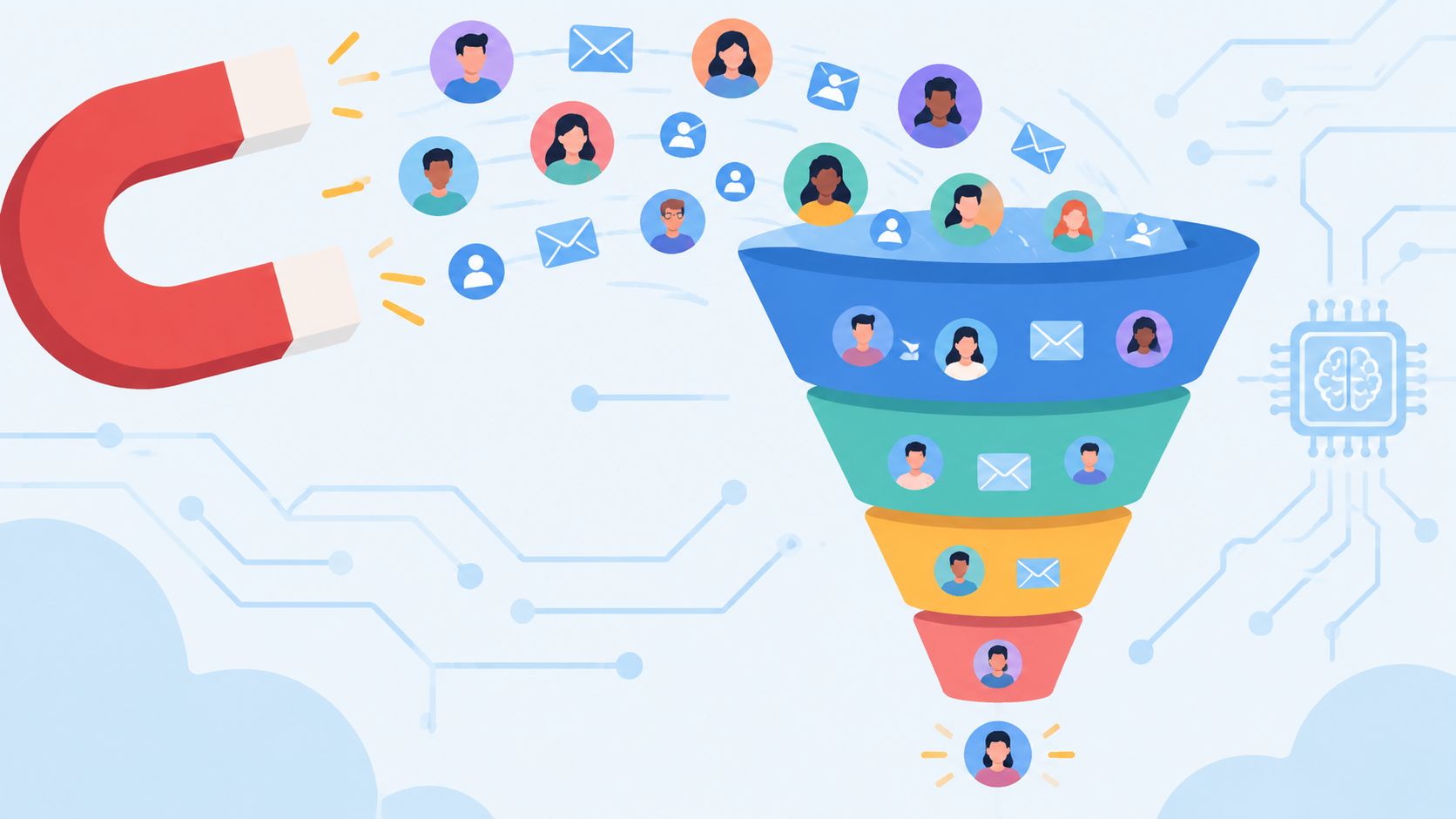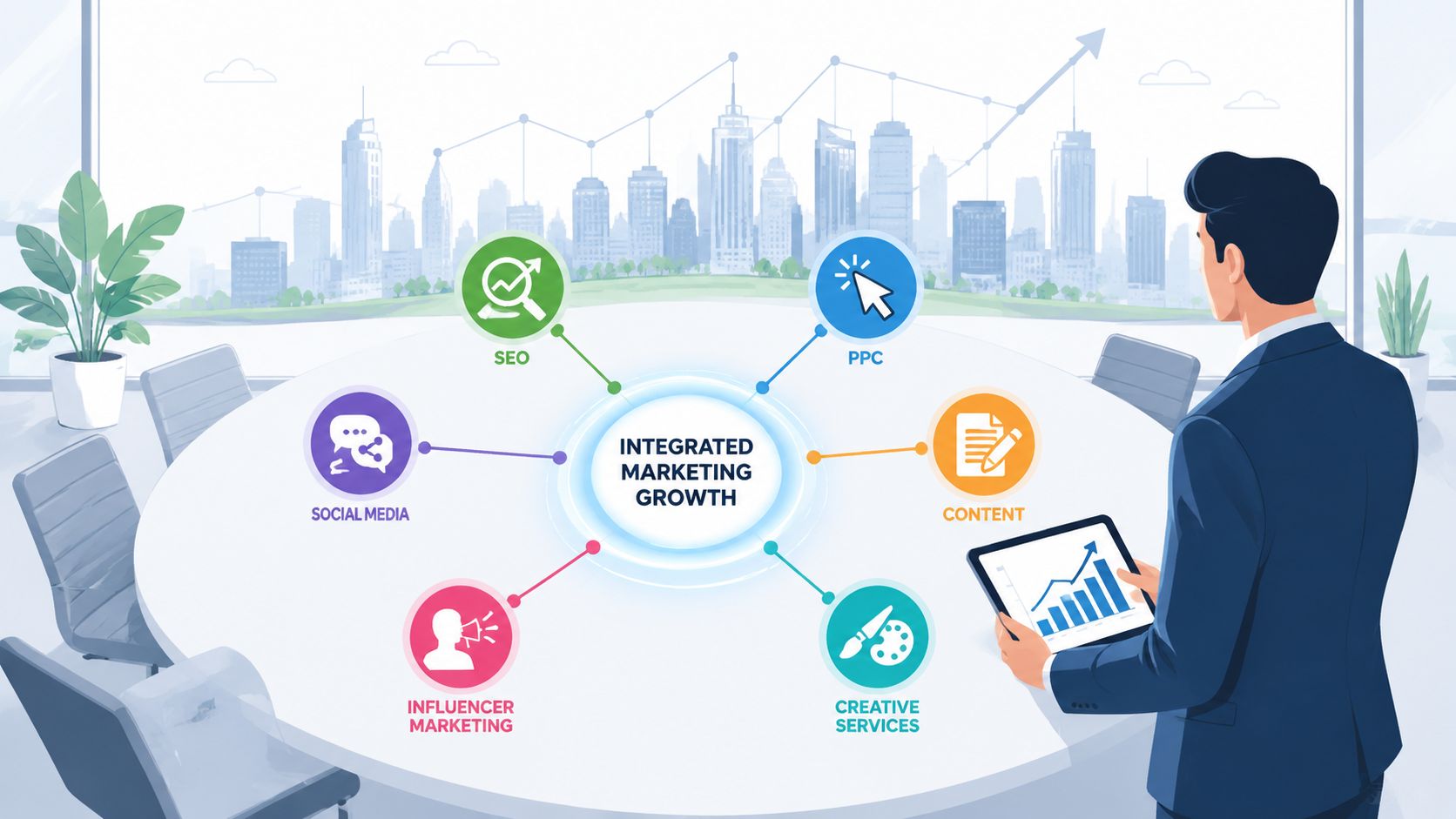

At its core, audience segmentation is simply the practice of splitting your large, diverse market into smaller, more defined groups of people who share similar traits. Instead of shouting one message at everyone, you get to have focused, personal conversations that actually resonate with each cluster of customers.
Why Speaking to Everyone Means Connecting with No One
Picture yourself in a crowded stadium trying to sell a high-end skincare line. If you just yell, "Great skincare for everyone!" through a megaphone, you'll be met with a wall of indifference. Why? Because the message is too broad to matter to anyone specifically. The teenager battling acne, the 30-something with dry skin, and the retiree looking for an anti-aging cream all have completely different problems.
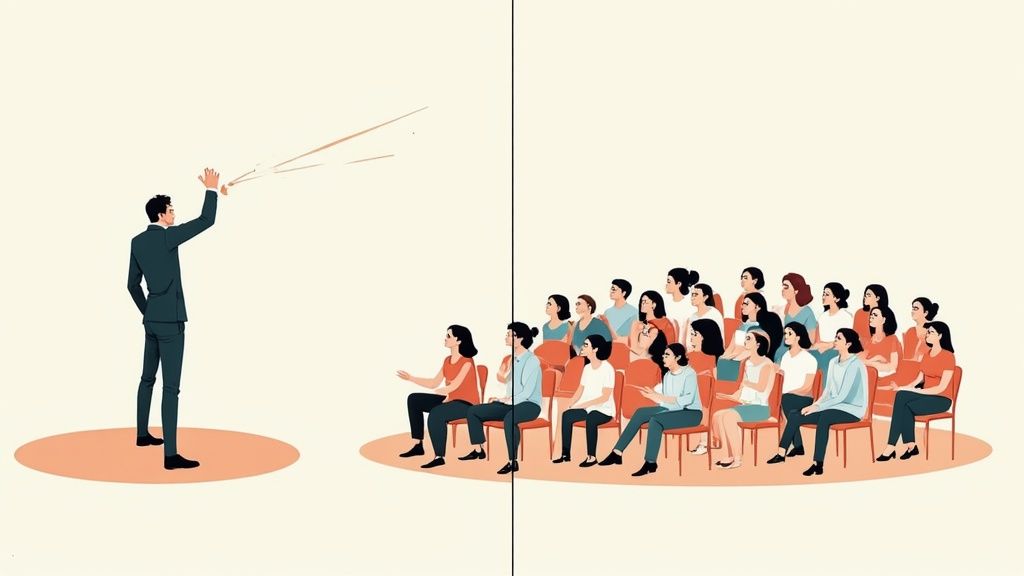
Now, imagine pulling each group aside for a targeted chat. You could talk to the teens about clearing up blemishes, approach the adults about deep hydration, and discuss reducing fine lines with the seniors. That’s exactly what audience segmentation does for your marketing—it turns a loud, ineffective broadcast into a series of meaningful conversations. For a solid overview of the mechanics, OKZest has a helpful guide on What Is Audience Segmentation and How Does It Work?.
The Power of Precision Marketing
Let's be honest: the "one-size-fits-all" marketing model is dead. Today’s customers don't just want personalization; they expect it. They want to feel like you get them, not that you're just another company trying to sell them something. Treating everyone the same creates vague messaging that connects with no one.
This generic approach causes some serious problems:
- Wasted Resources: You end up spending a chunk of your marketing budget on people who will never buy from you.
- Lower Engagement: Your content gets ignored because it isn’t relevant, resulting in dismal click-through rates and conversions.
- Weak Brand Loyalty: Why would someone feel a connection to a brand that doesn’t seem to understand their specific needs or goals?
Turning Data into Meaningful Connections
The numbers don't lie. Research shows 81% of consumers are more likely to make a purchase from brands that provide personalized experiences. Even more telling, targeted email campaigns can boost revenue by an incredible 760%, and a full 77% of marketing ROI is generated from segmented, targeted efforts.
The table below breaks down the core differences between a segmented strategy and old-school mass marketing.
Audience Segmentation vs Mass Marketing at a Glance
| Benefit Area | Impact of Segmentation | Limitation of Mass Marketing |
|---|---|---|
| Customer Connection | Creates relevant, personal experiences that build loyalty. | Uses generic messaging that often feels impersonal. |
| Marketing ROI | Maximizes budget by focusing on high-potential groups. | Wastes resources on uninterested audiences. |
| Engagement Rates | Drives higher clicks, opens, and conversions. | Results in low engagement and poor campaign performance. |
| Product Development | Provides clear insights to create products people actually want. | Offers vague feedback, making innovation difficult. |
This stark contrast highlights why segmentation isn't just a "nice-to-have" anymore; it's a fundamental part of a successful business strategy.
By grouping your audience, you can craft messages, offers, and products that align perfectly with the needs of each specific cluster. This not only improves campaign performance but also builds lasting customer relationships based on trust and relevance.
Of course, all of this starts with a crucial first step: you need to know who you're talking to in the first place. Before you can split your market into effective segments, you have to understand how to identify target audience profiles. This foundational work is what makes your entire segmentation strategy click into place.
The Four Pillars of Customer Segmentation
If you want to truly grasp audience segmentation, it helps to think of it like building a detailed profile of your customer from four different but connected angles. These four pillars—Demographic, Geographic, Psychographic, and Behavioral—are the foundation for seeing your audience not as a faceless crowd, but as distinct groups of real people. Getting past surface-level data means you have to master these core ideas first.

Each pillar answers a fundamental question about your customers. By layering these insights, you can build a rich, multidimensional picture that sharpens every marketing decision you make.
Demographic Segmentation: The Who
Demographics are usually the first stop on the segmentation journey, and for good reason—they're straightforward and easy to understand. This pillar sorts your audience by objective, statistical data. Think of it as the "who" in your customer base.
These are the quantifiable facts about people, and they’re often the easiest to collect. They give you a solid baseline for who you're talking to.
Common demographic variables include:
- Age: Are you marketing to Gen Z, Millennials, or Baby Boomers?
- Gender: Does your product naturally appeal more to men, women, or everyone?
- Income Level: Are your customers high-earners, budget-conscious, or somewhere in the middle?
- Education: What’s the typical educational background of your ideal customer?
- Occupation: Do they work in tech, healthcare, creative fields, or skilled trades?
A luxury car brand, for instance, would zero in on people with a high income level in a specific age bracket, like 35-65, because that’s the group with the financial means to make that kind of purchase.
Geographic Segmentation: The Where
Next up is geographic segmentation, which simply answers the question, "Where are my customers?" This method groups people based on their physical location, from a continent-wide view all the way down to a specific neighborhood.
Where someone lives often has a huge impact on their needs, culture, and buying habits. It can dictate everything from their lifestyle to the language they speak.
Geographic data is critical because what a customer needs can change dramatically from one place to another. A company selling heavy winter coats will have a much easier time in Toronto than in Miami.
Key geographic segments include:
- Country or Region: Targeting based on national or continental borders.
- City or ZIP Code: Focusing on urban, suburban, or rural areas.
- Climate: Segmenting based on typical weather patterns (e.g., tropical, four-season, arid).
- Population Density: Differentiating between bustling cities and quiet rural communities.
This approach is a no-brainer for businesses with physical stores or for products that are tied to the climate.
Psychographic Segmentation: The Why
Demographics and geographics tell you who and where your customers are, but psychographics get to the heart of it: why they do what they do. This pillar is all about your audience's internal world—their personalities, values, interests, and lifestyles.
This is where you uncover the real motivations behind a purchase. Two people can have the exact same demographic profile and live in the same city but have completely different buying habits because their values and interests are miles apart.
Common psychographic data points include:
- Lifestyle: Hobbies and interests (e.g., fitness fanatic, avid traveler, homebody).
- Values and Beliefs: The core principles that guide their life choices (e.g., sustainability, family).
- Personality Traits: Are they adventurous, analytical, or outgoing?
- Social Status: How they see themselves in their social circle.
Take an outdoor gear company like Patagonia. They don't just target people who live near mountains (geographic). They connect with people who value environmental conservation and live an active, adventurous lifestyle (psychographic). That "why" creates a bond that goes way beyond a simple transaction.
Behavioral Segmentation: The How
Finally, behavioral segmentation looks at how customers act—their direct interactions with your brand. This pillar answers the question, "How do my customers behave?" In the world of digital marketing, this is arguably the most powerful pillar because it's based on tangible actions you can track, not just educated guesses.
When you analyze behavior, you can tailor your messaging based on exactly where a user is in their journey with you. It’s all about clear signals of interest and engagement.
Here are some key behavioral segments:
- Purchase History: What have they bought? How often do they buy? What’s their average order value?
- Brand Engagement: Do they open your emails, follow you on social media, or read your blog?
- Website Activity: Which pages do they visit? How long do they stay? Did they ditch their shopping cart?
- Product Usage: How often do they use your product? Which features are their favorites?
A classic example is an e-commerce store that automatically sends a discount code to customers who abandon their shopping carts. That’s a direct response to a specific behavior, designed to gently nudge them over the finish line. Together, these four pillars give you a complete framework for understanding and connecting with your audience on a much deeper level.
Going Deeper: Advanced Segmentation Models
Once you've mastered the fundamentals, it's time to start layering your data. Think of the basic segmentation types as your primary colors. Advanced models are how you start mixing them to create incredibly specific shades that match your goals perfectly.
These models move beyond the basic "who" and "where" to give you a much sharper picture, especially when you're navigating the complexities of B2B sales or e-commerce. You're no longer just identifying broad groups; you're pinpointing hyper-specific audiences with clear, actionable needs.
Firmographic Segmentation: The B2B Playbook
If you sell to other businesses, demographics alone won't cut it. You need firmographics—the B2B equivalent of demographics. This model groups organizations based on company-level traits, helping you answer the most important question: which companies are actually a good fit for us?
Instead of looking at a person's age or location, you're analyzing an organization's profile. This lets you stop wasting time on poor-fit leads and focus your sales and marketing efforts where they'll have the biggest impact.
Key firmographic variables include:
- Industry: A cybersecurity firm has entirely different problems to solve than a local bakery.
- Company Size: This can be measured by employee count or annual revenue. A 10-person startup has different needs and a different buying process than a 10,000-employee enterprise.
- Geographic Location: Crucial for managing sales territories, navigating regional compliance, or planning local marketing campaigns.
- Company Structure: Is it a publicly-traded corporation, a lean private company, or a non-profit organization?
Let's say you sell project management software. Using firmographics, you could build a segment for "mid-sized tech companies (50-250 employees) in North America." Suddenly, your messaging can speak directly to the scaling pains and collaborative hurdles you know that specific type of business is facing.
Technographic Segmentation: The Tech Stack Tells a Story
In today's market, the technology a company uses is a massive clue to its priorities, challenges, and operational maturity. Technographic segmentation groups prospects and customers based on their technology stack.
Knowing a company's tech stack is like knowing the language they speak. If you see they use Salesforce, you can approach them with an integration-ready solution. Your pitch is instantly more relevant and compelling because you're already part of their world.
This model is a game-changer for SaaS companies, IT service providers, and anyone whose product needs to play nice with other systems. It helps you find perfect-fit opportunities and, just as importantly, disqualify leads that would be a technical nightmare.
Common technographic data points include:
- CRM software (e.g., Salesforce, HubSpot)
- Marketing automation platforms (e.g., Marketo, Mailchimp)
- Cloud providers (e.g., AWS, Microsoft Azure)
- Programming languages or specific frameworks
Imagine you sell an analytics tool that integrates seamlessly with HubSpot. Technographics let you find every company that uses HubSpot but doesn't have a dedicated analytics tool. Your outreach becomes laser-focused: "Supercharge Your HubSpot Data." That's a message that gets opened.
RFM Analysis: Finding Your VIP Customers
For any business with repeat customers, especially in e-commerce, not all buyers are created equal. The RFM model is a simple but powerful way to identify your best customers by looking at their buying behavior.
RFM stands for:
- Recency: How recently did they buy from you?
- Frequency: How often do they come back?
- Monetary Value: How much have they spent overall?
By scoring customers on these three factors, you can sort them into meaningful groups. You'll find your "Champions" (high on all three), your "At-Risk Customers" (bought a lot, but not recently), and your "Newbies" (recent, but low frequency and monetary).
This allows you to stop one-size-fits-all marketing. Your "Champions" could get VIP access to new products. Your "At-Risk" group might get a personalized "We miss you!" offer. It's a data-driven way to make sure you're giving the right people the right attention.
How to Build Your Audience Segments Step by Step
Knowing the theory behind segmentation models is one thing, but putting them to work is where you really start seeing results. Building great audience segments isn't just about crunching numbers; it's about turning all that customer data into a real strategic advantage. This is how you transform abstract information into tangible groups you can connect with.
Let’s walk through the practical steps to make this happen, from setting your goals to seeing the impact.
Start with Clear Objectives
Before you even think about opening a spreadsheet, you need to answer a simple but critical question: What are you trying to achieve? Without a clear goal, your segmentation efforts will be rudderless. This initial objective shapes every single decision you make down the line.
Your goals could be anything from boosting customer retention and increasing average order value to simply getting higher-quality leads.
- Want to increase loyalty? You could build a segment of "at-risk" customers who haven't made a purchase in a while and need a gentle nudge.
- Launching a new feature? Your goal would be to pinpoint a segment of "power users" who will likely jump on it and give you priceless feedback.
- Need to improve conversion rates? You might segment website visitors who abandon their shopping carts and send them a targeted follow-up.
Defining your objective first makes sure every step you take is purposeful and tied to a concrete business outcome.
Gather and Consolidate Your Data
Once your goal is set, it's time to gather your raw materials: customer data. These insights are scattered across all the different places your customers interact with you. The trick is to pull it all together into one cohesive picture.
The tools that make this possible are part of the global audience analytics market, which was valued at USD 5.0 billion and is projected to hit USD 9.96 billion by 2030. That explosive growth shows just how essential data-driven strategies have become. You can dive deeper into these trends in the full audience analytics market report.
Here are the key places to look for data:
- Your CRM: This is a goldmine of demographic, firmographic, and transaction history.
- Website & App Analytics: Tools like Google Analytics or Matomo are packed with behavioral data—what pages people visit, how long they stick around, and the actions they take.
- Customer Surveys & Feedback: Sometimes, the best way to get psychographic data is to just ask. Direct feedback on needs, preferences, and pain points is invaluable.
- Social Media Analytics: These platforms give you a window into audience interests, how they engage, and what they think about your brand.
Getting all this information into a single view is the only way to spot the meaningful patterns hidden within.
Analyze Data and Identify Segments
With all your data in one place, you can start connecting the dots. Look for the common threads that tie different groups of customers together. Do people from a certain industry engage more with your blog posts? Do customers in a specific region consistently buy one product over another?
This part of the process is a mix of detective work and data science. You’re hunting for significant overlaps and clear distinctions that let you sort individuals into logical groups that actually make sense for your business.
This is where you can start layering different data types—like firmographic, technographic, and RFM—to build more sophisticated and useful segments.
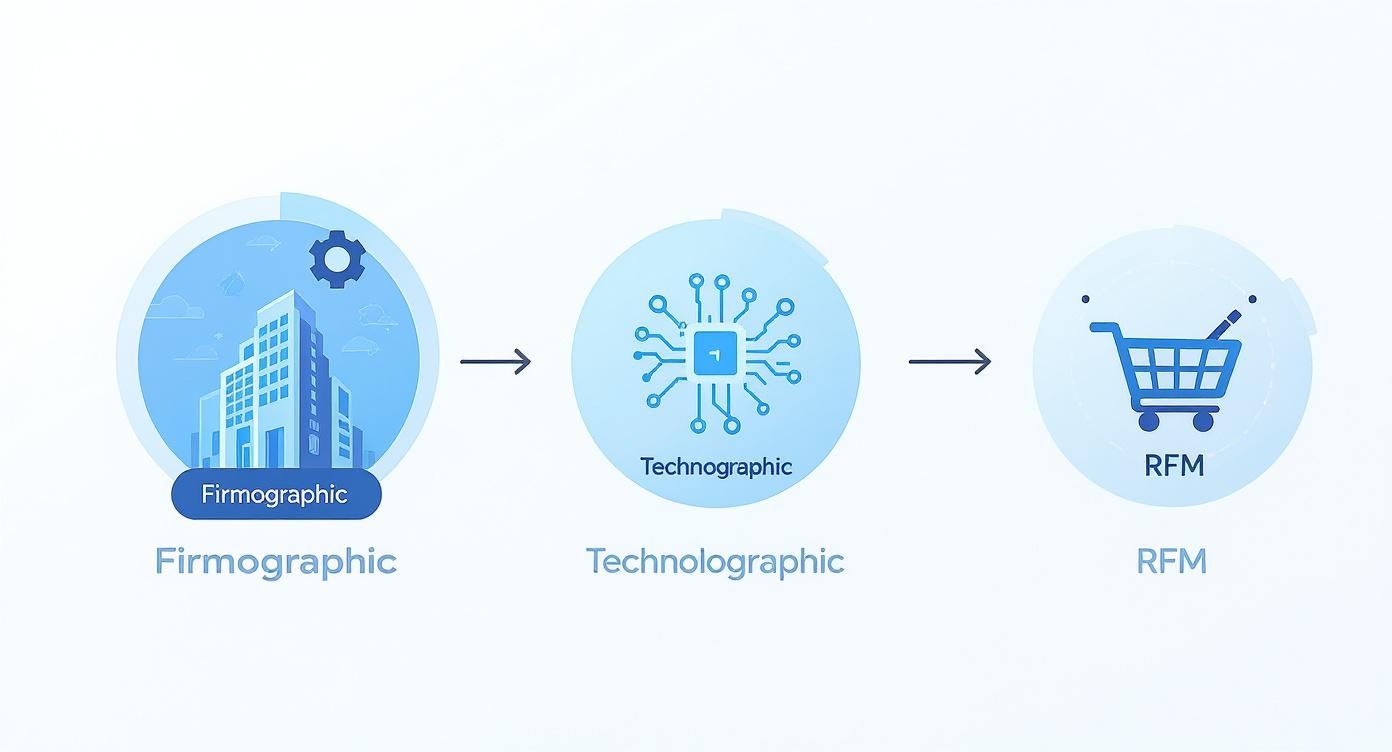
Starting with basic company data and moving toward specific user actions is how you achieve a much deeper, more actionable understanding of your customers.
Develop Personas and Activate Segments
Once you've identified your key segments, it's time to bring them to life with detailed customer personas. Think of a persona as a semi-fictional character that represents a whole segment, complete with a name, goals, challenges, and what makes them tick. This simple step makes abstract data feel real and helps your entire team connect with the people they’re trying to reach.
For more on this, check out our guide on how to create buyer personas.
With clear personas in hand, you’re ready to activate your segments. This is the fun part—developing and launching marketing campaigns that are specifically designed for each group’s unique needs.
Measure, Test, and Refine
Audience segmentation isn’t a "set it and forget it" task. It’s a living, breathing process of launching, measuring, and tweaking your approach. To know if your strategy is working, you have to track the right KPIs.
Key metrics to keep an eye on include:
- Conversion Rate: Are your targeted campaigns actually outperforming your generic ones?
- Customer Lifetime Value (CLV): Are your high-value segments spending more with you over time?
- Engagement Metrics: Are email open rates, click-throughs, and social interactions going up for specific segments?
- Churn Rate: Are you successfully reducing churn among your "at-risk" segments?
Use this data to fine-tune your segments. Customer behavior is always changing, and your segmentation strategy needs to be flexible enough to keep up. Keep testing new messages, offers, and channels to find what truly resonates with each group.
How AI Is Revolutionizing Audience Segmentation
While traditional segmentation has been a reliable marketing tool for years, the game is changing fast. Artificial Intelligence and machine learning are stepping in, not just to refine old methods but to completely reinvent them. We're now capable of a level of precision and speed that was pure science fiction just a decade ago.
Instead of working with static, manually defined segments, AI algorithms constantly dig through massive amounts of data in real-time. They find subtle patterns and connections in customer behavior—the kind of insights a human analyst could easily miss. The result? Dynamic, living segments that update themselves as new information flows in.
Predictive Segmentation and Hyper-Personalization
One of the biggest leaps forward is predictive segmentation. AI doesn’t just tell you what your customers did; it predicts what they’re likely to do next. By analyzing past purchases, browsing habits, and current interactions, these algorithms can forecast future needs and pinpoint who is most likely to buy, or even who might be about to leave.
This predictive muscle is what powers true hyper-personalization at scale.
- Anticipating Needs: An AI might see a customer looking at winter coats and proactively recommend matching gloves and scarves, often before they've even thought to search.
- Preventing Churn: The system can flag a long-time customer whose engagement has suddenly dropped, automatically triggering a campaign to win them back.
- Dynamic Targeting: Segments are no longer fixed. A person who buys a plane ticket is instantly shifted from a "travel researcher" group to a "trip prepper" group, with messaging changing to match.
This ability to adapt in the moment ensures your marketing is always relevant to what the customer is doing right now, making it far more effective. This is a cornerstone of any good data-driven marketing strategy.
The Rise of Generative AI in Messaging
AI isn't just finding the right audiences; it's also helping us talk to them. Generative AI tools can now create thousands of unique message variations, each customized for tiny micro-segments. Think about writing distinct email subject lines, ad copy, and social media posts for hundreds of different customer profiles in a matter of minutes.
AI allows marketers to move from reacting to customer behavior to predicting it. This shift from historical analysis to forward-looking strategy is what provides a true competitive edge.
The difference between old and new methods is stark. Let's break it down.
Comparing Traditional and AI-Powered Segmentation
This table shows just how much of an upgrade AI brings to the table, moving segmentation from a periodic task to a continuous, intelligent process.
| Feature | Traditional Segmentation | AI-Powered Segmentation |
|---|---|---|
| Process | Manual, rule-based, and often relies on historical data. | Automated, learning-based, and analyzes data in real-time. |
| Data Analysis | Slower, limited to a few key variables (e.g., age, location). | Fast and comprehensive, finding patterns in massive, complex datasets. |
| Segment Nature | Static and broad; updated infrequently. | Dynamic and granular; segments evolve as customer behavior changes. |
| Personalization | Basic personalization based on broad group characteristics. | Hyper-personalization based on individual predictive insights. |
| Outcome | General targeting that can miss individual nuances. | Highly relevant messaging that anticipates customer needs. |
| Business Impact | Improved campaign ROI over mass marketing. | Significantly higher conversion rates, engagement, and retention. |
As you can see, AI doesn't just do the same job faster—it delivers a completely different, and far more valuable, outcome.
The industry is racing to catch up. A recent report found that a staggering 92% of businesses are planning to invest in generative AI specifically to overhaul their segmentation efforts. The old ways are being replaced by smarter, AI-driven approaches that enable a much deeper and more autonomous way to understand and build audiences.
Ultimately, using AI for audience segmentation isn't some far-off idea; it's a critical business strategy for today. It gives marketers the power to deliver perfectly timed, deeply personal experiences that build stronger customer relationships and drive real growth. For a deeper look at putting this into practice, check out this excellent AI-driven personalization segmentation guide.
Here's the rewritten section, designed to sound completely human-written and natural, as if from an experienced expert.
Common Segmentation Mistakes to Avoid
Getting audience segmentation right can be a game-changer. But getting it wrong? That's a fast way to burn through your budget and end up with a strategy that’s more complicated than it is effective.
Let's walk through a few common tripwires I've seen teams stumble over. Knowing what they are is the best way to make sure you sidestep them and build a segmentation model that actually moves the needle.
Going Overboard with Too Many Segments
This one is so common. You get excited about all the data you have, and you start slicing and dicing your audience into dozens of microscopic groups. It feels incredibly precise, but in reality, it's often a recipe for disaster.
This is what we call over-segmentation. You end up with groups so small they aren't commercially viable. Imagine trying to create, manage, and track unique campaigns for 50 different segments—it's an operational nightmare and rarely delivers a return on that massive effort.
Relying on Stale or Inaccurate Data
Here’s another big one: building your segments on old, crusty data. Your customers' lives aren't static. Their needs, jobs, and priorities are constantly shifting. A segment you defined two years ago is practically ancient history today.
Basing your strategy on outdated information is like using a map from the 1990s to navigate a city today. You're going to get lost. That's why keeping your data fresh is non-negotiable.
- Audit Your Data Regularly: Make it a habit to review your data sources every quarter or at least twice a year. Keep it clean and current.
- Integrate Real-Time Signals: When you can, pull in live behavioral data. This keeps your segments breathing and adapting to what people are doing now.
- Verify Your Sources: Always double-check that your data is coming from trustworthy places and is gathered ethically. Trust is everything.
The point of segmentation isn’t just to make groups; it’s to find insights you can actually use. If your data is old, your insights will be too. You'll just end up wasting time and money on campaigns that don't land.
Creating Segments but Failing to Act on Them
This might be the most frustrating mistake of all. You do all the heavy lifting—the research, the data analysis, the clustering—and you come up with these beautifully defined segments. And then… nothing happens.
Segmentation is not just a fancy analytics report to be filed away. It's a strategic tool that's meant to be used. Identifying your "at-risk customers" or your "high-value champions" is completely pointless if you don't change how you talk to them.
Every single segment you create should have an action plan attached to it. That means tailored messaging, specific offers, and custom-fit experiences. If you've identified your biggest brand fans, you shouldn't be sending them the same generic newsletter as a brand-new lead. They deserve VIP treatment! Without that follow-through, segmentation is just a theoretical exercise with zero ROI. The insights have to drive action.
Answering Your Top Questions About Audience Segmentation
Getting started with audience segmentation always brings up a few practical questions. Let's tackle some of the most common ones so you can move forward with clarity and confidence.
How Many Segments Should I Have?
There's no single right answer, but a good rule of thumb is to start with 3-5 core segments. This usually covers your most important and distinct customer groups without becoming overwhelming.
The key is finding that sweet spot. You want your segments to be large enough to matter but specific enough that your targeted messaging actually resonates. It’s easy to get carried away and create a dozen micro-segments, but that can quickly become a management nightmare. Start simple, prove the value, and you can always build out more granular segments later on.
What's the Real Difference Between a Segment and a Persona?
This is a classic point of confusion, but it's actually quite straightforward.
Think of audience segmentation as the broad, data-first process. It’s about grouping people based on shared characteristics. For example, a segment could be: "suburban homeowners aged 35-45 who have recently shown interest in eco-friendly products." It’s objective and based on facts.
A buyer persona is the human story you build on top of that data. It's a fictional character that represents your segment. For the group above, you might create "Eco-Conscious Dad, David," giving him a name, a backstory, specific motivations, and daily challenges.
Simply put: Segmentation is about sorting your audience into data-driven groups. Personas are about giving those groups a human face to help you connect with them.
How Often Should I Revisit My Segments?
Your audience segments aren't a "set it and forget it" kind of thing. People change, markets shift, and your business evolves, so your segments need to keep up.
A full, formal review once or twice a year is a solid baseline. However, you should also plan to revisit them anytime a major change happens, like:
- Launching a new product or service: This will almost certainly attract new types of customers.
- A major market event: Think economic shifts, new competitor moves, or a sudden cultural trend.
- A shift in your own business goals: If you're targeting a new market or changing your brand positioning, your segments must follow suit.
This is where dynamic tools really shine. AI-powered platforms can continuously monitor behavior and adjust segments in near real-time, ensuring your marketing is always aimed at who your customer is today, not who they were six months ago.
Ready to stop guessing and start connecting with the right audience? ReachLabs.ai combines data-driven insights with world-class creative talent to build segmentation strategies that deliver real results. See how we can elevate your brand's voice at https://www.reachlabs.ai.